Smart City Lighting Control Systems: CMS Platforms…

Cinn Song
Founder & Chief Solutions Architect

Watch the video
TL;DR
Smart city lighting CMS platforms let cities and EPC operators remotely control connected streetlights, solar poles, sensors, cameras, and chargers. The business case comes from 30-70% energy savings, 20-40% lower maintenance effort, faster fault detection, and better asset visibility across 500 to 100,000 poles. Buyers should specify interoperability, cybersecurity, GIS integration, and EPC pricing before procurement.
Smart city lighting control systems use CMS software, node controllers, and sensors to cut streetlight energy use by 30-70%, detect faults in minutes, and manage 1,000+ smart poles from one dashboard.
Summary
Smart city lighting control systems use CMS software, node controllers, and sensors to cut streetlight energy use by 30-70%, detect faults in minutes, and manage 1,000+ smart poles from one dashboard.
Key Takeaways
A CMS lighting platform can control 1,000+ luminaires, reduce truck rolls by 20-40%, and standardize dimming, alarms, assets, and reports across districts.
- Specify open CMS integration with TALQ, Zhaga Book 18, or DALI-2 interfaces to avoid 1-vendor lock-in across 10-25 year city projects.
- Deploy adaptive dimming schedules such as 100% at peak traffic, 50-70% after midnight, and sensor-triggered 100% output for safety events.
- Compare total project cost across 3 tiers: FOB supply, CIF delivered, and EPC turnkey with installation, commissioning, training, and CMS setup.
- Quantify ROI by combining 30-70% energy savings, 20-40% maintenance reduction, and avoided cabinet assets on solar smart pole corridors.
- Select pole hardware with IP66 luminaires, surge protection, 4G/5G/NB-IoT communications, and 10-15 year controller availability planning.
- Integrate CMS alarms with GIS maps so engineers can locate faults, battery issues, door-open events, or offline nodes within minutes.
- Use SOLARTODO smart streetlight platforms for border checkpoints, boulevards, tunnels, logistics parks, and solar-powered off-grid corridors.
Smart City Lighting Control Systems Explained
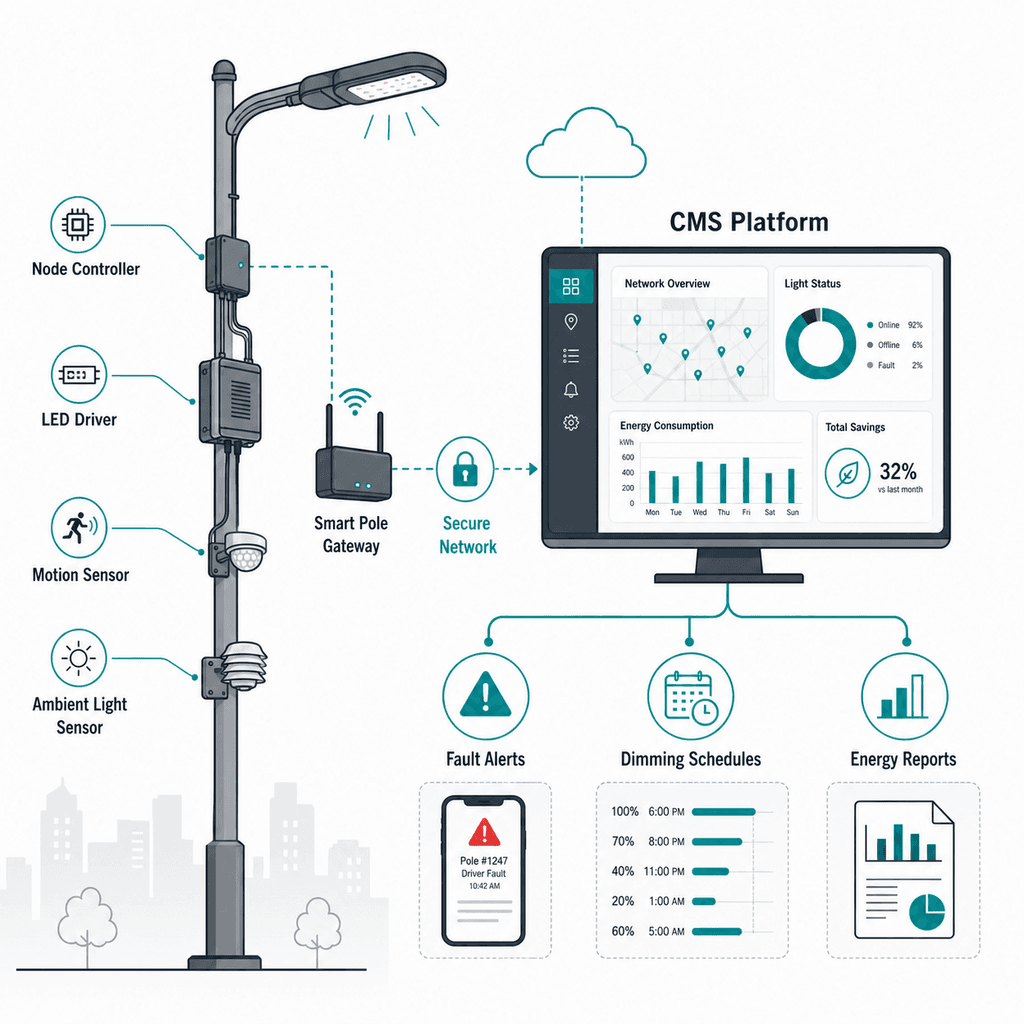
A smart city lighting CMS centralizes 30-70% energy savings, real-time fault alerts, dimming schedules, and asset control for streetlight networks from 500 to 100,000 poles.
A Central Management System, or CMS, is the software and communications layer that lets a municipality, utility, airport, port, or industrial estate operate streetlights as connected infrastructure instead of isolated electrical loads. It links luminaires, pole controllers, gateways, meters, sensors, cameras, EV chargers, and maintenance workflows into one operational platform. For B2B buyers, the CMS decision is as important as pole height, LED wattage, and battery capacity because it determines how efficiently the lighting network can be monitored over 10-25 years.
A typical CMS stack includes field node controllers on each luminaire, a communication network, cloud or private-server software, mobile maintenance tools, and APIs for GIS, SCADA, ERP, or smart city platforms. According to the U.S. Department of Energy (2023), networked lighting controls can provide large additional savings beyond LED conversion when occupancy, scheduling, daylight, and tuning strategies are applied correctly. The practical value is not only lower kWh consumption; it is faster fault isolation, verified operating hours, evidence-based dimming policy, and auditable service-level reporting.
For SOLARTODO smart streetlight projects, CMS design is matched to the physical pole configuration. A 7m Ø400 Cylindrical CIGS Smart Pole for border checkpoints may prioritize camera uptime, emergency alerts, WiFi 6, and 3,000Wh LFP battery monitoring. A 12m Wind-Solar Hybrid Smart Pole with VAWT, monocrystalline panels, 5-15kWh storage, and 7kW or 11kW AC EV charging needs energy-flow visibility and charging-status integration. A 10m Tunnel Entrance Smart Pole needs LED output, environmental data, display control, and video monitoring for threshold safety.
The International Energy Agency states, 'Solar PV is now the cheapest source of electricity in history.' For solar streetlight projects, that matters because CMS platforms increasingly manage hybrid assets: luminaires, PV generation, wind input, LFP battery state of charge, EV charging, and edge devices. According to IRENA (2025), solar PV accounted for 452.1GW, or 77.8%, of global renewable capacity additions in 2024, reinforcing why cities and EPCs are combining smart lighting with distributed clean energy infrastructure.
CMS Architecture, Field Devices, and Data Flow
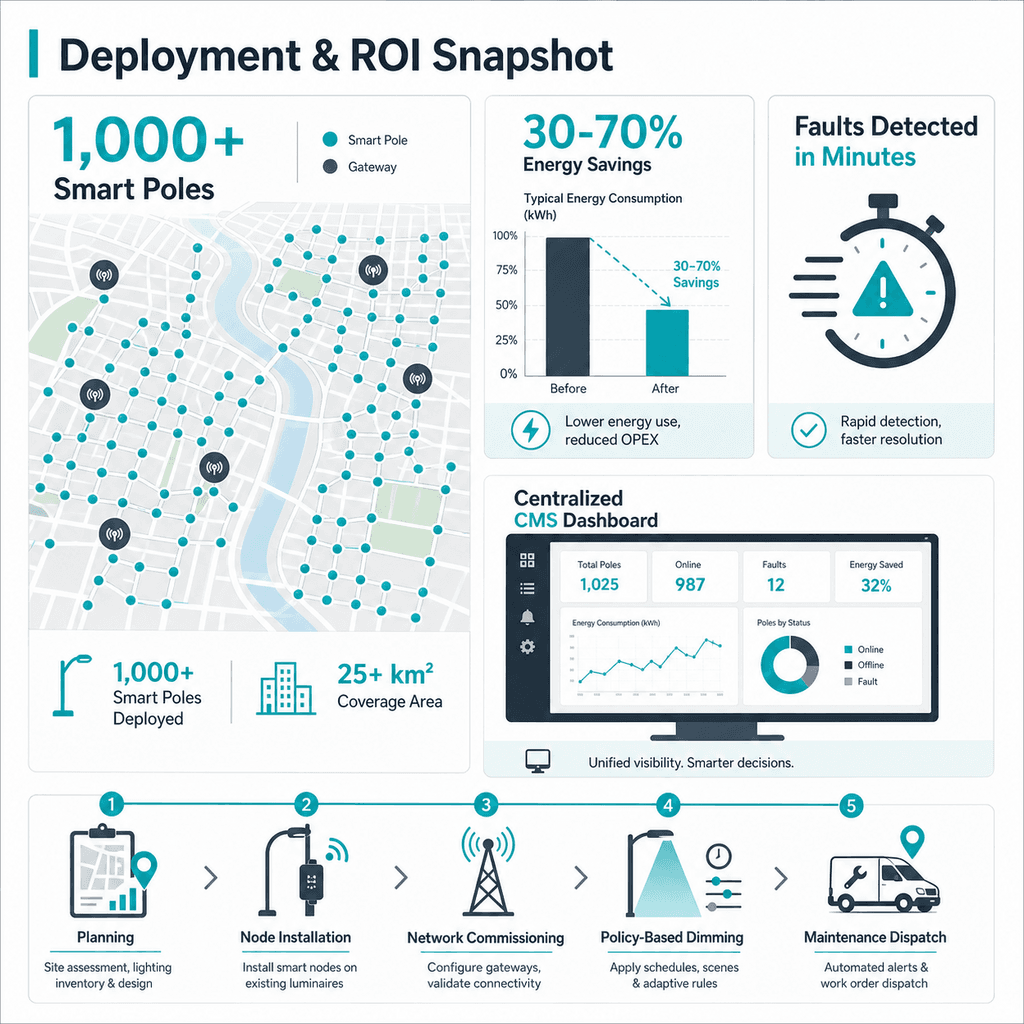
A CMS lighting architecture normally has 5 layers: luminaire drivers, pole controllers, communications, platform software, and enterprise integrations for GIS or maintenance systems.
At the pole level, a controller sends commands to the LED driver and receives status from the luminaire, meter, battery system, cabinet, motion sensor, or environmental device. Communication may use cellular 4G/5G, NB-IoT, LoRaWAN, RF mesh, PLC, Ethernet, or fiber depending on terrain, density, cybersecurity policy, and carrier availability. For procurement teams, the key question is not which network is fashionable, but which network gives verified coverage, predictable latency, and maintainable service contracts for the project area.
A mature CMS platform should support these operational functions:
- Remote on/off and dimming by pole, group, feeder, route, zone, or time schedule.
- Fault alarms for driver failure, lamp failure, overvoltage, undervoltage, offline node, battery low, door open, and abnormal consumption.
- Asset registry with pole ID, GPS position, installation date, luminaire wattage, controller serial number, firmware, and warranty status.
- Energy reporting by luminaire, cabinet, district, project, or billing period.
- Role-based access for operators, engineers, contractors, police, utilities, and project owners.
- API export for GIS, ERP, ticketing, SCADA, traffic platforms, and finance dashboards.
According to IEC 62386 (DALI-2), digital lighting control improves interoperability by defining standardized command and device behavior for lighting systems. In street lighting, DALI-2 is often used between the controller and driver, while the CMS communicates through cellular, RF mesh, or other wide-area networks. This separation is important because a city can standardize luminaire behavior while still choosing the best field communications for each geography.
TALQ is also relevant for B2B buyers. The TALQ Consortium describes TALQ as a smart city protocol that provides a common interface between outdoor device networks and CMS platforms. In practical terms, TALQ helps cities avoid being trapped by one proprietary CMS if future tenders add new pole brands, controllers, or district-scale applications.
For solar and hybrid smart poles, CMS data flow must include energy telemetry, not only lighting status. SOLARTODO projects commonly require PV generation, LFP battery state of charge, charging cycles, load consumption, camera uptime, and communication signal quality. This is where a CMS shifts from a lighting dashboard to an infrastructure operations platform.
Core Technical Specifications
A well-specified lighting CMS should define controller protocol, cybersecurity, data retention, alarm latency, dashboard roles, API access, and minimum 99% platform availability.
Procurement specifications should be measurable. A controller should report energy, voltage, current, power factor, dimming level, temperature, and fault state at defined intervals such as 5, 15, or 60 minutes. The CMS should store historical data for at least 24 months for warranty, energy-savings verification, and public-private partnership reporting. For high-control sites such as border checkpoints, ports, and tunnels, alarm latency may need to be under 60 seconds for emergency devices and under 5 minutes for lighting faults.
Cybersecurity must be written into the tender, not added later. Require encrypted communication, unique device identities, role-based permissions, audit logs, firmware update controls, and documented data residency. For large projects, ask whether the CMS supports private cloud, on-premise deployment, or regional hosting.
EPC Investment Analysis and Pricing Structure
EPC delivery packages smart poles, CMS commissioning, installation, testing, and training into 3 price tiers with typical payback from 3-7 years.
Engineering, Procurement, and Construction delivery is suitable when the buyer wants one accountable party for design validation, supply, civil works, electrical works, installation, CMS configuration, testing, and operator training. For smart city lighting, EPC scope should include lighting design, pole foundation drawings, cable routing, grounding, surge protection, SIM or network provisioning, CMS setup, field commissioning, as-built documents, and warranty handover.
SOLARTODO is a B2B manufacturer and exporter, not an online marketplace, so pricing follows inquiry, technical clarification, offline quotation, and project financing review. For a 10m Tunnel Entrance Smart Pole, EPC installed pricing is typically USD 1,800-2,200 per unit, depending on configuration, quantities, installation conditions, and CMS scope. For 7m border checkpoint smart poles or 12m hybrid boulevard systems, pricing depends heavily on CIGS capacity, LFP storage size, EV charger rating, cameras, communication devices, and civil works.
| Pricing tier | What it includes | Best fit | Buyer responsibility |
|---|---|---|---|
| FOB Supply | Factory price for poles, luminaires, controllers, solar/storage hardware, and packing | Importers, distributors, EPCs with local teams | Freight, customs, installation, CMS local setup |
| CIF Delivered | Product supply plus sea freight and insurance to destination port | Public buyers needing landed-cost clarity | Inland transport, permits, foundations, installation |
| EPC Turnkey | Engineering, supply, installation, commissioning, CMS setup, and training | Cities, ports, airports, logistics parks, border projects | Site access, approvals, utility coordination |
Volume pricing should be requested during quotation because component batching, container optimization, and commissioning efficiency materially affect cost. As a planning guide, 50+ units may qualify for about 5% discount, 100+ units for about 10%, and 250+ units for about 15%, subject to final configuration and Incoterms.
ROI should compare the smart CMS solution against conventional LED or legacy HPS installations. Energy savings usually come from LED efficiency plus dimming strategy; maintenance savings come from fewer nighttime patrols and faster fault localization. For solar or hybrid smart poles, additional value comes from avoiding trenching in remote roads, reducing separate camera or EV charger cabinets, and consolidating 4-8 exposed devices into one integrated pole. Payment terms are typically 30% T/T deposit plus 70% against bill of lading, or 100% L/C at sight. Financing may be available for large projects above USD 1,000K; contact [email protected] or +6585559114 for quotation support.
Use Cases for Smart Streetlight CMS Platforms
CMS platforms create the highest value in 4 recurring environments: cities, controlled corridors, tunnels, and off-grid solar or hybrid infrastructure.
Urban roadway lighting is the most common CMS use case. Cities use dimming calendars, traffic-sensitive schedules, and alarm maps to reduce energy and improve maintenance performance. According to IEA (2025), renewables are expected to grow faster than any major energy source in the next decade, which increases the relevance of grid-interactive streetlight networks that can coordinate efficiency, solar generation, and future distributed energy resources.
Border checkpoints and police inspection corridors need a different CMS profile. The SOLARTODO 7m Ø400 Cylindrical CIGS Smart Pole combines 100W LED lighting, 15,000lm output, about 256W CIGS solar generation, 3,000Wh LFP storage, 7kW AC charging, 4MP IR video, and WiFi 6 connectivity in one monolithic 7m column. A CMS for this site should show battery status, camera uptime, emergency event logs, charger state, and lighting status for each lane node, commonly spaced around 28m.
Tunnel entrances and underpasses require strict operational discipline because driver visual adaptation can change rapidly between exterior daylight and interior luminance. The SOLARTODO 10m Tunnel Entrance Smart Pole uses a 200W LED luminaire, AI camera, environmental sensor, and LED display in a 4-in-1 design. CMS value here is immediate: engineers can confirm whether the 200W luminaire is operating, whether environmental readings are abnormal, and whether display content is synchronized with traffic conditions.
Hybrid boulevards and smart mobility corridors add energy and charging requirements. The SOLARTODO 12m Wind-Solar Hybrid Smart Pole integrates a 400-500W vertical-axis wind turbine, two 100W-200W monocrystalline panels, 160W LED lighting, 5-15kWh LFP storage, and a 7kW or 11kW Type 2 AC EV charger. A CMS must track generation, storage, charging, lighting, and communications so the operator can evaluate whether renewable assets are supporting actual load demand.
NREL states, 'PVWatts estimates the energy production of grid-connected photovoltaic energy systems.' That matters for CMS planning because expected PV generation should be modeled before solar pole deployment and then compared with CMS-measured field performance after commissioning.
Platform Comparison and Procurement Guide
Buyers should compare CMS options across 8 criteria: interoperability, communications, energy data, cybersecurity, alarms, integrations, hosting, and lifecycle support.
The cheapest dashboard is rarely the lowest-risk CMS. A city may operate lighting assets for 20 years, but communication contracts, controller firmware, SIM plans, and cloud platforms can change every 3-5 years. Engineers should evaluate the CMS as a long-term infrastructure system, not only a software subscription.
| Selection factor | Minimum requirement | Stronger B2B specification |
|---|---|---|
| Interoperability | Vendor API export | TALQ-ready, DALI-2 driver control, Zhaga/NEMA controller options |
| Communications | One network supported | 4G/5G, NB-IoT, LoRaWAN, RF mesh, or PLC selected by site survey |
| Energy data | Monthly consumption | 5-15 minute telemetry with voltage, current, power, and dimming state |
| Alarms | Offline and lamp failure | Driver, surge, door, battery, charger, camera, and abnormal load alarms |
| Cybersecurity | Login password | Encryption, audit logs, role control, firmware governance, data residency |
| GIS mapping | Pole list | Map-based asset registry with GPS, photos, serial numbers, and tickets |
| Hosting | Public cloud only | Public cloud, private cloud, or on-premise options for government projects |
| Lifecycle support | 1-year warranty | 5-10 year controller roadmap and documented spare-part strategy |
According to UL 8750, LED equipment safety evaluation covers LED arrays, modules, controllers, and related components used in lighting products. According to IEEE 802.15.4, low-rate wireless personal area networks provide a foundation for many mesh and sensor networks. These standards do not replace project engineering, but they help procurement teams ask better questions about compliance, safety, and communication architecture.
For SOLARTODO buyers, the recommended procurement sequence is straightforward. First, define the roadway or site type, pole spacing, illuminance target, smart devices, and power source. Second, confirm whether the CMS must integrate with existing city platforms. Third, request a quotation with FOB, CIF, and EPC options. Fourth, run a pilot of 10-30 poles before citywide deployment if the project includes new communications or multiple smart devices.
FAQ
A CMS FAQ should answer 10 procurement questions on cost, controls, standards, installation, maintenance, solar integration, security, warranty, and EPC delivery.
Q: What is a smart city lighting CMS platform? A: A smart city lighting CMS platform is software that remotely monitors and controls connected streetlights, smart poles, and related devices. It typically manages dimming, alarms, energy reports, GIS assets, user permissions, and maintenance tickets. For projects above 500 poles, CMS functionality often determines operating cost more than the luminaire alone.
Q: How much energy can a CMS save compared with normal LED streetlights? A: A CMS can typically save an additional 10-30% beyond LED conversion by applying schedules, adaptive dimming, motion response, and output tuning. Total savings versus legacy HPS systems can reach 30-70%, depending on original wattage, traffic profile, dimming policy, and local lighting regulations.
Q: What communication networks are used for CMS streetlight control? A: Common networks include 4G/5G cellular, NB-IoT, LoRaWAN, RF mesh, PLC, Ethernet, and fiber. Cellular is simple for dispersed poles, while RF mesh can work well in dense urban grids. The best choice depends on coverage survey results, latency needs, cybersecurity policy, and recurring data cost.
Q: How does CMS pricing work for EPC smart lighting projects? A: Pricing is usually quoted in FOB supply, CIF delivered, or EPC turnkey tiers. EPC includes engineering, installation, commissioning, CMS setup, and training, while FOB and CIF leave more work to the buyer or local contractor. Volume discounts may reach about 5% at 50+ units, 10% at 100+, and 15% at 250+.
Q: What should engineers specify in a CMS tender? A: Engineers should specify controller protocol, dimming interface, communications, alarm latency, data retention, hosting model, cybersecurity, GIS integration, and API requirements. They should also require pole-level asset IDs, GPS coordinates, firmware records, and commissioning reports. These details prevent disputes after installation and simplify long-term maintenance.
Q: Can a CMS manage solar smart streetlights? A: Yes, a suitable CMS can manage solar streetlights by tracking PV generation, battery state of charge, load consumption, luminaire status, and fault alarms. For hybrid poles, it may also monitor wind input, EV charger state, camera uptime, and communication signal quality. This is essential for off-grid or weak-grid projects.
Q: Is TALQ necessary for every smart streetlight project? A: TALQ is not mandatory for every project, but it is valuable when a city wants multi-vendor interoperability. A TALQ-ready architecture can reduce vendor lock-in by standardizing the interface between outdoor device networks and CMS platforms. It is especially useful for phased deployments across multiple districts.
Q: How long does CMS commissioning take after pole installation? A: Commissioning can take a few minutes per pole when SIM cards, GPS data, controller IDs, and luminaire profiles are prepared correctly. Larger projects need additional time for zone grouping, dimming schedules, alarm thresholds, GIS import, and user training. A 100-pole pilot is commonly commissioned within days, not months.
Q: What maintenance benefits does CMS provide? A: CMS maintenance benefits include automatic fault detection, reduced night patrols, faster truck-roll planning, and verified repair closure. Instead of waiting for public complaints, operators can locate offline nodes, abnormal energy use, battery problems, or driver failures from a map. This can reduce maintenance effort by 20-40%.
Q: What warranty and lifecycle issues should buyers check? A: Buyers should check controller warranty, luminaire warranty, battery warranty, CMS subscription terms, firmware update policy, spare-part availability, and data ownership. Smart poles may last 20-25 years structurally, but communications and software need lifecycle planning. Require written support commitments before awarding large projects.
Q: Can SOLARTODO provide project financing for smart lighting? A: SOLARTODO can review financing options for large projects above USD 1,000K after technical scope, buyer profile, country, and payment structure are confirmed. Standard payment terms are 30% T/T plus 70% against bill of lading, or 100% L/C at sight. For EPC quotations, contact [email protected].
Conclusion
A smart city lighting CMS is the operating system for 500-100,000 connected poles, turning LEDs, solar storage, sensors, cameras, and EV chargers into managed infrastructure.
The bottom line: for municipalities, EPC contractors, and infrastructure owners, CMS selection should be treated as a 10-25 year operating decision, not a software accessory. SOLARTODO smart streetlight systems combine integrated pole hardware with CMS-ready project design, helping buyers evaluate energy savings, maintenance reduction, and EPC delivery risk before procurement.
References
The references below include 8 authoritative sources covering lighting controls, smart city protocols, PV modeling, LED safety, interoperability, and renewable energy economics.
- U.S. Department of Energy (2023): Networked Lighting Controls resources explaining control strategies for energy savings, scheduling, tuning, occupancy, and operational management. https://www.energy.gov/eere/buildings/networked-lighting-controls
- IRENA (2025): Renewable Power Generation Costs in 2024, reporting renewable cost competitiveness and 452.1GW of solar PV additions in 2024. https://www.irena.org/Publications
- IEA (2020): World Energy Outlook 2020, stating that solar PV became the cheapest electricity source in history for high-quality resources and low-cost finance. https://www.iea.org/reports/world-energy-outlook-2020
- NREL (2024): PVWatts Calculator documentation for estimating photovoltaic energy production and comparing modeled output with field performance. https://pvwatts.nrel.gov
- IEC 62386 (2024): Digital Addressable Lighting Interface standard series for interoperable digital lighting control devices and commands.
- TALQ Consortium (2024): Smart city protocol documentation defining a common interface between CMS platforms and outdoor device networks. https://www.talq-consortium.org
- UL 8750 (2021): Standard for Light Emitting Diode Equipment for Use in Lighting Products, covering LED modules, arrays, controls, and safety evaluation.
- IEEE 802.15.4 (2020): Standard for low-rate wireless networks used as a technical foundation for many mesh, sensor, and IoT communication systems.
About SOLARTODO
SOLARTODO is a global integrated solution provider specializing in solar power generation systems, energy-storage products, smart street-lighting and solar street-lighting, intelligent security & IoT linkage systems, power transmission towers, telecom communication towers, and smart-agriculture solutions for worldwide B2B customers.
About the Author

Cinn Song
Founder & Chief Solutions Architect
Cinn Song founded SOLARTODO LIMITED and leads its smart-city infrastructure engineering — from solar, storage and integrated smart poles to the company's push into physical-AI city edge nodes: pole-mounted edge computing, vertical LLMs for smart cities, drone-based O&M with autonomous battery swapping, robotic maintenance, and high-speed counter-UAS interception. Since 2010, he has directed turnkey EPC + BOT delivery across 50+ countries, including telecom monopole supply for national grid operators, off-grid solar street-lighting for African municipalities, and integrated smart-pole programs for Gulf smart cities.
Cite This Article
Cinn Song. (2026). Smart City Lighting Control Systems: CMS Platforms…. SOLARTODO. Retrieved from https://solartodo.com/knowledge/smart-city-lighting-control-systems-cms-platforms-explained
@article{solartodo_smart_city_lighting_control_systems_cms_platforms_explained,
  title = {Smart City Lighting Control Systems: CMS Platforms…},
  author = {Cinn Song},
  journal = {SOLARTODO Knowledge Base},
  year = {2026},
  url = {https://solartodo.com/knowledge/smart-city-lighting-control-systems-cms-platforms-explained},
  note = {Accessed: 2026-10-14}
}
Published: July 6, 2026 | Available at: https://solartodo.com/knowledge/smart-city-lighting-control-systems-cms-platforms-explained
Subscribe to Our Newsletter
Get the latest solar energy news and insights delivered to your inbox.
View All Articles