Smart City Drone Surveillance: Pole-Mounted Nests vs…

Cinn Song
Founder & Chief Solutions Architect
Watch the video
TL;DR
Pole-mounted drone nests are best for fast local surveillance across 1-3 km patrol cells, using 5-20 kWh storage, about 7-10 kWh/day solar replenishment, and edge AI that keeps raw data local. Centralized hangars remain better for 5-20 km regional routes, larger drones, and deeper maintenance. Many B2B projects benefit from a hybrid architecture.
Pole-mounted drone nests reduce response distance by placing 5-20 kWh off-grid energy buffers, 7-10 kWh/day solar replenishment, and local AI beside patrol zones, while centralized hangars suit fewer, longer-range sorties.
Summary
Pole-mounted drone nests reduce response distance by placing 5-20 kWh off-grid energy buffers, 7-10 kWh/day solar replenishment, and local AI beside patrol zones, while centralized hangars suit fewer, longer-range sorties.
Key Takeaways
- Choose pole-mounted nests for patrol areas within 1-3 km where short response time, local processing, and multiple daily redeployments matter more than aircraft size.
- Use centralized hangars for 5-20 km missions where larger drones, deeper maintenance tooling, and fewer launch points can cover wide regional assets.
- Specify 5-20 kWh battery storage per off-grid pole to buffer high-power drone and robot tasks while solar replenishment contributes about 7-10 kWh/day in strong sun.
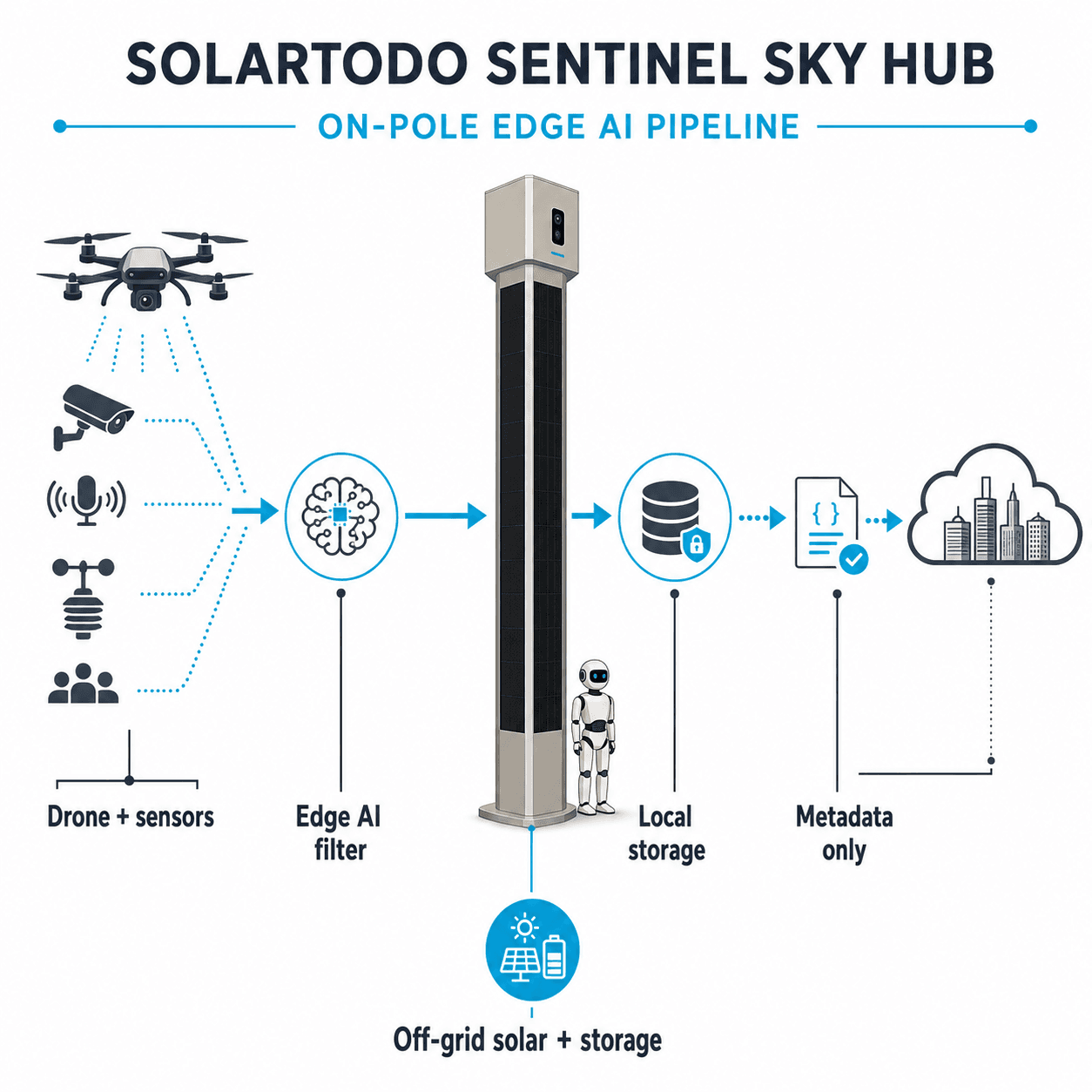
- Keep raw video and sensor streams on the edge node, transmitting only de-identified event and status metadata to reduce bandwidth and privacy exposure.
- Require human authorization for every regulated C-UAS response, limiting mitigation to detection, tracking, command coordination, soft net-capture, or close-approach deterrence.
- Compare EPC scopes across FOB supply, CIF delivered, and turnkey installation because civil works, commissioning, and warranty logistics can shift total cost by 30-60%.
- Plan volume procurement at 50+, 100+, and 250+ units to target 5%, 10%, and 15% price reductions on repeatable pole-mounted deployments.
- Validate safety and interoperability using IEC 62619:2022, UL 9540:2023, IEEE 1547-2018, IEC 62443, and local aviation rules before procurement.
Smart City Drone Surveillance Architecture
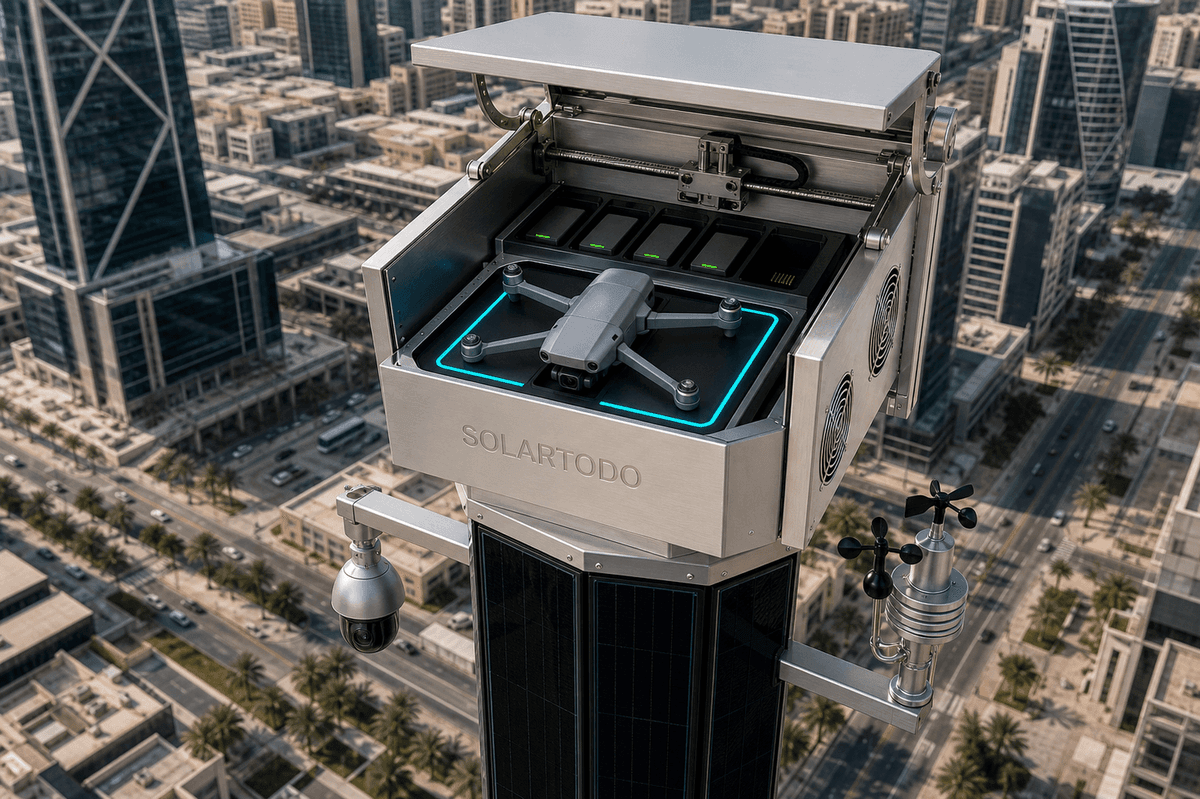
Pole-mounted drone nests place launch capacity inside each patrol zone, while centralized hangars concentrate 5-20 km aircraft operations at fewer serviced sites.
For smart districts, campuses, industrial parks, ports, city perimeters, and critical-infrastructure zones, the core design choice is not simply where to park drones. It is where to place compute, energy storage, landing automation, inspection workflow control, and human authorization. A centralized hangar can support larger aircraft and a deeper maintenance bench, but it also creates longer transit legs before each inspection begins.
A pole-mounted nest changes the geometry of surveillance. Instead of flying from one depot to every event, the node sits close to the fence line, gate, roadway, storage yard, substation, or coastal asset it is assigned to protect. SOLARTODO Sentinel / Sky Hub follows this distributed model as a pure smart pole with no lighting system: the pole hosts sensing, edge compute, off-grid energy, drone operations, robot coordination, and local command workflows in one field node.
The operational distinction is most visible during recurring patrols. Centralized hangars work well when missions are scheduled, long-range, and maintenance-heavy. Pole-mounted nests are stronger when the mission pattern is local, repetitive, event-triggered, and time-sensitive. For example, a perimeter alarm at a 2 km industrial boundary should not wait for a drone to travel from a remote hangar if a nearby node can launch, inspect, return, swap battery, and redeploy.
According to the FAA (2023), Remote ID helps authorities identify control stations when drones operate unsafely or in restricted areas; the agency states that Remote ID acts like a "digital license plate." For B2B buyers, that reinforces a practical point: city drone surveillance infrastructure must be planned as governed aviation infrastructure, not only as video equipment.
Technical Architecture: Pole-Mounted Nests vs Centralized Hangars
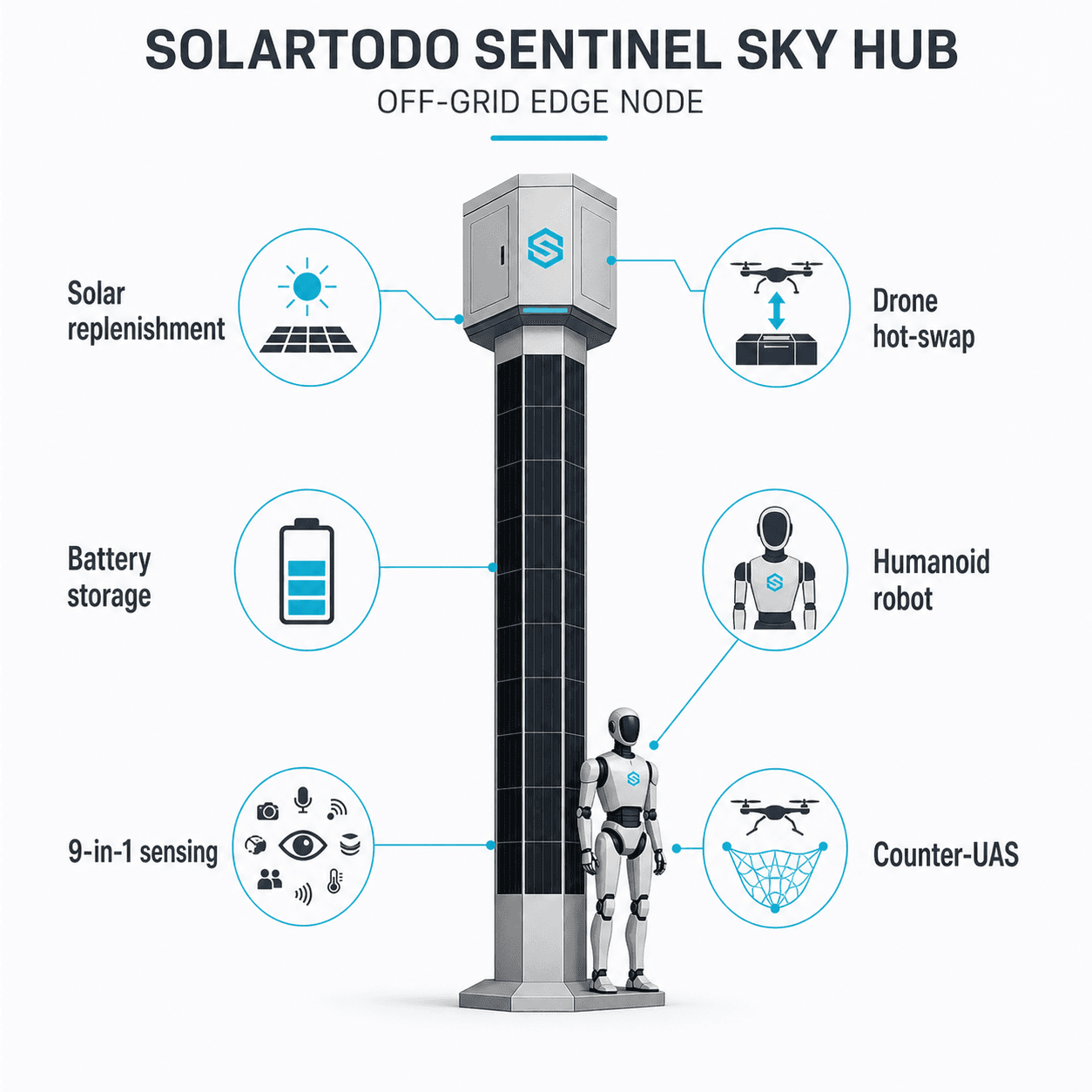
A distributed pole nest combines 1 local launch point, edge AI, battery buffering, and field sensing, while a hangar centralizes aircraft, tools, and operators.
A centralized hangar is a depot. It normally holds multiple aircraft, spares, chargers, maintenance workstations, network equipment, and operator interfaces. It is useful when a city, port, or utility wants fewer secured buildings and can tolerate longer outbound flight time. It also simplifies technician access because batteries, payloads, tools, and weather-protection equipment sit in one service location.
A pole-mounted nest is a micro-station. In the SOLARTODO Sky Hub architecture, the pole is fully off-grid with on-pole photovoltaic replenishment and battery storage. The solar body is a supplemental energy layer, not a claim of unlimited solar operation. Realistic clear-sky output in a high-irradiance region is about 1.0-1.3 kW DC peak and roughly 7-10 kWh/day, while high-power flight and robot activities are scheduled against a 5-20 kWh-class storage buffer.
The field node runs local inference on Jetson-class edge compute. It can process PTZ video, environmental measurements, and operational telemetry on the pole. Raw video and raw sensor streams stay on the node; only de-identified event metadata, health state, audit logs, and mission status should leave the site by default. This is a PDPL-LGPD-oriented architecture because it reduces unnecessary data movement, but certification or legal compliance still depends on the project, jurisdiction, and deployed controls.
According to NIST (2022), moving IoT processing from cloud to edge brings networking efficiency benefits but also creates privacy concerns. That is why procurement teams should ask where raw video is stored, who can export it, how event summaries are de-identified, and whether access logs are auditable.
Workflow Control
The operating loop is sensing, authorized assessment and response, edge-compute scheduling, and field operations and maintenance. A common operating picture should show event class, drone availability, battery state, local weather, mission queue, robot status, and authorization state. In pole-mounted deployments, this view is normally more granular because every pole becomes an accountable operational cell.
For C-UAS coordination, the pole can detect and track an unauthorized drone and coordinate an approved response using a friendly drone. Mitigation must remain non-lethal and human-authorized. Allowed actions include command coordination, soft aerial net-capture, and close-approach deterrence. Radar should be treated only as an optional partner-sensor input, not as built-in pole hardware.
Applications and Deployment Economics
Pole nests are strongest when 10-50 distributed patrol cells reduce travel time, while centralized hangars fit fewer missions across larger operating envelopes.
In a campus deployment, pole-mounted nests can assign local aerial coverage to entrances, substations, parking areas, warehouses, and restricted perimeters. Each node can launch for alarm verification, routine inspection, post-event documentation, and maintenance checks. Ground robots can also coordinate with the pole, patrol locally, respond to alarms, inspect field assets, and return to the pole base for wireless charging.
In a port or industrial park, centralized hangars may remain useful for heavy aircraft, specialized payloads, and scheduled inspection routes. The practical architecture is often hybrid: centralized hangars handle long-distance and maintenance-intensive sorties, while pole-mounted nests cover recurring local missions and fast alarm response. This avoids forcing one aircraft class to solve every mission.
According to IEA (2025), global renewable capacity additions reached about 700 GW in 2024, and solar PV contributed around 550 GW. The IEA also states that solar PV accounted for "over three-quarters" of renewable additions. This matters because off-grid field infrastructure is becoming more bankable and easier to source, but engineering still must size storage and duty cycles realistically.
The business case is usually driven by avoided dispatches, shorter incident verification time, lower trenching complexity, and fewer separate field assets. A conventional approach may require one camera pole, one communications cabinet, one power feed, one drone building, and one robot charger. A pole-mounted nest consolidates sensing, energy buffering, compute, drone turnaround, and robot charging at the patrol point.
| Decision Factor | Pole-Mounted Drone Nest | Centralized Drone Hangar |
|---|---|---|
| Best patrol radius | 1-3 km local cells | 5-20 km regional routes |
| Energy model | 5-20 kWh battery plus 7-10 kWh/day solar replenishment | Larger grid-tied or building-scale energy system |
| Response speed | Short travel leg from nearby node | Longer outbound flight before inspection starts |
| Maintenance model | Modular field service across many nodes | Deeper service bench at fewer sites |
| Data handling | Raw data processed locally on the pole | Often routed through depot or control-room systems |
| Aircraft fit | Compact autonomous patrol drones with automated battery exchange | Larger drones and specialized payloads |
| Best use cases | Perimeters, campuses, substations, gates, yards | Pipelines, long corridors, regional inspection routes |
| Main limitation | More distributed assets to commission and maintain | More transit time and larger site dependency |
EPC Investment Analysis and Pricing Structure
EPC pricing should separate FOB supply, CIF delivery, and turnkey installation because logistics, foundations, and commissioning can change total cost by 30-60%.
For SOLARTODO projects, EPC means Engineering, Procurement, and Construction. Engineering covers site survey assumptions, foundation loading review, energy modeling, communications planning, aviation workflow design, data-governance configuration, and commissioning method statements. Procurement covers pole systems, batteries, photovoltaic components, drone nest equipment, edge compute, sensing modules, spares, and documentation. Construction covers foundations, lifting, cabling inside the node, grounding, commissioning, operator training, and acceptance testing.
Pricing should be compared in three tiers. FOB supply covers factory supply from SOLARTODO and is suitable for buyers with their own freight forwarder and installation team. CIF delivered adds ocean freight, insurance, and destination-port delivery assumptions. EPC turnkey includes delivered equipment, local civil coordination, installation support, commissioning, training, and project documentation, subject to site access, local permits, and civil conditions.
Volume guidance should be explicit in early procurement. For repeatable projects, use 50+ units as a 5% planning discount level, 100+ units as a 10% level, and 250+ units as a 15% level. These figures are commercial planning bands, not automatic quotes; final pricing depends on battery capacity, drone nest configuration, edge compute class, sensing package, corrosion protection, logistics route, and local installation scope.
ROI should be modeled against the conventional alternative: separate surveillance poles, separate drone facilities, site power works, communications cabinets, and repeated vehicle dispatches. In many industrial and campus cases, payback is strongest when the system prevents 2-4 manual patrol rounds per day, reduces incident verification time by 50% or more, and avoids trenching for grid power. Financing is available for large projects above USD 1,000K, with standard payment terms of 30% T/T plus 70% against B/L, or 100% L/C at sight. Commercial inquiries can be sent to [email protected].
Procurement Selection Guide
Buyers should score at least 8 factors: patrol radius, response time, energy autonomy, aircraft size, data policy, maintenance access, aviation rules, and lifecycle cost.
The first procurement question is geography. If the asset is a compact perimeter, substation, industrial campus, logistics yard, or gated community, pole-mounted nests usually make better operational sense. If the asset is a long pipeline, transmission corridor, regional road network, or sparse rural area, centralized hangars may offer lower site count and easier fleet maintenance.
The second question is energy. A fully off-grid pole-mounted system must be treated as a battery-backed micro-station with solar replenishment. The on-pole photovoltaic layer can materially extend endurance, especially in high-irradiance markets, but drone flights, battery hot-swap cycles, edge inference, communications, and robot charging must be duty-cycle managed. NREL PVWatts Version 8.5.2 uses 30 years of historical weather data to estimate variability, so project teams should run location-specific energy simulations rather than applying one generic yield figure.
The third question is governance. For surveillance, the safer default is local processing with de-identified metadata leaving the pole. For C-UAS, the architecture must separate detection, decision support, authorization, and response. No buyer should accept claims of autonomous attack, hard-kill response, RF or GNSS denial, or weaponized mitigation.
| Procurement Requirement | Recommended Threshold | Why It Matters |
|---|---|---|
| Local patrol radius | 1-3 km per pole cell | Reduces transit time for alarms |
| Daily solar replenishment | 7-10 kWh/day in strong sun | Supports off-grid duty-cycle planning |
| Storage capacity | 5-20 kWh per node | Buffers drone, robot, compute, and communications loads |
| Environmental sensing | 9 measured parameters | Supports flight safety and site monitoring |
| Data export | Event metadata only | Reduces privacy and bandwidth risk |
| C-UAS authorization | Human-in-the-loop required | Keeps response legally bounded |
| Battery safety basis | IEC 62619 / UL 9540 review | Supports procurement and AHJ acceptance |
| Cybersecurity basis | IEC 62443-aligned controls | Improves lifecycle security planning |
FAQ
Pole-mounted nests and centralized hangars solve different drone surveillance problems, and the right choice depends on patrol radius, energy model, and governance.
Q: What is the main difference between a pole-mounted drone nest and a centralized hangar? A: A pole-mounted nest places launch, charging or battery exchange, edge compute, and sensing near the patrol area. A centralized hangar groups aircraft and maintenance resources at fewer sites. The pole model is better for 1-3 km local response cells, while hangars suit 5-20 km regional missions.
Q: When should a city or industrial park choose pole-mounted drone nests? A: Choose pole-mounted nests when alarms, inspections, and patrol routes repeat around fixed assets such as gates, fences, yards, substations, or campuses. The model reduces flight transit time and supports faster event verification. It is most useful when 10-50 local patrol cells need frequent autonomous redeployment.
Q: When is a centralized hangar the better option? A: A centralized hangar is better when larger drones, specialized payloads, long routes, and deeper maintenance tooling matter more than immediate local response. It also reduces the number of secured field sites. Utilities, pipeline operators, and regional infrastructure owners often use hangars for 5-20 km inspection envelopes.
Q: Is SOLARTODO Sky Hub a smart streetlight? A: No. SOLARTODO Sky Hub is a pure smart pole for sensing, edge compute, off-grid energy, drone operations, robot coordination, and command workflows. It has no lighting system. Buyers should evaluate it as a city AI edge node, not as a roadway illumination product.
Q: How does the off-grid energy system support drone surveillance? A: The pole uses battery storage as the main buffer and on-pole solar as a replenishment layer. In high-irradiance regions, realistic clear-sky output is about 1.0-1.3 kW DC peak and 7-10 kWh/day. High-power drone and robot tasks are scheduled against a 5-20 kWh storage class.
Q: Does raw video leave the pole-mounted node? A: The recommended SOLARTODO Sentinel architecture keeps raw video and raw sensor streams on the pole for local processing. Only de-identified event metadata, device health, mission logs, and status data may leave the node. This reduces bandwidth load and supports PDPL-LGPD-oriented data governance.
Q: Can the system identify faces or license plates? A: Face recognition and license-plate recognition should not be treated as active capabilities for this product scope. The appropriate security analytics are anonymous vehicle count, crowd density, intrusion detection, perimeter awareness, and event classification. This keeps the surveillance architecture aligned with privacy-oriented edge processing.
Q: How does C-UAS coordination work in this architecture? A: The pole can detect and track an unauthorized drone, then support a human-authorized response using a friendly drone. Permitted actions are non-lethal: command coordination, soft aerial net-capture, or close-approach deterrence. The system must not be described as shooting down, jamming, destroying, or autonomously attacking aircraft.
Q: What does EPC turnkey delivery include for this type of project? A: EPC turnkey delivery includes engineering review, procurement, delivery coordination, foundation and installation support, commissioning, training, documentation, and acceptance testing. Pricing should be compared as FOB supply, CIF delivered, and EPC turnkey. For large projects above USD 1,000K, SOLARTODO can discuss financing and staged delivery.
Q: What standards should procurement teams reference? A: Buyers should reference IEC 62619:2022 for industrial lithium battery safety, UL 9540:2023 for energy storage systems, IEEE 1547-2018 where distributed energy interconnection applies, IEC 62443 for industrial cybersecurity, and applicable aviation rules such as FAA Remote ID. Local authority review remains essential.
Q: What is the maintenance tradeoff between distributed nests and hangars? A: Pole-mounted nests distribute service points across the site, so maintenance planning must cover multiple batteries, landing systems, sensors, and edge nodes. Centralized hangars simplify workshop access but increase mission transit distance. Many buyers use a hybrid model: hangars for heavy maintenance and pole nests for fast local response.
Q: How should ROI be calculated for drone surveillance infrastructure? A: ROI should compare the system against separate camera poles, drone buildings, trenching, communications cabinets, and manual patrol dispatches. A strong case usually combines 2-4 avoided patrol rounds per day, 50% faster incident verification, and lower civil works. Final payback depends on labor cost, site size, and mission frequency.
References
- NREL PVWatts (2025): PVWatts Version 8.5.2 uses updated NSRDB weather data and 30-year historical variability for PV production estimates. https://pvwatts.nrel.gov/version_8.php — https://www.nrel.gov/research/data-tools.html
- IEA Global Energy Review (2025): Reports about 700 GW of renewable additions in 2024, including roughly 550 GW of solar PV. https://www.iea.org/reports/global-energy-review-2025/electricity — https://www.iea.org/reports/world-energy-outlook-2024
- IEA Renewables (2024): Forecasts solar PV will account for 80% of global renewable power growth to 2030. https://www.iea.org/reports/renewables-2024/executive-summary — https://www.iea.org/reports/world-energy-outlook-2024
- IEEE 1547-2018 (2018): Standard for interconnection and interoperability of distributed energy resources with electric power systems. https://standards.ieee.org/ieee/1547/5915/ — https://standards.ieee.org/ieee/1547/7382/
- IEC 62619:2022 (2022): Safety requirements for industrial lithium cells and batteries, including stationary energy storage applications. https://webstore.iec.ch/en/publication/64073 — https://webstore.iec.ch/
- ANSI/CAN/UL 9540 (2023): Energy storage system safety standard covering stationary indoor and outdoor installations. https://webstore.ansi.org/standards/ul/ansiul95402023 — https://www.ul.com/
- ISA/IEC 62443 (2025): Cybersecurity requirements and lifecycle practices for industrial automation and control systems. https://www.isa.org/standards-and-publications/isa-standards/isa-iec-62443-series-of-standards — https://webstore.iec.ch/
- NREL PVWatts (2025): PVWatts Version 8.5.2 uses updated NSRDB weather data and 30-year historical variability for PV production estimates.
- IEA (2025): Global Energy Review 2025 reports about 700 GW of renewable additions in 2024, including roughly 550 GW of solar PV.
- IEA (2024): Renewables 2024 forecasts solar PV will account for 80% of global renewable power growth to 2030.
- IEEE 1547-2018 (2018): IEEE Standard 1547 defines interconnection and interoperability requirements for distributed energy resources.
- IEC 62619:2022 (2022): IEC 62619 specifies safety requirements for industrial lithium cells and batteries, including stationary energy storage applications.
- UL 9540:2023 (2025 listing page): ANSI/CAN/UL 9540 covers integrated energy storage system safety for stationary indoor and outdoor installations.
- ISA/IEC 62443 (2025): ISA/IEC 62443 provides cybersecurity requirements and lifecycle practices for industrial automation and control systems.
- FAA (2023): Remote ID enforcement notice explains Remote ID obligations and enforcement timing for drone operators.
Conclusion
Pole-mounted drone nests are the stronger choice for 1-3 km local surveillance cells, while centralized hangars remain useful for 5-20 km regional missions and heavy maintenance.
The bottom line: SOLARTODO Sentinel / Sky Hub is best evaluated as an off-grid, edge-compute smart pole that keeps raw data local, uses 5-20 kWh storage with 7-10 kWh/day solar replenishment, and supports governed drone and robot operations where fast local response matters.
About SOLARTODO
SOLARTODO is a global integrated solution provider specializing in solar power generation systems, energy-storage products, smart street-lighting and solar street-lighting, intelligent security & IoT linkage systems, power transmission towers, telecom communication towers, and smart-agriculture solutions for worldwide B2B customers.
About the Author

Cinn Song
Founder & Chief Solutions Architect
Cinn Song founded SOLARTODO LIMITED and leads its smart-city infrastructure engineering — from solar, storage and integrated smart poles to the company's push into physical-AI city edge nodes: pole-mounted edge computing, vertical LLMs for smart cities, drone-based O&M with autonomous battery swapping, robotic maintenance, and high-speed counter-UAS interception. Since 2010, he has directed turnkey EPC + BOT delivery across 50+ countries, including telecom monopole supply for national grid operators, off-grid solar street-lighting for African municipalities, and integrated smart-pole programs for Gulf smart cities.
Cite This Article
Cinn Song. (2026). Smart City Drone Surveillance: Pole-Mounted Nests vs…. SOLARTODO. Retrieved from https://solartodo.com/knowledge/smart-city-drone-surveillance-pole-mounted-nests-vs-centralized-hangars
@article{solartodo_smart_city_drone_surveillance_pole_mounted_nests_vs_centralized_hangars,
  title = {Smart City Drone Surveillance: Pole-Mounted Nests vs…},
  author = {Cinn Song},
  journal = {SOLARTODO Knowledge Base},
  year = {2026},
  url = {https://solartodo.com/knowledge/smart-city-drone-surveillance-pole-mounted-nests-vs-centralized-hangars},
  note = {Accessed: 2026-10-14}
}
Published: August 11, 2026 | Available at: https://solartodo.com/knowledge/smart-city-drone-surveillance-pole-mounted-nests-vs-centralized-hangars
Subscribe to Our Newsletter
Get the latest solar energy news and insights delivered to your inbox.
View All Articles