Sky Hub Network Coverage Planning: Drone Range and Pole…

Cinn Song
Founder & Chief Solutions Architect
Watch the video
TL;DR
Sky Hub network design is a site-specific coverage exercise, not a simple drone-range calculation. Procurement teams should model 30-60 m pole spacing, 5-20 kWh battery storage, 7-10 kWh/day solar replenishment, local AI processing and human-authorized response workflows before ordering a 50+ node deployment.
Sky Hub coverage planning links 30 m pole spacing, 5-20 kWh storage and 7-10 kWh/day solar replenishment to drone patrol radius, local AI processing and human-authorized response workflows.
Summary
Sky Hub coverage planning links 30 m pole spacing, 5-20 kWh storage and 7-10 kWh/day solar replenishment to drone patrol radius, local AI processing and human-authorized response workflows.
Key Takeaways
- Plan 30-60 m pole spacing after mapping fence lines, blind zones, wireless links and drone turnaround points.
- Size each off-grid node around 5-20 kWh storage and 7-10 kWh/day clear-sky replenishment in high-irradiance regions.
- Model drone missions with 3 segments: outbound flight, task execution and reserve return energy.
- Keep raw video and sensor streams on the pole while transmitting only de-identified event metadata and health status.
- Use 2.8-3.2 kWp on-pole PV as replenishment, not as a promise of unlimited solar-only operation.
- Specify anonymous analytics for vehicle counts, crowd density, intrusion and perimeter awareness without face or licence-plate recognition.
- Design C-UAS workflows around 1 human authorization step before soft net-capture or close-approach deterrence.
- Compare FOB, CIF and EPC scopes before ordering 50+, 100+ or 250+ node programs.
Sky Hub Network Coverage Planning Basics
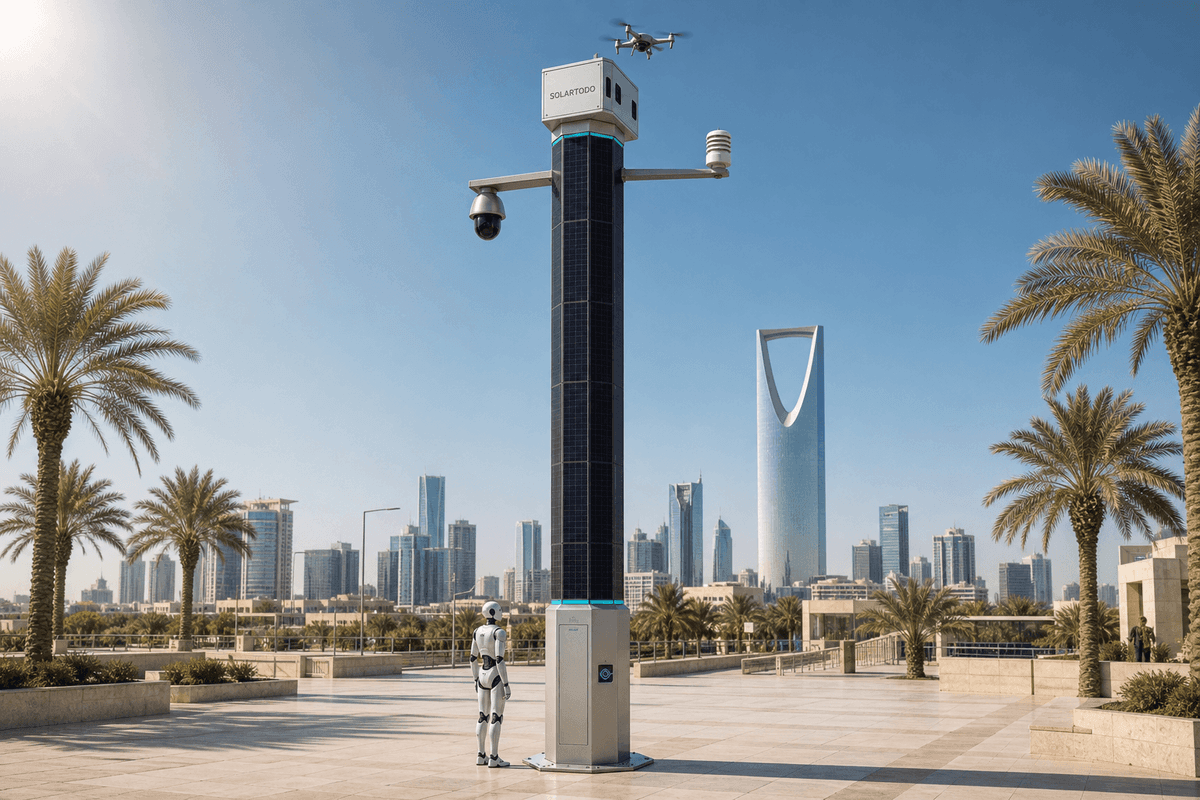
Sky Hub network planning combines 30-60 m pole spacing, 5-20 kWh batteries and mission-radius modeling to create repeatable off-grid inspection coverage.
SOLARTODO Sky Hub is a pure smart pole architecture for sites that need sensing, edge computing, drone operations, robot support and local command coordination without using grid or site power. It is not a lighting product. In coverage planning, the pole is treated as a distributed field node: each location contributes local perception, energy buffering, communications, autonomous drone service and ground-robot support.
The planning question is not simply “how far can one drone fly?” A bankable design asks how often it must fly, how much reserve energy it must keep, how many events occur per shift, what local wind and dust conditions do to availability, and how many adjacent poles can absorb demand if one node is under maintenance. A port perimeter, industrial park or critical-infrastructure boundary usually benefits from overlapping coverage rather than maximum theoretical radius.
According to NREL PVWatts documentation (2026), PVWatts estimates PV energy production from inputs such as system size, losses, tilt, azimuth and local resource data. That matters for Sky Hub because vertical on-pole PV should be modeled as a replenishment layer, while the battery handles high-power drone and robot tasks.
NREL states, "PVWatts estimates the energy production" of PV systems. For procurement teams, the practical meaning is straightforward: use solar-resource modeling to size duty cycles, not to advertise unlimited autonomy. In high-irradiance regions, a Sky Hub node can be planned around approximately 2.8-3.2 kWp of on-pole PV, about 1.0-1.3 kW DC clear-sky peak output and roughly 7-10 kWh/day under favorable conditions.
Technical Coverage Model
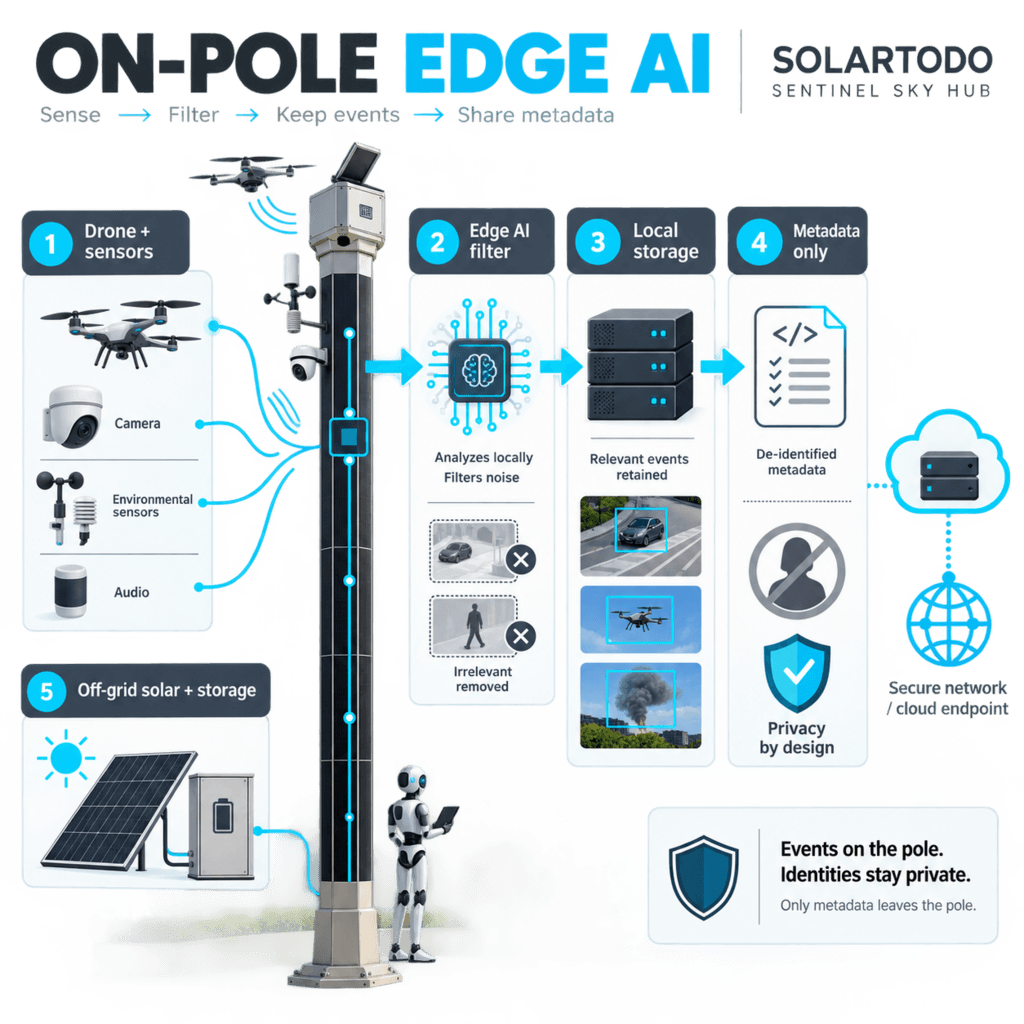
A practical Sky Hub grid uses 3 planning layers: physical spacing, sortie energy and local data processing at each off-grid pole.
Coverage begins with the asset map. Engineers divide the site into perimeter corridors, high-value assets, restricted zones, service roads, gate areas and inspection targets. Each pole is then evaluated for line of sight, communications path, drone launch clearance, robot return path, maintenance access and civil foundation feasibility. The goal is a service grid that keeps response time predictable, not a sparse layout that depends on perfect flight conditions.
For a linear perimeter, 30 m spacing creates dense overlap and short response paths; 60 m spacing may be suitable where terrain is open, risk is lower and wireless propagation is stable. A representative 77-pole layout at 30 m intervals covers about 2.31 km before site-specific offsets, curves, setbacks and no-fly buffers are applied. The same 2.31 km can be covered with fewer poles at wider spacing, but redundancy, robot reach and maintenance isolation decrease.
Drone Range and Sortie Logic
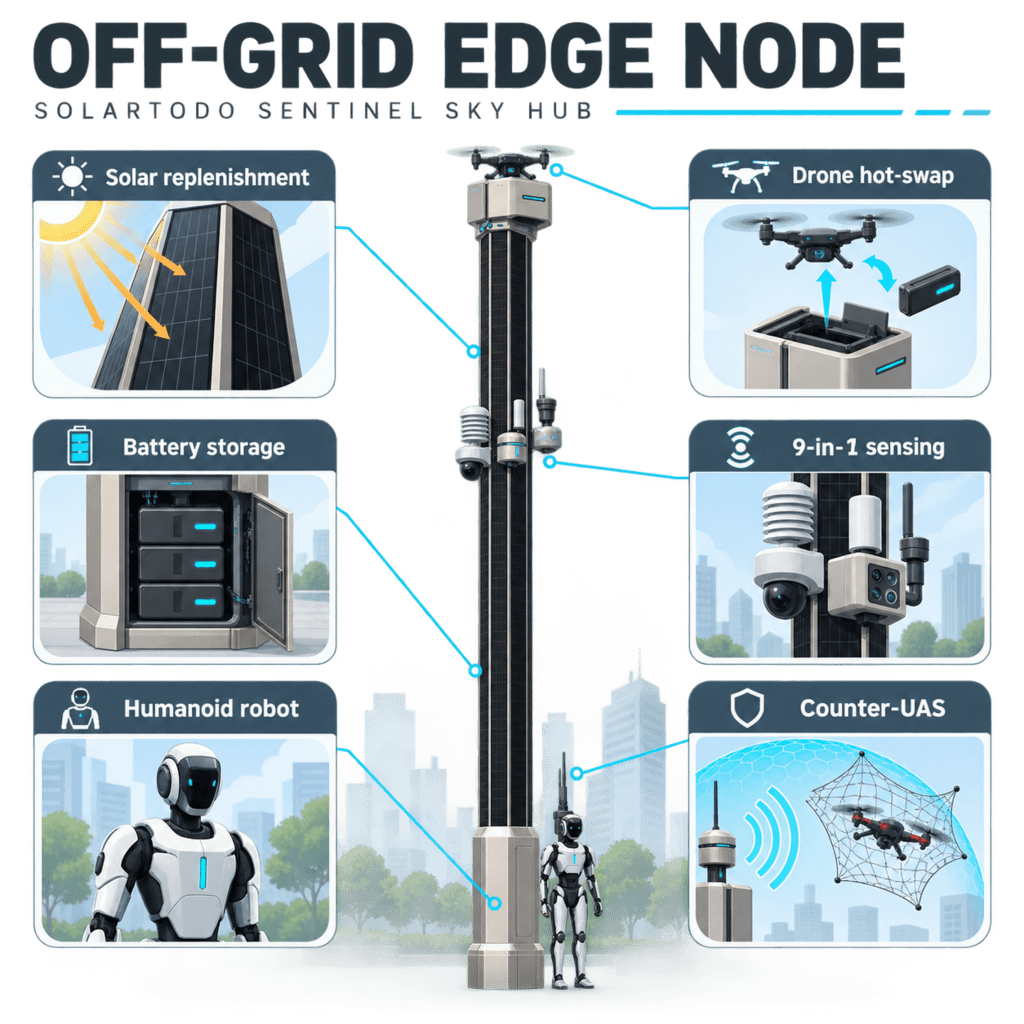
Drone range should be treated as a duty-cycle budget. A mission consumes energy during launch, outbound transit, inspection, hover, return, landing and battery exchange. Planning should reserve enough capacity for return flight and contingency holding, especially around ports, high winds, cranes, metal structures and moving vehicles. The hot-swap magazine improves availability by allowing landed drones to receive charged packs and return to the task queue without a technician at each sortie.
Mission management covers route planning, task queueing, charge and swap states, aircraft health, operator authorization and logs. When an event is detected by a nearby pole, the command view can assign the nearest suitable drone or a better-positioned neighboring node. For high-risk zones, two-node overlap allows one pole to continue routine inspection while another handles alarm response.
Edge AI and Data Boundaries
The Sky Hub edge layer uses Jetson-class compute to run local inference and workload scheduling on the pole. Raw video and sensor data stay on the pole for local processing. Only de-identified event metadata, status summaries, mission logs, energy state and maintenance alerts should leave the node. This supports a PDPL/LGPD-oriented data-minimization posture, while still giving operators a common operating picture.
Analytics should be specified around anonymous vehicle counts, crowd density, intrusion logic and perimeter awareness. Do not build procurement requirements around active face recognition or licence-plate recognition for this product configuration. Where a security policy requires identity workflows, they should be handled by separately approved systems outside the Sky Hub claim set.
Pole Spacing, Energy and Network Sizing
A 77-node Sky Hub perimeter at 30 m spacing can cover about 2.31 km while producing roughly 539-770 kWh/day of modeled replenishment.
Energy planning is the main constraint behind credible coverage. Each pole is fully off-grid in normal operation, with on-pole solar replenishment and battery storage. The solar body is useful because it provides distributed daily energy close to the loads, but it is not a claim of unlimited solar-only self-sufficiency. Drone flights, robot charging, compute load, communications and weather losses must be scheduled against the storage reserve.
According to IRENA (2025), utility-scale solar PV reached a global weighted average LCOE of USD 0.043/kWh in 2024, while battery storage costs declined 93% from 2010 to 2024. These figures do not price a Sky Hub pole directly, but they help explain why distributed PV and battery-buffered infrastructure has become a realistic procurement category.
IRENA states, "renewables remained the most cost-competitive option" for new electricity generation in 2024. For Sky Hub coverage planning, the stronger point is resilience: off-grid nodes avoid trenching, reduce dependence on utility tie-ins and allow inspection grids in sites where civil works would dominate cost and schedule.
| Planning variable | Conservative design input | Procurement implication |
|---|---|---|
| Pole spacing | 30-60 m | Use 30 m for high-risk perimeters and 60 m where overlap demand is lower |
| On-pole PV nameplate | 2.8-3.2 kWp | Model as replenishment, not continuous load supply |
| Clear-sky PV output | 1.0-1.3 kW DC peak | Validate against local irradiance, soiling and seasonal conditions |
| Daily replenishment | 7-10 kWh/day | Schedule drone and robot activity by duty cycle |
| Battery storage | 5-20 kWh class | Increase storage for frequent sorties or longer autonomy windows |
| Data export | Metadata only | Keep raw video and sensor streams local |
| C-UAS response | Human-authorized only | Use soft net-capture or close-approach deterrence, never jamming or destructive action |
The 9-in-1 environmental station supports operational decisions by measuring wind speed, wind direction, temperature, humidity, atmospheric pressure, noise, PM10, PM2.5 and illuminance. These readings help determine whether a sortie should launch, wait, change route or hand off to another node. In dusty regions, soiling assumptions and cleaning intervals should be included in the EPC model.
Applications and Operating Workflows
Sky Hub supports 4 linked workflows: sensing, authorized response, edge scheduling and field maintenance across ports, campuses and industrial perimeters.
In a port perimeter, dense spacing supports fence-line patrol, container-yard observation, tank-farm inspection, restricted-zone alarm response and berth-side event verification. The common operating picture should show event type, location, node health, battery state, drone availability and operator authorization status. It should not require raw video export to perform routine event triage.
In an industrial park, Sky Hub can coordinate drone sorties and ground-robot patrols from the same field node. A robot can inspect accessible corridors, respond to nearby alarms and return to the pole base for wireless charging. The drone can verify roofs, pipelines, utility corridors, elevated assets and inaccessible zones. Air-ground coordination improves coverage because the drone handles speed and elevation while the robot handles closer local inspection.
Counter-UAS coordination must remain non-lethal and human-authorized. The pole can detect and track an unauthorized drone through local sensing or optional partner-sensor inputs, then coordinate its own friendly drone for soft aerial net-capture or close-approach deterrence after approval. Radar should be treated only as an optional partner input, not built-in pole hardware. The workflow must exclude hard-kill effects, RF or GNSS denial, autonomous attack and destructive interception.
According to ISA/IEC 62443 guidance (2025), industrial automation cybersecurity standards define requirements and processes for electronically secure industrial automation and control systems. For Sky Hub, that supports segmented networks, role-based access, event logging and separation between operational controls and external dashboards.
EPC Investment Analysis and Pricing Structure
EPC planning for 50-250+ Sky Hub nodes should compare FOB, CIF and turnkey delivery against trenching, manual inspection and separate device costs.
EPC turnkey delivery includes engineering, procurement, construction, commissioning and warranty support. Engineering covers pole loading, foundation assumptions, radio planning, energy modeling, mission workflow, data-interface definition and local authority requirements. Procurement covers the pure smart pole, PV replenishment layer, battery storage, power electronics, edge compute, sensing package, communications, drone service hardware and controls.
Construction includes foundations, installation, grounding, enclosure setup, communications checks and site acceptance. Commissioning should test battery behavior, PV charging, drone launch and return, battery exchange, robot charging, alarm workflow, operator authorization, metadata reporting and fail-safe procedures. Warranty terms should be confirmed in the project quote because final scope depends on site conditions and selected configuration.
| Pricing tier | Scope | Indicative unit range |
|---|---|---|
| FOB Supply | Equipment supply, ex-works China | USD 4,030-8,840 |
| CIF Delivered | Equipment plus ocean freight and insurance | USD 4,527-9,931 |
| EPC Turnkey | Installed, commissioned and covered by 1-year warranty | USD 6,500-13,000 |
| Volume band | Indicative discount | Planning use |
|---|---|---|
| 50+ units | 5% | Multi-gate industrial park or short perimeter |
| 100+ units | 10% | Large port zone or multi-corridor campus |
| 250+ units | 15% | Multi-site framework procurement |
ROI depends on avoided trenching, avoided utility service points, reduced manual inspection visits and fewer separate drone-support assets. If a conventional program spends USD 2,000 per pole-equivalent on electrical service, USD 1,200 per year on manual inspection visits and USD 600 per year on distributed device maintenance, an EPC Sky Hub program may target a 3-6 year payback where labor access and power extension are major cost drivers.
Payment terms are typically 30% T/T advance plus 70% against bill of lading, or 100% irrevocable L/C at sight for qualified international trade. Project financing can be discussed for programs above USD 1,000K. Procurement teams can contact [email protected] with site coordinates, quantity, storage autonomy, drone duty cycle and civil-work assumptions.
FAQ
Sky Hub buyers usually need 10 practical answers covering range, spacing, off-grid energy, data handling, pricing, maintenance and operating limits.
Q: What is Sky Hub network coverage planning? A: Sky Hub network coverage planning defines where pure smart poles should be installed so drones, robots, sensors and edge compute can cover a site reliably. A typical study maps 30-60 m spacing, patrol routes, radio links, battery reserves, maintenance access and event-response zones before final pole quantities are quoted.
Q: How far apart should Sky Hub poles be placed? A: Many perimeter projects start with 30-60 m spacing, then adjust after site survey and radio planning. Use 30 m spacing for high-risk boundaries, blocked sight lines or dense operational areas. Wider spacing can work in open zones, but it reduces overlap, redundancy and response flexibility.
Q: Does drone range alone determine the number of poles? A: No. Drone range is only one input because each sortie also needs reserve energy, safe return time, landing availability and battery exchange capacity. Pole count should also reflect inspection frequency, blocked zones, communications quality, robot routes, maintenance isolation and the required response time for alarms.
Q: Is Sky Hub fully off-grid? A: Yes, Sky Hub is designed for normal operation without grid, city or site power. The on-pole PV provides approximately 2.8-3.2 kWp nameplate replenishment, while 5-20 kWh-class storage buffers drone, robot, compute and communications loads. Solar output still requires site-specific modeling.
Q: How much solar energy can one pole produce? A: In high-irradiance regions, a Sky Hub pole can be planned around roughly 1.0-1.3 kW DC clear-sky peak output and about 7-10 kWh/day. This is a replenishment estimate, not a guarantee. Soiling, shade, season, albedo, temperature and duty cycle must be modeled.
Q: What data leaves the pole? A: Raw video and raw sensor streams stay on the pole for local processing. The command system should receive only de-identified event metadata, health state, mission logs, battery status, environmental summaries and maintenance alerts. This supports PDPL/LGPD-oriented design while reducing bandwidth and privacy exposure.
Q: Can Sky Hub perform counter-UAS response? A: Sky Hub can support non-lethal, human-authorized counter-UAS coordination. It may detect and track an unauthorized drone through local or optional partner-sensor inputs, then coordinate a friendly drone for soft net-capture or close-approach deterrence. It does not use jamming, destructive interception or autonomous attack.
Q: What does EPC turnkey delivery include? A: EPC turnkey delivery includes engineering, procurement, construction, commissioning and typically 1-year warranty support. For Sky Hub, that means foundation assumptions, energy modeling, radio planning, pole supply, battery and PV integration, drone workflow checks, metadata reporting tests, operator handover and site acceptance documentation.
Q: How much does a Sky Hub project cost? A: Indicative ranges are USD 4,030-8,840 for FOB supply, USD 4,527-9,931 for CIF delivered equipment and USD 6,500-13,000 for EPC turnkey delivery. Final pricing depends on quantity, storage size, drone duty cycle, civil works, communications, export terms and local commissioning requirements.
Q: What maintenance is required for a Sky Hub network? A: Maintenance should cover PV cleaning, battery health checks, enclosure inspection, communications tests, drone service hardware, robot charging alignment, sensor calibration and software logs. Dusty or coastal sites need tighter inspection intervals. EPC planning should include spare packs, cleaning access and node isolation procedures.
Q: Which standards should buyers reference? A: Buyers should reference IEC 61215 and IEC 61730 for PV modules, IEC 60529 for ingress protection, UL 9540 for energy storage systems and ISA/IEC 62443 for industrial cybersecurity architecture. Drone operations must also follow the civil aviation rules in the deployment country.
Q: When should a buyer choose denser pole spacing? A: Choose denser spacing when the site has high-value assets, short response-time requirements, blind corners, heavy vehicle movement, difficult wireless propagation or frequent inspections. A 30 m grid costs more upfront than a wider layout, but it improves redundancy and reduces the distance from event detection to field response.
References
- NREL PVWatts (2026): PVWatts Calculator Version 8 documentation for PV energy estimation using system size, losses, orientation and resource inputs. https://pvwatts.nrel.gov/ — https://www.nrel.gov/research/data-tools.html
- IRENA (2025): Renewable Power Generation Costs in 2024, reporting USD 0.043/kWh global weighted-average utility-scale solar PV LCOE and major battery cost declines. https://www.irena.org/Publications/2025/Jun/Renewable-Power-Generation-Costs-in-2024 — https://www.irena.org/Data/View-data-by-topic/Capacity-and-Generation
- IEC 61215-1:2021 (2021): Terrestrial photovoltaic module design qualification and type approval test requirements for crystalline silicon modules. — https://webstore.iec.ch/
- IEC 61730-1:2023 (2023): Photovoltaic module safety qualification requirements for construction and testing. — https://webstore.iec.ch/
- IEC 60529 (2013): Degrees of protection provided by enclosures, commonly used for IP rating evaluation in outdoor electrical equipment. — https://webstore.iec.ch/
- ANSI/CAN/UL 9540:2023 (2025): Energy Storage Systems and Equipment standard covering ESS safety requirements and protective functions. https://webstore.ansi.org/standards/ul/ansiul95402023 — https://www.ul.com/
- ISA/IEC 62443 (2025): Industrial automation and control systems cybersecurity standards for secure IACS processes and requirements. https://www.isa.org/standards-and-publications/isa-standards/isa-iec-62443-series-of-standards — https://webstore.iec.ch/ These 7 references support PV modeling, energy-storage safety, cybersecurity architecture, PV qualification, ingress protection and renewable-energy cost assumptions.
- NREL PVWatts (2026): PVWatts Calculator Version 8 documentation for PV energy estimation using system size, losses, orientation and resource inputs. https://pvwatts.nrel.gov/
- IRENA (2025): Renewable Power Generation Costs in 2024, reporting USD 0.043/kWh global weighted-average utility-scale solar PV LCOE and major battery cost declines. https://www.irena.org/Publications/2025/Jun/Renewable-Power-Generation-Costs-in-2024
- IEC 61215-1:2021 (2021): Terrestrial photovoltaic module design qualification and type approval test requirements for crystalline silicon modules.
- IEC 61730-1:2023 (2023): Photovoltaic module safety qualification requirements for construction and testing.
- IEC 60529 (2013): Degrees of protection provided by enclosures, commonly used for IP rating evaluation in outdoor electrical equipment.
- ANSI/CAN/UL 9540:2023 (2025): Energy Storage Systems and Equipment standard covering ESS safety requirements and protective functions. https://webstore.ansi.org/standards/ul/ansiul95402023
- ISA/IEC 62443 (2025): Industrial automation and control systems cybersecurity standards for secure IACS processes and requirements. https://www.isa.org/standards-and-publications/isa-standards/isa-iec-62443-series-of-standards
Conclusion
Sky Hub coverage planning should combine 30-60 m spacing, 5-20 kWh storage and 7-10 kWh/day replenishment with verified site modeling.
The bottom line: SOLARTODO Sky Hub is best specified as an off-grid, battery-backed physical-AI pole network where drone range, pole spacing, edge processing and human-authorized response are engineered together. For procurement teams, the most defensible path is a site-specific EPC model that validates spacing, duty cycle, storage and communications before ordering 50+ nodes.
About SOLARTODO
SOLARTODO is a global integrated solution provider specializing in solar power generation systems, energy-storage products, smart street-lighting and solar street-lighting, intelligent security & IoT linkage systems, power transmission towers, telecom communication towers, and smart-agriculture solutions for worldwide B2B customers.
About the Author

Cinn Song
Founder & Chief Solutions Architect
Cinn Song founded SOLARTODO LIMITED and leads its smart-city infrastructure engineering — from solar, storage and integrated smart poles to the company's push into physical-AI city edge nodes: pole-mounted edge computing, vertical LLMs for smart cities, drone-based O&M with autonomous battery swapping, robotic maintenance, and high-speed counter-UAS interception. Since 2010, he has directed turnkey EPC + BOT delivery across 50+ countries, including telecom monopole supply for national grid operators, off-grid solar street-lighting for African municipalities, and integrated smart-pole programs for Gulf smart cities.
Cite This Article
Cinn Song. (2026). Sky Hub Network Coverage Planning: Drone Range and Pole…. SOLARTODO. Retrieved from https://solartodo.com/knowledge/sky-hub-network-coverage-planning-drone-range-and-pole-spacing
@article{solartodo_sky_hub_network_coverage_planning_drone_range_and_pole_spacing,
  title = {Sky Hub Network Coverage Planning: Drone Range and Pole…},
  author = {Cinn Song},
  journal = {SOLARTODO Knowledge Base},
  year = {2026},
  url = {https://solartodo.com/knowledge/sky-hub-network-coverage-planning-drone-range-and-pole-spacing},
  note = {Accessed: 2026-10-14}
}
Published: August 26, 2026 | Available at: https://solartodo.com/knowledge/sky-hub-network-coverage-planning-drone-range-and-pole-spacing
Subscribe to Our Newsletter
Get the latest solar energy news and insights delivered to your inbox.
View All Articles