Sky Hub Edge AI: On-Pole Drone Data Processing Pipeline |…

Cinn Song
Founder & Chief Solutions Architect

TL;DR
Sky Hub Edge AI is a pure SOLARTODO smart pole architecture for local drone data processing. It buffers drone and robot workloads with 5-20 kWh storage, replenishes with roughly 7-10 kWh/day in high-irradiance conditions, and keeps raw video on the pole while sending only de-identified metadata to the command view.
Sky Hub Edge AI processes drone and sensor data on a fully off-grid SOLARTODO pole, using 5-20 kWh storage, 7-10 kWh/day solar replenishment and metadata-only backhaul.
Summary
Sky Hub Edge AI processes drone and sensor data on a fully off-grid SOLARTODO pole, using 5-20 kWh storage, 7-10 kWh/day solar replenishment and metadata-only backhaul.
Key Takeaways
Sky Hub procurement should be evaluated as an 8-function edge pipeline, not a camera pole, because power, compute, drones, sensing and privacy controls are interdependent.
- Specify 5-20 kWh battery storage to buffer high-power drone sorties, robot charging and edge inference without assuming unlimited solar autonomy.
- Design around 7-10 kWh/day clear-sky replenishment and 1.0-1.3 kW DC-class realistic solar peak in high-irradiance regions.
- Keep raw video and sensor data on the pole; transmit only de-identified event metadata, status logs and health summaries.
- Use Jetson-class edge compute for 4 core workloads: ingestion, local inference, mission scheduling and event compression.
- Reduce backhaul load by sending event clips as metadata records, typically cutting always-on video bandwidth by 50-90% in edge-first deployments.
- Apply 3 maturity tiers: hardware-ready infrastructure, pilot-stage drone workflows and leading-position air-ground coordination.
- Evaluate 3 commercial models: FOB supply, CIF delivered and EPC turnkey, with 5%, 10% and 15% volume guidance at 50, 100 and 250 units.
Sky Hub Edge AI Architecture for Drone Data Processing
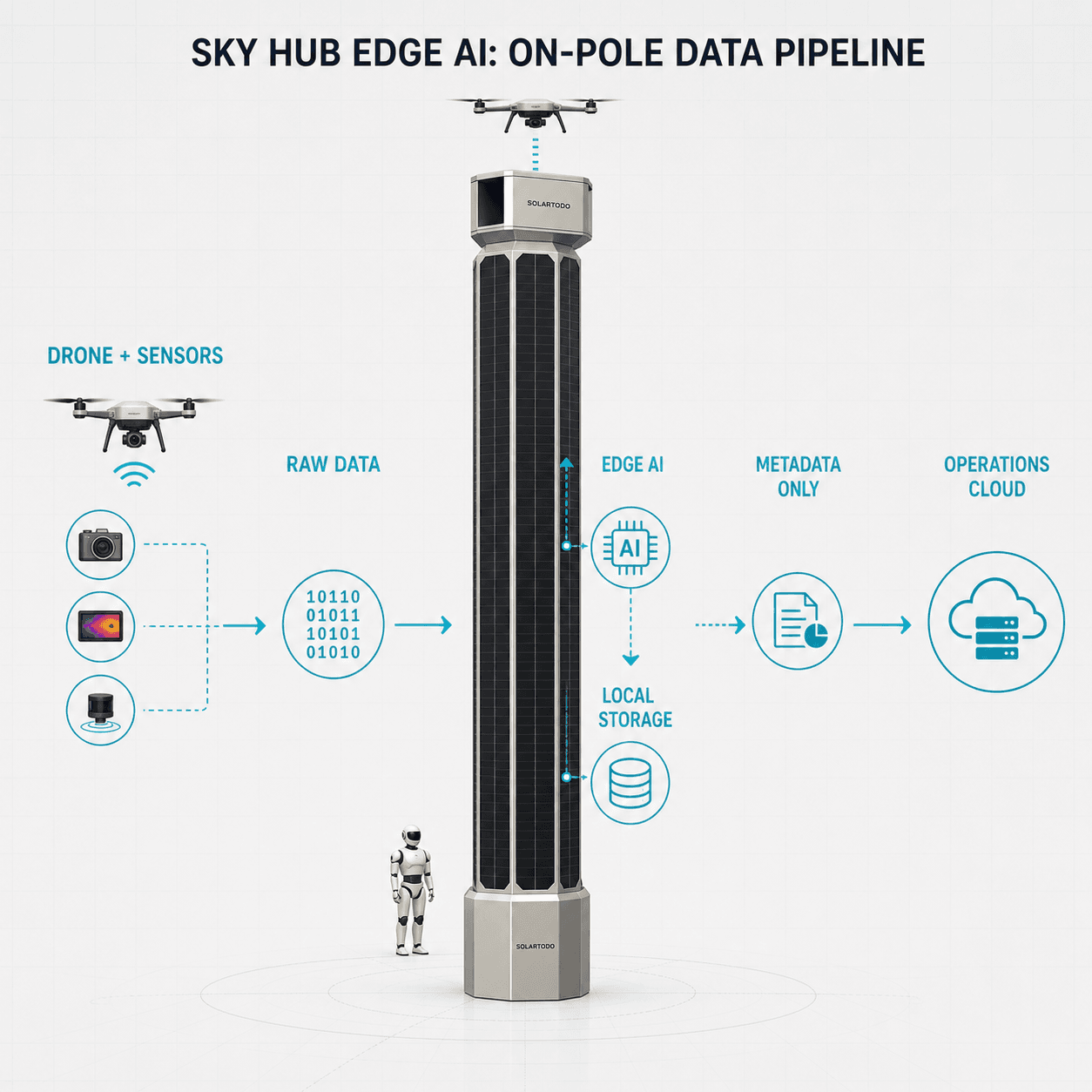
Sky Hub is a pure SOLARTODO smart pole that processes drone data locally through 4 pipeline stages: capture, inference, decision support and metadata export.
The architecture discussed here treats advanced autonomy, robotic coordination and automated drone service as concept or pilot-stage capabilities unless separately qualified by project evidence. In practical B2B planning, that means buyers should evaluate the Sky Hub as a deployable edge infrastructure pattern first, then qualify each autonomous workflow through site acceptance testing, aviation approvals and operational risk review.
The pole acts as an off-grid micro-station. On-pole photovoltaic replenishment is a supplemental charging layer, while the battery bank carries the operational peaks created by drone launch cycles, battery exchange, robot charging, PTZ analytics and wireless communications. The solar subsystem can support roughly 1.0-1.3 kW DC-class clear-sky peak output and about 7-10 kWh/day in high-irradiance regions, but task scheduling must still respect storage state of charge, weather and mission priority.
Sky Hub is not a smart streetlight and should not be specified as one. Its function is to host sensing, edge computing, drone operations management, battery-service workflows, environmental monitoring and command-view integration in one non-lighting smart infrastructure node.
According to IEA (2024), electricity use from data centres, AI and cryptocurrency could rise from about 460 TWh in 2022 to more than 1,000 TWh in 2026. IEA states, 'Data centres are significant drivers of growth in electricity demand in many regions.' For distributed infrastructure, this supports an edge-first approach: classify and summarize data near the field device instead of moving all raw streams to a remote cloud.
Technical Pipeline: From Drone Capture to Local Metadata
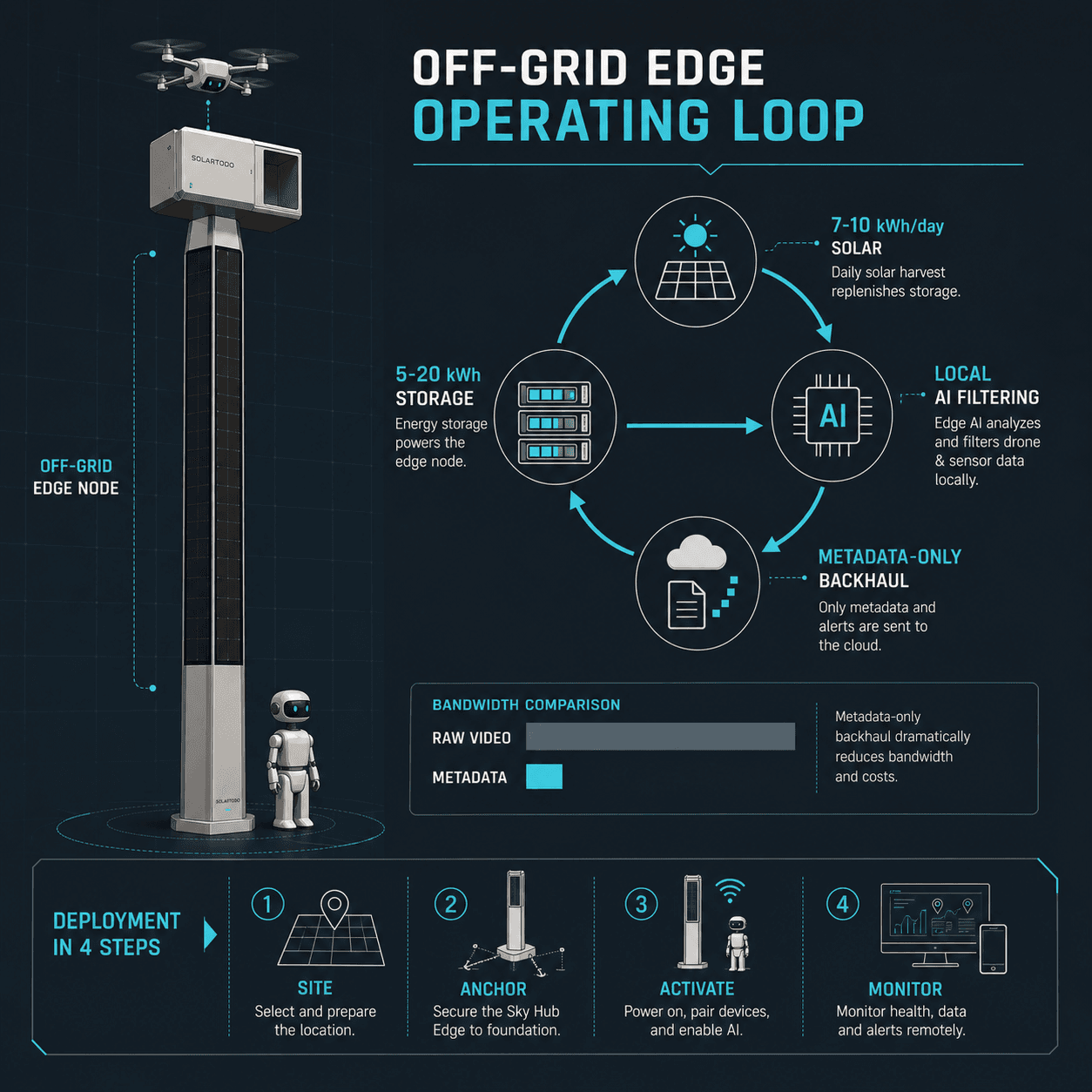
A Sky Hub pipeline should process 6 data classes locally: drone telemetry, mission logs, video frames, environmental readings, battery state and event alerts.
The pipeline begins when a drone returns from patrol, inspection or alarm verification. Telemetry records position, route completion, battery condition and mission status. Video or imagery is ingested into the pole-side edge module for local inference, while environmental sensors add wind, temperature, humidity, pressure, noise, PM10, PM2.5 and illuminance context. The system then correlates those streams with PTZ analytics such as anonymous vehicle count, crowd density, intrusion and perimeter awareness.
The core processing loop is straightforward:
- Ingest drone, PTZ and environmental sensor data at the pole.
- Normalize timestamps, device IDs, battery state and mission IDs.
- Run local inference for detection, anomaly scoring and operational rules.
- Create event records with confidence score, time, location zone and recommended response.
- Retain raw video and sensor data on the pole according to the project retention policy.
- Export only de-identified event metadata, status telemetry and health summaries to the command view.
This privacy posture is designed for local processing and PDPL/LGPD-oriented deployment planning; it is not a certification claim. ISO states, 'ISO/IEC 27001 is the world's best-known standard for information security management systems.' ISO (2022) also reports more than 70,000 certificates across 150 countries, showing why procurement teams often use ISO/IEC 27001 language when defining security governance for edge infrastructure.
The operating system layer, OTATODO, can be treated as the workload scheduler and device coordinator. It prioritizes inference jobs, drone battery exchange state, mission queues, sensor polling, storage health and communications. When storage is low or wind exceeds a local launch threshold, the scheduler should delay non-critical sorties and preserve energy for security sensing, command communications and emergency response.
Counter-UAS coordination remains non-lethal and human-authorized. In a demonstration workflow, the pole may detect and track an unauthorized drone, correlate optional partner-sensor inputs, request operator approval and command a friendly drone for simulated aerial net-capture or close-approach deterrence. Radar is not pole hardware; it is only an optional external input where the project includes a qualified partner sensor.
EPC Investment Analysis and Pricing Structure
EPC buyers should price Sky Hub in 3 layers: equipment supply, delivered logistics and turnkey deployment with commissioning, training and acceptance testing.
For procurement, SOLARTODO should be evaluated as a B2B manufacturer and exporter, not an online marketplace. The normal commercial path is inquiry, technical clarification, offline quotation and project financing review where applicable. Large infrastructure projects above $1,000K may be assessed for financing support, subject to country, buyer profile, project security and payment risk.
A turnkey EPC scope normally includes engineering, procurement and construction coordination. For Sky Hub, that means site survey, foundation and civil interface design, pole and cabinet integration, battery and solar sizing, communications design, drone workflow configuration, edge analytics setup, command-view integration, operator training, documentation and commissioning tests. Aviation permissions, local permits and site security procedures remain buyer-side or jointly managed items, depending on contract terms.
| Commercial tier | Buyer receives | Best fit | Pricing logic |
|---|---|---|---|
| FOB Supply | Factory-ready Sky Hub hardware and standard documentation | Experienced EPCs with local crews | Lowest unit price; buyer handles freight, import and installation |
| CIF Delivered | Equipment delivered to destination port with export logistics included | Distributors and regional integrators | Adds freight, insurance and export handling |
| EPC Turnkey | Delivered system, installation coordination, commissioning and training | campuses, ports, industrial parks and critical infrastructure | Highest project price; reduces buyer integration risk |
Volume guidance can be framed as 5% for 50+ units, 10% for 100+ units and 15% for 250+ units, subject to final specification, logistics and support scope. Standard payment terms are 30% T/T deposit plus 70% against bill of lading, or 100% L/C at sight. Project inquiries should be directed to [email protected].
ROI should be modelled against avoided standalone infrastructure: separate camera poles, environmental stations, drone service facilities, edge cabinets, communications enclosures and patrol charging points. IRENA (2024) reported that battery storage project costs dropped 89% between 2010 and 2023, while utility-scale solar PV project LCOE fell 12% from 2022 to 2023. These trends support off-grid edge infrastructure economics, but the business case still depends on patrol frequency, labor displacement, site risk, civil works and data connectivity costs.
Deployment Workflows and System Selection
A Sky Hub deployment should be selected by duty cycle, because 3 daily drone sorties require different storage, compute and maintenance assumptions than 12 sorties.
For smart districts and campuses, the main value is automated inspection readiness, perimeter awareness and environmental monitoring from one managed node. For ports, logistics yards and industrial parks, value shifts toward asset inspection, queue monitoring, incident verification and weather-aware drone dispatch. For critical-infrastructure perimeters, value depends on reliable local processing, low-latency event summaries and human-authorized response coordination.
According to NREL PVWatts documentation, long-term PV yield estimates use 30 years of historical weather data to indicate possible interannual variation. That matters because Sky Hub energy modelling should not be based on a single sunny-day output claim. A procurement-grade model should include local irradiance, dust, high-temperature derating, storage reserve, launch windows and maintenance access.
According to IRENA (2024), solar PV was 56% less costly than weighted-average fossil fuel-fired alternatives in 2023. The same report estimates that renewable capacity added since 2000 reduced electricity-sector fuel costs by at least USD 409 billion in 2023. For off-grid smart infrastructure, the relevant lesson is not that solar alone can run every workload, but that solar plus storage can reduce field power dependency when missions are duty-cycle controlled.
| Selection factor | Conservative specification | Higher-duty specification | Procurement implication |
|---|---|---|---|
| Battery storage | 5-10 kWh | 10-20 kWh | Size for sorties, robot charging and reserve hours |
| Solar replenishment | 7 kWh/day assumption | 10 kWh/day assumption | Use local irradiance and soiling assumptions |
| Edge compute | Single Jetson-class module | Higher TOPS module with workload isolation | Match inference models to thermal and power limits |
| Data export | Metadata-only events | Metadata plus selected operator-approved evidence packages | Keep raw data on the pole by default |
| Operations maturity | Hardware-ready and pilot workflows | Leading-position coordination workflows | Require site trials before scaling |
Maintenance should focus on battery health, connector integrity, sensor calibration, drone-service mechanics, software updates and log review. IEC 62443-style segmentation is useful because the drone control loop, video analytics, battery management and command dashboard should not be treated as one flat network. IEEE 1547-2018 is less central because Sky Hub is not grid-dependent, but its distributed energy language is still useful when integrators document storage, inverter and power-control interfaces.
FAQ
Sky Hub FAQ answers should clarify 10 procurement topics: architecture, data handling, power, drones, security, pricing, installation, maintenance, compliance and limits.
Q: What is the Sky Hub on-pole drone data processing pipeline? A: It is a local edge workflow that ingests drone telemetry, imagery, PTZ analytics and environmental data at the SOLARTODO pole. The system processes raw streams locally, generates de-identified event metadata, and exports only status or command-view summaries. This reduces backhaul demand while preserving field-level operational context.
Q: Does Sky Hub upload raw video to the cloud? A: No. The design assumption is that raw video and sensor data stay on the pole for local processing and retention. Only de-identified event metadata, equipment status, mission logs and health summaries may leave the pole. This supports PDPL/LGPD-oriented deployment planning without claiming legal certification.
Q: How much solar energy can the pole realistically produce? A: In high-irradiance regions, the on-pole photovoltaic body is modelled at roughly 1.0-1.3 kW DC-class clear-sky peak and about 7-10 kWh/day. This is replenishment, not unlimited self-sufficiency. Drone and robot workloads require battery buffering, reserve limits and duty-cycle scheduling.
Q: What battery capacity should EPC teams specify? A: Most concept specifications should start with 5-20 kWh-class storage, then adjust for drone sortie count, edge compute load, robot charging and local weather. A low-duty campus node may need less capacity than a port perimeter node running frequent patrols. Storage sizing should include reserve hours, not only daily energy yield.
Q: What analytics are appropriate for the PTZ and drone workflow? A: Appropriate analytics include anonymous vehicle count, crowd density, intrusion detection, perimeter awareness and asset-condition flags. The product should not be specified around face recognition or licence-plate recognition as active capabilities. For procurement, define measurable event categories, confidence thresholds and operator review steps.
Q: Can Sky Hub perform counter-UAS response? A: Sky Hub can be described only as non-lethal, human-authorized coordination for detection, tracking and demonstration response. A simulated workflow may command a friendly drone for aerial net-capture or close-approach deterrence after operator approval. Radar is not integrated pole hardware unless a project adds an optional partner sensor.
Q: What does EPC turnkey pricing include? A: EPC turnkey delivery typically includes engineering review, supplied equipment, logistics coordination, installation support, commissioning, documentation, training and acceptance testing. Pricing is quoted offline after site and specification review. Volume guidance may apply at 50+, 100+ and 250+ units, with financing review possible for projects above $1,000K.
Q: How should buyers compare FOB, CIF and EPC quotes? A: FOB supply is best for experienced local EPCs that control freight and installation. CIF delivered adds export logistics and delivery to destination port. EPC turnkey carries the highest project scope but reduces integration risk by bundling deployment coordination, commissioning and training into one commercial package.
Q: What standards matter for a Sky Hub data pipeline? A: Useful references include ISO/IEC 27001:2022 for information security management, IEC 62443 for industrial control cybersecurity, NREL PVWatts for PV yield modelling, UL 9540 for energy storage systems and FAA Remote ID rules for drone identification context. These are reference frameworks, not automatic product certifications.
Q: What are the main technical limitations? A: The main limits are energy budget, weather, aviation rules, communications coverage, compute thermal capacity and workflow maturity. Advanced drone, robot and counter-UAS workflows should be validated as pilots before fleet scaling. Buyers should require site trials, acceptance metrics and maintenance planning before committing to volume rollout.
References
These 7 references support Sky Hub technical evaluation across energy yield, storage safety, cybersecurity, drone identification and distributed infrastructure governance.
- IEA (2024): Electricity 2024 - global electricity demand, AI/data-centre energy growth and renewable generation outlook.
- IRENA (2024): Renewable Power Generation Costs in 2023 - solar PV cost trends, storage cost decline and renewable fuel-cost savings.
- NREL (2024): PVWatts Calculator - PV production estimates using long-term weather data and system assumptions.
- ISO/IEC 27001:2022 - requirements for information security management systems and risk-based governance.
- IEC 62443-3-3 (2013) and IEC 62443-4-2 (2019) - industrial automation security requirements, security levels and component security controls.
- IEEE 1547-2018 - interconnection and interoperability reference for distributed energy resources and associated power-system interfaces.
- FAA Remote ID / 14 CFR Part 89 (2024) - UAS identification and location broadcast framework for registered drones.
Conclusion
Sky Hub Edge AI is best specified as a 4-stage, off-grid local-processing pipeline with 5-20 kWh storage and metadata-only communications.
The bottom line: SOLARTODO Sky Hub can reduce field data movement and consolidate drone-ready infrastructure when buyers size energy storage honestly, keep raw data on the pole, and validate pilot-stage workflows before scaling. For B2B projects, the strongest fit is a controlled campus, port, industrial park or perimeter deployment where local processing, duty-cycle scheduling and human authorization are procurement requirements.
About SOLARTODO
SOLARTODO is a global integrated solution provider specializing in solar power generation systems, energy-storage products, smart street-lighting and solar street-lighting, intelligent security & IoT linkage systems, power transmission towers, telecom communication towers, and smart-agriculture solutions for worldwide B2B customers.
About the Author

Cinn Song
Founder & Chief Solutions Architect
Cinn Song founded SOLARTODO LIMITED and leads its smart-city infrastructure engineering — from solar, storage and integrated smart poles to the company's push into physical-AI city edge nodes: pole-mounted edge computing, vertical LLMs for smart cities, drone-based O&M with autonomous battery swapping, robotic maintenance, and high-speed counter-UAS interception. Since 2010, he has directed turnkey EPC + BOT delivery across 50+ countries, including telecom monopole supply for national grid operators, off-grid solar street-lighting for African municipalities, and integrated smart-pole programs for Gulf smart cities.
Cite This Article
Cinn Song. (2026). Sky Hub Edge AI: On-Pole Drone Data Processing Pipeline |…. SOLARTODO. Retrieved from https://solartodo.com/knowledge/sky-hub-edge-ai-on-pole-drone-data-processing-pipeline
@article{solartodo_sky_hub_edge_ai_on_pole_drone_data_processing_pipeline,
  title = {Sky Hub Edge AI: On-Pole Drone Data Processing Pipeline |…},
  author = {Cinn Song},
  journal = {SOLARTODO Knowledge Base},
  year = {2026},
  url = {https://solartodo.com/knowledge/sky-hub-edge-ai-on-pole-drone-data-processing-pipeline},
  note = {Accessed: 2026-06-22}
}
Published: June 22, 2026 | Available at: https://solartodo.com/knowledge/sky-hub-edge-ai-on-pole-drone-data-processing-pipeline
Subscribe to Our Newsletter
Get the latest solar energy news and insights delivered to your inbox.
View All Articles