Santiago Power Transmission Tower Market Analysis: 220kV Double-Circuit Steel Tubular Configuration Guide
Summary
Santiago’s grid concentration, growing electricity demand, and central role in Chile’s transmission backbone support a 220kV double-circuit steel tubular pole profile using approximately 60 units over 9 km. A recommended configuration uses 35 m hot-dip galvanized Q345 poles, ACSR 240 conductors, 150 m spans, and IEC 60826-based loading for 30 m/s wind conditions.
Key Takeaways
- Santiago’s Metropolitan Region concentrates more than 7 million residents, which increases dependence on high-capacity backbone corridors rather than only 10-35 kV urban distribution assets, according to INE Chile (2024).
- For this grid profile, a typical transmission reinforcement package would use 220 kV, which aligns with the 35-55 m height and 15-35 t/pole engineering class for steel tubular poles.
- A recommended configuration for this article is approximately 60 units of 35 m tapered steel tubular poles over about 9 km, using double circuit geometry and 150 m spans.
- Each pole in this configuration is specified at about 35 t, using hot-dip galvanized Q345 steel, which places it at the upper end of the 220 kV weight range and fits backbone-duty loading.
- The conductor set is ACSR 240, rated here at 920 kg/km with 70 kN max tension, paired with 2.5 m insulator length, 6 m phase spacing, and 7 m ground clearance.
- The site loading basis is Wind Class 2, 30 m/s, with spread footing foundations, plus climbing steps, cross-arms, grounding, bird guards, and vibration dampers for a 30-year design life.
- According to IEC (2019), line design should account for combined wind, conductor tension, and reliability loading; according to Chile’s transmission planning framework, backbone expansion remains critical for central-system stability.
Market Context for Santiago
Santiago is Chile’s largest power-load center, and that concentration makes 220 kV backbone infrastructure more relevant than a narrow focus on medium-voltage urban feeders. According to Instituto Nacional de Estadísticas, Chile (INE) (2024), the Metropolitan Region has more than 7 million residents, while the World Bank (2023) reports Chile remains one of Latin America’s most urbanized economies, with urbanization above 87%.
That urban density matters because Santiago is not an isolated municipal load pocket; it is the main demand center within Chile’s interconnected national system. According to the Coordinador Eléctrico Nacional (CEN) (2024), Chile’s transmission system is structured around trunk and zonal networks that move bulk power across long distances from generation zones to major consumption centers. In practical terms, this raises the value of 220 kV transmission corridors for redundancy, congestion relief, and substation interconnection around Santiago’s industrial, commercial, and residential clusters.
Climate and terrain also influence tower selection. Santiago sits near latitude -33.45 and longitude -70.67, with a Mediterranean climate, dry summers, and seasonal wind exposure shaped by basin topography and Andean foothills. According to World Bank Climate Change Knowledge Portal data (2023), central Chile faces increasing temperature stress and hydrological variability, which can shift generation dispatch and make transmission flexibility more important during peak periods.
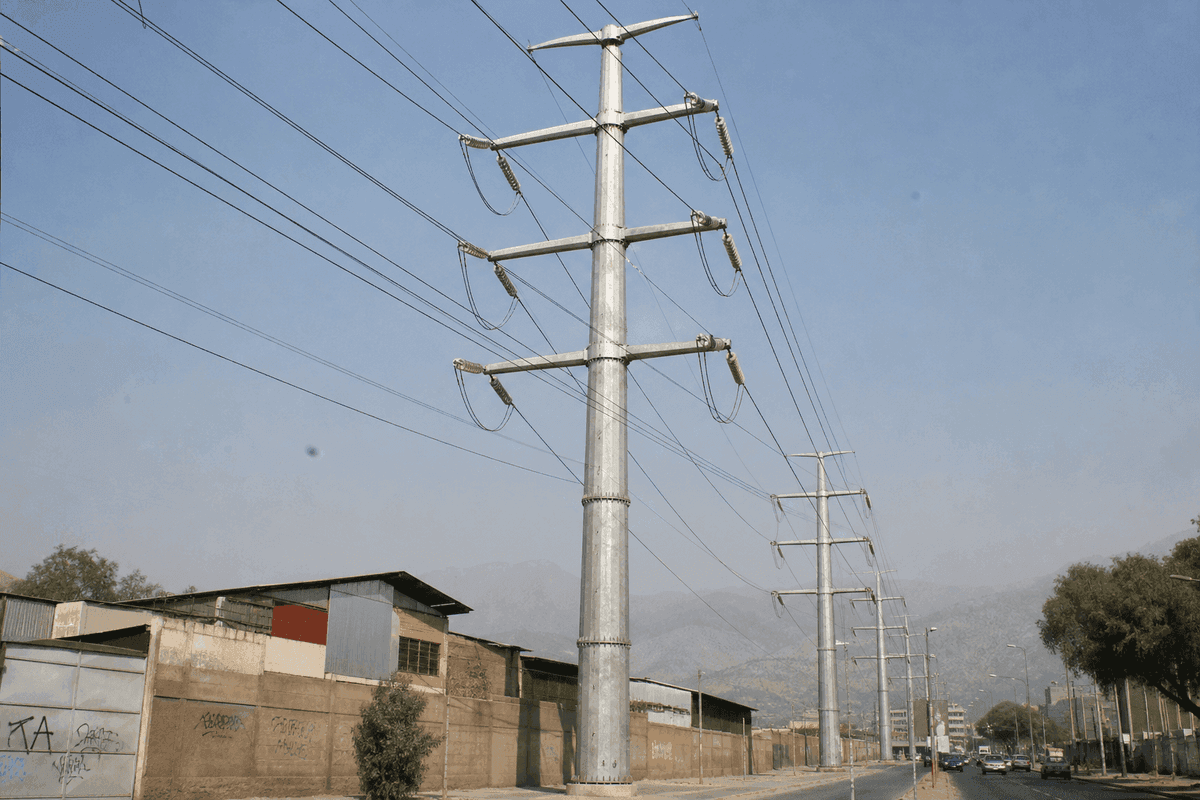
A steel tubular pole is often a strong fit where right-of-way, visual impact, and urban-periphery land constraints matter. Compared with lattice structures, a monopole-style tubular geometry typically uses a smaller footprint at the structure base, which can help on constrained corridors near roads, industrial zones, and expanding suburban edges. For Santiago, that matters because reinforcement projects may pass through mixed land-use areas where civil works access, transport clearances, and compact foundations affect schedule risk.
According to IEA (2023), electrification and grid strengthening are central to Latin American energy transition pathways, especially where cities absorb growing demand from transport, data infrastructure, and commercial loads. According to IRENA (2023), transmission expansion is a prerequisite for integrating renewable generation at scale. For Santiago, that means a 220 kV backbone-class Power Transmission Tower is not an overspecification if the purpose is bulk transfer, substation tie-in, or corridor uprating; it is the correct class when the line function is high-voltage transmission rather than neighborhood distribution.
The standards environment also supports a conservative specification. IEC states, "IEC 60826 specifies loading and strength requirements of overhead transmission lines," which is directly relevant for 220 kV mechanical design under wind and conductor tension. Chilean transmission owners and EPC contractors also evaluate line works against national design practice and utility approval requirements, so a specification that references IEC 60826, GB 50545, and DL/T 5092 gives a clear compliance basis for export manufacturing and technical review.
Recommended Technical Configuration
For Santiago’s backbone-grid use case, a 220 kV double-circuit steel tubular pole in the 35-55 m class is the technically consistent recommendation, and the specified 35 m, 35 t configuration fits that class exactly. This avoids the common engineering error of mixing medium-voltage dimensions with high-voltage loading.
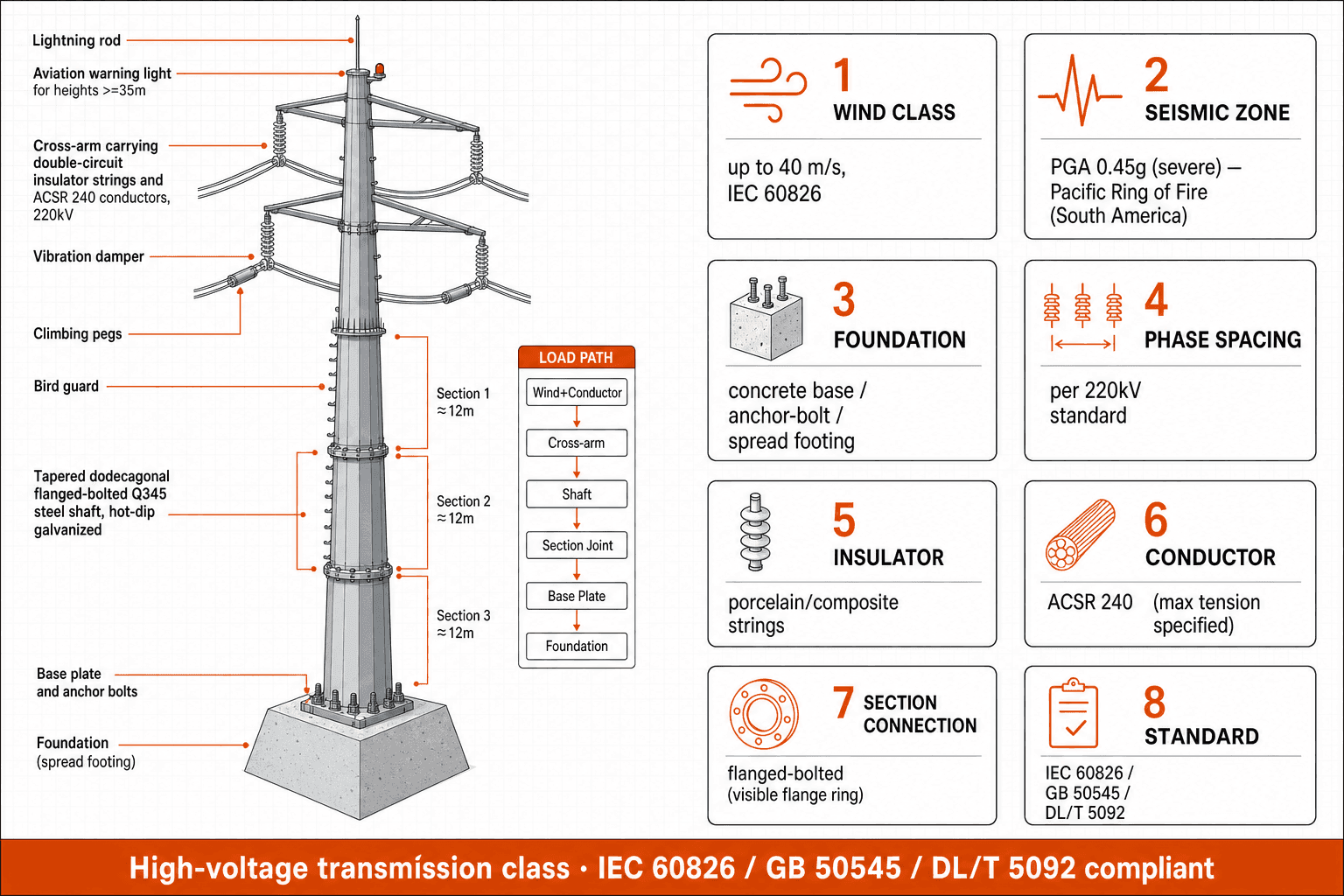
A typical deployment of this scale would consist of approximately 60 units of 35 m tapered steel tubular poles for a 220 kV double-circuit line over about 9 km. The project-specific configuration given here uses hot-dip galvanized Q345 steel, about 35 t per pole, and a linear weight basis of 1000 kg/m for the double-circuit variant. This is a high-voltage transmission backbone profile, not a 10-35 kV distribution structure.
The conductor recommendation is ACSR 240, specified here at 920 kg/km with maximum tension of 70 kN. For Santiago, that is a practical mid-heavy conductor choice for a 220 kV corridor where thermal capacity, sag control, and hardware availability must stay balanced. The associated geometry uses 6 m phase spacing, 7 m ground clearance, and 2.5 m insulator length, which are consistent with a compact but transmission-grade tubular arrangement.
The specified 150 m span is shorter than the broader 220 kV typical span range of 350-450 m, but it can still be justified where route constraints, approach angles, urban-edge crossings, or conservative mechanical loading drive denser structure placement. In constrained corridors near Santiago, shorter spans may reduce deflection risk, simplify erection sequencing, and improve clearances at road or utility crossings. Buyers should treat this as a route-specific engineering choice rather than a universal 220 kV spacing rule.
Foundation selection is spread footing, which suits locations with manageable geotechnical conditions and where anchor-cage monopole erection is preferred over larger special foundations. For Santiago-area projects, final footing dimensions would still depend on soil bearing capacity, seismic checks, groundwater, and uplift calculations. Chile’s seismic context means civil design review is not optional; pole shaft strength alone is never the full answer.
SOLAR TODO would typically position this configuration for utilities, industrial power parks, substation interconnection packages, and transmission EPC bidders needing a compact 220 kV steel pole alternative to lattice towers. On procurement logic, the fit is strongest where corridor width, transport logistics, and visual profile matter as much as pure steel tonnage. Buyers evaluating Power Transmission Tower options should therefore start with line function, voltage class, and corridor constraints before comparing section design.
Technical Specifications
This Santiago-oriented recommendation uses a 220 kV double-circuit tubular pole package with 35 m height, 35 t unit weight, 150 m spans, and IEC 60826 / GB 50545 / DL/T 5092 compliance references. All key dimensions below are aligned to the 220 kV transmission class rather than lower-voltage distribution ranges.
- Product type: Steel tubular Power Transmission Tower, tapered monopole form
- Voltage class: 220 kV high-voltage transmission backbone
- Circuit configuration: Double circuit
- Recommended quantity: Approximately 60 units
- Pole height: 35 m
- Engineering class check: 220 kV table range is 35-55 m, so 35 m is compliant
- Pole weight: About 35 t/pole
- Engineering class check: 220 kV table range is 15-35 t/pole, so 35 t is compliant at the upper bound
- Pole material: Q345 steel
- Surface protection: Hot-dip galvanized
- Section connection: Flanged bolt sections
- Conductor type: ACSR 240
- Conductor mass: 920 kg/km
- Maximum conductor tension: 70 kN
- Phase spacing: 6 m
- Ground clearance: 7 m
- Insulator length: 2.5 m
- Span length: 150 m
- Total line length: About 9 km
- Wind class: Class 2, 30 m/s
- Foundation type: Spread footing foundation
- Accessories: Climbing steps, cross-arm, grounding, bird guard, vibration damper
- Design life: 30 years
- Applicable standards: IEC 60826 / GB 50545 / DL/T 5092
From an engineering-table perspective, the first decision is voltage class. Once 220 kV is fixed, the allowable structure envelope becomes 35-55 m height and 15-35 t/pole, with the line usually arranged as double circuit. That sequence is important because a Santiago buyer comparing alternatives should reject any offer that pairs 220 kV with distribution-class heights such as 15 m or 18 m.
IEC states, "The purpose of IEC 60826 is to specify reliability requirements and loading assumptions for overhead lines," which is the right basis for checking wind, conductor tension, and structural utilization. SOLAR TODO should therefore be evaluated on whether section modulus, flange design, galvanizing thickness, and foundation reactions are documented against these code assumptions rather than only on nominal height.
Implementation Approach
A typical 220 kV tubular-pole rollout in Santiago would move through survey, design review, factory fabrication, foundation works, erection, stringing, and energization over roughly 8-14 months, depending on permits and corridor access. The schedule risk is usually driven more by right-of-way, civil sequencing, and utility approvals than by steel manufacturing alone.
1. Route and geotechnical definition
The first step is route confirmation for the about 9 km alignment, including topographic survey, geotechnical borings, and crossing analysis. For a 60-unit layout at 150 m average spans, buyers should expect localized span adjustments at road crossings, angle points, and substation approaches. In Santiago, seismic checks and soil characterization are especially important because spread footing performance depends on both bearing and uplift resistance.
2. Electrical and structural design review
The second step is detailed line design around the 220 kV duty, ACSR 240 conductor, 70 kN maximum tension, and 30 m/s wind basis. This stage verifies pole shaft thickness, flange bolt pattern, arm geometry, insulator swing, and clearances. According to IEC (2019), reliability levels and loading combinations should be established before final member sizing, not after procurement.
3. Factory fabrication and galvanizing
Fabrication typically uses plate rolling, longitudinal welding, flange machining, trial assembly checks, and hot-dip galvanizing for each 35 m pole set. Because each unit is about 35 t, transport planning should be integrated with section length and local road restrictions. SOLAR TODO buyers should request mill certificates for Q345 steel, galvanizing reports, and dimensional inspection records before shipment release.
4. Civil works and foundation casting
Spread footing construction includes excavation, rebar placement, anchor-cage positioning, concrete casting, and curing. For 60 foundations, a staggered civil plan usually reduces idle time between concrete cure and steel erection. In Santiago’s dry season, dust control and access-road preparation can affect productivity as much as concrete supply logistics.
5. Pole erection, stringing, and commissioning
Erection proceeds by section assembly, crane lift, flange bolting, grounding installation, and hardware mounting. After that, crews install insulator strings, ACSR 240 conductors, vibration dampers, and bird guards before sagging and tensioning. Final commissioning includes continuity checks, grounding verification, clearance inspection, and utility witness testing.
Expected Performance & ROI
For Santiago, the main value of a 220 kV double-circuit tubular line is network capacity, corridor efficiency, and lower outage risk rather than a simple equipment-only payback metric. In transmission projects, ROI is usually measured through avoided congestion, reduced curtailment, deferred outages, and lower lifecycle maintenance exposure over 30 years.
A double-circuit 220 kV line over about 9 km can materially improve transfer reliability between substations or backbone nodes, especially where one circuit can maintain partial service during maintenance or contingency events. According to IEA (2023), grid expansion and modernization are essential to absorb load growth and variable renewable generation. According to IRENA (2023), insufficient transmission capacity directly limits renewable integration and system efficiency.
From an asset-life view, hot-dip galvanized steel with a 30-year design life supports predictable inspection and repaint-avoidance intervals compared with less protected steelwork. NREL (2023) notes that transmission expansion economics are often dominated by availability and utilization rather than simple first-cost comparison. For a buyer in Santiago, that means the right question is not only capex per kilometer, but also outage cost, corridor constraints, and maintenance access over 3 decades.
Maintenance on tubular poles is also more concentrated at the shaft, flange, hardware, and grounding system. A typical utility regime would include annual visual inspection, 3- to 5-year detailed corrosion and bolt checks, and post-event inspection after major wind or seismic events. Where urban-edge access is constrained, fewer protruding members than a lattice tower can simplify some inspection tasks, although crane access and conductor work still need full planning.
Quantifying payback in strict years depends on tariff structure, congestion cost, and curtailment value, so a universal number would be misleading. A more defensible procurement approach is to model avoided outage hours, reduced technical bottlenecks, and maintenance labor over the 30-year design life. SOLAR TODO can support this by aligning tower quotations with route class, foundation assumptions, and conductor loading so EPC bidders can compare lifecycle scenarios on equal terms.
Results and Impact
For Santiago, a 220 kV tubular-pole corridor of about 9 km and 60 structures would primarily improve transfer resilience, substation connectivity, and corridor compactness in constrained land-use areas. The impact is strongest where utilities need double-circuit redundancy, 35 m structure height, and 30 m/s wind compliance without shifting to a broader-footprint lattice solution.
In practical network terms, the expected result is a backbone asset class that supports load-center reliability rather than only local feeder extension. The combination of 220 kV, double circuit, ACSR 240, and 35 t/pole places the solution in the high-voltage transmission category, which is appropriate for bulk transfer and grid reinforcement around Santiago. For procurement teams, that makes this a technical fit question first and a fabrication question second.
Comparison Table
This comparison shows why the specified 220 kV, 35 m, 35 t tubular configuration fits Santiago backbone use better than lower-voltage pole classes or a generic lattice alternative. The key selection driver is line function, followed by corridor width, span strategy, and foundation conditions.
| Option | Voltage Class | Height Range | Weight Range | Circuit Type | Typical Span | Footprint | Best Use in Santiago |
|---|---|---|---|---|---|---|---|
| Recommended tubular pole | 220 kV | 35-55 m | 15-35 t/pole | Usually double | 350-450 m typical* | Compact | Backbone reinforcement, substation tie-ins |
| Urban distribution tubular pole | 10-35 kV | 12-18 m | 1-3 t/pole | Single/double | 80-150 m | Small | City feeder distribution only |
| Sub-transmission tubular pole | 66-110 kV | 18-30 m | 5-15 t/pole | Single/double | 200-300 m | Moderate | Outer-ring substation links |
| Lattice transmission tower | 220 kV | 35-55 m | Project-specific | Usually double | 350-450 m typical | Larger base | Open corridors where footprint is less constrained |
*Project-specific configuration in this guide uses 150 m spans over about 9 km for route-control reasons, even though broader 220 kV systems often use longer spans.
Pricing & Quotation
SOLAR TODO offers three pricing tiers for this product line: FOB Supply (equipment ex-works China), CIF Delivered (including ocean freight and insurance), and EPC Turnkey (fully installed, commissioned, with 1-year warranty). Volume discounts are available for large-scale deployments. Configure your system online for an instant estimate, or request a custom quotation from our engineering team at [email protected].
For Santiago buyers, quotation accuracy depends on 5 inputs: voltage class, span profile, wind speed, foundation type, and transport constraints. A 220 kV tubular pole at 35 t per unit cannot be priced responsibly using only height. SOLAR TODO should therefore be asked to quote against route drawings, conductor data, geotechnical assumptions, and required standards from the utility or EPC package.
Frequently Asked Questions
Q1: Why is 220 kV the recommended class for this Santiago configuration? A 220 kV class fits backbone transmission, substation interconnection, and bulk transfer roles around Santiago’s main load center. The specified 35 m height and 35 t/pole weight match the 220 kV engineering table exactly. A 10-35 kV or 66-110 kV pole would be too small for this duty and would not support the same conductor geometry or insulation envelope.
Q2: Is a 35 m steel tubular pole technically correct for 220 kV? Yes. The hard engineering range for 220 kV is 35-55 m, and this configuration uses 35 m, which is compliant at the lower bound. The same check applies to weight: 35 t/pole is also within the 15-35 t range for 220 kV. That makes the specification internally consistent.
Q3: Why does this guide use 150 m spans when 220 kV often uses longer spans? The standard 220 kV span range is often 350-450 m, but route-specific conditions can justify shorter spans. Near Santiago, constrained corridors, crossing density, access limitations, or conservative deflection control may push designers toward 150 m spacing. Buyers should treat span as a route-engineering variable, not as a fixed voltage rule.
Q4: What conductor is recommended for this configuration? The specified conductor is ACSR 240, with 920 kg/km mass and 70 kN maximum tension. This is a practical choice for a 220 kV double-circuit line where ampacity, sag, and hardware compatibility must stay balanced. Final conductor selection should still be checked against thermal rating, losses, and utility standards.
Q5: What foundation type is suitable for Santiago conditions? This guide uses spread footing foundations, which are common where soil conditions and uplift loads are manageable. Final footing dimensions depend on geotechnical data, seismic checks, groundwater, and anchor-cage reactions. In Chile, seismic verification is essential, so buyers should not approve foundation drawings without site-specific soil and structural review.
Q6: How long would a typical 60-unit, 9 km project take to implement? A realistic program is often 8-14 months, depending on permits, right-of-way, and utility approvals. Fabrication of 60 poles can move in parallel with geotechnical work and foundation casting. The critical path usually includes route access, civil curing time, and energization approvals rather than only the steel production schedule.
Q7: How does a tubular pole compare with a lattice tower? A tubular pole usually offers a more compact base footprint and a cleaner corridor profile, which can help in mixed industrial and urban-edge areas around Santiago. A lattice tower may still be preferred on open land where very long spans or familiar utility practice dominate. The right choice depends on corridor width, erection access, and foundation strategy.
Q8: What maintenance regime should buyers expect over 30 years? A typical plan includes annual visual checks, detailed inspections every 3-5 years, and event-driven inspections after severe wind or seismic activity. Key items are galvanizing condition, flange bolts, grounding continuity, insulator hardware, and vibration dampers. Hot-dip galvanizing helps reduce corrosion-related interventions compared with unprotected steel.
Q9: Is EPC pricing available for Santiago, Chile? Yes, but EPC pricing depends on scope boundaries. Buyers need to define whether the quote covers only steel supply, CIF delivery, or full civil, erection, stringing, and commissioning. For a 220 kV line, the quotation should also state assumptions for foundations, conductor supply, local labor, cranes, and utility testing requirements.
Q10: What warranty terms are typical for this product line? The standard commercial structure referenced here includes a 1-year warranty under the EPC Turnkey tier. Buyers should also request separate documentation on galvanizing quality, steel certificates, bolt grades, and dimensional tolerances. For transmission assets, warranty language should clearly distinguish manufacturing defects from site-condition or overload issues.
Q11: What documents should an EPC contractor request before purchase? At minimum, request general arrangement drawings, pole loading calculations, foundation reaction data, steel mill certificates for Q345, galvanizing reports, bolt specifications, and compliance references to IEC 60826 / GB 50545 / DL/T 5092. For a 35 t pole, transport section lengths and erection weights should also be included in the submittal package.
Q12: Where can buyers contact SOLAR TODO for technical review? Buyers can review the Power Transmission Tower product page for baseline specifications and use the contact page for route-specific discussions. For Santiago projects, it is best to send line voltage, route length, wind basis, conductor type, and preliminary geotechnical assumptions so SOLAR TODO can align the quotation with actual design conditions.
References
- Instituto Nacional de Estadísticas, Chile (2024): Metropolitan Region population and demographic statistics relevant to Santiago load concentration.
- World Bank (2023): Chile urbanization and macro infrastructure indicators; supports Santiago’s role as a high-density electricity demand center.
- Coordinador Eléctrico Nacional, Chile (2024): National transmission system structure, trunk and zonal network planning context for Chile’s interconnected grid.
- IEC (2019): IEC 60826 — Design criteria of overhead transmission lines; loading, reliability, and strength requirements.
- International Energy Agency (IEA) (2023): Grid modernization and transmission expansion needs for electrification and system reliability.
- International Renewable Energy Agency (IRENA) (2023): Transmission network expansion as a prerequisite for renewable integration and system efficiency.
- World Bank Climate Change Knowledge Portal (2023): Climate risk indicators for central Chile, including temperature and hydrological stress relevant to infrastructure planning.
- GB 50545 (China National Standard): Code for design of 110kV-750kV overhead transmission line engineering, used as a supplementary design reference in export manufacturing.
- DL/T 5092 (China Electric Power Standard): Technical code for design of overhead transmission lines, used for detailed design and fabrication reference.
Equipment Deployed
- 60 × 35 m tapered steel tubular Power Transmission Tower poles, 220 kV, double circuit
- Hot-dip galvanized Q345 steel pole sections with flanged bolt connections
- Pole weight approximately 35 t/unit, 1000 kg/m double-circuit class
- ACSR 240 conductor, 920 kg/km, maximum tension 70 kN
- 2.5 m insulator strings for 220 kV line configuration
- Cross-arm brackets for double-circuit insulator and conductor arrangement
- Spread footing foundations with anchor cage interface
- Grounding system set for each pole location
- Climbing steps for maintenance access
- Bird guards and vibration dampers for line protection
- Phase spacing 6 m and minimum ground clearance 7 m hardware layout
- Wind Class 2 structural design basis, 30 m/s