San José Solar Streetlight (Split-Type) Market Analysis: 499-Unit Wind-Solar Hybrid Configuration Guide for 6m Roads
Summary
San José’s tropical 5.5-hour solar resource, dense urban roads, and resilience needs support a typical 499-unit Solar Streetlight (Split-Type) layout using 5 m poles, 40 W LEDs, 500 W panels, and 200 W HAWT hybrid generation for 15 m spacing on 6 m roads.
Key Takeaways
- A typical 499-unit deployment in San José would fit 6 m road corridors with 15 m pole spacing, using 5 m hot-dip galvanized steel poles rated for 45 m/s wind resistance.
- Based on the specified configuration, each pole would use a 40 W LED head delivering 6,000 lm at 150 lm/W, suitable for local streets, access roads, and public-path lighting.
- The recommended hybrid top assembly combines a 200 W horizontal-axis wind turbine with a 500 W Mono PERC solar panel, supporting tropical operation with about 5.5 peak-sun-hours.
- Each unit would use a visible external 12 V/100 Ah LiFePO4 battery box on the pole body, with MPPT control, 90% DoD, 3,500 cycles, and 3-5 days of cloudy backup.
- Motion sensing and dimming control can reduce lighting energy demand by about 30% and 15% respectively, improving battery autonomy and lowering lifecycle maintenance frequency.
- According to IRENA (2024), Costa Rica continues to operate one of Latin America’s highest-renewable electricity systems, but off-grid lighting still helps avoid trenching, meter points, and outage exposure in municipal roads.
- According to IEC 60598 and IEC 62124, outdoor luminaires and PV-system performance should be verified against electrical safety and operating-performance criteria; the specified system aligns with those standards plus CJJ 45-2015.
- SOLAR TODO should position this product in San José as a resilience-focused municipal streetlighting option for approximately 499 poles, not as an all-in-one light, but as a split-type system with external battery service access.
Market Context for San José
San José’s urban lighting demand is shaped by a dense metropolitan population, tropical rainfall, and municipal pressure to improve public-space safety without adding trenching-heavy electrical works. According to the Instituto Nacional de Estadística y Censos de Costa Rica, the cantón de San José has a population above 340,000, while the Greater Metropolitan Area concentrates a much larger commuting population that increases nightly road and pedestrian use. For a city at coordinates 9.93, -84.08, this means lighting design must account for mixed traffic, frequent cloud cover, and constrained roadside construction windows.
According to the World Bank (2023), Costa Rica’s urban population exceeds 80% of the national total, which supports the case for distributed public-lighting assets in compact road networks rather than long rural feeder corridors. In San José, many secondary streets and community connectors are about 6 m wide, making a 5 m to 7 m lighting class practical where pole foundations must fit narrow sidewalks and utility congestion. This is relevant for SOLAR TODO because split-type solar streetlights can avoid cable trenching, service drops, and meter coordination on infill road segments.
Solar resource in central Costa Rica is adequate for autonomous lighting when battery sizing is conservative. According to the Global Solar Atlas (World Bank/ESMAP, 2024), the San José area typically receives around 4.8-5.5 kWh/m²/day of solar irradiation, while the project-specific climate assumption here uses 5.5 sun-hours. That level supports dusk-to-dawn operation for a 40 W fixture when paired with a larger 500 W panel and hybrid wind input, especially where rainy-season cloud cover can reduce daily harvest for several consecutive days.
Wind contribution matters because San José’s wet season can reduce PV charging consistency even when annual solar resource remains favorable. According to IEA (2023), resilient public-energy systems increasingly rely on distributed assets that reduce single-point failure risk during grid disturbances and extreme weather. A wind-solar hybrid streetlight does not replace the city grid, but it can maintain basic road illumination on priority corridors when outages or feeder maintenance affect conventional streetlights.
Costa Rica’s electricity mix is already low-carbon, but that does not remove the municipal value of autonomous lighting. IRENA (2024) notes that Costa Rica remains a global reference for renewable electricity, yet local governments still face capex and maintenance constraints in extending wired infrastructure to every road segment. In San José, the business case for off-grid streetlighting is therefore less about carbon alone and more about civil-works avoidance, outage resilience, and faster installation on roads where duct banks are expensive.
The product fit also depends on standards and maintainability. IEC states, "Luminaires shall be so designed and constructed that in normal use they function safely," under IEC 60598 safety principles. For a municipal buyer, that points toward a split-type form factor with serviceable battery access, internal cabling, and a visible external battery box rather than concealed low-access components.
Recommended Technical Configuration
A typical 499-unit deployment in San José would use a wind-solar hybrid Solar Streetlight (Split-Type) configuration sized for 6 m roads, 15 m spacing, tropical 5.5-hour sun conditions, and 3-5 days of cloudy backup. This recommendation follows the project-specific configuration while keeping the article in advisory, non-deployment form.
The specified system uses 5 m poles with 40 W LED luminaires, which sits below the standard 50-60 W / 7-8 m community-road class in the generic table but remains technically reasonable because the road width is only 6 m and the spacing is a relatively short 15 m. The oversized 500 W PV panel and added 200 W HAWT materially increase charging margin, compensating for the tropical rainy season and supporting the 12 V/100 Ah battery. For San José, this is best interpreted as a resilience-heavy custom configuration for short urban roads rather than a minimum-cost standard package.
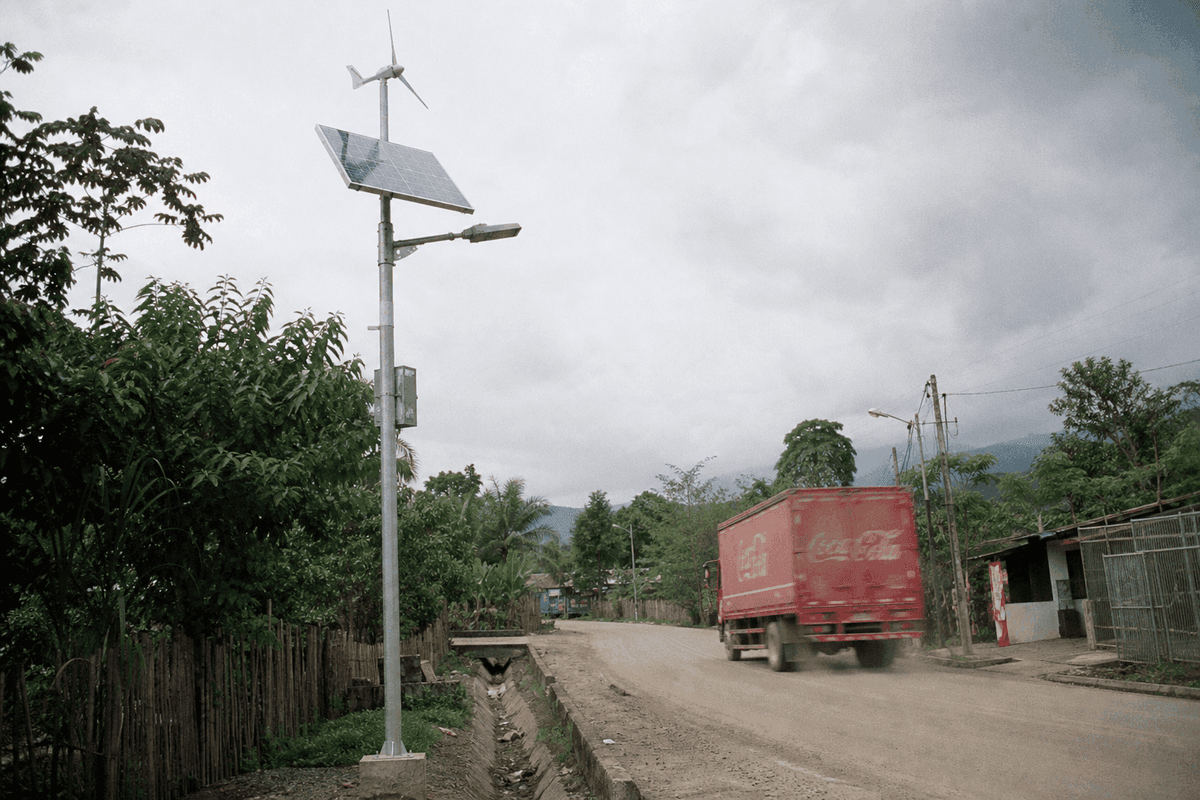
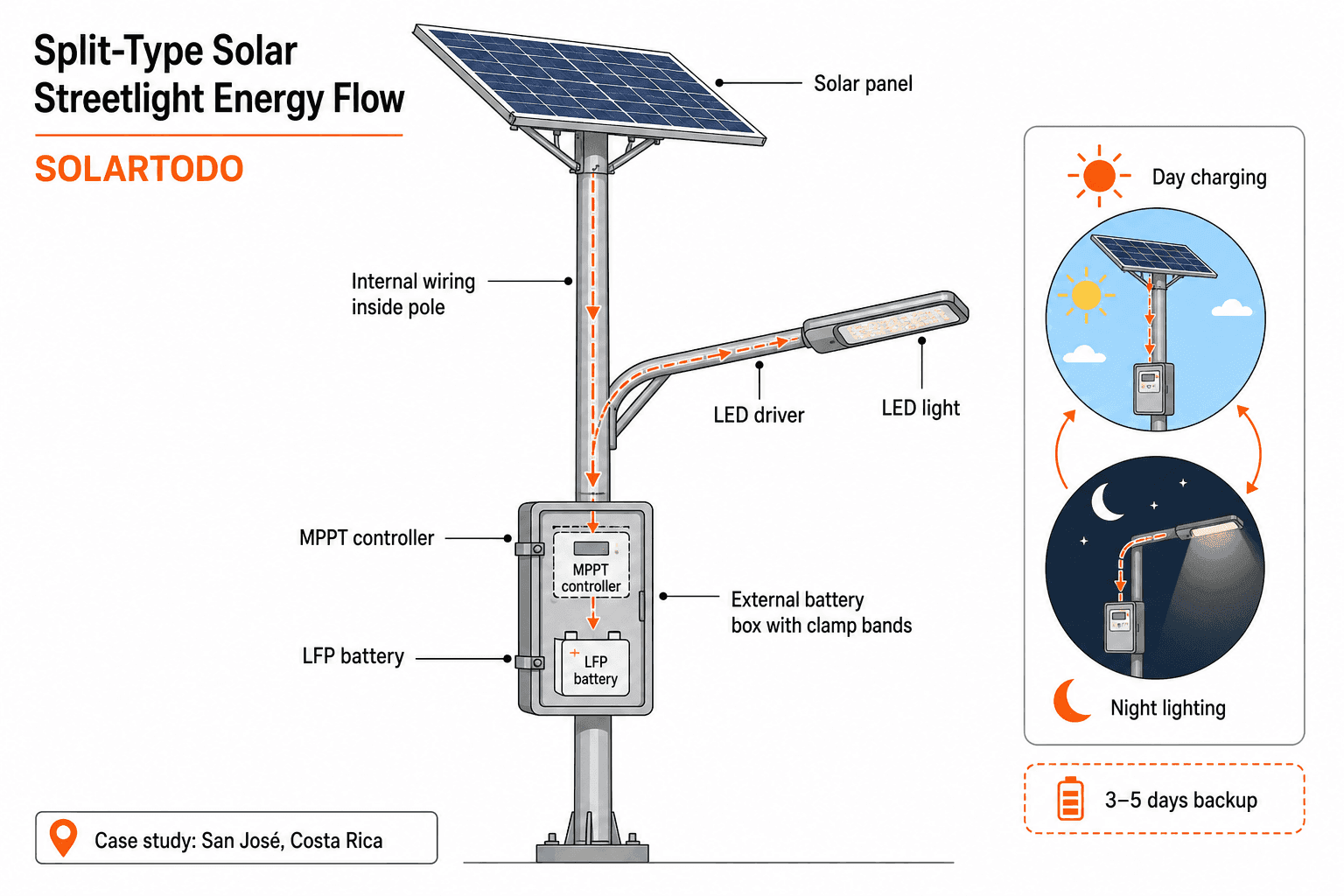
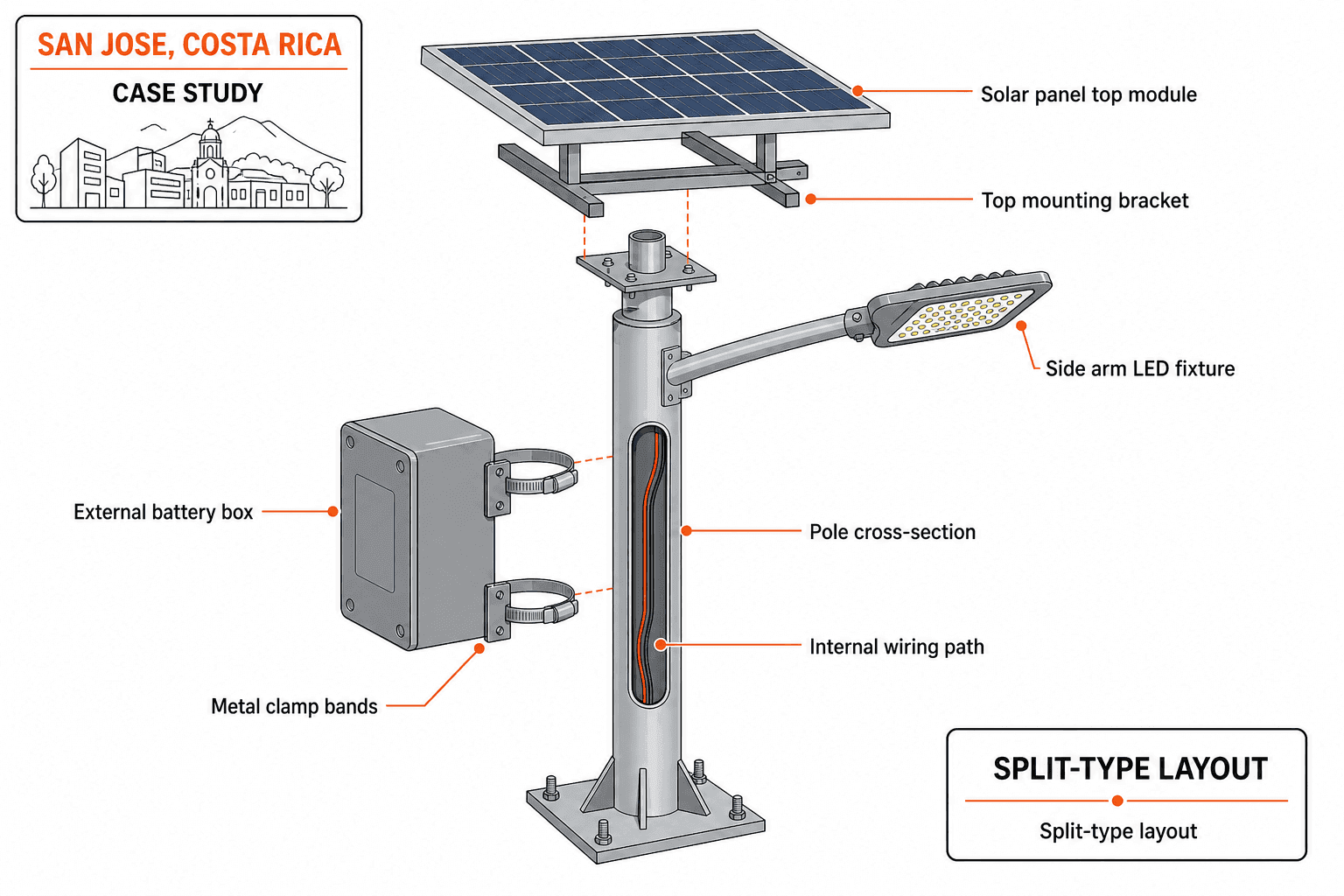
A typical 499-unit deployment of this scale would consist of split-type poles with the wind turbine at the top, the solar panel mounted below on a tilted bracket, and the LED head fixed on a side arm below the panel. The battery box should remain externally mounted on the pole body as a visible grey enclosure, with the MPPT controller inside the box and all wiring routed inside the pole. That arrangement simplifies inspection, reduces accidental cable exposure, and aligns with the stated product architecture for SOLAR TODO.
For San José’s rainfall pattern, LiFePO4 is the correct battery chemistry. A 12 V/100 Ah LFP pack provides about 1.2 kWh nominal storage, and at 90% depth of discharge the usable energy is about 1.08 kWh. With a 40 W luminaire operating 12 hours per night, gross nightly load is about 0.48 kWh before dimming and motion-based reduction, so 3-5 days of backup is realistic when hybrid charging and load control are both active.
Municipal spec writers should also note that this is not an all-in-one light. SOLAR TODO’s recommended San José configuration is a split-type system with separate generation, luminaire, and battery components. That matters for procurement because the maintenance workflow, spare-parts stocking, and pole-top load calculations differ from integrated products.
Technical Specifications
The recommended San José configuration uses approximately 499 split-type hybrid poles with 5 m height, 40 W LED output, 500 W PV generation, 200 W wind generation, and 12 V/100 Ah LiFePO4 storage for 6 m roads at 15 m spacing.
- Product type: Solar Streetlight (Split-Type), not integrated/all-in-one
- Quantity basis: approximately 499 units for a corridor set of this scale
- Pole material: hot-dip galvanized steel
- Pole height: 5 m
- Wind resistance: 45 m/s
- Pole design life: 25 years
- Top assembly: 200 W horizontal-axis wind turbine at pole top
- Solar module position: 500 W panel mounted below turbine on tilted bracket
- PV technology: Mono PERC, 21% efficiency
- PV degradation: 0.4% per year
- PV warranty reference: 25 years
- Luminaire power: 40 W LED
- Luminous flux: 6,000 lm
- Luminous efficacy: 150 lm/W
- CRI: greater than 70
- Mounting geometry: LED head on side arm below panel
- Battery chemistry: LiFePO4 / LFP
- Battery capacity: 12 V / 100 Ah
- Battery energy density: 160 Wh/kg
- Cycle life: 3,500 cycles
- Depth of discharge: 90%
- Battery warranty reference: 8 years
- Battery enclosure: external pole-mounted grey box, visible on pole body
- Controller: MPPT, installed inside battery box
- Wiring method: all wiring inside pole, no external surface cables
- Control mode: dusk-to-dawn automatic switching
- Smart controls: motion sensor plus dimming control
- Expected energy reduction: about 30% from motion sensing and 15% from dimming control, depending on traffic profile
- Backup autonomy: 3-5 cloudy days
- Road width basis: 6 m
- Pole spacing basis: 15 m
- Climate basis: tropical, about 5.5 sun-hours
- Applicable standards: CJJ 45-2015, IEC 60598, IEC 62124
This custom specification is stronger than a basic walkway class because the generation package is intentionally oversized for resilience. According to IEC 62124, PV-system performance verification should consider operating conditions and component interaction, which is relevant when combining a 500 W module, a 200 W HAWT, and a 12 V battery platform. According to CJJ 45-2015, road-lighting design should match road function, spacing, and safety requirements rather than fixture wattage alone.
Implementation Approach
A 499-unit San José rollout would typically be implemented in 4 phases over about 16-24 weeks, covering survey, fabrication, civil works, erection, and commissioning without assuming any past local deployment. This is the practical path for municipalities, EPCs, and district contractors evaluating SOLAR TODO.
Phase 1 is corridor survey and photometric layout. For 6 m roads and 15 m spacing, the design team would confirm curb offsets, sidewalk widths, underground utility conflicts, and pole setbacks. A 499-unit program usually needs route segmentation into 4-8 work packages so that traffic management, concrete curing, and logistics remain controllable.
Phase 2 is procurement and factory configuration. The buyer would lock pole thickness, bracket geometry, battery-box clamp design, controller settings, and HAWT mounting hardware before shipment. Because all wiring must run inside the pole and no external cables are allowed, pole fabrication drawings need exact entry and exit points for luminaire, panel, and turbine conductors.
Phase 3 is foundation and pole installation. Typical works include anchor-bolt setting, concrete pedestal curing, pole erection, turbine and panel installation, and battery-box mounting at service height. For 499 units, crews often target 12-20 foundations per day depending on access, weather, and municipal traffic restrictions.
Phase 4 is commissioning and acceptance testing. Each pole would be checked for charging current, battery voltage window, dusk-to-dawn switching, motion-sensor response, dimming profile, and insulation continuity. IEC states, "Tests are made to determine compliance with the requirements of this standard," which is why acceptance should include electrical safety checks under IEC 60598 and operating verification under IEC 62124.
A CKD or semi-knocked-down shipping model can also be considered if local assembly capacity exists. That approach reduces container volume and can improve customs handling for 5 m poles and large 500 W modules. For buyers comparing supply models, SOLAR TODO can support specification review through its Solar Streetlight product page or via direct technical consultation at contact us.
Expected Performance & ROI
A 499-unit hybrid split-type layout in San José can reasonably target 12-hour nightly operation, 3-5 days of autonomy, and lower civil-works cost than grid-tied streetlights because trenching, cabling, and utility meter interfaces are largely avoided. The strongest economic value usually comes from avoided infrastructure works rather than from electricity savings alone.
At 40 W per light and 12 hours per night, each pole consumes about 0.48 kWh nightly if operated at full output continuously. Across 499 poles, that is about 239.5 kWh per night or roughly 87,400 kWh per year before motion and dimming controls. If motion sensing reduces energy use by 30% in low-traffic periods and dimming contributes another 15% under programmed schedules, effective annual load can fall substantially, extending battery life and reducing replacement frequency.
According to NREL (2023), LED streetlighting can materially reduce energy use compared with legacy sodium systems, and controls further improve operating efficiency when dimming schedules match traffic conditions. According to IEA (2022), public-lighting modernization often delivers some of the fastest municipal energy-service improvements because lighting runs for 4,000 or more hours annually. In an off-grid system, those same control strategies improve autonomy rather than utility-bill savings, which is a critical distinction for San José procurement teams.
Lifecycle cost should be evaluated over 8-25 years, not only at purchase. The pole is specified for 25 years, the PV module for a 25-year warranty class with 0.4% annual degradation, and the LFP battery for 3,500 cycles with an 8-year warranty reference. That means a municipal owner would typically budget at least one battery replacement event during long-horizon ownership, while the steel pole and luminaire structure remain in service longer.
Payback in San José depends on the counterfactual baseline. If the alternative is extending grid-fed streetlights with trenching, conduits, copper cable, service panels, and utility interconnection, off-grid split-type lights can reach favorable payback in roughly 4-8 years on difficult corridors. If the alternative is already-wired poles with available feeder capacity, payback may be longer, and the value case shifts toward resilience and outage tolerance.
Results and Impact
For San José, the main impact of a 499-unit Solar Streetlight (Split-Type) program would be better road visibility, reduced dependence on feeder availability, and faster deployment on 6 m roads where trenching is disruptive or expensive. The strongest fit is for municipal roads, parkside connectors, housing access roads, campuses, and public facilities that need autonomous dusk-to-dawn lighting.
A hybrid configuration is especially relevant in tropical climates because generation diversity improves charging reliability during cloudy periods. With 500 W solar input, 200 W wind support, and 12 V/100 Ah LFP storage, the system is configured for resilience rather than minimum material use. For SOLAR TODO, that positions the product as a technical solution for continuity of service under variable weather rather than as a basic commodity fixture.
The operational impact also includes maintenance visibility. External battery boxes make inspection faster than buried or hidden battery layouts, and internal pole wiring reduces tampering risk. For public buyers in San José, those details matter because maintenance labor, safety compliance, and spare-parts planning often determine long-term project success more than nominal LED wattage.
Comparison Table
The table below compares the specified San José hybrid configuration with a conventional grid-tied streetlight baseline and a smaller standard split-type class for short urban roads.
| Metric | San José Recommended Hybrid Split-Type | Standard Split-Type Community Road Class | Conventional Grid-Tied Streetlight |
|---|---|---|---|
| Typical road width | 6 m | 6-8 m | 6-12 m |
| Pole height | 5 m | 7-8 m | 7-9 m |
| LED power | 40 W | 50-60 W | 70-100 W equivalent common municipal range |
| Generation source | 500 W PV + 200 W HAWT | 100 W PV only | Grid only |
| Battery | 12 V/100 Ah LFP | 12 V/100 Ah | None on pole |
| Backup autonomy | 3-5 days | 2-3 days typical | Depends on grid uptime |
| Wiring | Internal pole wiring only | Internal pole wiring only | Underground feeder and service cabling |
| Civil works intensity | Low to medium | Low | Medium to high |
| Best-fit use case | Resilience-focused short urban roads | Community roads, parking | Existing electrified streets |
| Maintenance focus | Battery, controller, turbine, cleaning | Battery, controller, cleaning | Grid faults, cable faults, luminaire |
Pricing & Quotation
SOLAR TODO offers three pricing tiers for this product line: FOB Supply (equipment ex-works China), CIF Delivered (including ocean freight and insurance), and EPC Turnkey (fully installed, commissioned, with 1-year warranty). Volume discounts are available for large-scale deployments. Configure your system online for an instant estimate, or request a custom quotation from our engineering team at [email protected].
Frequently Asked Questions
A 499-unit San José specification typically raises questions about sizing, installation, maintenance, warranties, and ROI; the answers below address the most common technical and procurement issues in 40-80 words each.
Q1: Why use a split-type streetlight instead of an all-in-one model in San José?
A split-type system separates the panel, battery, controller, and luminaire, which improves service access and thermal management. In San José’s tropical climate, the external 12 V/100 Ah LiFePO4 battery box is easier to inspect and replace than a concealed battery. It also supports larger generation hardware, including the 500 W panel and 200 W HAWT.
Q2: Is 5 m pole height enough for a 6 m road with 15 m spacing?
Yes, for short urban roads and access streets, 5 m can be workable when spacing is limited to 15 m and the fixture output is 6,000 lm. The design is tighter than a standard 7-8 m community-road layout, but the short spacing and 6 m carriage width make it a practical custom solution.
Q3: How much backup does the 12 V/100 Ah battery provide?
The battery stores about 1.2 kWh nominal and about 1.08 kWh usable at 90% depth of discharge. A 40 W luminaire running 12 hours consumes about 0.48 kWh per night before controls. With motion sensing, dimming, and hybrid charging, 3-5 days of cloudy backup is a realistic design target.
Q4: What maintenance would a 499-unit hybrid system require?
Routine maintenance usually includes panel cleaning every 3-6 months, turbine inspection, fastener torque checks, controller diagnostics, battery health review, and luminaire cleaning. Because all wiring is internal to the pole, visible cable damage risk is lower. Most municipal owners should plan one major battery replacement cycle within about 8 years.
Q5: How does this compare with grid-tied streetlighting in ROI terms?
ROI depends on whether the alternative requires new trenching and utility connection. On roads without nearby electrical infrastructure, off-grid split-type lights often recover cost in about 4-8 years through avoided civil works and faster deployment. On already-electrified roads, the financial case is usually driven more by resilience than by direct payback.
Q6: What standards should be written into the tender document?
For this configuration, the tender should reference CJJ 45-2015 for road-lighting design, IEC 60598 for luminaire safety, and IEC 62124 for PV-system performance verification. Buyers should also specify 45 m/s wind resistance, internal pole wiring, external battery-box mounting, and no exposed surface cables on the pole.
Q7: How long would installation typically take for approximately 499 units?
A realistic program is about 16-24 weeks, depending on permits, weather, and road access. Survey and engineering may take 2-4 weeks, fabrication and shipping 6-10 weeks, and civil works plus erection another 6-10 weeks. Work packaging by corridor is important to keep traffic disruption manageable.
Q8: Why is LiFePO4 preferred over NCM lithium for this application?
LiFePO4 offers about 3,500 cycles, 90% depth of discharge, and better thermal stability than many NCM packs used in smaller lighting products. In municipal outdoor service, that longer cycle life and safer chemistry usually matter more than compactness. For San José’s warm, wet climate, LFP is the lower-risk battery choice.
Q9: Does the 200 W wind turbine materially improve performance?
Yes, especially during cloudy or rainy periods when solar harvest drops for several days. The 200 W HAWT does not replace the PV array, but it adds charging diversity and improves resilience. In a tropical climate with seasonal cloud cover, that can reduce deep discharge events and support more stable dusk-to-dawn operation.
Q10: What should EPC bidders include in their quotation scope?
A complete EPC quotation should separate supply, freight, civil works, installation, commissioning, and warranty terms. It should also list foundation design assumptions, battery replacement exclusions, smart-control programming, and acceptance tests for illumination, charging, and switching. For municipal comparison, bidders should show line items for each of the 499 units.
References
- Instituto Nacional de Estadística y Censos de Costa Rica (2023): Population and territorial statistics for San José canton and metropolitan demographic context.
- World Bank (2023): Urban population indicators for Costa Rica and infrastructure planning context.
- Global Solar Atlas / World Bank Group / ESMAP (2024): Solar resource data for the San José, Costa Rica area, including average daily irradiation ranges.
- IRENA (2024): Renewable energy profile and electricity-system context for Costa Rica.
- IEA (2023): Energy resilience and distributed infrastructure planning considerations for public systems.
- IEC (2020): IEC 60598 luminaire safety requirements for outdoor lighting equipment.
- IEC (2017): IEC 62124 photovoltaic system performance monitoring and verification framework.
- Ministry of Housing and Urban-Rural Development of China (2015): CJJ 45-2015 standard for urban road lighting design.
- NREL (2023): LED street-lighting efficiency and control-strategy performance guidance for public lighting.
SOLAR TODO should use these references and the stated 499-unit specification as a San José market-fit guide, not as a claim of completed deployment. For project-specific layouts, photometric files, and tender support, buyers can review the Solar Streetlight product page or contact us for engineering discussion.
Equipment Deployed
- 499 × Solar Streetlight (Split-Type), wind-solar hybrid configuration
- 5 m hot-dip galvanized steel pole, 45 m/s wind resistance, 25-year design life
- 200 W horizontal-axis wind turbine mounted at pole top
- 500 W Mono PERC solar panel, 21% efficiency, 0.4%/year degradation, 25-year warranty class
- 40 W LED luminaire, 6,000 lm, 150 lm/W, CRI >70
- 12 V/100 Ah LiFePO4 battery, 160 Wh/kg, 3,500 cycles, 90% DoD, 8-year warranty class
- External pole-mounted grey battery box with MPPT controller inside
- Internal pole wiring only, no visible external surface cables
- Motion sensor control, approximately 30% energy saving
- Dimming control, approximately 15% energy saving
- Dusk-to-dawn automatic switching
- Design basis: 15 m spacing on 6 m road width, tropical climate, 5.5 sun-hours, 3-5 days autonomy