Rooftop Solar System for Commercial Buildings Guide

SOLAR TODO
Solar Energy & Infrastructure Expert Team
Watch the video
TL;DR
A commercial rooftop solar system usually makes financial sense when a building has strong daytime demand, usable roof area, and tariffs above self-generated power cost. A 100kW system can produce 150-190MWh/year, use about 500-550m2, and often pay back in 4-7 years. Add 200kWh storage where demand charges, outages, or evening loads justify the extra capex.
Commercial rooftop solar systems typically deliver 150-190MWh/year from a 100kW array, cut daytime electricity costs by 20-40%, and reach payback in about 4-7 years when paired with demand-charge reduction and sound EPC design.
Summary
Commercial rooftop solar systems typically deliver 150-190MWh/year from a 100kW array, cut daytime electricity costs by 20-40%, and reach payback in about 4-7 years when paired with demand-charge reduction and sound EPC design.
Key Takeaways
- Assess roof capacity early; commercial PV loads commonly add 12-20kg/m2, and structural review should verify wind, ballast, and attachment compliance before final layout.
- Size systems from interval load data; a 100kW rooftop plant often produces 150-190MWh/year, which supports self-consumption and lowers grid purchases during peak tariff hours.
- Select high-efficiency modules; N-type TOPCon panels at 22.5-24.5% efficiency reduce roof area demand to roughly 500-550m2 for 100kWp installations.
- Pair storage where tariffs justify it; adding 200kWh LFP battery capacity can shift evening loads, reduce demand peaks, and improve backup resilience for 1-3 critical hours.
- Verify interconnection standards; use equipment compliant with IEC 61215, IEC 61730, IEEE 1547, and UL 9540 or related local codes to reduce approval and insurance risk.
- Compare EPC pricing by scope; 100kW plus 200kWh commercial systems commonly fall in the USD 79,200-101,200 EPC turnkey range depending on civil, electrical, and grid-connection work.
- Model ROI using actual tariffs; sites with high daytime consumption and demand charges often achieve 4-7 year payback, while low self-consumption sites may need export credits or storage.
- Plan O&M from day one; quarterly inspections and annual thermography can help maintain output losses below 2-3% from soiling, loose terminations, or inverter alarms.
Commercial Rooftop Solar System Basics
Commercial rooftop solar systems for buildings usually operate in the 50-500kW range, deliver roughly 1,200-1,900kWh per kW each year, and reduce purchased daytime electricity by 20-60% when load matching is strong.
A rooftop solar system for commercial buildings is a grid-connected or hybrid photovoltaic installation mounted on an industrial, office, retail, warehouse, school, or logistics roof. The business case depends on three numbers: annual irradiation, daytime load profile, and tariff structure. For many B2B sites, self-consumed solar electricity costs less than utility power over a 20-25 year asset life.
According to IRENA (2024), utility-scale solar costs have fallen by about 90% since 2010, and commercial systems have followed the same direction even though rooftop balance-of-system costs remain higher than ground-mount. According to the International Energy Agency, "Solar PV is set to become the largest renewable power source by 2029." That matters for procurement teams because module pricing, inverter efficiency above 97%, and standardized mounting systems now support predictable project economics.
For commercial buildings, the main objective is usually not full energy independence. It is cost control. A facility with a 300kW daytime base load can use a 100kW to 250kW rooftop array to offset expensive daytime imports, lower exposure to tariff escalation, and improve ESG reporting with measured kWh and CO2 data. SOLAR TODO typically discusses these projects through inquiry, offline quotation, and project-specific engineering rather than online checkout.
Core system components
A commercial rooftop PV plant normally includes modules, string or hybrid inverters, DC combiner or protection devices, AC distribution equipment, mounting structures, monitoring, and optional battery storage from 100kWh upward.
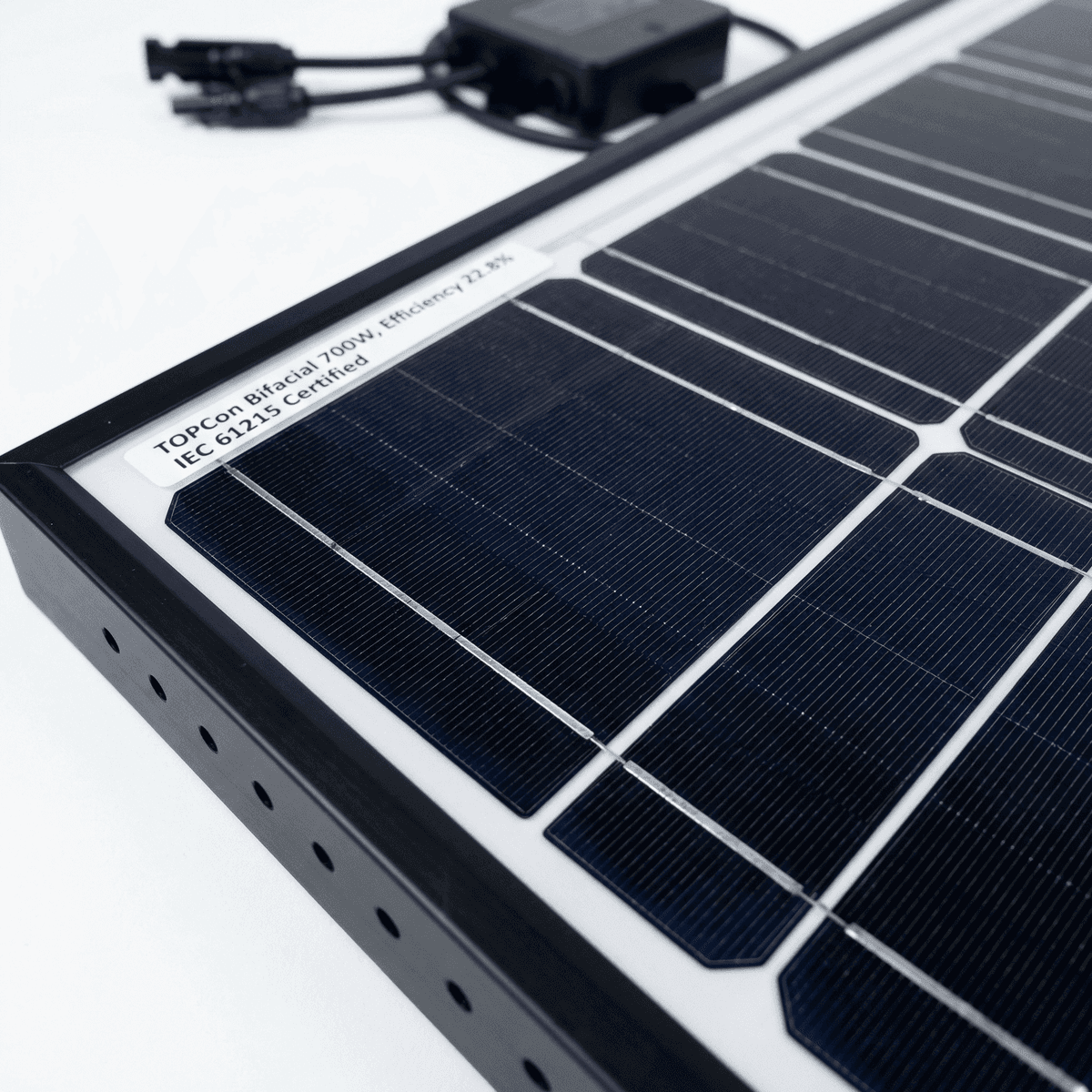
The module side now favors monocrystalline N-type TOPCon products in the 22.5-24.5% efficiency range. For a 100kWp rooftop system using 700W-class modules, the array may need about 500-550m2 depending on spacing, access lanes, and fire setbacks. First-year degradation is typically below 1.0%, with annual degradation below 0.4% in mainstream premium warranties.
The inverter side is selected around roof segmentation, string length, shade conditions, and grid code. Commercial string inverters often achieve peak efficiency above 98%, while hybrid platforms support battery charging, backup loads, and export control. Monitoring should report string-level or MPPT-level performance, alarm history, and daily yield so O&M teams can act before a 2% issue becomes a 10% underperformance event.
Technical Design and Performance Factors
A well-designed commercial rooftop solar system uses roof geometry, tariff data, and electrical constraints to convert 1m2 of roof area into the highest practical annual kWh at the lowest lifecycle cost.
The first technical screen is roof suitability. Engineers check dead load, live load, wind uplift, drainage, waterproofing interfaces, and fire access. Typical added loads for rooftop PV can fall around 12-20kg/m2 depending on framed modules, ballast, and support rails. On metal sheet roofs, attachment details matter as much as module selection because poor fastening can create leakage and corrosion risk within 2-5 rainy seasons.
The second screen is electrical architecture. A 100kW commercial system may use multiple MPPT strings to handle roof orientation differences and partial shading from parapets, HVAC units, or telecom equipment. According to NREL (2024), array losses from mismatch, soiling, wiring, and temperature can materially affect annual yield, so realistic performance modeling is more useful than nameplate-only comparisons.
Roof type, orientation, and shading
South-facing roofs in the northern hemisphere or north-facing roofs in the southern hemisphere usually maximize annual yield, but east-west layouts can improve self-consumption by spreading generation over more operating hours.
Flat commercial roofs often use low-tilt east-west mounting because it increases module density and reduces row-to-row shading. A 10-15 degree tilt may improve cleaning and thermal behavior, while a 5-10 degree east-west arrangement can fit more kWp on the same roof. For buildings with high morning and afternoon loads, this broader generation curve can be more valuable than chasing maximum noon output.
Shading analysis should include seasonal sun paths, rooftop equipment, and future obstructions. Even 3-5% annual shading can materially change payback if tariffs are high. Thermal imaging, drone surveys, and 3D roof models help identify hot spots, cracked cells, and underperforming strings before commissioning and during annual inspections.
Storage, backup, and power quality
Battery storage is most useful when demand charges, evening tariffs, or outage risks are high, and a 200kWh LFP system commonly supports 1-3 hours of critical-load shifting in a 100kW commercial plant.
For example, a 100kW + 200kWh commercial solar and storage package can generate around 150-190MWh per year depending on irradiance and temperature while also reducing peak demand events. LFP chemistry is common because it offers long cycle life, thermal stability, and broad certification support. According to UL (2023), energy storage safety requires tested system-level integration, not only cell-level claims, which is why UL 9540 and related fire safety reviews matter in procurement.
Power quality also matters. Inverters should support anti-islanding, reactive power control, export limitation, and grid-code compliance. IEEE 1547-2018 remains a key reference for distributed energy interconnection behavior. For sites with sensitive machinery, harmonic performance, transfer logic for backup circuits, and protection coordination should be checked before final single-line approval.
EPC Investment Analysis and Pricing Structure
Commercial rooftop solar EPC pricing is usually evaluated in three layers—FOB Supply, CIF Delivered, and EPC Turnkey—with 100kW plus 200kWh systems often landing between USD 79,200 and USD 101,200 for full delivery scope.
EPC means Engineering, Procurement, and Construction. In practical B2B terms, turnkey delivery usually includes system design, bill of materials, module and inverter supply, mounting structure, cable and protection devices, installation, testing, commissioning, and basic operator training. Depending on the country, EPC scope may also include structural verification, utility submission, SCADA integration, and as-built documentation.
The three-tier pricing model helps procurement teams compare offers fairly:
| Pricing Tier | Typical Scope | Best Use Case | Cost Position |
|---|---|---|---|
| FOB Supply | Equipment ex-factory or port, no freight or installation | EPC contractors with local installation teams | Lowest upfront unit price |
| CIF Delivered | Equipment plus ocean freight and insurance to destination port | Importers managing customs and local works | Mid-level landed cost |
| EPC Turnkey | Supply, installation, testing, commissioning, and project management | End users seeking single-point responsibility | Highest capex, lowest coordination burden |
For volume procurement, SOLAR TODO can structure indicative discounts around order scale. A common framework is 5% discount for 50+ units or equivalent project volume, 10% for 100+, and 15% for 250+ where logistics and production planning support it. Final discounts depend on module wattage, battery capacity, destination, and Incoterms.
Payment terms for export projects commonly follow 30% T/T deposit and 70% against B/L, or 100% L/C at sight for larger transactions. For large projects above USD 1,000K, financing support may be available subject to project profile, jurisdiction, and credit review. Commercial inquiries can be directed to [email protected] or +6585559114 for offline quotation.
ROI, savings, and payback logic
Commercial rooftop solar ROI is strongest when self-consumption exceeds 70%, daytime tariffs are high, and annual system yield stays above about 1,400kWh/kW under local climate conditions.
Sample deployment scenario (illustrative): a 100kW rooftop system producing 160MWh/year offsets electricity priced at USD 0.12/kWh. That yields about USD 19,200 in annual energy value before O&M. If storage also trims demand charges by USD 4,000-8,000 per year, total annual savings can reach USD 23,200-27,200, making a 4-7 year payback plausible depending on capex and financing.
According to NREL (2024), realistic bankable models should include degradation, temperature losses, inverter replacement assumptions, and downtime allowances. According to IEA PVPS (2024), commercial PV performance varies significantly by climate, design, and O&M quality, so procurement teams should request P50 and, where needed, P90 production estimates instead of relying on a single headline number.
Applications, Selection Criteria, and Comparison Guide
The best commercial rooftop solar projects are sites with stable daytime loads above 50kW, usable roof area above 300m2, and tariffs where self-consumed solar beats grid power by at least 20-30%.
Common applications include factories, cold storage buildings, office parks, shopping centers, hospitals, schools, and logistics warehouses. In manufacturing, the target is often daytime self-consumption and demand reduction. In office buildings, the target may be ESG compliance plus lower common-area electricity costs. In retail, broad daytime operating hours improve self-consumption ratios and shorten payback.
SOLAR TODO generally recommends starting with 12 months of interval electricity data, a roof survey, and a preliminary single-line review. That process identifies whether a 50kW, 100kW, or 250kW rooftop system fits the building and whether adding 100-500kWh of storage improves economics. The International Energy Agency states, "Solar PV is becoming the backbone of new electricity systems," which is increasingly relevant for commercial building owners facing tariff volatility.
Comparison of common commercial configurations
A side-by-side comparison helps buyers match roof area, load profile, and budget to a practical system size.
| Configuration | Typical Roof Area | Annual PV Yield | Main Benefit | Typical Use Case |
|---|---|---|---|---|
| 50kW PV only | 250-300m2 | 75-95MWh | Low capex, daytime bill reduction | Small offices, clinics, retail |
| 100kW PV only | 500-550m2 | 150-190MWh | Strong self-consumption economics | Warehouses, schools, factories |
| 100kW PV + 200kWh storage | 500-550m2 + battery room | 150-190MWh + peak shaving | Demand reduction and backup support | C&I sites with evening loads |
| 250kW PV only | 1,250-1,450m2 | 375-475MWh | Better scale economics | Large logistics and industrial roofs |
Selection should also consider module efficiency, roof warranty impact, inverter redundancy, and local code compliance. IEC 61215 and IEC 61730 are baseline module references. For storage-equipped systems, buyers should also review UL 9540 or local equivalent requirements, fire separation distances, and emergency shutdown design. A lower purchase price can become a higher lifecycle cost if service access, spare parts, or monitoring quality are weak.
FAQ
Commercial rooftop solar systems usually answer eight core buyer questions—cost, sizing, roof suitability, standards, storage, maintenance, payback, and warranty—with most decisions turning on 100kW-scale economics and 20-25 year asset life.
Q: What size rooftop solar system is suitable for a commercial building? A: The right size depends on daytime load, roof area, and interconnection limits. Many commercial buildings start in the 50-250kW range, while larger factories may exceed 500kW. A practical first step is matching 60-90% of daytime base load rather than trying to offset 100% of annual consumption.
Q: How much electricity can a commercial rooftop solar system generate? A: Output depends on irradiance, temperature, tilt, and losses. A 100kW system commonly produces about 150-190MWh per year in strong solar regions, while cooler climates may be lower. Bankable estimates should include soiling, shading, wiring, and inverter losses rather than using nameplate capacity alone.
Q: What roof conditions must be checked before installation? A: The roof must be checked for structural capacity, waterproofing condition, drainage, wind exposure, and remaining service life. PV systems can add roughly 12-20kg/m2 depending on mounting type. If the roof needs replacement within 3-5 years, it is usually better to complete that work before installing solar.
Q: Is battery storage necessary for commercial rooftop solar? A: Battery storage is not always necessary. It becomes attractive when the site has high demand charges, evening tariffs, or outage-sensitive loads. A 200kWh LFP battery paired with a 100kW PV system can shift energy into evening hours and support 1-3 hours of critical backup depending on load size.
Q: What is included in EPC turnkey delivery for a commercial rooftop project? A: EPC turnkey delivery usually includes design, equipment supply, mounting, electrical installation, testing, commissioning, and operator training. Some contracts also include utility submission, structural checks, and monitoring setup. Buyers should confirm whether civil works, transformer upgrades, and export-control devices are included or priced separately.
Q: How is pricing structured for commercial rooftop solar projects? A: Pricing is commonly quoted as FOB Supply, CIF Delivered, or EPC Turnkey. For a 100kW plus 200kWh commercial system, EPC turnkey budgets often fall around USD 79,200-101,200 depending on destination and scope. Typical payment terms are 30% T/T and 70% against B/L, or 100% L/C at sight.
Q: What payback period should a business expect? A: Many commercial rooftop systems achieve payback in about 4-7 years when self-consumption is high and tariffs are favorable. Sites with low daytime usage or weak export compensation may take longer. Accurate ROI models should include degradation below 0.4% per year, O&M, and any inverter replacement assumptions.
Q: Which standards and certifications matter most? A: Core references include IEC 61215 for module design qualification, IEC 61730 for module safety, and IEEE 1547 for interconnection behavior. If storage is included, UL 9540 or local equivalent is important. These standards reduce technical, insurance, and permitting risk for commercial buyers.
Q: How much maintenance does a commercial rooftop system require? A: Maintenance is moderate but must be scheduled. Most sites benefit from quarterly inspections, annual thermography, inverter alarm review, and cleaning based on dust conditions. Without routine O&M, soiling and loose terminations can reduce yield by 2-5% or create avoidable downtime.
Q: How long do commercial rooftop solar components last? A: Modules commonly carry 25-30 year performance warranties, with retained output around 87.4% at year 30 in premium product classes. Inverters often have 5-10 year standard warranties, extendable to 15-20 years. Battery life depends on cycle count, temperature, and depth of discharge.
Q: Can a commercial rooftop system operate during a grid outage? A: A standard grid-tied PV system usually shuts down during an outage for safety. To keep selected loads running, the project needs hybrid inverters or separate backup architecture plus battery storage. Backup duration depends on battery size; for example, 200kWh may support a 50kW critical load for about 4 hours before losses.
Q: How should buyers compare suppliers such as SOLAR TODO? A: Buyers should compare technical scope, not only price. Review module efficiency, degradation warranty, inverter topology, monitoring detail, certifications, spare parts access, and response time for service. SOLAR TODO should be evaluated the same way: against bankable yield assumptions, clear EPC boundaries, and documented compliance.
References
References for commercial rooftop solar should prioritize standards, performance modeling, and market data from organizations such as NREL, IEC, IEEE, IEA, IRENA, and UL because procurement decisions often span 20-30 years.
- [NREL] (2024): PVWatts Calculator and performance modeling methodology for estimating PV energy yield, losses, and system output.
- [IRENA] (2024): Renewable Power Generation Costs in 2023, including long-term solar cost decline and competitiveness data.
- [IEA PVPS] (2024): Trends in Photovoltaic Applications 2024, covering deployment, performance, and market observations across participating countries.
- [IEC 61215-1] (2021): Terrestrial photovoltaic modules—design qualification and type approval test requirements.
- [IEC 61730-1] (2023): Photovoltaic module safety qualification—requirements for construction and testing.
- [IEEE 1547] (2018): Standard for interconnection and interoperability of distributed energy resources with electric power systems interfaces.
- [UL 9540] (2023): Energy storage system safety requirements relevant to commercial PV-plus-storage projects.
- [IEA] (2024): Market outlook statements on solar PV growth and its role in future electricity supply.
Conclusion
Commercial rooftop solar systems for buildings can deliver 150-190MWh/year from 100kW, reach 4-7 year payback, and reduce daytime electricity exposure when self-consumption and EPC scope are properly aligned.
For most B2B buyers, the best decision is to start with interval load data, roof structural review, and a comparative EPC quote from SOLAR TODO or another qualified supplier before locking module count, battery size, and interconnection scope.
About SOLARTODO
SOLARTODO is a global integrated solution provider specializing in solar power generation systems, energy-storage products, smart street-lighting and solar street-lighting, intelligent security & IoT linkage systems, power transmission towers, telecom communication towers, and smart-agriculture solutions for worldwide B2B customers.
About the Author

SOLAR TODO
Solar Energy & Infrastructure Expert Team
SOLAR TODO is a professional supplier of solar energy, energy storage, smart lighting, smart agriculture, security systems, communication towers, and power tower equipment.
Our technical team has over 15 years of experience in renewable energy and infrastructure, providing high-quality products and solutions to B2B customers worldwide.
Expertise: PV system design, energy storage optimization, smart lighting integration, smart agriculture monitoring, security system integration, communication and power tower supply.
Cite This Article
SOLAR TODO. (2026). Rooftop Solar System for Commercial Buildings Guide. SOLARTODO. Retrieved from https://solartodo.com/knowledge/rooftop-solar-system-for-commercial-buildings
@article{solartodo_rooftop_solar_system_for_commercial_buildings,
  title = {Rooftop Solar System for Commercial Buildings Guide},
  author = {SOLAR TODO},
  journal = {SOLARTODO Knowledge Base},
  year = {2026},
  url = {https://solartodo.com/knowledge/rooftop-solar-system-for-commercial-buildings},
  note = {Accessed: 2026-06-08}
}
Published: June 8, 2026 | Available at: https://solartodo.com/knowledge/rooftop-solar-system-for-commercial-buildings
Subscribe to Our Newsletter
Get the latest solar energy news and insights delivered to your inbox.
View All Articles