Remote Site Security Cost Report 2026: Solar + LTE Camera…

SOLAR TODO
Solar Energy & Infrastructure Expert Team
Watch the video
TL;DR
For remote checkpoints, farms, utility yards, and industrial sites, solar + LTE security is often the lowest 5-year cost option. A 16-camera, 32-zone off-grid package typically costs $7,100-9,200, can cut operating expense by 40-70% versus diesel-heavy setups, and often reaches payback in 2.5-5.5 years when fuel, trenching, and service visits are reduced.
Remote site security in 2026 typically costs $7,100-9,200 for a 32-zone off-grid package. Solar power cuts energy OPEX by 40-70%, while LTE backhaul reduces trenching and deployment costs by 15-35% at remote industrial and border sites.
Summary
Remote site security in 2026 typically costs $7,100-9,200 for a 32-zone off-grid package, while solar power cuts diesel-related energy OPEX by 40-70% and LTE connectivity reduces trenching costs by 15-35% at remote checkpoints, mines, farms, and utility sites.
Key Takeaways
- Compare total 5-year cost, not hardware price alone; diesel-powered remote surveillance often carries 25-45% higher OPEX than solar + LTE designs once fuel, maintenance, and generator service are included.
- Size solar autonomy at 2-3 days and battery reserve at 1.2-1.5x daily load; a 16-camera off-grid site commonly needs 3-8 kWh/day and 10-20 kWh usable storage.
- Use LTE or 4G backhaul where trenching exceeds 200-500 m; wireless deployment can reduce civil works by 15-35% and shorten commissioning by 2-6 weeks.
- Select a 32-zone architecture when a site has 1 gate, 2-4 lanes, 16 cameras, and 32 detector points; this leaves spare capacity for 20-50% future expansion.
- Target payback in 2.5-5.5 years when replacing diesel-only surveillance at high-fuel-cost sites; ROI improves where generator runtime falls by 60-90%.
- Verify compliance with EN 50131, IEC 62676, UL 681, and NFPA 72 principles; standards alignment lowers integration risk and supports insurer and consultant review.
- Plan video retention around bandwidth and evidentiary needs; 16 HD cameras with 30-day retention usually require local NVR storage, while LTE uplink is best reserved for alerts, clips, and health data.
- Use three-tier procurement analysis; FOB supply is lowest upfront, CIF delivered improves import planning, and EPC turnkey reduces interface risk on projects above $100,000.
Remote Site Security Cost Outlook 2026
Remote site security in 2026 is driven by three hard numbers: $7,100-9,200 EPC pricing for a 32-zone off-grid package, 15-35% lower deployment cost with LTE backhaul, and 40-70% lower energy OPEX when solar replaces diesel-heavy operation.
Procurement teams are no longer comparing cameras alone. They are comparing full-site risk control across power, communications, installation, and service intervals over 3-10 years. For remote checkpoints, utility yards, telecom compounds, farms, and fuel depots, the cost driver is usually not the camera count. It is the combined burden of trenching, generator runtime, battery replacement cycles, and truck rolls over distances of 50-300 km.
According to IEA (2024), energy security and infrastructure resilience remain central investment priorities as distributed power and digital monitoring expand across industrial assets. According to IRENA (2025), solar generation costs remain structurally low enough to support off-grid commercial applications where diesel fuel logistics are unstable. For remote surveillance buyers, that means solar + LTE is now a financial decision as much as a technical one.
The International Energy Agency states, "Solar PV is expected to become the largest source of installed power capacity worldwide by 2030." That matters for security projects because remote surveillance loads of 3-8 kWh/day are small enough to be served by distributed PV and batteries without waiting for grid extension. NREL also notes that storage-backed solar systems can improve resilience where outage costs exceed equipment cost within a few incidents.
2021-2026 trend line and 2027-2040 outlook
Remote surveillance economics changed sharply between 2021 and 2026 because component prices, cellular coverage, and battery bank design all improved. In 2021, many remote sites still relied on diesel-only camera trailers or hybrid generator systems with 8-16 hours/day of engine runtime. By 2025-2026, more buyers shifted to solar-primary systems with LTE alerting and local video storage.
| Metric | 2021-2022 | 2025-2026 | 2027-2030 outlook | 2030-2040 outlook |
|---|---|---|---|---|
| Typical remote camera architecture | Diesel or grid extension | Solar + battery + LTE | Solar + AI edge analytics | Solar + AI + multi-sensor fusion |
| Generator runtime | 8-16 h/day | 1-6 h/day backup only | 0-3 h/day at optimized sites | Near-zero except emergency backup |
| LTE/4G role | Basic remote viewing | Main alert and health channel | Wider private LTE/5G use | Higher edge autonomy, lower bandwidth dependence |
| Battery chemistry | Lead-acid common | LiFePO4 common | LiFePO4 dominant | Longer-life storage with improved BMS |
| Alarm logic | Motion-based | Multi-zone + video verification | AI-assisted classification | Sensor fusion with predictive maintenance |
Sample deployment scenario (illustrative): a 16-camera border or utility site consuming 5 kWh/day could require a 1.8-2.8 kWp PV array and 10-15 kWh usable LiFePO4 storage for 2 days of autonomy, depending on irradiance and seasonal derating. That same site on diesel-only supply could consume 1,000-2,500 liters/year if generator runtime is not tightly managed.
Cost Structure of Solar + LTE Security Systems
A remote solar + LTE security system usually allocates 35-50% of budget to surveillance and alarms, 20-35% to power, and 10-25% to communications, poles, and installation logistics.
For B2B buyers, cost modeling should separate capital cost from recurring field cost. A camera package may look inexpensive at bid stage, but the wrong power architecture can double maintenance visits over 5 years. At remote sites, every unplanned truck roll can cost $150-600 depending on distance, permit requirements, and technician level.
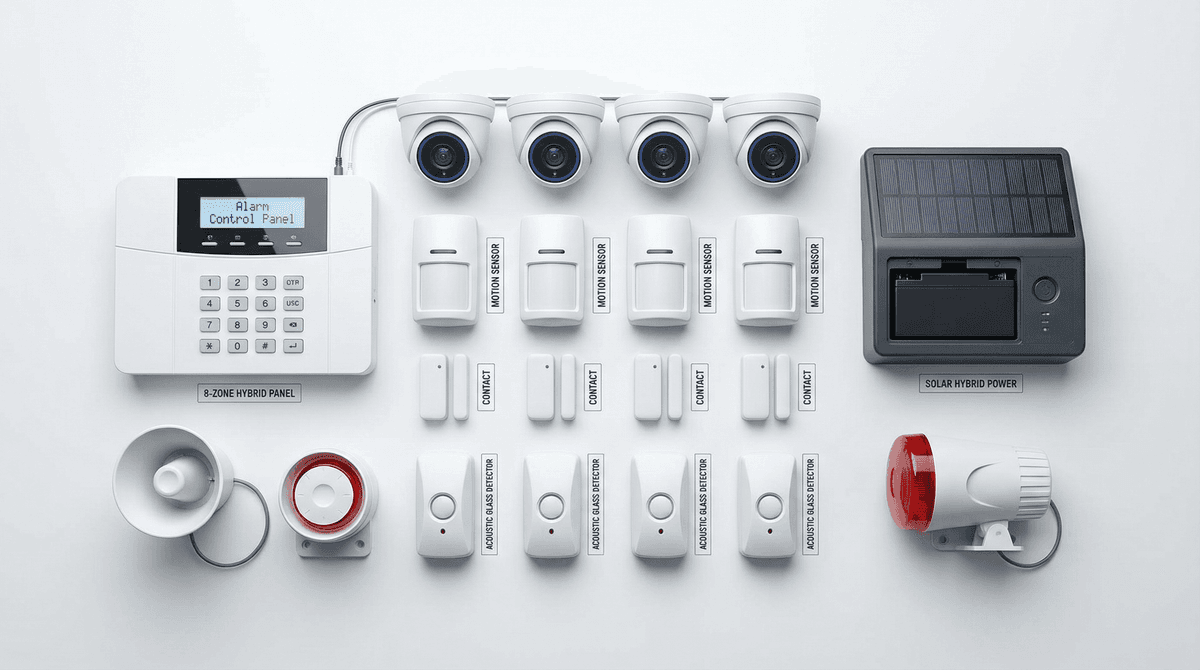
The Border Checkpoint 32-Zone Off-Grid package supplied by SOLAR TODO includes 16 cameras, 32 intrusion detectors, a 32-channel NVR, and a 64-zone hybrid alarm panel configured for 32 active zones. The turnkey EPC range is USD 7,100-9,200 for the standard package scope. This is a useful benchmark for medium-security sites with 1 gate area, 2-4 lanes, 1 inspection building, and 1 perimeter strip.
Typical CAPEX breakdown by subsystem
The table below shows a practical budget structure for remote sites using local recording and LTE alerting rather than continuous cloud streaming.
| Cost element | Share of CAPEX | Typical notes |
|---|---|---|
| Cameras, NVR, alarm panel, detectors | 35-50% | 12 fixed + 4 PTZ + 32 detector points is common for a 32-zone site |
| Solar array, charge control, battery storage | 20-35% | Often 1.5-3.0 kWp PV with 10-20 kWh LiFePO4 usable storage |
| LTE router, antennas, SIM, network devices | 5-12% | Dual-SIM and external antennas improve uptime at weak-signal sites |
| Poles, enclosures, mounting, cabling | 8-18% | Wind loading, IP rating, and corrosion class affect cost |
| Installation, testing, commissioning | 10-25% | Higher where sites are 100+ km from service base |
Operating cost comparison
The largest savings usually come from reduced fuel, fewer service visits, and lower civil works. According to NREL (2024), distributed solar and storage economics improve where avoided outage and fuel costs are high relative to load size. According to BloombergNEF (2024), battery and solar supply chains remain favorable for commercial distributed applications compared with diesel-only lifecycle costs.
| Cost category over 5 years | Solar + LTE | Grid extension + wired comms | Diesel-heavy hybrid |
|---|---|---|---|
| Upfront equipment cost | Medium | High if trenching/grid extension is long | Medium |
| Civil works cost | Low to medium | High | Low |
| Fuel cost | Very low | None | High |
| Routine maintenance | Low to medium | Medium | High |
| Outage resilience | High with battery reserve | Medium unless backup added | Medium |
| 5-year TCO index | 100 | 115-155 | 125-170 |
Technical Design Benchmarks for 2026 Procurement
A 16-camera remote site in 2026 commonly needs 3-8 kWh/day, 2-3 days of autonomy, LTE failover, and local storage sized for 14-30 days of retention rather than full-time cloud upload.
The technical design starts with load, not with panel wattage. Twelve fixed HD cameras, four PTZ cameras, an NVR, a hybrid alarm panel, LTE router, and detector loops can create a continuous load of 120-330 W depending on camera codec, IR use, PTZ duty cycle, and heater loads. Over 24 hours, that becomes roughly 2.9-7.9 kWh/day.
For remote sites, LiFePO4 storage is increasingly preferred over lead-acid because cycle life is commonly 4,000-6,000 cycles at appropriate depth of discharge, versus 500-1,200 cycles for many lead-acid duty profiles. That difference matters when a site is expected to run daily charge-discharge cycles for 8-12 years. According to NREL (2024), battery life and thermal control strongly affect lifecycle cost in distributed systems.
Example specification comparison
| Parameter | Basic remote site | Mid-range 32-zone site | High-availability remote site |
|---|---|---|---|
| Cameras | 4-8 HD | 16 HD with 4 PTZ included | 24-32 mixed fixed/PTZ/thermal |
| Detector points | 8-16 | 32 | 48-64 |
| Daily energy load | 1.5-3.0 kWh | 3.0-8.0 kWh | 8.0-15.0 kWh |
| Solar array | 0.8-1.5 kWp | 1.5-3.0 kWp | 3.0-6.0 kWp |
| Usable battery | 4-8 kWh | 10-20 kWh | 20-40 kWh |
| Video retention | 7-14 days | 14-30 days | 30-90 days |
| Connectivity | LTE single-SIM | LTE dual-SIM + Ethernet option | LTE + microwave/fiber hybrid |
Standards alignment also matters in bid review. EN 50131 supports intrusion logic and zone planning. IEC 62676 covers video surveillance system requirements. UL 681 addresses installation practices for burglary systems. NFPA 72 becomes relevant where supervisory signaling or fire interface is included. These standards do not remove the need for local engineering review, but they give consultants and EPC teams a common baseline.
The International Electrotechnical Commission states that IEC 62676 provides a framework for video surveillance system performance, interoperability, and operational planning. For procurement managers, this helps convert vague camera claims into measurable requirements such as resolution, retention period, scene coverage, and event verification workflow.
Regional Cost and ROI Data by Application
Asia-Pacific, Latin America, Middle East/Africa, Europe, and North America show different ROI profiles because fuel cost, labor cost, LTE coverage, and theft risk vary by 15-60% across regions.
The best-performing remote security investments are usually found where three conditions overlap: unstable grid access, high fuel logistics cost, and meaningful loss exposure from theft, intrusion, or operational downtime. A remote pump station losing one copper theft event, one fuel theft event, or one shutdown can justify a large share of the system cost.
According to IRENA (2025), solar resource quality and falling renewable generation cost continue to support off-grid and weak-grid commercial infrastructure. According to Wood Mackenzie (2024), distributed energy plus digital monitoring is expanding in industrial and infrastructure applications where resilience has measurable financial value.
| Region | Typical remote security driver | Solar + LTE payback | 5-year ROI range | Notes |
|---|---|---|---|---|
| Asia-Pacific | Remote utilities, telecom, mining | 2.5-4.5 years | 25-70% | Strong solar resource in many markets; labor cost varies widely |
| Latin America | Farms, pipelines, border and logistics sites | 2.8-5.0 years | 20-65% | LTE often cheaper than trenching over long rural distances |
| Middle East/Africa | Border, oil and gas, desert infrastructure | 2.5-4.0 years | 30-80% | High fuel logistics cost favors solar-primary systems |
| Europe | Utility, rail, environmental and public assets | 4.0-6.5 years | 10-40% | Higher labor cost but strong compliance requirements |
| North America | Construction, utility, remote industrial yards | 3.0-5.5 years | 15-55% | Savings depend on labor rates and avoided service trips |
Use-case economics
Sample deployment scenario (illustrative): a border checkpoint using the SOLAR TODO 32-zone off-grid package at USD 7,100-9,200 can reach payback in about 2.5-4.5 years if it replaces diesel-heavy surveillance, avoids 6-12 truck rolls per year, and reduces generator runtime by 60-90%. A farm or pipeline block valve station may see a longer 3.5-5.5 year payback if incident frequency is lower but still benefits from lower OPEX and better evidentiary footage.
| Application | Typical system size | Main savings source | Indicative payback |
|---|---|---|---|
| Border checkpoint | 16 cameras, 32 zones | Fuel reduction + fewer patrol visits | 2.5-4.5 years |
| Farm perimeter and yard | 8-16 cameras, 16-32 zones | Theft deterrence + labor efficiency | 3.0-5.5 years |
| Utility substation edge site | 8-24 cameras, 16-48 zones | Outage response + reduced site visits | 3.0-5.0 years |
| Construction site | 4-12 cameras, mobile or fixed | Theft reduction + insurance support | 1.5-3.5 years |
| Remote fuel station | 16 cameras, 32 zones | Shrinkage control + incident evidence | 2.5-4.5 years |
SOLAR TODO is relevant in this segment because its security_system portfolio includes both off-grid and cloud-connected packages, allowing buyers to compare remote solar-powered architecture against grid-powered multi-site models under one procurement process.
EPC Investment Analysis and Pricing Structure
EPC turnkey delivery for remote security usually includes design, supply, installation, testing, and commissioning, while 5-year ROI often improves by 20-40% when solar power avoids diesel fuel and repeated field service.
B2B buyers should request three price layers from the start. FOB Supply covers equipment ex-works or port handover. CIF Delivered adds freight and cargo planning to the destination port. EPC Turnkey adds site engineering, installation labor, testing, commissioning, and handover documents. This format makes bid comparison clearer across integrators.
For the SOLAR TODO Border Checkpoint 32-Zone Off-Grid package, the reference EPC range is USD 7,100-9,200 depending on final scope, communications options, storage sizing, and local installation conditions. Equipment-only pricing will be lower, while delivered and turnkey pricing increase with freight distance, import terms, and civil work content.
What EPC turnkey usually includes
- Site load assessment and zone layout for 16 cameras and 32 detector points
- Power system sizing for 2-3 days autonomy and local irradiance conditions
- Supply of cameras, NVR, alarm panel, detectors, LTE router, poles, enclosures, and battery system
- Installation, aiming, alarm programming, network setup, and commissioning tests
- Basic operator training, as-built documents, and punch-list closure
Three-tier pricing structure
| Commercial model | What is included | Best fit |
|---|---|---|
| FOB Supply | Equipment only, factory dispatch documents | EPC contractors with local installation teams |
| CIF Delivered | Equipment + freight to destination port | Importers managing customs and site works |
| EPC Turnkey | Supply + installation + testing + commissioning | End users seeking single-point responsibility |
Volume pricing, payment terms, and financing
- 50+ units or equivalent project volume: about 5% discount
- 100+ units or equivalent project volume: about 10% discount
- 250+ units or equivalent project volume: about 15% discount
- Standard payment terms: 30% T/T + 70% against B/L
- Alternative payment terms: 100% L/C at sight
- Financing can be discussed for large projects above $1,000K
- Commercial contact: [email protected]
ROI and annual savings logic
A remote site spending $2,000-4,500 per year on fuel, generator service, and repeated maintenance visits can often save $1,200-3,500 annually after shifting to solar-primary surveillance. If theft loss avoidance adds even $1,000-2,000 per year, total annual benefit can reach $2,200-5,500. Against a turnkey cost of $7,100-9,200, that supports indicative payback of roughly 2.5-4.5 years in favorable conditions.
Selection Guidance for Procurement Managers
The best remote security design in 2026 is usually the one that matches 24/7 load, 14-30 day retention, and 2-3 day power autonomy without oversizing battery cost by more than 20%.
Procurement managers should ask five questions before comparing bids. First, what is the verified daily energy load in kWh/day at night with IR active? Second, what is the required autonomy in days during poor weather? Third, is LTE intended for clips and alarms or full-time streaming? Fourth, how many zones are active on day one and how many are reserved? Fifth, what service interval and spare parts plan is included over 24-60 months?
A common mistake is to overspecify cloud bandwidth. Sixteen HD cameras cannot usually stream continuously over LTE at acceptable cost in remote markets. A better design stores primary footage on the NVR for 14-30 days and sends event clips, health status, and low-bitrate live views over LTE. This reduces data charges and preserves evidentiary footage if bandwidth drops.
SOLAR TODO should also be evaluated against expansion needs. A 64-zone hybrid panel configured for 32 active zones leaves 32 spare zones for fence vibration loops, panic buttons, thermal relay inputs, or additional lane sensors. That can delay a second panel purchase and simplify future site growth.
FAQ
Q: What does a remote solar + LTE security system usually cost in 2026? A: A medium-size off-grid package with 16 cameras and 32 alarm zones typically falls around $7,100-9,200 in EPC turnkey scope. Final cost depends on battery size, pole count, LTE signal conditions, freight distance, and whether civil works or local permits are included.
Q: Why is solar + LTE often cheaper than diesel or grid extension for remote sites? A: Solar + LTE is often cheaper because it avoids trenching, reduces generator runtime, and cuts fuel logistics. At sites more than 200-500 m from practical grid access, civil works and recurring service visits can exceed the extra cost of PV modules and battery storage within 2-5 years.
Q: How much power does a 16-camera remote security site consume? A: A 16-camera site with NVR, alarm panel, LTE router, and detectors commonly uses about 3-8 kWh/day. Actual demand depends on PTZ duty cycle, IR lighting, codec settings, ambient temperature, and whether heaters, access control devices, or external sirens are active overnight.
Q: How much battery storage is needed for off-grid surveillance? A: Most medium remote sites need 10-20 kWh usable battery storage for 2-3 days of autonomy. The correct size depends on daily load, local solar irradiance, seasonal derating, and the allowed depth of discharge. LiFePO4 is usually preferred for 4,000-6,000 cycle life.
Q: Can LTE support continuous video streaming from all cameras? A: LTE can support remote viewing, alarms, and event clips, but continuous full-resolution streaming from 16 cameras is usually uneconomic. Most B2B sites use local NVR storage for 14-30 days and reserve LTE bandwidth for low-bitrate live view, system health checks, and incident uploads.
Q: What standards should a remote security system follow? A: Buyers should check alignment with EN 50131 for intrusion systems, IEC 62676 for video surveillance, UL 681 for burglary installation practice, and NFPA 72 where signaling or fire interface is relevant. These references help consultants compare bids on a consistent technical basis.
Q: What payback period is realistic for remote site security? A: Payback of 2.5-5.5 years is realistic when the system replaces diesel-heavy surveillance, reduces service trips, or lowers theft loss. Faster returns are common at border, fuel, mining, and utility sites where one avoided incident or one reduced outage can save thousands of dollars.
Q: What is included in EPC turnkey delivery? A: EPC turnkey normally includes site assessment, design, equipment supply, installation, testing, commissioning, and handover documents. It is useful where the buyer wants one responsible party for power, communications, alarm programming, and camera commissioning rather than coordinating several subcontractors.
Q: What commercial terms are common for B2B orders? A: Common terms are 30% T/T in advance and 70% against B/L, or 100% L/C at sight for qualified transactions. Volume guidance often starts at about 5% discount for 50+ units, 10% for 100+, and 15% for 250+ equivalent project volume.
Q: How often does a solar-powered security system need maintenance? A: Most sites need inspection every 6-12 months, with battery health review, panel cleaning, connector checks, and camera lens cleaning. Remote desert or dusty environments may need more frequent cleaning. Preventive maintenance is cheaper than emergency visits, especially when sites are 100 km or more from service teams.
Q: When should a buyer choose a 32-zone system instead of a smaller package? A: A 32-zone system is appropriate when the site has one main gate, multiple lanes or access points, an inspection building, and a perimeter requiring separate logic. It also suits projects expecting 20-50% expansion, because spare zones can absorb future detectors without replacing the core panel.
Q: How can buyers contact SOLAR TODO for pricing or project review? A: Buyers can request an offline quotation and project discussion through SOLAR TODO using [email protected]. For larger projects above $1,000K, financing discussions may be available, and the supplier can quote equipment-only, delivered cargo, or EPC turnkey scope depending on project structure.
Conclusion
Remote site security in 2026 delivers the best financial result when buyers compare 5-year total cost, where solar + LTE can cut operating expense by 40-70% and support 2.5-5.5 year payback at remote industrial and border sites.
For medium-security sites needing 16 cameras and 32 zones, SOLAR TODO provides a practical benchmark at $7,100-9,200 EPC turnkey; the bottom line is simple: size power correctly, keep primary video local, and buy on lifecycle cost rather than camera count alone.
References
- IEA (2024): World Energy Outlook 2024 and related energy security analysis on distributed power, resilience, and electrification trends.
- IRENA (2025): Renewable Power Generation Costs and Renewable Capacity Statistics data used for solar cost and deployment benchmarks.
- NREL (2024): Distributed solar and storage performance, lifecycle, and resilience analysis relevant to off-grid commercial systems.
- BloombergNEF (2024): Energy transition and battery supply-chain market data relevant to distributed solar-storage economics.
- Wood Mackenzie (2024): Industrial and distributed energy market analysis relevant to remote infrastructure investment decisions.
- IEC 62676 (2024 reference set): Video surveillance systems for use in security applications.
- EN 50131 (2024 reference set): Alarm systems for intrusion and hold-up applications.
- UL 681 (2023): Installation and classification of burglary and holdup alarm systems.
- NFPA 72 (2022): National Fire Alarm and Signaling Code, relevant where supervisory signaling and interface functions apply.
About SOLARTODO
SOLARTODO is a global integrated solution provider specializing in solar power generation systems, energy-storage products, smart street-lighting and solar street-lighting, intelligent security & IoT linkage systems, power transmission towers, telecom communication towers, and smart-agriculture solutions for worldwide B2B customers.
About the Author

SOLAR TODO
Solar Energy & Infrastructure Expert Team
SOLAR TODO is a professional supplier of solar energy, energy storage, smart lighting, smart agriculture, security systems, communication towers, and power tower equipment.
Our technical team has over 15 years of experience in renewable energy and infrastructure, providing high-quality products and solutions to B2B customers worldwide.
Expertise: PV system design, energy storage optimization, smart lighting integration, smart agriculture monitoring, security system integration, communication and power tower supply.
Cite This Article
SOLAR TODO. (2026). Remote Site Security Cost Report 2026: Solar + LTE Camera…. SOLAR TODO. Retrieved from https://solartodo.com/knowledge/remote-site-security-cost-report-2026-solar-lte-camera-solutions-roi-data
@article{solartodo_remote_site_security_cost_report_2026_solar_lte_camera_solutions_roi_data,
  title = {Remote Site Security Cost Report 2026: Solar + LTE Camera…},
  author = {SOLAR TODO},
  journal = {SOLAR TODO Knowledge Base},
  year = {2026},
  url = {https://solartodo.com/knowledge/remote-site-security-cost-report-2026-solar-lte-camera-solutions-roi-data},
  note = {Accessed: 2026-05-10}
}
Published: May 10, 2026 | Available at: https://solartodo.com/knowledge/remote-site-security-cost-report-2026-solar-lte-camera-solutions-roi-data
Subscribe to Our Newsletter
Get the latest solar energy news and insights delivered to your inbox.
View All Articles