Regulaciones de Interconexión para smart traffic pole en…

Cinn Song
Founder & Chief Solutions Architect

Watch the video
TL;DR
Smart traffic pole projects in Chile must be approved as traffic infrastructure and electrical assets. UOCT governs signalized intersections under DS 78/2012, while SEC/CNE rules apply when PV, batteries, export, Net Billing, or PMGD interconnection is included. For 50+ unit SOLARTODO projects, use an EPC package with documented interfaces, FAT/SAT testing, and a 5-8 year ROI model.
Smart traffic pole interconnection in Chile requires UOCT approval for signal functions, SEC/CNE rules for 300kW low-voltage generation, and documented electrical, telecom, and civil interfaces before procurement.
Summary
Smart traffic pole interconnection in Chile requires UOCT approval for signal functions, SEC/CNE rules for 300kW low-voltage generation, and documented electrical, telecom, and civil interfaces before procurement.
Key Takeaways
Use a 3-layer approval map for every Chile smart traffic pole: UOCT for traffic control, SEC/CNE for grid connection, and the municipality or MOP for the road asset.
- Verify UOCT approval before installing or modifying any signalized intersection, because DS 78/2012 requires an approved traffic-light study and project.
- Classify the power interface at concept stage: off-grid, low-voltage distributed generation up to 300kW, or PMGD medium-voltage connection.
- Specify SOLARTODO smart traffic poles with 4 core modules: 4K AI camera, 77GHz radar, traffic signal interface, and 275 TOPS edge AI.
- Require a TE-7 declaration for PMGD energization and SEC-compliant documentation when the pole cluster exports or interconnects as generation.
- Size communications with at least 2 backhaul options, such as fiber plus 4G/5G, for UOCT traffic control and remote diagnostics.
- Budget EPC delivery across 3 tiers: FOB Supply, CIF Delivered, and EPC Turnkey, with 5%, 10%, and 15% discounts above 50, 100, and 250 units.
- Model ROI over 5-8 years by comparing fewer controller cabinets, fewer civil foundations, reduced night patrols, and lower signal downtime.
- Confirm cybersecurity, data retention, and camera governance before commissioning 4K video analytics in public road or municipal environments.
Regulatory Framework for Smart Traffic Pole Interconnection in Chile
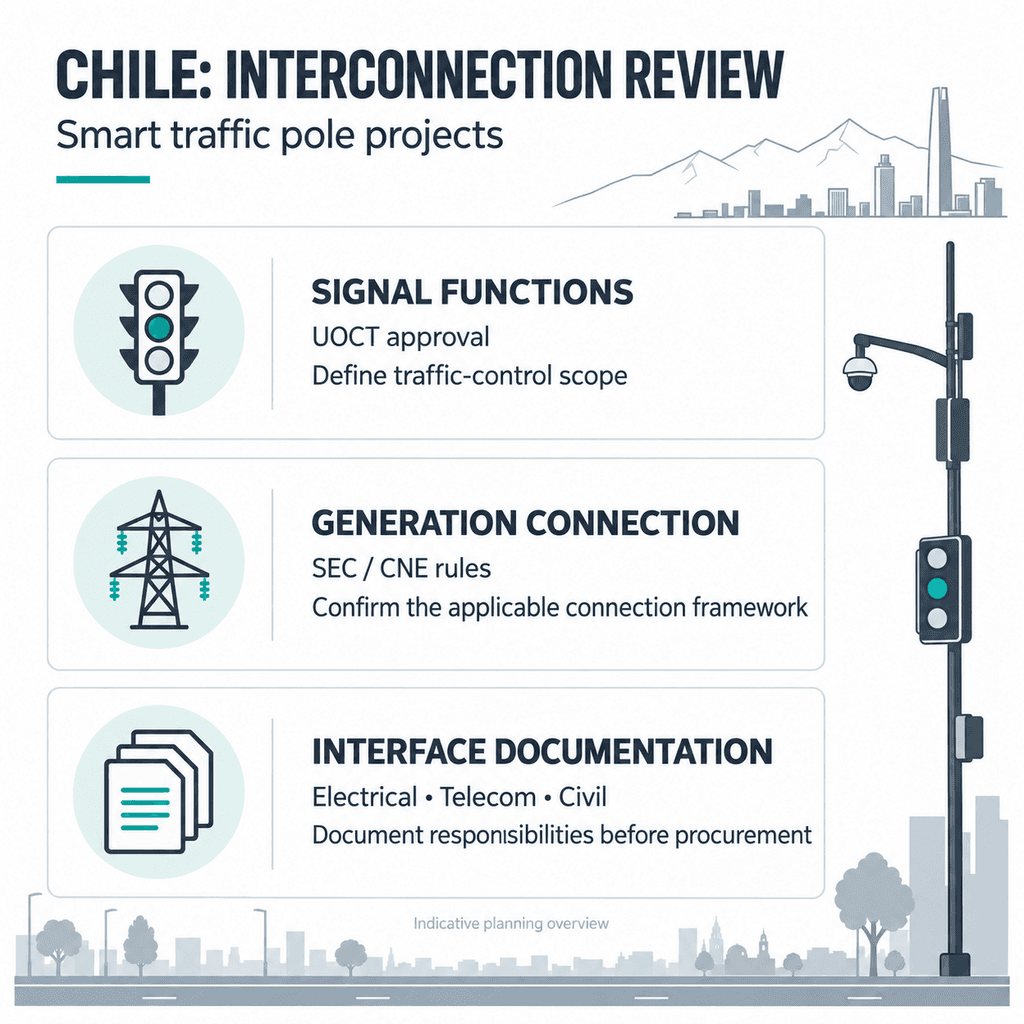
A smart traffic pole in Chile must satisfy at least 3 approval tracks: traffic-signal authorization, electrical interconnection, and public-road installation control.
For procurement teams, the first compliance mistake is treating a smart traffic pole as a normal lighting pole. In Chile, a pole that connects to traffic lights, signal controllers, radar detection, CCTV, adaptive timing, or UOCT network control becomes part of a regulated traffic-management environment. The Manual de Señalización de Tránsito and Decreto Supremo 78/2012 set the national framework for traffic signal uniformity, while UOCT reviews signal justification, controller behavior, programming, and technical specifications.
The second track is electrical. If a pole is only grid-supplied and does not inject energy, the project follows normal low-voltage installation, protection, grounding, and SEC declaration practice. If it includes photovoltaic generation, battery storage, or export to the distribution network, the buyer must evaluate whether the asset falls under Chile's distributed generation framework, Net Billing low-voltage rules, or PMGD medium-voltage rules.
According to CNE (2026), Chile has a February 2026 Norma Técnica de Conexión y Operación de PMGD in medium-voltage installations, plus the 2019 Net Billing technical standard for low-voltage generation equipment. According to SEC (2025), RGR 06/2024 defines technical requirements for battery energy storage installations communicated to the Superintendencia de Electricidad y Combustibles. These rules matter when a smart traffic pole uses solar panels and LFP batteries instead of a simple utility feeder.
CONASET states, "complete uniformity" is the purpose of Chile's national traffic signal rules. That phrase is short, but it is important for B2B engineering: imported smart infrastructure must adapt to Chile's signal-control architecture, not force the road authority to adapt to a proprietary pole.
For SOLARTODO, the practical recommendation is to separate the pole package into 4 compliance envelopes: structure, traffic function, power system, and communications/data. A Chilean EPC tender can then define which parts are factory-delivered by SOLARTODO and which parts require local engineering sign-off by an authorized electrical installer, traffic consultant, municipality, MOP, distribution utility, or UOCT regional office.
Technical Interconnection Requirements for Power, Signals, and Data
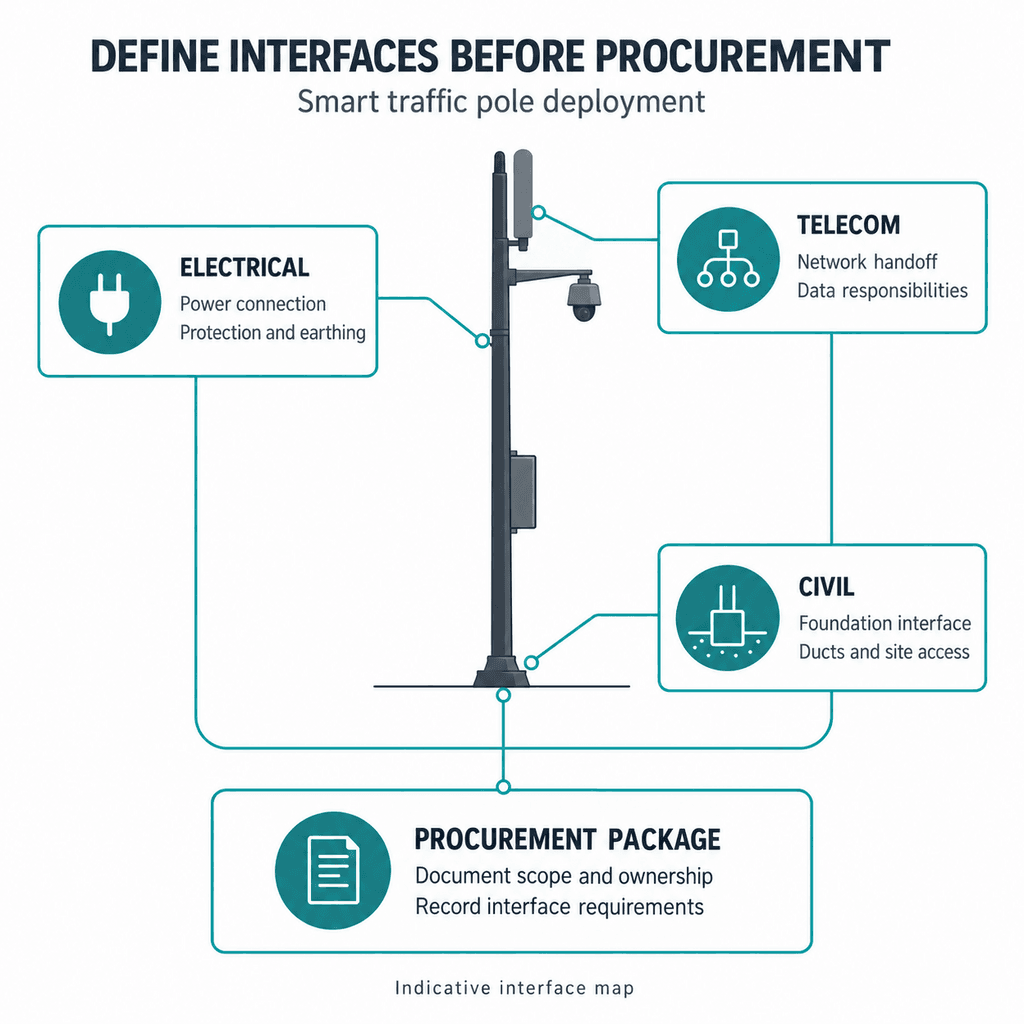
A compliant Chile smart traffic pole should document 4 interfaces: AC supply, optional PV or BESS, traffic controller wiring, and secure IP communications.
The electrical design begins with the single-line diagram. For grid-powered poles, engineers should show incoming voltage, breakers, surge protection, residual-current protection where applicable, grounding, controller load, LED signal load, camera load, radar load, router load, and maintenance isolation. For hybrid poles, the drawings must also show PV strings, MPPT controller, battery inverter, anti-islanding behavior, metering, and whether the system is non-export or grid-interactive.
SOLARTODO smart traffic pole architecture is suited to AI traffic corridors because it combines 4K camera analytics, 77GHz radar vehicle detection, signal-light integration, and a 275 TOPS edge AI processor in one roadside asset. For Chilean interconnection, however, the AI stack is secondary to fail-safe signal behavior. Traffic lights must remain predictable during communications loss, controller fault, camera failure, or power transfer from grid to battery.
According to IEEE 1547-2018, distributed energy resources require defined interconnection and interoperability performance at the electric power system interface. Chile does not simply copy IEEE 1547 for every low-voltage street asset, but the principles are useful for anti-islanding, voltage behavior, frequency behavior, and commissioning tests. For PV yield estimation, NREL PVWatts v8.5.2 remains a practical pre-design tool for comparing Santiago, Antofagasta, Valparaíso, and southern Chile solar production scenarios.
IEA (2024) reports that distributed applications make up almost 40% of forecast PV expansion, while solar PV and wind account for 95% of global renewable capacity growth through 2030. IRENA (2025) reports a global utility-scale solar PV LCOE of USD 0.043/kWh in 2024 and a 93% decline in utility-scale battery storage installed costs from 2010 to 2024. These statistics support solar-assisted poles, but they do not remove the need for Chile-specific utility review.
For traffic data interconnection, the project should define whether the pole talks directly to a UOCT-compatible controller, a municipal command center, a cloud dashboard, or all 3. Minimum documentation should include IP addressing, VPN requirements, latency target, event logs, cybersecurity controls, camera retention policy, and ownership of AI detection metadata. A 4K camera and 77GHz radar system should be procured with configurable privacy masks and role-based access because Chilean municipalities may require different data policies by city.
Applications and Approval Workflow for Chilean Roads
Most Chile smart traffic pole projects should pass through 6 workflow gates before installation: site study, UOCT review, utility review, civil design, FAT, and SAT.
The highest-value use cases are intersections with congestion, pedestrian conflict, bus-priority demand, port access, mining logistics roads, and municipal corridors that need video evidence plus adaptive detection. A conventional intersection may use separate signal poles, detector loops, CCTV masts, controller cabinets, communication boxes, and lighting poles. A SOLARTODO smart traffic pole can consolidate multiple functions into fewer roadside assets while preserving the formal UOCT signal-control process.
A typical workflow starts with a traffic engineering study. Under DS 78/2012, the study of justification for a traffic signal must be submitted to UOCT, and a public-road signal cannot be installed without approval. The project then prepares the semaforización package: layout drawings, phase diagram, phase sequence, load schedule, single-line diagram, installed-power table, maximum-demand table, controller sizing, and cabling table.
After traffic approval, the utility and electrical path must be confirmed. If each pole is a load-only device, the EPC contractor normally handles service connection, protection, grounding, and SEC declaration through local licensed professionals. If the project includes PV generation or storage that can export, procurement should trigger Net Billing or PMGD screening. For distributed generation in low voltage, Chile's framework is commonly applied up to 300kW, while larger or medium-voltage projects may move into PMGD evaluation.
The International Energy Agency states, "Solar PV will account for around 80%" of renewable capacity growth over the next five years. For Chile, that macro trend explains why municipalities and concessionaires are evaluating solar-assisted ITS assets, but final approval still depends on road safety, electrical protection, and communications compatibility.
Factory acceptance testing should include at least 10 records: pole dimensional inspection, galvanization or coating check, controller interface simulation, LED signal-module test, 4K camera stream test, radar detection test, edge AI event test, router failover test, electrical insulation test, and battery protection test where storage is included. Site acceptance should repeat live signal behavior, grounding, cabinet access, nighttime imaging, emergency override, UOCT connectivity, and cloud alarms.
Comparison and Selection Guide
The right interconnection route depends on whether the smart traffic pole is load-only, self-consumption solar, low-voltage export, or PMGD-scale generation.
| Configuration | Typical power mode | Chile approval focus | Best use case | Procurement risk |
|---|---|---|---|---|
| Grid-only smart traffic pole | 230/400V AC load | UOCT project plus SEC electrical installation | Urban intersections with reliable feeders | Lower energy autonomy |
| Solar-assisted non-export pole | PV + LFP + grid backup | SEC battery/PV safety and no-export protection | Remote roads, mining access, municipal corridors | More control logic |
| Low-voltage distributed generation cluster | Up to 300kW screening | CNE/SEC Net Billing and distributor review | Campus, port, or municipal network | Utility paperwork delays |
| PMGD smart corridor energy plant | Medium voltage, PMGD route | DS 88 and CNE PMGD technical standard | Larger solar canopy or depot-linked systems | Longer grid studies |
| Traffic control only retrofit | Existing feeder and controller | UOCT compatibility and cabinet wiring | Upgrading detection at existing intersections | Legacy controller constraints |
Selection should begin with jurisdiction. Urban public roads usually involve the municipality for installation and maintenance, while roads under MOP control require separate coordination. Traffic functionality is not optional: if the pole affects signal phases, detector calls, pedestrian timing, or dynamic control, UOCT must be treated as an approval stakeholder early in design.
Technical buyers should also check environmental exposure. Northern Chile offers strong solar resource but dust, UV, and temperature cycling affect camera windows, radar covers, batteries, and cable glands. Coastal regions add corrosion risk, making coating specification, stainless fasteners, and maintenance intervals important. Southern regions may have lower PV yield and higher moisture exposure, so utility backup and IP-rated enclosures become more important than panel wattage alone.
For SOLARTODO export projects, the specification should avoid locked proprietary dependencies. Recommended open interfaces include ONVIF-compatible video where practical, documented controller I/O, OCPP only if EV charging is added, SNMP or MQTT telemetry for diagnostics, and exportable event logs. The buyer should require a Spanish-language commissioning dossier for Chilean authorities and an English technical dossier for factory QA.
EPC Investment Analysis and Pricing Structure
A Chile EPC budget should compare 3 price tiers, 3 volume discounts, and a 5-8 year payback model against conventional traffic equipment.
EPC means Engineering, Procurement, and Construction. For a smart traffic pole project in Chile, engineering includes traffic-layout coordination, UOCT documentation support, electrical single-line diagrams, civil foundation design, communications topology, and interconnection screening. Procurement covers SOLARTODO factory equipment, FAT/QC, packing, export documentation, spare parts, and Incoterms alignment. Construction covers foundations, crane erection, cabling, terminations, grounding, network configuration, and road-work safety. Commissioning covers signal behavior, detector calibration, video analytics, cloud telemetry, utility energization, and handover documentation.
| Pricing tier | Scope | Planning use |
|---|---|---|
| FOB Supply | Equipment only, ex-works China | Lowest equipment benchmark for importer-led projects |
| CIF Delivered | Equipment plus ocean freight and insurance to Chile | Best for distributor or EPC buyers controlling installation |
| EPC Turnkey | Installed, commissioned, and covered by 1-year warranty | Best for municipalities, ports, campuses, and concessionaires |
| Order volume | Discount from applicable tier | Typical Chile use |
|---|---|---|
| 50+ units | 5% | Pilot corridor or 10-20 intersections |
| 100+ units | 10% | Multi-district traffic modernization phase |
| 250+ units | 15% | Citywide, port-campus, or highway access rollout |
ROI should compare the smart pole against a fragmented design with separate detector masts, camera poles, communication cabinets, signal rewiring, and maintenance visits. A 100-pole deployment can reduce asset points by hundreds if each pole consolidates traffic detection, surveillance, communication, and lighting support. The financial value usually comes less from solar energy alone and more from avoided civil works, shorter installation windows, fewer truck rolls, and lower downtime at signalized intersections.
For budget planning, SOLARTODO recommends modeling a 5-8 year payback window for projects above 50 units. Inputs should include local electricity tariff, night lighting hours, maintenance labor cost, communication fees, trenching cost per meter, foundation cost, and expected reduction in manual traffic surveys. Payment terms are typically 30% T/T deposit plus 70% against bill of lading, or 100% irrevocable L/C at sight for approved buyers. Project financing can be discussed for orders above USD 1,000K; contact [email protected] with drawings, pole count, target Incoterms, utility data, and UOCT status.
FAQ
Smart traffic pole FAQ answers should cover at least 8 procurement questions across UOCT approval, SEC interconnection, cost, installation, and maintenance.
Q: What is a smart traffic pole in Chilean interconnection planning? A: A smart traffic pole is a roadside pole integrating traffic detection, cameras, communications, and sometimes signal interfaces or solar power. In Chile, it must be planned as both a traffic-control asset and an electrical installation. If it affects semáforos, UOCT approval is required; if it generates or stores energy, SEC/CNE rules also apply.
Q: Does every smart traffic pole require UOCT approval in Chile? A: UOCT approval is required when the pole installs, modifies, controls, detects for, or connects to traffic signals on public roads. DS 78/2012 requires approved studies and projects for semáforo installations. A pole used only for lighting or private-site surveillance may follow different municipal and electrical approval routes.
Q: When does SEC or CNE interconnection review become relevant? A: SEC and CNE become relevant when the pole includes PV generation, battery storage, grid export, or PMGD-scale energy equipment. Load-only poles mainly need compliant electrical installation and declaration. Exporting or grid-interactive systems require distributor coordination, technical documentation, protection settings, and potentially TE-series electronic declarations.
Q: Can a SOLARTODO smart traffic pole operate without exporting power? A: Yes, a SOLARTODO smart traffic pole can be specified as solar-assisted non-export equipment with local LFP storage and grid backup. This reduces utility interconnection complexity because the PV system supports pole loads rather than selling energy. Engineers must still document no-export protection, grounding, battery safety, and maintenance isolation.
Q: What documents should be prepared for a Chile smart traffic pole project? A: Prepare layout drawings, phase diagrams, controller schedules, single-line diagrams, load tables, cabling tables, communications topology, foundation drawings, and equipment datasheets. For PV or BESS, add inverter certificates, battery safety documentation, protection settings, and commissioning reports. UOCT and SEC-facing documents should be available in Spanish.
Q: What is the difference between Net Billing and PMGD for smart pole projects? A: Net Billing generally applies to smaller low-voltage distributed generation for self-consumption and regulated injection, commonly screened up to 300kW. PMGD applies to small distributed generation connected at distribution level, often medium voltage, under a more detailed CNE technical standard. The project size and connection voltage determine the path.
Q: How long does installation and approval usually take? A: Timing depends on UOCT review, utility response, municipal permits, civil works, and imported equipment logistics. A 50-pole pilot can often be planned in phases over 30-90 construction days after approvals and shipment. Grid-export projects take longer because distributor studies and protection reviews must precede energization.
Q: How should cybersecurity be specified for AI traffic poles? A: Require VPN or private APN access, role-based accounts, encrypted remote access, update logs, password rotation, and segmented networks for cameras and signal controllers. The 4K camera and 275 TOPS edge AI processor should not have unrestricted public internet exposure. Event logs should support audits without exposing private video unnecessarily.
Q: What maintenance is required after commissioning? A: Maintenance should include quarterly visual checks, annual electrical inspection, camera cleaning, radar alignment verification, firmware review, grounding checks, and battery diagnostics where storage is installed. Traffic functions should follow UOCT maintenance procedures. For coastal or desert sites, shorten inspection intervals due to salt, dust, UV, and thermal cycling.
Q: How much does EPC turnkey delivery include and how is it paid? A: EPC turnkey delivery includes engineering, procurement, construction, commissioning, and usually 1-year warranty support. SOLARTODO payment terms are typically 30% T/T deposit and 70% against bill of lading, or 100% irrevocable L/C at sight for approved buyers. Financing can be discussed for projects above USD 1,000K.
Q: Can smart traffic poles use 5G, fiber, and LoRaWAN together? A: Yes, multi-backhaul design is recommended for resilience. Fiber is preferred for high-bandwidth video and UOCT integration, while 4G/5G provides backup or rapid deployment. LoRaWAN is useful for low-rate sensors but not for 4K video. The final topology should define latency, failover, and data ownership.
Q: What standards should engineers cite in specifications? A: Chile-specific specifications should cite DS 78/2012, the Manual de Señalización de Tránsito, UOCT controller and installation documents, SEC RGR 06/2024, and CNE Net Billing or PMGD standards where relevant. Internationally, IEC 60598, IEC 61851, IEC 62196-2, IEEE 1547-2018, and UL battery safety references can support equipment quality.
References
- IEEE 1547-2018 (2018): Standard for interconnection and interoperability of distributed energy resources with electric power systems interfaces. — https://standards.ieee.org/ieee/1547/7382/
- IRENA Renewable Power Generation Costs in 2024 (2025): Reports USD 0.043/kWh global solar PV LCOE in 2024 and 93% utility-scale battery storage cost decline since 2010. — https://www.irena.org/Data/View-data-by-topic/Capacity-and-Generation
- IEA Renewables 2024 (2024): Forecasts 5,500GW of new renewable capacity by 2030, with solar PV providing about 80% of growth. — https://www.iea.org/reports/world-energy-outlook-2024 These 8 references combine Chilean law, UOCT traffic requirements, distributed-energy rules, and international standards for smart traffic pole procurement.
- CNE (2026): Norma Técnica de Conexión y Operación de PMGD in medium-voltage installations, February 2026 update for distributed generation connection and operation.
- CNE (2019): Norma Técnica Net Billing for low-voltage generation equipment connection and operation under Chilean distributed generation rules.
- SEC (2025): RGR 06/2024 battery energy storage technical instruction, updated by REX 33038/2025 for declared electrical installations.
- Ministerio de Transportes y Telecomunicaciones (2012): Decreto Supremo 78/2012, official traffic signaling manual framework requiring UOCT-approved semáforo studies.
- CONASET (2024): Manual de Señalización de Tránsito, Chapter 4 on traffic lights, signal justification, programming, and national uniformity.
- IEEE 1547-2018 (2018): Standard for interconnection and interoperability of distributed energy resources with electric power systems.
- IRENA (2025): Renewable Power Generation Costs in 2024, reporting USD 0.043/kWh solar PV LCOE and 93% battery storage cost decline since 2010.
- IEA (2024): Renewables 2024, forecasting 5,500GW of new renewable capacity by 2030 and about 80% of growth from solar PV.
Conclusion
For Chile, a smart traffic pole is procurement-ready only when 3 interfaces are resolved: UOCT traffic approval, SEC/CNE electrical compliance, and road-owner installation permission.
The bottom line: SOLARTODO smart traffic poles can support Chilean traffic modernization with 4K AI video, 77GHz radar, 275 TOPS edge processing, and optional solar-storage power, but buyers should lock the approval route before shipment. For projects above 50 units, the strongest specification is a Chile-adapted EPC package with UOCT documentation, electrical interconnection screening, FAT/SAT records, and a 5-8 year ROI model.
About SOLARTODO
SOLARTODO is a global integrated solution provider specializing in solar power generation systems, energy-storage products, smart street-lighting and solar street-lighting, intelligent security & IoT linkage systems, power transmission towers, telecom communication towers, and smart-agriculture solutions for worldwide B2B customers.
About the Author

Cinn Song
Founder & Chief Solutions Architect
Cinn Song founded SOLARTODO LIMITED and leads its smart-city infrastructure engineering — from solar, storage and integrated smart poles to the company's push into physical-AI city edge nodes: pole-mounted edge computing, vertical LLMs for smart cities, drone-based O&M with autonomous battery swapping, robotic maintenance, and high-speed counter-UAS interception. Since 2010, he has directed turnkey EPC + BOT delivery across 50+ countries, including telecom monopole supply for national grid operators, off-grid solar street-lighting for African municipalities, and integrated smart-pole programs for Gulf smart cities.
Cite This Article
Cinn Song. (2026). Regulaciones de Interconexión para smart traffic pole en…. SOLARTODO. Retrieved from https://solartodo.com/knowledge/regulaciones-de-interconexin-para-smart-traffic-pole-en-chile
@article{solartodo_regulaciones_de_interconexin_para_smart_traffic_pole_en_chile,
  title = {Regulaciones de Interconexión para smart traffic pole en…},
  author = {Cinn Song},
  journal = {SOLARTODO Knowledge Base},
  year = {2026},
  url = {https://solartodo.com/knowledge/regulaciones-de-interconexin-para-smart-traffic-pole-en-chile},
  note = {Accessed: 2026-09-10}
}
Published: September 10, 2026 | Available at: https://solartodo.com/knowledge/regulaciones-de-interconexin-para-smart-traffic-pole-en-chile
Subscribe to Our Newsletter
Get the latest solar energy news and insights delivered to your inbox.
View All Articles