Precision Agriculture Monitoring for Fertilizer Savings

SOLARTODO Editorial Team
Solar Energy & Infrastructure Expert Team
Watch the video
TL;DR
Smart agriculture monitoring systems improve remote farm management by collecting soil, weather, and water data every 10 minutes and turning it into irrigation and fertigation decisions. For many 30-50 hectare operations, this supports fertilizer savings of 10-30%, water savings of 20-50%, and payback in roughly 12-36 months when labor, travel, and avoided crop loss are included.
Smart agriculture monitoring systems cut field inspection delays from days to 10-minute intervals, support 20-50% irrigation water reduction, and can lower fertilizer losses by 10-30% through zone-based sensing, remote alerts, and data-driven application timing.
Summary
Smart agriculture monitoring systems cut field inspection delays from days to 10-minute intervals, support 20-50% irrigation water reduction, and can lower fertilizer losses by 10-30% through zone-based sensing, remote alerts, and data-driven application timing.
Key Takeaways
- Deploy monitoring nodes at 1 point per 2-5 hectares to capture soil and microclimate variation that manual scouting often misses within 10-60 minutes.
- Use 10-minute data intervals and threshold alerts to react before nutrient leaching, frost, or irrigation stress causes 5-20% yield loss.
- Combine weather, soil moisture, and EC data to reduce fertilizer over-application by 10-30% in drip and fertigation programs.
- Select LoRaWAN for 30-40 hectare blocks and 4G LTE for 50 hectare remote sites where backhaul distance exceeds 2-5 km.
- Size solar-powered field nodes to IP67/IP68 practice with LFP battery support for year-round operation and lower maintenance visits by 30-60%.
- Compare FOB, CIF, and EPC delivery early; orders above 50 units typically target 5% discount, 100 units 10%, and 250 units 15%.
- Calculate payback against labor, water, and fertilizer savings; many remote-monitoring projects target 12-36 month payback depending on crop value and input intensity.
- Verify compliance with ISO 11783, IEC electrical safety practice, and WMO weather observation guidance before procurement and deployment.
Why precision agriculture monitoring matters
Smart agriculture monitoring systems address remote monitoring needs by collecting weather, soil, and crop data every 10 minutes across 30-50 hectares, helping operators reduce fertilizer waste by 10-30% and respond faster than manual scouting.
Remote farming decisions often fail because one field visit per day, or even 1-2 visits per week, cannot capture fast changes in soil moisture, canopy stress, rainfall, wind, or evapotranspiration. In orchards, tea gardens, and desert reclamation sites, conditions can shift within 1-3 hours after irrigation, rainfall, or a heat event. That timing gap directly affects nutrient uptake, root-zone oxygen, and fertilizer retention.
According to FAO practice guidance used across precision agriculture programs, nutrient efficiency improves when application timing matches crop stage, soil condition, and weather risk rather than fixed calendar schedules. According to IEA (2024), digitalization and better control systems are increasingly important for reducing energy, water, and input waste across agriculture and infrastructure. For B2B operators, the question is not whether data matters, but whether the data arrives fast enough to change field action.
SOLAR TODO addresses this gap with smart agriculture monitoring systems that combine field sensors, solar-powered nodes, gateway communications, and cloud dashboards. The available product range shows three useful deployment models: Orchard Frost Early Warning 40ha with 10 sensing points and LoRaWAN, Tea Garden Precision Monitoring 30ha with 15 sensors and AI disease detection, and Desert Reclamation Solar+Agriculture 50ha with 20 sensors, 500 kW solar PV, and 4G LTE communications.
The International Energy Agency states, "Digital technologies can improve efficiency, productivity and resilience across energy-consuming sectors." That statement applies directly to agriculture, where each 10-minute data point can influence irrigation timing, fertigation concentration, and labor dispatch. For procurement managers, this turns monitoring from a reporting tool into an operating control layer.
How Smart Agriculture Monitoring Systems solve remote monitoring needs
Remote monitoring works best when 10-minute field data, long-range communications, and cloud alerts are combined into one system, allowing 1 manager to supervise 10-20 distributed zones without constant site visits.
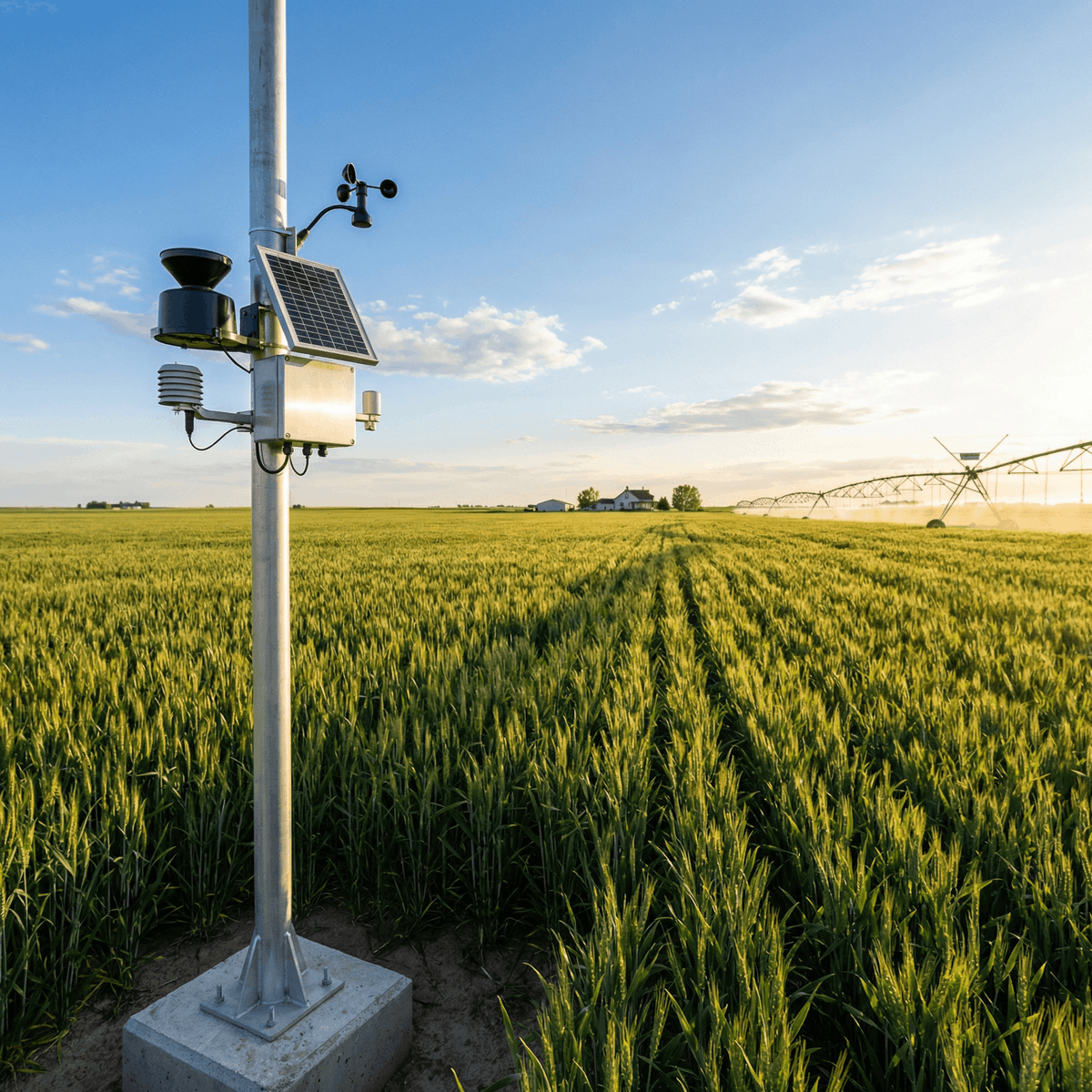
A practical smart agriculture architecture has 4 layers: sensing, communications, power, and analytics. The sensing layer includes weather stations, soil moisture probes, soil temperature probes, EC or salinity monitoring, water-quality points, and crop-specific devices such as leaf scanners. The communications layer usually uses LoRaWAN for low-power field coverage over several kilometers, or 4G LTE where the site is more isolated or spread over 50 hectares.
Sensing layer for fertilizer optimization
Fertilizer optimization depends on measuring the root zone, not just the air above it, and a useful setup typically combines 3-7 soil parameters with 8-10 weather parameters.
For fertilizer savings, the most important variables are soil moisture, soil temperature, electrical conductivity, rainfall, solar radiation, evapotranspiration, and sometimes water quality. If a field receives fertigation before heavy rain or when the root zone is already saturated, nutrient leaching increases and uptake efficiency drops. If application is delayed too long during high evapotranspiration, the crop can enter stress and reduce nutrient absorption.
The Desert Reclamation Solar+Agriculture 50ha package is especially relevant because it combines 10-parameter weather monitoring, 7-parameter soil analysis, water-quality tracking, and automated drip-irrigation control. In high-evaporation areas where evapotranspiration can exceed 5-10 mm/day, this data can materially change daily fertilizer and irrigation decisions. According to NREL (2024), remote energy and monitoring systems perform best when power supply, communications, and field loads are evaluated together rather than as separate subsystems.
Communications and power architecture
LoRaWAN supports low-power monitoring over large agricultural blocks, while 4G LTE is often preferred for remote 50-hectare sites that need direct cloud backhaul and fewer relay constraints.
The Orchard Frost Early Warning 40ha system uses LoRaWAN with 10 field sensing points and solar-powered outdoor nodes. That setup fits orchards where multiple microclimate pockets exist within 1 large 40-hectare block or 2-4 adjacent zones. The Tea Garden Precision Monitoring 30ha package also uses LoRaWAN, which is suitable where terrain changes by 10-500 m in elevation and cable installation is impractical.
The Desert Reclamation Solar+Agriculture 50ha system uses 4G LTE and 2 gateways, which is useful where grid power is unstable and field assets are spread over wider distances. Solar-powered nodes with LFP battery support reduce maintenance dependence on utility supply. For remote deployments, this matters because a failed power source can create a blind spot exactly when irrigation or nutrient decisions are time-sensitive.
Alerting and control logic
Threshold alerts convert raw sensor readings into action windows, and SMS, email, or app push notifications can shorten response time from several hours to less than 15 minutes.
The Orchard Frost Early Warning 40ha package includes SMS, Email, and App Push alerts plus wind machine control. The same logic applies to fertilizer management: alerts can be configured for low soil moisture before fertigation, high rainfall probability after application, or EC values outside the target band. Instead of sending staff to inspect all blocks, the system sends staff only to blocks that cross a threshold.
WMO weather observation guidance supports consistent measurement practice, and ISO 11783 supports agricultural data interoperability across equipment categories. For engineers, those references matter because data quality and compatibility affect whether monitoring can later connect to irrigation controllers, farm management software, or reporting platforms.
How remote monitoring improves fertilizer optimization savings
Fertilizer savings come from applying the right dose in the right zone at the right time, and monitoring systems typically improve this by linking soil data, weather risk, and irrigation status every 10 minutes.
Fertilizer losses usually occur in 4 ways: over-application, poor timing, uneven field distribution, and washout after irrigation or rain. A remote monitoring platform reduces each of these by showing where the field is dry, where it is saturated, and where crop demand is rising. Instead of one uniform application rate across 30-50 hectares, managers can split the field into practical management zones.
According to IRENA (2023), digital control and renewable-powered infrastructure improve operational efficiency in distributed systems where energy access and monitoring reliability are constraints. According to FAO digital agriculture case studies, precision input management can reduce waste while improving yield consistency when field variability is measured rather than assumed. In practical B2B terms, this means fewer blanket applications and more targeted fertigation cycles.
Sample savings logic by crop type
Crop-specific monitoring can reduce fertilizer waste by 10-30%, with the exact result depending on irrigation method, soil texture, rainfall pattern, and baseline management quality.
In orchards, fertilizer is often lost where low spots remain wet after irrigation while higher rows dry faster. With 10 sensing points across 40 hectares, operators can identify which zones need delayed application and which need immediate fertigation. In tea cultivation, slope exposure and elevation differences of 10-500 m create uneven moisture and disease pressure, so nutrient timing can be aligned with actual field conditions rather than average conditions.
In desert reclamation, the risk is different: high evapotranspiration, unstable grid supply, and variable water quality can push operators toward conservative over-application. The 50-hectare SOLAR TODO package adds water-quality points and automated drip control, which helps prevent nutrient concentration errors and supports tighter fertigation scheduling. The product knowledge indicates potential irrigation water reduction up to 50%, pesticide reduction around 30%, and yield improvement of 15-25% when paired with agronomic response protocols.
The International Renewable Energy Agency states, "Data and digitalization are becoming key enablers of efficiency and flexibility." For agriculture, that translates into a simple operating rule: if the field is measured every 10 minutes, the fertilizer plan can be adjusted before losses happen, not after tissue tests or visible stress appear.
Comparison of suitable smart agriculture system types
A good system choice depends on hectare range, communications method, sensor count, and whether the farm needs monitoring only or monitoring plus automated control.
The table below compares the three relevant SOLAR TODO smart agriculture configurations for remote monitoring and fertilizer optimization planning.
| System | Typical Coverage | Communications | Sensor/Device Count | Key Functions | Best Fit |
|---|---|---|---|---|---|
| Orchard Frost Early Warning 40ha | 40 ha | LoRaWAN | 10 sensing points | Weather, soil moisture-temperature, frost alerts, wind machine control | Orchards needing microclimate alerts and zone-based fertigation timing |
| Tea Garden Precision Monitoring 30ha | 30 ha | LoRaWAN | 15 sensors/devices | Weather, soil monitoring, AI leaf disease detection | Tea estates with elevation variation and disease-linked nutrient planning |
| Desert Reclamation Solar+Agriculture 50ha | 50 ha | 4G LTE | 20 sensors | 500 kW solar PV, 10-parameter weather, 7-parameter soil, water quality, drip control | Remote agricultural sites needing energy, irrigation, and nutrient control together |
Selection criteria for procurement teams
Procurement should compare 5 factors first: coverage area, communications path, sensor density, control requirements, and service model over at least 12-24 months.
If the site is 30-40 hectares with clustered zones and low-power nodes, LoRaWAN usually offers lower operating cost. If the site is 50 hectares, energy-constrained, and far from stable backhaul, 4G LTE with solar-powered gateways may be the better choice. If fertilizer optimization is the main KPI, prioritize systems that include soil moisture, soil temperature, EC or salinity, rainfall, and evapotranspiration rather than weather-only packages.
For B2B buyers, cloud service terms also matter. The listed systems commonly include 1 professional cloud tier or 1 year of professional cloud service. That should be checked against data retention period, alert rules, API availability, and user account limits before PO release.
EPC Investment Analysis and Pricing Structure
For remote agriculture projects, EPC turnkey delivery combines engineering, procurement, installation, commissioning, and training into one scope, which reduces interface risk and shortens deployment time by weeks rather than days.
A smart agriculture EPC scope typically includes site survey, sensor layout design, gateway placement, solar power kit sizing, mounting structures, controller configuration, cloud onboarding, alarm setup, field commissioning, and operator training. For larger sites above 30 hectares, this integrated scope reduces coordination gaps between irrigation teams, electrical contractors, and IT staff.
SOLAR TODO generally works through inquiry and offline quotation rather than online checkout. For procurement comparison, pricing is usually discussed in 3 tiers:
- FOB Supply: Equipment only, ex-works/export basis, suitable when the buyer manages freight, customs, and local installation.
- CIF Delivered: Equipment plus freight and insurance to destination port, suitable when the buyer wants landed cost visibility before local works.
- EPC Turnkey: Full delivery including design, installation support, commissioning, and training, suitable when the buyer wants one accountable package.
Volume pricing guidance for project procurement is commonly structured as:
- 50+ units: target 5% discount
- 100+ units: target 10% discount
- 250+ units: target 15% discount
Payment terms commonly follow:
- 30% T/T deposit + 70% against B/L
- 100% L/C at sight
For large projects above $1,000K, financing is available subject to project review, delivery scope, and buyer profile. Commercial discussions can be directed to [email protected] or the main contact +6585559114.
ROI logic for remote monitoring and fertilizer savings
Projects that reduce fertilizer waste by 10-30%, water use by 20-50%, and field visits by 30-60% often target payback within 12-36 months, depending on crop value and labor cost.
A simple ROI model should include 5 lines: fertilizer savings, water savings, labor reduction, avoided crop loss, and service cost. Sample deployment scenario (illustrative): if a 40-hectare orchard spends $40,000 per year on fertilizer and monitoring cuts waste by 15%, annual fertilizer savings alone equal $6,000. If labor and travel savings add $4,000 and avoided crop loss adds $8,000, the annual benefit reaches $18,000 before service fees.
That model becomes stronger on remote sites where each emergency visit costs several staff-hours and vehicle fuel. It also improves where irrigation and fertigation are already automated, because data can trigger immediate control action rather than waiting for manual interpretation. For many B2B operators, the strongest business case is not sensor cost alone but reduced decision delay across 1-3 critical seasons.
FAQ
Smart agriculture buyers usually ask about coverage, fertilizer savings, communications, installation, and EPC scope because those 5 topics determine technical fit and total cost over 12-36 months.
Q: What is a smart agriculture monitoring system in precision agriculture? A: A smart agriculture monitoring system is a field platform that collects weather, soil, water, and crop data at intervals such as 10 minutes and sends it to a cloud dashboard. It helps managers supervise 30-50 hectare sites remotely, set alerts, and improve decisions on irrigation, fertigation, and field labor.
Q: How does remote monitoring reduce fertilizer use? A: Remote monitoring reduces fertilizer use by showing actual root-zone moisture, temperature, rainfall, and sometimes EC before application. That allows operators to avoid applying nutrients before washout events or into already saturated zones. In many precision programs, this supports fertilizer waste reduction of about 10-30% when field actions follow the data.
Q: What sensors are most important for fertilizer optimization? A: The most useful sensors are soil moisture, soil temperature, EC or salinity, rainfall, solar radiation, and evapotranspiration inputs from a weather station. These parameters show whether nutrients are likely to stay in the root zone and whether crop uptake conditions are favorable. Water-quality monitoring is also important for drip fertigation sites.
Q: When should I choose LoRaWAN instead of 4G LTE? A: Choose LoRaWAN when the site covers about 30-40 hectares, sensor nodes are low power, and you can place a gateway to serve clustered zones over long range. Choose 4G LTE when the site is more isolated, backhaul is difficult, or direct cloud communication is preferred across wider remote areas.
Q: How many sensing points are needed for a 40-hectare farm? A: The required number depends on crop uniformity, irrigation zoning, and terrain variation, but 1 sensing point per 2-5 hectares is a practical starting range. A 40-hectare orchard package with 10 sensing points is suitable where microclimate and soil conditions vary across rows, low spots, or adjacent blocks.
Q: Can smart monitoring work without stable grid power? A: Yes. Many field nodes use solar power with battery storage, and remote systems can operate year-round when power demand, charging profile, and communications load are matched correctly. This is especially useful on desert reclamation or remote orchard sites where grid reliability is poor and maintenance visits are costly.
Q: What is included in EPC turnkey delivery for these systems? A: EPC turnkey delivery usually includes engineering design, equipment supply, mounting layout, gateway and power configuration, installation support, commissioning, cloud setup, alarm logic, and operator training. This approach reduces coordination risk between electrical, irrigation, and agronomy teams and is often preferred for projects above 30 hectares.
Q: What pricing structures are available from SOLAR TODO? A: SOLAR TODO generally offers offline quotation under FOB Supply, CIF Delivered, or EPC Turnkey structures. Standard payment terms are typically 30% T/T plus 70% against B/L, or 100% L/C at sight. For larger projects above $1,000K, financing may be available after project and buyer review.
Q: What payback period should buyers expect? A: Many remote-monitoring projects target payback in 12-36 months, but the result depends on crop value, fertilizer spend, labor cost, and whether irrigation control is included. Sites with high travel cost, high-value crops, or frequent over-irrigation usually see faster returns because more avoidable loss exists in the baseline operation.
Q: How difficult is installation and maintenance? A: Installation is moderate in complexity and usually includes sensor placement, gateway setup, solar kit mounting, calibration, and cloud onboarding. Maintenance is mainly periodic inspection, cleaning, battery health checks, and sensor verification at intervals such as 6-12 months. Systems with IP67/IP68 outdoor practice reduce weather-related service issues.
Q: How do these systems support compliance and data interoperability? A: Many professional systems align with WMO weather observation guidance and ISO 11783 agricultural data interoperability principles. That helps standardize data collection and improves compatibility with controllers, reporting tools, and future farm software integration. Buyers should also review electrical safety and enclosure protection details during technical evaluation.
Q: Which SOLAR TODO package is best for fertilizer optimization? A: The best package depends on site conditions. For orchards, the 40-hectare LoRaWAN system is useful where microclimate zones drive fertigation timing. For tea estates, the 30-hectare package adds disease visibility. For remote reclamation sites, the 50-hectare system is strongest because it combines soil, water, weather, drip control, and 500 kW solar support.
References
Authoritative guidance shows that remote sensing, standard-compliant data collection, and digital control improve agricultural efficiency when systems are matched to field conditions, communications limits, and operating economics.
- NREL (2024): PVWatts Calculator and distributed system methodology relevant to solar-powered remote field equipment sizing and performance estimation.
- IEA (2024): Energy Technology Perspectives and digitalization guidance describing how digital systems improve efficiency, resilience, and operational control.
- IRENA (2023): Renewable energy and digitalization publications covering efficiency gains in distributed infrastructure and remote operations.
- WMO (2023): Weather observation guidance for consistent measurement of meteorological parameters used in agricultural monitoring.
- ISO 11783 (2024): Agricultural electronics and data communication framework for interoperability between farm equipment and digital systems.
- IEC 60529 (2013): Degrees of protection provided by enclosures, relevant to IP67/IP68 field device practice.
- IEEE 802.15.4 (2020): Low-rate wireless personal area network basis used in many long-range, low-power agricultural sensor architectures.
- FAO (2022): Digital agriculture and precision input management guidance supporting improved water and nutrient efficiency.
Conclusion
Smart agriculture monitoring systems improve remote farm supervision by turning 10-minute field data into faster irrigation and fertilizer decisions, with practical savings of 10-30% on fertilizer and 20-50% on water in suitable applications.
For orchards, tea estates, and remote reclamation projects above 30 hectares, SOLAR TODO provides workable LoRaWAN and 4G LTE options with EPC delivery, cloud monitoring, and financing support for projects above $1,000K. The bottom line: if your operation loses money to delayed field visibility, a monitored, zone-based fertigation strategy is usually the fastest path to measurable savings.
About SOLARTODO
SOLARTODO is a global integrated solution provider specializing in solar power generation systems, energy-storage products, smart street-lighting and solar street-lighting, intelligent security & IoT linkage systems, power transmission towers, telecom communication towers, and smart-agriculture solutions for worldwide B2B customers.
About the Author

SOLARTODO Editorial Team
Solar Energy & Infrastructure Expert Team
SOLAR TODO is a professional supplier of solar energy, energy storage, smart lighting, smart agriculture, security systems, communication towers, and power tower equipment.
Our technical team has over 15 years of experience in renewable energy and infrastructure, providing high-quality products and solutions to B2B customers worldwide.
Expertise: PV system design, energy storage optimization, smart lighting integration, smart agriculture monitoring, security system integration, communication and power tower supply.
Cite This Article
SOLARTODO Editorial Team. (2026). Precision Agriculture Monitoring for Fertilizer Savings. SOLARTODO. Retrieved from https://solartodo.com/knowledge/precision-agriculture-how-smart-agriculture-monitoring-systems-addresses-remote-monitoring-needs-and-improves
@article{solartodo_precision_agriculture_how_smart_agriculture_monitoring_systems_addresses_remote_monitoring_needs_and_improves,
  title = {Precision Agriculture Monitoring for Fertilizer Savings},
  author = {SOLARTODO Editorial Team},
  journal = {SOLARTODO Knowledge Base},
  year = {2026},
  url = {https://solartodo.com/knowledge/precision-agriculture-how-smart-agriculture-monitoring-systems-addresses-remote-monitoring-needs-and-improves},
  note = {Accessed: 2026-07-31}
}
Published: July 5, 2026 | Available at: https://solartodo.com/knowledge/precision-agriculture-how-smart-agriculture-monitoring-systems-addresses-remote-monitoring-needs-and-improves
Subscribe to Our Newsletter
Get the latest solar energy news and insights delivered to your inbox.
View All Articles