Power Transmission Towers Technical Guide: smart grid…

SOLAR TODO
Solar Energy & Infrastructure Expert Team
Watch the video
TL;DR
For modern utility projects, the best power transmission tower is not the one with the lowest steel price but the one that minimizes total corridor cost over 50 years. Smart grid-ready monopoles and poles for 10kV to 220kV lines can reduce footprint by 50-85%, support 100-300m spans, and often deliver a 3-7 year payback in constrained right-of-way conditions when inspection, land, and outage costs are included.
Power transmission towers for smart grids must balance IEC 60826 loading, 50-year asset life, and right-of-way costs that can vary by 20-40% by corridor type. Compact monopoles can cut footprint by 50-85%, while digital inspection can reduce outage risk and maintenance response time.
Summary
Power transmission towers for smart grids must balance IEC 60826 loading, 50-year asset life, and right-of-way costs that can vary by 20-40% by corridor type. Compact monopoles can cut footprint by 50-85%, while digital inspection can reduce outage risk and maintenance response time.
Key Takeaways
- Select tower geometry by voltage and corridor width: 10kV urban monopoles at 18m suit about 100m spans, while 66kV octagonal poles at 25m suit 150m spans and reduce footprint by 70-85% versus lattice towers.
- Apply smart grid sensors on critical lines to capture conductor temperature, tilt, and vibration data at intervals as short as 1-15 minutes for faster fault localization and higher network visibility.
- Use IEC 60826, ASCE 10-15, and EN 50341 checks to verify wind, broken-wire, and 15mm ice loading before procurement, fabrication, and foundation release.
- Reduce inspection cost by combining annual ground patrols, 2-4 year climbing checks, and drone thermography that can shorten defect detection cycles by more than 50% on long corridors.
- Compare right-of-way economics early: compact steel monopoles can lower occupied land area by 50-85%, which often offsets higher steel tonnage in suburban and peri-urban routes.
- Budget EPC delivery in three tiers: FOB supply, CIF delivered, and EPC turnkey, with indicative volume discounts of 5% at 50+ units, 10% at 100+, and 15% at 250+.
- Plan lifecycle maintenance around a 50-year design life by tracking galvanizing condition, bolt torque, foundation settlement, and corrosion class exposure in C3-C4 environments.
- Quantify ROI against conventional structures by including land acquisition, outage reduction, erection time, and maintenance access; in constrained corridors, the payback from compact structures often falls within 3-7 years.
Power Transmission Towers in Smart Grid Networks
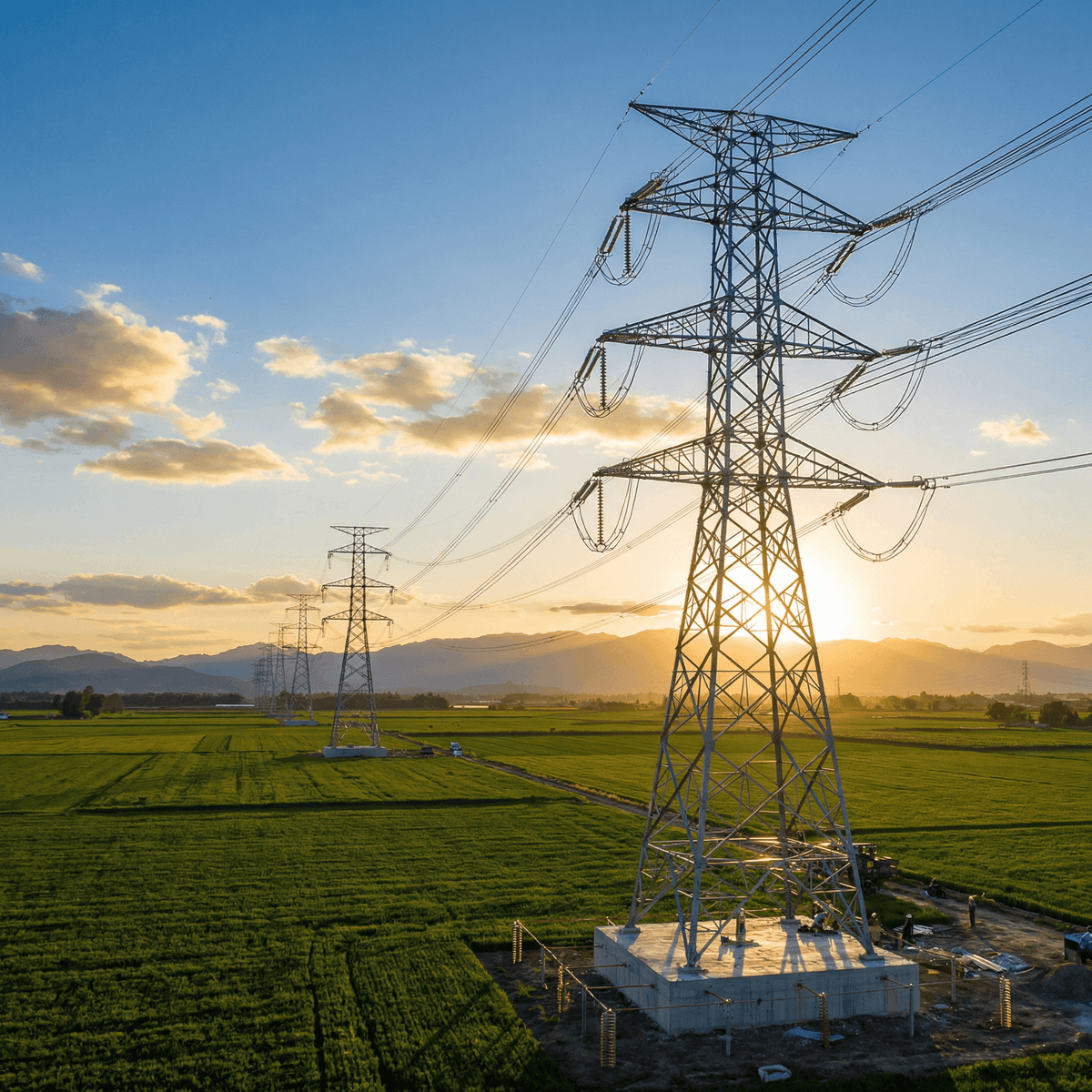
Power transmission towers in smart grid networks must carry 10kV to 220kV circuits over 100-300m spans while supporting sensors, communications, and a 50-year structural design life.
For utilities and EPC contractors, the tower is no longer only a passive support structure. It is part of a monitored network that must handle conductor loads, wind action, ice accretion, outage restoration, and digital data collection. In practical procurement terms, tower selection now affects line availability, inspection frequency, and right-of-way cost as much as steel weight or base plate dimensions.
According to the International Energy Agency (IEA) (2023), grids need stronger digitalization and network investment to integrate variable power sources and maintain reliability. The IEA states, "Digital technologies can make electricity systems more connected, intelligent, efficient, reliable and sustainable." For tower buyers, that means specifying attachment provisions for sensors, gateways, and communication equipment during the design stage rather than adding them later at higher retrofit cost.
SOLAR TODO supplies power transmission tower and pole solutions for urban, suburban, industrial, and utility corridors where land occupation and erection speed matter. In the current product range, an 18m 10kV tapered monopole supports a typical 100m span, a 25m 66kV octagonal double-circuit pole supports a 150m design span, and a 40m 220kV dodecagonal transmission pole supports a 300m design span with 2 circuits. These reference configurations help procurement teams compare compact monopoles against conventional lattice structures on a like-for-like basis.
Why structure choice matters for smart grids
Compact tower forms reduce occupied area, simplify access roads, and provide cleaner geometry for sensor placement and line monitoring. A monopole with a 50-85% smaller footprint than a lattice alternative can materially reduce easement conflict in 6-12m road reserves or constrained industrial corridors.
According to IRENA (2023), transmission and distribution expansion is a core requirement for cost-effective energy transition. That system-level pressure is visible at project level: every extra meter of right-of-way can increase compensation, permitting time, and civil complexity. For this reason, utilities often compare lattice towers, tubular monopoles, and polygonal poles not only on capex per structure but on total corridor cost per kilometer.
Technical Design Criteria and Smart Grid Integration
Smart grid-ready transmission towers should be specified with 1-15 minute monitoring intervals, IEC 60826 load cases, and communication mounting provisions that do not compromise clearances or structural utilization.
The technical baseline starts with structural loading. For overhead lines, the key checks typically include everyday tension, maximum wind, radial ice, broken-wire condition, construction loads, and serviceability deflection. In the supplied product references, the 25m 66kV octagonal double-circuit pole is checked around a 150m span under Class B wind and 15mm ice, while the 40m 220kV dodecagonal pole is configured for a 300m design span and broken-wire cases using IEC 60826 and ASCE 10-15 guidance.
From a smart grid perspective, the structure must also support digital hardware. Common devices include weather sensors, conductor temperature monitors, tilt sensors, vibration monitors, line fault indicators, and communication nodes. These devices often transmit data every 1-15 minutes depending on the criticality of the line, and mounting points must be coordinated with phase spacing, climbing access, and maintenance envelopes.
According to NREL (2021), grid modernization depends on visibility, sensing, and control across transmission and distribution assets. IEEE (2018) also provides interoperability guidance through IEEE 1547 for grid-connected assets and communications context around distributed energy resources. While IEEE 1547 is not a tower design code, it matters when tower-mounted monitoring supports feeder automation, DER visibility, and fault isolation on mixed networks.
Typical smart grid features specified on towers
A practical smart grid tower specification usually includes both structural and communication details. Procurement documents should define these items before fabrication release.
- Sensor brackets for conductor temperature, sag, and vibration monitoring
- Tilt or inclination sensors with alarm thresholds such as 0.5-1.0 degrees
- Gateway or RTU mounting zones with IP-rated enclosures, often IP65 or above
- Fiber or wireless backhaul routing provisions
- Earthing and surge protection interfaces aligned with utility practice
- Access control and anti-climb features for public corridors
- Identification plates, QR tags, or RFID markers for digital asset management
Comparison of common tower options
Compact steel poles can reduce corridor occupation, but they must be checked against line angle, conductor bundle, and maintenance access requirements.
| Structure type | Typical voltage use | Example height | Example span | Circuits | Footprint effect | Connection type | Best-fit corridor |
|---|---|---|---|---|---|---|---|
| Tapered monopole | 10kV distribution | 18m | 100m | 2 | 50-70% lower than lattice | Slip-joint | Dense urban streets, industrial parks |
| Octagonal monopole | 66kV subtransmission | 25m | 150m | 2 | 70-85% lower than lattice | Slip-joint | Suburban roads, utility easements |
| Dodecagonal monopole | 220kV transmission | 40m | 300m | 2 | Lower than lattice, higher capacity than many 8-sided poles | Flanged | Substation exits, constrained HV corridors |
| Conventional lattice tower | 66-220kV+ | Varies | Varies | 1-2+ | Larger land take | Bolted members | Open land, long rural corridors |
For buyers comparing these options, SOLAR TODO typically advises evaluating total installed cost per kilometer rather than unit price per structure. A lower-cost lattice tower can still produce a higher project cost if land compensation, access width, and visual permitting become difficult.
Inspection Methods, Defect Detection, and Maintenance Planning
A risk-based inspection program should combine annual visual patrols, 2-4 year close inspections, and drone or thermographic surveys to detect corrosion, bolt loss, and conductor clearance issues before failure.
Inspection strategy depends on voltage class, environmental exposure, and consequence of failure. A 220kV double-circuit line serving a substation exit generally requires tighter inspection intervals than a lower-consequence spur line because one defect can affect more load and restoration time. The practical goal is to identify deterioration early enough to repair it during planned maintenance rather than after forced outage.
The most common defect categories are corrosion, coating breakdown, loose bolts, cracked welds, foundation settlement, member deformation, insulator contamination, and vegetation encroachment. For galvanized steel poles in C3-C4 environments, coating life can support a 50-year design target, but only if inspection confirms that local damage, standing water exposure, and cut-edge corrosion remain controlled.
According to ASTM International (2013), ASTM A123/A123M defines zinc coating requirements for hot-dip galvanized steel products. According to IEC 60826 (2017), overhead line design must consider climatic loads and reliability levels. These standards matter because inspection findings should be judged against the original design assumptions, not only visual appearance.
Common inspection methods
Each method finds different defect types, so utilities usually combine at least 3 methods across the asset life.
- Ground visual patrol: checks missing members, leaning, vandalism, and vegetation; often performed every 6-12 months
- Climbing inspection: checks bolts, welds, attachments, and insulators at close range; often every 2-4 years
- Drone inspection: captures high-resolution imagery and reduces climbing exposure; useful for long corridors above 10km
- Thermography: identifies hot connectors and abnormal resistance heating, especially under load
- LiDAR survey: measures conductor sag, clearance, and encroachment with high repeatability
- Foundation survey: checks settlement, cracking, drainage, and anchor condition
Digital inspection and predictive maintenance
Digital inspection improves maintenance timing by converting field observations into trend data, alarm thresholds, and asset health scores. Utilities using image analytics and sensor data can move from fixed-interval inspection to condition-based maintenance on selected 66kV to 220kV assets.
According to the U.S. Department of Energy (2023), grid resilience improves when utilities use data-driven asset management and faster fault detection. The International Energy Agency also notes that digitalization can reduce operational inefficiencies and improve reliability. In practical terms, a tower with tilt, temperature, and weather data can trigger targeted inspection after a storm event instead of waiting for the next annual patrol.
SOLAR TODO can support tower configurations that allow future sensor retrofits, which is often useful when procurement budgets separate civil supply from digital packages. That approach helps project managers phase capex while preserving mounting access and cable routing from day 1.
Right-of-Way Costs, Corridor Planning, and EPC Investment Analysis and Pricing Structure
Right-of-way cost can account for 20-40% of total line cost in constrained corridors, so compact tower selection often delivers better project economics than a lower steel-only price.
Right-of-way cost includes land acquisition or easement compensation, legal processing, permitting, access roads, vegetation control, and sometimes social mitigation measures. In suburban and peri-urban lines, these costs can rise faster than steel or foundation costs because each additional meter of corridor width affects more landowners, more interfaces, and more permit conditions. That is why a compact 25m 66kV octagonal pole or 40m 220kV dodecagonal pole can outperform a lattice alternative on total cost of ownership.
A simple comparison illustrates the point. If a monopole reduces occupied footprint by 50-85% and shortens erection staging area, the saving may offset higher fabrication cost within the first project phase. Sample deployment scenario (illustrative): a corridor with high land compensation and limited 6-12m reserve width may achieve a 3-7 year payback from compact structures through lower right-of-way payments, fewer access conflicts, and faster approvals.
What EPC turnkey delivery includes
EPC delivery for power transmission towers usually covers engineering review, shop drawings, structural calculations, fabrication, galvanizing, logistics, foundations, erection, stringing coordination, testing support, and handover documentation. For digital-ready lines, EPC scope may also include sensor brackets, communication cabinets, earthing integration, and as-built asset tagging.
Three-tier pricing structure
Procurement teams usually compare three commercial layers to align budget, risk, and local execution capability.
| Pricing tier | What is included | Best use case | Commercial note |
|---|---|---|---|
| FOB Supply | Tower steel, accessories, drawings, factory QA | Buyer has local freight and erection teams | Lowest supply price, buyer manages shipping and site risk |
| CIF Delivered | FOB scope plus sea freight and insurance | Import projects needing landed cost clarity | Better logistics visibility for cross-border projects |
| EPC Turnkey | CIF scope plus civil works, erection, testing, handover | Utilities and IPPs seeking single-point delivery | Higher contract value, lower interface risk |
Volume pricing, payment terms, and financing
SOLAR TODO generally structures volume guidance as follows for tower and pole packages: 5% discount at 50+ units, 10% at 100+ units, and 15% at 250+ units, subject to steel grade, galvanizing scope, and route complexity. Standard payment terms are 30% T/T with 70% against B/L, or 100% L/C at sight. Financing is available for large projects above $1,000K, and commercial inquiries can be directed to cinn@solartodo.com or +6585559114.
ROI analysis for utilities and EPC buyers
ROI should include more than tower supply cost. A proper model compares steel, foundations, transport, erection hours, outage exposure, inspection access, and right-of-way compensation over at least 20 years.
Sample deployment scenario (illustrative): if a compact monopole package costs 8-18% more in supply but reduces land and corridor costs by 15-30%, total installed cost per kilometer may still be lower. If digital inspection also cuts emergency response events and avoids one major outage over a 5-year period, the financial case improves further. For many corridor-constrained projects, that produces a practical payback within 3-7 years compared with conventional structures.
Selection Guide for Utilities, EPC Contractors, and Industrial Developers
The best tower selection combines voltage class, 100-300m span requirement, corridor width, and inspection strategy rather than choosing only by lowest steel tonnage.
Selection starts with the electrical duty. A 10kV urban feeder with 18m height and 100m span has very different needs from a 220kV double-circuit line at 40m height and 300m span. The first may prioritize streetscape, anti-climb design, and municipal permitting, while the second prioritizes broken-wire loading, bundle conductor geometry, and substation interface.
The second filter is corridor economics. If land is open and inexpensive, lattice towers may remain competitive. If the route passes suburban roads, industrial estates, or utility reserves only 6-12m wide, compact monopoles usually deserve serious evaluation because right-of-way and permit friction can dominate the budget.
The third filter is maintenance philosophy. Utilities with drone programs, digital asset registries, and condition-based maintenance may prefer structures with cleaner geometry, easier tagging, and better sensor mounting access. SOLAR TODO often sees this preference in projects where owners want to standardize inspection workflows across 66kV and 220kV assets.
A useful procurement checklist includes:
- Confirm voltage class, number of circuits, and conductor type
- Define design span, wind zone, and ice thickness such as 15mm radial ice
- Specify design codes including IEC 60826, ASCE 10-15, and EN 50341 where applicable
- Review foundation assumptions against geotechnical data
- Compare right-of-way width and land compensation scenarios
- Decide sensor and communication provisions at tender stage
- Align inspection intervals with risk class and access conditions
- Check galvanizing specification and coating inspection requirements
FAQ
Power transmission tower buyers usually ask about smart grid readiness, inspection intervals, and corridor cost because these 3 factors often decide lifecycle value more than initial steel price.
Q: What is the main difference between a transmission tower and a transmission pole? A: A transmission tower usually refers to a lattice structure made from bolted steel members, while a transmission pole is often a tubular or polygonal monopole. Poles generally use less ground area and can reduce footprint by 50-85%, while towers may remain cost-effective in open rural corridors with fewer right-of-way constraints.
Q: How do smart grid features change tower specifications? A: Smart grid features add requirements for sensor brackets, communication equipment, earthing interfaces, and maintenance access. In practice, buyers should define mounting loads, cable routing, and enclosure zones during design because retrofits after fabrication can increase cost and create clearance conflicts on 66kV to 220kV lines.
Q: What inspection interval is typical for power transmission towers? A: Many utilities use ground patrols every 6-12 months, close visual or climbing inspections every 2-4 years, and event-based checks after storms. The exact interval depends on voltage, corrosion exposure, and consequence of failure, especially for double-circuit lines and substation exits.
Q: Which defects are most common on steel transmission structures? A: The most common defects are corrosion, galvanizing damage, loose bolts, weld cracking, foundation settlement, insulator contamination, and vegetation encroachment. On older assets, drainage problems and repeated wind vibration can accelerate deterioration, so defect ranking should consider both severity and network criticality.
Q: Why can monopoles reduce right-of-way cost? A: Monopoles use a smaller base footprint and often need less corridor width for installation and long-term occupation. In constrained suburban routes, that can reduce land compensation, access conflict, and visual objections enough to offset a higher unit steel cost within a 3-7 year payback period.
Q: What standards should be referenced in a transmission tower tender? A: A solid tender usually references IEC 60826 for loading, ASCE 10-15 for structural design practice, EN 50341 where regional overhead line rules apply, and ASTM A123/A123M for galvanizing. Project teams may also add utility-specific standards for insulators, earthing, and foundation design.
Q: How does digital inspection improve maintenance economics? A: Digital inspection combines drones, thermography, image analytics, and sensor data to identify defects earlier and target crews more efficiently. On long corridors, this can shorten defect detection cycles by more than 50% and reduce unnecessary climbing inspections, especially where access is difficult or outage windows are limited.
Q: What should EPC turnkey pricing include for transmission tower projects? A: EPC turnkey pricing should include engineering review, drawings, fabrication, galvanizing, logistics, foundations, erection, testing support, and handover documents. For smart grid-ready projects, it should also define sensor brackets, communication provisions, and digital asset tagging so there are no scope gaps at commissioning.
Q: What are typical payment terms and volume discounts? A: Common terms are 30% T/T in advance and 70% against B/L, or 100% L/C at sight for export supply. SOLAR TODO also provides indicative volume guidance of 5% discount at 50+ units, 10% at 100+, and 15% at 250+, subject to project scope and steel market conditions.
Q: How long do galvanized transmission poles and towers last? A: Properly designed and maintained galvanized steel structures are commonly specified for a 50-year design life. Actual service life depends on corrosion category, coating quality, drainage, inspection discipline, and whether local damage is repaired before section loss becomes structurally significant.
Q: When is a 220kV dodecagonal monopole a better choice than lattice? A: A 40m 220kV dodecagonal monopole is often a better choice where a 300m span, double-circuit duty, and constrained land use must be balanced. Typical examples include suburban transmission diversions, substation exits, and industrial corridors where visual impact and access width matter.
Q: How can buyers contact SOLAR TODO for quotations or financing? A: Buyers can send project requirements, route data, and preliminary loading assumptions to SOLAR TODO for an offline quotation. For large projects above $1,000K, financing support may be available, and inquiries can be sent to cinn@solartodo.com or discussed via +6585559114.
References
Power transmission tower design and smart grid integration should be aligned with recognized standards and utility guidance, with at least 5 authoritative references used for loading, interoperability, inspection, and corridor planning.
- IEC (2017): IEC 60826, Design criteria of overhead transmission lines, covering climatic loads, reliability concepts, and structural loading methodology.
- ASCE (2015): ASCE 10-15, Design of Latticed Steel Transmission Structures, widely used as structural design guidance for transmission support systems.
- IEEE (2018): IEEE 1547-2018, Standard for Interconnection and Interoperability of Distributed Energy Resources with Associated Electric Power Systems Interfaces.
- IEA (2023): Electricity Grids and Secure Energy Transitions, explaining the need for grid expansion, digitalization, and reliability investment.
- IRENA (2023): World Energy Transitions Outlook 2023, highlighting the importance of transmission and distribution buildout for energy transition pathways.
- NREL (2021): Grid Modernization research publications and technical resources on sensing, visibility, and digital grid operations.
- ASTM International (2013): ASTM A123/A123M, Standard Specification for Zinc (Hot-Dip Galvanized) Coatings on Iron and Steel Products.
- U.S. Department of Energy (2023): Grid Resilience and Innovation Partnerships program materials on resilience, monitoring, and infrastructure modernization.
Conclusion
Power transmission towers deliver the best lifecycle value when 50-year structural design, 20-40% right-of-way cost exposure, and smart grid inspection capability are evaluated together rather than as separate decisions.
For 10kV to 220kV projects, compact monopoles and digital-ready specifications often reduce corridor friction, improve inspection efficiency, and shorten payback to about 3-7 years in constrained routes. SOLAR TODO recommends comparing FOB, CIF, and EPC turnkey options early, then locking in code compliance, sensor provisions, and right-of-way assumptions before tender award.
About SOLARTODO
SOLARTODO is a global integrated solution provider specializing in solar power generation systems, energy-storage products, smart street-lighting and solar street-lighting, intelligent security & IoT linkage systems, power transmission towers, telecom communication towers, and smart-agriculture solutions for worldwide B2B customers.
About the Author

SOLAR TODO
Solar Energy & Infrastructure Expert Team
SOLAR TODO is a professional supplier of solar energy, energy storage, smart lighting, smart agriculture, security systems, communication towers, and power tower equipment.
Our technical team has over 15 years of experience in renewable energy and infrastructure, providing high-quality products and solutions to B2B customers worldwide.
Expertise: PV system design, energy storage optimization, smart lighting integration, smart agriculture monitoring, security system integration, communication and power tower supply.
Cite This Article
SOLAR TODO. (2026). Power Transmission Towers Technical Guide: smart grid…. SOLAR TODO. Retrieved from https://solartodo.com/knowledge/power-transmission-towers-technical-guide-smart-grid-integration-inspection-methods-and-right-of-way-costs
@article{solartodo_power_transmission_towers_technical_guide_smart_grid_integration_inspection_methods_and_right_of_way_costs,
  title = {Power Transmission Towers Technical Guide: smart grid…},
  author = {SOLAR TODO},
  journal = {SOLAR TODO Knowledge Base},
  year = {2026},
  url = {https://solartodo.com/knowledge/power-transmission-towers-technical-guide-smart-grid-integration-inspection-methods-and-right-of-way-costs},
  note = {Accessed: 2026-04-26}
}
Published: April 26, 2026 | Available at: https://solartodo.com/knowledge/power-transmission-towers-technical-guide-smart-grid-integration-inspection-methods-and-right-of-way-costs
Subscribe to Our Newsletter
Get the latest solar energy news and insights delivered to your inbox.
View All Articles