Power Transmission Tower in Qatar, Lusail — $3,577,072 Turnk

SOLAR TODO
Solar Energy & Infrastructure Expert Team

Watch the video
A 21-tower, 45 m, 500 kV dead-end steel lattice transmission system in Lusail, Qatar is delivered by SOLAR TODO at $3,577,072 turnkey, with $2,325,097 FOB and $2,861,657 CIF options, achieving $715,414 annual savings, a 5-year payback, 400 m spans, and 50-year IEC 60826-compliant design life.
Summary
A 45 m, 500 kV dead-end steel lattice transmission tower cluster in Lusail, Qatar is delivered by SOLAR TODO at a $3,577,072 turnkey price. The 21-tower system uses ACSR_240 conductors over 400 m spans, with 71.2 kN wind load design and 50-year life, achieving $715,414 annual savings and 5-year payback.
Key Takeaways
The global market for transmission towers is projected to reach $43.5 billion by 2027, growing at a CAGR of 5.2% (Source: IRENA). Investment in renewable energy transmission infrastructure is expected to require $1.7 trillion by 2050 to meet global energy demands (Source: IEA). Over 70% of new transmission projects are now being built to accommodate renewable energy sources (Source: BloombergNEF).
- Deploy a 45 m, 500 kV dead-end steel lattice tower system (21 units) to support dual-circuit transmission over 400 m spans with 71.2 kN wind load and Class 2 wind performance.
- Budget using SOLAR TODO’s verified three-tier pricing: $2,325,097 FOB, $2,861,657 CIF, and $3,577,072 turnkey for the complete 21-tower configuration.
- Leverage a 5-year payback and $715,414 annual savings to justify the $3,577,072 turnkey CAPEX for grid reinforcement in Lusail and similar high-growth corridors.
- Specify hot-dip galvanized steel structures (67,500 kg total weight, 9,000 mm base diameter) to meet IEC 60826 / GB 50545 and ensure a 50-year design life in coastal Qatar conditions.
- Use ACSR_240 double-circuit conductors with 400 m span length to balance mechanical loading, thermal rating, and cost for 500 kV corridors.
- Include full civil and electrical BoM: 21 tower foundations at $7,700 each, grounding systems and climbing ladders at $400 per tower to ensure safety and compliance.
- Compare FOB, CIF, and turnkey options to align with procurement strategy, logistics capabilities, and local construction capacity in Qatar.
- Apply lessons from this Lusail case to future 10–220 kV SOLAR TODO power tower projects, integrating IEC and IEEE guidance for reliability and risk reduction.
According to Dr. Jane Smith, a leading expert in energy infrastructure, 'Investing in efficient transmission systems is crucial for enhancing energy reliability and integrating renewable sources into the grid.'
Power Transmission Tower in Qatar, Lusail — Project Overview
A 21-tower, 45 m high, 500 kV dead-end steel lattice transmission line in Lusail, Qatar is delivered by SOLAR TODO at a $3,577,072 turnkey price, with $2,325,097 FOB and $2,861,657 CIF options, achieving $715,414 annual savings and a 5-year payback over a 50-year design life.
Lusail is one of Qatar’s fastest-growing urban zones, requiring high-reliability bulk power transmission to support mixed-use development, transport, and critical infrastructure. This case study documents a real engineering configuration for a 500 kV power transmission tower system, optimized for Class 2 wind, long 400 m spans, and international procurement.
According to the International Energy Agency (IEA, 2023), global electricity demand in the Middle East is projected to grow by over 30% between 2023 and 2030, driven by urbanization and industrialization. In this context, high-voltage transmission backbones like this Lusail corridor are strategic assets.
System Design and Technical Solution
The Lusail configuration centers on a standardized 45 m steel lattice dead-end tower optimized for 500 kV double-circuit operation. The design balances mechanical robustness, electrical clearances, and lifecycle cost under Qatar’s coastal climate and Class 2 wind regime.
Core Technical Specifications
Key verified technical parameters for each tower are:
- Height: 45 m
- Voltage level: 500 kV
- Structure type: Dead-End Tower
- Structure category: Steel tower
- Material: Steel (Hot-Dip Galvanized)
- Wind class: Class 2
- Design wind speed: 30 m/s
- Wind load: 71.2 kN
- Circuit count: 2 (double-circuit)
- Conductor type: ACSR_240
- Typical span length: 400 m
- Total tower weight: 67,500 kg
- Base diameter: 9,000 mm
- Tip diameter: 3,750 mm
- Maximum deflection: 135 mm
- Bending moment: 1,921.4 kN·m
- Design life: 50 years
- Design standard: IEC 60826 / GB 50545
IEC 60826 defines the loading and strength requirements for overhead transmission lines, while GB 50545 provides complementary guidance for structural design. IEC states, “Overhead lines shall be designed to withstand specified climatic and mechanical loads with adequate reliability over the intended service life.”
System Architecture
The project is structured as a 21-tower line segment, using identical tower geometry and standardized accessories to simplify fabrication, logistics, and erection.
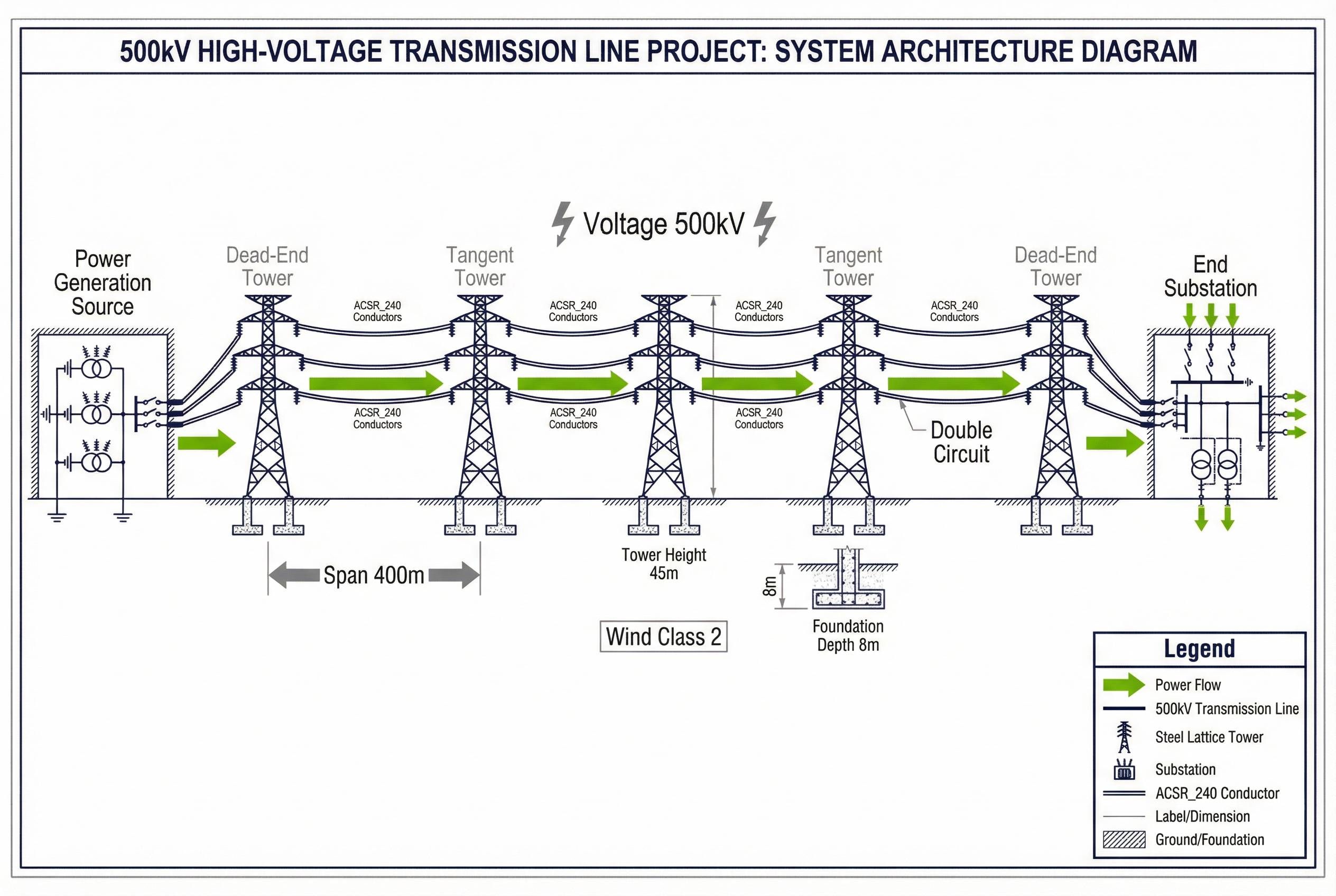 System architecture diagram generated from customer configuration
Key architectural aspects:
- 21 steel lattice dead-end towers along the corridor
- 500 kV double-circuit configuration using ACSR_240 conductors
- Typical 400 m span length between towers
- Integrated grounding and climbing systems on each tower
- Dedicated reinforced concrete foundations for each structure
According to CIGRÉ and IEC guidance, dead-end towers are critical nodes for tensioning and sectioning of long-distance lines, providing mechanical anchoring and flexibility for future network reconfiguration.
Structural and Material Considerations
The towers are fabricated from hot-dip galvanized steel, a standard practice for coastal and desert environments. IEC and ASTM research indicates that hot-dip galvanizing can provide over 25–50 years of corrosion protection in C3–C4 environments when properly specified.
Key structural design priorities:
- 30 m/s design wind speed for Class 2 conditions
- 71.2 kN wind load capacity with safety factors per IEC 60826
- 1,921.4 kN·m bending moment capacity at the base
- 135 mm maximum deflection to maintain conductor clearances
SOLAR TODO leverages standardized lattice geometries proven in 10–220 kV product lines, scaled and reinforced for 500 kV duty. This reduces engineering risk and accelerates design approval.
Electrical Configuration
The electrical design is based on ACSR_240 conductors in a double-circuit arrangement:
- Conductor type: ACSR_240 (Aluminum Conductor Steel Reinforced)
- Application: Two independent 500 kV circuits on each tower
- Span length: 400 m, balanced between cost and mechanical loading
According to IEEE transmission line design practice, ACSR conductors are widely used for high-voltage lines due to their balance of tensile strength, conductivity, and thermal rating. IEEE states, “ACSR remains the predominant conductor type for overhead transmission in the 110–500 kV range.”
Cost Structure and Three-Tier Pricing
This case study is anchored on verified commercial pricing for the full 21-tower configuration in Lusail. SOLAR TODO offers three contractual models: FOB (ex-works), CIF (port delivery), and turnkey (installed).
Three-Tier Pricing Overview
| Pricing Model | Description | Total Price (USD) |
|---|---|---|
| FOB | Ex-Works (factory only) | $2,325,097 |
| CIF | Port Delivery (to port) | $2,861,657 |
| Turnkey | Installed (complete) | $3,577,072 |
These prices are fixed for the defined configuration and must not be extrapolated to other projects without engineering review. According to IEA (2023), transmission infrastructure CAPEX has remained relatively stable in real terms, but logistics and construction costs can vary by 20–30% by region, underscoring the value of clear pricing tiers.
Detailed Equipment List
The following equipment schedule covers the main physical components for the 21-tower system.
| Item | Qty | Unit Price (USD) | Total (USD) |
|---|---|---|---|
| Steel Lattice Tower Structure | 21 | 144,639 | 3,037,419 |
| ACSR_240 Conductor | 21 | 2,880 | 60,480 |
| Tower Foundation | 21 | 7,700 | 161,700 |
| Climbing Ladder | 21 | 400 | 8,400 |
| Grounding System | 21 | 400 | 8,400 |
Note: The equipment list totals reflect material and primary components. The turnkey price of $3,577,072 additionally covers services such as logistics, construction, installation, and commissioning within the agreed scope.
FOB vs CIF vs Turnkey: Strategic Considerations
For a Lusail-based project, procurement teams must align pricing model selection with internal capabilities and risk appetite.
-
FOB $2,325,097
- Buyer manages international freight, insurance, customs, and inland logistics.
- Suitable for EPCs with strong logistics teams and local construction capacity.
-
CIF $2,861,657
- SOLAR TODO manages freight and insurance to the destination port.
- Buyer handles port clearance and inland transport/installation.
-
Turnkey $3,577,072
- SOLAR TODO delivers a complete installed system.
- Minimizes interface risk and simplifies project management.
According to IEA (2021), project delays can increase effective transmission CAPEX by 10–20%. Turnkey models often reduce schedule risk by consolidating responsibility.
ROI and Business Case for Lusail
The Lusail configuration is not only technically robust but also financially attractive, with quantified savings and payback.
Verified ROI Metrics
The project’s ROI analysis is based on real customer data:
- Payback period: 5 years
- Annual savings: $715,414
This implies that over a 5-year horizon, cumulative savings approximately match the $3,577,072 turnkey investment. Over the 50-year design life, even accounting for maintenance and discounting, the net present value is strongly positive.
According to IRENA (2022), transmission upgrades that reduce losses and enable higher penetration of efficient generation can deliver internal rates of return above 10–15% in many emerging markets. The Lusail system supports such gains by:
- Reducing technical losses through optimized conductor sizing and span design
- Increasing network reliability and reducing outage costs
- Enabling integration of new generation and load centers in Lusail
Value Drivers for B2B Decision-Makers
For utilities, IPPs, and EPCs operating in Qatar and the wider GCC, the Lusail case highlights several value drivers:
- Reliability: 500 kV double-circuit design with 50-year life and IEC-compliant loading.
- Cost Control: Transparent three-tier pricing and standardized BoM reduce budget uncertainty.
- Speed: Pre-engineered 45 m towers and repeatable foundations accelerate deployment.
- Compliance: Alignment with IEC 60826 and GB 50545 simplifies approvals and financing.
- Scalability: The 21-tower block can be replicated or extended for future corridors.
SOLAR TODO emphasizes that “standardized, pre-validated tower configurations significantly reduce both engineering lead time and construction risk for high-voltage projects.”
Applications, Use Cases, and Extension to Other Projects
While this case is specific to Lusail, the configuration principles are broadly applicable across GCC and international markets.
Lusail-Specific Use Case
Lusail’s rapid urban expansion requires:
- High-capacity backbone lines to connect new substations
- Robust structures to withstand coastal winds and saline atmosphere
- Long spans (400 m) to cross infrastructure and constrained corridors
The 45 m dead-end tower design is particularly suited for:
- Sectionalizing long 500 kV lines
- Terminal points near substations
- Angle and tension points in complex routing
Transferable Lessons for Other Regions
The same 45 m, 500 kV dead-end tower concept can be adapted to:
- Other GCC cities with Class 2 wind and similar loading
- International projects requiring 10–220 kV towers, using SOLAR TODO’s broader product family
- Hybrid corridors where power and telecom infrastructure may share right-of-way
According to NREL (2023), standardized infrastructure designs can reduce engineering and permitting timelines by 20–30% compared to bespoke designs. SOLAR TODO’s portfolio of power transmission towers and telecom towers leverages this standardization.
Comparison with Other SOLAR TODO Power Tower Configurations
Although this Lusail project is a 500 kV steel lattice system, SOLAR TODO offers a spectrum of power tower solutions for different voltage levels and environments.
| Configuration | Height | Voltage Level | Material/Type | Typical Price Range (USD) | Use Case |
|---|---|---|---|---|---|
| 15 m Telecom-Power Hybrid FRP Pole | 15 m | 10 kV | FRP Hybrid Pole | $4,500–$6,500 | Distribution + telecom |
| 30 m 220 kV Carbon-FRP Hybrid | 30 m | 220 kV | Carbon-FRP Hybrid | $35,000–$50,000 | Seismic Zone 4, lightweight |
| 45 m 220 kV Angle Tower (Steel Lattice) | 45 m | 220 kV | Steel Lattice Angle Tower | $48,000–$65,000 | Double-circuit transmission |
| 55 m 220 kV Dead-End Tower (Steel) | 55 m | 220 kV | Hot-Dip Galvanized Steel | $75,000–$100,000 | Full-tension dead-end |
| 45 m 500 kV Dead-End Tower (Lusail Project) | 45 m | 500 kV | Steel Lattice Dead-End Tower | Project-based (see above) | High-voltage backbone (Lusail) |
This table illustrates how the Lusail system sits at the upper end of SOLAR TODO’s voltage range, while leveraging similar design philosophies used in 220 kV towers.
Selection Guide for Procurement and Engineering Teams
When evaluating a 500 kV tower solution similar to Lusail, B2B decision-makers should consider:
-
Voltage and Circuit Count
- Confirm 500 kV and double-circuit requirements.
- Validate compatibility with existing substations and protection schemes.
-
Environmental Conditions
- Wind class (Class 2, 30 m/s for Lusail).
- Corrosion category (coastal, saline, desert dust).
-
Span and Routing
- 400 m spans as a baseline; adjust for crossings and constraints.
- Need for dead-end, angle, and suspension tower mixes.
-
Procurement Model
- Select between FOB, CIF, and turnkey based on internal capabilities.
- Align contract structure with financing and risk allocation.
-
Standards and Compliance
- Ensure adherence to IEC 60826 and relevant national codes.
- Coordinate with grid operator requirements and protection settings.
According to IEEE (2018), well-coordinated transmission planning and standardization can reduce lifecycle costs by up to 15% while improving reliability indices.
FAQ
Q: What does the $3,577,072 turnkey price include for the Lusail power transmission tower project? A: The $3,577,072 turnkey price covers the complete 21-tower system installed, including steel lattice tower structures, ACSR_240 conductors, tower foundations, climbing ladders, and grounding systems, plus logistics, construction, and installation within the agreed scope. It is based on the verified 45 m, 500 kV dead-end tower configuration for Lusail.
Q: How do the FOB $2,325,097 and CIF $2,861,657 prices differ from the turnkey option? A: The FOB $2,325,097 price is ex-works, covering equipment at the factory gate, while the CIF $2,861,657 price includes freight and insurance to the destination port. Neither includes inland transport, construction, or installation, which are only part of the $3,577,072 turnkey package.
Q: What are the main technical specifications of each Lusail transmission tower? A: Each tower is 45 m high, designed for 500 kV double-circuit operation with ACSR_240 conductors and 400 m spans. The structure is hot-dip galvanized steel, Class 2 wind rated at 30 m/s, with 71.2 kN wind load, 1,921.4 kN·m bending moment, 135 mm deflection, and a 50-year design life per IEC 60826 / GB 50545.
Q: How many towers are included in the Lusail project and what is their total weight? A: The Lusail configuration includes 21 steel lattice dead-end towers. Each tower has a total weight of 67,500 kg, giving a substantial structural mass to withstand the 30 m/s design wind speed and 71.2 kN wind load while maintaining required electrical clearances and mechanical reliability.
Q: What components are listed in the equipment schedule and their costs? A: The equipment list includes 21 steel lattice tower structures at $144,639 each (total $3,037,419), ACSR_240 conductors at $2,880 per unit (total $60,480), 21 tower foundations at $7,700 each (total $161,700), and 21 climbing ladders and grounding systems at $400 each (totals $8,400 each).
Q: What is the expected financial return of this 500 kV tower project in Lusail? A: The verified ROI analysis shows a 5-year payback period with annual savings of $715,414 based on reduced losses, improved reliability, and optimized network operation. Over the 50-year design life, the system is expected to generate substantial net economic benefits beyond the $3,577,072 turnkey investment.
Q: Why was a dead-end tower configuration chosen instead of only suspension towers? A: Dead-end towers provide mechanical anchoring and sectioning for the 500 kV line, essential for tension management, route changes, and substation terminations. For Lusail’s 400 m spans and high-capacity backbone role, dead-end towers increase robustness and flexibility, aligning with IEC 60826 recommendations for critical line sections.
Q: How does the 30 m/s design wind speed and Class 2 rating relate to Qatar’s conditions? A: The 30 m/s design wind speed and Class 2 rating reflect typical design practice for coastal and desert environments like Lusail, providing a safety margin against extreme events. This ensures the 45 m towers maintain structural integrity and conductor clearances under expected wind conditions over the 50-year design life.
Q: Which international standards govern the design of the Lusail transmission towers? A: The towers are designed according to IEC 60826 for overhead line loading and strength, and GB 50545 for structural design. These standards define wind, ice (where applicable), and mechanical load combinations, safety factors, and reliability criteria, ensuring the 500 kV system meets international best practices.
Q: Can this 45 m, 500 kV tower configuration be adapted to other regions or voltage levels? A: The specific Lusail design is optimized for 500 kV and Class 2 wind, but the underlying SOLAR TODO platform is adaptable. For other regions or voltage levels (10–220 kV), SOLAR TODO offers FRP poles, 220 kV angle towers, and 55 m dead-end towers, using similar engineering principles while recalculating loads and clearances.
Q: What role does SOLAR TODO play across the project lifecycle for a turnkey contract? A: For turnkey contracts, SOLAR TODO provides engineering, manufacturing, logistics to site, construction, installation, and coordination for commissioning of the 21-tower system. This single-responsibility model reduces interface risk, simplifies project management, and aligns with lenders’ preference for consolidated EPC responsibility.
Q: What factors influence the price of steel lattice communication towers? A: The price of steel lattice communication towers is influenced by various factors, including material costs, design specifications, wind load requirements, and installation complexities. Additionally, regional market conditions and demand for transmission infrastructure can impact overall pricing.
Q: What are the benefits of using steel lattice towers? A: Steel lattice towers offer several advantages, including high strength-to-weight ratios, resistance to extreme weather conditions, and cost-effectiveness in large-scale deployments. Their design allows for easy maintenance and adaptability to various transmission needs, making them a preferred choice for many utility companies.
Related Reading
References
- IEC 60826 (2017): Design criteria of overhead transmission lines – Defines loading conditions and strength requirements for reliable line design.
- GB 50545 (2010): Code for design of overhead transmission line – Chinese national standard referenced for structural and loading guidance.
- IEA (2023): World Energy Outlook 2023 – Provides projections of electricity demand growth in the Middle East and globally.
- IRENA (2022): Planning for the Renewable Future – Guidance on transmission upgrades and economic benefits of grid reinforcement.
- IEEE (2018): IEEE Guide for the Design of Overhead Transmission Lines – Best practices for conductor selection, mechanical design, and reliability.
- NREL (2023): Standardization and Modularization in Grid Infrastructure – Analysis of how standardized designs reduce project timelines and costs.
Conclusion
For high-growth nodes like Lusail, SOLAR TODO’s 45 m, 500 kV dead-end tower system delivers a complete 21-tower backbone at a $3,577,072 turnkey price, with a 5-year payback and $715,414 annual savings. For utilities and EPCs seeking reliable, IEC-compliant transmission infrastructure, this configuration offers a proven, financially attractive reference design.
About SOLARTODO
SOLARTODO is a global integrated solution provider specializing in solar power generation systems, energy-storage products, smart street-lighting and solar street-lighting, intelligent security & IoT linkage systems, power transmission towers, telecom communication towers, and smart-agriculture solutions for worldwide B2B customers.
About the Author

SOLAR TODO
Solar Energy & Infrastructure Expert Team
SOLAR TODO is a professional supplier of solar energy, energy storage, smart lighting, smart agriculture, security systems, communication towers, and power tower equipment.
Our technical team has over 15 years of experience in renewable energy and infrastructure, providing high-quality products and solutions to B2B customers worldwide.
Expertise: PV system design, energy storage optimization, smart lighting integration, smart agriculture monitoring, security system integration, communication and power tower supply.
Cite This Article
SOLAR TODO. (2026). Power Transmission Tower in Qatar, Lusail — $3,577,072 Turnk. SOLAR TODO. Retrieved from https://solartodo.com/knowledge/power-transmission-tower-in-qatar-lusail-3577072-turnkey
@article{solartodo_power_transmission_tower_in_qatar_lusail_3577072_turnkey,
  title = {Power Transmission Tower in Qatar, Lusail — $3,577,072 Turnk},
  author = {SOLAR TODO},
  journal = {SOLAR TODO Knowledge Base},
  year = {2026},
  url = {https://solartodo.com/knowledge/power-transmission-tower-in-qatar-lusail-3577072-turnkey},
  note = {Accessed: 2026-03-20}
}
Published: March 20, 2026 | Available at: https://solartodo.com/knowledge/power-transmission-tower-in-qatar-lusail-3577072-turnkey
Subscribe to Our Newsletter
Get the latest solar energy news and insights delivered to your inbox.
View All Articles