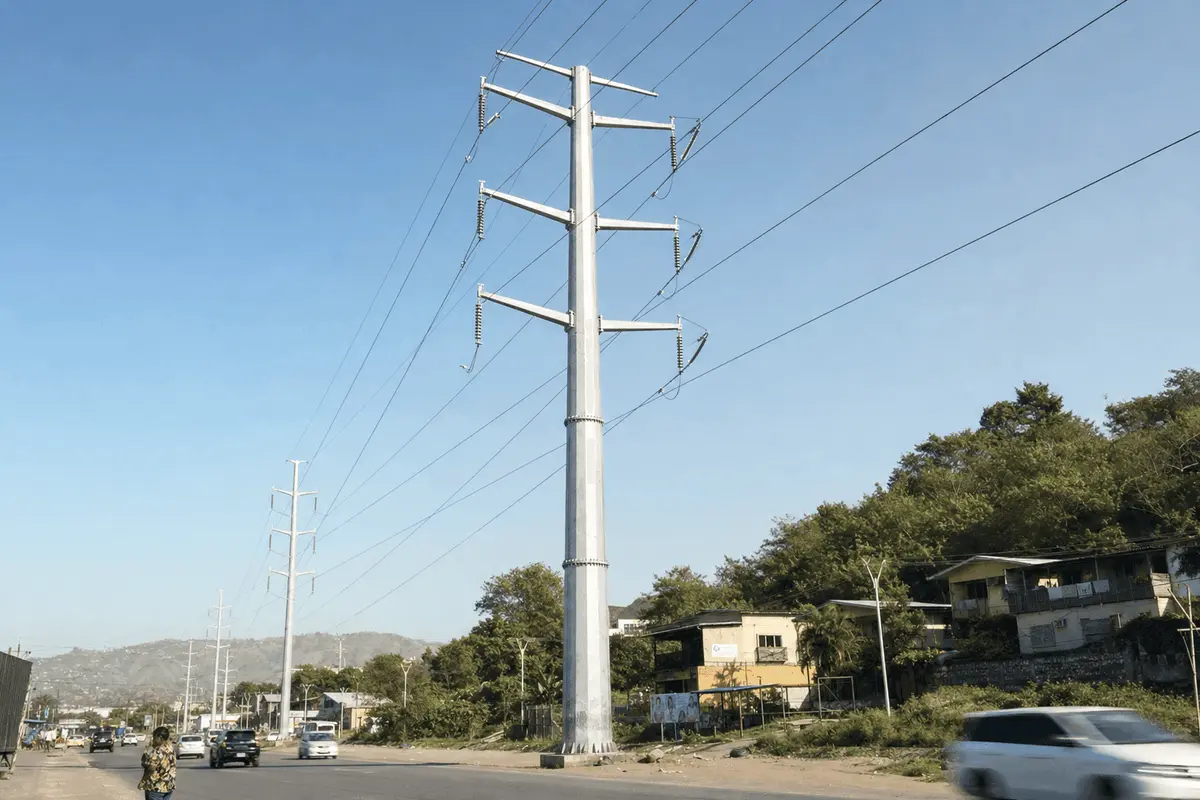
Port Moresby Power Transmission Tower Market Analysis: 110kV Double-Circuit Steel Tubular Pole Guide
Summary
Port Moresby’s 756,754-person capital grid profile supports a 110kV double-circuit Power Transmission Tower configuration using approximately 58 steel tubular poles, 35m height, ACSR-240 conductor, and 12km line length.
Key Takeaways
This Port Moresby guide recommends a 58-unit, 110kV backbone configuration with 200m spans, 30m/s wind design, and 30-year service life.
- A typical NCD backbone segment would use approximately 58 tapered steel tubular poles over about 12km, based on 200m spans.
- The recommended voltage class is 110kV double circuit, with ACSR-240 conductor rated at about 920kg/km and 70kN maximum tension.
- Each pole is specified at 35m height and about 35t/pole under a 1000kg/m double-circuit structural loading basis.
- The configuration uses Q345 hot-dip galvanized steel, flanged bolted sections, and concrete base foundations with anchor cages.
- The design basis includes IEC 60826, GB 50545, and DL/T 5092 for overhead-line loading, tower design, and Chinese transmission practice.
- Port Moresby’s annual rainfall is roughly 900-1,170mm, so corrosion control, drainage, grounding, and access logistics matter more than snow loading.
- SOLARTODO should position this as a high-voltage transmission backbone recommendation, not a fabricated installation record or completed project claim.
Market Context for Port Moresby
Port Moresby’s transmission demand is shaped by a capital-city load center, isolated grid topology, and national electrification constraints below mature-market levels.
Port Moresby is Papua New Guinea’s capital and the commercial center of the National Capital District. Public population summaries report 364,145 residents in the 2011 census and 756,754 in the 2024 census, creating a dense urban load pocket compared with PNG’s mostly rural national settlement pattern. According to World Bank data cited in public country profiles, PNG’s urban electricity access was about 80.23% in 2017, while rural access was about 50.42%, showing why grid reinforcement remains a national infrastructure priority.
According to IRENA (2013), PNG Power operates three separate grid systems, including the Port Moresby system serving the National Capital District. That topology makes Port Moresby different from an interconnected continental grid: a single 110kV backbone reinforcement can have visible reliability value because redundancy options are geographically limited. The city’s load is also tied to water, airport, port, government, commercial, and LNG-adjacent infrastructure rather than only residential distribution.
Climate and constructability also affect tower selection. According to World Bank climate-risk reporting and public climate summaries, Port Moresby sits in a comparatively dry rain-shadow zone for PNG, with annual rainfall often cited below 1,000mm to around 1,170mm depending on dataset. The main engineering issues are therefore tropical corrosion, salt-laden coastal exposure, wet-season access, lightning performance, grounding resistance, and wind loading rather than ice accretion. World Bank states, "access to electricity" as a core development indicator; for Port Moresby, that indicator translates into a need for transmission assets that reduce bottlenecks before distribution upgrades can perform.
Recommended Technical Configuration
A typical 110kV Port Moresby backbone segment would use approximately 58 double-circuit steel tubular poles over 12km with 200m spans.
For this city profile, the recommended SOLARTODO Power Transmission Tower configuration is a high-voltage steel tubular monopole line, not lattice, FRP, wood, or concrete. A standard 66-110kV sub-transmission class normally sits in the 18-30m, 5-15t/pole range for many utility corridors. However, the specified Port Moresby backbone configuration is a heavy-duty 110kV double-circuit monopole class: 35m height, approximately 35t per pole, and 1000kg/m structural loading for the double-circuit variant.
A typical 58-unit deployment of this scale would consist of hot-dip galvanized Q345 tapered steel tubular poles with flanged bolted sections. The line would use ACSR-240 conductors, 4m phase spacing, 6m ground clearance, 1.5m insulator strings, and concrete base foundations. Accessories should include climbing steps, cross arms, grounding, bird guards, and vibration dampers because Port Moresby corridors combine urban access constraints with tropical exposure.
According to IEC (2017), IEC 60826 covers "Design criteria of overhead transmission lines." SOLARTODO’s recommended design workflow should therefore start with voltage class, wind class, conductor tension, clearance, and foundation bearing data before final pole detailing. For procurement planning, the Power Transmission Tower product page should be used for configuration review, while technical teams can contact us for line-specific drawings and foundation schedules.
Technical Specifications
The recommended technical package is a 110kV double-circuit steel tubular pole system with 35m height, ACSR-240 conductors, and 30m/s wind design.
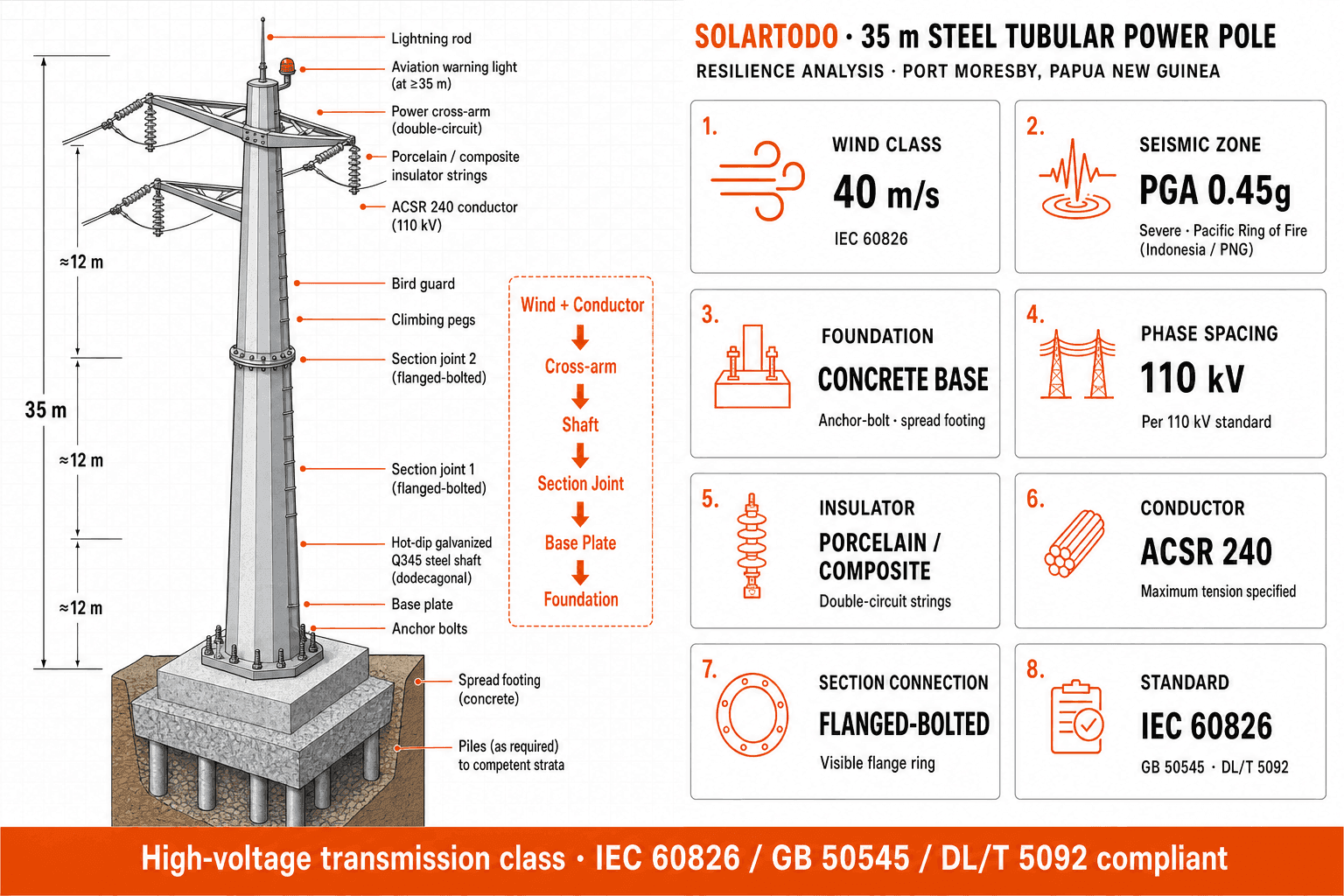
- Product form: tapered round or dodecagonal steel tubular monopole, hot-dip galvanized, not lattice and not FRP.
- Quantity basis: approximately 58 units for a typical 12km line at 200m span spacing.
- Voltage and circuit: 110kV double circuit, high-voltage transmission backbone class.
- Pole height and weight: 35m tapered steel tubular pole, approximately 35t/pole under 1000kg/m double-circuit loading.
- Steel grade: Q345 hot-dip galvanized steel, with Q420 available for higher stress checks where required.
- Conductor: ACSR-240, approximately 920kg/km, with maximum tension around 70kN.
- Clearances: 4m phase spacing and 6m ground clearance, subject to route survey and final sag-tension study.
- Insulation: 1.5m insulator strings with cross-arm brackets for conductor and insulator attachment.
- Foundations: concrete base foundation with anchor cage, drainage detailing, and geotechnical confirmation before casting.
- Wind class: Class 2, 30m/s design wind, with final checks under IEC 60826 loading combinations.
- Accessories: climbing steps, cross arm, grounding, bird guard, vibration damper, and galvanized connection hardware.
- Design life: 30 years with periodic inspection, corrosion checks, bolt torque audits, and grounding resistance testing.
- Standards: IEC 60826, GB 50545, and DL/T 5092.
According to GB 50545 (2010), overhead transmission design practice defines structural, clearance, and loading requirements for AC line engineering. According to DL/T 5092 (1999), transmission tower structural design requires load-case verification for conductor, wind, and installation conditions. For Port Moresby, those standards should be applied with local geotechnical data, utility clearance rules, and coastal corrosion assumptions.
Implementation Approach
A 12km Port Moresby tower program would typically move through survey, detailed design, procurement, shipping, foundations, erection, stringing, and commissioning.
The first phase is corridor confirmation: route survey, soil investigation, land-access review, utility interface mapping, and clearance modeling. For approximately 58 pole sites, a practical engineering package would include pole spotting tables, foundation drawings, sag-tension charts, earthing layout, and transport lifting plans. This stage should verify that the 35m heavy-duty monopole class is justified by terrain, conductor geometry, road crossings, existing network interfaces, and future line capacity.
The second phase is manufacturing and logistics. SOLARTODO would normally prepare flanged pole sections, cross arms, anchor cages, insulator hardware, grounding materials, and conductor accessories for CKD or section-based shipment. For Port Moresby, packaging should account for ocean freight handling, port laydown space, tropical storage, and wet-season transport windows. Hot-dip galvanized surfaces should be protected from abrasion during unloading and inland hauling.
The third phase is civil and electrical installation. Concrete base foundations are excavated, reinforced, fitted with anchor cages, poured, cured, and surveyed for bolt alignment. Pole sections are erected by crane, bolted at flanges, fitted with cross arms and insulators, then strung with ACSR-240 conductors. Commissioning should include grounding resistance checks, bolt torque records, conductor sag verification, vibration damper placement, bird-guard confirmation, and as-built route documentation.
Expected Performance & ROI
Expected value comes from higher transfer capacity, reduced corridor congestion, and 30-year asset life rather than short-term commodity-price savings.
A 110kV double-circuit line using ACSR-240 provides stronger backbone capacity than a lower-voltage distribution extension because it can move bulk power between substations with lower current for a given delivered power. For Port Moresby, that matters because the grid is a capital-city system with concentrated loads and limited interconnection diversity. According to ADB (2022), the "Port Moresby Power Grid Development Project" reflects the strategic importance of reinforcing the capital’s network.
ROI should be assessed as avoided outage cost, reduced technical losses, deferred corridor duplication, and improved ability to connect generation or substations. Without using article-level prices, a utility-grade evaluation would compare a 30-year lifecycle model against alternatives such as wood poles, concrete poles, underground cable, or lattice towers. The monopole advantage is strongest where right-of-way is constrained, visual footprint matters, and fast erection reduces urban disruption.
Maintenance economics are also part of ROI. Hot-dip galvanized Q345 steel, concrete foundations, vibration dampers, bird guards, and grounding accessories reduce predictable failure modes when inspections are disciplined. A typical maintenance plan would include annual visual inspection, post-storm patrols after severe wind events, five-year corrosion and bolt audits, and grounding checks after major soil or drainage changes.
Comparison Table
The 110kV steel tubular monopole option balances 12km backbone capacity, compact corridor footprint, and faster erection than lattice alternatives.
| Option | Typical voltage class | Height range | Pole/tower mass | Corridor fit | Port Moresby technical fit |
|---|---|---|---|---|---|
| SOLARTODO steel tubular monopole | 110kV double circuit | 35m specified | ~35t/pole specified | Compact urban and peri-urban ROW | Recommended for backbone reinforcement |
| Standard 66-110kV sub-transmission pole | 66-110kV | 18-30m | 5-15t/pole | Good for lighter corridors | Suitable where 35m clearance is not required |
| Lattice transmission tower | 110-220kV | 25-55m typical | Variable steel tonnage | Wider footprint | Strong but less compact in urban routes |
| Concrete pole | 10-35kV typical | 12-18m | Heavy handling | Distribution corridors | Not recommended for this 110kV backbone profile |
| Underground cable | 66-110kV | N/A | N/A | Minimal visual impact | High civil complexity and repair time |
Pricing & Quotation
SOLARTODO structures quotations around 3 delivery scopes while excluding public article pricing to preserve project-specific engineering accuracy.
SOLARTODO offers three pricing tiers for this product line: FOB Supply (equipment ex-works China), CIF Delivered (including ocean freight and insurance), and EPC Turnkey (fully installed, commissioned, with 1-year warranty). Volume discounts are available for large-scale deployments. Configure your system online for an instant estimate, or request a custom quotation from our engineering team at [email protected].
For Port Moresby, quotation inputs should include route length, pole count, voltage class, wind speed, conductor family, foundation soil data, shipping terms, installation scope, and utility acceptance requirements. SOLARTODO can align the Power Transmission Tower configuration with IEC 60826, GB 50545, and DL/T 5092 checks before final commercial submission.
Frequently Asked Questions
These 10 FAQ answers cover the 110kV configuration, 58-pole quantity basis, installation process, maintenance, pricing scope, and warranty assumptions.
Q1: What Power Transmission Tower configuration fits Port Moresby’s 110kV backbone needs? A typical Port Moresby backbone configuration would use approximately 58 tapered steel tubular monopoles for a 12km, 110kV double-circuit line. The specified design uses 35m poles, about 35t per pole, ACSR-240 conductors, 200m spans, 4m phase spacing, and concrete base foundations. This is a technical recommendation, not a claim of completed deployment.
Q2: Why use steel tubular monopoles instead of lattice towers? Steel tubular monopoles provide a smaller footprint, cleaner urban profile, and faster section-by-section erection than lattice towers. For a 12km Port Moresby route with approximately 58 pole sites, fewer foundation footprint conflicts can reduce access complexity. Lattice towers remain useful for wide corridors, but monopoles are better when right-of-way, visual impact, and installation speed matter.
Q3: Is 35m height normal for every 110kV line? No. A standard 66-110kV sub-transmission class often uses 18-30m structures with 5-15t per pole. This recommended Port Moresby configuration is a heavier 110kV high-voltage backbone profile with 35m height and about 35t per pole. Final acceptance should depend on route survey, clearances, wind loading, conductor sag, and utility review.
Q4: What conductor is recommended for this line? The recommended conductor is ACSR-240, with approximate mass of 920kg/km and maximum tension around 70kN. This conductor family is appropriate for a 110kV double-circuit backbone where strength, availability, and utility familiarity matter. Sag-tension calculations should be completed using Port Moresby temperature, span, wind, and clearance assumptions before procurement.
Q5: How long would installation typically take? A 58-pole, 12km program is commonly planned in phases: survey and design, manufacturing, ocean freight, foundation works, pole erection, stringing, and commissioning. The actual timeline depends on land access, wet-season logistics, port clearance, crane availability, and utility outage windows. A practical schedule should include foundation curing time and post-erection inspection before energization.
Q6: What maintenance is required over a 30-year design life? Maintenance should include annual patrols, post-storm inspection, bolt torque checks, grounding resistance tests, corrosion inspection, bird-guard review, and vibration damper inspection. Hot-dip galvanized Q345 steel reduces corrosion risk, but coastal tropical exposure still requires disciplined inspection. The 30-year design life assumes routine maintenance and timely repair of damaged coating, hardware, or earthing components.
Q7: How should ROI or payback be evaluated without public pricing? ROI should be modeled through avoided outage cost, reduced technical losses, corridor efficiency, deferred rebuilds, and improved substation or generation connection capacity. Public pricing is not appropriate because foundations, freight, access, and utility requirements vary by route. For Port Moresby, the strongest value case is usually reliability and backbone capacity over a 30-year lifecycle.
Q8: What standards should the design follow? The technical basis should include IEC 60826 for overhead transmission-line design criteria, GB 50545 for AC overhead line design, and DL/T 5092 for transmission tower structural design. Local utility requirements, geotechnical reports, environmental permits, and clearance rules must also be applied. Standards alignment should be documented before manufacturing drawings are released.
Q9: What is included in an EPC quotation? An EPC Turnkey quotation normally includes detailed engineering, supply, logistics coordination, civil foundations, pole erection, conductor stringing, accessories, commissioning, and a 1-year warranty. For this product line, SOLARTODO also offers FOB Supply and CIF Delivered scopes. The right scope depends on whether the buyer has local civil, crane, and utility-interface capacity.
Q10: What foundation type is recommended for Port Moresby? The specified foundation is a concrete base foundation with anchor cage, designed after soil investigation and load verification. For a 35m, approximately 35t steel tubular pole, foundation design must consider overturning, uplift, drainage, corrosion at the base plate, and construction access. Wet-season excavation and concrete curing should be included in the implementation schedule.
References
The references below provide 7 authority anchors for Port Moresby context, PNG electrification data, grid planning, and transmission-line design standards.
- World Bank (2021): Climate Risk Country Profile for Papua New Guinea; identifies tropical hazard exposure, rainfall variability, and infrastructure resilience concerns.
- World Bank SE4ALL Database (2017): PNG electricity access indicators, including about 80.23% urban access and 50.42% rural access in cited country datasets.
- IRENA (2013): Pacific Lighthouses, Papua New Guinea; describes PNG Power’s separate Port Moresby, Ramu, and Gazelle grid systems.
- Asian Development Bank (2022): Papua New Guinea: Port Moresby Power Grid Development Project; supports the strategic need for capital-grid reinforcement.
- IEC (2017): IEC 60826, Design criteria of overhead transmission lines; governs overhead-line loading and design criteria.
- GB 50545 (2010): Code for design of 110kV-750kV overhead transmission lines; provides AC overhead-line design requirements used in Chinese engineering practice.
- DL/T 5092 (1999): Technical code for designing 110kV-500kV overhead transmission line tower structures; supports tower structural load-case design.
Equipment Deployed
- 58 units x 35m tapered steel tubular pole for 110kV double-circuit line
- Hot-dip galvanized Q345 steel monopole, flanged bolt sections
- Approx. 35t per pole, 1000kg/m double-circuit structural loading basis
- ACSR-240 conductor, approx. 920kg/km, max tension 70kN
- 4m phase spacing, 6m ground clearance, 1.5m insulator length
- 200m span, total line length approx. 12km
- Wind class 2, 30m/s design wind
- Concrete base foundation with anchor cage
- Accessories: climbing steps, cross arm, grounding, bird guard, vibration damper
- Design life 30 years; standards IEC 60826, GB 50545, DL/T 5092