Commercial Solar PV Systems for Factory Carbon Targets

SOLAR TODO
Solar Energy & Infrastructure Expert Team
Watch the video
TL;DR
Manufacturing facilities can use Commercial Solar PV Systems to reduce electricity-related carbon emissions by roughly 20-60%, especially when daytime process loads match solar output. Typical factory projects in the 100-500 kWp range often pay back in 4-7 years, while a 50 kW solar carport can generate 75-90 MWh/year and avoid about 45-54 tons of CO2 annually. SOLAR TODO supports supply and EPC quotation for site-specific projects.
Commercial Solar PV Systems help factories cut Scope 2 emissions by 20-60%, generate 75-90 MWh/year from a 50 kW solar carport, and often reach 4-7 year payback where tariffs are $0.10-$0.18/kWh.
Summary
Commercial Solar PV Systems help factories cut Scope 2 emissions by 20-60%, generate 75-90 MWh/year from a 50 kW solar carport, and often reach 4-7 year payback where tariffs are $0.10-$0.18/kWh. This article explains sizing, EPC pricing, ROI, and compliance.
Key Takeaways
- Quantify baseline electricity use first; a factory consuming 500-1,500 MWh/year can often offset 10-35% of grid demand with a 300-800 kWp Commercial Solar PV System.
- Match system size to daytime load; keeping self-consumption above 70% usually improves payback to roughly 4-7 years at power prices of $0.10-$0.18/kWh.
- Select N-type TOPCon modules with 22.5-24.5% efficiency when roof or carport area is limited and annual yield per square meter matters.
- Verify compliance with IEC 61215, IEC 61730, IEEE 1547, and local interconnection rules before procurement to reduce approval and commissioning delays.
- Compare mounting options carefully; a 50 kW solar carport can cover about 320-420 m2 and produce 75-90 MWh/year while adding EV-ready parking value.
- Structure procurement in 3 tiers: FOB Supply, CIF Delivered, and EPC Turnkey, then apply volume discounts of 5% at 50+, 10% at 100+, and 15% at 250+ units.
- Model carbon reduction with actual grid factors; at 0.60 tCO2/MWh, a 50 kW system producing 75-90 MWh/year can avoid about 45-54 tons of CO2 annually.
- Plan maintenance every 12 months and inverter checks every 6 months to keep long-term performance near modeled output over a 25-30 year project life.
Why manufacturing facilities use Commercial Solar PV Systems to meet carbon targets
Commercial Solar PV Systems can reduce factory grid electricity purchases by 15-40% and cut Scope 2 emissions by 20-60% when matched to daytime loads and available roof or carport area.
Manufacturing facilities face pressure from customer audits, ESG reporting, and internal decarbonization plans. In most plants, electricity is one of the largest controllable contributors to operational carbon footprint, especially where daytime demand from motors, compressors, HVAC, chillers, and process lines runs between 08:00 and 18:00. That load profile aligns well with solar generation, which is why factory solar projects are now reviewed as energy assets rather than only sustainability projects.
According to the International Energy Agency, "Solar PV is set to become the largest renewable power source by installed capacity" in global power expansion pathways. For factory managers, that matters because the technology is mature, bankable, and measurable in kWh, tCO2, and payback years. According to IRENA (2024), utility-scale solar PV remains among the lowest-cost new power sources globally, and distributed commercial systems benefit from the same module and inverter cost declines.
SOLAR TODO works with B2B buyers that need practical project structuring rather than online checkout. For manufacturing sites, the first step is usually a load study covering at least 12 months of bills, interval demand data, roof condition, and local interconnection rules. A plant with 1,000 MWh/year consumption does not need to offset 100% of demand to make a carbon impact; even a 300-500 kWp system can create visible emission reductions and hedge tariff escalation.
According to NREL PVWatts methodology, fixed-tilt commercial PV in good solar regions commonly reaches a capacity factor of about 17-20%. That means a 500 kWp system may produce roughly 745-876 MWh/year depending on irradiation, tilt, temperature, and shading assumptions. If the local grid emission factor is 0.45-0.70 tCO2/MWh, annual avoided emissions can land in the range of about 335-613 tons of CO2.
Technical design factors that determine carbon and financial performance
Correct sizing, module selection, inverter architecture, and interconnection design usually determine more than 80% of a factory solar project's lifetime yield, uptime, and payback outcome.
The technical objective is simple: maximize useful daytime solar consumption while keeping electrical design compliant with site conditions. In manufacturing, the best-performing systems are often sized below annual daytime baseload rather than above it. This approach limits low-value exports, improves self-consumption, and reduces transformer or protection upgrade costs.
Load profile and system sizing
A factory with a stable daytime demand of 200-400 kW can often absorb a 150-300 kWp array with self-consumption above 80%. If the site runs two shifts and maintains daytime process loads on weekdays, the PV output curve will overlap strongly with facility demand. According to NREL (2024), better load matching improves the economic value of each generated kWh because fewer units are exported at discounted tariffs.
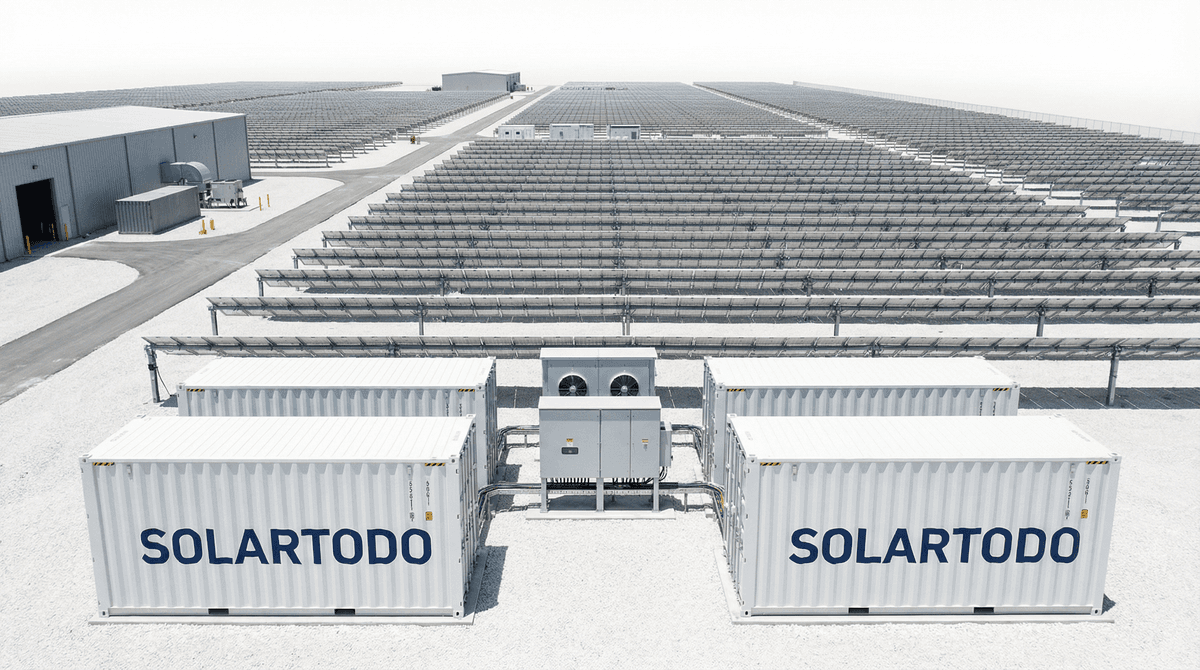
For sites with parking areas but limited roof strength, a solar carport is often the practical option. The SOLAR TODO 50kW Factory Solar Carport uses N-type TOPCon mono modules with stated module efficiency up to 24.5% and typically generates 75-90 MWh/year in irradiation bands of 1,500-1,800 kWh/m2/year. At a grid factor of 0.60 tCO2/MWh, that output avoids about 45-54 tons of CO2 each year.
Module, inverter, and BOS selection
N-type TOPCon modules have become mainstream in 2025-2026, with multiple market trackers such as BloombergNEF and Wood Mackenzie reporting strong adoption due to higher efficiency and lower degradation compared with older P-type products. For factories where roof area is constrained, a module efficiency range of 22.5-24.5% can materially increase installed kWp on the same footprint. That is often more valuable than choosing a lower-cost module with lower energy density.
Inverter choice depends on array layout, shade conditions, and maintenance strategy. String inverter architectures are common in 50 kW to multi-MW commercial projects because they simplify replacement logistics and support MPPT segmentation across different roof orientations. Interconnection design should also reference IEEE 1547-2018 for distributed energy resource interoperability, especially where utility protection, anti-islanding, and ride-through settings are reviewed during approval.
Compliance and durability
Factory buyers should treat standards compliance as a procurement filter, not a paperwork step. IEC 61215 covers design qualification and type approval for crystalline silicon modules, while IEC 61730 addresses module safety. UL 1703 remains a common reference in many project documents, and local fire, structural, and electrical codes still govern final approval.
The International Energy Agency states, "Solar is now the cheapest source of electricity in many countries." That statement is useful only if the system remains productive for 25-30 years. For that reason, module warranties, corrosion environment, cable routing, earthing, and maintenance access need to be reviewed with the same discipline as CAPEX.
Applications, carbon reduction pathways, and selection guide
A well-sized factory PV project usually works best when linked to carbon reporting, tariff reduction, and operational resilience targets instead of being justified on a single KPI.
Manufacturing facilities use Commercial Solar PV Systems in several practical ways. Roof-mounted arrays suit warehouses, assembly plants, and light manufacturing sites with large unobstructed spans. Carports fit sites where parking lots offer 320-420 m2 per 50 kW block and where management also wants shaded parking or EV charging readiness. Ground-mounted systems are used where land is available and roof loading is limited.
Sample deployment scenario (illustrative): a plant consuming 1,200 MWh/year installs 400 kWp of fixed-tilt PV. At a 17-20% capacity factor, annual generation may reach about 596-701 MWh. If 85% of that output is self-consumed and electricity costs $0.12/kWh, annual direct savings may land around $60,800-$71,500 before O&M and financing effects.
From a carbon perspective, the same illustrative 400 kWp system can avoid about 268-491 tons of CO2 each year using grid factors of 0.45-0.70 tCO2/MWh. That reduction can support supplier scorecards, CDP reporting inputs, customer decarbonization requests, and internal net-zero roadmaps. It also creates a measurable energy intensity improvement in kWh per unit of production if output data is tracked monthly.
Comparison table: common factory deployment options
| Option | Typical Size | Annual Yield* | Typical Use Case | Key Advantage | Main Constraint |
|---|---|---|---|---|---|
| Roof-mounted PV | 100-1,000 kWp | 149-1,752 MWh | Warehouses, assembly plants | Lowest structural cost if roof is suitable | Roof age, loading, penetrations |
| Solar carport | 50-500 kWp | 75-876 MWh | Factories with parking areas | Uses parking area and adds vehicle shade | Higher steel and civil cost |
| Ground-mounted PV | 250 kWp-5 MWp | 373 MWh-8.76 GWh | Industrial campuses | Easier maintenance access and layout flexibility | Land availability |
| PV + battery | 100 kWp+ with 100-1,000 kWh | Site-specific | Demand charge reduction, backup support | Better load shifting and resilience | Higher CAPEX and controls complexity |
*Estimated using roughly 1,490-1,752 kWh/kWp/year equivalent output under 17-20% capacity factor assumptions.
Selection criteria for procurement teams
- Review 12-24 months of interval load data before fixing system size.
- Check roof age; if remaining roof life is under 10 years, reroofing may be cheaper than future dismantling.
- Confirm transformer spare capacity, switchgear ratings, and utility export limits.
- Request module data sheets, degradation curves, and certification to IEC 61215 and IEC 61730.
- Compare O&M scope, inverter replacement assumptions, and guaranteed performance ratio.
SOLAR TODO typically supports these early-stage reviews with technical documentation and offline quotation. For B2B buyers, this reduces the risk of comparing only module wattage while missing BOS, structural, and interconnection costs that often determine the real project return.
EPC Investment Analysis and Pricing Structure
Factory solar EPC projects usually return value through 4-7 year payback, 25-30 year asset life, and annual savings tied directly to avoided grid purchases at $0.10-$0.18/kWh.
For manufacturing clients, EPC means Engineering, Procurement, and Construction delivered as one scope. That normally includes site survey, electrical single-line design, structural review, module and inverter supply, mounting structure, cabling, protection devices, installation, testing, commissioning, and handover documents. Some projects also include utility application support, SCADA integration, and performance monitoring.
Three-tier pricing structure
| Pricing Tier | What is included | Best for | Commercial note |
|---|---|---|---|
| FOB Supply | Modules, inverters, structure, BOS packed for export | EPCs and distributors with local installation teams | Lowest ex-works or port-side cost |
| CIF Delivered | FOB scope plus sea freight and insurance to destination port | Buyers wanting landed cost visibility | Import duties and local inland delivery usually excluded |
| EPC Turnkey | Supply, installation, testing, commissioning, and documentation | Factory owners seeking one contract | Highest upfront price but lower coordination risk |
Volume pricing guidance for repeat procurement is straightforward:
- 50+ units: about 5% discount
- 100+ units: about 10% discount
- 250+ units: about 15% discount
Payment terms commonly used are 30% T/T deposit plus 70% against B/L, or 100% L/C at sight. Financing is available for large projects above $1,000K, subject to project profile, country risk, and buyer credit review. For EPC and export quotations, buyers can contact [email protected] or SOLAR TODO at +6585559114.
ROI and carbon-payback logic
Sample deployment scenario (illustrative): a 500 kWp factory system in a strong solar region generates 745-876 MWh/year. At electricity tariffs of $0.10-$0.18/kWh and self-consumption of 75-90%, annual savings may range from about $55,900 to $141,900 before O&M. Depending on installed cost, local tax treatment, and financing, simple payback often falls between 4 and 7 years.
Compared with conventional grid-only supply, the project also reduces exposure to tariff escalation and carbon-accounting pressure. If the local grid factor is 0.60 tCO2/MWh, the same 500 kWp system can avoid about 447-526 tons of CO2 per year. That gives procurement and sustainability teams a common business case using both cost and emissions metrics.
SOLAR TODO generally advises buyers to compare projects on levelized savings over 20-25 years, not only first-cost per watt. A lower CAPEX offer can become more expensive if it uses lower-efficiency modules, lighter structures, or weak O&M coverage that reduces yield by even 3-5% annually.
FAQ
A concise FAQ with 10 direct answers helps procurement teams compare Commercial Solar PV Systems on sizing, cost, compliance, maintenance, and EPC delivery without missing key technical details.
Q: What carbon reduction can a factory expect from Commercial Solar PV Systems? A: A factory can often cut Scope 2 emissions by 20-60% if solar output aligns with daytime demand and grid electricity is carbon intensive. The exact reduction depends on annual kWh generation and the local emission factor, which commonly ranges from 0.45 to 0.70 tCO2/MWh in many industrial grids.
Q: How large should a factory solar system be? A: The right size is usually based on daytime baseload, not total annual consumption alone. Many factories start with 100-500 kWp, then expand later. If daytime demand is consistently above system output, self-consumption often stays above 70-80%, which usually improves project economics.
Q: What is the payback period for a manufacturing solar project? A: Many factory projects reach simple payback in about 4-7 years where electricity tariffs are $0.10-$0.18/kWh. Payback depends on installed cost, self-consumption ratio, financing, tax treatment, and export compensation. Sites with stable daytime loads usually perform better than sites with irregular operations.
Q: Is a roof-mounted system better than a solar carport for factories? A: Roof-mounted PV is often lower in structural cost if the roof has enough load capacity and at least 10 years of remaining life. A solar carport costs more per watt but can use parking space, cover 20-30 vehicle bays per 50 kW block, and add EV-ready infrastructure.
Q: What standards should factory buyers require? A: Buyers should typically require IEC 61215 for module qualification, IEC 61730 for module safety, and IEEE 1547 for distributed energy interconnection where applicable. Project documents should also address local electrical, fire, and structural codes because these usually control final approval and energization.
Q: How much maintenance do Commercial Solar PV Systems need? A: Maintenance is moderate and predictable. Most factories schedule visual inspections and inverter checks every 6 months, plus cleaning based on dust conditions and rainfall. A more detailed annual service usually covers torque checks, thermography, string testing, and monitoring review to protect long-term yield.
Q: Can solar alone eliminate a factory's carbon footprint? A: No, solar usually reduces only the electricity-related portion unless the site is fully electrified and has enough area for very high PV penetration. Most manufacturers combine solar with efficiency upgrades, power factor correction, process optimization, and sometimes battery storage to reach broader carbon targets.
Q: When does battery storage make sense for a factory PV project? A: Battery storage makes sense when export tariffs are low, demand charges are high, or backup support is valuable for critical loads. It is also useful when the plant wants to shift midday excess solar into evening operations. The added CAPEX must be tested against tariff structure and cycle economics.
Q: What does EPC turnkey delivery include from SOLAR TODO? A: EPC turnkey delivery typically includes engineering, procurement, mounting structure, BOS, installation, testing, commissioning, and handover documentation. Depending on project scope, it may also include utility coordination and monitoring setup. SOLAR TODO provides offline quotations rather than online checkout because factory projects need site-specific design review.
Q: How are pricing and payment terms usually structured? A: Pricing is commonly offered as FOB Supply, CIF Delivered, or EPC Turnkey. Standard payment terms are often 30% T/T plus 70% against B/L, or 100% L/C at sight. For large projects above $1,000K, financing may be available subject to project and credit review.
Q: Why are N-type TOPCon modules often preferred for factories? A: N-type TOPCon modules are often preferred because they offer high efficiency, commonly around 22.5-24.5%, which increases installed capacity on limited roof or carport area. They also support strong long-term energy yield, which matters more than small first-cost differences over a 25-30 year asset life.
Q: How should procurement teams compare supplier offers? A: Procurement teams should compare total delivered performance, not only $/W. Review module efficiency, degradation warranty, inverter architecture, structure material, certification, O&M scope, and estimated annual kWh. A bid that is 5% cheaper upfront can underperform if annual yield is 3-5% lower over the project life.
References
A short list of authoritative references supports the technical and commercial assumptions used in factory solar planning, including yield, standards compliance, interconnection, and energy transition context.
- NREL (2024): PVWatts Calculator methodology and solar resource assumptions for estimating annual PV output and capacity factor.
- IEC 61215-1 (2021): Terrestrial photovoltaic modules - Design qualification and type approval test requirements for crystalline silicon modules.
- IEC 61730-1 (2023): Photovoltaic module safety qualification - Requirements for construction and testing.
- IEEE 1547 (2018): Standard for interconnection and interoperability of distributed energy resources with electric power systems interfaces.
- IEA PVPS (2024): Trends in Photovoltaic Applications report covering deployment patterns, market development, and PV economics.
- IRENA (2024): Renewable Power Generation Costs report summarizing global cost competitiveness of solar PV.
- BloombergNEF (2024): Tier 1 module manufacturer bankability framework used widely in project procurement.
- UL 1703 (latest referenced in project documentation): Flat-plate photovoltaic modules and panels safety reference used in many specifications.
Conclusion
Commercial Solar PV Systems give manufacturing facilities a practical route to cut 20-60% of electricity-related emissions, with many projects paying back in 4-7 years and operating for 25-30 years.
For factories with stable daytime loads, SOLAR TODO recommends sizing solar to actual baseload, verifying IEC and IEEE compliance, and comparing EPC offers on lifetime kWh and CO2 reduction rather than only first-cost per watt.
About SOLARTODO
SOLARTODO is a global integrated solution provider specializing in solar power generation systems, energy-storage products, smart street-lighting and solar street-lighting, intelligent security & IoT linkage systems, power transmission towers, telecom communication towers, and smart-agriculture solutions for worldwide B2B customers.
About the Author

SOLAR TODO
Solar Energy & Infrastructure Expert Team
SOLAR TODO is a professional supplier of solar energy, energy storage, smart lighting, smart agriculture, security systems, communication towers, and power tower equipment.
Our technical team has over 15 years of experience in renewable energy and infrastructure, providing high-quality products and solutions to B2B customers worldwide.
Expertise: PV system design, energy storage optimization, smart lighting integration, smart agriculture monitoring, security system integration, communication and power tower supply.
Cite This Article
SOLAR TODO. (2026). Commercial Solar PV Systems for Factory Carbon Targets. SOLAR TODO. Retrieved from https://solartodo.com/knowledge/overcoming-carbon-footprint-targets-in-manufacturing-facilities-with-commercial-solar-pv-systems
@article{solartodo_overcoming_carbon_footprint_targets_in_manufacturing_facilities_with_commercial_solar_pv_systems,
  title = {Commercial Solar PV Systems for Factory Carbon Targets},
  author = {SOLAR TODO},
  journal = {SOLAR TODO Knowledge Base},
  year = {2026},
  url = {https://solartodo.com/knowledge/overcoming-carbon-footprint-targets-in-manufacturing-facilities-with-commercial-solar-pv-systems},
  note = {Accessed: 2026-05-17}
}
Published: May 16, 2026 | Available at: https://solartodo.com/knowledge/overcoming-carbon-footprint-targets-in-manufacturing-facilities-with-commercial-solar-pv-systems
Subscribe to Our Newsletter
Get the latest solar energy news and insights delivered to your inbox.
View All Articles