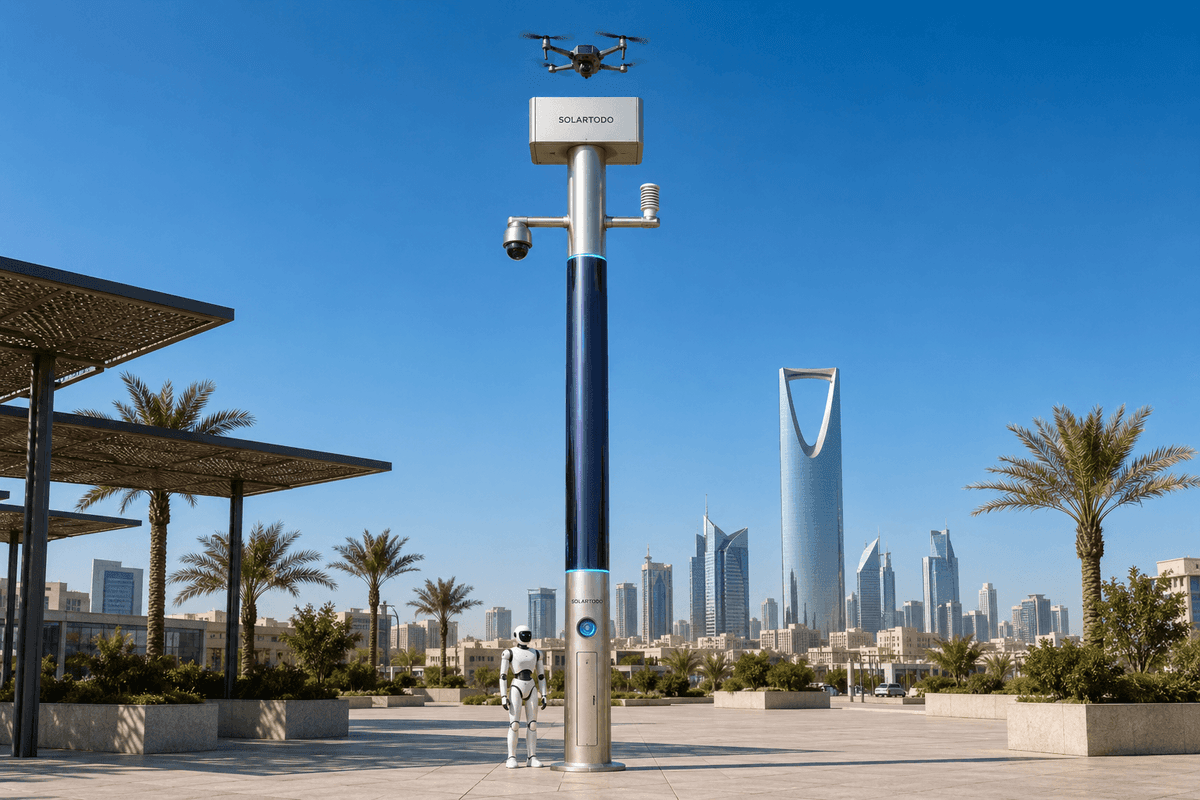
A City AI Pole is a non-lighting physical-AI edge node that combines off-grid power, local compute, sensing, drone operations and ground robot coordination in one urban pole. In Nairobi, SOLARTODO Sentinel Sky Hub is proposed as a temporary-event night-response node for a water-authority operating zone near transport-hub activity, processing raw data on-pole and sending only de-identified event or status metadata.
1. Incident Context: A Night-Economy Water Response Problem
Nairobi’s night economy concentrates movement around transport hubs, market corridors, event venues and service roads long after normal utility inspection shifts have ended. For a water authority, the difficult operating window is not a routine daytime inspection. It is the two-hour period after a crowd surge, heavy vehicle movement or informal night vending activity when a burst pipe, open chamber, suspicious intrusion or service obstruction can escalate before a field crew reaches the location.
This case study frames a proposed temporary-event deployment of SOLARTODO Sentinel Sky Hub poles around a transport-hub-adjacent operating zone in Nairobi. The deployment is not presented as a citywide rollout or an achieved customer result. It is an illustrative configuration for a water authority that needs stronger night-response coverage during a defined event season, where traffic, public safety constraints and labor availability make repeated manual patrols expensive and inconsistent.
The operating issue is simple: night incidents are time-sensitive, but manual confirmation is slow. A dispatcher may receive a report of water pooling, perimeter intrusion, tampering near a valve chamber or an unsafe crowding pattern near utility works. Conventional response often depends on a guard, a roving vehicle or a call-out technician. In a dense transport-hub setting, those resources can be delayed by congestion, limited visibility and the need to avoid sending people into uncertain conditions without a first look.
The proposed Sentinel Sky Hub changes the sequence. Instead of waiting for a person to reach the site first, the pole becomes a local physical-AI edge node that observes, classifies, dispatches and records. It remains a pure smart pole with no lighting system and no dependence on grid, city or site power. Its role is to provide an autonomous night-patrol and response layer for water-authority assets during temporary high-demand periods, subject to final engineering confirmation for siting, autonomy limits, aviation permissions and local operating procedures.
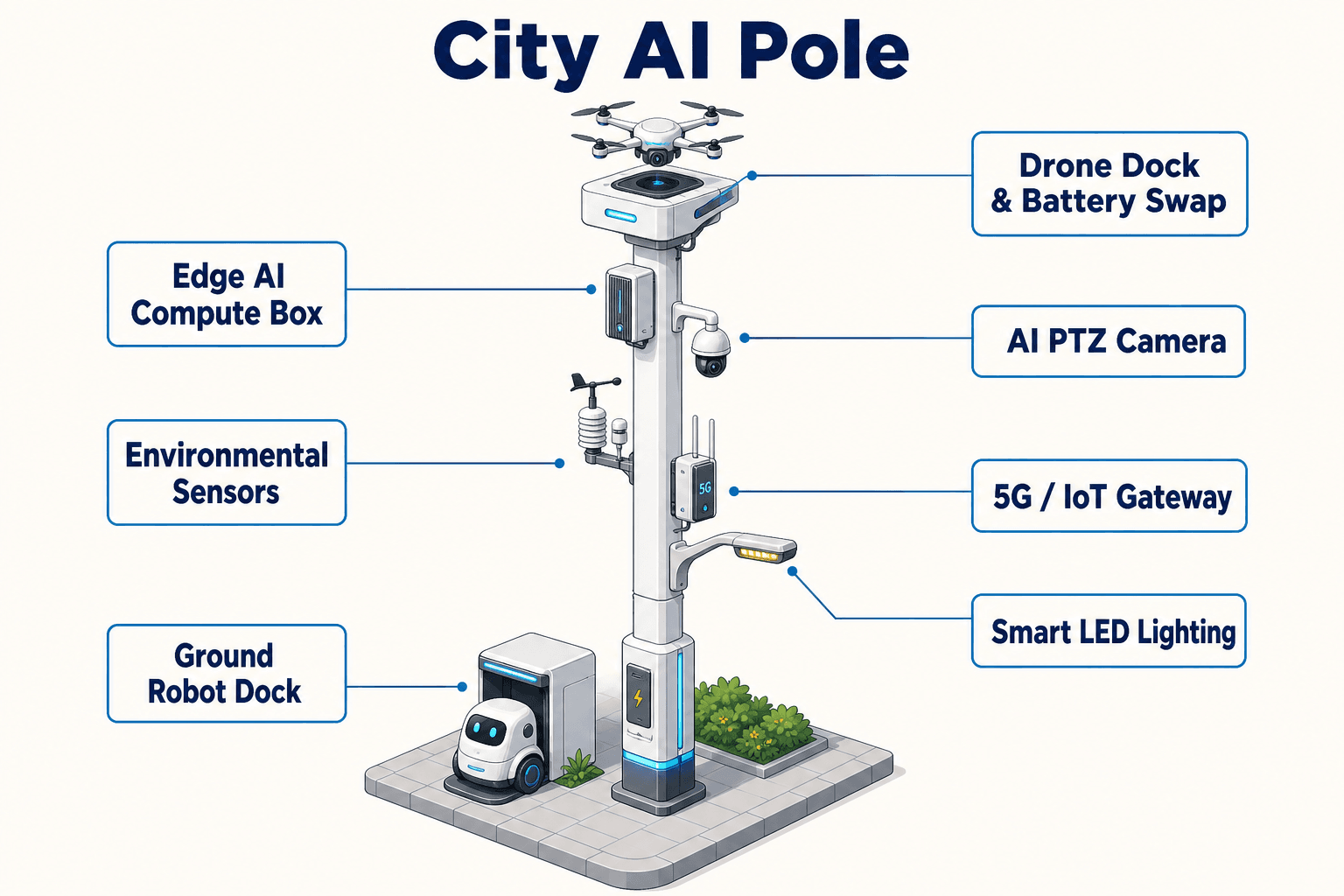
2. Proposed Deployment Shape: Temporary Sky Hub Nodes at the Transport Edge
The proposed configuration places Sentinel Sky Hub nodes at selected utility-risk points around the temporary-event perimeter: near valve access zones, service yards, tanker staging areas, road crossings, pump-station approaches or fenced water-infrastructure boundaries serving the transport-hub district. Exact node counts and coverage areas are deliberately not asserted here; those must be determined through a site survey, radio study, route risk review and authority operating plan.
Each Sky Hub is a fully off-grid micro-station. The pole body carries approximately 15 square meters of 360-degree wrapped flexible CIGS thin-film solar across a vertical cylindrical surface about 8 meters tall and about 0.6 meters wide. This solar layer is a supplemental replenishment source, not a promise of unlimited solar self-sufficiency. In a high-irradiance region, realistic clear-sky output is roughly 0.8 to 1.1 kW DC peak, typically peaking in the mid-morning or afternoon rather than exactly at noon, with about 6 to 9 kWh per day. Nairobi’s actual yield would require local irradiance, shading, dust, orientation and seasonal analysis.
The deployment is designed around battery-backed continuity. A 5 to 20 kWh-class storage system buffers drone sorties, ground robot charging, PTZ observation, edge inference, communications and control functions. Workloads are scheduled by duty cycle, so the most energy-intensive tasks are reserved for incident confirmation, patrol windows and authorized response actions rather than continuous high-power operation.
The pole’s core value in this scenario is not that it replaces every field task. It changes which tasks must be performed manually at night. Routine visual checks, first-look incident confirmation, repeated perimeter passes and post-response evidence packaging can be shifted to local AI, autonomous drone sorties and a service robot that returns to the pole base for wireless charging. Field crews are then reserved for repairs, valve operation, public safety coordination and technical intervention.
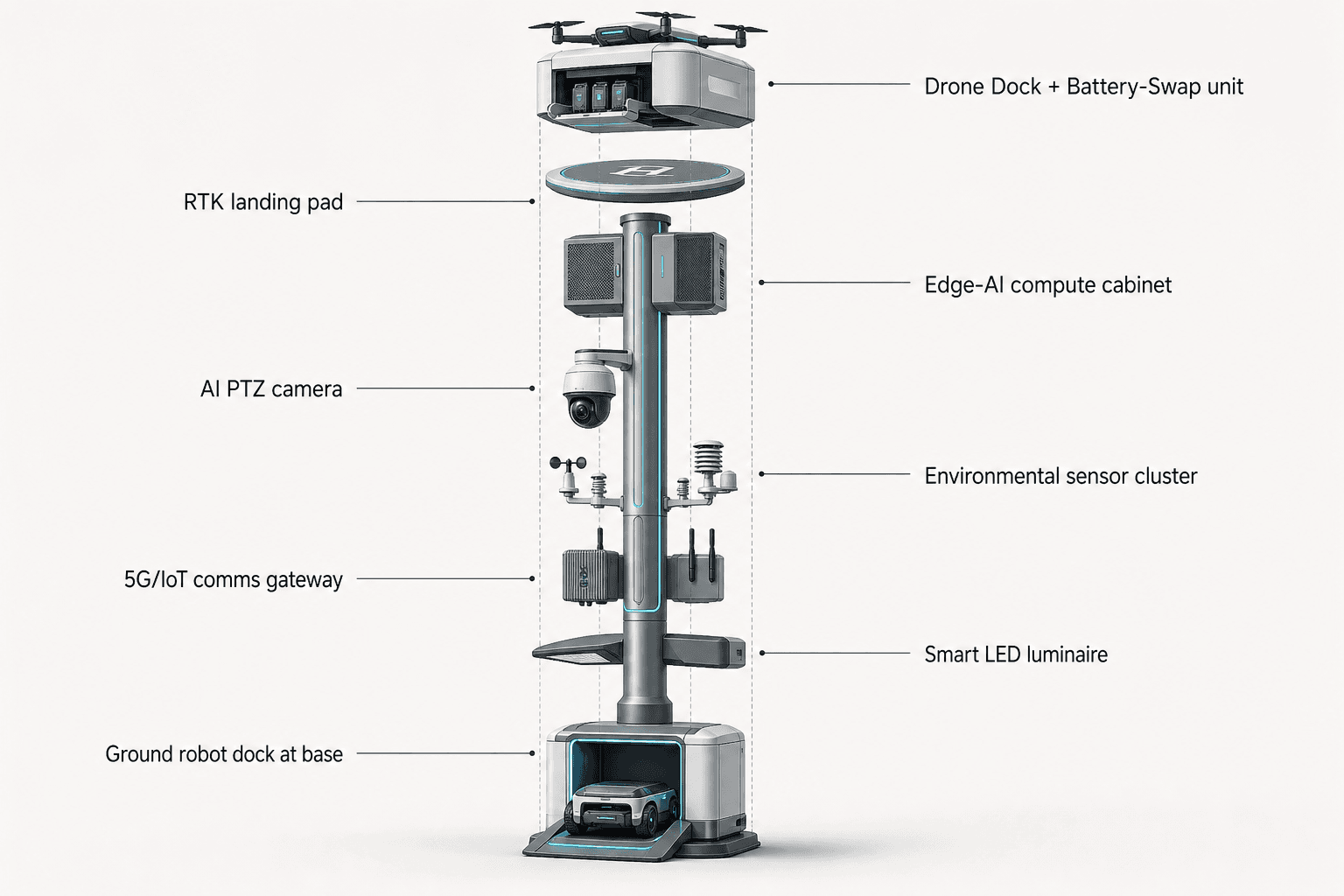
3. Battery-Swap as the Night-Patrol Continuity Module
The module focus for this Nairobi scenario is drone battery hot-swap. Night response fails when a drone can make only one short inspection and then waits for manual handling or charging. Sentinel Sky Hub is configured with a multi-bay battery magazine that performs an automated rear-service battery exchange after the drone lands. The landed drone receives a charged pack and can relaunch for another sortie without an on-site operator.
For a water authority, that matters because incident review often requires more than one pass. A first sortie may check whether water pooling is from a burst line, blocked drain, road runoff or unrelated activity. A second sortie may inspect the upstream access point or a fenced service yard. A third may support a ground robot or field crew moving through a congested corridor. Multiple battery bays allow several consecutive sorties to be planned, while the command view manages route planning, charge and swap state, task queueing, fleet health and mission logs.
This is where the labor-replacement KPI becomes concrete. The proposed evaluation should not claim achieved savings before operation. Instead, it should measure how many planned manual night patrols can be replaced by automated patrol tasks, how many call-outs can be triaged remotely before a crew is dispatched, and how often a first-look drone sortie gives the dispatcher enough confidence to send the right team rather than the nearest available team.
The ground robot adds a second response layer. In the proposed operating model, a humanoid or service robot can patrol the pole base area, approach marked utility assets, inspect access points, support alarm response and coordinate with the drone’s aerial view. It returns to the pole base for wireless charging. The system is still human-in-the-loop: the pole can classify and recommend, but defined response actions, especially those affecting public safety or Counter-UAS mitigation, require human authorization.
4. Incident Review Loop: From Detection to Authorized Action
The operational pattern follows the sensing, authorized assessment and response, edge-compute scheduling, field operations and maintenance loop known as “运查打算协同.” For the water-authority command team, this appears as a single common-operating-picture view rather than separate camera, drone, battery and robot dashboards.
At night, the on-pole PTZ camera runs local perception for anonymous vehicle count, crowd density, intrusion and perimeter awareness. It does not need to upload raw video to perform these tasks, and this proposed configuration does not claim face recognition or licence-plate recognition. Raw video and sensor data stay on the pole for local processing; only de-identified event and status metadata may leave the pole, aligned with PDPL/LGPD-oriented design principles.
Environmental sensing supports operational context. Wind speed and direction affect drone launch decisions. Temperature, humidity and pressure help interpret site conditions. Noise, PM10, PM2.5 and illuminance help build a local incident record, especially where construction activity, generator use, traffic dust or crowd activity may affect night operations.
Counter-UAS coordination is handled conservatively. If an unauthorized drone is detected and tracked through on-pole perception or an optional partner-sensor input, the pole can coordinate the node’s own friendly drone for a human-authorized, non-kinetic response such as soft aerial net-capture or close-approach deterrence. Radar is not built into the pole; if radar is required for a site, it remains an optional external or partner-sensor input. The workflow excludes shoot-downs, jamming, denial actions, autonomous attacks or weapons.
5. Evaluation Design: What the Buyer Should Measure
For a Nairobi water authority, the evaluation should be framed around target planning metrics, not claimed results. The practical question is whether temporary-event Sky Hub nodes reduce the number of routine manual night patrols, shorten first-look confirmation effort and improve the quality of incident records while keeping raw data local.
A useful baseline would compare existing manual night-response patterns against automated patrol schedules. The authority can count planned patrols per week, average crew dispatches for uncertain reports, repeat visits caused by insufficient initial information, and after-hours supervision time spent assembling evidence. The proposed Sentinel configuration then targets a shift from routine patrol labor to exception-based intervention.
The labor-replacement framing should remain disciplined. A drone sortie does not replace a licensed repair crew. A robot does not replace a water engineer. The replacement target is the repetitive inspection and confirmation workload: checking whether a zone is clear, verifying if an alarm corresponds to a visible incident, confirming whether a crew can safely approach, and documenting what happened before and after intervention.
Final engineering confirmation would define the exact battery capacity, sortie frequency, geofenced flight paths, robot routes, telecommunications design, data-retention rules, public-safety procedures and authority approvals. The strongest B2B case is not an inflated technology claim. It is a controlled night-response operating model that gives a water authority a local, off-grid, privacy-oriented edge node for temporary-event pressure without adding grid dependence or turning the project into a street-lighting program.
System Configuration
| Parameter | Configuration |
|---|---|
| Pole category | SOLARTODO Sentinel Sky Hub pure smart pole; non-lighting city-AI edge node for temporary-event night response |
| Power architecture | Fully off-grid battery-backed micro-station with 360-degree wrapped flexible CIGS thin-film replenishment |
| Solar layer | Approximately 15 m² vertical cylindrical wrap; about 2.4-2.7 kWp nameplate; realistic clear-sky output requires local Nairobi engineering confirmation |
| Storage class | 5-20 kWh-class battery storage sized by patrol duty cycle, drone sorties, robot charging and communications load |
| Drone module | Autonomous launch, patrol, landing and rear-service multi-bay battery hot-swap with task queue and mission logs |
| Sensing and compute | AI PTZ, nine-sensor environmental pack and Jetson-class edge inference; raw video and sensor data processed on-pole |
| Ground operations | Service-robot patrol support with wireless charging at the pole base and coordination through a common-operating-picture view |
How It Works
- On-pole PTZ and environmental sensors flag a night anomaly near a water-authority asset.
- Edge AI classifies the event locally and scores it for intrusion, crowding, pooling, access risk or unsafe approach conditions.
- A human supervisor reviews the common-operating-picture view and authorizes a drone patrol, robot check or field-crew dispatch.
- The drone launches, inspects the route, lands and receives an automated hot-swap battery exchange if another sortie is required.
- The ground robot performs local base-area inspection or response support and returns to the pole for wireless charging.
- The pole records mission logs and de-identified event metadata while raw video and sensor data remain processed on-pole.
Planning Assumptions (Indicative)
Illustrative planning inputs a buyer can recompute — target metrics, not achieved results. Subject to final engineering confirmation.
| Metric | Planning assumption | Indicative value |
|---|---|---|
| Inspection labor | Target replacement of routine visual checks during defined night-event windows | ~10-20 patrol tasks/week automated per operating zone |
| First-look triage | Drone sortie used before dispatching a field crew to uncertain night reports | ~50-70% of low-confidence alerts reviewed remotely before crew assignment |
| Battery-swap continuity | Multi-bay magazine supports consecutive sorties before manual service is required | ~3-6 planned sorties per night window, subject to route length and wind limits |
| Crew allocation | Manual teams reserved for confirmed repair, valve, safety or asset-protection tasks | ~1 routine inspection shift equivalent targeted for redeployment during event weeks |
| Evidence handling | Incident metadata, mission logs and de-identified status records assembled automatically for supervisor review | ~100% of automated patrol tasks logged as target operating practice |
Deployed Equipment
- SOLARTODO Sentinel Sky Hub pure smart pole body with integrated equipment bays
- 360-degree wrapped flexible CIGS thin-film solar replenishment layer
- 5-20 kWh-class battery storage and off-grid power-management system
- Autonomous drone launch and landing module with multi-bay battery hot-swap magazine
- AI PTZ camera for local anonymous vehicle count, crowd density, intrusion and perimeter awareness
- Nine-in-one environmental monitoring package
- Jetson-class edge AI compute cabinet running OTATODO edge OS
- Ground robot wireless charging base and local operations interface
Frequently Asked Questions
Is Sentinel Sky Hub a smart streetlight?
No. Sentinel Sky Hub is a pure smart pole and city-AI physical edge node with no lighting system. Its purpose in this Nairobi scenario is night-response intelligence for water-authority assets: local sensing, edge compute, drone operations, battery hot-swap, robot coordination and event logging. It should not be scoped, procured or evaluated as a street-lighting upgrade.
How can the pole operate at night if it is fully off-grid?
The pole is designed as a battery-backed off-grid micro-station. The flexible CIGS wrap replenishes the battery during daylight, while storage buffers night patrols, drone sorties, robot charging and compute loads. The solar layer is supplemental replenishment, not an unlimited pure-solar claim. Actual autonomy depends on Nairobi site shading, duty cycle, battery sizing and weather.
Why is battery hot-swap important for a temporary-event deployment?
Temporary events create bursts of night activity, and one short drone flight may not be enough for incident review. A multi-bay battery magazine lets a landed drone receive a charged pack and relaunch without an on-site operator. This supports consecutive patrols, follow-up inspection and air-ground coordination while reducing repetitive manual night checks.
What data leaves the pole?
The proposed configuration is designed for local processing. Raw video and raw sensor data stay on the pole for edge inference and operational review according to the authority’s retention rules. Only de-identified event metadata, system status, mission logs and authorized alerts may leave the pole. The design is PDPL/LGPD-oriented, not presented as already certified compliant.
Can the system identify faces or licence plates?
This proposed deployment does not claim face recognition or licence-plate recognition as active capabilities. The PTZ and edge AI are framed for anonymous vehicle count, crowd density, intrusion and perimeter awareness. That keeps the case focused on water-authority night response, public-space awareness and local processing rather than personal identification.
What does Counter-UAS coordination mean here?
Counter-UAS coordination means the pole can detect and track an unauthorized drone through local perception or optional partner-sensor input, then support a human-authorized non-kinetic response. Allowed responses include soft aerial net-capture or close-approach deterrence by the node’s own friendly drone. The configuration excludes shoot-downs, weapons, jamming, denial actions and autonomous attacks.
What should a water authority measure during evaluation?
The evaluation should measure target planning metrics rather than claim outcomes in advance. Useful metrics include manual night patrol tasks avoided, uncertain alerts triaged before dispatch, consecutive sorties supported by battery hot-swap, crew hours redeployed to confirmed interventions, and completeness of de-identified mission logs for incident review.
Explore Further
- City AI Pole / smart streetlight product line
- More smart-city deployment cases
- Talk to our engineering team
Planning a similar physical-AI deployment for streets, campuses or public spaces? Request an engineering consultation