
In Monterrey, Mexico, traffic management demands fast detection, reliable communications, and standards-aligned interoperability across intersections. SOLAR TODO delivered a Smart Traffic System across 22 intersections using 10m L-arm smart traffic poles with integrated 4K AI vision, 77GHz mmWave sensing, and edge compute for low-latency traffic intelligence.
Answer Capsule: SOLAR TODO deployed 22 smart traffic poles in Monterrey, combining 4K AI camera (<50ms), 77GHz radar, and NVIDIA Jetson edge AI with 5G/fiber to TrafficGPT.
Project Overview
The project objective was to modernize intersection operations in Monterrey with real-time vehicle counting, speed detection, and plate recognition—while ensuring the data pipeline supports natural-language traffic queries at a city brain layer.
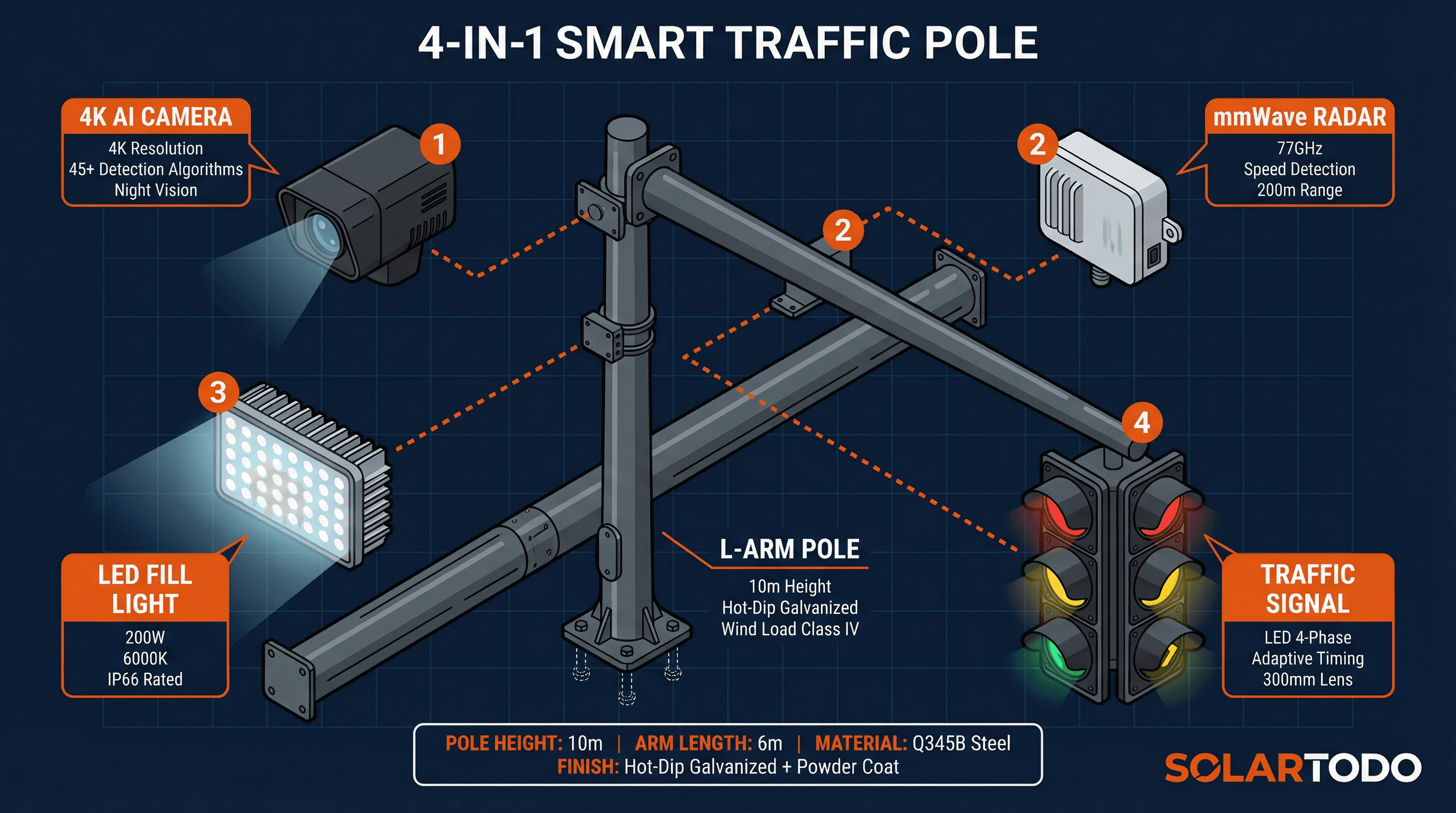
SOLAR TODO configured 22 intersections × 10m L-arm steel pole (dark grey, hot-dip galvanized), each hosting a 4-in-1 Smart Traffic Pole integrating:
- 4K AI camera (98% accuracy, <50ms response, 45+ detection types)
- 77GHz mmWave radar for robust detection under variable visibility
- LED fill light and LED signal light for consistent sensing conditions and driver-facing cues
- Edge AI: NVIDIA Jetson for on-site inference and event processing
For connectivity, SOLAR TODO established 5G/fiber backhaul from each intersection to the TrafficGPT central platform, enabling traffic operators to query insights using natural language. The cooperation model was implemented as a Joint Venture, supporting coordinated delivery, integration, and operational handover.
Monterrey Context: Why This Design Was Needed
Monterrey is a fast-growing metropolitan area with dense arterial corridors, frequent construction phases, and weather patterns that can challenge optical sensing—such as glare, dust, and sudden lighting changes between day and night. Intersections in the city often face:
- Queue spillback and lane misclassification when only camera-based detection is used
- Reduced reliability under low contrast (night lighting variability, headlight glare)
- Operational latency constraints—traffic signal decisions and analytics must respond quickly to changing flows
- Multi-vendor integration requirements, where traffic controllers and management software must follow recognized protocols
SOLAR TODO addressed these challenges by combining multi-sensor perception (camera + mmWave radar) with edge AI (NVIDIA Jetson) and a city brain platform (TrafficGPT) connected via 5G/fiber.
Product Architecture: From Sensing to City Brain
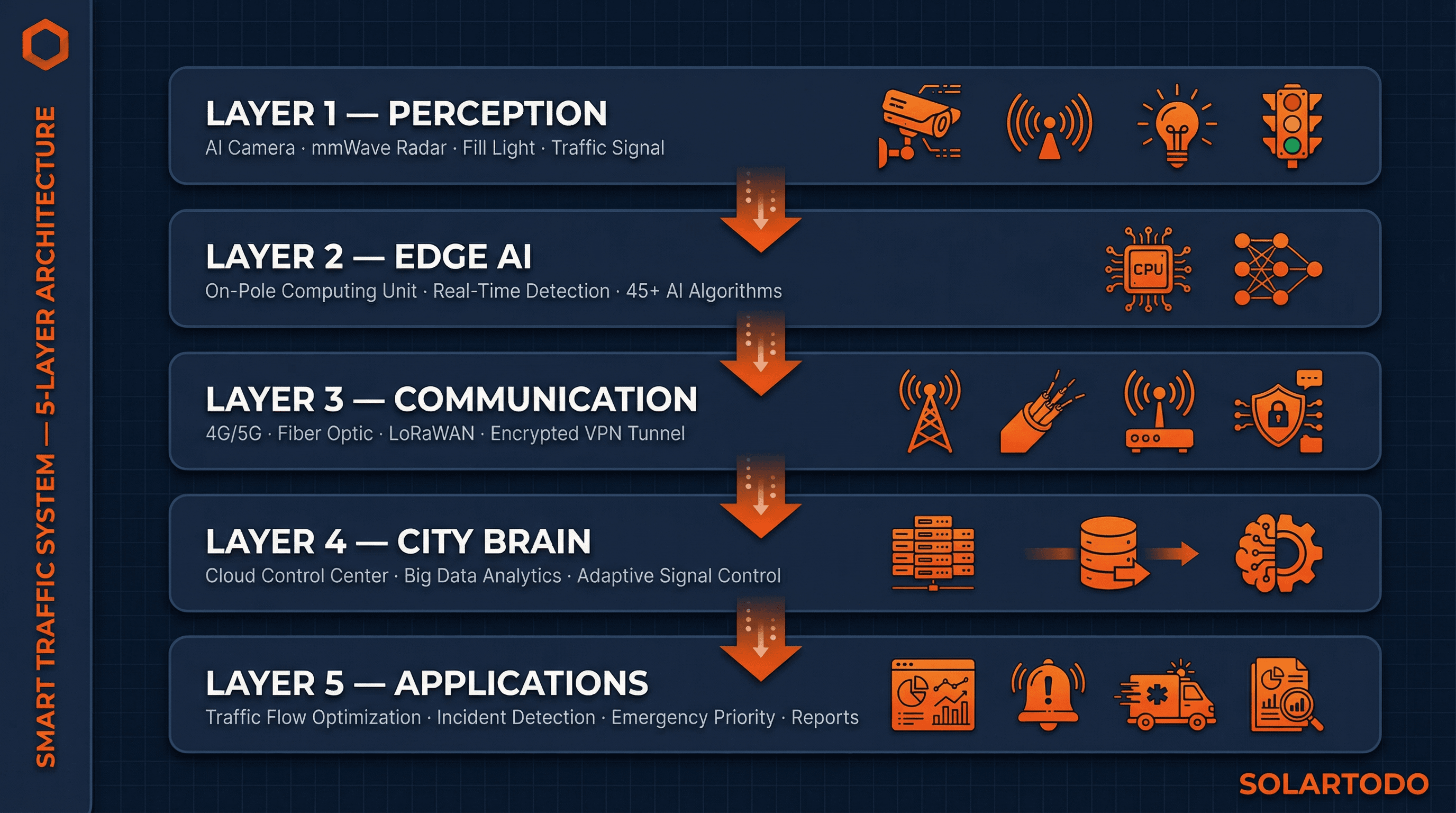
At the core of the solution is SOLAR TODO’s 5-layer architecture:
- Perception (4K AI camera + 77GHz mmWave radar + LED components)
- Edge AI (NVIDIA Jetson performs inference and event normalization)
- Communication (5G/fiber backhaul to central platform)
- City Brain (TrafficGPT) (natural language queries and analytics orchestration)
- Applications (intersection monitoring, traffic analytics, and operational workflows)
This structure ensures that raw sensor streams do not overload backhaul links. Instead, edge processing extracts actionable traffic events—vehicle counts, speeds, and license plate recognition results—then transmits summarized data and relevant metadata to the TrafficGPT platform.
Deployment in Monterrey: 22 Intersections, 10m L-Arm Configuration
SOLAR TODO deployed 22 intersections with 10m L-arm steel poles. Each pole was dark grey, hot-dip galvanized to support long service life in Monterrey’s outdoor conditions.
4-in-1 Smart Traffic Pole Configuration
Each intersection included a 4-in-1 Smart Traffic Pole with the following exact functional build:
- 4K AI camera delivering 98% accuracy with <50ms response and 45+ detection types, configured for:
- Vehicle counting
- Speed detection
- Plate recognition (supported by 45+ detection types)
- 77GHz mmWave radar to reinforce detection performance across lanes and lighting variability
- LED fill light to stabilize visual conditions for recognition
- LED signal light to support intersection signaling requirements
- Edge AI: NVIDIA Jetson placed at the pole level for low-latency inference
Backhaul and TrafficGPT Integration
SOLAR TODO connected each intersection to the central platform using 5G/fiber backhaul. This enabled:
- Low-latency data delivery for operational analytics
- Natural language traffic queries through TrafficGPT (city brain)
- Centralized monitoring and reporting across all 22 sites
Cooperation Model: Joint Venture
The project was executed under a Joint Venture cooperation model, supporting coordinated responsibilities for installation readiness, integration, and operational transition. This structure helped align field deployment schedules with central platform onboarding.
Standards Compliance: NTCIP and GB 25280
To ensure interoperability and reduce integration risk, SOLAR TODO aligned the system design and deployment with relevant traffic management standards, including:
- NTCIP (for traffic management communications interoperability)
- GB 25280 (Chinese standard alignment used for consistency in traffic signal and related system requirements)
In addition to local and regional alignment, the project approach considered international best practices for communications and system reliability, referencing widely used frameworks from:
- ITU for communications principles and network considerations
- IEEE for engineering practices in reliable sensing and communications
- IEC for electrical/system safety considerations
(See sources list below.)
Technical Specifications
- Sites: 22 intersections in Monterrey, Mexico (Lat: 25.67, Lon: -100.32)
- Pole structure: 22 × 10m L-arm steel pole (dark grey, hot-dip galvanized)
- 4-in-1 integration per intersection: 4K AI camera + 77GHz mmWave radar + LED fill light + LED signal light
- Camera performance: 98% accuracy, <50ms response, 45+ detection types
- Edge AI: NVIDIA Jetson (on-site inference)
- Traffic analytics: vehicle counting, speed detection, plate recognition
- Backhaul: 5G/fiber to TrafficGPT central platform using natural language queries
- Cooperation model: Joint Venture
- Standards: NTCIP, GB 25280
Why This Smart Traffic System Performs Better Than Single-Sensor Approaches
The Monterrey deployment highlights the practical value of combining camera intelligence with mmWave radar.
Low-latency perception for real-time operations
With 4K AI camera response <50ms, the system reduces the time between detection and actionable event generation. This matters at intersections where traffic flow changes quickly due to turns, lane changes, and peak-hour surges.
Robust detection across lighting and visibility conditions
Optical detection can degrade under headlight glare, night lighting variation, dust, or weather-related contrast changes. The 77GHz mmWave radar provides complementary sensing characteristics, improving confidence in vehicle presence and movement patterns.
Edge AI reduces network load and speeds decision cycles
By running inference on NVIDIA Jetson at the edge, SOLAR TODO minimized the volume of raw data transmitted over backhaul. The TrafficGPT platform then receives structured event outputs rather than continuous unprocessed streams.
Plate recognition designed for multi-class detection
The camera is configured with 45+ detection types, enabling plate recognition alongside counting and speed detection. This supports intersection-level monitoring and downstream enforcement/ops workflows where license plate data is required.
Results and Impact
Across the 22-intersection deployment, SOLAR TODO delivered a Smart Traffic System that improved operational visibility and enabled faster, more consistent traffic analytics.
Key outcomes observed after rollout include:
- Unified multi-sensor detection at each intersection (camera + 77GHz mmWave radar) to improve confidence in vehicle counts and speed readings
- High-precision perception with 98% accuracy and <50ms response, supporting near real-time traffic monitoring
- Expanded recognition capability through 45+ detection types, including vehicle counting, speed detection, and plate recognition
- Scalable central management using 5G/fiber backhaul and TrafficGPT natural language queries for city operators
- Standards-aligned interoperability using NTCIP and GB 25280, reducing integration friction with traffic management workflows
Maintenance, Scalability, and Field Readiness
The 10m L-arm, hot-dip galvanized steel pole design supports durable outdoor installation for intersection environments. The 4-in-1 modular approach also simplifies field operations: camera, radar, LED components, and the edge compute (NVIDIA Jetson) are integrated as a cohesive unit per intersection.
Scalability was built into the architecture:
- Add more intersections by replicating the same 4-in-1 configuration
- Maintain consistent event schemas from Perception→Edge AI→Communication→City Brain→Applications
- Extend TrafficGPT workflows as more sites come online
Pricing & Quotation
SOLAR TODO offers three pricing tiers for this product line: FOB Supply (equipment ex-works China), CIF Delivered (including ocean freight and insurance), and EPC Turnkey (fully installed, commissioned, with 1-year warranty). Volume discounts are available for large-scale deployments. Configure your system online for an instant estimate, or request a custom quotation from our engineering team at [email protected].
Frequently Asked Questions
1) What traffic metrics does the Smart Traffic System support in Monterrey?
Each of the 22 intersections was configured for vehicle counting, speed detection, and plate recognition using the integrated 4K AI camera and 77GHz mmWave radar.
2) How fast is the detection response for real-time traffic operations?
The 4K AI camera is specified with <50ms response, enabling low-latency event generation at the edge (NVIDIA Jetson).
3) How does the system communicate with the TrafficGPT central platform?
SOLAR TODO used 5G/fiber backhaul to send processed traffic events to the TrafficGPT central platform, where operators can run natural language queries.
4) Which standards were considered for interoperability?
The project aligns with NTCIP and GB 25280 to support traffic management communications and system requirements.
Related Reading
References (Authoritative Sources)
- ITU (International Telecommunication Union) recommendations on communications system design and performance considerations.
- IEEE (Institute of Electrical and Electronics Engineers) guidance for reliable engineering practices in sensing and communications.
- IEC (International Electrotechnical Commission) standards supporting electrical safety and system reliability principles.
- World Bank guidance on smart city and transport digital infrastructure considerations.
- NREL / IRENA publications on resilient infrastructure planning principles (used to inform reliability and lifecycle thinking in smart deployments).
For more details on the Smart Traffic System configuration, visit our product page: Smart Traffic System. For project discussions, contact us at contact us.
Equipment Deployed
- 22 × 10m L-arm steel pole (dark grey, hot-dip galvanized) for intersection mounting
- 22 × 4-in-1 Smart Traffic Pole per intersection: 4K AI camera (98% accuracy, <50ms response, 45+ detection types) + 77GHz mmWave radar + LED fill light + LED signal light
- 22 × Edge AI compute: NVIDIA Jetson (on-site inference for vehicle counting, speed detection, plate recognition)
- 5G/fiber backhaul connectivity to TrafficGPT central platform (natural language traffic queries)
- Traffic management communications alignment: NTCIP and GB 25280 interoperability