Summary
Monterrey’s industrial corridors favor approximately 38 SOLARTODO Sentinel City AI Pole nodes at 40 m spacing, with 5–20 kWh storage per node for off-grid operation. This guide evaluates configuration and procurement, without claiming a completed deployment.
Key Takeaways — Monterrey’s Corridor Decisions
A typical 38-node Monterrey configuration should prioritize industrial perimeter operations, flood-aware placement, local data processing, and energy-limited aerial and ground inspection schedules.
- Approximately 38 nodes at 40 m spacing represent a corridor-scale design, subject to engineering confirmation.
- According to Data México’s 2022 industrial-park data, Monterrey municipality registers 13 industrial parks, supporting targeted perimeter applications.
- Each node uses 5–20 kWh-class storage; select capacity from measured sensing, computing, cooling, and mobility loads.
- Solar replenishment has a 2.4–2.7 kWp nameplate, distinct from approximately 0.8–1.1 kW DC clear-sky operating peak under favorable reference conditions.
- Each environmental package measures 9 variables, including PM2.5, PM10, wind, temperature, and humidity.
- Mexican NOM-107-SCT3-2019 makes aviation authorization a separate requirement from automated drone capability.
- 38 local processing boundaries keep raw video and sensor records on their originating poles; only de-identified event and status metadata may leave.
Market Context for Monterrey
Monterrey’s 13 registered industrial parks provide a stronger initial market for 38 autonomous inspection nodes than an undifferentiated claim of coverage across the municipality.
According to Mexico’s Secretaría de Economía, Data México’s 2020 census profile records 1,142,994 municipal residents, with 0.66% population growth from 2010. According to the same organization’s 2022 industrial-park dataset, Monterrey registers 13 parks. These figures describe the municipality, not the entire metropolitan area, and support a procurement focus on bounded industrial estates, campuses, and infrastructure perimeters. Secretaría de Economía, Data México
Heat, dust, and seasonal runoff
Monterrey is inland, with mountain-influenced terrain and a different exposure profile from a Mexican coastal port. According to Nuevo León’s official climatology page, accessed in 2026, statewide average summer maxima reach approximately 34°C, average January minima are approximately 5°C, and annual precipitation averages 654 mm. These are regional screening values, not Monterrey station extremes or equipment qualification limits. Nuevo León’s agriculture authority states, “las principales lluvias se presentan en verano,” reinforcing the need to assess seasonal operating conditions. Nuevo León climatology
Dust accumulation, battery temperature, and drainage therefore deserve separate engineering checks. According to Nuevo León’s government (2023), the metropolitan area’s relationship with the Santa Catarina River includes repeated flooding after hurricanes, tropical depressions, and heavy rainfall. Delivery access, foundations, robot routes, and service positions should avoid flood conveyance paths and locations where runoff can isolate equipment. Nuevo León flood-risk statement
Municipal ownership and aviation boundaries
According to Monterrey’s government (2026), the municipal council approved an updated risk atlas on 16 October 2026. Buyers should screen candidate parcels against that atlas before confirming foundations or access routes. Public-space procurement should identify the municipal asset owner and coordinate with Protección Civil, while private estates should identify the party responsible for access, security response, and maintenance. Monterrey risk-atlas notice
Mexico’s NOM-107-SCT3-2019 establishes RPAS operating requirements, including general separation provisions of 9.2 km from aerodromes and 0.900 km from heliports, alongside special-authorization procedures. These provisions require site-specific aviation review rather than a blanket assumption that automated patrol is permitted. Applicable operating permissions must be confirmed with the aviation authority before aerial missions begin. Official NOM text
Recommended Technical Configuration
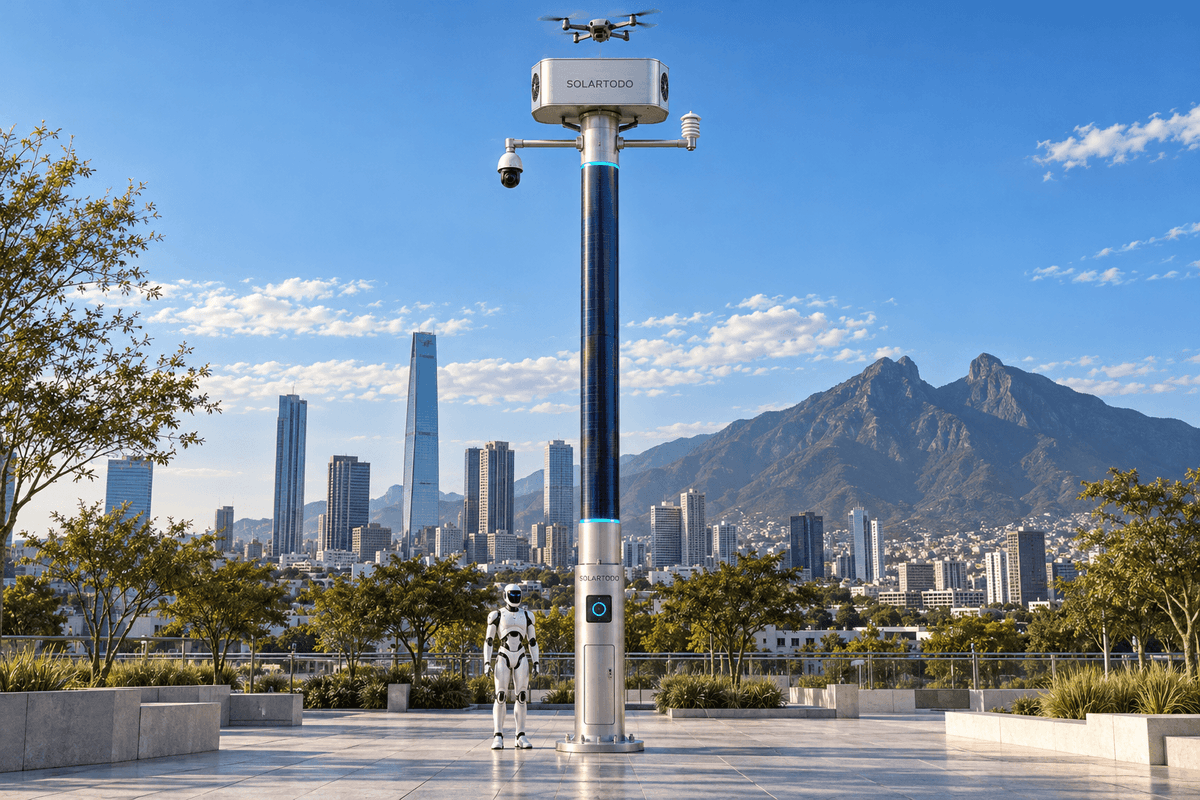
A typical 38-unit deployment would use the Sky Hub physical-AI configuration, combining autonomous inspection workflows, nine-variable environmental sensing, and independently managed off-grid energy storage.
The appropriate class is the robot-ready and drone-ready city edge node, rather than a utility-voltage or pole-height class. No structural size-class table is supplied for this configuration, so foundation loads, wind resistance, anchorage, and lifting requirements must come from approved engineering drawings. Approximately 38 units would be assigned to selected Monterrey corridors or bounded sites, with approximately 40 m spacing used as an initial layout assumption. Explore the SOLARTODO physical-AI solutions architecture when defining the procurement scope.
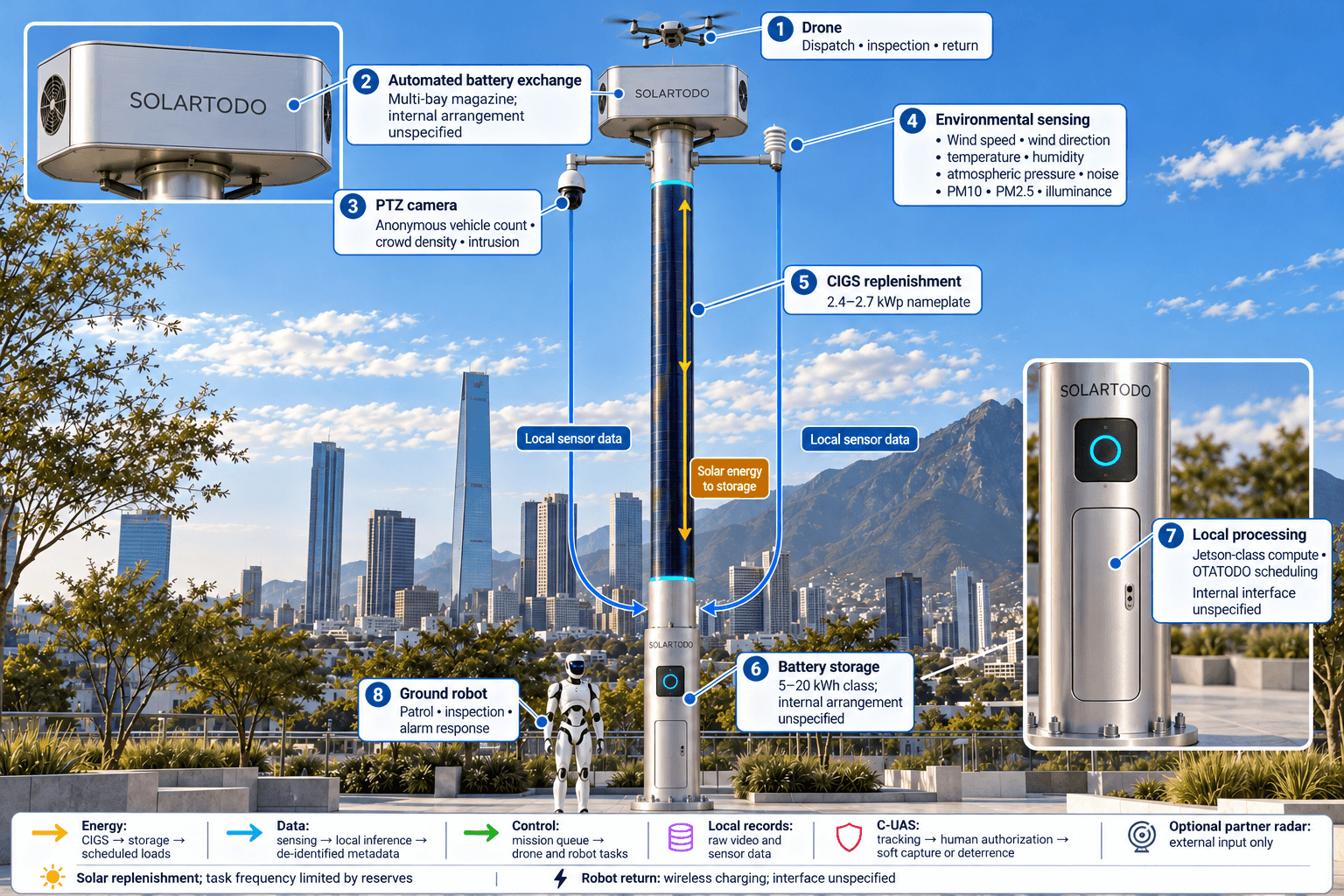
Each node combines local perception, OTATODO workload orchestration, autonomous drone servicing, and ground robot support. Drone operations encompass dispatch, inspection routes, return, automated battery exchange, and subsequent task assignment without an operator stationed at the pole. Ground robots perform patrol, inspection, alarm response, and coordinated air-ground tasks before returning for wireless charging. Mission queues should reserve capacity for priority events rather than schedule every node for simultaneous maximum activity.
A single command view brings together sensing, authorized response, workload scheduling, and maintenance status. Human authorization remains mandatory for counter-UAS intervention, including soft aerial net-capture or close-approach deterrence by a friendly drone. Detection and tracking do not themselves authorize interception, and any radar information would come from an optional external partner sensor. Local aviation and security permissions determine where these mature workflows may operate.
Technical Specifications
The proposed 38-node specification combines 5–20 kWh-class storage, Jetson-class local computing, nine environmental measurements, and automated drone battery exchange, with final engineering confirmation required.
- Quantity and layout: approximately 38 SOLARTODO Sentinel City AI Pole units, initially planned at approximately 40 m intervals within selected locations.
- Product architecture: Sky Hub pole-form physical-AI station with sensing, computation, drone servicing, and ground robot operations; no lighting system.
- Energy architecture: fully off-grid battery-backed operation with on-pole flexible CIGS replenishment and no grid, city, or site-power connection.
- Solar rating: approximately 2.4–2.7 kWp nameplate; favorable high-irradiance reference output approximately 0.8–1.1 kW DC peak and 6–9 kWh/day, not a Monterrey production guarantee.
- Storage: 5–20 kWh-class capacity per node; usable energy depends on reserve settings, temperature, conversion losses, and aging.
- Computing: Jetson-class Orin- or Thor-class processing, selected against inference workloads and thermal budgets.
- Environmental monitoring: wind speed, wind direction, temperature, humidity, atmospheric pressure, noise, PM10, PM2.5, and illuminance.
- Security perception: PTZ-assisted anonymous vehicle counting, crowd-density estimation, intrusion detection, and perimeter awareness.
- Mobility services: automated multi-bay drone battery exchange, mission scheduling, fleet health records, ground robot coordination, and wireless robot charging.
- Data boundary: raw video and sensor records remain on each pole; only de-identified event and status metadata may leave.
IEC states that IEC 62619:2022 covers “safe operation of secondary lithium cells and batteries used in industrial applications.” Procurement should request applicable battery test evidence and separately review enclosure protection, thermal behavior, structural calculations, and protective earthing. Citing IEC 62619 does not establish certification of the complete pole or its mobile battery packs. IEC 62619:2022
Implementation Approach
A proposed 38-node rollout should progress through parcel screening, configuration approval, logistics, civil works, installation, and witnessed acceptance, with aviation permissions managed separately.
Survey before purchase commitment
Start with utility-location surveys, geotechnical investigation, flood screening, communications testing, and robot-route assessment. At 40 m intervals, adjacent nodes may encounter different obstructions, foundations, pedestrian movements, and drainage conditions. Confirm every position individually, including safe maintenance access and the space needed for authorized aerial operations.
Procurement and installation
The approved bill of materials should distinguish pole equipment, aircraft, robot assets, battery magazines, storage capacity, communications services, and optional sensor integrations. Shipping documentation should address battery transport and Mexican import requirements, while the packing plan should establish whether shipment is assembled or modular. Engineers should determine foundations, erection methods, protective bonding, and local electrical protections without introducing an external operating-power dependency.
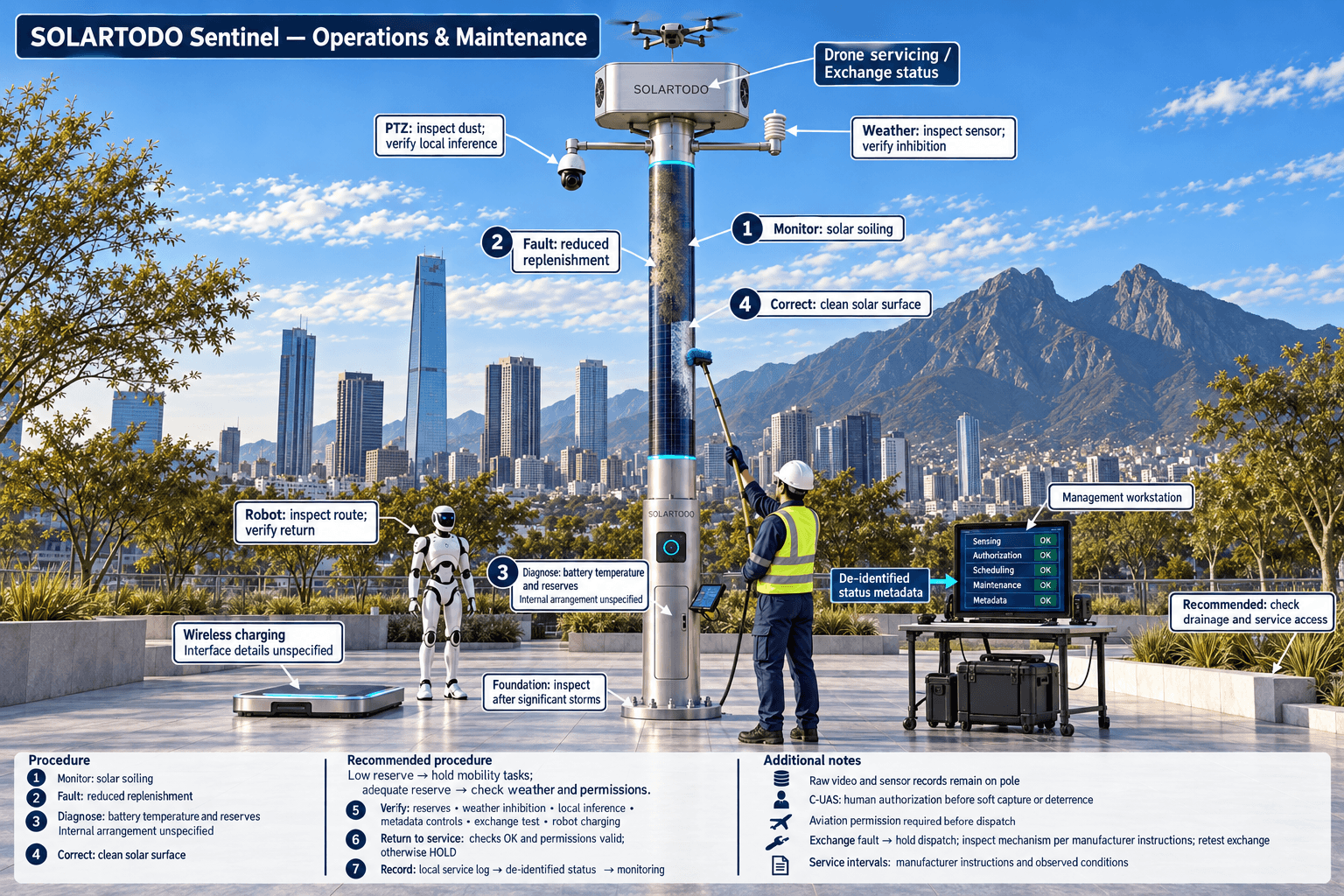
A purchaser could structure implementation into four acceptance stages: design release, factory inspection, site acceptance, and operational handover. A defensible calendar follows supplier lead times, customs review, civil-work sequencing, and permission requirements; no fixed completion date is established here. Commissioning should verify local inference, raw-data confinement, metadata export controls, automated servicing, weather inhibition, reserve-energy behavior, and human authorization records.
Expected Performance & ROI
For approximately 38 nodes, credible returns depend on inspection productivity and avoided infrastructure work, while 5–20 kWh storage constrains mission frequency and reserve duration.
Capacity without false coverage claims
A straight sequence of 38 poles creates 37 intervals, giving approximately 1,480 m between the first and last positions at 40 m spacing. Multiple corridors divide that span differently, and neither arrangement establishes detection range or citywide coverage. Camera sightlines, occlusion, flight permissions, and robot accessibility must determine the service area.
Storage across the proposed fleet totals 190–760 kWh nominal, calculated from the supplied per-node range. This is distributed capacity: one pole cannot assume access to another pole’s stored energy. Likewise, multiplying the favorable 6–9 kWh/day reference by 38 gives 228–342 kWh/day only as reference arithmetic, not as a local yield forecast.
According to NREL’s PVWatts Version 5 Manual (2014), typical-weather estimates can have errors of approximately ±10% annually and ±30% monthly. Those figures describe that modeling method, not a validated uncertainty range for this wrapped CIGS installation. Monterrey assessment requires local weather, shading, temperature, soiling, and geometry-specific modeling rather than directly transferring a high-irradiance reference. NREL PVWatts manual
Evaluate operations, not guaranteed payback
Compare annualized ownership cost with verified savings from inspection travel, repeated manual visits, incident triage, and avoided power-connection works. Include software support, communications, battery replacement, cleaning, calibration, insurance, and flight-management obligations. Simple payback equals incremental investment divided by positive annual net benefit, but neither a numerical payback nor a savings percentage is supportable without buyer operating records and a scoped quotation.
Results and Impact
A proposed 38-node acceptance program should measure inspection completion, event quality, energy reserves, and authorization traceability before procurement teams assign operational or financial benefits.
Useful measures include completed inspections per approved mission window, actionable events per reviewed alert, maintenance hours per node, and energy consumed per completed task. Establish a buyer-approved baseline and distinguish weather cancellations from equipment faults or permission restrictions. These are proposed evaluation measures, not reported Monterrey results.
Comparison Table
Across a proposed 38-location program, an integrated Sky Hub architecture consolidates inspection workflows, while separate fixed sensors and mobile teams retain distinct operational advantages.
| Decision factor | SOLARTODO Sentinel City AI Pole | Separate sensors and mobile inspection teams |
|---|---|---|
| Planning quantity | Approximately 38 integrated nodes | Device and team quantities require survey |
| Initial layout | Approximately 40 m intervals | Layout follows individual device functions |
| Operating energy | Fully off-grid; 5–20 kWh-class storage per node | Architecture varies by selected equipment |
| Environmental measurements | 9 variables per equipped node | Separate instruments may be required |
| Drone servicing | Automated multi-bay battery exchange | Service method depends on selected arrangement |
| Ground inspection | Autonomous robot workflows and wireless return charging | Personnel or separately managed robots |
| Raw-data handling | Retained on originating pole | Must be specified for each subsystem |
| Principal constraint | Integrated duty-cycle and mission coordination | More separate operating and maintenance interfaces |
| Best-fit buying decision | Repeated coordinated inspection at bounded sites | Occasional tasks or dispersed locations |
Pricing & Quotation
For approximately 38 nodes, quotation accuracy depends on storage capacity, aircraft and robot allocation, civil works, permissions, logistics, and the defined commissioning acceptance scope.
SOLARTODO offers three pricing tiers for this product line: FOB Supply (equipment ex-works China), CIF Delivered (including ocean freight and insurance), and EPC Turnkey (fully installed, commissioned, with 1-year warranty). Volume discounts are available for large-scale deployments. Configure your system online for an instant estimate, or request a custom quotation from our engineering team at [email protected].
The signed quotation should clarify the named delivery place, applicable Incoterms, customs responsibilities, and installation boundaries. In particular, FOB and ex-works are different commercial terms, so their contractual meaning must be resolved explicitly. No price or guaranteed financial return is stated in this guide.
Frequently Asked Questions
These 10 answers address the proposed Monterrey configuration’s specifications, installation, maintenance, commercial scope, and operating limits without implying that the 38-node program already exists.
Q1: What configuration fits Monterrey industrial corridors?
A typical 38-unit deployment would use Sky Hub nodes with local computing, nine-variable environmental monitoring, automated drone servicing, and ground robot support. Approximately 40 m spacing is a starting layout assumption. Storage would fall within the supplied 5–20 kWh class, with capacity selected from actual workloads, reserves, temperature exposure, and permitted mission frequency.
Q2: How long would deployment take?
No verified delivery or installation duration is available for this proposed program. The schedule should separately identify engineering, permissions, manufacturing, battery transport, customs, foundations, installation, and acceptance. Procurement teams should request a dated critical-path schedule after site surveys, with clear responsibility for delays involving public-space access, aviation permissions, and civil works.
Q3: What ROI or payback should buyers expect?
No numerical payback is justified without a buyer-specific baseline and quotation. Evaluate avoided inspection travel, recurring site visits, and power-connection works against maintenance, communications, software, insurance, and battery replacement. Calculate simple payback only when annual net benefit is positive, and test whether reduced flight availability or higher servicing requirements materially change the result.
Q4: What maintenance does Monterrey require?
Maintenance should address dust-related sensor degradation, solar soiling, drainage, battery temperature, automated exchange mechanisms, and robot charging interfaces. Establish intervals from manufacturer instructions and observed conditions rather than inventing a universal service frequency. Inspect foundations and access routes after significant storms, and maintain local service records while exporting only de-identified status metadata.
Q5: How does this compare with fixed cameras?
Fixed cameras suit continuous observation of known viewpoints, while Sentinel combines local perception with aerial and ground inspection workflows. Its value depends on repeated tasks that benefit from that integration. A 40 m pole interval does not prove better detection, and a simpler fixed-sensor arrangement may suit sites requiring only occasional mobile inspection.
Q6: What determines EPC quotation scope?
An EPC quotation should identify approximately 38 node positions, storage selections, aircraft and robot allocation, civil works, communications, import responsibilities, training, and acceptance testing. It should also identify permissions excluded from the contractor’s responsibility. No prices are provided here; buyers need a surveyed, itemized scope before comparing commercial offers or evaluating ownership cost.
Q7: What warranty applies?
The stated EPC Turnkey offer includes a 1-year warranty. Buyers should obtain written terms identifying the commencement date, covered components, replacement logistics, response commitments, and exclusions. Battery degradation, drone consumables, robot wear components, software support, and inspection services require explicit treatment. This article does not establish additional warranty periods or local service guarantees.
Q8: What does installation require?
Installation requires approved structural drawings, geotechnical review, underground-utility checks, foundations, lifting access, and safe service clearances. Flood screening is especially relevant around Monterrey’s drainage corridors. The pole operates without external power, but protective bonding, earthing, battery safety, and local electrical requirements still need engineering review before the installation can be accepted.
Q9: Can drones operate without on-site staff?
Automated launch, return, battery exchange, and task redeployment support operations without an operator stationed at the pole. This capability does not remove Mexican aviation requirements or remote supervision obligations. NOM-107-SCT3-2019 addresses operating permissions and special operations; the intended routes, aircraft category, airspace, and operational model require review before service begins.
Q10: How are privacy and counter-UAS controls handled?
Raw video and sensor records remain on their originating poles, while only de-identified event and status metadata may leave. Local processing is PDPL/LGPD-oriented design, not a claim of Mexican legal certification. Counter-UAS detection and tracking are separate from intervention: soft aerial net-capture or close-approach deterrence requires human authorization and applicable local permissions.
References
These 7 public references support Monterrey’s market context, regional climate screening, flood-aware siting, aviation requirements, battery procurement, and the limits of solar-production estimates.
- Secretaría de Economía, Data México (2020/2022): Monterrey municipal population, population change, and registered industrial parks. Municipal profile.
- Government of Nuevo León, Campo NL (undated; accessed 2026): Statewide temperature and precipitation context, including 34°C average summer maxima and 654 mm annual precipitation. Climatology.
- Government of Nuevo León (2023): Santa Catarina River flooding history and metropolitan emergency-risk coordination. Flood-risk statement.
- Government of Monterrey (2026): Municipal risk atlas approved on 16 October 2026. Official notice.
- Secretaría de Comunicaciones y Transportes, Diario Oficial (2019): NOM-107-SCT3-2019, RPAS operating requirements and special-authorization procedures. Official standard.
- IEC (2022): IEC 62619:2022, safety requirements for secondary lithium cells and batteries used in industrial applications. Standard scope.
- NREL (2014): PVWatts Version 5 Manual, typical-weather production estimates and modeling uncertainty; not validation of the proposed pole geometry. Technical manual.
Equipment Deployed
- Approximately 38 SOLARTODO Sentinel City AI Pole nodes in Sky Hub configuration; approximately 40 m initial spacing, subject to survey
- 5–20 kWh-class battery storage per node; usable capacity and reserve settings subject to engineering
- On-pole flexible CIGS replenishment: approximately 2.4–2.7 kWp nameplate; favorable reference output approximately 0.8–1.1 kW DC peak
- Jetson-class Orin- or Thor-class edge computing running OTATODO workload orchestration
- PTZ sensing for anonymous vehicle counts, crowd density, intrusion, and perimeter awareness
- Nine-variable environmental package: wind speed, wind direction, temperature, humidity, pressure, noise, PM10, PM2.5, and illuminance
- Automated multi-bay drone battery exchange and mission-management subsystem; aircraft allocation to be confirmed
- Ground robot operations and wireless charging subsystem; robot allocation to be confirmed
- Local raw-data storage with de-identified event and status metadata interfaces
- Human-authorized counter-UAS coordination; optional external partner-sensor input, with no integrated radar