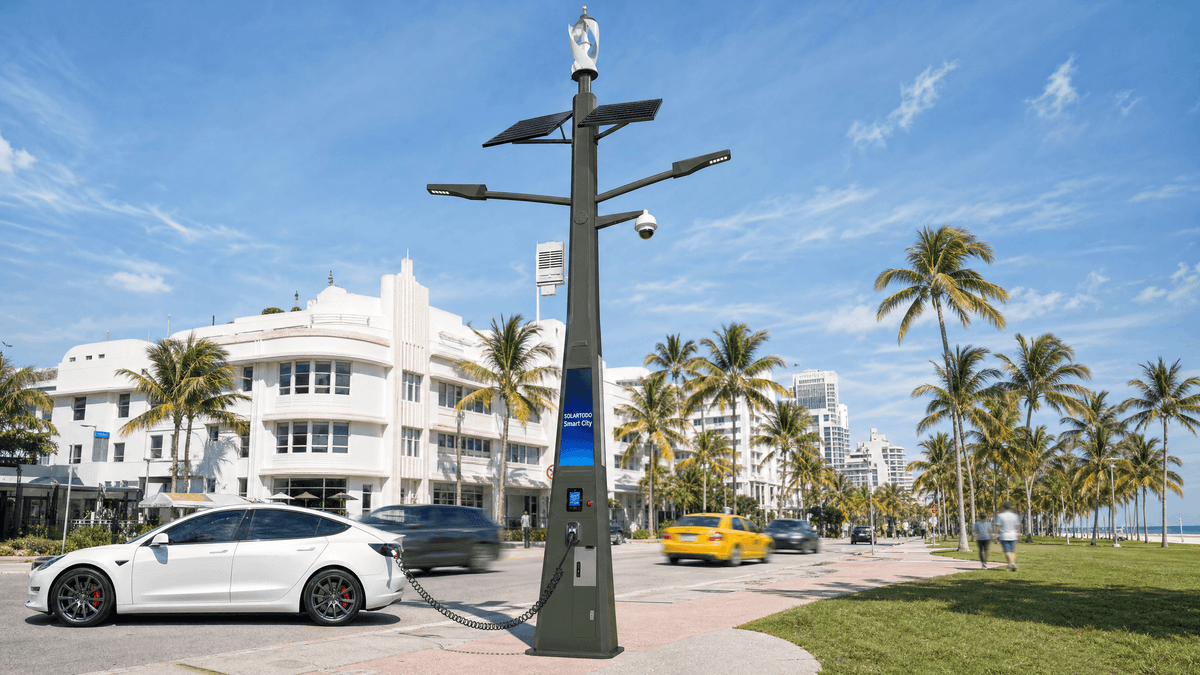
Mombasa Smart Streetlight Market Analysis: 106-Unit Hybrid 12m Configuration Guide for Coastal Roads and Urban Corridors
Summary
Mombasa’s coastal humidity, dense urban corridors, and growing EV and data needs make a 12m hybrid Smart Streetlight a practical fit. A typical 106-unit layout at 35m spacing covers about 3.7km, using 500W wind, 2×100W solar, and 10kWh LFP storage per pole.
Key Takeaways
A Mombasa corridor-scale Smart Streetlight plan would typically use approximately 106 units at 35m spacing, covering about 3.71km of arterial or collector roadway.
- A recommended Mombasa configuration uses 12m octagonal tapered steel poles with base Ø45cm to top Ø15cm, matching urban road lighting and surveillance height needs better than 6-8m park poles.
- Each pole would combine 1× 500W Darrieus H-type VAWT, 2× 100W monocrystalline panels at 15° tilt, and 1× 10kWh LFP battery with MPPT and grid backup.
- The lighting package is specified as 2× 80W LED luminaires, 150 lm/W, 4000K, on 1.5m twin arms with +8° tilt, giving a total fixture load of 160W per pole.
- The EV function is not a separate pedestal: the lower 2.2m of the pole is the charger cabinet, housing a 7kW AC Type 2 charger compliant with IEC 62196-2 and OCPP 1.6J.
- Public safety hardware includes a 360° mini PTZ dome, 20x zoom, IR 100m, one-press SOS, and 2× 30W / 93dB IP audio columns mounted flush against opposite pole faces.
- Environmental monitoring is stronger than basic 8-in-1 systems: this configuration uses a 12-parameter sensor covering meteorology, air quality, rain, and gases including CO, NO2, and O3.
- Communications are suitable for smart-city backhaul, with WiFi 6, 5G gateway, GbE uplink, and LoRaWAN, plus a P3 1000×2000mm LED display rated at over 6000 cd/m².
- For Mombasa’s marine climate, buyers should prioritize hot-dip galvanized steel, powder coating in RAL6014, sealed cable paths, and maintenance intervals aligned to salt-laden air exposure rather than inland assumptions.
Market Context for Mombasa
Mombasa is Kenya’s main seaport city and a dense coastal metro where transport, tourism, logistics, and urban services converge within a humid marine environment. According to the Kenya National Bureau of Statistics (2019), Mombasa County has a population of about 1.21 million, while county land area is roughly 229.7 km², creating high service density and strong pressure on road lighting, security, and public communications infrastructure.
According to the World Bank (2023), Kenya’s urbanization rate is above 28% and continues to rise, with coastal cities facing growing demand for safer roads, public internet access, and more resilient municipal infrastructure. In Mombasa, that demand is concentrated along port access roads, CBD corridors, tourism routes, and mixed-use commercial streets where a single pole often needs to support lighting, surveillance, public messaging, and telecom equipment within a limited right-of-way.
Climate matters in equipment selection. According to the Kenya Meteorological Department and World Bank Climate Change Knowledge Portal data, Mombasa’s average temperatures commonly stay around 24-31°C through the year, with high humidity and two rainy seasons. That profile increases corrosion risk, raises enclosure sealing requirements, and makes hybrid self-power attractive because wind and solar resources can complement each other during different parts of the day and season.
Grid reliability and urban service continuity are also relevant. According to the International Energy Agency (2023), Kenya has made major gains in electricity access, reaching above 75% nationally, but municipal street assets still benefit from local battery support because outages and voltage disturbances can interrupt lighting, cameras, and communications. For Mombasa, a hybrid Smart Streetlight with battery and grid backup is therefore more suitable than a simple grid-only pole when the use case includes safety, EV charging, and sensor uptime.
Telecom and digital infrastructure trends support multifunction poles. The Communications Authority of Kenya reports continued growth in mobile broadband subscriptions and data usage, which increases the value of street furniture that can host WiFi 6, edge gateways, and future small-cell equipment. As the ITU states, "smart sustainable cities use information and communication technologies to improve quality of life, efficiency of urban operation and services, and competitiveness" (ITU, 2022). That definition fits Mombasa’s need for poles that do more than provide light.
For these reasons, the correct size class for Mombasa is not a 6-8m garden light and not a highway mast. The practical fit is the 12m hybrid Smart Streetlight class for urban streets and corridors, with spacing in the 25-50m range and enough height for camera visibility, speaker coverage, and display clearance over pedestrians and parked vehicles.
Recommended Technical Configuration
A typical Mombasa deployment of this profile would use approximately 106 hybrid 12m Smart Streetlights across about 3.71km of urban corridor at 35m spacing, balancing lighting uniformity, EV access, and smart-city coverage.
For Mombasa’s coastal roads, the most suitable SOLAR TODO configuration is the project-specific hybrid_12m variant rather than the standard modular pole or the premium cylindrical CIGS model. The reason is practical: the hybrid 12m pole combines local generation, 10kWh storage, and backup grid tie in one structure, which supports lighting and communications continuity even when the grid is unstable for short periods.
A typical 106-unit deployment at this scale would consist of 12m octagonal tapered steel poles finished in military green RAL6014 powder coat over galvanized steel. The pole profile is Ø45cm at the base to Ø15cm at the top, which is appropriate for urban road applications where the structure must carry twin luminaires, a vertical-axis wind turbine, sensors, speakers, a display, and communications devices without moving into the heavy visual footprint of a utility monopole.
The self-power package is well matched to Mombasa’s coastal climate. Each pole uses a Darrieus H-type VAWT with 3 straight vertical blades, rotor size Ø80×110cm, rated 500W, plus 2× 100W deep-black monocrystalline panels mounted mid-pole on A-frame brackets at 15° tilt in a symmetric east-west pair. This arrangement helps diversify generation across morning, midday, evening, and breezier coastal periods, while the 10kWh LFP battery inside the base provides autonomy for critical loads.
The lighting package is specified as 2× 80W LED luminaires on 1.5m symmetric arms with +8° upward tilt, delivering 150 lm/W at 4000K. That gives 160W total LED load per pole before accessories. For Mombasa’s collector roads, mixed commercial streets, and port-adjacent corridors, twin-arm geometry improves carriageway distribution and can reduce the need for separate roadside fixtures.
This configuration also fits emerging EV demand without adding street clutter. The lower 2.2m of the pole is the EV charging cabinet itself, welded as one continuous steel structure rather than a separate charger pedestal. The integrated charger is 7kW single-gun AC, Type 2, with OCPP 1.6J, 5m coiled cable, touchscreen, emergency stop, and maintenance door, which is a practical format for municipal fleets, hotels, mixed-use streets, and destination charging near public parking.
For urban safety and operations, each pole would also include a 15cm mini white PTZ dome camera with 360° rotation, 20x zoom, and IR 100m on a 40cm L-bracket; a 12-parameter environmental sensor for weather and air quality; 2× 30W / 93dB IP audio columns; one-press SOS; a P3 1000×2000mm portrait LED display above 6000 cd/m²; and a flush-mounted WiFi 6 + 5G gateway with GbE uplink and LoRaWAN at 8.7m height.
According to IRENA (2023), hybridized distributed energy assets can improve service continuity where local resilience matters as much as pure energy yield. For Mombasa, that means the recommended SOLAR TODO Smart Streetlight should be treated as urban digital infrastructure with lighting attached, not just as a lamp pole.
Technical Specifications
The recommended Mombasa specification is a 12m hybrid Smart Streetlight with 500W wind, 200W solar, 10kWh LFP storage, 160W LED load, and a fully integrated 7kW AC EV charger in the lower 2.2m pole body.
- Pole type: SOLAR TODO hybrid 12m octagonal tapered steel smart pole
- Pole height: 12m
- Pole geometry: Base Ø45cm → top Ø15cm
- Finish: Military green RAL6014 powder coat over corrosion-protected steel
- Deployment scale: Approximately 106 units
- Pole spacing: 35m typical center-to-center
- Coverage length: About 3.71km for a linear corridor layout
- Wind generator: Darrieus H-type VAWT, 3 straight vertical blades, Ø80×110cm, 500W, red aviation LED
- Solar module set: 2× 100W monocrystalline deep-black panels
- Solar mounting: Mid-pole A-frame, 15° tilt, symmetric east-west pair
- Battery: 10kWh LFP inside pole base
- Charge control: MPPT controller with backup grid tie
- Luminaire configuration: Twin symmetric arms, 1.5m each, +8° upward tilt
- LED power: 2× 80W
- LED efficacy: 150 lm/W
- CCT: 4000K
- Camera: 15cm mini white PTZ dome, 360°, 20x zoom, IR 100m
- Camera mount: 40cm L-bracket
- Environmental sensing: 12-parameter sensor for meteorology, air quality, rain, CO, NO2, O3
- Public address: 2× IP audio columns, Ø10×50cm, 30W, 93dB, TCP/IP networked
- Emergency system: One-press SOS with camera linkage
- EV charging: Integrated 7kW single-gun AC charger
- EV standard: Type 2, OCPP 1.6J, IEC 62196-2
- Charging accessories: 5m coiled cable, touchscreen, E-stop, maintenance door
- Display: P3 vertical LED screen, 1000×2000mm, portrait, >6000 cd/m²
- Communications: WiFi 6 + 5G gateway, GbE uplink + LoRaWAN
- Gateway position: Flush on flat pole face at 8.7m
- User charging extras: Qi wireless phone pad + USB-A
- Lighting standard: IEC 60598
- Smart pole standard reference: GB/T 37024
- EV connector standard: IEC 62196-2
According to IEC (2020), IEC 60598 defines general luminaire safety requirements for street lighting equipment, while IEC (2016) notes that IEC 62196-2 covers dimensional compatibility and interchangeability for AC charging connectors. For Mombasa tenders, those codes should appear directly in the technical schedule.
The IEEE states, "interoperability is essential for scalable electric-vehicle charging infrastructure" (IEEE, 2021). That is why OCPP 1.6J and Type 2 matter in this configuration; they reduce lock-in risk for municipal buyers and private concession operators.
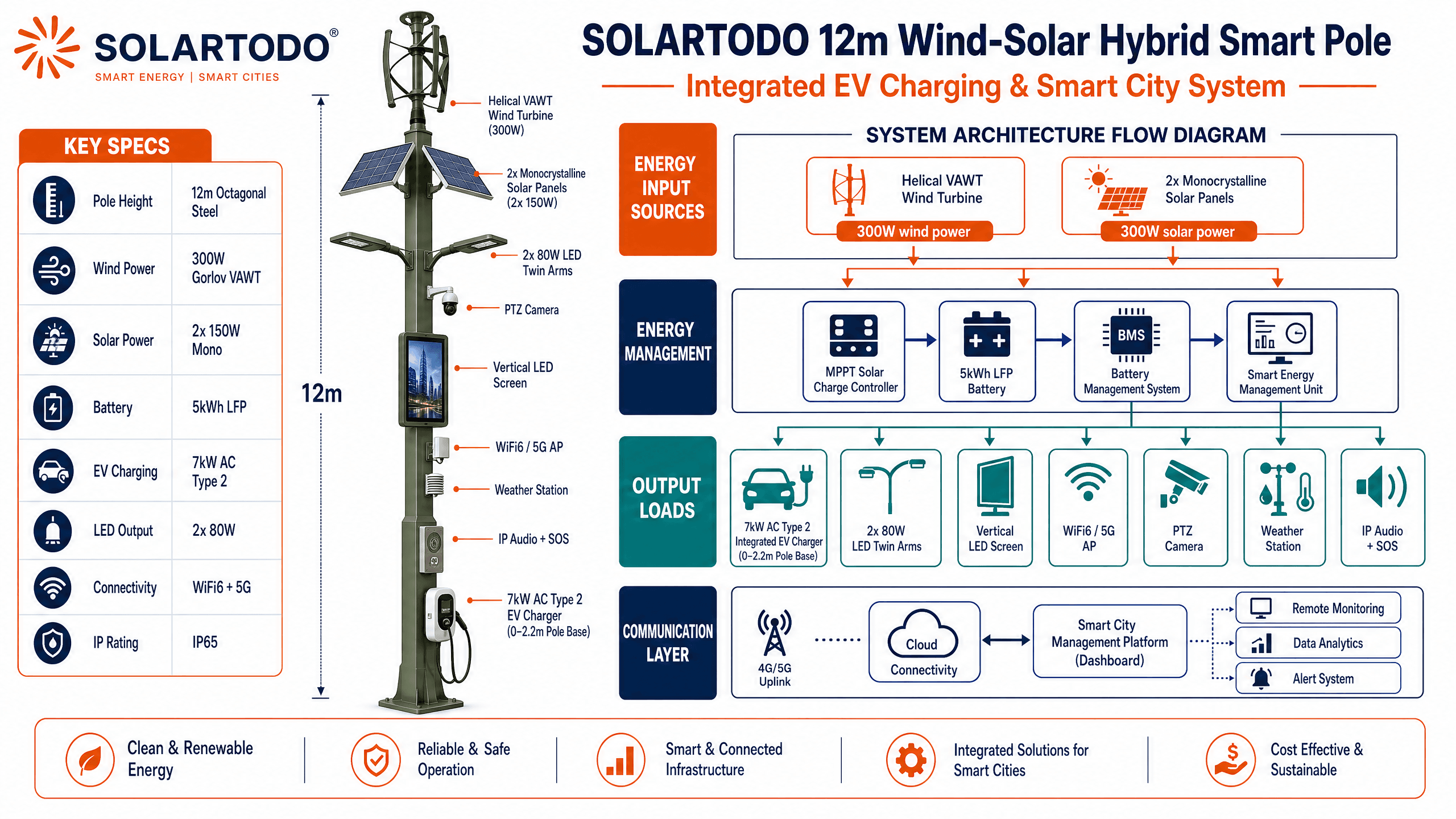
Implementation Approach
A corridor-scale Mombasa rollout would typically be delivered in 4 phases over about 20-32 weeks, covering site survey, civil works, pole erection, and commissioning with IEC-based acceptance testing.
Phase 1 is route definition and utility coordination. For a 106-unit corridor, the municipality or EPC contractor would usually confirm right-of-way, underground utility conflicts, charging demand points, and communications backhaul options over 3-6 weeks. At this stage, wind exposure, salt spray severity, and drainage conditions should be checked because foundation and coating choices in a coastal city differ from inland Kenya.
Phase 2 is detailed design and procurement. This usually takes 4-8 weeks and includes foundation drawings, anchor bolt schedules, feeder sizing for grid backup, earthing design, and network architecture for the camera, display, WiFi 6, and 5G gateway. If the project uses CKD or semi-knocked-down logistics, packing plans should protect the 1000×2000mm LED display, 15cm PTZ dome, and charger touchscreen from transit moisture.
Phase 3 is civil and electrical installation. Typical work includes excavation, reinforced concrete foundations, conduit placement, grounding, pole erection, and terminations. For 12m poles with integrated 10kWh batteries and charger cabinets, lifting plans and access windows should be prepared in advance because the lower 2.2m section contains active electrical equipment and requires careful handling during craning.
Phase 4 is software integration and acceptance. This normally takes 2-4 weeks and includes charger commissioning, OCPP setup, camera and SOS linkage, PA testing, display content upload, and sensor calibration. Acceptance should verify LED operation, EV charging, emergency stop, network connectivity, battery response, and alarm reporting under both hybrid and backup-grid modes.
For Mombasa, maintenance planning should be front-loaded rather than treated as a later issue. According to NREL (2021), preventive maintenance and remote monitoring materially improve uptime and lower lifecycle cost for distributed energy assets. On coastal roads, that means scheduled cleaning of panels and display surfaces, corrosion inspection at fasteners and seals, and periodic checks on speaker grilles, charging connectors, and grounding resistance.
Expected Performance & ROI
For Mombasa corridors, a 106-unit hybrid Smart Streetlight layout would typically improve lighting, surveillance, public communications, and EV service density in one asset line, while reducing dependence on separate poles, cabinets, and charger pedestals.
From a lighting standpoint, each pole provides 160W of LED load at 150 lm/W, or about 24,000 lumens total luminaire output per pole before optical losses. Across 106 poles, that is roughly 2.54 million lumens of installed LED output. Compared with legacy sodium or metal-halide streetlights commonly ranging from 250W to 400W per point, LED conversion alone can reduce lighting electricity use by 40-70%, depending on baseline and dimming strategy. According to the U.S. Department of Energy (2022), LED street lighting regularly delivers energy savings in that range.
The hybrid energy package does not fully replace all grid use in every operating condition, but it can reduce grid dependence for auxiliary loads and improve continuity. With 500W wind and 200W solar nameplate per pole, the distributed generation capacity across 106 units equals about 74.2kW. More important than nameplate is resilience: the aggregate battery capacity is 1,060kWh, which can sustain critical loads such as lighting at reduced output, communications, SOS, and surveillance during outages.
The EV layer adds a separate revenue or service value stream. A 7kW AC charger is destination-charging class rather than highway fast charging, which suits hotels, port-adjacent parking, civic buildings, and mixed-use streets. According to the IEA (2024), public charging availability remains a key factor in EV uptake, especially in early-stage markets where visible charging access reduces adoption friction.
Return on investment depends on whether the buyer values the pole as a lamp, a smart-city node, or a revenue asset. If a municipality only compares fixture CAPEX to a basic streetlight, payback will look longer. If the same buyer includes avoided costs for separate CCTV poles, speaker columns, environmental stations, WiFi hardware, advertising structures, and standalone EV chargers, the total-street-furniture model is stronger. In many urban tenders, the better comparison is not one streetlight versus one streetlight; it is one multifunction pole versus 5-7 separate devices and mounting points.
A reasonable planning assumption for Mombasa is a 6-10 year blended payback under municipal or PPP structures, depending on ad-display monetization, charging utilization, telecom leasing, and avoided trenching for separate systems. According to IRENA (2023), lifecycle economics for distributed urban infrastructure improve when multiple services share one civil foundation and one maintenance route. That principle is central to the SOLAR TODO Smart Streetlight business case.
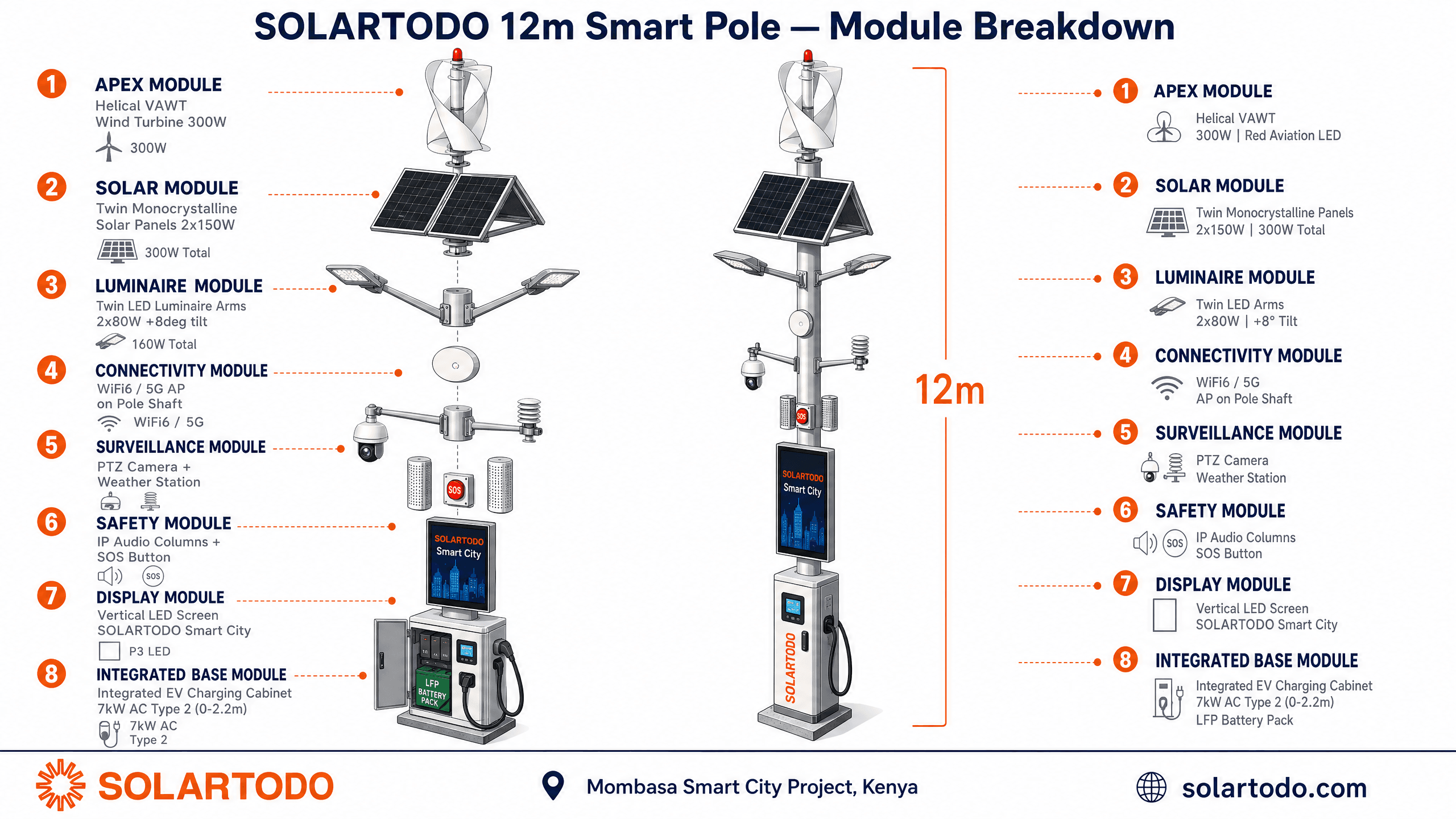
Comparison Table
For Mombasa, the 12m hybrid Smart Streetlight offers the best balance of resilience, service density, and corridor coverage when compared with a basic grid pole or a premium cylindrical solar-only visual design.
| Metric | Recommended Mombasa Hybrid 12m | Basic Grid Smart Pole 10-12m | Premium Cylindrical Solar Pole |
|---|---|---|---|
| Pole height | 12m | 10-12m | Typically urban class |
| Power architecture | 500W wind + 200W solar + 10kWh LFP + grid backup | Grid only | Wrapped CIGS solar + battery |
| Lighting load | 2×80W = 160W | 80-150W typical | 80-150W typical |
| EV charging | Integrated 7kW AC Type 2 in lower 2.2m pole | Optional separate or add-on | Flush embedded charger |
| Camera | 360°, 20x zoom, IR 100m | Optional | Optional |
| Environmental sensing | 12 parameters incl. rain, CO, NO2, O3 | Basic 8-in-1 typical | Optional premium package |
| Public address | 2×30W / 93dB IP audio columns | Optional | Optional |
| Display | P3 1000×2000mm, >6000 cd/m² | Optional smaller display | Usually limited by aesthetics |
| Communications | WiFi 6 + 5G + GbE + LoRaWAN | 4G/LoRaWAN typical | WiFi/4G optional |
| Coastal resilience fit | High, if galvanized + coated + sealed | Medium | Medium-high |
| Best use in Mombasa | Arterials, CBD, tourism, port corridors | Budget-only retrofits | Premium plazas and showcase streets |
Pricing & Quotation
SOLAR TODO offers three pricing tiers for this product line: FOB Supply (equipment ex-works China), CIF Delivered (including ocean freight and insurance), and EPC Turnkey (fully installed, commissioned, with 1-year warranty). Volume discounts are available for large-scale deployments. Configure your system online for an instant estimate, or request a custom quotation from our engineering team at [email protected].
For Mombasa buyers, quotation accuracy depends on 6 main variables: foundation design, corrosion protection level, charger metering and backend requirements, display brightness specification, telecom backhaul scope, and import/logistics terms through Kenya. A useful RFQ should also specify whether the 106-unit concept is a single corridor, multi-road package, or phased rollout.
Buyers comparing offers should request a line-by-line schedule for pole steel, battery chemistry, charger protocol, display pixel pitch, sensor list, and standards compliance. For the SOLAR TODO Smart Streetlight, the most important tender checkpoints are IEC 60598, IEC 62196-2, battery enclosure design, and whether the charger is truly integrated into the lower 2.2m pole body rather than supplied as a separate pillar.
Frequently Asked Questions
This FAQ answers the most common Mombasa procurement questions on specifications, installation, maintenance, ROI, warranty, and how a 106-unit hybrid Smart Streetlight compares with simpler streetlight options.
Q1: Why is a 12m Smart Streetlight recommended for Mombasa instead of a 6-8m pole? A 12m pole is better suited to Mombasa’s arterial and mixed-use urban roads because it supports wider light distribution, better camera sightlines, and higher mounting for WiFi 6 and 5G equipment. At 35m spacing, a 12m class also reduces the number of poles needed compared with shorter poles on the same corridor.
Q2: Is this a solar streetlight or a grid streetlight? It is a hybrid system. Each pole combines 500W wind, 2×100W solar, a 10kWh LFP battery, and backup grid tie. That means lighting and smart-city functions can continue during short grid disruptions, while the grid still supports continuity for EV charging and higher auxiliary loads when needed.
Q3: How many poles would a typical Mombasa corridor require? At the specified 35m spacing, approximately 106 poles cover about 3.71km of roadway. The exact count depends on junction density, setbacks, median or roadside placement, and whether the route includes plazas, bus bays, or parking areas that need different spacing or charger allocation.
Q4: What makes the EV charger different from a standard roadside charger pedestal? The charger is built into the lower 2.2m of the pole as one welded steel structure, not a separate cabinet beside the pole. It provides 7kW AC charging, Type 2 connection, OCPP 1.6J communication, a 5m coiled cable, touchscreen, and emergency stop in a smaller streetscape footprint.
Q5: How long would installation usually take for a 106-unit package? A realistic program is about 20-32 weeks, depending on approvals, shipping terms, civil readiness, and grid interface scope. Site surveys and utility coordination often take 3-6 weeks, procurement 4-8 weeks, installation 8-14 weeks, and software commissioning another 2-4 weeks.
Q6: What maintenance is most important in Mombasa’s coastal climate? Salt-laden air increases corrosion risk, so routine inspection of coatings, fasteners, seals, grounding points, and charger connectors is important. Buyers should plan periodic cleaning for the solar panels, LED display, and camera dome, plus battery health checks and communications diagnostics at scheduled intervals through the year.
Q7: What payback period should buyers expect? A blended planning range of 6-10 years is reasonable when the pole is treated as a multi-service asset rather than only a lamp. Payback improves if the project includes display revenue, telecom leasing, avoided standalone CCTV poles, and EV charging income or fleet electrification savings.
Q8: How does this compare with a basic smart pole without wind and battery storage? A basic grid pole usually has lower initial cost, but it depends fully on grid continuity and often needs separate cabinets or devices for EV, sensors, and communications. The hybrid 12m version adds resilience, cleaner streetscape integration, and more service density in one foundation, which can improve lifecycle economics.
Q9: What standards should appear in the tender documents? At minimum, the tender should reference IEC 60598 for luminaires, IEC 62196-2 for the Type 2 EV connector, and the supplied smart-pole compliance reference GB/T 37024. Buyers should also request clear documentation for charger interoperability, battery protection, grounding, and corrosion-protection specifications.
Q10: What warranty structure is typical for this type of supply? Warranty terms vary by scope, but turnkey packages commonly include a 1-year installation warranty, while component warranties may differ for LEDs, batteries, displays, and chargers. Buyers should ask for separate warranty periods by subsystem and confirm what preventive maintenance is required to keep each warranty valid.
Q11: Can this pole support telecom or public WiFi use cases? Yes. The specified package includes WiFi 6, a 5G gateway, GbE uplink, and LoRaWAN, with the communications module mounted at 8.7m. That makes it suitable for corridor connectivity, IoT data collection, and future integration with municipal platforms, provided backhaul and spectrum arrangements are in place.
Q12: Where can buyers request a technical review or quotation? Buyers can review the product line at /products/smart-streetlight and send route drawings or tender documents via contact us. For a useful quotation, include target pole count, road width, foundation assumptions, charger backend requirements, and whether the project is supply-only, CIF, or EPC turnkey.
References
This guide uses public standards and market sources including Kenyan demographic data, international energy data, and IEC charging and lighting standards relevant to a 12m hybrid Smart Streetlight in Mombasa.
- Kenya National Bureau of Statistics (2019): 2019 Kenya Population and Housing Census; Mombasa County population about 1.21 million.
- World Bank (2023): World Development Indicators and Climate Change Knowledge Portal; Kenya urbanization data and coastal climate context for Mombasa.
- International Energy Agency (2023): Kenya energy profile and electricity access trends relevant to municipal infrastructure resilience.
- International Energy Agency (2024): Global EV Outlook; public charging availability remains a key factor in EV adoption.
- International Renewable Energy Agency (2023): Distributed energy and urban infrastructure integration improve resilience and lifecycle economics when multiple services share assets.
- IEC (2020): IEC 60598 luminaires standard for safety and performance of lighting equipment.
- IEC (2016): IEC 62196-2 plugs, socket-outlets, vehicle connectors and vehicle inlets for conductive charging of electric vehicles.
- ITU (2022): Smart sustainable cities framework; ICT use to improve urban services and quality of life.
- U.S. Department of Energy (2022): LED street lighting guidance showing typical energy savings versus legacy technologies.
- NREL (2021): Best practices for distributed energy asset monitoring and preventive maintenance.
- IEEE (2021): EV charging interoperability guidance; importance of open communication and compatibility for scalable charging infrastructure.
- Communications Authority of Kenya (2023): Sector statistics on mobile broadband and digital connectivity trends relevant to smart-pole applications.
Equipment Deployed
- 12m octagonal tapered steel Smart Streetlight pole, base Ø45cm to top Ø15cm, military green RAL6014 powder coat
- Integrated lower 2.2m pole-as-charger cabinet, welded as one continuous steel structure
- Darrieus H-type VAWT, 3 straight vertical blades, Ø80×110cm, 500W, red aviation LED
- 2×100W deep-black monocrystalline solar panels on mid-pole A-frame brackets at 15° tilt
- 10kWh LFP battery pack inside pole base with MPPT controller and backup grid tie
- Twin 1.5m symmetric luminaire arms with +8° upward tilt
- 2×80W LED luminaires, 150 lm/W, 4000K
- 15cm mini white PTZ dome camera, 360°, 20x zoom, IR 100m, mounted on 40cm L-bracket
- 12-parameter environmental sensor for meteorology, air quality, rain, CO, NO2, and O3
- 2× IP audio columns, Ø10×50cm, 30W, 93dB, TCP/IP networked
- One-press SOS emergency button with camera linkage
- Integrated 7kW AC EV charger, Type 2, OCPP 1.6J, 5m coiled cable, touchscreen, E-stop
- P3 vertical LED display, 1000×2000mm, portrait, >6000 cd/m², content set to SOLARTODO Smart City
- Flush-mounted WiFi 6 + 5G gateway with GbE uplink and LoRaWAN at 8.7m
- Qi wireless phone charging pad and USB-A outlet
- Compliance set: IEC 60598, GB/T 37024, IEC 62196-2