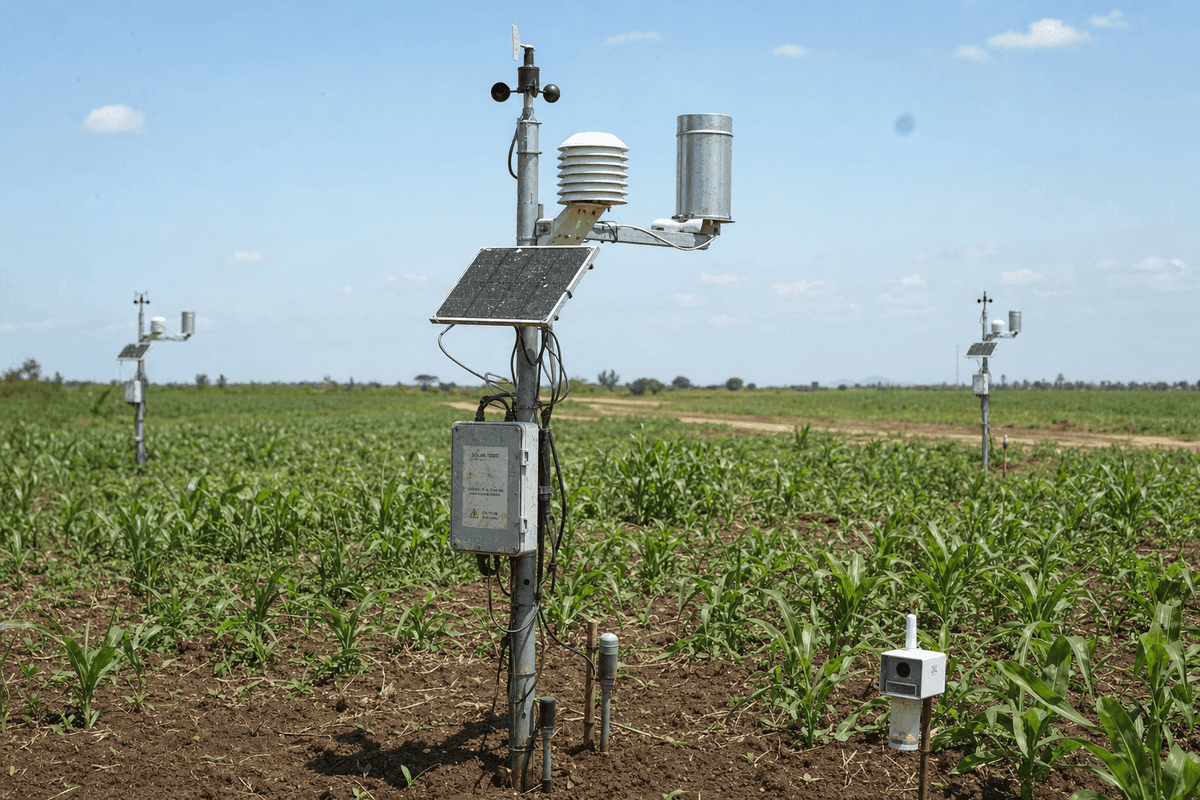
Mombasa Smart Agriculture Monitoring Guide: 284-Hectare NB-IoT Configuration for Coastal Farms
Summary
Mombasa’s 1.21M population and 212.5 km2 land area make peri-urban farming data-intensive; a 284 ha Smart Agriculture Monitoring design would use 3 weather stations, 29 soil nodes, and NB-IoT.
Key Takeaways
A 284 ha Mombasa smart-farm profile fits the medium-size class, requiring 3 weather stations, 29 soil sensors, 29 pest traps, and 3 disease nodes.
- According to KNBS (2019), Mombasa County has 1,208,333 residents on about 212.5 km2 of land, creating pressure for high-yield peri-urban food systems.
- The recommended configuration uses 3x 7-sensor weather stations measuring temperature, humidity, rainfall, wind speed, wind direction, pressure, and solar radiation at +/-0.3 C and +/-2% RH.
- Approximately 29 EC + pH soil sensors at 15-30 cm depth provide salinity and acidity monitoring for coastal soils affected by irrigation quality and marine influence.
- Approximately 29 pheromone + AI photo-counting smart traps cover about 58 ha at 2 ha per unit; these are monitoring traps, not insect-killing lamps.
- Disease surveillance should use 3 volumetric air-sampling spore-capture units to detect airborne pathogen pressure before visible canopy symptoms appear.
- NB-IoT nodes operating at 20-250 kbps fit low-data telemetry across a 284 ha farm where carrier coverage is available.
- Every field device should use a medium solar kit with an 80 W panel and 400 Wh battery, supporting up to a 25 W load off-grid.
- SOLARTODO’s professional platform tier adds AI prediction, 3-year historical data, and API access for agronomy dashboards and ERP integration.
Market Context for Mombasa
Mombasa’s compact 212.5 km2 land base and humid coastal climate make precision monitoring useful where agriculture competes with urban, port, and tourism land uses.
According to the Kenya National Bureau of Statistics (2019), Mombasa County recorded 1,208,333 people in the 2019 census, making it one of Kenya’s densest county economies. That density changes the agriculture problem: farms near Mombasa are less likely to scale by adding land and more likely to scale through irrigation control, pest surveillance, disease warning, and high-value crop scheduling. For buyers evaluating SOLARTODO Smart Agriculture Monitoring, the relevant question is not whether monitoring is technically possible, but how many nodes produce usable decisions without over-specifying the farm.
According to Mombasa County (2023), the county development planning context emphasizes urban services, climate resilience, food security, and efficient land use across a small coastal territory. Coastal farms around Mombasa face high humidity, salt stress, variable rainfall, and fast pest reproduction cycles, so weather-only monitoring is insufficient. The correct technical fit combines microclimate stations, EC + pH soil probes, AI pest counts, spore capture, and solar-powered communications.
According to the World Bank Climate Change Knowledge Portal (2021), Kenya is exposed to rainfall variability, floods, droughts, and heat stress that directly affect crop planning. In Mombasa, the operational risk is not only drought; humid periods can raise fungal disease pressure, while intense rainfall can leach nutrients and shift soil electrical conductivity. This is why the recommended configuration includes 3 disease-monitoring nodes and 29 EC + pH sensors rather than relying on a basic weather station alone.
FAO states, "CSA is an approach" that guides agri-food systems toward climate-resilient practices. For Mombasa, that means site-specific telemetry should support irrigation timing, salinity management, pesticide threshold decisions, and disease-risk alerts. SOLARTODO should be framed as a technical monitoring layer for those decisions, not as a claim of a completed local project.
Recommended Technical Configuration
A typical 284 ha deployment in Mombasa should use the medium class, with 3 weather stations, 29 soil sensors, 29 pest monitors, and NB-IoT telemetry.
The 284 hectare project-specific profile fits the medium farm class in SOLARTODO’s engineering table, which covers 100-500 ha farms. The configuration is denser than the baseline medium table because coastal pest and soil variability justify more sampling points, but it remains realistic: 29 soil sensors across 284 ha equals roughly 1 sensor per 9.8 ha, not an over-specified 100-sensor layout. A typical deployment of this scale would consist of distributed monitoring clusters around irrigation blocks, crop zones, drainage patterns, and pest corridors.
A recommended configuration for Mombasa is approximately 3 units of 7-sensor weather stations, approximately 29 EC + pH soil sensors at 15-30 cm depth, approximately 29 pheromone + AI photo-counting pest traps, approximately 3 volumetric spore-capture disease units, and approximately 6 smart rodent traps with activity sensors. Communications should use NB-IoT carrier-network nodes at 20-250 kbps where signal testing confirms coverage. All field nodes should be solar-powered and off-grid capable using the medium solar kit.
The platform should be SOLARTODO’s professional tier because Mombasa’s coastal conditions benefit from AI prediction, 3-year history, and API access. Three years of history is important for comparing long-rain, short-rain, and dry-season crop responses. API access also allows agribusiness operators to connect sensor data to irrigation logs, agronomist reports, procurement systems, or farm-management software.
Technical Specifications
The 284 ha Mombasa configuration uses 3 weather stations, 29 soil sensors, 29 AI pest traps, 3 disease units, 6 rodent nodes, and solar NB-IoT telemetry.
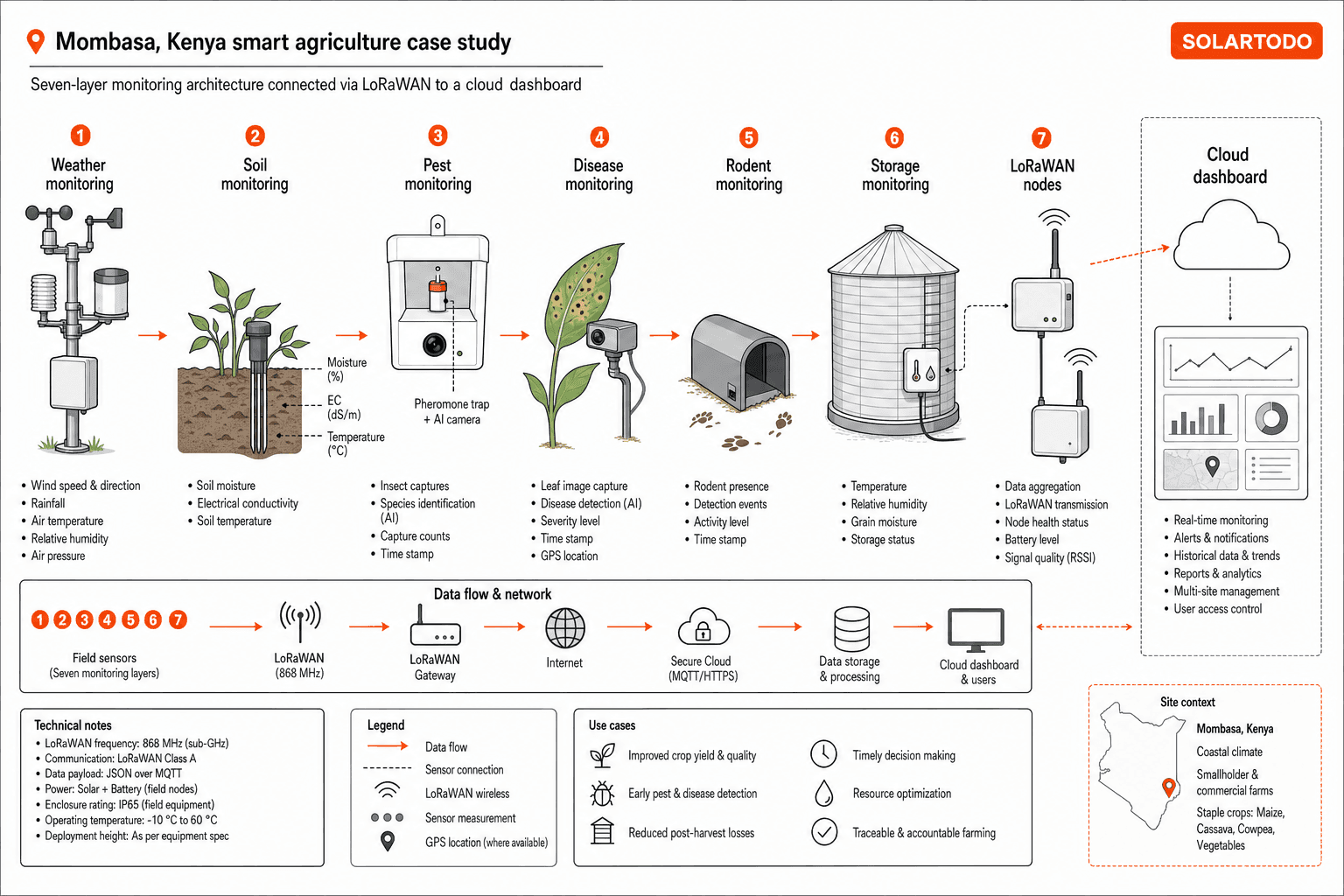
Core Field Equipment
- Weather monitoring: approximately 3 units of 7-sensor weather stations with temperature, humidity, rainfall, wind speed, wind direction, atmospheric pressure, and solar radiation.
- Weather accuracy: +/-0.3 C for temperature and +/-2% RH for humidity, aligned with precision farm-decision requirements.
- Soil monitoring: approximately 29 EC + pH sensors installed at 15-30 cm depth for root-zone salinity and acidity monitoring.
- Pest monitoring: approximately 29 pheromone + AI photo-counting smart traps, each covering about 2 ha; these are not insect-killing lamps.
- Disease monitoring: approximately 3 volumetric air-sampling spore-capture units for early fungal and airborne pathogen surveillance.
- Rodent monitoring: approximately 6 smart trap + activity sensor units for storage areas, canal edges, and crop-border corridors.
- Communication: NB-IoT nodes using carrier networks with 20-250 kbps telemetry for small sensor packets and alert events.
- Power: medium solar kit with 80 W panel and 400 Wh battery, supporting a 25 W load for off-grid field operation.
- Platform: professional cloud platform with AI prediction, 3-year historical data retention, and API access.
- Standards alignment: WMO meteorological practices and ISO 11461 soil-quality methods.
According to 3GPP (2016), NB-IoT was standardized in Release 13 for low-power wide-area cellular IoT, making it suitable for small sensor payloads rather than high-bandwidth video. According to WMO (2023), meteorological observations depend on standardized units and exposure practices; WMO states, "SI should be used" for international meteorological exchange. According to ISO (1995), ISO 11461 defines soil-quality determination of soil water content as a volume fraction using coring sleeves, which supports disciplined soil-sampling practice around sensor calibration.
Implementation Approach
A typical Mombasa rollout would be implemented in 4 phases: survey, configuration, installation, and commissioning across weather, soil, pest, and disease layers.
The first phase should be a field survey covering crop zoning, irrigation blocks, drainage gradients, NB-IoT signal strength, shading, security risk, and maintenance access. Weather stations should be placed away from building turbulence and tall obstructions, while soil sensors should be installed at representative 15-30 cm root-zone depths. Pest traps should follow crop-specific pheromone selection and be distributed by pressure zones rather than placed in a uniform grid only.
The second phase should finalize the bill of materials and CKD shipment plan. For a 284 ha system, the equipment package would include 3 weather-station assemblies, 29 soil probes, 29 AI pest traps, 3 disease-sampling units, 6 rodent sensors, NB-IoT communication modules, solar kits, mounting hardware, and cloud-platform provisioning. SOLARTODO documentation should specify sensor IDs, installation coordinates, SIM profiles, API credentials, and acceptance-test thresholds.
The third phase should cover installation and activation. Weather stations require pole mounting, solar orientation, sensor leveling, and rainfall gauge calibration checks. Soil sensors require consistent depth placement and a soil-contact verification procedure. Pest and disease equipment should be registered in the dashboard with crop block, trap type, target pest or pathogen, and inspection interval.
The fourth phase should commission the system with data validation. A practical acceptance test would verify 24-72 hours of telemetry, battery charging, NB-IoT packet delivery, dashboard alerts, API access, and agronomist report generation. Training should cover trap image review, soil EC interpretation, spore-count trend reading, and alert escalation.
Expected Performance & ROI
A 284 ha Mombasa monitoring system could target combined yield-risk improvements of 3% weather, 8% soil, 5% pest, and 7% disease management.
The expected performance should be presented as conditional agronomic improvement, not as a past deployment result. The project-specific improvement assumptions are weather +3%, soil +8%, pest +5%, and disease +7%. These gains should not be added mechanically because weather, soil, pest, and disease factors overlap; the practical value is earlier intervention and fewer blind management decisions.
According to FAO (2019), climate-smart agriculture aims to increase productivity, adapt to climate risk, and reduce emissions where possible. In Mombasa, the clearest ROI mechanism is avoided loss: EC + pH monitoring can flag salinity and acidity before yield decline becomes visible, while pheromone + AI counts can support threshold-based spraying. Spore capture can shift disease management from reactive fungicide application to risk-based timing.
Maintenance affects ROI as much as hardware selection. A realistic operating model should include monthly visual inspections, seasonal calibration checks, trap-lure replacement according to pest protocol, SIM data-plan review, panel cleaning after dust or salt accumulation, and quarterly agronomist review of alert thresholds. SOLARTODO’s professional platform is appropriate because AI prediction and 3-year data retention improve value after the first season.
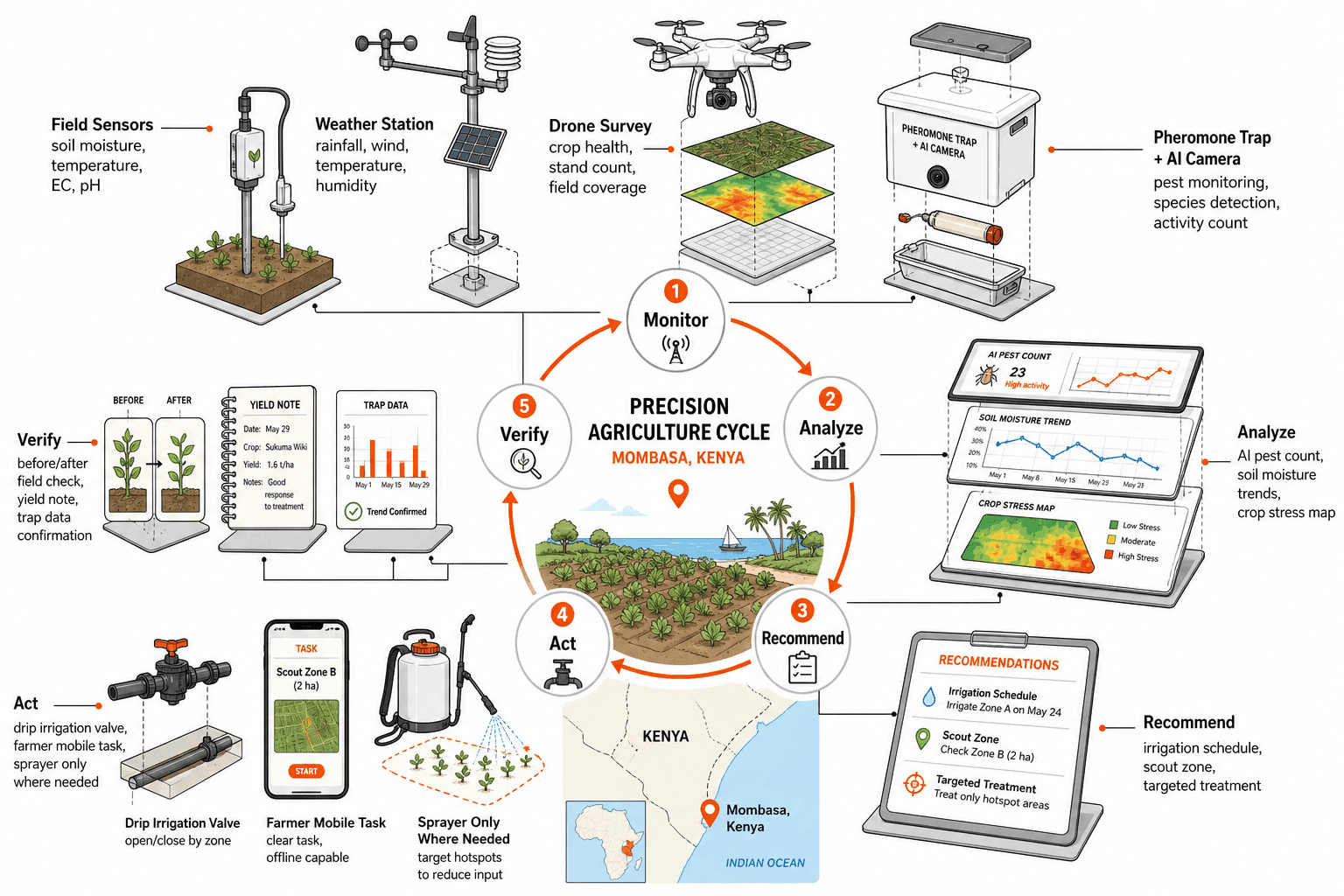
Results and Impact
For Mombasa buyers, the expected impact is earlier agronomic intervention across 284 ha using 70 connected monitoring assets and professional analytics.
A properly configured system should create a single operating picture for microclimate, root-zone chemistry, pest pressure, airborne disease risk, and rodent activity. The most important result is not the number of devices; it is whether farm managers can act earlier with fewer manual checks. On a 284 ha site, 70 connected monitoring assets provide enough spatial coverage for block-level decisions without pushing the design into a large-farm control-room architecture.
The impact should be evaluated by leading indicators before yield is measured. These include irrigation adjustments triggered by weather and soil readings, pest interventions triggered by AI count thresholds, disease actions triggered by spore trends, and maintenance tickets triggered by battery or communication alerts. After 2-3 cropping cycles, the 3-year history should support better seasonal benchmarks.
Comparison Table
The recommended Mombasa configuration is more complete than a weather-only system because it monitors 7 climate variables, EC + pH, pests, spores, and rodents.
| Configuration option | Area fit | Weather | Soil | Pest and disease | Communication | Best use case |
|---|---|---|---|---|---|---|
| Basic monitoring | <30 ha | 1x 4-sensor station | 5-8 moisture + temp sensors | 1 pest trap | LoRaWAN gateway | Small farm visibility |
| Mombasa recommended | 284 ha | 3x 7-sensor stations | 29 EC + pH sensors | 29 AI pest, 3 spore, 6 rodent units | NB-IoT 20-250 kbps | Coastal medium farm control |
| Large estate design | 1000+ ha | 5+ weather stations | 50+ comprehensive sensors | 5+ pest, multi-disease nodes | 4G mesh | Control-room operations |
This comparison shows why the Mombasa recommendation should remain in the medium class. A 4G mesh and 50+ soil sensors may fit a 1000+ ha estate, but they would add cost and maintenance complexity for 284 ha. NB-IoT is a better technical match where carrier coverage is available and sensor payloads are small.
Pricing & Quotation
SOLARTODO provides 3 commercial quotation paths for the 284 ha configuration: FOB Supply, CIF Delivered, and EPC Turnkey without publishing fixed prices.
SOLARTODO offers three pricing tiers for this product line: FOB Supply (equipment ex-works China), CIF Delivered (including ocean freight and insurance), and EPC Turnkey (fully installed, commissioned, with 1-year warranty). Volume discounts are available for large-scale deployments. Configure your system online for an instant estimate, or request a custom quotation from our engineering team at [email protected].
For Mombasa, a quotation should confirm crop type, block layout, NB-IoT carrier coverage, required integration API, installation responsibility, customs route, and warranty service model. Buyers comparing supply-only and EPC scopes should request the same technical schedule for both, including sensor quantities, solar kit rating, platform tier, and commissioning criteria.
Frequently Asked Questions
The 284 ha Mombasa design is best understood through 10 buyer questions covering specifications, installation, ROI, maintenance, warranty, pricing, and alternatives.
Q1: What is the recommended Smart Agriculture Monitoring configuration for a 284 ha farm in Mombasa? A typical 284 ha Mombasa configuration would use 3 seven-sensor weather stations, 29 EC + pH soil sensors, 29 pheromone + AI photo-counting pest traps, 3 volumetric spore-capture units, and 6 smart rodent activity sensors. The system should use NB-IoT telemetry, medium solar kits, and SOLARTODO’s professional cloud platform.
Q2: Why is this a medium-size deployment rather than a large-farm design? SOLARTODO’s size table classifies 100-500 ha as medium, and the Mombasa profile is 284 ha. A large design would normally start around 1000+ ha with 50+ soil nodes, 5+ weather stations, multi-disease arrays, 4G mesh, and a control room. That would be unnecessarily complex for this profile.
Q3: How long would installation and commissioning typically take? A typical schedule would allow 1-2 weeks for survey and layout confirmation, 2-4 weeks for procurement and logistics after specification lock, and about 5-10 field days for installation depending on access. Commissioning should include 24-72 hours of live data validation, alert testing, battery checks, and dashboard training.
Q4: What ROI or payback should buyers expect? The project-specific assumptions are weather +3%, soil +8%, pest +5%, and disease +7% yield-risk improvement. Actual payback depends on crop value, baseline losses, labor cost, chemical-use reduction, and irrigation savings. Buyers should model ROI by avoided losses and decision speed, not by assuming every percentage gain stacks linearly.
Q5: How is this different from a basic farm weather station? A weather-only system measures climate but misses root-zone chemistry, pest counts, airborne spores, and rodent activity. The Mombasa recommendation includes 3 weather stations plus 29 soil sensors, 29 AI pest traps, 3 disease units, and 6 rodent nodes. That combination supports operational decisions across irrigation, crop protection, and field scouting.
Q6: Are the pest devices insect-killing lamps? No. The specified pest devices are pheromone + AI photo-counting smart traps with about 2 ha coverage per unit. They are monitoring devices, not insect-killing lamps. Their role is to count and classify pest activity so farm managers can apply integrated pest management thresholds and reduce unnecessary interventions.
Q7: What maintenance is required in coastal Mombasa conditions? Maintenance should include monthly device inspection, solar-panel cleaning, enclosure checks for salt and humidity exposure, trap-lure replacement by pest protocol, soil-probe verification, SIM connectivity review, and seasonal calibration. Disease spore units need regular sampling consumables and microscopy workflow checks. A quarterly agronomy review should tune alert thresholds.
Q8: Why use NB-IoT instead of LoRaWAN or 4G LTE? NB-IoT is appropriate where carrier coverage exists and devices send small telemetry packets at 20-250 kbps. LoRaWAN is strong for private networks and low recurring data use, while 4G LTE is better for video-heavy applications. This Mombasa configuration does not require continuous video, so NB-IoT is technically efficient.
Q9: What does EPC Turnkey include for this product line? EPC Turnkey typically covers installed equipment, commissioning, platform activation, training, and a 1-year warranty. For Mombasa, the EPC scope should also define survey responsibility, mounting works, SIM activation, dashboard configuration, API setup, acceptance tests, and handover documents. Civil works and local permits should be clarified before quotation.
Q10: What warranty and data platform should be specified? The required commercial paragraph specifies EPC Turnkey with a 1-year warranty, while the technical platform should be professional tier with AI prediction, 3-year history, and API access. Buyers should confirm whether warranty service covers sensors, solar kits, communication modules, cloud access, and replacement logistics in Kenya.
References
This guide uses 7 public and standards references covering Mombasa demographics, climate risk, NB-IoT, weather observation, soil testing, and climate-smart agriculture.
- Kenya National Bureau of Statistics (2019): 2019 Kenya Population and Housing Census; Mombasa County population reported at 1,208,333 and land area around 212.5 km2.
- County Government of Mombasa (2023): County Integrated Development Plan 2023-2027; local planning context for land use, climate resilience, services, and food-security priorities.
- World Bank Climate Change Knowledge Portal (2021): Kenya climate profile identifying exposure to rainfall variability, floods, droughts, and temperature stress.
- World Meteorological Organization (2023): Guide to Instruments and Methods of Observation, WMO-No. 8; observation practice, units, exposure, and meteorological measurement guidance.
- ISO (1995): ISO 11461 Soil quality - Determination of soil water content as a volume fraction using coring sleeves.
- 3GPP (2016): Release 13 NB-IoT standardization for low-power wide-area cellular IoT using narrowband communication for sensor devices.
- FAO (2019): Climate-Smart Agriculture guidance describing productivity, resilience, and emissions objectives for agricultural transformation.
Equipment Deployed
- 3x 7-sensor weather stations with wind direction, pressure, solar radiation, +/-0.3 C and +/-2% RH accuracy
- 29x EC + pH soil sensors installed at 15-30 cm root-zone depth
- 29x pheromone + AI photo-counting smart traps with 2 ha coverage per unit, not insect-killing lamps
- 3x volumetric air-sampling spore-capture disease monitoring units
- 6x smart rodent trap + activity sensor units
- NB-IoT communication nodes operating at 20-250 kbps on carrier network
- Medium solar kit per device class with 80 W panel and 400 Wh battery supporting 25 W load
- Professional cloud platform with AI prediction, 3-year historical data, and API access