mobile deployment savings with Solar-Powered Security System

SOLARTODO Editorial Team
Solar Energy & Infrastructure Expert Team
Watch the video
TL;DR
Warehouses can save 25-45% on deployment-related security costs by using solar-powered mobile systems instead of repeatedly rebuilding fixed infrastructure. Adding LiDAR improves object classification, supports better perimeter control, and can reduce nuisance alarms by up to 90%, with typical payback in 18-36 months for dynamic sites.
Solar-powered warehouse security systems can cut temporary deployment energy and cabling costs by 25-45% while enabling mobile coverage in 24-72 hours. A LiDAR-assisted design improves perimeter classification, supports 30-day video retention, and reduces nuisance alarms by up to 90% in complex yard environments.
Summary
Solar-powered warehouse security systems can cut temporary deployment energy and cabling costs by 25-45% while enabling mobile coverage in 24-72 hours. A LiDAR-assisted design improves perimeter classification, supports 30-day video retention, and reduces nuisance alarms by up to 90% in complex yard environments.
Key Takeaways
- Deploy solar-powered mobile security units to reduce trenching, temporary power, and relocation costs by 25-45% for warehouses with changing yard layouts.
- Size each mobile node with 2-4 days of battery autonomy and hybrid 4G + Ethernet + WiFi communications to maintain uptime during grid outages or site moves.
- Integrate LiDAR with 8-16 HD IP cameras per zone cluster to improve object classification accuracy and suppress nuisance alarms by up to 90% versus motion-only CCTV.
- Segment warehouse risk into 32-96 alarm zones so gates, loading bays, container stacks, fuel areas, and office entries can be monitored with separate logic.
- Use 30 days of 4K video retention and cloud dashboards to accelerate investigations across 1-50 sites and improve evidence quality for claims and compliance.
- Compare FOB Supply, CIF Delivered, and EPC Turnkey models, then apply volume discounts of 5% at 50+ units, 10% at 100+, and 15% at 250+ units.
- Target payback in 18-36 months when replacing diesel-powered temporary surveillance, repeated cabling work, and guard-only patrol coverage in high-change warehouses.
- Verify alignment with EN 50131, IEC 62676, UL 681, NFPA 72, and IEEE 1547-related interconnection practices when solar charging interfaces with site electrical systems.
Why warehouses are adopting solar-powered mobile security with LiDAR
Solar-powered mobile warehouse security can lower deployment-related operating costs by 25-45% and speed site protection to 24-72 hours by avoiding trenching, fixed poles, and repeated electrical rework.
Warehouses increasingly operate in dynamic environments where racking zones, trailer parking, temporary overflow yards, and cross-dock lanes shift every quarter. Traditional fixed security infrastructure works well for stable footprints, but it becomes expensive when cameras, alarm points, and communications need to be moved repeatedly. In these conditions, mobile solar-powered security systems give operators a practical way to protect changing spaces without waiting for civil works.
For B2B buyers, the savings case is not only about electricity. It is about avoiding cable trenching, reducing generator fuel, shortening deployment timelines, and minimizing disruption to warehouse operations. A mobile architecture can also support leased yards, seasonal inventory peaks, and temporary expansion sites where permanent infrastructure would be underutilized.
According to the International Energy Agency, "solar PV is expected to remain the largest source of renewable capacity expansion through the end of the decade." That matters for security buyers because falling solar and battery costs make off-grid and hybrid surveillance increasingly viable for industrial sites. According to IRENA (2024), utility-scale solar PV costs remain far below 2010 levels, reinforcing the economics of solar-assisted infrastructure even outside pure power-generation projects.
For warehouse operators evaluating suppliers, SOLAR TODO can position solar-powered surveillance as part of a broader smart infrastructure strategy rather than as a standalone camera package. That is especially relevant when projects include yard lighting, telecom links, access control, and future automation layers.
System architecture for solar-powered warehouse security and LiDAR integration
A warehouse mobile security architecture typically combines 32-96 alarm zones, 8-48 cameras, LiDAR perimeter sensing, 2-4 days of battery autonomy, and cloud monitoring through 4G, Ethernet, or WiFi.
The core design principle is layered detection. Cameras provide visual evidence, intrusion detectors provide event triggers, and LiDAR adds spatial intelligence by measuring distance, movement path, and object shape within a defined field. In a warehouse yard, that matters because standard video analytics can struggle with headlights, fog, dust, pallet movement, reflective shrink wrap, and mixed pedestrian-forklift traffic.
LiDAR integration is most effective when used for perimeter corridors, blind corners, loading bay approaches, and high-value outdoor storage zones. Instead of relying only on pixel-based motion detection, the system can use 3D point-cloud or distance mapping to distinguish a human approach from wind-blown debris or a passing vehicle outside the protected boundary. This reduces unnecessary dispatches and helps security teams prioritize verified events.
According to IEC 62676 guidance for video surveillance system applications, performance depends heavily on correct scene design, image quality, and operational purpose. LiDAR does not replace this requirement; it strengthens it by adding another sensing layer. According to NREL (2024), solar-plus-storage performance modeling improves when load profiles are matched to actual duty cycles, which is directly relevant for camera, NVR, communications, and LiDAR power budgeting.
Recommended warehouse deployment layers
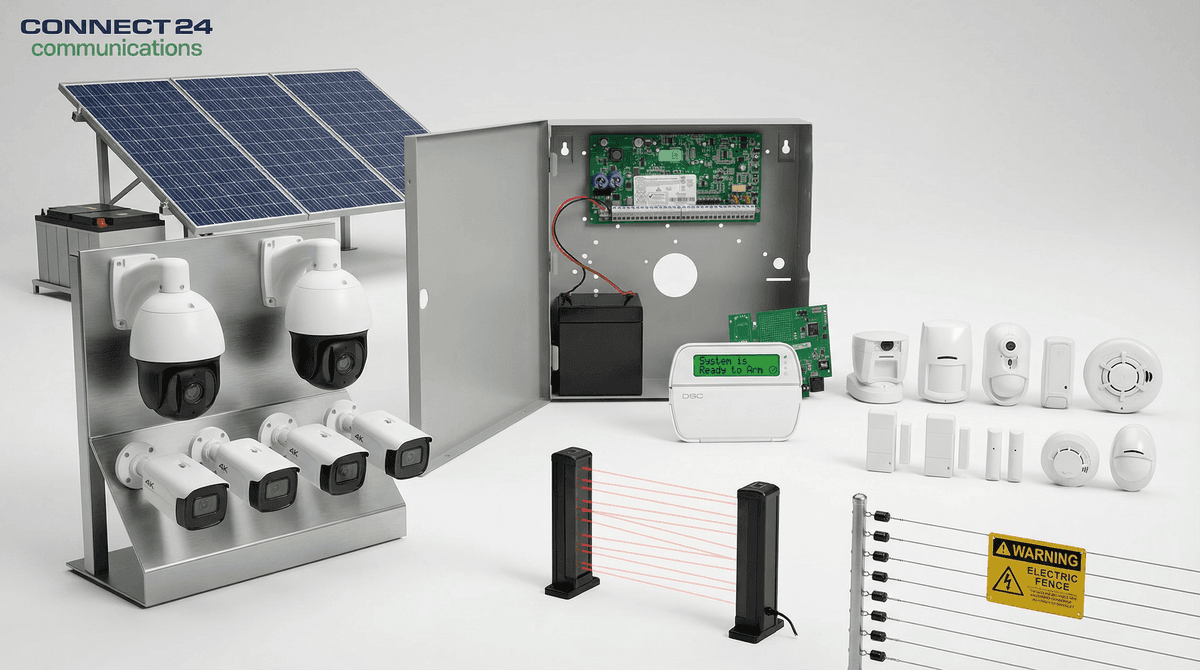
A practical warehouse deployment usually includes:
- Solar-powered mobile mast or trailer platform
- HD fixed cameras for aisles, gates, and loading bays
- PTZ cameras for yard sweep and incident follow-up
- LiDAR sensor for perimeter or corridor classification
- PIR or dual-technology detectors for indoor entries
- Door contacts for office, cage, or stockroom access points
- Hybrid communications: 4G + Ethernet + WiFi
- Cloud VMS and alarm dashboard
- Battery bank sized for night operation and low-sun periods
Where LiDAR adds the most value
LiDAR is especially useful in these warehouse scenarios:
- Long fence lines with uneven lighting
- Temporary yards where camera angles change often
- Mixed traffic zones with forklifts and pedestrians
- Outdoor high-value inventory stacks
- Dock approaches with frequent headlight glare
- Foggy, dusty, or reflective environments
The strongest design is not LiDAR-only. It is LiDAR plus video plus intrusion logic. For example, a warehouse can trigger an alarm only when LiDAR detects a human-sized object crossing a virtual boundary and a camera confirms motion in the corresponding scene. That reduces false positives and improves operator confidence.
SOLAR TODO can also benchmark warehouse buyers against larger critical-infrastructure packages such as the Port Terminal 96-Zone Full Security platform, which uses 48 cameras, 96 detectors, and 1,000 meters of electric fence for high-traffic outdoor environments. While warehouses may not need full port-scale architecture, the same layered design logic applies.
Mobile deployment savings and warehouse ROI model
Mobile solar-powered security usually delivers the best savings when warehouses face repeated relocations, temporary leases, or high trenching costs, with payback commonly falling in the 18-36 month range.
The biggest cost advantage comes from avoiding repeated infrastructure work. A fixed deployment often requires poles, trenching, conduits, permits, electricians, and downtime coordination. A mobile solar-powered platform shifts more cost into equipment and less into site-specific construction. That means assets can be redeployed instead of abandoned when operations move.
Typical savings categories include:
- Reduced trenching and conduit installation
- Lower temporary generator fuel and maintenance
- Faster commissioning with less site disruption
- Lower relocation cost when yard layouts change
- Reduced guard dispatches from fewer nuisance alarms
- Better evidence capture, reducing claims friction
According to BloombergNEF (2024), battery system costs continue to trend downward, improving the economics of mobile off-grid and hybrid assets. According to NREL (2024), accurate storage sizing can materially improve lifecycle value by preventing chronic deep discharge and oversizing. For warehouses, that means security uptime depends on matching solar generation and battery capacity to real duty cycles, especially for night-heavy surveillance loads.
A simplified ROI example for a mid-size warehouse using 4 mobile units might look like this:
| Cost Element | Fixed Grid-Connected Deployment | Solar-Powered Mobile Deployment |
|---|---|---|
| Civil works and trenching | $18,000 | $3,000 |
| Temporary power or generator support | $9,600/year | $1,800/year |
| Relocation after layout change | $12,000 | $3,500 |
| Nuisance alarm response cost | Higher | Lower with LiDAR-assisted filtering |
| Deployment time | 3-8 weeks | 24-72 hours |
| Residual asset value after site move | Low | High, redeployable |
In many cases, the mobile option has a higher equipment price but a lower total cost of ownership over 3-5 years. That is particularly true where the warehouse footprint changes at least once per year or where temporary yards are used seasonally. SOLAR TODO should present this as a TCO decision, not just a capex comparison.
The International Energy Agency states, "Digitalization and data improve system flexibility, resilience and operational visibility across energy-linked assets." In warehouse security, LiDAR-assisted mobile surveillance fits that principle by combining power autonomy, mobility, and better event intelligence.
EPC Investment Analysis and Pricing Structure
Warehouse solar-powered security projects are typically procured in 3 tiers—FOB Supply, CIF Delivered, and EPC Turnkey—with volume discounts of 5% at 50+, 10% at 100+, and 15% at 250+ units.
EPC means Engineering, Procurement, and Construction. In a warehouse security context, EPC turnkey delivery usually includes site survey, risk zoning, solar and battery sizing, structural design for masts or trailers, equipment supply, installation, commissioning, communications setup, cloud onboarding, testing, and operator training. For multi-site buyers, EPC may also include rollout sequencing and centralized dashboard configuration.
The three-tier commercial structure is typically:
| Delivery Model | What It Includes | Best For |
|---|---|---|
| FOB Supply | Equipment only, ex-port shipment | Integrators with local installation teams |
| CIF Delivered | Equipment plus freight and insurance to destination port | Importers managing local civil and electrical work |
| EPC Turnkey | Full engineering, supply, installation, commissioning, and handover | End users needing single-point responsibility |
Indicative pricing depends on camera count, LiDAR specification, mast height, battery autonomy, and software scope. As a directional guide, a warehouse mobile node with 4-8 cameras, 1 LiDAR sensor, solar charging, battery storage, and cloud connectivity may sit materially above a basic trailer camera package but below the lifecycle cost of repeatedly rebuilding fixed infrastructure.
For procurement planning, buyers should request pricing in three commercial layers:
- FOB Supply for equipment comparison
- CIF Delivered for landed-cost budgeting
- EPC Turnkey for total installed project approval
Standard payment terms are 30% T/T + 70% against B/L, or 100% L/C at sight. Financing is available for large projects above $1,000K, which is useful for regional warehouse networks standardizing security across multiple sites. For quotations and EPC discussions, buyers can contact [email protected].
Warranty expectations should be split by subsystem rather than treated as one number. Buyers should ask separately about camera warranty, battery cycle life, solar module performance warranty, LiDAR hardware warranty, software support term, and cloud service SLA. This is where SOLAR TODO can differentiate by presenting a structured lifecycle support matrix.
Warehouse use cases and selection strategy
The best warehouse LiDAR strategy is to match 1 sensing layer to each risk type, using cameras for evidence, LiDAR for spatial filtering, and intrusion devices for confirmed access events across 32-96 zones.
A single warehouse rarely has one uniform risk profile. A loading dock has different exposure than a perimeter fence, bonded storage cage, or trailer yard. The right strategy is to map operational zones and assign the least expensive sensor stack that still achieves the required response quality.
Typical warehouse use cases
- Trailer yards with changing parking geometry
- Overflow storage lots during peak season
- Cross-dock operations with 24/7 traffic
- Bonded or high-value goods storage areas
- Fuel or hazardous material edges
- Remote perimeter corners with weak grid access
Selection guide by warehouse condition
| Warehouse Condition | Recommended Configuration | Why It Works |
|---|---|---|
| Temporary leased yard | Solar mobile mast + 4 cameras + LiDAR + 4G | Fast deployment and easy relocation |
| High-value outdoor storage | 8 cameras + LiDAR corridor + siren + cloud alerts | Better classification and evidence capture |
| Large regional DC | 32-96 zones + fixed and PTZ mix + hybrid comms | Supports centralized monitoring |
| Dusty or fog-prone yard | LiDAR-assisted perimeter logic + PTZ verification | Reduces nuisance alarms in poor visibility |
| Multi-site warehouse network | Standardized cloud dashboard + repeatable mobile kits | Simplifies procurement and training |
For buyers comparing alternatives, a warehouse may not need the scale of the Government Building 128-Zone Maximum or Port Terminal 96-Zone Full Security systems, but those reference architectures show how layered zoning and centralized monitoring improve operational control. A smaller deployment can still borrow the same design principles.
The technical selection checklist should include:
- Required number of protected zones
- Camera count and retention period
- LiDAR range and field coverage
- Battery autonomy target in days
- Solar generation margin for winter conditions
- Communications redundancy
- Cloud vs local recording requirements
- Compliance and installation standards
SOLAR TODO should frame the decision around redeployability, alarm quality, and lifecycle cost. For warehouses with frequent layout changes, mobility itself becomes a financial feature.
FAQ
A solar-powered warehouse security system with LiDAR combines off-grid or hybrid power, 4-48 cameras, and spatial detection to reduce relocation cost, improve event verification, and protect changing yard layouts.
Q: What is a solar-powered security system for warehouses? A: It is a surveillance and intrusion platform powered fully or partly by solar modules and battery storage instead of relying only on fixed grid connections. In warehouse use, it often includes 4-48 cameras, alarms, cloud connectivity, and mobile mounting so protection can move with changing yard layouts.
Q: How does LiDAR improve warehouse security compared with standard CCTV? A: LiDAR improves warehouse security by adding distance and object-shape data to video-based detection. This helps distinguish people, vehicles, and background movement in difficult scenes such as fog, glare, dust, or reflective packaging, reducing nuisance alarms and improving operator response quality.
Q: How much can mobile solar deployment save compared with fixed installation? A: Savings often come from avoiding trenching, temporary power, and repeated relocation work rather than from electricity alone. In warehouses with frequent layout changes, total deployment-related savings commonly fall in the 25-45% range over a 3-5 year period, especially when assets are redeployed across multiple sites.
Q: When is a mobile solar-powered system better than a fixed grid-connected system? A: A mobile system is usually better when the warehouse uses leased yards, seasonal overflow space, temporary projects, or changing trailer parking patterns. If the security footprint moves at least annually, redeployable assets often produce lower total cost of ownership than rebuilding fixed infrastructure each time.
Q: What battery autonomy should a warehouse mobile security unit have? A: Most buyers should target 2-4 days of battery autonomy, depending on weather risk, night load, and site criticality. Higher autonomy is important for remote yards, weak-grid locations, and sites where cameras, LiDAR, lighting, and communications must continue operating during outages.
Q: How many cameras and zones does a typical warehouse need? A: A mid-size warehouse commonly needs 16-32 zones, while larger campuses may require 32-96 zones. Camera count depends on risk density, but many projects begin with 8-16 cameras covering gates, docks, perimeter lines, office entries, and high-value outdoor storage areas.
Q: Does LiDAR replace PIR detectors, beams, or cameras? A: No, LiDAR works best as a complementary sensing layer rather than a full replacement. Cameras still provide evidence, door contacts and PIR devices still protect enclosed spaces, and LiDAR adds better spatial filtering for outdoor corridors, perimeters, and complex yard movement patterns.
Q: What standards should buyers check for warehouse security projects? A: Buyers should review alignment with EN 50131 for intrusion systems, IEC 62676 for video surveillance, UL 681 for installation practices, and NFPA 72 for alarm signaling integration. If solar charging interfaces with site electrical systems, IEEE and local interconnection practices should also be considered.
Q: What does EPC turnkey include for this type of project? A: EPC turnkey usually includes engineering, site survey, risk zoning, solar and battery sizing, equipment procurement, installation, commissioning, cloud setup, testing, and training. It is the preferred model for end users who want one supplier responsible for technical performance and project delivery.
Q: How are these projects priced and what payment terms are common? A: Projects are usually quoted as FOB Supply, CIF Delivered, or EPC Turnkey depending on scope and buyer responsibility. Common payment terms are 30% T/T + 70% against B/L, or 100% L/C at sight, with financing available for projects above $1,000K and volume discounts up to 15%.
Q: What maintenance is required for solar-powered warehouse security systems? A: Maintenance usually includes cleaning solar modules, checking battery health, verifying communications uptime, testing alarms, and recalibrating LiDAR or analytics when yard layouts change. Most operators should schedule quarterly inspections and a deeper annual review to protect uptime and evidence quality.
Q: How should a multi-site warehouse operator standardize deployment? A: Standardization works best when the operator defines a repeatable kit by risk tier, such as small yard, medium DC, and high-value site profiles. That allows common spare parts, consistent training, centralized monitoring, and faster rollout across 5-50 sites using the same dashboard and alarm logic.
References
A warehouse LiDAR and solar-security procurement decision should rely on recognized standards and 2024-2025 authority sources covering surveillance, power modeling, alarm integration, and industrial deployment practices.
- NREL (2024): PVWatts and solar-plus-storage performance modeling guidance relevant to sizing off-grid and hybrid surveillance loads.
- IEC 62676 (2024): Video surveillance systems for use in security applications, including system design and operational performance considerations.
- EN 50131 (2024): Intrusion and hold-up alarm system framework used for security zoning, detectors, and alarm architecture.
- UL 681 (2024): Installation and classification practices for burglary and holdup alarm systems.
- NFPA 72 (2025): National Fire Alarm and Signaling Code principles relevant to signaling pathways and integrated alarm notification.
- IEEE 1547-2018: Interconnection and interoperability requirements relevant when distributed energy resources interface with site electrical systems.
- IEA (2024): Renewable capacity and energy system digitalization outlook supporting the economics of solar-powered infrastructure.
- IRENA (2024): Renewable power generation cost data showing long-term solar cost reductions that support mobile solar asset economics.
Conclusion
For warehouses with changing layouts, solar-powered mobile security with LiDAR can reduce deployment-related costs by 25-45%, accelerate commissioning to 24-72 hours, and improve alarm quality versus motion-only systems.
The bottom line is clear: if your site needs redeployable protection across 16-96 zones, SOLAR TODO should be evaluated on total lifecycle cost, LiDAR-assisted verification, and EPC delivery capability rather than on camera price alone.
About SOLARTODO
SOLARTODO is a global integrated solution provider specializing in solar power generation systems, energy-storage products, smart street-lighting and solar street-lighting, intelligent security & IoT linkage systems, power transmission towers, telecom communication towers, and smart-agriculture solutions for worldwide B2B customers.
Further Reading
About the Author

SOLARTODO Editorial Team
Solar Energy & Infrastructure Expert Team
SOLAR TODO is a professional supplier of solar energy, energy storage, smart lighting, smart agriculture, security systems, communication towers, and power tower equipment.
Our technical team has over 15 years of experience in renewable energy and infrastructure, providing high-quality products and solutions to B2B customers worldwide.
Expertise: PV system design, energy storage optimization, smart lighting integration, smart agriculture monitoring, security system integration, communication and power tower supply.
Cite This Article
SOLARTODO Editorial Team. (2026). mobile deployment savings with Solar-Powered Security System. SOLARTODO. Retrieved from https://solartodo.com/knowledge/mobile-deployment-savings-with-solar-powered-security-systems-lidar-integration-strategy-for-warehouses
@article{solartodo_mobile_deployment_savings_with_solar_powered_security_systems_lidar_integration_strategy_for_warehouses,
  title = {mobile deployment savings with Solar-Powered Security System},
  author = {SOLARTODO Editorial Team},
  journal = {SOLARTODO Knowledge Base},
  year = {2026},
  url = {https://solartodo.com/knowledge/mobile-deployment-savings-with-solar-powered-security-systems-lidar-integration-strategy-for-warehouses},
  note = {Accessed: 2026-10-14}
}
Published: July 12, 2026 | Available at: https://solartodo.com/knowledge/mobile-deployment-savings-with-solar-powered-security-systems-lidar-integration-strategy-for-warehouses
Subscribe to Our Newsletter
Get the latest solar energy news and insights delivered to your inbox.
View All Articles