Mexico City Battery Energy Storage (BESS) Market Analysis: 5 MWh Peak-Shaving Configuration Guide
Summary
Mexico City's 9.21 million residents and 21.44 million metro market make a 5,000 kWh / 1,250 kW BESS suitable for 4-hour TOU arbitrage using 5 containerized LFP units at utility and critical-load sites.
Key Takeaways
A 5 MWh BESS in Mexico City is best framed as a utility-scale, 4-hour peak-shaving asset for 1.5 daily cycles.
- Recommended capacity: 5,000 kWh / 1,250 kW, equal to 4 hours of rated discharge at full PCS output.
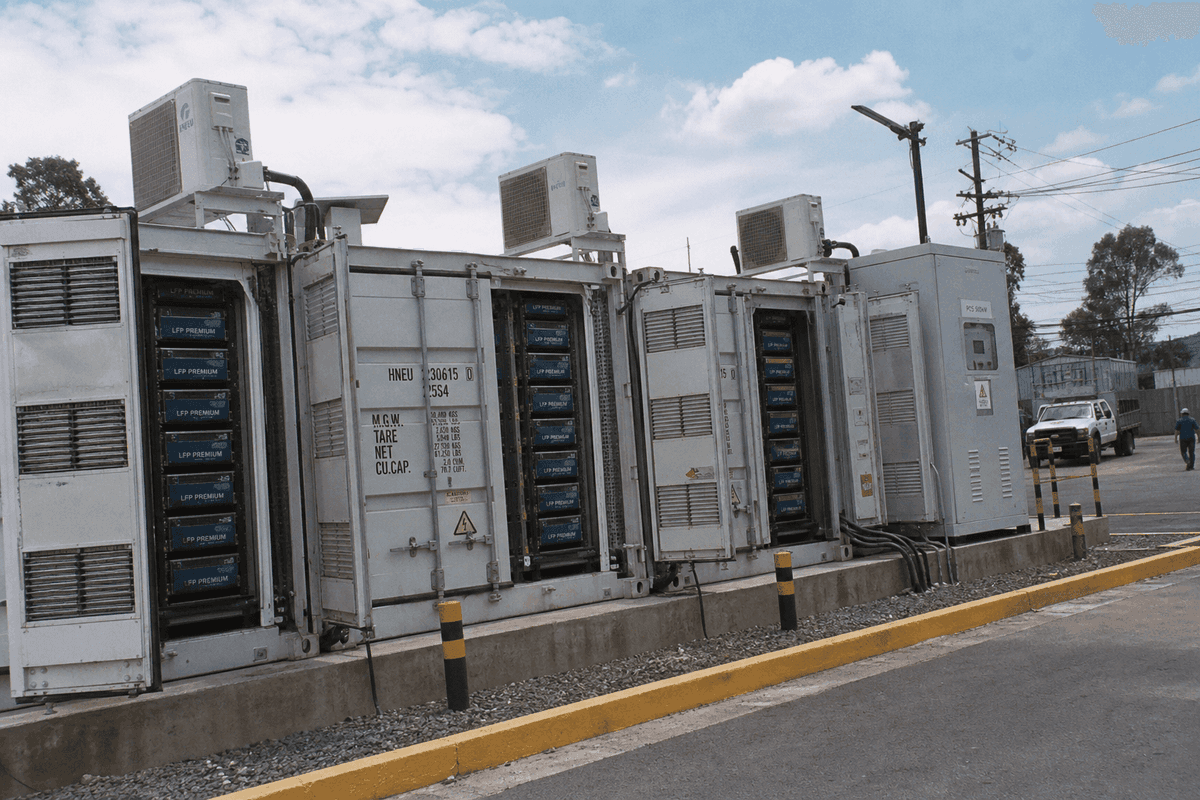
- Typical form factor: approximately 5 units of 20ft containerized LFP battery equipment, not a cabinet.
- Operating profile: charge during valley periods and discharge during peak periods at 1.5 cycles/day and 80% depth.
- Battery specification: LFP Premium chemistry with 97% round-trip efficiency, 95% usable DoD, and 10,000-cycle design life.
- Degradation model: 2%/year planning allowance with a 20-year warranty for lifecycle energy modeling.
- Safety architecture: BMS, forced-air cooling, water-mist fire suppression, IEC 62619, UL 9540, and NFPA 855 alignment.
- Grid interface: PCS inverter plus step-up transformer, typically studied at 13.2, 23, or 34.5 kV.
- SOLARTODO's commercial path is technical sizing first, then FOB, CIF, or EPC quotation after load-data review.
Market Context for Mexico City
Mexico City's 9.21 million city population and 21.44 million metro footprint create dense peak-load conditions suited to modular BESS deployment at utility and campus nodes.
According to INEGI (2020), Mexico City has 9,209,944 residents across 16 boroughs. According to SEDATU, CONAPO, and INEGI (2023), the metropolitan area includes 63 municipalities and 21,436,911 residents. This load density makes energy storage most relevant where feeders serve hospitals, data rooms, commercial towers, transit depots, water pumping, logistics sites, and mixed-use campuses with repeatable daily peaks.
Mexico City's operating environment also affects configuration. The city sits at roughly 2,240 m altitude, and the valley climate concentrates rainfall in the May-October wet season. Battery containers therefore need thermal management sized for altitude-adjusted airflow, protected cable entries, drainage planning, and fire separation distances reviewed under NFPA 855.
According to SENER (2024), PRODESEN is Mexico's 15-year planning instrument for the National Electric System, covering generation, transmission, and distribution development through 2038. For Mexico City, a recommended BESS configuration should therefore be evaluated as a demand-side flexibility asset, not only as backup power. IEA states, "Battery storage helps to strengthen electricity security in all markets."
Recommended Technical Configuration
A typical 5-container BESS configuration for Mexico City would deliver 5,000 kWh and 1,250 kW for peak-shaving and TOU arbitrage.
For the project profile specified here, SOLARTODO would recommend the 2-10 MWh utility-scale class from the BESS form-factor table. That class requires multiple 20ft or 40ft containers in an array plus a central transformer step-up system. A 5,000 kWh project is too large for an outdoor cabinet and correctly fits approximately 5 units of 20ft containerized battery equipment.
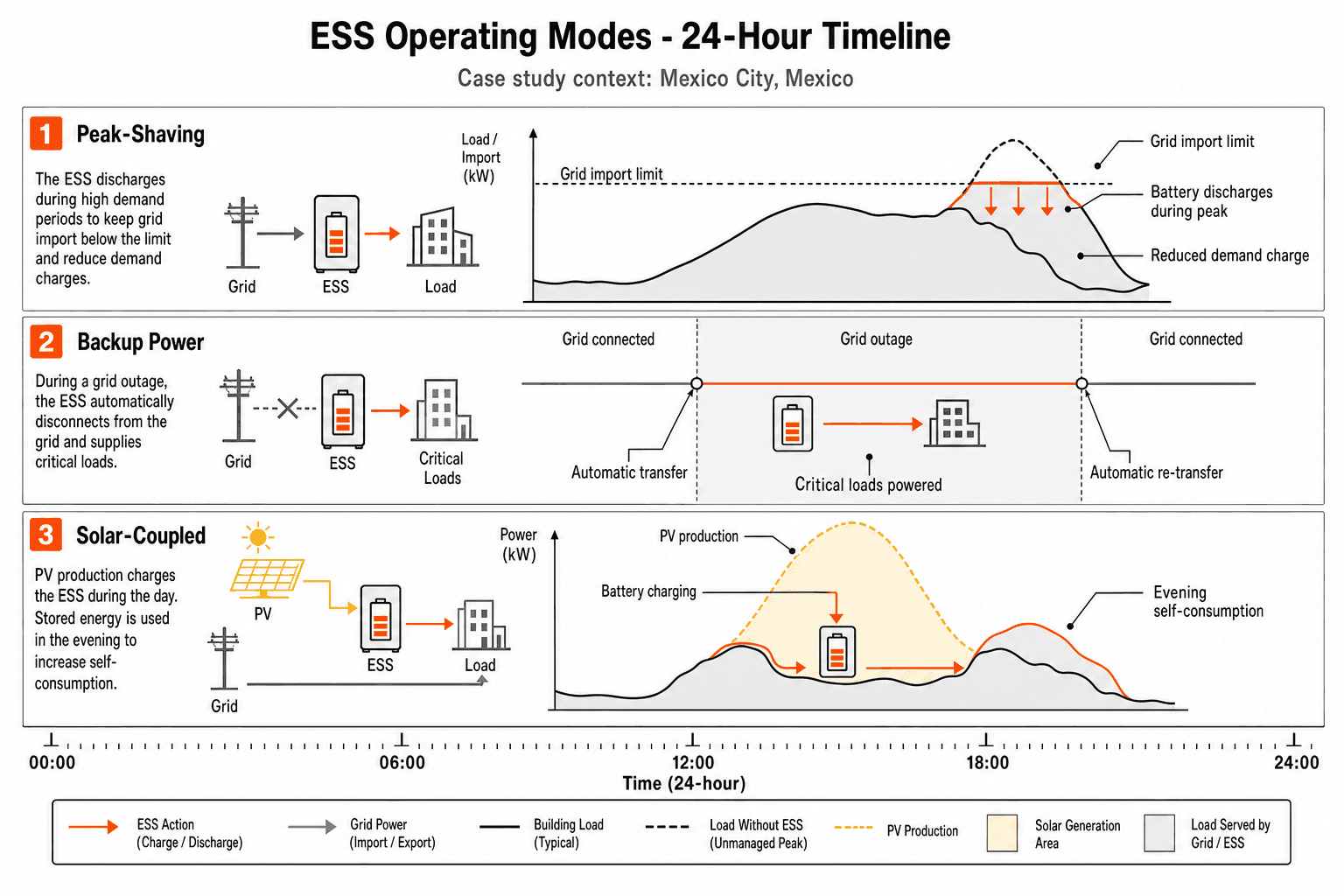
The recommended use case is Peak-shaving / TOU arbitrage: charge during valley tariff windows and discharge during peak tariff windows. The operating model uses 1.5 cycles/day at 80% depth, which implies up to about 6,000 kWh/day of discharged energy before degradation adjustment. At full power, the 1,250 kW PCS supports a 4-hour discharge duration from the 5,000 kWh nominal system.
This is an analytical configuration, not a claim that SOLARTODO has completed a deployment in Mexico City. The proposed system would be appropriate for a utility interconnection point, industrial campus, high-load commercial node, metro-adjacent depot, or municipal critical infrastructure site after interval-meter review. SOLARTODO's Battery Energy Storage (BESS) product page provides the product-line context, while site-specific engineering should be confirmed through contact us.
Technical Specifications
The recommended Mexico City BESS uses 5,000 kWh LFP storage, 1,250 kW PCS output, and 5 modular 20ft containers.
- Product type: Battery Energy Storage (BESS), containerized utility configuration.
- Battery chemistry: LFP Premium battery modules.
- Rated energy: 5,000 kWh nominal system capacity.
- Rated power: 1,250 kW PCS inverter output.
- Duration: 4 hours at rated power.
- Housing: approximately 5 units of 20ft containerized BESS equipment.
- Efficiency: 97% round-trip efficiency under specified operating conditions.
- Usable depth: 95% DoD design capability; operating plan uses 80% depth for cycle life control.
- Cycle life and warranty: 10,000-cycle design life, 2%/year degradation assumption, and 20-year warranty.
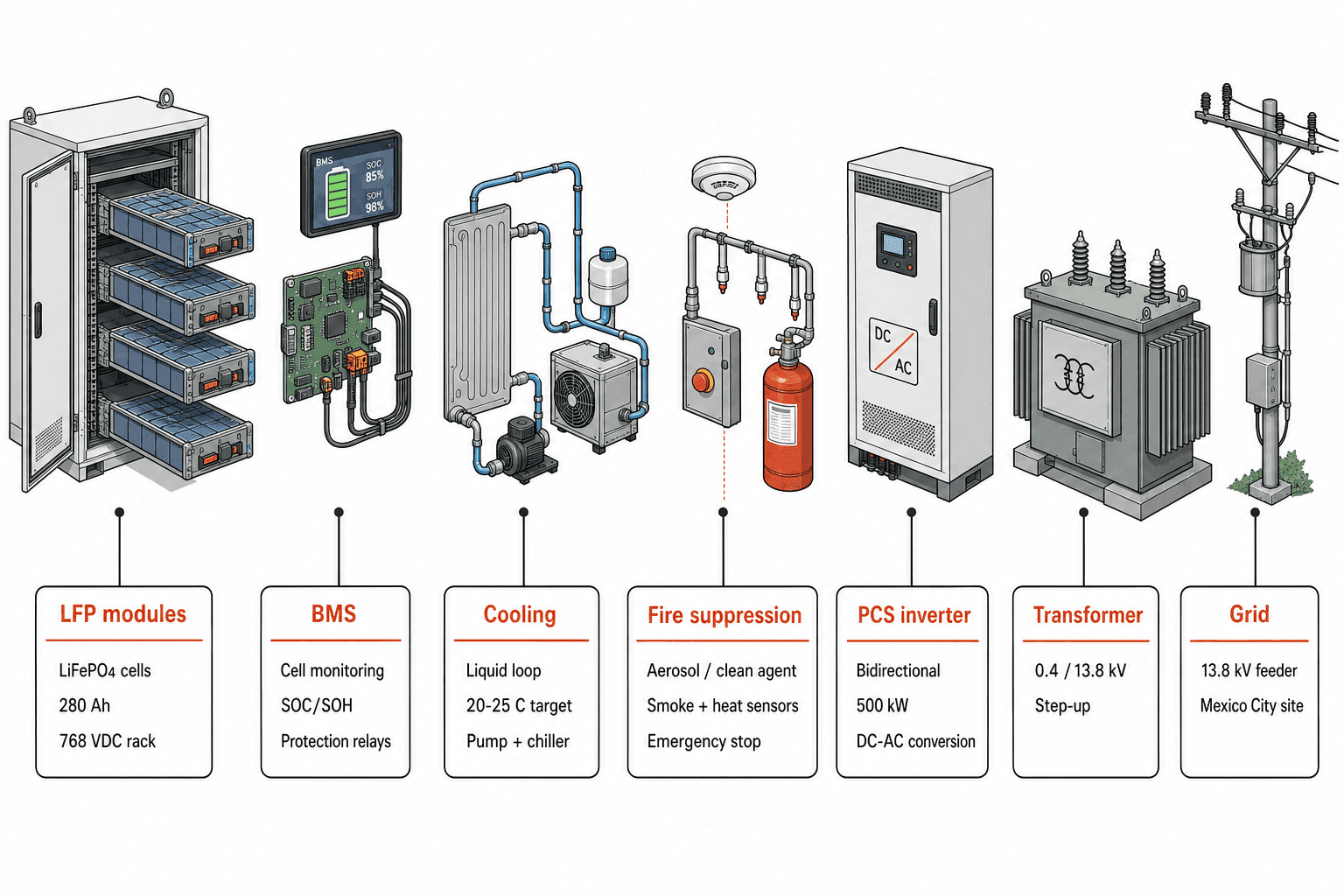
- Controls and cooling: BMS with cell, rack, container, and system monitoring plus forced-air cooling.
- Fire safety: water-mist fire suppression, alarms, detection, emergency stop, and isolation coordination.
- Power conversion: PCS inverter plus step-up transformer for medium-voltage interconnection.
- Standards: IEC 62619, UL 9540, and NFPA 855.
According to IEC (2022), IEC 62619 defines safety requirements for secondary lithium cells and batteries used in industrial applications. According to UL (2023), UL 9540 covers energy storage systems and equipment as an integrated system standard. NFPA 855 governs installation-level spacing, hazard mitigation analysis, ventilation, fire protection, and emergency response coordination.
Implementation Approach
A typical Mexico City BESS rollout would move through 6 phases: feasibility, interconnection, procurement, civil works, commissioning, and O&M.
The first phase is data review. A qualified engineering team should analyze at least 12 months of 15-minute or hourly load data, tariff periods, feeder constraints, outage history, available footprint, and utility interconnection requirements. This determines whether the 1,250 kW PCS should operate only for TOU arbitrage or reserve capacity for backup power.
The second phase is grid and site engineering. According to CFE Distribución (2018), Mexican distribution design references medium-voltage classes including 13.2 kV, 23 kV, and 34.5 kV, so the step-up transformer and protection scheme should match the local feeder. Protection design should include anti-islanding, relay coordination, grounding, harmonics, and SCADA communications.
Procurement and logistics would cover battery containers, PCS, transformer, switchgear, EMS, BMS, HVAC, fire suppression, auxiliary power, spare parts, and commissioning tools. Installation then adds pad foundations, drainage, fencing, bollards, cable trenching, grounding grid, fire access, and authority-having-jurisdiction clearances before commissioning tests verify insulation, rack communication, HVAC, water-mist logic, PCS synchronization, metering, and emergency stop.
Expected Performance & ROI
At 1.5 cycles/day and 80% depth, this BESS can discharge about 6 MWh/day before degradation and availability adjustments.
Expected annual discharged energy is approximately 2,190 MWh in the first operating year before applying availability, curtailment, or degradation assumptions. With 97% round-trip efficiency, the energy charged to deliver that output would be about 2,258 MWh/year. Over 10,000 cycles at 80% depth, the technical throughput target is approximately 40,000 MWh of delivered energy.
According to IEA (2024), battery storage added 42 GW globally in 2023, more than doubling year on year. According to IEA (2024), LFP chemistry represented about 80% of new battery storage in 2023, supporting LFP for stationary Mexico City applications where safety, cycle life, and cost stability matter more than maximum energy density.
ROI should be modeled from tariff spread, peak-demand reduction, avoided diesel runtime, outage-cost avoidance, and degradation reserve. A practical procurement gate is whether the modeled payback remains within the asset owner's finance threshold after applying 2%/year degradation, auxiliary loads, maintenance, insurance, and interconnection costs. NREL states, "Battery storage costs have changed rapidly over the past decade."
Results and Impact
A correctly modeled 5 MWh BESS could shift about 2.19 GWh/year from valley to peak periods in Mexico City.
The expected impact is a more controllable load profile, lower peak grid draw during selected tariff windows, and additional backup capability for critical circuits if reserve capacity is configured. It should not be presented as a guaranteed savings claim before tariff review, because payback depends on contract demand, time-of-use spread, load coincidence, and interconnection limits.
Comparison Table
A 5,000 kWh BESS is utility-scale in form factor, while 100-500 kWh systems remain cabinet-scale in technical planning.
| Configuration class | Typical capacity | Correct housing | Mexico City fit | Operating mode | Notes |
|---|---|---|---|---|---|
| Small commercial BESS | 100-500 kWh | Outdoor IP54 cabinet | Mini-market or small facility | Backup or peak shaving | Not enough energy for a 1.25 MW peak window |
| Factory / commercial BESS | 500 kWh-2 MWh | 1 standard 20ft container | Single building or plant | Peak shaving | Smaller than the requested 5 MWh system |
| Recommended utility BESS | 5,000 kWh / 1,250 kW | Approximately 5 x 20ft containers | Utility node, campus, depot, critical load | TOU arbitrage / peak shaving | 4-hour duration; LFP Premium; PCS plus transformer |
| Grid-scale BESS | 10 MWh+ | Container farm plus dedicated substation | Transmission-adjacent or large utility use | Grid services | Requires multiple containers and substation engineering |
Pricing & Quotation
SOLARTODO structures BESS quotations in 3 commercial tiers after confirming capacity, voltage, logistics, commissioning scope, and site-specific interconnection requirements.
SOLARTODO offers three pricing tiers for this product line: FOB Supply (equipment ex-works China), CIF Delivered (including ocean freight and insurance), and EPC Turnkey (fully installed, commissioned, with 1-year warranty). Volume discounts are available for large-scale deployments. Configure your system online for an instant estimate, or request a custom quotation from our engineering team at [email protected].
Frequently Asked Questions
These 10 FAQs cover the main technical, financial, warranty, installation, and maintenance questions for a 5 MWh Mexico City BESS.
Q1: What BESS size is recommended for this Mexico City configuration? A typical configuration would use a 5,000 kWh / 1,250 kW Battery Energy Storage (BESS) system. That creates a 4-hour discharge duration at rated power and fits the 2-10 MWh utility-scale class. It should be housed in approximately 5 units of 20ft containerized LFP equipment, not an outdoor cabinet.
Q2: Why is LFP chemistry recommended for this application? LFP is suitable because stationary BESS projects value safety, long cycle life, and stable thermal behavior more than maximum energy density. The specified LFP Premium battery provides 97% round-trip efficiency, 95% DoD capability, 10,000-cycle design life, 2%/year degradation planning, and a 20-year warranty for lifecycle modeling.
Q3: How would the BESS operate for peak-shaving and TOU arbitrage? The system would charge during valley tariff periods and discharge during peak periods. The specified operating model is 1.5 cycles/day at 80% depth, equal to approximately 6 MWh/day of discharged energy before degradation and availability factors. The EMS should enforce cycle limits, tariff schedules, demand caps, and reserve settings.
Q4: What is the expected deployment timeline? A typical timeline depends on permitting and interconnection review, but the technical sequence is usually feasibility, interconnection study, procurement, logistics, civil works, installation, commissioning, and operator training. For a 5-container system, interconnection and site works are often the schedule drivers because transformer protection, foundations, fire access, and utility approvals must align.
Q5: How should ROI or payback be evaluated without using generic claims? ROI should be calculated from site-specific interval load data, time-of-use tariff spread, demand-charge reduction, avoided outage cost, auxiliary consumption, degradation, insurance, and maintenance. A 5 MWh BESS can shift about 2.19 GWh/year at 1.5 cycles/day and 80% depth, but payback should not be claimed until tariff and load studies are complete.
Q6: What maintenance is required for a containerized BESS? Maintenance should include BMS alarm review, HVAC filter and fan checks, fire suppression inspection, water-mist system testing, thermal imaging, insulation checks, torque verification, firmware review, PCS diagnostics, container sealing inspection, and capacity tracking. For Mexico City's wet season, drainage, cable entries, corrosion protection, and enclosure integrity deserve additional inspection.
Q7: How does this compare with diesel backup generation? A BESS responds faster, operates without on-site combustion, and can cycle daily for tariff optimization, while diesel generation is typically reserved for longer outages or emergency backup. However, BESS duration is finite: this configuration provides 4 hours at 1,250 kW. Critical sites may combine BESS with grid and generator backup.
Q8: What standards should the installation follow? The battery system should align with IEC 62619 for industrial lithium battery safety, UL 9540 for energy storage system equipment, and NFPA 855 for stationary energy storage installation. Interconnection engineering should also address local utility requirements, protection relays, grounding, short-circuit study, arc-flash labeling, communications, and emergency response plans.
Q9: What does EPC pricing include? EPC Turnkey usually includes engineering, procurement, installation, commissioning, and a defined warranty scope, but the exact boundary must be specified. Civil works, transformer, switchgear, grid interconnection, permits, logistics, crane services, SCADA integration, and O&M training should be explicitly listed. SOLARTODO also offers FOB Supply and CIF Delivered tiers.
Q10: What warranty assumptions apply to this configuration? The specified configuration uses a 20-year warranty, 10,000-cycle design life, and 2%/year degradation planning assumption. Warranty compliance typically depends on operating temperature, depth of discharge, cycle count, charge/discharge rate, maintenance records, fire safety system status, and EMS data logs. Operators should preserve BMS records for warranty review.
References
The reference base includes 8 authoritative sources covering Mexico City demographics, grid planning, BESS market data, and safety standards for Mexico City.
- INEGI (2020): Censo de Población y Vivienda 2020 reports Mexico City's 9,209,944 residents and borough-level demographic data. https://www.inegi.org.mx/programas/ccpv/2020/
- SEDATU / CONAPO / INEGI (2023): Metrópolis de México 2020 defines the Mexico City metropolitan zone at 21,436,911 residents across 63 municipalities. https://www.gob.mx/conapo/documentos/metropolis-de-mexico-2020
- SENER (2024): PRODESEN 2024-2038 is Mexico's 15-year National Electric System development program. https://www.gob.mx/sener/documentos/programa-de-desarrollo-del-sistema-electrico-nacional-2024-2038
- CFE Distribución (2018): Distribution construction and design references include 13.2 kV, 23 kV, and 34.5 kV medium-voltage classes. https://lapem.cfe.gob.mx/normas/
- IEA (2024): Batteries and Secure Energy Transitions reports 42 GW of battery storage additions in 2023 and LFP at about 80% of new battery storage. https://www.iea.org/reports/batteries-and-secure-energy-transitions
- NREL (2023): Cost Projections for Utility-Scale Battery Storage: 2023 Update discusses utility-scale lithium-ion BESS performance assumptions with focus on 4-hour systems. https://www.nrel.gov/docs/fy23osti/85332.pdf
- IEC / UL (2022-2023): IEC 62619 covers industrial lithium battery safety, and UL 9540 covers energy storage systems and equipment. https://webstore.iec.ch/publication/66864 ; https://www.shopulstandards.com/ProductDetail.aspx?productId=UL9540
- NFPA (2023): NFPA 855 provides installation requirements for stationary energy storage systems, including fire safety and emergency planning. https://www.nfpa.org/codes-and-standards/nfpa-855-standard-development/855
Equipment Deployed
- 5,000 kWh / 1,250 kW Battery Energy Storage (BESS) system
- Approximately 5 x 20ft containerized LFP Premium battery units
- PCS inverter system with 4-hour rated discharge capability
- Step-up transformer for medium-voltage grid interconnection
- BMS with cell, rack, container, and system-level monitoring
- Forced-air cooling and HVAC thermal management
- Water-mist fire suppression with detection, alarms, and emergency stop
- EMS configured for peak-shaving / TOU arbitrage at 1.5 cycles/day and 80% depth