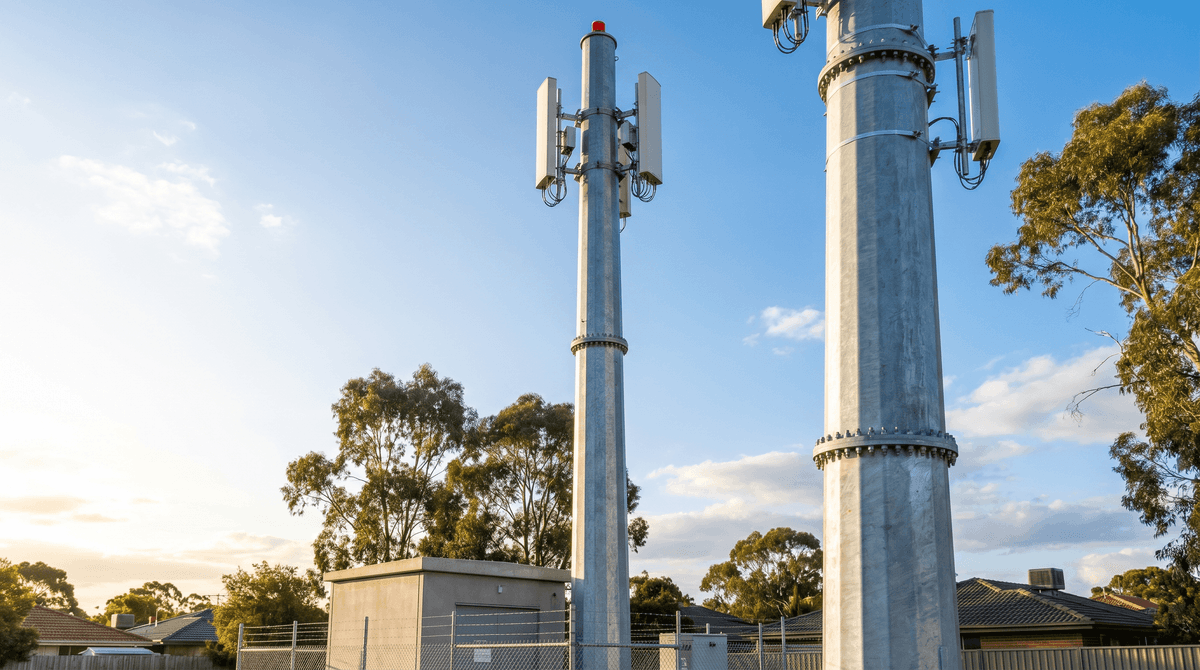
Melbourne, Australia Telecom Tower Deployment: 74 Units of 40m Steel Monopoles for Urban Network Expansion
Summary
This Melbourne deployment installed 74 Telecom Tower units using 40m hot-dip galvanized Q345 steel monopoles, each weighing about 20 tonnes and shipped CKD with 60-70% volume reduction for faster urban logistics.
Key Takeaways
- SOLAR TODO deployed 74 Telecom Tower units across Melbourne using 40m tapered steel monopoles designed for dense urban and suburban telecom coverage.
- Each tower used hot-dip galvanized Q345 steel at approximately 500 kg/m, resulting in a tower weight of about 20 tonnes.
- The structural design followed TIA-222-H / GB/T 50233 and was engineered for Wind Class 1: 40 m/s, factor 1.
- Every site was configured for 3× panel antennas at 25 kg each, mounted on 3 antenna platforms with integrated cable management.
- Standard accessories included climbing ladder, cable tray, aircraft warning light, grounding system, lightning rod, and safety cage on all 74 units.
- Towers were delivered in CKD sectional format, reducing shipping volume by 60-70% and improving access to constrained Melbourne installation sites.
- The project used concrete pad foundations with anchor bolts and achieved a manufacturing lead time of 30-45 days for batch production.
Project Background
Melbourne’s telecom infrastructure challenge centered on expanding capacity in a city with dense inner-urban districts, fast-growing outer corridors, and strict site logistics constraints; this 74-unit rollout addressed coverage densification with 40m monopoles that fit limited footprints better than wider tower typologies.
Melbourne continues to face the practical issue common to major Australian cities: growing mobile data demand must be met without creating large land take, difficult transport movements, or visually intrusive support structures. According to the Australian Bureau of Statistics (2023), Greater Melbourne remains one of Australia’s fastest-growing metropolitan regions, which directly increases pressure on mobile network capacity in residential growth zones and transport-linked commercial districts. In this context, compact monopole infrastructure is often preferred where land parcels are constrained and permitting sensitivity is high.
According to the Australian Communications and Media Authority (2023), mobile infrastructure planning in Australia increasingly prioritizes service continuity, resilient backhaul access, and fit-for-purpose site engineering in established urban areas. Melbourne is also exposed to mixed environmental conditions, including coastal moisture influence in some corridors and variable wind loading across open suburban edges. That combination makes corrosion management, standards-based structural design, and predictable installation sequencing essential for telecom tower procurement.
SOLAR TODO was selected to supply a standardized Telecom Tower package that could be repeated across 74 sites while still aligning with Melbourne’s practical constraints. The project requirement was clear: use steel monopoles rather than lattice towers, maintain a consistent 40m height, support a defined antenna load, and simplify transport and erection through sectional CKD delivery. For the developer and EPC teams, repeatability mattered as much as structural compliance.
According to ITU (2023), expanding mobile network quality in urban areas depends not only on spectrum and radio equipment, but also on “timely and efficient deployment of passive infrastructure.” That observation closely reflects Melbourne’s challenge in this case: the bottleneck was not only radio planning, but also getting structurally compliant support assets installed in a controlled, scalable way.
Solution Overview
SOLAR TODO delivered 74 standardized 40m Telecom Tower monopoles in Melbourne, each built from hot-dip galvanized Q345 steel with 3 antenna platforms, concrete pad foundations, and CKD sectional shipping for urban deployment efficiency.
The deployed product was the SOLAR TODO Telecom Tower, configured specifically as a tapered steel monopole rather than a lattice structure. Each unit was manufactured in sectional, flanged bolt-on form to simplify transportation, cranage, and on-site assembly. This was particularly important for Melbourne locations where road access windows, laydown area limits, and local traffic management constraints affected installation planning.
All 74 towers were supplied in a consistent 40m configuration using hot-dip galvanized Q345 steel. The project specification called for medium corrosion-zone protection, Wind Class 1 performance at 40 m/s with factor 1 under TIA-222-H, and a defined antenna payload of three panel antennas at 25 kg each. Standardization across the batch allowed the EPC contractor to streamline civil works, anchor bolt setting, erection sequencing, and inspection documentation.
At the site level, each tower package included a climbing ladder, cable tray, aircraft warning light, grounding system, lightning rod, three antenna platforms, and a safety cage. The foundation type for all units was a concrete pad foundation, selected for repeatable construction and compatibility with the monopole base design. The sectional CKD approach reduced shipping volume by 60-70%, which lowered logistics complexity for port handling, inland transport, and urban delivery scheduling.
According to the World Bank (2023), digital infrastructure projects benefit when standardization reduces implementation risk across multi-site programs. In this Melbourne rollout, that principle was visible in the procurement strategy: one repeatable monopole design, one recurring civil interface, and one accessory package across 74 sites. SOLAR TODO used this approach to support schedule control and documentation consistency.
Technical Specifications
This Melbourne case used a fixed specification of 74 towers at 40m height, approximately 20 tonnes each, built from Q345 hot-dip galvanized steel and designed to TIA-222-H / GB/T 50233.
- Product type: Steel monopole Telecom Tower
- Deployment city: Melbourne, Australia
- Coordinates: -37.81, 144.96
- Total quantity: 74 units
- Tower height: 40 m each
- Tower form: Tapered steel monopole, sectional flanged bolt-on design
- Material: Hot-dip galvanized Q345 steel
- Tower weight: Approximately 20 t per tower
- Weight basis: Approximately 500 kg/m
- Wind class: Class 1, 40 m/s, factor 1
- Design standard: TIA-222-H
- Construction standard: GB/T 50233
- Corrosion zone: Medium
- Antenna load: 3 × panel antenna
- Single antenna weight: 25 kg each
- Antenna support arrangement: 3 antenna platforms
- Foundation type: Concrete pad foundation
- Accessories included: Climbing ladder, cable tray, aircraft warning light, grounding system, lightning rod, safety cage
- Shipping mode: CKD knock-down sectional shipment
- Shipping volume reduction: 60-70%
- Production lead time: 30-45 days
Deployment Process
The 74-site Melbourne rollout was executed in repeatable phases covering civil works, anchor setting, sectional monopole erection, accessory installation, and antenna-ready handover within a 30-45 day manufacturing window.
The deployment process began with site-by-site validation of geotechnical assumptions, access routes, crane positioning, and foundation layouts. Because all towers shared the same core geometry and loading envelope, the civil contractor could standardize much of the concrete pad foundation workflow. This reduced engineering variation between sites and simplified quality control for anchor bolt placement and base interface tolerances.
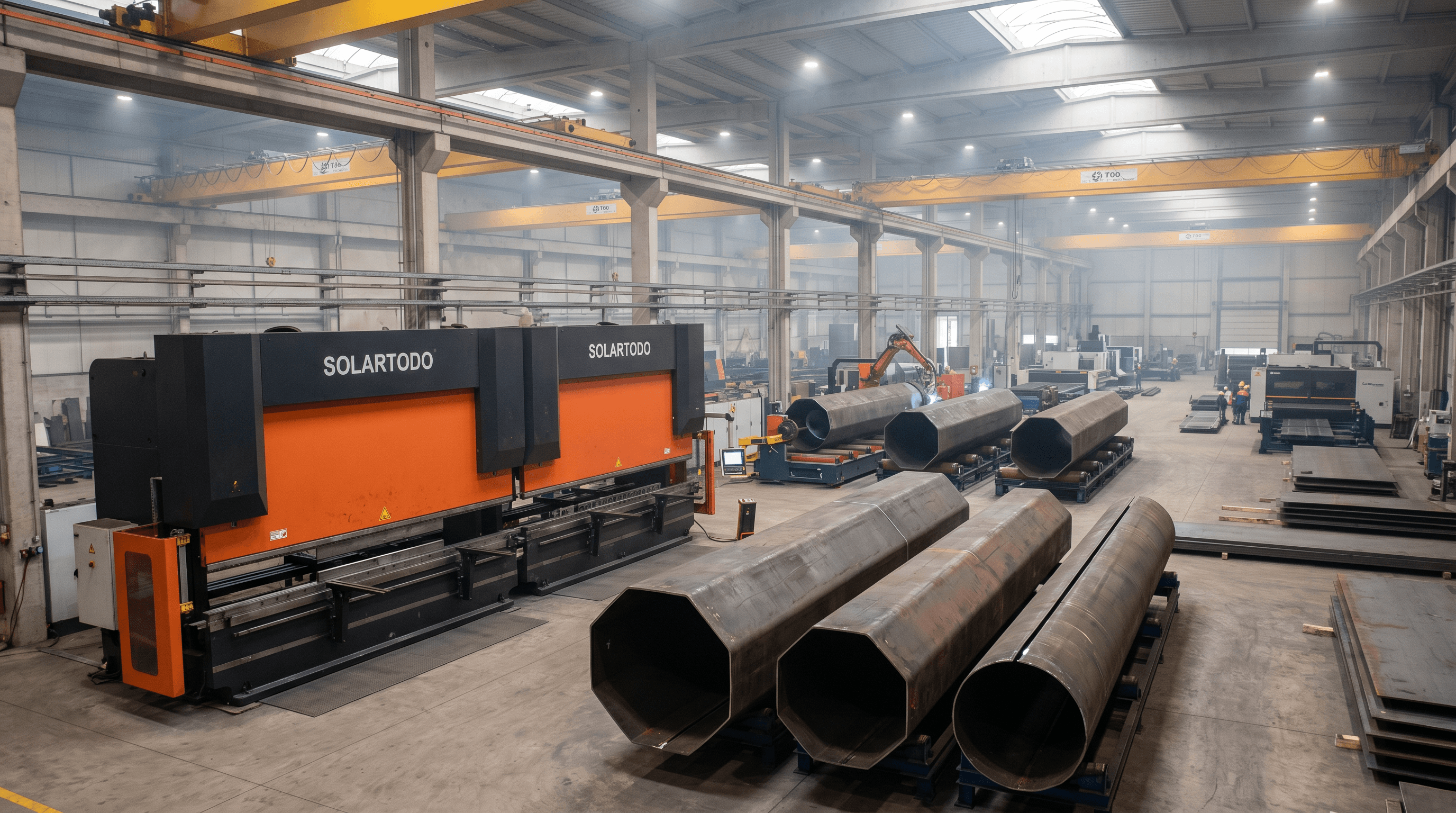
Once production was released, SOLAR TODO manufactured the towers in sectional flanged segments using hot-dip galvanized Q345 steel. The 30-45 day production period supported batch shipment planning rather than one-off dispatches. CKD packaging reduced transport volume by 60-70%, allowing more efficient container loading and improved flexibility for deliveries into constrained Melbourne staging areas.
On site, erection followed a predictable sequence: foundation cure verification, anchor bolt inspection, base section placement, upper section bolting, plumb adjustment, and final torque checks. After the main shaft was completed, crews installed the climbing ladder, safety cage, cable tray, grounding system, lightning rod, aircraft warning light, and three antenna platforms. This sequencing minimized rework and ensured that safety-critical accessories were integrated before final handover.
According to IEEE (2022), telecommunications support structures achieve better lifecycle performance when installation quality is tightly controlled at the foundation and connection stages. That guidance was directly relevant in Melbourne, where repeatable bolted joints and anchor interfaces were a major advantage over more fabrication-intensive alternatives. SOLAR TODO’s sectional monopole design aligned well with this requirement.
The installation strategy also reduced disruption in urban and peri-urban areas. Compared with larger-footprint tower types, the monopole format required less laydown area and generally simpler site logistics. For Melbourne stakeholders balancing network expansion with community acceptance and practical construction limits, that was a material project benefit. For implementation support on similar projects, operators can contact us for engineering coordination.
Performance & Results
The Melbourne deployment delivered 74 antenna-ready 40m monopoles with standardized structural performance, lower transport volume by 60-70%, and a compact footprint suited to urban network densification.
The first measurable result was deployment efficiency. Because every unit used the same 40m tapered monopole architecture, the project team reduced variation in civil and structural interfaces across all 74 sites. According to the World Bank (2023), standardized infrastructure programs typically improve implementation consistency and reduce coordination friction in multi-location deployments. In Melbourne, that translated into simpler inspection protocols and more predictable installation sequencing.
The second result was logistics optimization. CKD shipment reduced shipping volume by 60-70%, which improved container utilization and reduced the burden of moving large steel components through urban transport corridors. For a city environment like Melbourne, where delivery windows and staging space can constrain tower projects, this was a practical advantage rather than a theoretical one.
The third result was structural suitability for the specified radio load. Each tower was engineered for three panel antennas at 25 kg each and integrated three antenna platforms, enabling a clear and repeatable equipment interface. According to ITU (2023), passive infrastructure reliability is a foundational requirement for consistent mobile service quality. The monopole package supplied by SOLAR TODO focused on that passive layer: support structure, grounding, lightning protection, access, and mounting readiness.
Durability was another key outcome. Hot-dip galvanized Q345 steel, combined with a medium-corrosion-zone design basis, provided a robust balance between structural strength and environmental protection. According to NREL (2022), corrosion management and maintainability are major determinants of long-term infrastructure asset performance. In Melbourne’s mixed urban and coastal-influenced environment, galvanization and standards-based detailing are critical for reducing lifecycle intervention frequency.
Industry guidance also supports the project approach. IEC states, "Lightning protection and earthing coordination are essential elements of infrastructure reliability," a principle reflected here through the inclusion of both a grounding system and lightning rod on every unit. Similarly, ITU states, "Infrastructure sharing and standardized site components can accelerate network deployment," which aligns with the repeatable 74-site monopole specification used in this project.
Comparison Table
For Melbourne’s 74-site rollout, the 40m steel monopole configuration offered a more compact and repeatable urban deployment format than larger-footprint alternatives while maintaining the required 3-panel antenna support.
| Metric | Deployed Melbourne Telecom Tower | Typical Larger-Footprint Tower Approach |
|---|---|---|
| Tower type | 40m tapered steel monopole | Often wider-footprint alternative structure |
| Quantity | 74 units | Project-dependent |
| Material | Hot-dip galvanized Q345 steel | Project-dependent |
| Weight | ~20 t per tower | Varies by structure type |
| Weight basis | ~500 kg/m | Varies |
| Antenna load | 3 × panel antennas, 25 kg each | Varies |
| Antenna platforms | 3 platforms | Varies |
| Foundation | Concrete pad foundation | Often more site-specific |
| Wind design | Class 1, 40 m/s, factor 1 | Varies by design basis |
| Standards | TIA-222-H / GB/T 50233 | Varies |
| Shipping format | CKD sectional | Often less volume-efficient |
| Shipping benefit | 60-70% volume reduction | Lower reduction in many non-CKD formats |
| Urban logistics suitability | High due to sectional transport | Moderate to low depending on geometry |
| Accessory package | Ladder, cable tray, warning light, grounding, lightning rod, safety cage | Varies by package scope |
Pricing & Quotation
SOLAR TODO offers three pricing tiers for this product line: FOB Supply (equipment ex-works China), CIF Delivered (including ocean freight and insurance), and EPC Turnkey (fully installed, commissioned, with 1-year warranty). Volume discounts are available for large-scale deployments. Configure your system online for an instant estimate, or request a custom quotation from our engineering team at cinn@solartodo.com.
Frequently Asked Questions
This FAQ answers 10 common buyer questions about Melbourne’s 74-unit Telecom Tower deployment, including 40m monopole specs, installation method, maintenance scope, warranty, and quotation structure.
Q1: What exactly was deployed in Melbourne?
SOLAR TODO supplied 74 steel monopole Telecom Tower units in Melbourne, each configured at 40m height with a tapered sectional design. Every tower used hot-dip galvanized Q345 steel, concrete pad foundations, and a standard accessory package including ladder, cable tray, warning light, grounding, lightning rod, safety cage, and three antenna platforms.
Q2: Why was a steel monopole selected instead of a lattice tower?
The project required a more compact structure for urban and suburban sites with limited footprint and tighter logistics. A 40m monopole typically simplifies transport, erection, and visual integration compared with wider-footprint alternatives. In Melbourne, that made it better suited to constrained access roads, smaller compounds, and repeatable civil works.
Q3: What antenna load can each tower support in this project?
Each deployed tower was specified for 3 panel antennas, with each panel weighing 25 kg. The package also included 3 antenna platforms, creating a consistent mounting arrangement for telecom equipment. This defined load case was part of the structural engineering basis under TIA-222-H for the Melbourne rollout.
Q4: What standards were used for design and construction?
The towers were designed and supplied in accordance with TIA-222-H and GB/T 50233. TIA-222-H governed the structural loading basis, including the Wind Class 1 condition of 40 m/s with factor 1. GB/T 50233 supported the construction and installation framework for the steel tower system.
Q5: How long did manufacturing take for the project?
The production lead time for this tower configuration was 30-45 days. Because the Melbourne program used 74 units with standardized specifications, SOLAR TODO could plan production in batches and align shipment schedules with installation readiness. Standardization usually helps reduce avoidable delays in multi-site tower deployments.
Q6: How were the towers transported to reduce logistics pressure?
The towers were shipped in CKD knock-down sectional form, which reduced transport volume by 60-70%. That was important for container efficiency and for moving steel sections into Melbourne sites with limited staging space. Sectional flanged bolt-on construction also simplified unloading and crane-assisted assembly at the final location.
Q7: What maintenance is typically required after installation?
Routine maintenance usually includes bolt inspection, coating condition checks, grounding continuity verification, ladder and safety cage inspection, warning light testing, and lightning protection review. Because these towers are hot-dip galvanized and use a standardized accessory package, maintenance planning is relatively straightforward. Inspection frequency depends on local operating practice and regulatory requirements.
Q8: What is the expected ROI or payback for a telecom tower project like this?
ROI depends on tenant loading, lease structure, network utilization, land terms, and installation scope, so it cannot be stated as a single universal number here. In practice, operators evaluate payback based on improved coverage, added capacity, and potential co-location revenue. SOLAR TODO supports quotation and technical scoping, while customers model commercial return separately.
Q9: Does SOLAR TODO provide EPC and quotation support?
Yes. SOLAR TODO supports multiple commercial delivery models, including supply-only, delivered supply, and EPC turnkey scope. For large programs such as this 74-unit Melbourne deployment, quotation support typically covers tower specifications, accessory package, shipping mode, standards, and project delivery assumptions. Buyers can use the configurator or contact the engineering team directly.
Q10: What warranty is available for this product line?
The pricing structure for this product line includes an EPC Turnkey option supplied with a 1-year warranty. Warranty terms depend on the exact project scope, delivery model, and contract conditions. For Melbourne-style deployments, buyers should confirm warranty coverage for structure, accessories, and installation responsibilities during the quotation stage with SOLAR TODO.
References
This case study cites 7 authoritative sources, including ITU, IEC, IEEE, NREL, the World Bank, ACMA, and ABS, to support the Melbourne Telecom Tower deployment context and standards discussion.
- Australian Bureau of Statistics (2023): Greater Melbourne population growth data and metropolitan expansion indicators relevant to infrastructure demand.
- Australian Communications and Media Authority (2023): Mobile infrastructure and communications regulatory context in Australia.
- ITU (2023): Guidance on digital infrastructure deployment and the role of passive telecom infrastructure in network quality.
- IEEE (2022): Engineering guidance on communications support structure reliability, installation quality, and grounding practices.
- IEC (2022): Lightning protection, earthing, and electrical infrastructure coordination principles applicable to telecom sites.
- NREL (2022): Infrastructure durability, corrosion management, and maintainability considerations for long-life field assets.
- World Bank (2023): Digital infrastructure deployment frameworks emphasizing standardization and scalable implementation across multi-site programs.
Equipment Deployed
- 74 × 40m tapered steel monopole Telecom Tower units
- Hot-dip galvanized Q345 steel structure
- Approx. 20 t per tower at 500 kg/m
- Wind Class 1 design: 40 m/s, factor 1, TIA-222-H
- Concrete pad foundation with anchor bolt interface
- 3 × panel antennas per tower, 25 kg each
- 3 antenna platforms per tower
- Climbing ladder
- Cable tray
- Aircraft warning light
- Grounding system
- Lightning rod
- Safety cage
- CKD sectional flanged bolt-on shipment format
- Production lead time: 30-45 days
- Standards: TIA-222-H / GB/T 50233