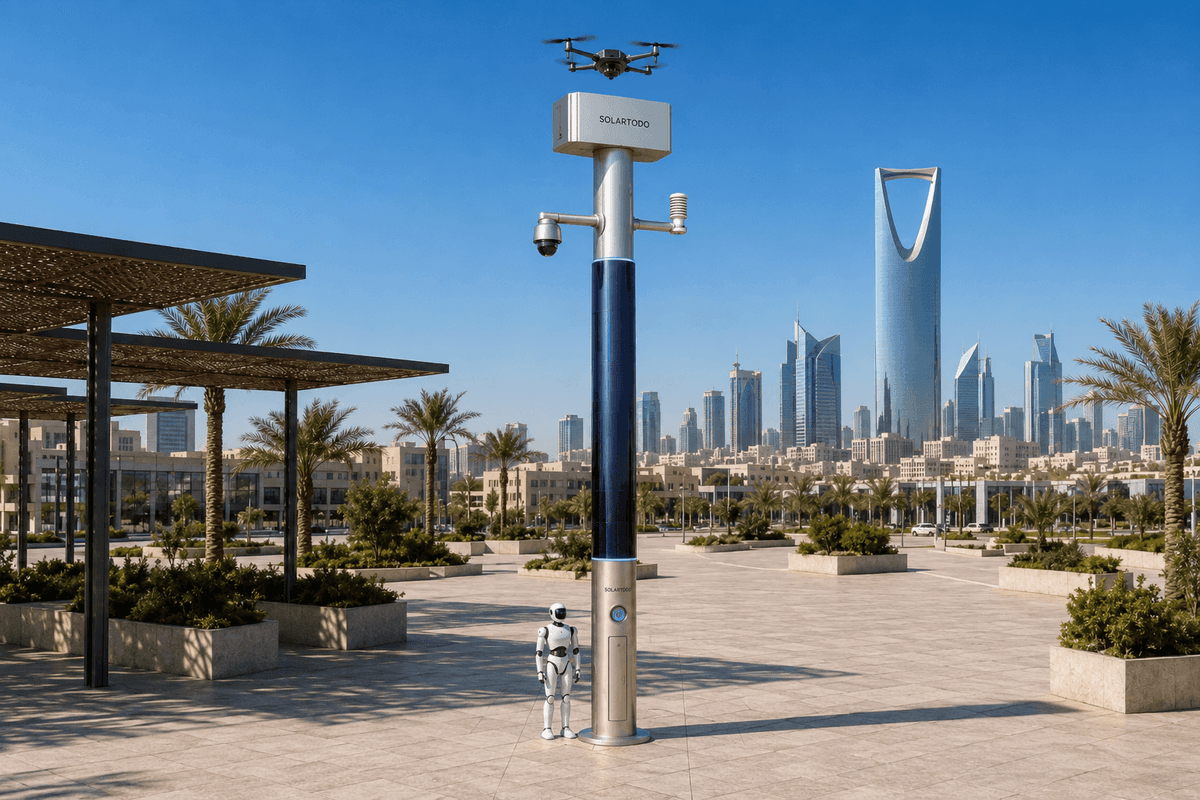
A City AI Pole, or SOLARTODO Sentinel Sky Hub, is a fully off-grid physical-AI edge node: a non-lighting smart pole with battery storage, wrapped CIGS solar replenishment, on-pole edge compute, sensing, drone operations and ground-robot coordination. In Manila, the proposed deployment supports utility border-watch coverage when communications or site networks are degraded.
1. Procurement Context: Manila Utility Border Watch During Holiday Load Peaks
For a Manila power utility, the holiday season creates a familiar operating tension: demand rises, streets become congested, maintenance access slows, and substations, cable corridors, depots and service yards need steadier perimeter awareness. The procurement case is not about adding street furniture or public lighting. It is about placing fully off-grid physical-AI edge nodes where the utility needs operational coverage even when site network connectivity is interrupted or when dispatch teams cannot reach a boundary quickly.
The proposed Sky Hub grid-mesh deployment treats each pole as a local watch, compute and action point. Nodes are sited at perimeter corners, service-gate approaches, cable landing zones, critical feeder access points and selected district interfaces. Each unit processes local camera and environmental data on the pole, keeps raw video and sensor feeds local, and sends only de-identified event or status metadata to the command view when communications are available.
The buyer objective is coverage, not spectacle: increase the percentage of priority boundary zones that can be sensed, assessed, patrolled and logged without relying on grid power, site power or a continuously healthy network. Final placement, mast foundations, wind loading, communications paths, aviation rules, emergency procedures and safety cases remain subject to final engineering confirmation.
2. Why Battery-Swap Drone Nesting Matters When Networks Degrade
The core pain point in this Manila case is network outage resilience. A conventional remote camera or connected sensor may still collect data, but if it depends on upstream cloud processing, continuous backhaul or fixed human patrol response, the operating picture can fragment exactly when the utility needs it most. Sky Hub changes the procurement question from “Can we stream everything?” to “Can each edge node detect, decide what matters locally, dispatch field assets and record the event even if the network is intermittent?”
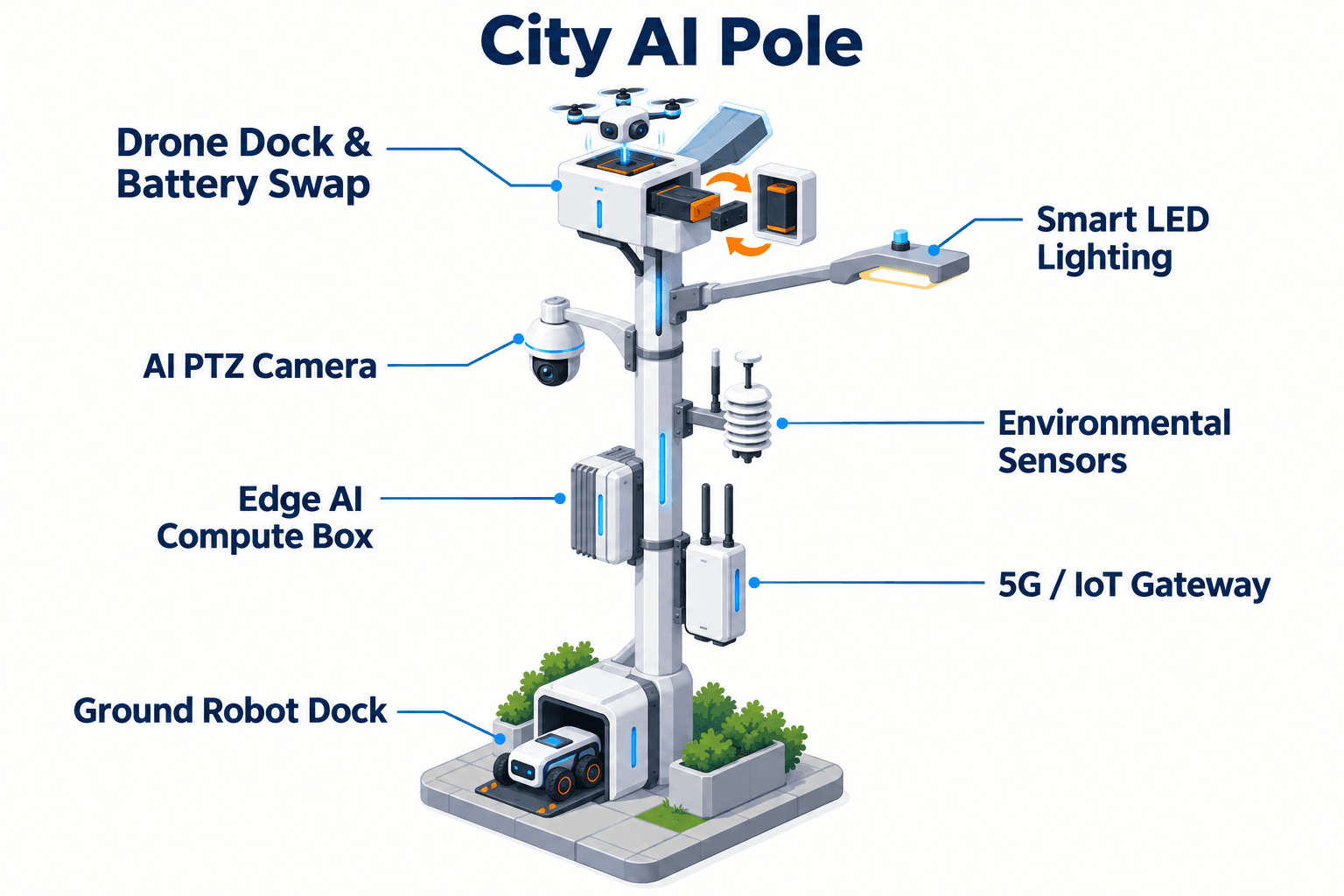
The module focus is the drone nest. A landed utility patrol drone returns to the rear-service nest, where a multi-bay battery magazine performs automated hot-swap so the aircraft receives a charged pack and can redeploy. Multiple bays support several consecutive sorties according to mission queue, safety authorization and available energy budget. No operator needs to stand at the node during normal sortie turnover.
This battery-swap capability matters for holiday border-watch because patrol gaps often occur between events: a gate alarm, a fence-line intrusion, a service-road obstruction, then a second anomaly minutes later. The node can sequence launch, regional patrol, inspection, return, swap and redeployment under a managed state machine. It does not promise unlimited flight or unlimited solar autonomy. It creates a controlled local operations loop, buffered by 5–20 kWh-class storage and scheduled by duty cycle.
3. Grid-Mesh Edge Operations: Sense, Authorize, Act and Record
The proposed deployment uses a grid-mesh operating pattern: several Sky Hub nodes work as neighboring edge stations rather than isolated devices. If one communications path is degraded, nearby nodes still maintain local sensing, local inference, event scoring, task queues and status records. Where mesh links or backhaul are restored, each node synchronizes de-identified event metadata, health state and mission logs into the common operating picture.
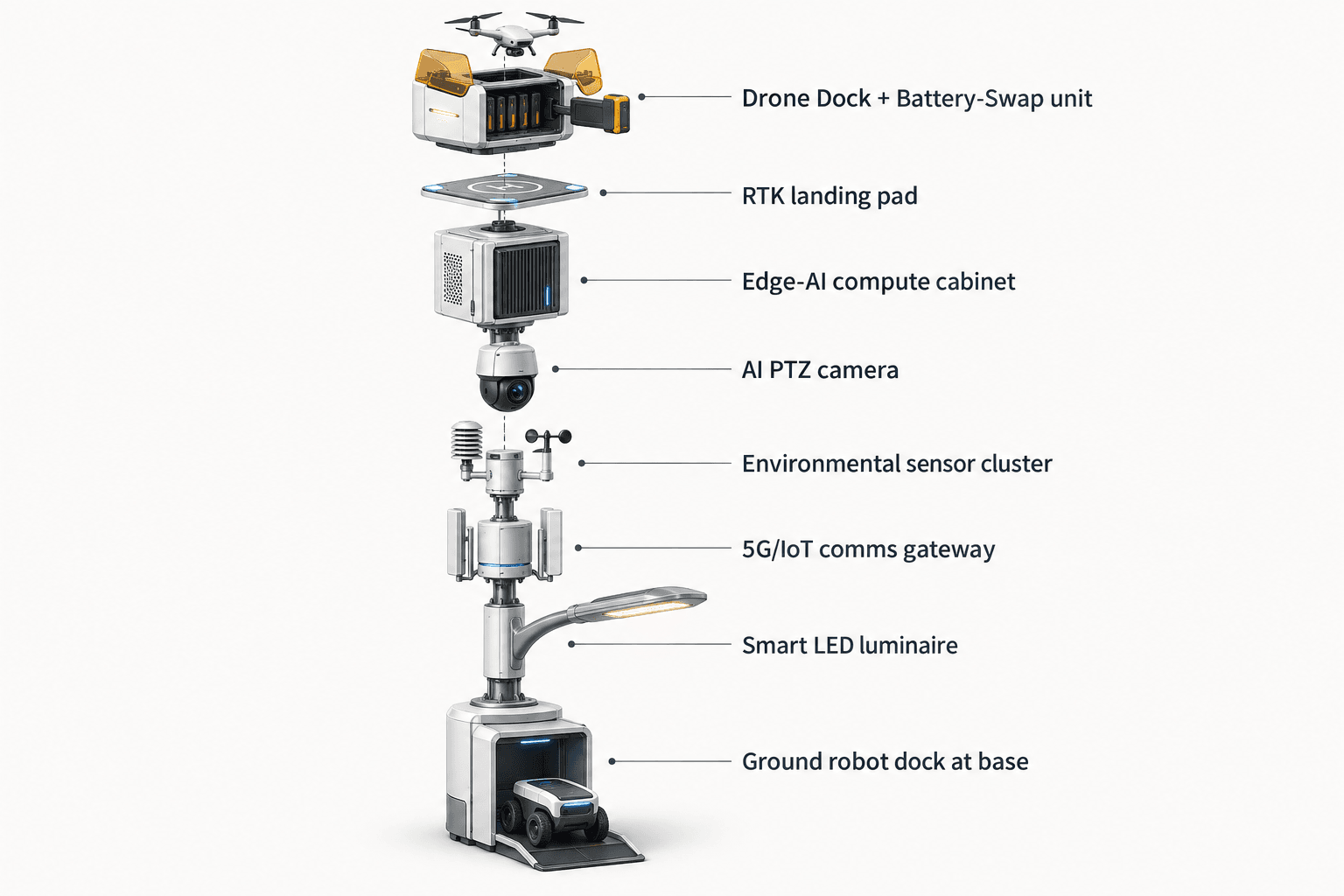
At the pole, the security-sensing layer uses a PTZ camera with local perception for anonymous vehicle count, crowd density, intrusion and perimeter awareness. It does not require face recognition or licence-plate recognition as an active deployed capability. The environmental package adds wind speed, wind direction, temperature, humidity, atmospheric pressure, noise, PM10, PM2.5 and illuminance, helping operators distinguish weather-driven risk, poor visibility and dust or smoke conditions from security events.
The operations loop follows sensing, authorized assessment and response, edge-compute scheduling, then field operations and maintenance. In practice, an alert enters the COP command view, an authorized operator confirms the action path, the edge scheduler assigns drone or ground-robot work, and the pole records event metadata, mission status, battery state and maintenance flags. Counter-UAS coordination follows the same human-in-the-loop rule: the pole may detect and track an unauthorized drone and command a friendly drone for soft aerial net-capture or close-approach deterrence only after human authorization. No shoot-down, jamming, denial or autonomous attack is part of the configuration.
4. Off-Grid Energy Reality: Battery-Backed Micro-Stations, Not Unlimited Solar
For Manila procurement teams, the important energy claim is simple: Sky Hub is designed as a fully off-grid node with no grid, city or site power requirement. Each pole carries battery storage and approximately 15 m² of 360°-wrapped flexible CIGS thin-film solar over a vertical body roughly 8 m tall and 0.6 m wide. The nominal wrap is approximately 2.4–2.7 kWp, but a vertical cylinder does not harvest from the whole wrap at once. Direct sun is collected mainly on the sun-facing projection.
In a high-irradiance region, a realistic clear-sky output is roughly 0.8–1.1 kW DC peak, typically peaking mid-morning or mid-afternoon rather than noon, with about 6–9 kWh per day. Manila’s actual yield must be confirmed with local irradiance, shading, typhoon-season weather, pollution film, installation spacing and maintenance assumptions. The CIGS layer should therefore be treated as supplemental replenishment for a battery-backed micro-station, not as unlimited pure-solar self-sufficiency.
This distinction protects the procurement model. High-power drone launches, drone battery swaps, ground-robot charging and edge-compute workloads are scheduled against storage, mission priority and duty cycle. During holiday operations, the target is to maintain coverage on priority boundaries by pacing sorties, deferring noncritical inspection tasks and reserving energy for authorized alarms and patrol handoffs.
5. Evaluation KPIs for a Manila Power-Utility Buyer
The evaluation frame should focus on coverage, continuity and auditability rather than claimed national-scale rollout numbers or achieved results. A useful procurement trial would define target boundary segments, outage scenarios, patrol frequency, event categories and operator authorization rules before installation. The utility can then compare the Sky Hub grid-mesh configuration with its existing manual patrol and fixed-camera model.
Coverage can be measured as the share of priority perimeter points with edge sensing, local event classification, drone sortie availability and COP visibility. Continuity can be measured by whether the node keeps recording and executing local workflows during simulated or real network degradation. Operational readiness can be measured through battery state, drone magazine availability, robot charging readiness, mission queue status and maintenance alerts. Data governance can be reviewed by confirming that raw video and sensor data stay on the pole and only de-identified event or status metadata leaves the node.
For procurement, the strongest case is not that Sky Hub replaces every patrol or solves every outage. It is that a fully off-grid physical-AI node can place compute, energy, sensing, drone operations and robot coordination at the boundary itself, giving Manila utility operators a more resilient common operating picture during the exact periods when access, bandwidth and staffing are under pressure.
System Configuration
| Parameter | Configuration |
|---|---|
| Node type | SOLARTODO Sentinel Sky Hub pure smart pole; non-lighting physical-AI city edge node |
| Energy system | Fully off-grid battery-backed micro-station with ~15 m² 360° flexible CIGS solar replenishment |
| Drone nest | Rear-service autonomous landing, multi-bay battery hot-swap, mission queueing and redeployment workflow |
| Edge AI compute | Jetson-class on-pole inference and workload scheduling module; raw data processed locally |
| Security sensing | AI PTZ camera for anonymous vehicle count, crowd density, intrusion and perimeter awareness |
| Environmental monitoring | Wind speed, wind direction, temperature, humidity, pressure, noise, PM10, PM2.5 and illuminance |
| Robot interface | Ground service robot patrol coordination with return-to-base wireless charging at the pole base |
How It Works
- On-pole sensing flags a perimeter anomaly or unauthorized aerial object.
- Edge AI classifies the event locally and assigns a confidence and priority score.
- The COP view presents de-identified metadata for human authorization.
- The node dispatches a drone sortie or ground-robot response after approval.
- The drone returns for battery hot-swap while mission logs and status metadata are recorded.
- Operators review coverage, energy state and maintenance needs across the grid-mesh nodes.
Planning Assumptions (Indicative)
Illustrative planning inputs a buyer can recompute — target metrics, not achieved results. Subject to final engineering confirmation.
| Metric | Planning assumption | Indicative value |
|---|---|---|
| Boundary coverage | priority utility perimeter points are grouped into monitored segments for evaluation | ~10–20 segments per district planning package |
| Inspection labor | scheduled drone sorties reduce repetitive manual visual checks during holiday shifts | ~20–40 routine patrol passes per week automated |
| Outage continuity | nodes retain local inference, mission logs and task queues during intermittent backhaul loss | ~8–24 hours local continuity target per outage scenario |
| Drone readiness | multi-bay battery magazine supports sequential sorties before manual service is required | ~3–6 sortie cycles per service window, subject to duty cycle |
| Data minimization | raw video and sensor feeds remain on-pole; only de-identified metadata is exported | 100% local raw-data processing design target |
Deployed Equipment
- SOLARTODO Sentinel Sky Hub pole body with 360° wrapped flexible CIGS surface
- Battery-backed off-grid energy cabinet
- Drone nest with autonomous landing interface and multi-bay battery magazine
- AI PTZ camera and local perception module
- Nine-parameter environmental sensor suite
- Jetson-class edge compute cabinet
- Ground robot wireless charging base interface
- COP command-view software with mission logs and fleet health dashboard
Frequently Asked Questions
Is Sky Hub a smart streetlight for Manila roads?
No. Sky Hub is a pure smart pole and includes no lighting system, lamp head or street-lighting function. In this Manila procurement case it is positioned as a physical-AI edge node for utility border-watch coverage, drone operations, ground-robot coordination, local sensing and off-grid resilience.
How does the battery-swap drone nest support holiday border-watch operations?
The drone nest allows a landed patrol drone to receive a charged pack through an automated rear-service battery exchange, then relaunch according to the authorized mission queue. This helps a utility maintain repeated inspection passes during congested holiday periods, while final sortie frequency depends on energy budget, weather, aviation rules and duty cycle.
What happens if the site network or backhaul is unavailable?
Each Sky Hub node is intended to continue local sensing, inference, event scoring, task queueing and mission logging on the pole. Raw video and sensor data remain local. When connectivity returns or mesh routing is available, the system can synchronize de-identified event and status metadata into the common operating picture.
Does the pole upload raw video or personal data to the cloud?
The Manila configuration is designed for local processing. Raw video and sensor data stay on the pole, where edge inference produces event classifications, status records and operational metadata. Only de-identified event or status metadata may leave the pole, supporting a PDPL/LGPD-oriented data-handling posture without claiming formal certification.
Can Sky Hub run entirely from solar power?
Sky Hub is fully off-grid, meaning it does not require grid, city or site power. However, the wrapped CIGS layer is a supplemental replenishment source, not an unlimited pure-solar guarantee. High-power drone and robot tasks are buffered by battery storage and scheduled against duty cycle, weather and mission priority.
What counter-UAS actions are included in this procurement case?
The node may detect and track an unauthorized drone and, after human authorization, command its own friendly drone to perform non-lethal soft aerial net-capture or close-approach deterrence. The configuration excludes shoot-down, hard-kill action, jamming, denial and autonomous attack. Radar is not pole hardware, though optional partner sensors may provide inputs.
What KPIs should a Manila power utility evaluate?
Recommended target KPIs include priority-boundary coverage, local continuity during network outage scenarios, drone battery-swap readiness, patrol pass completion, event metadata quality, operator authorization traceability and maintenance response time. These should be treated as planning and evaluation metrics, not claimed achieved results, until measured in the final engineered deployment.
Where would the poles typically be placed?
For this Manila CBD-oriented utility case, likely placements include substation perimeters, service yards, cable corridor approaches, controlled access gates and critical-infrastructure boundary points. Final siting must consider civil works, shading, communications paths, aviation constraints, maintenance access, public safety and the utility’s own operating procedures.
Explore Further
- City AI Pole / smart streetlight product line
- More smart-city deployment cases
- Talk to our engineering team
Planning a similar physical-AI deployment for streets, campuses or public spaces? Request an engineering consultation