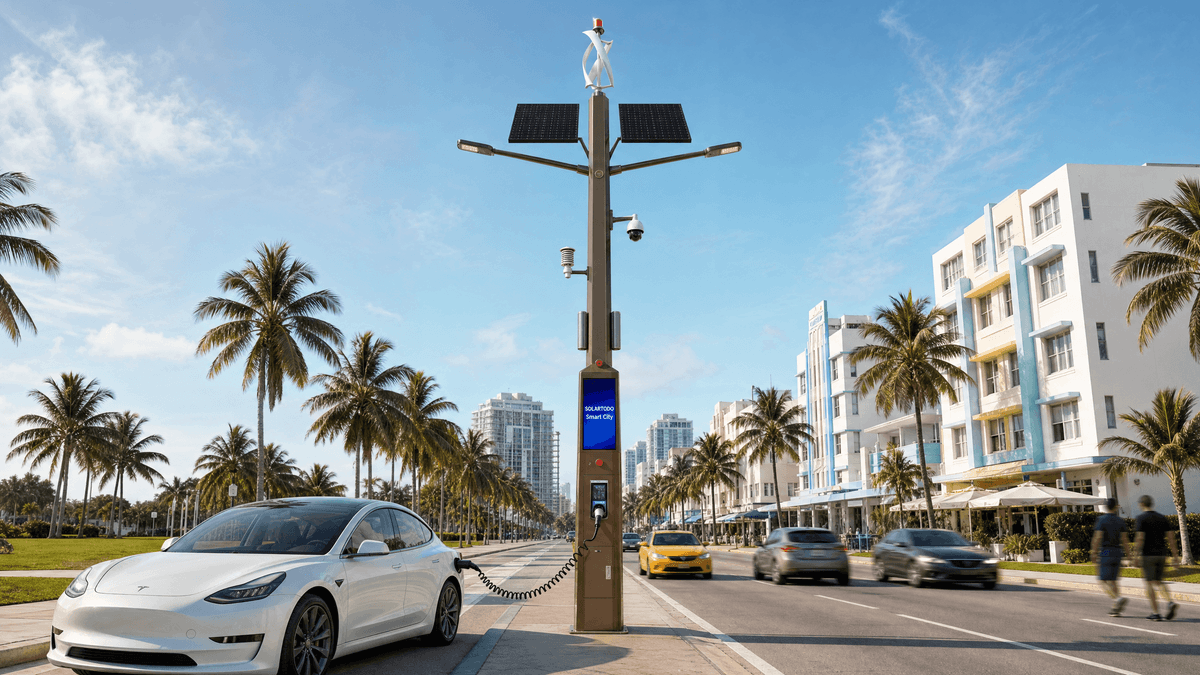
Manama Smart Streetlight Market Analysis: 11m Hybrid EV-Charging Pole Configuration Guide for Urban Corridors
Summary
Manama’s dense urban corridors, hot desert climate, and growing digital infrastructure make an approximately 112-unit, 11m hybrid Smart Streetlight layout technically suitable for 32m spacing, 7kW dual-gun EV charging, and 5G n78 coverage of about 200m per pole.
Key Takeaways
A typical Manama Smart Streetlight deployment of this profile would use approximately 112 units at 32m spacing, covering about 3.6km of urban corridor with lighting, communications, safety, and charging in one streetscape asset.
- Bahrain’s population exceeds 1.5 million, and the capital region concentrates the country’s highest road, telecom, and public-service density, which supports multi-function pole deployment rather than single-purpose lighting assets.
- According to the World Bank (2023), Bahrain’s urbanization rate is above 89%, which favors 11m city-street poles at 25-50m spacing instead of park-scale 6-8m poles or highway traffic mast systems.
- A typical 112-unit configuration would use 11m octagonal tapered steel poles with base diameter 45cm and top diameter 15cm, finished in antique bronze RAL8011 for premium urban streetscapes.
- Each pole would combine a 500W Darrieus H-type VAWT, 2 x 150W monocrystalline panels at 15° tilt, and a 10kWh LFP battery with MPPT control plus backup grid tie for resilience.
- Lighting output would come from twin 1.5m arms with 2 x 80W LED luminaires at 150 lm/W and 4000K, giving 160W per pole and about 24,000 lumens before optical losses.
- EV charging would be integrated into the lower 2.2m of the pole as one welded steel structure, using a 7kW dual-gun AC charger with 2 x Type 2 connectors and OCPP 1.6J.
- Telecom readiness would include a flush-mounted 5G NR n78 small cell with 4T4R MIMO and approximately 200m coverage radius, reducing the need for separate street furniture in dense corridors.
- Safety and civic functions would include a 360° PTZ dome camera with 20x zoom and 100m IR, 2 x 30W IP audio columns, SOS alarm linkage, and a 960 x 1920mm P4 LED display.
Market Context for Manama
Manama combines high urban density, high cooling-season electricity demand, and heavy roadside infrastructure concentration, so a multi-function Smart Streetlight can reduce street clutter while adding lighting, telecom, security, and EV charging at one point of connection.
Bahrain is one of the Gulf’s most urbanized markets. According to the World Bank (2023), about 89% of Bahrain’s population lives in urban areas. The Information & eGovernment Authority of Bahrain reports a national population above 1.5 million in recent official statistical releases, with the Capital Governorate and Greater Manama area carrying a large share of administrative, commercial, and transport activity. For urban corridors in Manama, that translates into high demand for poles that do more than support 80-150W street lighting.
Climate matters for pole selection. According to the Bahrain Meteorological Directorate, summer temperatures commonly exceed 40°C, and coastal humidity and salinity are persistent design constraints. According to IRENA (2019), Gulf urban infrastructure requires attention to corrosion resistance, thermal management, and power continuity because ambient conditions reduce electronics life if cabinets are undersized or poorly ventilated. In Manama, this supports galvanized steel construction, marine-suitable coatings, and battery/electronics placement inside a protected lower pole cavity.
Telecom density is another driver. According to the Telecommunications Regulatory Authority Bahrain (2023), mobile penetration in Bahrain remains well above 100%, and 5G service is commercially established. That makes city poles with 5G small-cell readiness more useful in Manama than standard lighting columns without communications volume or equipment space. The fit is strongest on commercial roads, mixed-use districts, seafront boulevards, and transport-linked municipal corridors where 200m small-cell coverage can complement macro coverage.
Grid context also supports a hybrid model rather than a fully off-grid one. Bahrain’s electricity system is mature and urban feeders are widely available, but public streets still benefit from backup power for critical services such as SOS, camera, and IP audio. According to the IEA (2022), Gulf power systems are reliable but face strong summer peaks from cooling loads. For Manama, a hybrid Smart Streetlight with battery storage and grid tie is therefore more practical than a pure solar pole if the asset includes 5G, advertising display, and EV charging.
The correct size class for this city profile is the 12m hybrid family, adapted here to the project-specific 11m octagonal tapered steel smart pole configuration. This class matches urban arterial and collector roads better than 6-8m garden poles, and it avoids the overbuild of highway mast systems that would normally exceed 12m and use different roadway optics.
Recommended Technical Configuration
For Manama’s urban corridors, a typical 112-unit Smart Streetlight deployment would use 11m hybrid poles with integrated EV charging, 160W LED lighting, 10kWh LFP storage, and flush-mounted 5G small cells at 32m spacing.
A typical 112-unit deployment of this scale would suit approximately 3.6km of premium urban roadway, calculated from 111 intervals at 32m spacing. This density fits the product guidance of 25-50m spacing and 30-50 poles per km. In Manama, that spacing is appropriate for municipal boulevards, waterfront roads, central business streets, and mixed-use corridors where lighting uniformity, public safety, and digital services matter as much as lux levels.
The recommended pole form is the hybrid 11m octagonal tapered steel type in antique bronze RAL8011. The lower 2.2m of the structure is the EV charging cabinet itself, welded as one continuous steel body rather than a separate charger pedestal. That matters in Manama because separate roadside cabinets add visual clutter, create more corrosion points, and increase the number of foundations and cable interfaces exposed to heat and salt air.
From an energy architecture perspective, this configuration uses three sources: a 500W Darrieus H-type VAWT, 2 x 150W monocrystalline panels, and backup grid tie. According to NREL (2021), hybrid distributed systems can improve service continuity where loads vary by hour and by service type. For Manama, the benefit is not full energy autonomy for every load at every hour; the benefit is resilience for critical functions such as LED lighting, camera, SOS, and communications during feeder interruptions or peak-demand events.
The communications stack also fits local needs. A flush 5G NR n78 small cell with 4T4R MIMO and roughly 200m coverage can densify service in areas with high pedestrian and vehicle throughput. ITU states, "IMT-2020 is intended to support enhanced mobile broadband, massive machine-type communications, and ultra-reliable low-latency communications." That quote is relevant here because a Smart Streetlight in Manama is increasingly a digital utility point, not only a luminaire support.
SOLAR TODO should therefore be viewed in this market as a multi-service urban asset platform. On streets where separate CCTV poles, EV chargers, speakers, signage, and telecom boxes compete for curb space, a combined Smart Streetlight can reduce the number of foundations, permit interfaces, and visible roadside objects.
Technical Specifications
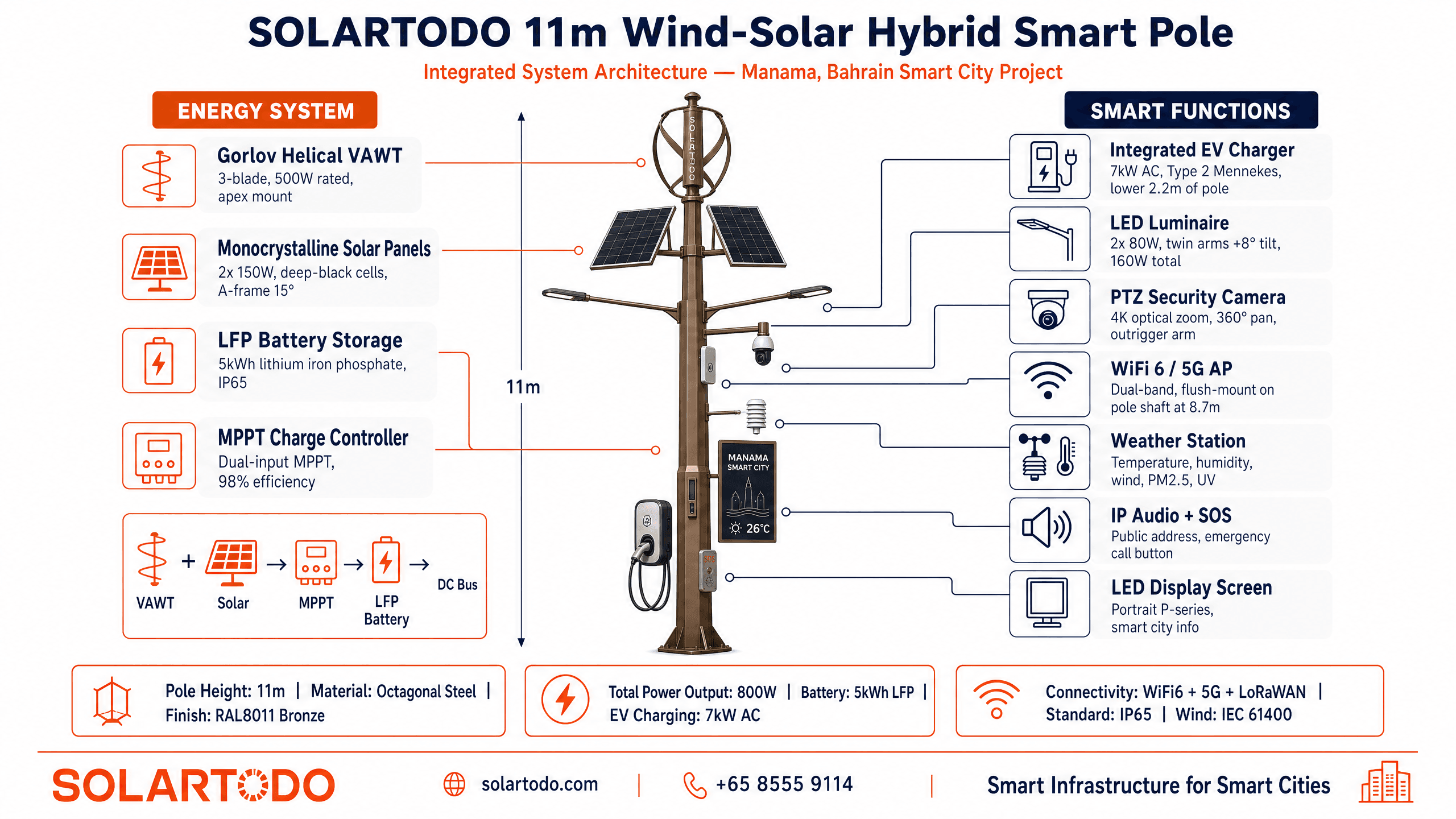
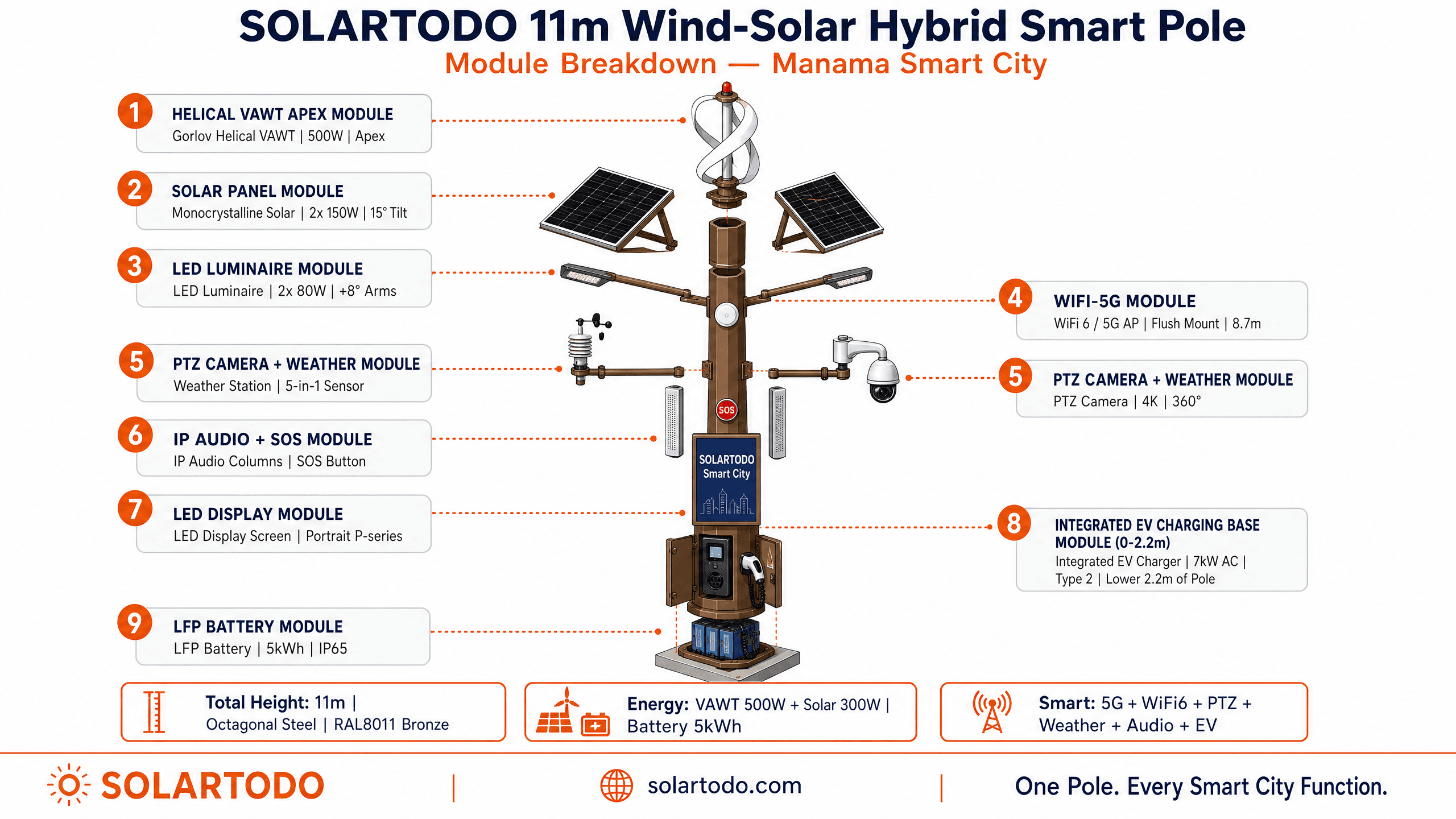
The recommended Manama configuration is an 11m hybrid Smart Streetlight with 500W wind input, 300W solar input, 10kWh LFP storage, 160W LED lighting, integrated 7kW dual-gun EV charging, and 5G n78 small-cell support.
- Quantity basis: approximately 112 units for a typical premium urban corridor deployment
- Pole height: 11m
- Pole geometry: octagonal tapered steel
- Pole diameter: base 45cm to top 15cm
- Finish: antique bronze RAL8011
- Structural charging design: lower 2.2m of the pole is the EV charging cabinet, welded as one continuous structure
- Wind turbine: Darrieus H-type VAWT, 3 straight vertical blades, 80cm diameter x 110cm height, 500W rating, red aviation LED
- Solar array: 2 x 150W monocrystalline deep-black panels on symmetric east-west A-frame brackets
- Solar tilt: 15°
- Battery: 10kWh LFP inside pole base
- Charge control: MPPT controller with backup grid tie
- LED luminaires: twin symmetric 1.5m arms with +8° upward tilt
- LED power: 2 x 80W
- LED efficacy: 150 lm/W
- CCT: 4000K
- Camera: 15cm mini white PTZ dome, 360°, 20x zoom, IR 100m, mounted on 40cm L-bracket
- Environmental sensor: 4-parameter top sensor for temperature, humidity, wind speed, and noise
- Public address: 2 x IP audio columns, diameter 10cm x height 50cm, 30W, 93dB, TCP/IP networked, flush against opposite flat pole faces
- Emergency functions: SOS, panic alarm, camera linkage, emergency broadcast trigger
- EV charging: integrated 7kW dual-gun AC charger, 2 x Type 2, OCPP 1.6J, 5m coiled cable, touchscreen, E-stop, maintenance door
- Display: P4 vertical LED screen, 960 x 1920mm portrait, above 5500 cd/m²
- Display content note: recommended civic or branding content must follow local municipal advertising rules; this specified configuration uses "SOLARTODO Smart City" text only
- Telecom: 5G NR n78 small cell, 4T4R MIMO, approximately 200m coverage
- 5G mounting: flush on flat pole face at 8.7m, color-matched to pole
- Spacing: 32m typical
- Applicable standards: IEC 60598, GB/T 37024, IEC 62196-2
According to IEC (2020), IEC 60598 covers luminaire safety requirements relevant to street lighting assemblies. According to IEC (2022), IEC 62196-2 defines dimensional compatibility for AC charging connectors such as Type 2. For Bahrain municipal buyers, those two standards are baseline checks before reviewing local utility interconnection and civil works details.
Implementation Approach
A typical Manama rollout would require 4 phases over roughly 20-32 weeks, covering design review, utility coordination, civil works, pole erection, systems integration, and commissioning.
Phase 1 is corridor survey and authority coordination. This usually takes 4-6 weeks for route mapping, underground utility checks, photometric review, telecom backhaul planning, and charger interconnection review. In Manama, this step is important because roadside space is limited in established districts and permit interfaces can involve municipal, utility, and telecom stakeholders.
Phase 2 is fabrication, FAT, and logistics. For approximately 112 units, manufacturing and pre-shipment testing would usually take 8-12 weeks depending on display, charger, and 5G equipment lead times. SOLAR TODO would normally configure the poles as integrated assemblies rather than shipping a standard pole plus multiple third-party roadside cabinets. That reduces field assembly points and helps preserve the intended flush device geometry.
Phase 3 is civil and electrical installation. Typical works include foundations, anchor setting, conduit, feeder pull, earthing, and charger supply connection. For 112 poles at 32m spacing, civil sequencing usually proceeds in blocks of 10-20 poles to keep one corridor lane plan manageable. In Bahrain’s hot season, night work or early-morning work windows may be preferable when daytime temperatures move above 40°C.
Phase 4 is commissioning and acceptance testing. This includes lux verification, charger communication checks, OCPP setup, PTZ camera addressing, IP audio testing, LED display validation, and small-cell integration. IEEE states, "Interoperability is essential to the successful deployment of smart city infrastructure." In practice, that means the charger, controller, camera, and telecom hardware should be tested as one managed node before corridor handover.
Expected Performance & ROI
For Manama, the strongest business case comes from combining 160W LED lighting, 7kW dual-gun charging, 5G lease potential, and reduced street-furniture count into one 11m Smart Streetlight asset.
Lighting efficiency is the first value layer. A 2 x 80W LED package at 150 lm/W provides about 24,000 lumens per pole, while replacing legacy HID systems that often operate at 250-400W input including ballast losses. According to the U.S. Department of Energy (2020), LED roadway upgrades commonly reduce lighting energy use by 40-75% depending on baseline technology and controls. In Manama, where street lighting operates roughly 4,000+ hours per year, that energy delta is material.
The second value layer is asset consolidation. One pole can carry lighting, CCTV, speaker, SOS, environmental sensing, display, telecom, and EV charging. That can reduce the number of separate foundations, feeder points, and maintenance visits compared with deploying 4-6 separate roadside devices. According to the World Bank (2020), integrated urban infrastructure lowers lifecycle cost when right-of-way is constrained and utility coordination is expensive.
The third value layer is service continuity. The 10kWh LFP battery, 500W VAWT, and 300W solar input do not replace the grid for all high-load functions continuously, but they can support priority services and reduce outage exposure. According to NREL (2021), battery-backed distributed systems improve resilience for critical loads when grid interruptions occur. For Manama, priority logic would usually keep LED lighting, SOS, camera, and communications active first, while EV charging and display loads can be curtailed if battery state of charge falls.
A realistic payback window depends on which revenue streams are counted. If the project is evaluated on lighting electricity savings alone, payback is slower. If the model includes telecom tenancy, digital display monetization, and charger utilization, the return period can move into a more acceptable municipal or PPP range. For many Gulf urban corridors, a blended payback of about 5-9 years would be a reasonable planning assumption, subject to local electricity tariffs, charger use, and telecom lease terms.
Maintenance should be budgeted on a preventive basis. LED modules typically target 50,000+ hours, LFP batteries often support several thousand cycles, and charger/camera/display components need periodic inspection every 3-6 months in coastal environments. According to IEA (2022), digitalized urban assets perform best when maintenance is condition-based rather than reactive. That is especially true in Manama, where salt, dust, and heat accelerate degradation of exposed connectors and filters.
Results and Impact
In Manama, an approximately 112-unit Smart Streetlight corridor would be expected to improve lighting efficiency, support 200m-class 5G densification, add 224 Type 2 charging guns, and reduce separate roadside asset count across about 3.6km.
For municipal planners, the main impact is corridor simplification. Instead of adding a light pole, charger pedestal, CCTV mast, speaker column, digital sign, and telecom attachment as separate assets, the city can evaluate one integrated streetscape node every 32m. That improves visual order on premium roads and can reduce the number of permit touchpoints during expansion.
For utilities and concessionaires, the impact is service stacking. A single node can support public safety, mobility, and connectivity. SOLAR TODO’s Smart Streetlight format is therefore best suited to streets where land value, curb management, and infrastructure density justify a higher-function pole than a standard 8m LED column.
Comparison Table
The table below compares a typical Manama hybrid Smart Streetlight configuration against a conventional smart pole and a standard LED streetlight for dense urban corridors.
| Metric | Recommended Manama Hybrid Smart Streetlight | Conventional Smart Pole | Standard LED Streetlight |
|---|---|---|---|
| Pole height | 11m | 8-10m | 8-10m |
| Spacing | 32m | 30-40m | 30-40m |
| Lighting load | 2 x 80W = 160W | 80-120W | 80-150W |
| Luminous efficacy | 150 lm/W | 130-150 lm/W | 120-150 lm/W |
| EV charging | 7kW dual-gun, 2 x Type 2 | Optional separate pedestal | Usually none |
| Backup energy | 500W wind + 300W solar + 10kWh LFP + grid tie | Grid only or small battery | Grid only |
| Camera | 360° PTZ, 20x zoom, IR 100m | Fixed or PTZ optional | Usually none |
| Public address | 2 x 30W IP audio columns | Optional | None |
| 5G support | n78 small cell, 4T4R, ~200m | Optional bracket mount | None |
| Display | P4 960 x 1920mm, >5500 cd/m² | Optional smaller panel | None |
| Street furniture count | 1 integrated asset | 2-4 separate assets | 1 asset only |
| Best fit in Manama | Premium corridors, CBD, waterfront, mixed-use roads | Mid-tier urban roads | Basic lighting-only streets |
Pricing & Quotation
SOLAR TODO offers three pricing tiers for this product line: FOB Supply (equipment ex-works China), CIF Delivered (including ocean freight and insurance), and EPC Turnkey (fully installed, commissioned, with 1-year warranty). Volume discounts are available for large-scale deployments. Configure your system online for an instant estimate, or request a custom quotation from our engineering team at [email protected].
For Manama tenders, quotation scope should clearly separate pole fabrication, charger certification, telecom integration, civil works, utility interconnection, and software platform scope. Buyers comparing SOLAR TODO with local pole fabricators should also request the exact battery capacity, charger protocol version, corrosion protection details, and whether the lower 2.2m charger body is integrated into the pole or supplied as a separate roadside cabinet.
For product review, see the Smart Streetlight product page. For corridor studies, BOQ review, or authority submission support, contact us.
Frequently Asked Questions
A Manama Smart Streetlight project usually raises questions about 11m pole design, hybrid power behavior, EV charging integration, standards, and payback, so the answers below focus on those procurement points.
Q1: Why is an 11m hybrid Smart Streetlight suitable for Manama instead of a shorter 8m pole?
Manama’s mixed-use urban corridors need wider light distribution, telecom mounting height, and clearance for displays, cameras, and speakers. An 11m pole supports twin 80W luminaires, a 5G unit at 8.7m, and integrated charging without making the streetscape look crowded. It fits city roads better than 6-8m park poles.
Q2: Is this system fully off-grid?
No. This recommended configuration is hybrid, not fully off-grid. It combines a 500W vertical-axis wind turbine, 2 x 150W solar panels, a 10kWh LFP battery, and backup grid tie. In Manama, that is usually the correct choice because EV charging, 5G, and LED displays create variable loads that benefit from grid support.
Q3: How many poles would a typical corridor need?
At 32m spacing, approximately 31-32 poles are needed per kilometer, depending on end conditions and intersections. A typical 112-unit layout would therefore cover about 3.6km of roadway. Final quantity depends on photometric design, curb geometry, crossing points, and whether both sides of the road require poles.
Q4: What EV charging capability is included in the pole?
The lower 2.2m of the pole is the charger body itself. It includes a 7kW dual-gun AC charger with 2 x Type 2 connectors, OCPP 1.6J communication, 5m coiled cables, touchscreen, E-stop, and maintenance access door. This is different from a standard pole with a separate charging pedestal beside it.
Q5: What standards should Bahraini buyers check first?
The baseline standards in this configuration are IEC 60598 for luminaires, GB/T 37024 for smart poles, and IEC 62196-2 for Type 2 charging interface compatibility. Buyers should also check local utility, municipality, and telecom requirements for earthing, feeder protection, civil works, and radio approvals before final procurement.
Q6: What is a realistic implementation timeline for about 112 units?
A practical planning range is 20-32 weeks. That usually includes 4-6 weeks for survey and approvals, 8-12 weeks for fabrication and FAT, and 6-14 weeks for civil works, installation, and commissioning. Lead time can increase if 5G equipment, display approvals, or charger-network integration require separate authority review.
Q7: What maintenance burden should be expected in Manama’s coastal climate?
Preventive inspection every 3-6 months is a reasonable baseline. Coastal humidity, salt, dust, and summer heat above 40°C increase the need to check seals, filters, connectors, charger cables, and coating condition. The battery, MPPT controller, and telecom hardware should also be monitored through the cloud platform for alarms and trend analysis.
Q8: What payback period is realistic?
If the project is judged only on lighting electricity savings, payback is usually longer. If the business case includes telecom lease revenue, charger utilization, display income, and reduced street-furniture count, a planning assumption of roughly 5-9 years can be reasonable. Actual return depends on tariff structure, utilization rates, and financing model.
Q9: How does this compare with a standard LED streetlight?
A standard LED streetlight mainly provides illumination. This Smart Streetlight adds EV charging, CCTV, SOS, IP audio, environmental sensing, display, and 5G support on one 11m pole. The capital cost is higher, but the city may avoid buying and maintaining several separate roadside assets and foundations.
Q10: Can the system operate during a grid outage?
Yes, but with load prioritization. The 10kWh LFP battery and renewable inputs can support critical services such as LED lighting, camera, SOS, and communications for a limited period. High-consumption functions such as EV charging and the LED display would normally be reduced or suspended first to preserve essential services.
Q11: What warranty and quotation structure should buyers request?
Buyers should ask for separate warranty terms for the steel structure, LED luminaires, battery, charger, display, and telecom equipment because service lives differ. They should also compare FOB, CIF, and EPC quotations line by line. For complex Manama tenders, the civil scope, utility tie-in scope, and software scope should be listed separately.
Q12: Can SOLAR TODO adapt the pole for local authority requirements?
Yes, that is typically part of pre-order engineering review. Common adjustments include foundation interface, coating system, charger metering requirements, display control rules, camera specification, and telecom mounting details. For Bahrain projects, buyers should submit local authority checklists early so compliance items are frozen before fabrication.
References
- World Bank (2023): Bahrain urban population share and national development indicators, showing urbanization above 89%.
- Information & eGovernment Authority, Kingdom of Bahrain (2023): Official population and demographic statistics for Bahrain and governorates.
- Telecommunications Regulatory Authority Bahrain (2023): Bahrain telecom market indicators and 5G/mobile penetration data.
- International Energy Agency (IEA) (2022): Gulf electricity demand patterns and the role of reliability and peak cooling loads in urban power systems.
- International Renewable Energy Agency (IRENA) (2019): Renewable energy and infrastructure conditions in the Gulf region, including climate and system design implications.
- IEC (2020): IEC 60598 luminaire safety requirements applicable to street lighting equipment.
- IEC (2022): IEC 62196-2 dimensional compatibility requirements for AC charging connectors including Type 2.
- NREL (2021): Distributed energy resilience guidance for battery-backed hybrid systems and critical-load continuity.
- U.S. Department of Energy (2020): LED roadway lighting energy savings benchmarks, commonly in the 40-75% range depending on baseline.
- ITU (2020): IMT-2020 framework describing 5G service objectives for enhanced mobile broadband and low-latency applications.
Equipment Deployed
- Approximately 112 x 11m octagonal tapered steel Smart Streetlight poles, base Ø45cm to top Ø15cm, antique bronze RAL8011
- Integrated lower 2.2m pole-as-charger body, welded as one continuous steel structure
- 500W Darrieus H-type VAWT, 3 straight vertical blades, Ø80 x 110cm, red aviation LED
- 2 x 150W deep-black monocrystalline solar panels on east-west A-frame brackets at 15° tilt
- 10kWh LFP battery pack inside pole base with MPPT controller and backup grid tie
- Twin 1.5m lighting arms with +8° upward tilt
- 2 x 80W LED luminaires, 150 lm/W, 4000K
- 15cm mini white PTZ dome camera, 360°, 20x zoom, IR 100m, on 40cm L-bracket
- 4-parameter environmental sensor for temperature, humidity, wind speed, and noise
- 2 x TCP/IP IP audio columns, Ø10 x 50cm, 30W, 93dB, flush-mounted on opposite pole faces
- SOS button and panic alarm system with camera linkage and emergency broadcast trigger
- Integrated 7kW dual-gun AC charger, 2 x Type 2, OCPP 1.6J, 5m coiled cable, touchscreen, E-stop
- P4 portrait LED display, 960 x 1920mm, brightness above 5500 cd/m²
- 5G NR n78 small cell, 4T4R MIMO, approximately 200m coverage, flush-mounted at 8.7m
- Compliance set: IEC 60598, GB/T 37024, IEC 62196-2