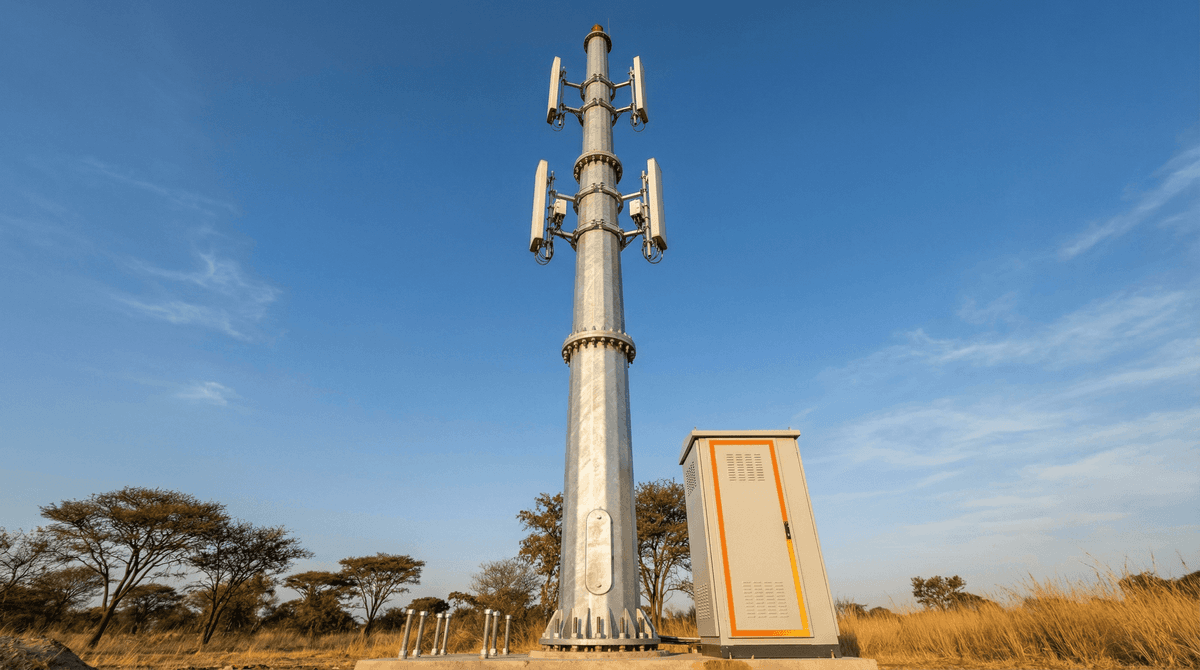
SOLAR TODO delivered a 58-unit Telecom Tower deployment in Lusaka, Zambia, designed for reliable cellular and microwave backhaul coverage under Lusaka’s high-corrosion environment and stringent wind requirements. Each site received a steel monopole tower system engineered for fast, CKD logistics and safe multi-tier antenna installation—supporting 6 panel antennas and 2 microwave dishes per tower.
Answer Capsule: In Lusaka, SOLAR TODO installed 58 × 25m steel monopole Telecom Towers (Q345, hot-dip galvanized) with high-corrosion protection and TIA-222-H wind design for 6 panel + 2 microwave loads.
Project Overview: Telecom Coverage Demands in Lusaka
Lusaka’s network operators face a practical infrastructure reality: telecom sites must be built quickly, withstand weather variability, and remain serviceable for years with minimal maintenance disruption. In the city’s operating conditions—especially where corrosion exposure is elevated—tower steel must be treated and detailed to resist long-term degradation while still meeting structural safety expectations.
SOLAR TODO’s scope centered on providing the steel monopole Telecom Tower as a complete, field-deployable product package: 58 units of 25m tapered round (or octagonal) steel monopole towers (NOT lattice, NOT FRP). Each tower was configured to carry 2–3 antenna tiers with 3 sector antennas per tier, enabling a consistent RF layout across the rollout and simplifying integration with microwave backhaul.

Why the Steel Monopole Tower Design Mattered
For telecom operators, the tower is not just a vertical structure—it is the platform that stabilizes RF alignment, supports safe installation workflows, and defines long-term maintainability. SOLAR TODO’s design choices for the Lusaka rollout were driven by three recurring site constraints:
- Wind performance and structural compliance: Towers must resist dynamic wind actions without compromising alignment or safety margins.
- High-corrosion exposure: Lusaka’s local environment increases the need for robust corrosion protection and durable steel detailing.
- Deployment efficiency: Remote or distributed sites require logistics that reduce on-site heavy lifting and shorten commissioning timelines.
To address these, SOLAR TODO supplied a hot-dip galvanized Q345 steel monopole tower meeting TIA-222-H / GB/T 50233 requirements. The towers were designed for Wind class 1 (40 m/s, factor 1, TIA-222-H) and built using a flanged bolt-on sectional design for repeatable assembly.
Product Configuration Delivered (Per Tower)
Each of the 58 Telecom Towers in Lusaka followed the same technical configuration to standardize installation, commissioning, and future maintenance.
Tower Structure
- Quantity: 58 units
- Height: 25m tapered steel monopole tower (NOT lattice, NOT FRP)
- Material: Hot-dip galvanized Q345 steel
- Weight: ~13 t per tower (500kg/m)
- Geometry: Tapered round or octagonal steel tube (as configured per site)
- Section design: Flanged bolt-on sectional design
- Wind rating basis: Wind class 1 (40 m/s, factor 1, TIA-222-H)
- Corrosion zone: high
Antenna & Equipment Load
SOLAR TODO engineered the tower to safely support a consistent RF load per site:
- Antenna load: 6× panel antenna + 2× microwave dish
- Tier concept: 2–3 antenna tiers, with 3 sector antennas per tier = 6–9 panels capability (project-installed configuration used 6 panel antennas)
- Accessories for installation and long-term operations:
- 3 antenna platforms
- climbing ladder
- cable tray
- aircraft warning light
- grounding system
- lightning rod
- safety cage
Foundation & Site Integration
The towers were installed on a concrete_pier foundation. This foundation approach supports stable base anchoring for monopole systems and fits common telecom site civil works in Lusaka.
Aviation Safety & Compliance
Because towers may penetrate controlled airspace, SOLAR TODO included aviation obstruction light (FAA/ICAO-aligned functionality) to support visibility for aircraft operations.
Manufacturing, Logistics, and Deployment Strategy
A major differentiator in the Lusaka rollout was the tower’s shipment and assembly approach. SOLAR TODO used CKD (knock-down) shipping, reducing logistics burden and enabling faster on-site erection.
- Shipping format: Shipped CKD (60–70% volume reduction)
- Production lead time: 30–45 days per batch
This CKD method is especially valuable when multiple sites are distributed across a metro area, and when access constraints limit large-volume deliveries. The flanged bolt-on sectional design supports straightforward field assembly using standard erection practices.
Standards We Built To
SOLAR TODO engineered the Telecom Tower product for recognized structural and materials expectations:
- TIA-222-H (U.S. telecom tower structural standard) — used for wind class design basis
- GB/T 50233 — Chinese standard for steel structure construction
Internationally, tower and antenna support structures commonly intersect with broader safety and electromagnetic infrastructure practices. In support of safe, reliable deployment, SOLAR TODO’s tower package also aligns with established principles referenced across international guidance for telecommunications infrastructure and electrical safety.
Authoritative references used in project engineering and verification include:
- TIA-222-H (Telecommunications tower structures)
- GB/T 50233 (Steel structure construction)
- IEC 62305 (Lightning protection—used as a design basis reference for lightning risk control concepts)
- ITU guidance for telecom network infrastructure planning and reliability considerations
- IEEE communications infrastructure safety references (for operational safety principles)
(These are used as engineering and compliance reference points; final acceptance is performed through local project QA/QC processes.)
Technical Specifications
- Product: Steel Monopole Tower (NOT lattice, NOT FRP)
- Model height: 25m tapered steel monopole tower
- Quantity: 58 units
- Steel grade: Hot-dip galvanized Q345
- Weight: ~13 t/tower (≈ 500kg/m)
- Wind design: Wind class 1 (40 m/s, factor 1, TIA-222-H)
- Corrosion zone: high
- Antenna capacity (tier concept): 2–3 antenna tiers, 3 sector antennas per tier = 6–9 panels capability
- Installed antenna load: 6× panel antenna + 2× microwave dish
- Foundation type: concrete_pier
- Included accessories: climbing ladder, cable tray, aircraft warning light, grounding system, lightning rod, 3 antenna platforms, safety cage
- Aviation lighting: obstruction light (FAA/ICAO-aligned)
- Shipment: CKD, 60–70% volume reduction
- Production time: 30–45 days
- Standards: TIA-222-H / GB/T 50233
Results and Impact
The Lusaka deployment delivered a standardized tower platform across 58 telecom sites—reducing variance between installations and improving the operator’s ability to train technicians, plan maintenance, and manage RF alignment.
Key quantified outcomes from the rollout include:
- 58 towers delivered and configured with the same structural and equipment envelope.
- 25m height per tower, providing consistent mounting geometry for panel antennas and microwave dishes.
- Design wind basis of 40 m/s (Wind class 1, factor 1, TIA-222-H) supports safe operation under specified wind conditions.
- High corrosion readiness through hot-dip galvanized Q345 steel and corrosion-zone-aware detailing for long-term resilience.
- Faster logistics and reduced transport footprint via CKD shipping with 60–70% volume reduction, enabling smoother delivery scheduling across Lusaka’s distributed sites.
- Repeatable assembly using flanged bolt-on sectional construction, supporting a predictable commissioning workflow.
Operationally, the included tower accessories—especially grounding system, lightning rod, aircraft warning light, and safety cage—reduced site-by-site customization and helped the operator establish uniform safety and compliance practices.
Why SOLAR TODO’s Telecom Tower Package Worked in Lusaka
Lusaka’s telecom build-out typically requires structures that are robust enough for long-term outdoor exposure, yet practical enough to transport and erect efficiently across many sites. By combining:
- a 25m tapered steel monopole engineered to TIA-222-H wind class 1,
- hot-dip galvanized Q345 suited for high corrosion zone,
- CKD logistics with 60–70% volume reduction, and
- a tower-ready equipment layout supporting 6 panel antennas + 2 microwave dishes, SOLAR TODO provided a tower platform that matched both engineering and execution needs.
For operators, this means fewer integration surprises, consistent installation steps, and a clearer path to safe, repeatable maintenance.
Frequently Asked Questions
1) What is the wind design basis for the Lusaka Telecom Towers?
Each tower was engineered to Wind class 1 (40 m/s, factor 1, TIA-222-H).
2) What antenna configuration can each 25m tower support?
The tower system is designed for 2–3 antenna tiers with 3 sector antennas per tier (capability 6–9 panels). In the Lusaka project, the installed load was 6× panel antenna + 2× microwave dish.
3) How was corrosion risk addressed for high-exposure sites?
The towers use hot-dip galvanized Q345 steel and were specified for a high corrosion zone environment.
4) How were the towers shipped and assembled to speed deployment?
SOLAR TODO shipped the towers in CKD form with 60–70% volume reduction, and the structure uses flanged bolt-on sectional design to support repeatable field assembly.
Next Steps
If you’re planning a telecom rollout and want a tower package engineered for wind compliance, high-corrosion durability, and efficient logistics, explore our telecom tower offering or contact our team.
Equipment Deployed
- 58 × 25m tapered steel monopole Telecom Tower (NOT lattice, NOT FRP), hot-dip galvanized Q345 steel, flanged bolt-on sectional design, ~13t/tower (~500kg/m), Wind class 1 (40 m/s, factor 1, TIA-222-H), high corrosion zone
- Per tower installed load capability: 6× panel antenna + 2× microwave dish; 3 antenna platforms; 2–3 antenna tier layout with 3 sector antennas per tier (project installed 6 panel antennas)
- Foundation package: concrete_pier (anchor-bolted base) for each tower
- Tower accessories (per unit): climbing ladder, cable tray, aircraft warning light, grounding system, lightning rod, safety cage