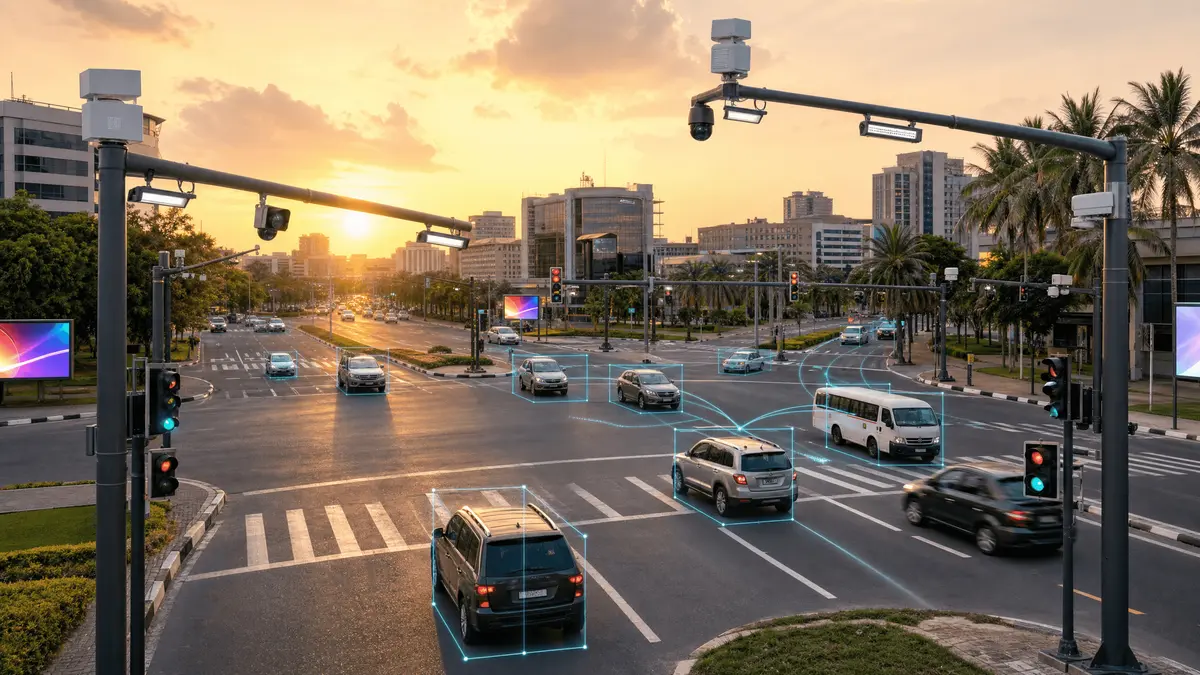
Luanda Smart Traffic System Market Analysis: 7-Intersection 6m Pole Configuration Guide
Summary
Luanda’s urban traffic profile supports a typical 7-intersection Smart Traffic System plan using 6m hot-dip galvanized L-arm poles, 4K AI cameras with 98% accuracy, and <50ms edge response. With 5G/fiber backhaul and adaptive control, this configuration fits dense arterial corridors and pedestrian-heavy junctions.
Key Takeaways
- A typical Luanda deployment of this scale would cover approximately 7 intersections using 6m L-arm steel poles in dark grey hot-dip galvanized finish.
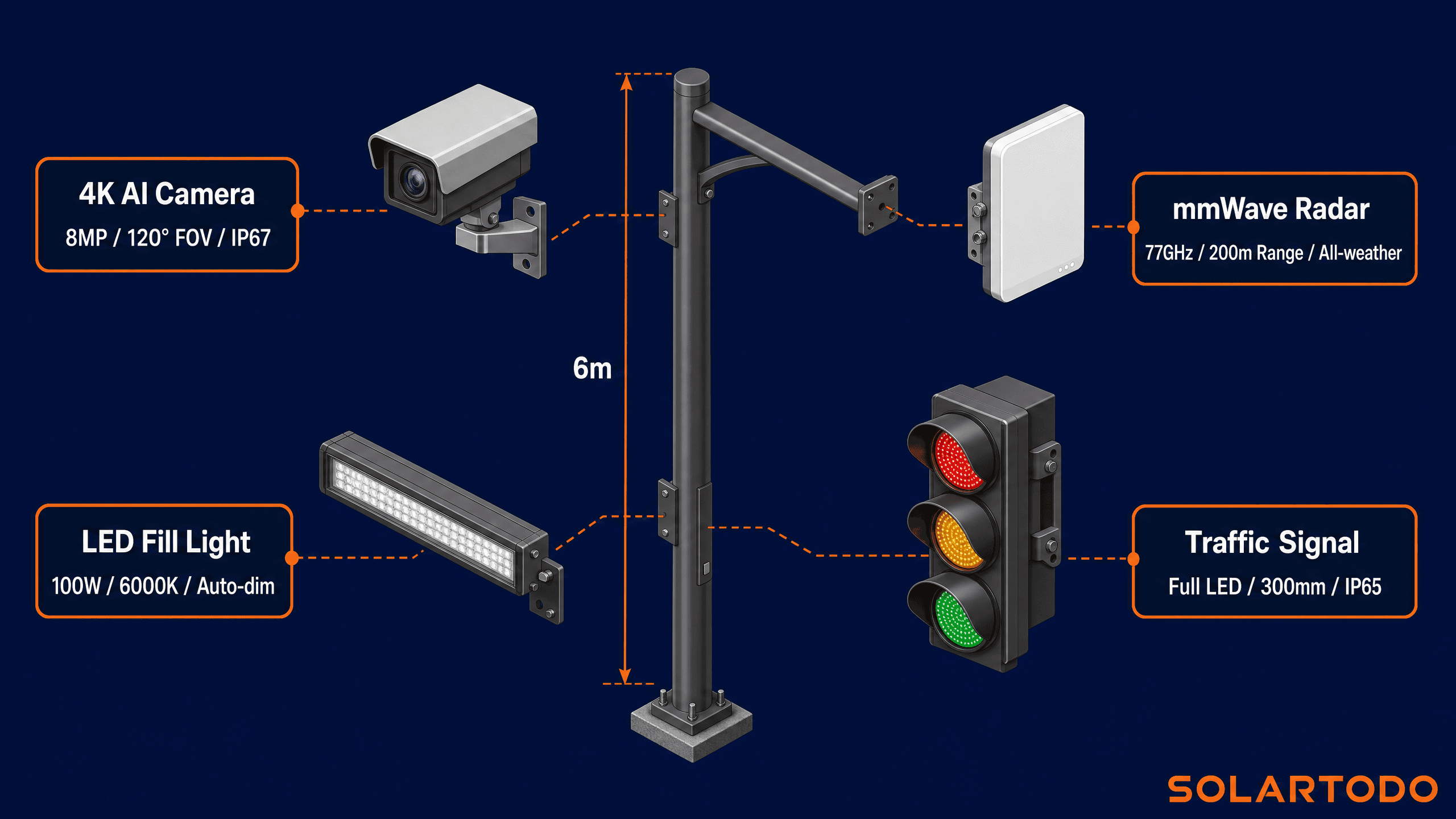
- Each pole combines 4 modules in 1 unit: 4K AI camera, 77GHz mmWave radar, LED fill light, and LED signal head.
- The edge stack uses NVIDIA Jetson and supports <50ms response time with up to 45+ detection types from the platform architecture.
- Camera analytics are rated at 98% detection accuracy, which is relevant for pedestrian detection, queue monitoring, and incident auto-alert logic.
- A typical intersection would use 4-12 poles, while this Luanda profile aligns with single-junction 6m pole layouts rather than 10-12m highway gantries.
- Backhaul should use 5G and/or fiber, linking field devices to TrafficGPT for central control and natural-language traffic queries.
- Applicable compliance references include NTCIP for traffic communications and GB 25280 for traffic signal device requirements.
- A practical commercial structure for Luanda is Joint Venture, especially where city authorities want phased rollout across 7 priority junctions without a full citywide EPC scope on day 1.
Market Context for Luanda
Luanda’s transport conditions support AI-based intersection control because the city combines high population density, heavy corridor congestion, and a fast-growing vehicle fleet within a coastal metropolitan area of national importance. According to the World Bank (2023), Angola remains one of Sub-Saharan Africa’s most urbanized economies, with urbanization above 67%, and Luanda is the country’s dominant metropolitan center. According to UN-Habitat (2020), Luanda’s urban agglomeration population exceeds 8 million, which places sustained pressure on arterial roads, pedestrian crossings, and signal timing plans.
Traffic management in Luanda is not only a mobility issue but also a road safety and public-service issue. According to the World Health Organization (2023), African cities continue to face a disproportionate burden of road traffic fatalities, with pedestrian exposure and mixed-traffic conditions as key risk factors. For Luanda, this means signalized intersections need more than fixed-time controllers; they need detection layers that can identify pedestrians, turning conflicts, stopped vehicles, and abnormal lane occupancy within milliseconds, not only after manual review.
Telecom readiness also matters for smart traffic infrastructure. According to the International Telecommunication Union (2023), mobile broadband coverage across African capitals has expanded materially, and urban corridors increasingly support 4G/5G migration alongside enterprise fiber. In practical terms, Luanda’s main junctions can support a Smart Traffic System architecture that uses 5G/fiber backhaul to move video metadata, radar events, and controller commands between field poles and a central platform. This is important because adaptive signal optimization loses value if communications latency is high or unstable.
Climate and corrosion exposure affect pole selection in Luanda. The city sits on the Atlantic coast near -8.84, 13.23, with marine humidity, salt exposure, and seasonal rainfall that can shorten the life of poorly protected steel. According to ISO 1461 guidance on hot-dip galvanized coatings and common coastal corrosion practice, galvanized steel remains a practical choice for urban roadside infrastructure when coating thickness and maintenance intervals are specified correctly. For this reason, a hot-dip galvanized steel pole in dark grey is the correct base form for Luanda rather than painted light-duty street hardware.
Public-sector modernization trends also support this product class. According to the African Development Bank (2022), Angola’s infrastructure agenda includes transport efficiency, digital systems, and urban service upgrades to improve economic productivity. A Smart Traffic System fits this direction because it combines traffic signals, sensing, edge computing, and central software in one roadside asset. SOLAR TODO’s product positioning is relevant here because buyers in Luanda typically need a single pole platform rather than separate procurement lots for camera masts, radar brackets, fill lights, and signal heads.
As the U.S. Federal Highway Administration states, “Adaptive signal control technologies adjust the timing of red, yellow, and green lights to accommodate changing traffic patterns and ease traffic congestion.” That statement is directly relevant to Luanda, where peak-hour conditions can vary sharply by corridor and by day. Likewise, NEMA notes that “Transportation systems management and operations strategies can improve safety, mobility, and system reliability,” which supports phased intelligent intersection upgrades instead of waiting for full road reconstruction.
Recommended Technical Configuration
A Luanda corridor with dense urban junctions would typically fit a 7-intersection Smart Traffic System using 6m L-arm poles, 5G/fiber backhaul, and edge AI for pedestrian detection, adaptive signal optimization, and incident auto-alerts. This size class is appropriate for standard city intersections where signal mounting and sensor coverage do not require 10-12m highway gantry geometry.
Based on the supplied project-specific configuration, the recommended setup for Luanda is a typical 7-intersection deployment using 6m L-arm steel poles with dark grey hot-dip galvanized finish. Each pole is a 4-in-1 smart traffic pole integrating a 4K AI camera, 77GHz mmWave radar, LED fill light, and LED signal. The edge AI layer uses NVIDIA Jetson, while the communications layer connects through 5G and/or fiber to the TrafficGPT central platform.
This 6m class is the correct fit because Luanda’s target use case is intersection management, not expressway gantry monitoring. The product line specifies 4-12 poles per intersection, depending on the number of approaches, channelized turns, pedestrian islands, and auxiliary coverage points. For a 7-junction package, a buyer would typically assess approximately 28-56 poles if using one primary pole per approach, though exact counts depend on lane geometry and whether median-side auxiliary poles are required.
The functional priorities in Luanda should be threefold. First, pedestrian detection is essential at mixed-use crossings near bus stops, schools, and market corridors. Second, adaptive signal optimization should be enabled at intersections with strong tidal flow patterns during morning and evening peaks. Third, incident auto-alert should trigger alarms for stopped vehicles, wrong-way movement, or blocked lanes, allowing a control center to respond before queues spill back into adjacent junctions.
A Joint Venture cooperation model is commercially credible in Luanda because it can align municipal agencies, local civil contractors, and technology suppliers around phased capital deployment. That model is often more practical than immediate citywide EPC when agencies want to validate 7 intersections first, confirm communications stability, and then expand to additional corridors. SOLAR TODO can therefore be positioned as a technical supply and integration partner within a local implementation framework rather than as a claimant of past completed deployment.
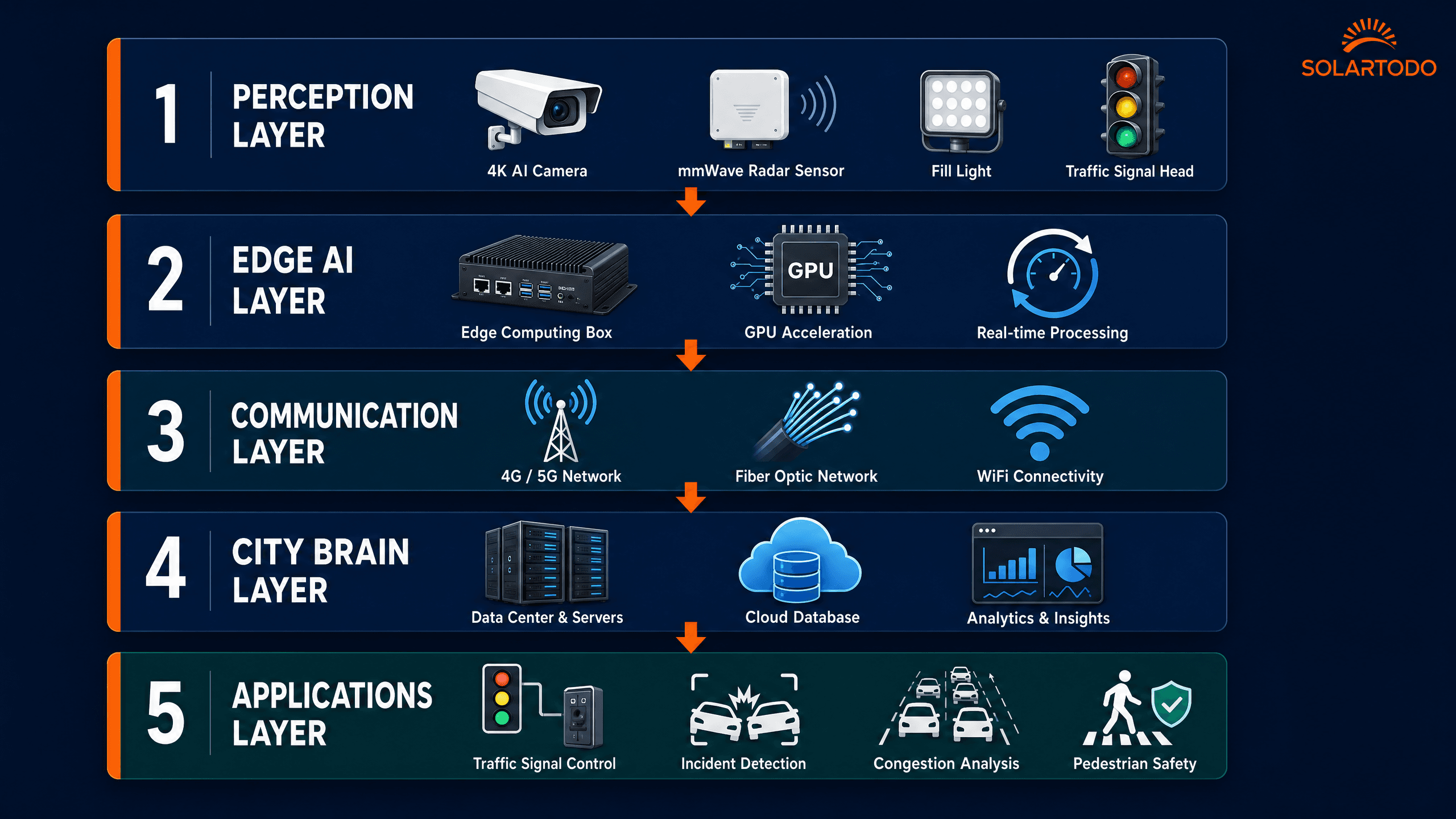
For procurement planning, the field architecture should follow the 5-layer stack defined for the product line:
- Perception: 4K camera + 77GHz radar + LED fill light + LED signal
- Edge AI: NVIDIA Jetson
- Communication: 5G/fiber
- City Brain: TrafficGPT
- Applications: signal optimization, pedestrian safety, incident alerts, analytics dashboards
This structure matters because it reduces dependence on cloud-only processing. A field response time of <50ms is materially better than sending raw video to a distant server for every decision event. In Luanda, where some junctions may experience variable backhaul quality, edge-first decision logic improves resilience and keeps core safety functions active even if central connectivity is temporarily degraded.
Technical Specifications
The recommended Luanda configuration uses 6m hot-dip galvanized L-arm poles with 4-in-1 sensing and signaling, NVIDIA Jetson edge AI, and NTCIP/GB 25280 compliance for a 7-intersection urban deployment.
- Product name: Smart Traffic System by SOLAR TODO
- Application profile: Urban signalized intersections in Luanda, Angola
- Typical deployment scale: 7 intersections
- Pole type: L-arm steel pole
- Pole height: 6m
- Pole finish: Dark grey, hot-dip galvanized
- Pole use case: Standard urban intersections, not highway gantries
- Integrated modules per pole: 4-in-1
- Camera specification: 4K AI camera
- Camera analytics accuracy: 98%
- Response time: <50ms
- Radar specification: 77GHz mmWave radar
- Lighting module: LED fill light
- Signal module: LED signal head
- Edge computing platform: NVIDIA Jetson
- Core functions: Pedestrian detection, adaptive signal optimization, incident auto-alert
- Communications: 5G/fiber backhaul
- Central software platform: TrafficGPT with natural language queries
- Intersection pole density: 4-12 poles per intersection depending on approaches and auxiliaries
- Standards: NTCIP, GB 25280
- Recommended commercial model: Joint Venture
From an engineering standpoint, the 6m height is suitable where mounting clearance, camera angle, and radar field-of-view must cover stop lines, crosswalks, and near-side lane approaches without moving into gantry-scale civil works. NTCIP compatibility matters because it supports interoperability between traffic controllers, signal heads, and central management software. GB 25280 is relevant because it defines requirements for road traffic signal lamps and helps buyers verify signal visibility and device quality.
Implementation Approach
A 7-intersection rollout in Luanda would typically proceed in 4 phases over roughly 12-24 weeks, covering survey, civil works, pole erection, communications, and controller commissioning. The exact schedule depends on fiber access, foundation curing time, and permit coordination at each junction.
Phase 1 is site survey and traffic engineering. This usually takes 2-4 weeks for 7 intersections and should include lane counts, pedestrian path mapping, mast-arm visibility checks, utility scans, and communications availability. According to FHWA guidance on signal retiming and adaptive systems, baseline traffic data is necessary before changing control logic. For Luanda, this means documenting queue lengths, cycle failures, and crossing demand by time band.
Phase 2 is detailed design and procurement. In this step, the buyer confirms pole locations, foundation drawings, conduit routing, power connection points, signal controller interfaces, and the 5G/fiber topology. A Luanda package using SOLAR TODO hardware should also confirm corrosion protection for marine exposure, cabinet ingress protection, and grounding practice suitable for coastal thunderstorms and utility fluctuations.
Phase 3 is civil and mechanical installation. Typical work includes excavation, anchor cage placement, concrete foundations, curing, pole erection, arm alignment, and signal head mounting. In many African urban projects, this phase takes 4-8 weeks depending on traffic management windows and local contractor capacity. If intersections remain live during works, night shifts or off-peak lane closures may be necessary to reduce disruption.
Phase 4 is systems integration and commissioning. This covers camera calibration, radar tuning, signal logic mapping, edge AI validation, NTCIP communications checks, and TrafficGPT dashboard setup. Acceptance testing should verify pedestrian detection, incident auto-alert, and adaptive timing behavior under at least 3 traffic conditions: off-peak, peak directional flow, and abnormal blockage. SOLAR TODO should be evaluated here on technical fit, standards compliance, and local support structure rather than on unsupported claims of prior deployment.
Expected Performance & ROI
A 7-intersection Smart Traffic System in Luanda would typically target 10-25% delay reduction, faster incident detection within seconds, and lower manual monitoring cost through edge AI and central analytics. Financial return depends on congestion cost, enforcement workflows, and whether fiber already exists at the corridor.
According to the U.S. Federal Highway Administration (2023), adaptive signal control can reduce travel time by more than 10% in suitable corridors and improve intersection efficiency when demand is variable. According to the National Association of City Transportation Officials (2023), better signal timing and protected pedestrian operations can improve safety outcomes at urban crossings. For Luanda, where queue spillback and crossing conflicts are common, even a 10-15% reduction in average delay can translate into meaningful productivity gains.
The ROI case is usually strongest when three value streams are counted together. The first is reduced congestion cost, measured through vehicle-hours saved. The second is reduced incident response time, since automated alerts can flag stopped vehicles or lane blockages within seconds rather than waiting for manual observation. The third is lower field maintenance cost because a 4-in-1 pole reduces the number of separate roadside devices, brackets, and cabinets that must be inspected.
A practical payback range for a 7-intersection package is often 3-6 years, depending on import duties, civil scope, communications reuse, and whether the city monetizes data for planning or enforcement support. According to the World Bank (2022), urban transport inefficiency in developing cities carries substantial economic cost through delay, fuel waste, and reduced labor productivity. Where Luanda can reuse existing ducts or fiber at even 30-50% of the corridor, the payback period would tend toward the lower end of that range.
Preventive maintenance should be planned on a quarterly and annual basis. Quarterly tasks include lens cleaning, radar health checks, signal visibility inspection, and communications diagnostics. Annual tasks include galvanization inspection, fastener torque checks, grounding verification, and edge compute firmware updates. In a coastal city like Luanda, this maintenance discipline is important because salt exposure can accelerate corrosion at joints and cable entries if ignored for more than 12 months.
Results and Impact
For Luanda, the main expected impact is better control of pedestrian-heavy junctions through sub-50ms edge response, 98% AI detection accuracy, and centralized optimization across 7 intersections. The strongest benefit appears where adjacent signals currently operate on fixed timing and where queue spillback affects 2 or more consecutive junctions.
From an operations perspective, a Smart Traffic System changes how a city manages intersections. Instead of relying on isolated signal heads and manual observation, operators receive machine-detected events, radar-confirmed movement data, and natural-language access through TrafficGPT. That means a traffic manager can ask for congestion trends, pedestrian conflict events, or incident logs without manually reviewing hours of footage.
For procurement teams, the impact is also structural. A 4-in-1 pole reduces device fragmentation by combining sensing, signaling, and illumination in one roadside asset. That simplifies bill-of-materials control, shortens installation sequencing, and can reduce the number of separate maintenance contracts over a 5-10 year asset life. In Luanda, where imported spare parts and field service logistics can add delay, that simplification has direct value.
Comparison Table
A Luanda buyer should compare 6m integrated smart poles against conventional fixed-time intersections and higher 10-12m gantry-style systems to match urban geometry, cost, and coverage requirements.
| Configuration | Typical Use Case | Height | Integrated Devices | Communications | Best Fit in Luanda | Main Limitation |
|---|---|---|---|---|---|---|
| SOLAR TODO Smart Traffic System, 6m L-arm pole | Urban intersections | 6m | 4K AI camera + 77GHz radar + LED fill light + LED signal | 5G/fiber | Dense city junctions, pedestrian crossings, arterial corridors | Requires careful calibration at complex multi-level junctions |
| Conventional signal pole + separate CCTV | Basic fixed-time control | 5-7m | Signal head plus separate camera systems | Often limited IP backhaul | Lower initial scope where analytics are not required | Higher device fragmentation and slower incident awareness |
| 10-12m smart gantry/pole system | Highway or wide expressway monitoring | 10-12m | Multi-lane detection, long-range coverage | Fiber preferred | Ring roads, express segments, toll approaches | Overspecified for standard city intersections |
| Manual traffic control + legacy signals | Congested emergency management | N/A | None or minimal | None | Temporary fallback during outages | No adaptive optimization, no event analytics |
Pricing & Quotation
SOLAR TODO offers three pricing tiers for this product line: FOB Supply (equipment ex-works China), CIF Delivered (including ocean freight and insurance), and EPC Turnkey (fully installed, commissioned, with 1-year warranty). Volume discounts are available for large-scale deployments. Configure your system online for an instant estimate, or request a custom quotation from our engineering team at [email protected].
For Luanda, quotation accuracy depends on 4 local variables: number of poles per intersection, foundation complexity, existing controller compatibility, and availability of 5G/fiber at each site. A corridor with 7 intersections and reused communications ducts will price differently from a corridor needing all-new trenching and cabinets. Buyers should therefore request a line-item quotation that separates equipment, logistics, civil works, commissioning, and annual maintenance.
Frequently Asked Questions
Q1: Why is a 6m pole recommended for Luanda instead of an 8m or 10m option?
A 6m L-arm pole fits standard urban intersections where the priority is stop-line visibility, crosswalk coverage, and compact civil works. The 10-12m class is more suitable for highways or very wide carriageways. In Luanda’s dense urban corridors, 6m usually gives the right balance of camera angle, radar coverage, and installation cost.
Q2: How many poles would a 7-intersection deployment typically require?
The product line allows 4-12 poles per intersection depending on approach count, medians, turning lanes, and auxiliary visibility needs. For 7 intersections, a planning estimate is approximately 28-56 poles. Final quantity depends on whether each approach needs a dedicated primary pole and whether pedestrian islands require additional units.
Q3: What does the 4-in-1 Smart Traffic System include on each pole?
Each pole integrates 4 modules: a 4K AI camera, 77GHz mmWave radar, LED fill light, and LED signal head. This reduces the need for separate roadside devices and brackets. The edge AI layer uses NVIDIA Jetson, which supports local event processing and helps maintain <50ms response for time-sensitive traffic functions.
Q4: What traffic functions are most relevant for Luanda?
The most relevant functions are pedestrian detection, adaptive signal optimization, and incident auto-alert. These address common urban issues such as unsafe crossings, peak-direction congestion, and blocked lanes. In a city with mixed traffic and high pedestrian activity, these three functions usually provide the strongest operational value during the first deployment phase.
Q5: How long would installation and commissioning usually take?
A 7-intersection package typically takes 12-24 weeks from survey to final commissioning. The timeline depends on permit approvals, concrete curing, traffic management windows, and communications access. If fiber and power are already present at most sites, the schedule can move faster. New trenching or utility relocation usually adds several weeks.
Q6: What payback period is realistic for this system?
A practical payback range is often 3-6 years. The lower end is more likely when the corridor already has reusable fiber, existing signal controllers, or high congestion costs that make delay reduction valuable. The upper end is more common when civil works are extensive or when the deployment starts as a standalone smart corridor without broader network integration.
Q7: How does this compare with a conventional fixed-time traffic signal setup?
A fixed-time setup can be cheaper at first purchase, but it lacks live detection and adaptive timing. The SOLAR TODO Smart Traffic System adds 98% AI detection accuracy, 77GHz radar, and <50ms edge response. That means better awareness of pedestrians and incidents, plus stronger central analytics through TrafficGPT and NTCIP-connected control workflows.
Q8: What maintenance should buyers plan for in coastal Luanda?
Maintenance should include quarterly cleaning and diagnostics plus annual structural and electrical inspection. Coastal humidity and salt exposure can affect cable entries, fasteners, and external coatings over 12 months if not checked. Buyers should include lens cleaning, radar calibration review, grounding checks, and galvanization inspection in the service scope.
Q9: Is EPC the only commercial model available?
No. For this product line, the available models include BOT, EPC turnkey, and Joint Venture. For Luanda, a Joint Venture model can be practical when local authorities want phased deployment, local civil participation, and shared implementation responsibilities. It also helps when the city wants to validate performance across 7 intersections before scaling.
Q10: What standards and interoperability points should procurement teams check?
Procurement teams should verify NTCIP compatibility for traffic communications and GB 25280 compliance for signal devices. They should also request documentation for controller integration, radar and camera calibration procedures, and environmental protection details for coastal conditions. These checks matter as much as hardware specifications because they affect long-term maintainability and multi-vendor interoperability.
References
- World Bank (2023): Angola urban development and infrastructure context; urbanization level above 67% supports demand for smarter city traffic systems.
- UN-Habitat (2020): Luanda urban agglomeration population estimates exceeding 8 million, indicating sustained pressure on roads and crossings.
- World Health Organization (2023): Global road safety data showing high traffic injury burden in African cities and the importance of pedestrian protection.
- International Telecommunication Union (2023): ICT development and mobile broadband expansion trends relevant to 5G/fiber-connected urban infrastructure.
- U.S. Federal Highway Administration (2023): Adaptive signal control guidance stating that timing adjusts to changing traffic patterns and can reduce congestion.
- NEMA (2021): Transportation systems management and operations guidance supporting technology-based safety and mobility improvements.
- ISO 1461 (latest applicable edition): Hot dip galvanized coatings on fabricated iron and steel articles, relevant to coastal corrosion protection for Luanda pole installations.
Equipment Deployed
- 6m L-arm steel pole, dark grey, hot-dip galvanized
- 4K AI camera with 98% detection accuracy
- 77GHz mmWave radar
- LED fill light
- LED signal head
- NVIDIA Jetson edge AI unit
- 5G/fiber communications backhaul interface
- TrafficGPT central management platform with natural language queries
- NTCIP-compatible traffic communications interface
- GB 25280-compliant traffic signal device set