LFP BESS Design: Thermal Management & VPP Standards

SOLARTODO Editorial Team
Solar Energy & Infrastructure Expert Team
Watch the video
TL;DR
LFP Battery Energy Storage Systems should be selected by duty cycle, ambient temperature, and dispatch role, not just capacity. For many B2B projects, liquid cooling above 100kWh, 6,000+ cycle LFP chemistry, and standards such as UL 9540, UL 9540A, IEEE 1547, and IEC 62933 are the practical baseline. VPP-ready systems also need 1-4 second telemetry, SOC guard bands, and clear EPC scope to protect ROI.
LFP Battery Energy Storage Systems require coordinated design across thermal control, power conversion, and dispatch logic: liquid cooling typically suits systems above 100kWh, LFP chemistry delivers 6,000+ cycles, and VPP response can reach sub-second to <100 ms depending on inverter and EMS architecture.
Summary
LFP Battery Energy Storage Systems require coordinated design across thermal control, power conversion, and dispatch logic: liquid cooling typically suits systems above 100kWh, LFP chemistry delivers 6,000+ cycles, and VPP response can reach sub-second to 100kWh to multi-MWh | | Temperature uniformity | Moderate | Better, often tighter by 2-5°C | | Auxiliary load | Lower at mild ambient | More predictable at high ambient | | High-cycle suitability | Moderate | Better for 1-2 cycles/day and 0.5C-1C | | Maintenance | Simpler fan/filter service | Pump, coolant, heat exchanger service | | Hot climate performance | Limited above 40°C ambient | Better control in 40-50°C ambient | | Capex | Lower | Higher |
Air cooling has fewer components and lower initial cost. It can work well for low-duty backup systems where discharge events are infrequent and room HVAC is already available. However, in dusty sites, telecom compounds, or utility containers with high solar gain, fan-based systems may face filter clogging, uneven airflow, and higher temperature gradients between racks.
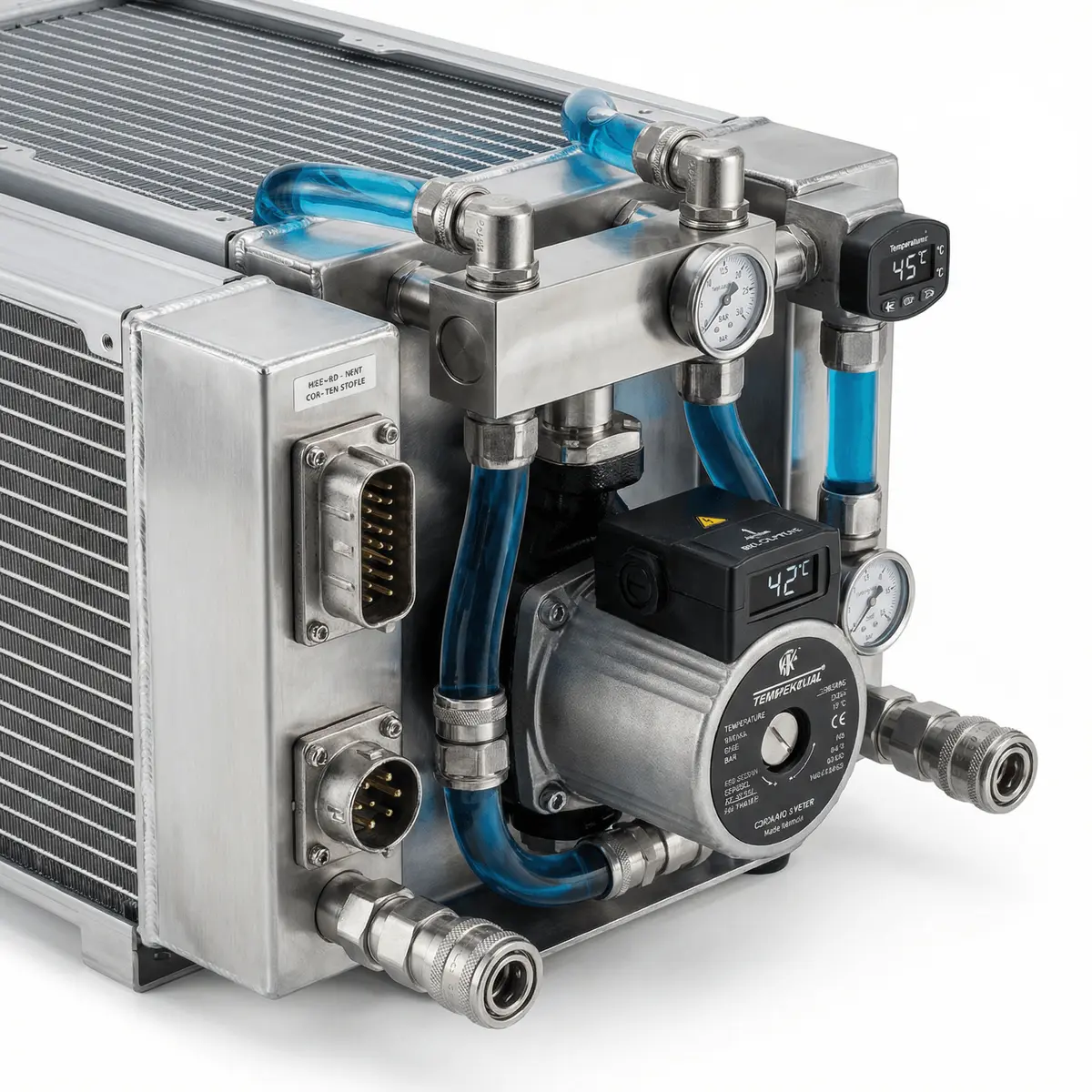
Liquid cooling adds pumps, piping, plate exchangers, and controls, but it gives tighter thermal control. That matters for systems with 6,000+ cycles, daily dispatch, or dense container layouts. SOLAR TODO typically recommends liquid cooling for larger commercial and utility storage where ambient conditions exceed 35°C for long periods or where the owner expects repeated cycling with stable performance.
Thermal design checkpoints
Procurement teams should ask for these thermal data points in the technical schedule:
- Cell operating temperature window
- Rack-to-rack temperature deviation at rated power
- Maximum ambient rating, such as 50°C
- Auxiliary consumption at 25°C and 40°C
- Cooling redundancy, for example N+1 pump or fan logic
- Ingress protection, such as IP54 or IP55 enclosure rating
- Fire detection and off-gas sensing method
- Thermal runaway propagation test reference, including UL 9540A
UL states through UL 9540A test methodology that thermal runaway behavior must be evaluated at cell, module, unit, and installation level. For EPC and insurer review, this is essential. A battery that looks acceptable on nameplate data alone may still trigger spacing, ventilation, or suppression redesign once fire test results are reviewed.
VPP Dispatch Protocols and Control Architecture
VPP dispatch protocols should define telemetry at 1-4 second intervals, SOC guard bands near 20-80%, and fallback modes because revenue stacking fails when dispatch logic conflicts with battery limits.
Virtual power plant participation changes system design. A battery used in a VPP is not only a storage box; it becomes a grid-interactive asset that must receive signals, validate operating constraints, dispatch power, and report performance. That requires coordination between the battery management system, power conversion system, site controller, EMS, utility meter, and market or aggregator interface.
According to NREL (2023), distributed energy resource aggregation depends on interoperable communications, predictable response, and verification-quality telemetry. For BESS owners, this means dispatch revenue is linked to data quality as much as inverter power. A system that can technically discharge 500kW but cannot prove interval performance may underperform in settlement.
Typical dispatch layers
A practical VPP architecture usually includes these layers:
- Cell and rack BMS for voltage, current, and temperature protection
- PCS controls for active and reactive power response
- Site EMS for SOC optimization and local load coordination
- Gateway or SCADA interface for utility or aggregator commands
- Market logic for day-ahead, intra-day, or real-time dispatch
Dispatch protocols should also define priority. For example, a hospital microgrid may rank backup reserve first, demand-charge reduction second, and market dispatch third. A commercial building may invert that order during non-critical hours. Without a hard priority matrix, the system can chase short-term revenue and compromise resilience.
The International Energy Agency states, "Digitalization is becoming increasingly important for secure and flexible power system operation." In BESS projects, that translates into protocol discipline: timestamp synchronization, secure remote access, event logging, and command acknowledgment are not optional extras. They are part of bankable performance.
Key VPP settings for procurement
Buyers should specify these items before FAT and SAT:
- Supported protocols such as Modbus TCP, IEC 61850, DNP3, or utility-specific APIs
- Telemetry granularity, such as 1-second, 2-second, or 4-second data
- Dispatch response target, such as <100 ms, <1 second, or <5 seconds
- SOC operating window, often 20-80% for regulation and 10-90% for backup
- Reactive power and power factor range, such as 0.9 leading to 0.9 lagging
- Black start or islanding support if required
- Cybersecurity controls and user-access hierarchy
- Warranty alignment between dispatch cycles and throughput limits
For example, a 10MW/10MWh frequency regulation BESS may hold 40-60% SOC to preserve symmetric up and down regulation capability. A hotel demand-management system may instead reserve 20-30% SOC for outage support while dispatching 60kW over 15-60 minute billing peaks. These are different control philosophies, even if both use LFP cells.
Standards, Safety, and Compliance Framework
LFP Battery Energy Storage Systems should be specified against UL 9540, UL 9540A, IEC 62933, IEEE 1547, and NFPA 855 because certification gaps often delay projects by 3-6 months.
Standards are not a paperwork exercise. They determine whether a project passes utility review, AHJ permitting, insurer scrutiny, and lender technical due diligence. For B2B buyers, the fastest way to create hidden cost is to procure a battery without aligning product certification to the installation jurisdiction.
The minimum compliance package depends on market, but several standards appear repeatedly in commercial and utility projects. UL 9540 covers energy storage system safety. UL 9540A provides the thermal runaway fire test method. NFPA 855 addresses installation requirements. IEEE 1547 governs interconnection and interoperability for distributed energy resources. IEC 62933 provides broader electrical energy storage system guidance.
Standards selection guide
| Standard / Code | Scope | Why it matters |
|---|---|---|
| UL 9540 | ESS safety certification | Common requirement for product acceptance and permitting |
| UL 9540A | Thermal runaway test method | Supports fire safety design, spacing, and mitigation review |
| NFPA 855 | Installation of stationary ESS | Influences siting, separation, ventilation, and emergency planning |
| IEEE 1547-2018 | DER interconnection | Defines grid support, interoperability, and ride-through behavior |
| IEC 62933 series | Electrical energy storage systems | Framework for design, safety, and performance evaluation |
| IEC 62619 | Safety for industrial lithium cells and batteries | Important for cell and battery safety qualification |
| IEC 62477-1 | Safety requirements for power electronic converter systems | Relevant to PCS and converter safety |
According to IEEE 1547-2018, DER systems must support interoperability and specified grid response functions under defined conditions. This matters for VPP and utility-interactive projects because the inverter and controller must behave predictably during voltage and frequency disturbances. A battery that cannot meet local ride-through settings may require firmware changes or interconnection redesign.
SOLAR TODO advises buyers to request a compliance matrix during bid review. That matrix should map each applicable code to the exact certificate, test report, and subsystem responsibility. It should also identify whether compliance sits at cell, module, rack, container, PCS, or full-system level, because gaps often appear between component certification and complete installation approval.
Applications, ROI, and EPC Investment Analysis and Pricing Structure
EPC evaluation should compare outage-cost avoidance, 3-5 year demand-charge payback, and three-tier pricing because the lowest FOB price rarely delivers the lowest 10-year total cost.
LFP BESS economics depend on use case. In resilience projects, the value is avoided downtime. In demand management, the value is reduced billed peak. In VPP or ancillary services, the value is dispatch revenue plus flexibility. The same 150kWh or 500kWh system can produce very different returns depending on tariff structure, cycle count, reserve policy, and interconnection limits.
According to NREL commercial storage case studies cited in recent market analysis, behind-the-meter storage can reach 3-5 year payback where demand charges are high and dispatch aligns with 15-minute billing windows. For mission-critical backup, ROI should be calculated against outage cost per hour, SLA penalties, and business continuity. A data facility with a 500kW critical load may justify a 500kWh battery on resilience grounds even when direct tariff savings are secondary.
Sample deployment scenarios
- Sample deployment scenario (illustrative): A hotel with 75kW discharge capability and 150kWh usable energy reduces 60kW billing peaks, improving annual savings where demand charges are $10-$16/kW-month.
- Sample deployment scenario (illustrative): A data center with 500kW critical load uses a 500kWh LFP BESS for roughly 1 hour autonomy and <10 ms transfer support when paired with suitable power electronics.
- Sample deployment scenario (illustrative): A 10MW/10MWh utility BESS participates in frequency regulation with <100 ms response and 40-60% SOC targeting for symmetric dispatch.
Three-tier pricing structure
SOLAR TODO typically discusses pricing in three commercial layers rather than one number:
| Pricing Tier | What is included | Best fit |
|---|---|---|
| FOB Supply | Battery racks/containers, PCS, BMS, standard documents | EPCs managing local logistics and installation |
| CIF Delivered | FOB scope plus sea freight and insurance to destination port | Importers and project owners controlling local works |
| EPC Turnkey | Supply, civil/electrical integration, commissioning, training, acceptance support | Owners seeking single-point delivery |
Volume guidance for portfolio procurement:
- 50+ units: about 5% discount guidance
- 100+ units: about 10% discount guidance
- 250+ units: about 15% discount guidance
Typical payment terms:
- 30% T/T deposit + 70% against B/L
- Or 100% L/C at sight
Financing may be available for large projects above $1,000K, subject to project profile, jurisdiction, and credit review. For EPC quotations, warranty terms, and project financing discussion, buyers can contact [email protected] or SOLAR TODO through its offline quotation process.
What EPC turnkey delivery should include
A proper EPC scope should define more than supply. It should include single-line diagrams, civil interface data, cable schedule boundaries, protection coordination, SCADA points list, FAT, SAT, commissioning plan, operator training, and warranty response process. If these items are omitted, the owner often absorbs change-order risk later.
SOLAR TODO generally recommends that buyers compare at least these commercial metrics over 10 years:
- Capex by pricing tier
- Auxiliary energy consumption in kWh/year
- Guaranteed usable energy at beginning and end of warranty
- Cycle or throughput warranty limits
- O&M labor and spare parts assumptions
- Revenue or savings by use case
- Downtime cost avoided
FAQ
LFP Battery Energy Storage Systems usually deliver 6,000+ cycles, 90% depth of discharge, and stronger thermal stability than legacy chemistries, but correct cooling and controls determine whether those numbers are achieved on site.
Q: What is an LFP Battery Energy Storage System? A: An LFP Battery Energy Storage System is a stationary battery system that uses lithium iron phosphate cells to store and discharge electricity. In commercial use, it typically offers 6,000+ cycles, about 90% usable depth of discharge, and a 10-15 year service horizon depending on temperature, cycling rate, and control strategy.
Q: Why is LFP often selected over other lithium chemistries for stationary storage? A: LFP is often selected because it prioritizes thermal stability, long cycle life, and safety over maximum energy density. For BESS projects above 100kWh, that tradeoff is usually favorable because footprint is less critical than 10-year warranty confidence, lower fire risk, and stable daily cycling performance.
Q: How do I choose between air cooling and liquid cooling? A: Choose air cooling for smaller systems, lighter cycling, and moderate ambient conditions where capex simplicity matters. Choose liquid cooling for systems above 100kWh, hot climates above 35-40°C, or 0.5C-1C duty where tighter temperature control can reduce imbalance and support more consistent performance.
Q: What temperature range is acceptable for LFP BESS operation? A: Acceptable range depends on the cell and enclosure design, but many systems are specified for ambient conditions from about -20°C to 50°C. The more important metric is temperature uniformity inside the battery, because sustained rack deviations above roughly 5°C can accelerate aging and reduce usable capacity.
Q: What standards should procurement teams check before buying a BESS? A: Procurement teams should review UL 9540, UL 9540A, NFPA 855, IEEE 1547-2018, and relevant IEC standards such as IEC 62933 and IEC 62619. These standards affect product safety, installation approval, interconnection behavior, and insurer acceptance, so missing documentation can delay a project by months.
Q: How fast can an LFP BESS respond for VPP or grid services? A: Response speed depends on the PCS, controller, and communications stack rather than the battery cells alone. Well-configured systems can support <100 ms response for frequency services, while building-level peak shaving often uses dispatch intervals of 1-5 minutes and telemetry updates of 1-4 seconds.
Q: What SOC window should be used for VPP dispatch? A: A common VPP operating window is 20-80% SOC because it preserves headroom for both charge and discharge events. Some backup-oriented sites use 30-90% or similar windows, but the final setting should match warranty limits, reserve requirements, and the specific market service being delivered.
Q: How is BESS ROI calculated for commercial projects? A: ROI should be based on the actual value stream: demand-charge reduction, outage-cost avoidance, PV self-consumption, or market dispatch revenue. Many demand-management projects can reach 3-5 year payback, while resilience projects are often justified by avoided downtime cost per hour rather than energy savings alone.
Q: What is included in EPC turnkey delivery for a battery project? A: EPC turnkey delivery usually includes system supply, engineering documents, installation coordination, testing, commissioning, training, and handover support. Buyers should confirm whether civil works, transformer scope, protection settings, SCADA integration, FAT, SAT, and local permitting support are included or excluded.
Q: How are SOLAR TODO battery projects typically priced and paid? A: SOLAR TODO commonly structures offers as FOB Supply, CIF Delivered, or EPC Turnkey, depending on project scope and buyer responsibility. Standard payment terms are typically 30% T/T plus 70% against B/L, or 100% L/C at sight, with financing review available for projects above $1,000K.
Q: What warranty points should be checked before signing a contract? A: Buyers should verify years of coverage, end-of-warranty retained capacity, throughput limits, response obligations, and exclusions tied to temperature or dispatch behavior. A strong warranty should clearly state whether the guarantee is based on 70% retained capacity at year 10, cycle count, or total delivered MWh.
Q: When does a BESS need liquid cooling instead of room HVAC support? A: Liquid cooling becomes more attractive when battery density, cycling frequency, or ambient heat makes room-level HVAC insufficient. As a rule of thumb, systems above 100kWh in hot climates or daily-cycling applications usually benefit from integrated liquid cooling rather than relying only on container or room air conditioning.
References
LFP Battery Energy Storage Systems are best evaluated against current standards and public research from NREL, IEA, IRENA, IEEE, UL, IEC, and NFPA because these sources define bankable safety and performance expectations.
- NREL (2024): Stationary storage market and performance analysis used to assess lithium-ion economics, duty cycles, and commercial storage value.
- NREL (2023): Distributed energy resource aggregation and grid-interactive controls research relevant to VPP telemetry, interoperability, and dispatch verification.
- IEA (2024): Energy storage and power system flexibility analysis covering battery operating behavior, digitalization, and renewable integration.
- IRENA (2024): Battery storage cost and deployment outlook for renewable-heavy grids, including flexibility and dispatch value.
- IEEE 1547-2018 (2018): Standard for interconnection and interoperability of distributed energy resources with electric power systems interfaces.
- UL 9540 (current edition): Safety standard for energy storage systems and equipment used in stationary applications.
- UL 9540A (current edition): Test method for evaluating thermal runaway fire propagation in battery energy storage systems.
- NFPA 855 (2023): Standard for the installation of stationary energy storage systems.
- IEC 62933 series (current editions): Electrical energy storage system framework covering safety, performance, and planning considerations.
- IEC 62619 (current edition): Safety requirements for secondary lithium cells and batteries for industrial applications.
Conclusion
LFP Battery Energy Storage Systems deliver the best B2B results when thermal design, standards compliance, and dispatch logic are specified together: 6,000+ cycles, liquid cooling above 100kWh, and <100 ms controls are practical benchmarks for many projects.
The bottom line is simple: choose the battery around duty cycle, ambient temperature, and revenue stack, not just $/kWh. For buyers comparing commercial and utility projects, SOLAR TODO recommends validating cooling strategy, UL/IEC compliance, and EPC scope before price negotiation to protect 10-year project economics.
About SOLARTODO
SOLARTODO is a global integrated solution provider specializing in solar power generation systems, energy-storage products, smart street-lighting and solar street-lighting, intelligent security & IoT linkage systems, power transmission towers, telecom communication towers, and smart-agriculture solutions for worldwide B2B customers.
Procurement paths
About the Author

SOLARTODO Editorial Team
Solar Energy & Infrastructure Expert Team
SOLAR TODO is a professional supplier of solar energy, energy storage, smart lighting, smart agriculture, security systems, communication towers, and power tower equipment.
Our technical team has over 15 years of experience in renewable energy and infrastructure, providing high-quality products and solutions to B2B customers worldwide.
Expertise: PV system design, energy storage optimization, smart lighting integration, smart agriculture monitoring, security system integration, communication and power tower supply.
Cite This Article
SOLARTODO Editorial Team. (2026). LFP BESS Design: Thermal Management & VPP Standards. SOLARTODO. Retrieved from https://solartodo.com/knowledge/lfp-battery-energy-storage-systems-system-design-thermal-management-selection-and-vpp-dispatch-protocols-standards
@article{solartodo_lfp_battery_energy_storage_systems_system_design_thermal_management_selection_and_vpp_dispatch_protocols_standards,
  title = {LFP BESS Design: Thermal Management & VPP Standards},
  author = {SOLARTODO Editorial Team},
  journal = {SOLARTODO Knowledge Base},
  year = {2026},
  url = {https://solartodo.com/knowledge/lfp-battery-energy-storage-systems-system-design-thermal-management-selection-and-vpp-dispatch-protocols-standards},
  note = {Accessed: 2026-08-30}
}
Published: July 5, 2026 | Available at: https://solartodo.com/knowledge/lfp-battery-energy-storage-systems-system-design-thermal-management-selection-and-vpp-dispatch-protocols-standards
Subscribe to Our Newsletter
Get the latest solar energy news and insights delivered to your inbox.
View All Articles