Kampala Flood-Prone Corridors and 5G Readiness: Smart Streetlight Hybrid 13m Configuration Guide
Summary
Kampala’s 1,144m inland plateau, 1,264mm annual rainfall and KCCA’s 325km road-upgrade target point to hybrid 13m Smart Streetlight poles with 35m spacing, 5kWh LFP backup and 11kW Type 2 AC charging.
Key Takeaways
A Kampala-ready Smart Streetlight program should prioritize 13m hybrid poles, 35m spacing, flood-aware foundations and 240V/415V grid interfaces for urban roads.
- A typical 52-unit deployment at 35m spacing would cover approximately 1.82km of urban corridor lighting, sensing and communications.
- Kampala sits about 1,144m above sea level, so corrosion risk is lower than coastal cities, but rainfall and drainage exposure remain decisive.
- According to KCCA (2025), Kampala targets 325km of road upgrades by 2030, raising the need for lighting, walkways and junction intelligence.
- Uganda low-voltage supply is commonly 240V single-phase and 415V three-phase, while 11kV and 33kV serve higher-load distribution customers.
- The recommended pole carries 2x80W LED heads, 2x100W solar panels, a 500W Darrieus VAWT and a 5kWh LFP battery.
- EV readiness is integrated through an 11kW Type 2 AC charger using OCPP 1.6J, built into the lower 2.2m pole body.
- The communications stack combines LoRaWAN/4G control with a 5G NR n78 4T4R small cell designed for about 200m coverage.
Market Context for Kampala
Kampala’s streetlight demand is shaped by 1,264mm annual rainfall, five city divisions, 362.3km of drainage channels and fast road reconstruction.
Kampala is an inland East African capital near 0.35°N, 32.58°E, with a mild tropical highland climate rather than a coastal salt-air profile. According to the World Meteorological Organization (2026), Kampala’s monthly mean maximum temperatures range roughly from 26.9°C to 29.3°C, while monthly rainfall peaks at 169.3mm in April and 148.7mm in November. That means pole specification should prioritize sealed electronics, drainage-aware foundations, UV-stable coatings and accessible maintenance doors, rather than marine-grade salt design as the dominant risk.
According to UBOS (2024), Uganda’s national population reached 45,905,417 people and 10,698,913 households in the 2024 census. Kampala’s daytime infrastructure load is higher than resident population alone because the capital concentrates government, commerce, universities, markets and intercity transport. According to the World Bank (2015), Kampala accounted for 31% of Uganda’s urban population, and 70% of Kampala residents walked to work in the referenced urban study, making nighttime pedestrian safety a core streetlight requirement rather than a secondary amenity.
The grid context also favors hybrid operation. According to UEDCL (2026), Uganda retail supply categories include 240V single-phase domestic supply, 415V three-phase low-voltage supply, and 11,000V or 33,000V high-voltage classes for larger consumers. A Kampala Smart Streetlight should therefore use grid backup for reliability, but not assume every roadside segment has spare low-voltage capacity or clean installation conditions. The Uganda Electricity Act identifies 33kV as a key threshold in bulk power facilities, while the Electricity Regulatory Authority remains the relevant regulator for sector rules.
Kampala procurement is municipal and donor-linked rather than purely private. According to KCCA (2025), the FY2025/26-FY2029/30 strategic plan is valued at UGX 11.9 trillion and targets 325km of road upgrades, 80km of drainage channels and 14.4km of BRT rollout by 2030. KCCA states, “The true measure of success will not be in the quality of these documents,” which places measurable service delivery ahead of brochure-style smart city claims. For SOLARTODO, this makes corridor-by-corridor configuration, standards compliance and maintainability more important than a generic premium pole aesthetic.
Recommended Technical Configuration
For Kampala arterials and dense commercial streets, the recommended fit is a 52-unit hybrid 13m Smart Streetlight package at 35m spacing.
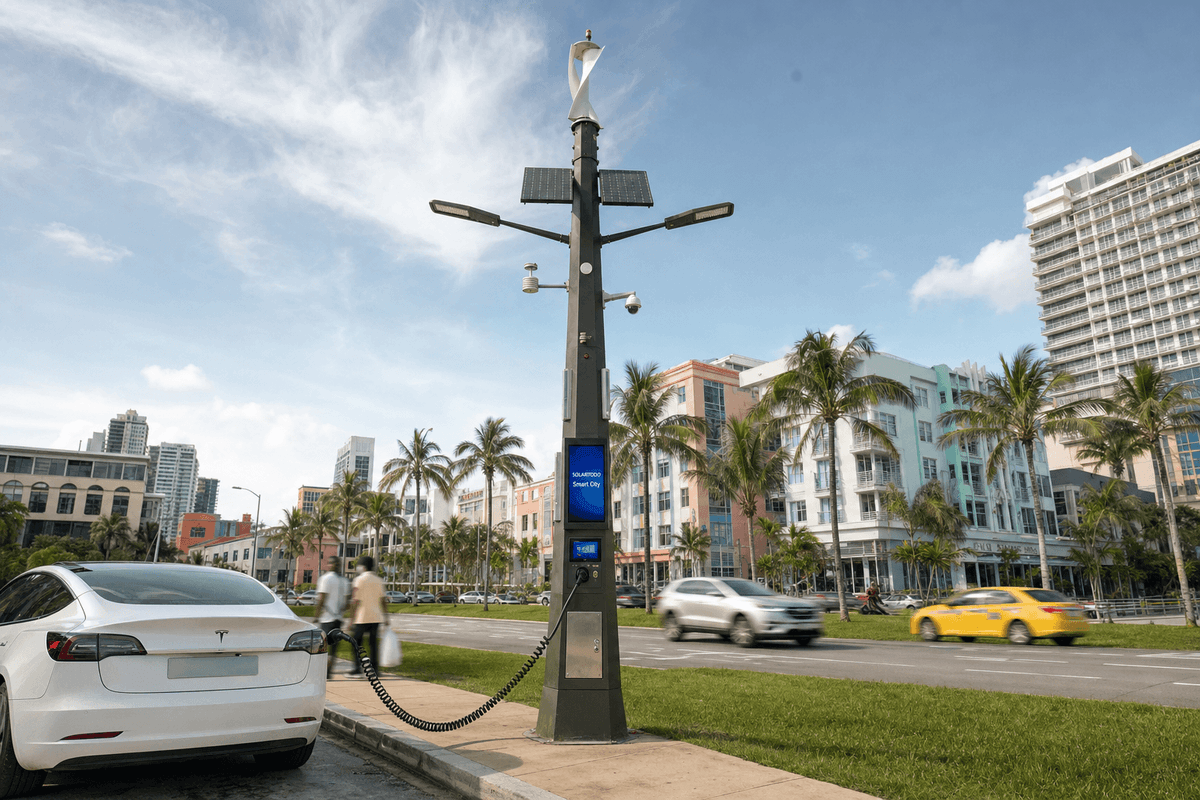
A typical 52-unit deployment in this profile would consist of 13m octagonal tapered steel smart poles, painted military green RAL6014 to suit civic streetscapes and reduce visual contrast. The 13m class is appropriate for urban street corridors, major junction approaches and BRT-adjacent roads; it is not a highway mast and not a 6-8m garden-lighting product. SOLARTODO should position this as a Smart Streetlight corridor system for lighting, public address, surveillance, air-quality sensing, EV top-up and small-cell densification.
The specified configuration is hybrid because Kampala has rain-heavy seasons, drainage blackspots and utility relocation constraints during road works. According to KCCA (2026), Kampala’s drainage network spans 362.3km across eight catchments, and recurring flash floods still affect vulnerable areas where drainage corridors are blocked, encroached or undersized. A base-mounted 5kWh LFP battery with MPPT, 2x100W monocrystalline panels and a 500W Darrieus H-type VAWT gives the lighting and control layer more resilience than grid-only poles during feeder interruptions or construction outages.
The lower 2.2m of each pole should be treated as the integrated EV charging cabinet, welded as one continuous steel structure rather than installed as a separate charger pillar. This matters in Kampala because dense old-town streets, markets, utility ducts and narrow pedestrian edges leave limited sidewalk space for side cabinets. A unified body also reduces vandalism exposure and improves procurement clarity: the civil contractor foundations, electrical installer, telecom integrator and EV commissioning team work around one asset envelope.
Technical Specifications
The Kampala configuration uses 52 hybrid 13m octagonal poles, each combining 160W LED output, 200W solar, 500W wind and 11kW AC charging.
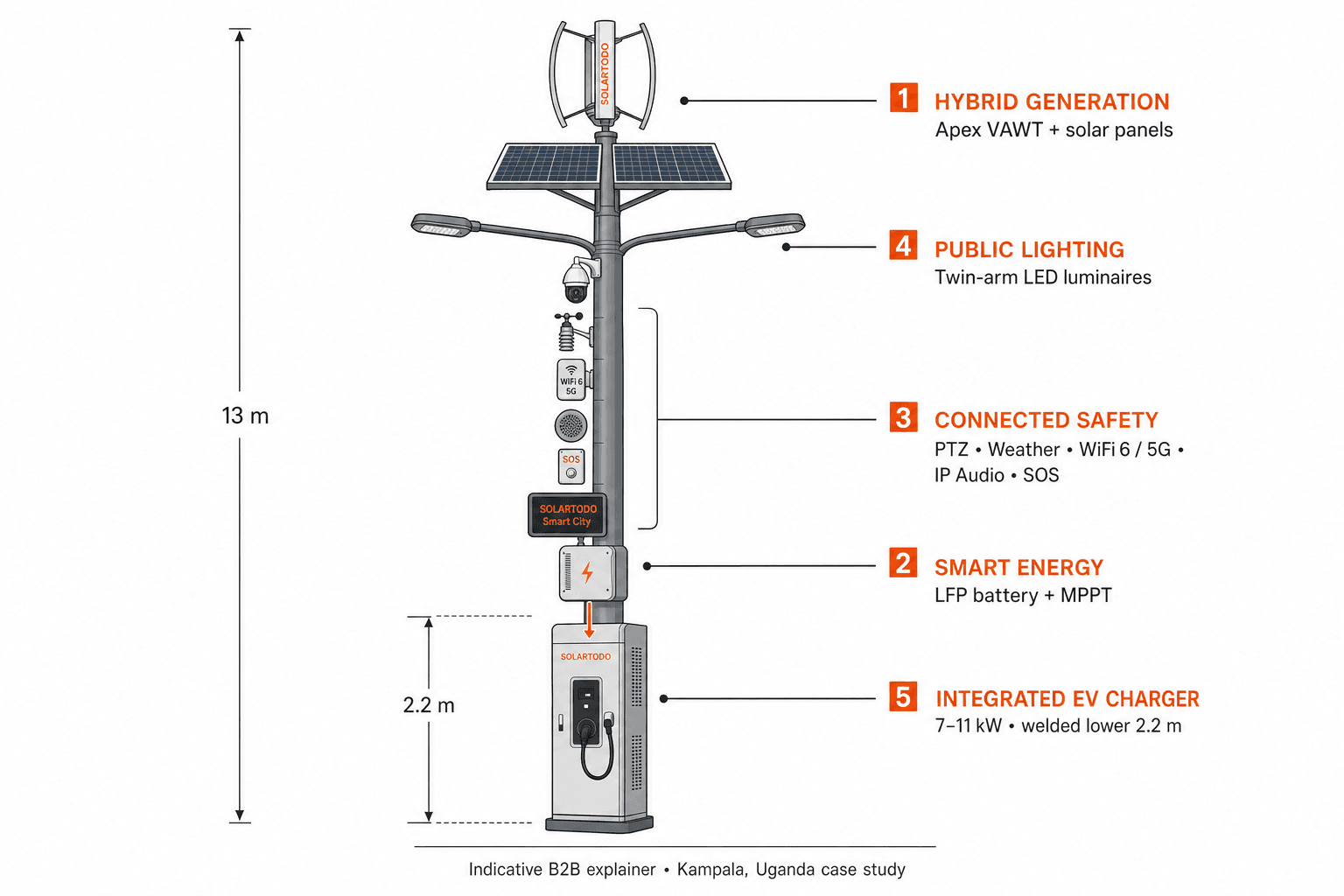
- Pole form: 13m octagonal tapered steel smart pole, base Ø45cm to top Ø15cm, RAL6014 military green powder coat.
- Power architecture: wind-solar hybrid self-powered system with backup grid tie and LoRaWAN/4G smart controller.
- Wind generation: Darrieus H-type VAWT, 3 straight vertical blades, Ø80x110cm, 500W, with red aviation LED.
- Solar generation: 2x100W deep-black monocrystalline panels on symmetric east-west A-frame brackets at 15° tilt.
- Battery and control: 5kWh LFP battery inside pole base with MPPT controller and maintenance access.
- Lighting: twin symmetric 1.5m arms with +8° upward tilt and 2x80W LED luminaires, 4000K, 150lm/W.
- Camera: 8MP fisheye 180° panoramic camera flush-mounted on pole body.
- Environmental sensing: 8-parameter top sensor for temperature, humidity, wind, pressure, noise, PM2.5, PM10 and illuminance.
- Public address: 2x symmetric IP audio columns, Ø10x50cm, 30W/93dB, TCP/IP networked, color-matched and flush against opposite flat pole faces.
- Emergency interface: one-press SOS button, two-way audio intercom and visual LED indicator.
- EV charging: integrated 11kW single-gun AC charger, Type 2, IEC 62196-2 interface, OCPP 1.6J, 5m coiled cable, touchscreen, E-stop and maintenance door.
- Display: P4 vertical LED screen, 960x1920mm portrait, >5500cd/m², content restricted to “SOLARTODO Smart City” in white sans-serif on deep blue.
- Telecom: 5G NR n78 small cell, 4T4R MIMO, approximately 200m coverage, flush-mounted at 8.7m with color-matched housing.
- User extras: Qi wireless phone charging pad and USB-A charging point.
- Spacing: 35m typical spacing, equal to about 28.6 poles per km.
- Standards: IEC 60598 for luminaires, GB/T 37024 for smart lighting application context, and IEC 62196-2 for Type 2 EV charging interfaces.
According to IEC (2024), IEC 60598 addresses general requirements and tests for luminaires, which is the relevant baseline for LED head safety. IEC states, “Part 1 specifies general requirements for luminaires,” a useful procurement anchor when comparing imported lighting systems. UNBS also matters locally: According to UNBS (2026), more than 70% of Uganda Standards are based on International Standards, supporting IEC-aligned technical submissions for municipal review.
Implementation Approach
A Kampala rollout should be sequenced in 6 phases over roughly 16-24 weeks, from corridor survey to commissioning and acceptance testing.
Phase 1 should map corridor geometry, road class, existing distribution feeders, drainage crossings, ducts, pedestrian flows and available foundation zones. The survey should mark areas such as old commercial streets, market frontages and flood-prone low points where a separate EV cabinet or side-mounted telecom enclosure would obstruct movement. For SOLARTODO Smart Streetlight design, the integrated pole-as-charger cabinet is especially useful where sidewalk width is constrained.
Phase 2 should convert the survey into a pole-by-pole schedule. At 35m spacing, 52 units represent approximately 1.82km of corridor, but the real count can shift at junctions, bus stops, drainage culverts and security hotspots. Each pole schedule should specify whether the EV charger is energized immediately or provisioned for later activation, because metering, tariff class and grid connection paperwork may move at different speeds.
Phase 3 covers factory configuration, CKD packaging and logistics into Uganda. Kampala is inland, so deliveries normally depend on regional import logistics, customs clearance and road freight into the capital rather than direct seaport unloading. Packaging should protect powder coat edges, LED display faces, touchscreen assemblies, coiled EV cables and flush-mounted small-cell housings from vibration and dust during overland transport.
Phase 4 covers civil works, foundation installation and utility coordination. According to KCCA (2025), recent road projects have faced utility-line relocation and right-of-way delays, so foundation construction should be synchronized with road rehabilitation rather than installed as a late add-on. For flood-prone locations, cable entries, door seals and foundation plinth height should be reviewed against drainage levels before poles are erected.
Phase 5 covers erection, electrical termination and ICT integration. Installers should verify 240V/415V availability, earthing resistance, RCD/MCB protection, OCPP connectivity, LoRaWAN/4G controller status, LED dimming profiles and camera privacy masking. The 5G n78 small cell at 8.7m requires telecom approval, spectrum/operator coordination and a backhaul plan before activation.
Phase 6 is commissioning and handover. Acceptance should include night lux checks, emergency intercom tests, public-address audio level checks, display brightness control, battery charge/discharge verification, EV charging handshake, OCPP transaction logs and controller alarms. Documentation should include IEC 60598 conformity evidence, IEC 62196-2 connector documentation, as-built coordinates and maintenance procedures.
Expected Performance & ROI
Expected benefits should be modeled from energy savings, avoided trenching, fewer separate assets and 200m-class small-cell coverage, not invented deployment results.
The lighting load is 160W per pole at full output, or 8.32kW across 52 poles before dimming schedules. With 150lm/W LEDs, each pole provides high-efficacy lighting suitable for urban corridors while reducing load compared with older low-efficiency luminaires. Adaptive dimming, motion schedules and hybrid energy input can reduce grid dependence, but the model should use measured nighttime profiles, local tariffs and battery cycling assumptions before quoting payback.
The strongest ROI case in Kampala is multi-function consolidation. One 13m asset can replace or pre-wire for a lighting pole, CCTV mounting point, public address post, SOS station, air-quality sensor mast, advertising display support, EV charger cabinet and small-cell attachment. According to the World Bank (2023), 25 million people in Eastern and Southern Africa gained new or improved electricity access from FY2018 to FY2023, including 8.8 million people in Uganda through ERT by March 2023. That wider access trend supports demand for grid-interactive public assets, but Kampala projects still need local tariff and service-revenue modeling.
Maintenance ROI should account for Kampala’s rainfall, dust from road works, traffic congestion and vandalism risk. Sealed flush modules reduce snag points, while the lower maintenance door gives technicians access to the battery, charger and controller without lifting equipment for every service event. The recommended warranty discussion should separate pole galvanizing/coating life, LED driver warranty, battery cycle warranty, EV charger warranty and telecom device warranty.
Results and Impact
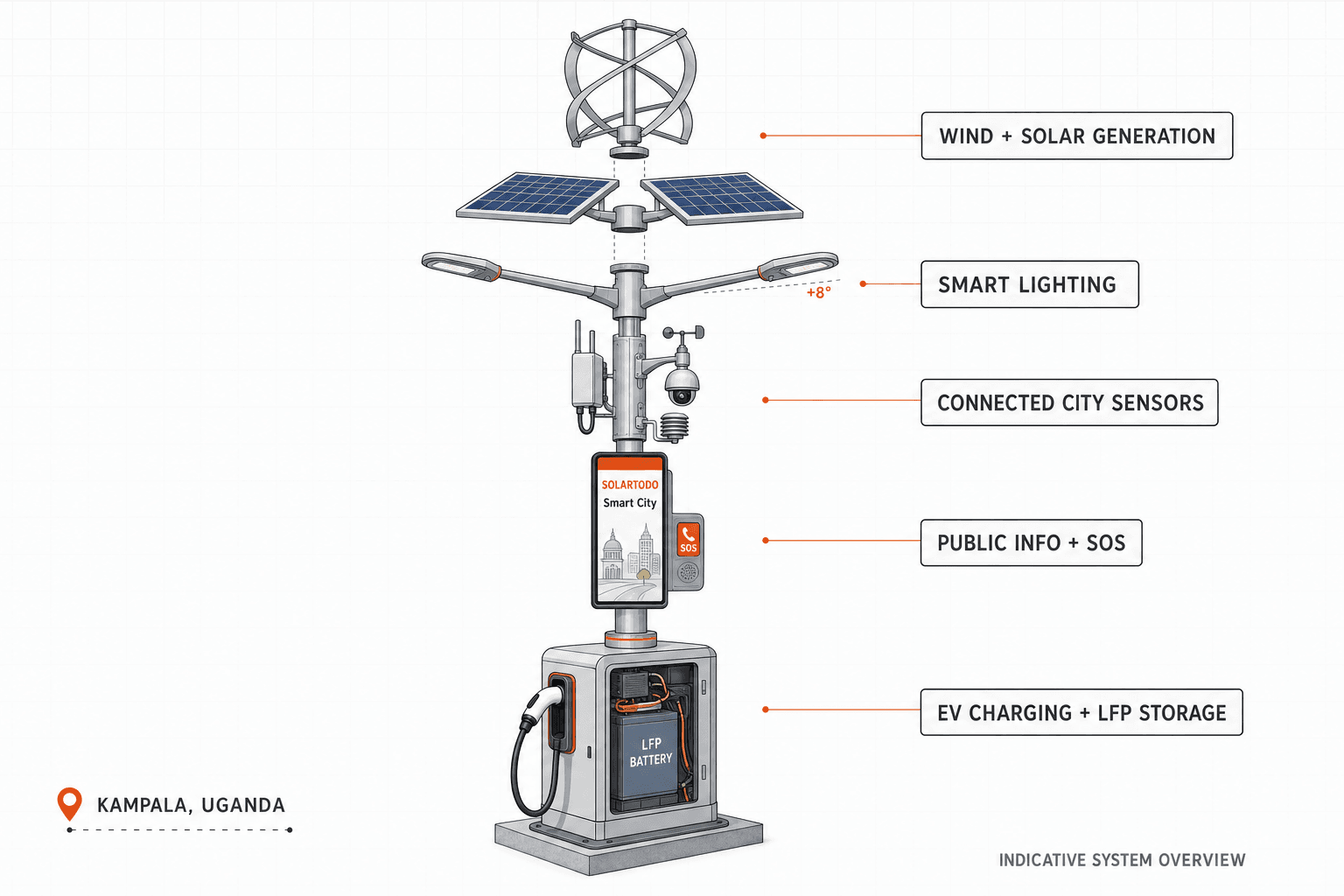
A properly specified 52-unit Kampala corridor could deliver about 1.82km of smart lighting, 52 SOS points and 10km-class overlapping 5G coverage zones.
This guide does not claim that SOLARTODO has deployed these units in Kampala. The impact is a planning estimate for municipal buyers, EPC contractors, telecom partners and mobility operators comparing a hybrid smart pole against conventional streetlight replacement. With 52 poles, the corridor would include 104 LED heads, 52 panoramic cameras, 104 IP audio columns, 52 EV charge points and 52 environmental sensor stations.
The public-service impact is strongest where road upgrades, drainage works and pedestrian safety overlap. KCCA states, “Growth brings waste, flooding, congestion and demand for services and dignity,” which fits a pole strategy that combines lighting, alerts, sensing and resilient power. For SOLARTODO, the technical value is not simply solar lighting; it is a standards-oriented civic infrastructure node sized for Kampala’s roads, climate and procurement reality.
Comparison Table
The 13m hybrid configuration gives Kampala more resilience than grid-only poles while avoiding the sidewalk clutter of separate EV and telecom cabinets.
| Option | Best fit in Kampala | Height / spacing | Power design | Integrated services | Key limitation |
|---|---|---|---|---|---|
| Conventional LED pole | Basic road lighting | 8-12m / 25-50m | Grid only, 240V/415V | LED only | No SOS, EV, sensing or telecom revenue path |
| Separate smart pole + EV pedestal | Wide boulevards or car parks | 10-12m / 30-50m | Grid only or hybrid | Lighting plus external charger | More sidewalk space and more civil interfaces |
| SOLARTODO hybrid Smart Streetlight | Kampala arterials, markets and BRT-linked roads | 13m / 35m | 500W VAWT + 200W solar + 5kWh LFP + grid backup | LED, 8MP camera, SOS, PA, EV, display, sensors, 5G n78 | Requires coordinated municipal, utility and telecom approvals |
| Cylindrical CIGS smart pole | Premium plazas and design-led districts | Ø180-400mm / 25-50m | Wrapped CIGS with grid support | Flush modules, premium appearance | Less aligned with this specified 13m hybrid configuration |
Pricing & Quotation
SOLARTODO offers three pricing tiers for this product line: FOB Supply (equipment ex-works China), CIF Delivered (including ocean freight and insurance), and EPC Turnkey (fully installed, commissioned, with 1-year warranty). Volume discounts are available for large-scale deployments. Configure your system online for an instant estimate, or request a custom quotation from our engineering team at [email protected].
For Kampala procurement, quotation inputs should include pole count, spacing, foundation class, trenching scope, grid connection distance, telecom activation scope and EV metering requirements. Product details should be aligned with the SOLARTODO Smart Streetlight configuration, while project documents and commercial queries can be routed through contact us.
Frequently Asked Questions
These 10 Kampala Smart Streetlight FAQs cover 52-unit sizing, 13m pole hardware, timeline, ROI, pricing tiers, installation and maintenance.
Q1: Why is a hybrid 13m Smart Streetlight recommended for Kampala? Kampala combines dense commercial corridors, rainfall-heavy drainage constraints and utility relocation challenges, so a hybrid 13m pole gives more resilience than a grid-only streetlight. The specified unit includes 2x80W LED, 500W wind, 200W solar, 5kWh LFP battery and grid backup, making it suitable for urban roads rather than parks or highways.
Q2: How many poles would a typical Kampala corridor require? At the specified 35m spacing, a 52-unit configuration covers approximately 1.82km before adjustments for junctions, bus stops, drainage crossings and driveway conflicts. For planning, buyers should budget around 28.6 poles per kilometer, then add or subtract units after lux simulation, topographic survey and utility mapping.
Q3: What electrical standards and voltage classes matter in Uganda? Uganda commonly uses 240V single-phase and 415V three-phase low-voltage service, with 11kV and 33kV classes for larger distribution customers. The proposed EV charger should be checked against local utility connection rules, while luminaires and charging interfaces should reference IEC 60598 and IEC 62196-2 in procurement documents.
Q4: How long would procurement and installation typically take? A 52-unit Kampala corridor would typically need about 16-24 weeks from survey to commissioning, assuming drawings, permits, import logistics and utility coordination move normally. The critical path is often not pole erection; it is foundation approvals, right-of-way, feeder availability, telecom approvals and synchronized road or drainage construction.
Q5: What ROI should a municipality or EPC expect? ROI should be modeled from LED energy savings, reduced separate asset purchases, lower trenching duplication, ad-screen potential, EV service use and telecom lease potential. SOLARTODO should not quote a universal payback for Kampala without tariff data, dimming schedules, service revenues and maintenance assumptions, but multi-function consolidation improves lifecycle economics.
Q6: Is the EV charger a separate roadside pedestal? No. In this configuration, the lower 2.2m of the pole is the EV charging cabinet, welded as one continuous steel structure. It includes an 11kW single-gun AC Type 2 charger, OCPP 1.6J, touchscreen, E-stop, 5m coiled cable and maintenance door, reducing sidewalk clutter.
Q7: How should maintenance be planned in Kampala’s climate? Maintenance should include quarterly visual inspections after heavy rain seasons, display cleaning, cable and door-seal checks, battery diagnostics, camera lens cleaning and controller alarm review. Kampala is inland, so salt corrosion is not the main issue; rainfall, dust from road works, flood exposure and vandalism protection are more important.
Q8: How does this compare with a conventional LED streetlight? A conventional LED pole mainly provides illumination, while the recommended SOLARTODO Smart Streetlight combines lighting, 8MP camera, SOS intercom, public address, EV charging, LED display, environmental sensing and 5G n78 small-cell readiness. The higher system complexity requires better commissioning, but it reduces the number of separate roadside assets.
Q9: What warranty structure should buyers request? Buyers should request a 1-year EPC turnkey warranty as stated in the pricing model, plus component-level terms for LED drivers, LFP battery, EV charger, controller, display and coating. Warranty documents should define response times, spare-parts stock, water ingress exclusions, vandalism handling and battery capacity retention conditions.
Q10: Does SOLARTODO provide EPC pricing for Kampala? SOLARTODO provides FOB Supply, CIF Delivered and EPC Turnkey quotation paths, but this article intentionally avoids publishing prices. EPC pricing needs corridor drawings, soil/foundation assumptions, grid connection distance, installation labor scope, import duties, telecom scope and commissioning requirements before a defensible number can be issued.
References
These 7 references ground the Kampala Smart Streetlight guide in climate data, public-road plans, electricity classes and international equipment standards.
- World Meteorological Organization (2026): Kampala climatology lists monthly maximum temperatures of about 26.9-29.3°C and rainfall peaking at 169.3mm in April.
- Uganda Bureau of Statistics (2024): National Population and Housing Census reports 45,905,417 people and 10,698,913 households in Uganda.
- Kampala Capital City Authority (2025): FY2025/26-FY2029/30 strategic plan targets UGX 11.9 trillion investment, 325km of road upgrades and 80km of drainage channels.
- Kampala Capital City Authority (2026): Flood-management update reports a 362.3km drainage network across eight major catchments in Kampala.
- Uganda Electricity Distribution Company Limited (2026): Retail tariff categories reference 240V single-phase, 415V three-phase, and 11kV/33kV high-voltage supply classes.
- World Bank (2023): Eastern and Southern Africa energy-access results cite 25 million people gaining new or improved access, including 8.8 million in Uganda through ERT by March 2023.
- IEC (2024): IEC 60598 covers general luminaire requirements and tests; IEC 62196-2 covers AC vehicle couplers including Type 2 interfaces.
Equipment Deployed
- 52 units x 13m octagonal tapered steel smart pole, base Ø45cm to top Ø15cm, RAL6014 military green powder coat
- 500W Darrieus H-type VAWT, 3 straight vertical blades, Ø80x110cm, red aviation LED
- 2x100W monocrystalline deep-black solar panels on symmetric east-west A-frame brackets at 15° tilt
- 5kWh LFP battery inside pole base with MPPT controller and backup grid tie
- Twin 1.5m symmetric arms with +8° upward tilt and 2x80W LED, 4000K, 150lm/W
- 8MP fisheye 180° panoramic camera flush-mounted on pole body
- 8-parameter environmental sensor for temperature, humidity, wind, pressure, noise, PM2.5, PM10 and illuminance
- 2x Ø10x50cm IP audio columns, 30W/93dB, TCP/IP networked and color-matched
- One-press SOS button with two-way audio intercom and visual LED indicator
- Integrated 11kW single-gun AC Type 2 charger, OCPP 1.6J, 5m coiled cable, touchscreen and E-stop
- P4 portrait LED display, 960x1920mm, >5500cd/m², showing only “SOLARTODO Smart City”
- 5G NR n78 4T4R MIMO small cell at 8.7m with about 200m coverage, flush color-matched housing
- Qi wireless phone charging pad and USB-A charging point