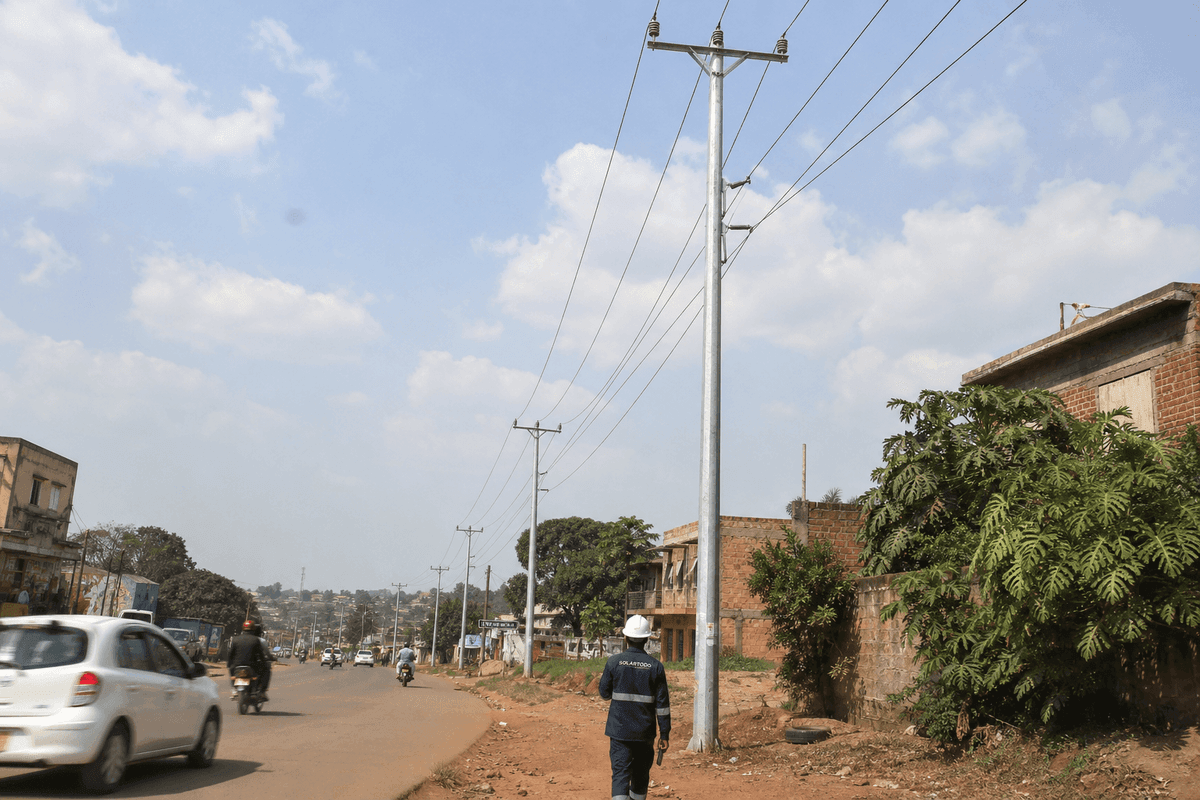
Kampala Low-Voltage Feeder Densification: Power Transmission Tower Configuration for 0.4kV Community Distribution
Summary
Kampala’s 1.875 million city population, 46-inch annual rainfall, and Uganda’s 0.4kV LV service class make approximately 369 galvanized 12m steel poles a practical configuration for an 11km community distribution feeder.
Key Takeaways
For Kampala’s 0.4kV community distribution profile, the recommended SOLARTODO Power Transmission Tower package uses 369 poles, 12m height, and 30m spans.
- A typical 369-unit deployment would cover approximately 11km using 12m tapered Q345 hot-dip galvanized steel tubular poles.
- The configuration is 0.4kV low-voltage, single circuit, with 0.4m phase spacing and 4.5m minimum ground clearance.
- Each pole weighs approximately 2t, based on a 200kg/m structural class suitable for community distribution rather than 35kV or 132kV corridors.
- ACSR 50 conductor is recommended, with 200kg/km conductor mass and maximum tension of 16kN.
- Kampala’s climate requires corrosion-aware detailing because average annual precipitation is about 46.11 inches, with April averaging 6.15 inches.
- Uganda’s transmission network reached 5,383km by end-2025, according to ERA, while LV infill remains a separate last-mile design problem.
- SOLARTODO should frame this as a low-voltage rural/community distribution package, not a 35kV, 132kV, or 220kV transmission tower project.
Market Context for Kampala
Kampala’s distribution challenge is not only city growth; it is the need to connect dense, wet, hilly neighborhoods using compact 0.4kV assets.
Kampala is an inland, highland capital near Lake Victoria at roughly 0.35 latitude and 32.58 longitude. According to UNdata using Uganda Bureau of Statistics provisional 2024 census data, Kampala city proper had 1,875,834 residents in 2024. KCCA also describes Kampala as a five-division capital with about 4 million daytime users and over 140,000 business establishments, which makes feeder reliability and street-level access important for clinics, markets, workshops, and informal retail.
The climate is relevant to steel-pole detailing. According to Timeanddate climate averages for Kampala based on 2012-2021 records, the city averages 73°F, 79% humidity, and 46.11 inches of annual precipitation, with April reaching 6.15 inches. Kampala is not a coastal salt-air city, but frequent rain, lateritic soils, road splash, and drainage stress increase the value of hot-dip galvanizing, sealed pole sections, proper grounding, and concrete foundation collars above standing-water level.
Uganda’s power-sector context also points to a last-mile distribution requirement. According to the International Energy Agency (2023), about 20% of Uganda’s population had access to electricity from the national grid in 2022, with another 10% supplied by solar home systems. IEA states, “universal access to electricity and 50% access to clean cooking by 2040.” For Kampala, that policy objective translates into denser LV feeders around peri-urban roads and community facilities, not oversized 220kV steel structures.
The local voltage and agency context matters. Uganda’s Electricity Regulatory Authority regulates generation, transmission, distribution, sale, export, and import of electricity, and it publishes installation-permit categories including works up to 415V, 33kV, and below 132kV. ERA also reports that Uganda’s transmission network reached 5,383km by end-2025, including 3,740km of 132kV lines and 1,002km of 220kV lines. A Kampala community feeder therefore should be specified at 0.4kV LV first, then sized down to a 12m pole class.
Recommended Technical Configuration
A Kampala 0.4kV feeder of approximately 11km should use 369 SOLARTODO 12m steel tubular poles rather than heavier 10-35kV structures.
A typical 369-unit deployment in this profile would consist of tapered steel tubular monopoles, not lattice towers, wood poles, FRP poles, or concrete poles. The selected voltage class is 0.4kV low-voltage distribution, so the configuration is intentionally smaller than the 10-35kV distribution range where 12-18m poles and 1-3t/pole are typical. The project-specific class remains compatible with a 12m structure because the span is only 30m and the conductor is ACSR 50, not ACSR 240 or ACSR 400.
The recommended SOLARTODO configuration is: 369 units x 12m tapered steel tubular pole, Q345 hot-dip galvanized steel, approximately 2t/pole, single circuit, 0.4m phase spacing, 4.5m ground clearance, and ACSR 50 conductor. The conductor mass is 200kg/km with maximum tension of 16kN. Insulator length is 0.1m, and accessories include climbing pegs, cross arm, grounding, and insulator pin.
This configuration fits Kampala’s terrain and logistics. Dense old-town streets around Nakasero, Old Kampala, and market access roads favor flanged bolt sections that can be delivered in manageable loads and assembled without the laydown area required for lattice towers. The city’s hills and drainage channels also favor discrete concrete base foundations with anchor cages, where foundation top levels can be set above nuisance flooding and road runoff.
Technical Specifications
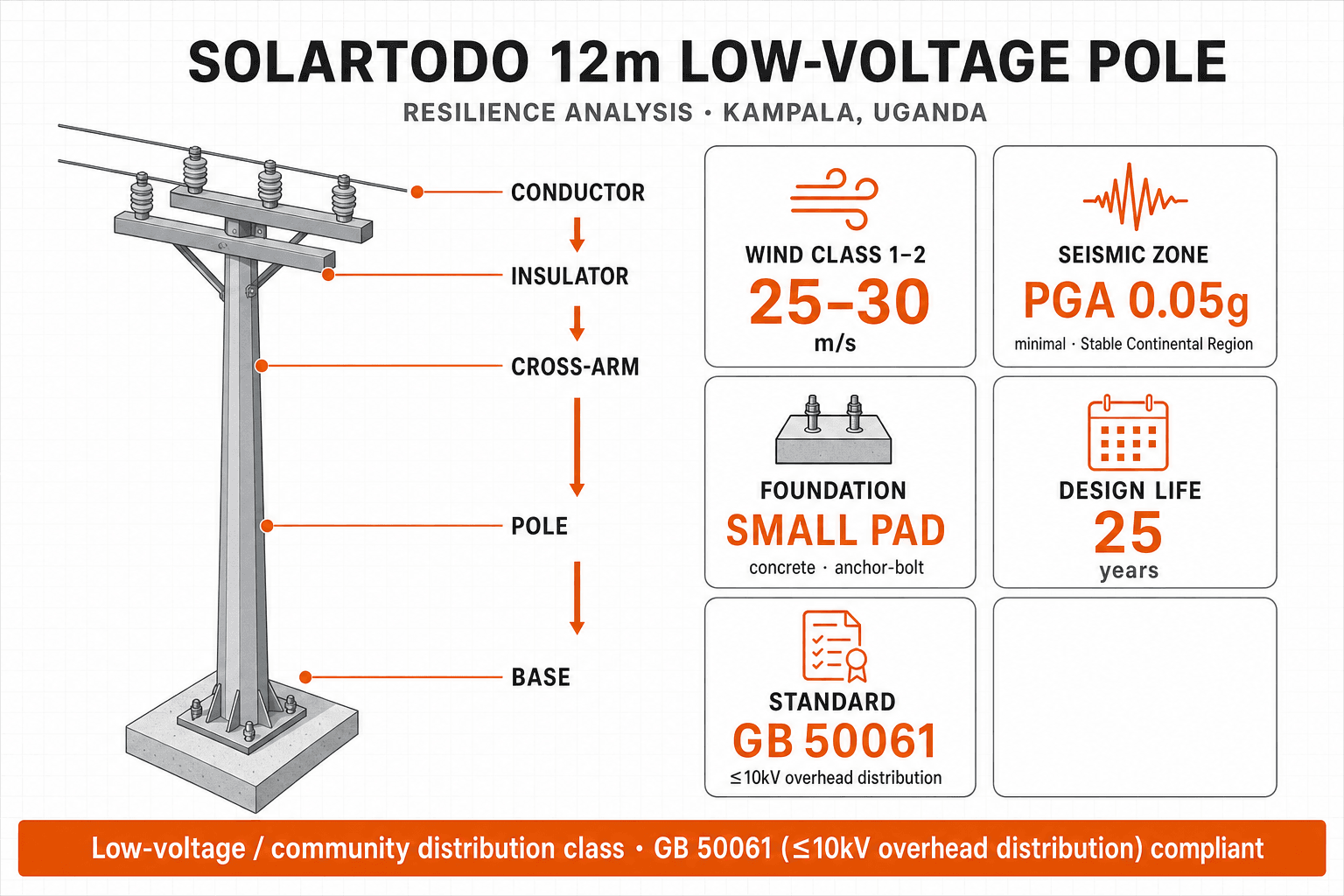
The SOLARTODO Kampala recommendation is a 0.4kV, 12m, 2t/pole LV steel tubular configuration with 30m spans and 25m/s wind design.
- Product: SOLARTODO Power Transmission Tower, configured as a steel tubular transmission pole for LV distribution.
- Form: tapered round or dodecagonal steel monopole; not lattice, FRP, wood, or concrete.
- Quantity: approximately 369 units for an 11km line profile.
- Voltage class: 0.4kV low-voltage distribution, single circuit.
- Pole height: 12m.
- Pole weight: approximately 2t/pole, based on 200kg/m.
- Steel grade and coating: hot-dip galvanized Q345 steel.
- Phase spacing: 0.4m.
- Minimum ground clearance: 4.5m.
- Conductor: ACSR 50, 200kg/km, maximum tension 16kN.
- Insulator: 0.1m length with insulator pin.
- Span: 30m; total line length approximately 11km.
- Wind class: Class 1, 25m/s.
- Foundation: concrete base foundation with anchor cage.
- Accessories: climbing pegs, cross arm, grounding system, insulator pins, and connection hardware.
- Design life: 25 years.
- Standards basis: GB 50061 for overhead distribution lines up to 10kV and IEC 60865 for short-circuit current mechanical effects.
For voltage discipline, the engineering sequence is voltage first, then height, weight, span, and foundation. A 35kV line should remain in the 12-18m and 1-3t/pole range, while a 220kV line moves to 35-55m and 15-35t/pole. This Kampala article does not recommend a 35kV 40m pole or a 220kV 15m pole because those combinations would be engineering mismatches.
Implementation Approach
A typical Kampala rollout can be planned in 5 phases: survey, procurement, CKD shipping, foundation works, and electrical commissioning.
The first phase is route verification. Engineers would confirm road reserve limits, service-drop locations, market access roads, drainage crossings, and existing utility clearances. Kampala’s five-division administrative structure means permits and traffic access windows should be coordinated early with municipal and utility stakeholders.
The second phase is technical submittal and procurement. SOLARTODO would prepare pole drawings, galvanizing requirements, anchor cage details, cross-arm arrangement, conductor schedule, and packing lists for CKD or sectional shipping. According to ERA (2026), Uganda’s electricity sector includes regulated installation permits; therefore local installation teams should be matched to the voltage and permit class before energization.
The third phase is foundation construction. For 12m LV steel poles, concrete bases should be set to resist overturning under 25m/s wind and conductor tension. In flood-prone low points or drainage-adjacent roads, foundation plinths should be raised and grounding conductors protected against mechanical damage.
The fourth phase is erection and stringing. Flanged sections reduce handling complexity compared with large lattice structures. After pole alignment, crews install cross arms, insulator pins, grounding, ACSR 50 conductor, and service-ready fittings while maintaining the 4.5m clearance requirement.
The final phase is commissioning. Tests should include visual inspection, bolt torque confirmation, grounding continuity, conductor sag check, phase spacing confirmation, and handover documentation. SOLARTODO can support engineering review through the Power Transmission Tower product page and project-specific drawings through contact us.
Expected Performance & ROI
For an 11km 0.4kV Kampala feeder, expected value comes from 25-year asset life, lower pole replacement frequency, and faster LV infill.
This market analysis does not claim a completed Kampala project or measured project savings. Instead, the ROI logic is lifecycle-based: galvanized Q345 steel, concrete base foundations, and bolt-section erection reduce recurring replacement risk compared with untreated timber in wet urban-edge environments. The 25-year design life supports municipal and utility procurement where capex must be justified across multiple budget cycles.
According to the World Bank (2023), Uganda’s Energy for Rural Transformation work directly benefited almost 8.8 million people by March 2023 through grid distribution extension, intensification, and energy services. World Bank states, “25 million people in AFE gained new or improved electricity access from FY18 to FY23.” Kampala’s share of this opportunity is less about long-distance transmission and more about repeatable LV feeder buildout for markets, schools, clinics, workshops, and road-edge settlements.
For payback, the realistic B2B metric is avoided rework rather than energy generation revenue. A 369-pole steel package can reduce replacement cycles, standardize spares, and simplify inspection because every pole uses the same 12m class, ACSR 50 tension basis, 0.1m insulator class, and grounding package. EPC teams should model ROI using avoided outage penalties, reduced emergency replacement, lower civil rework, and customer-connection revenue over 10-25 years.
Comparison Table
The 0.4kV Kampala recommendation uses 12m poles and 30m spans, while 35kV, 110kV, and 220kV corridors require different classes.
| Application class | Voltage | Typical height | Weight class | Span | Typical density | Kampala fit |
|---|---|---|---|---|---|---|
| Recommended LV community feeder | 0.4kV | 12m | ~2t/pole | 30m | ~33 poles/km | Best fit for 11km community distribution |
| Distribution corridor | 10-35kV | 12-18m | 1-3t/pole | 80-150m | 8-12 poles/km | Suitable for MV feeders, not this LV brief |
| Sub-transmission | 66-110kV | 18-30m | 5-15t/pole | 200-300m | 4-5 poles/km | Too large for 0.4kV community infill |
| HV transmission | 220kV | 35-55m | 15-35t/pole | 350-450m | 2-3 poles/km | Reserved for grid corridors |
| UHV transmission | 500kV | 50-70m | 35-55t/pole | 400-500m | 2 poles/km | Not relevant for Kampala LV distribution |
Pricing & Quotation
SOLARTODO structures quotations in 3 tiers, so Kampala buyers can compare FOB supply, CIF delivery, and EPC turnkey scope without unit-price assumptions.
SOLARTODO offers three pricing tiers for this product line: FOB Supply (equipment ex-works China), CIF Delivered (including ocean freight and insurance), and EPC Turnkey (fully installed, commissioned, with 1-year warranty). Volume discounts are available for large-scale deployments. Configure your system online for an instant estimate, or request a custom quotation from our engineering team at [email protected].
Frequently Asked Questions
These 10 Kampala-focused answers cover 0.4kV technical scope, installation, maintenance, quotation models, warranty, and lifecycle economics.
Q1: Is this Kampala configuration a transmission tower or a distribution pole? It is a SOLARTODO Power Transmission Tower product line configured as a 0.4kV low-voltage steel tubular distribution pole. The structure is a 12m tapered steel monopole, not a lattice transmission tower. That distinction matters because the 30m span, ACSR 50 conductor, and 2t/pole weight are LV community distribution parameters.
Q2: Why is 12m the correct pole height for this 0.4kV Kampala feeder? The specified feeder uses 0.4kV service voltage, 4.5m ground clearance, 0.4m phase spacing, and 30m spans, so a 12m pole is proportionate. Taller 18-30m or 35-55m structures belong to 66-110kV and 220kV corridors, where conductor loads, clearances, and right-of-way geometry are substantially different.
Q3: What conductor is recommended for the Kampala technical profile? The project-specific conductor is ACSR 50 with 200kg/km mass and maximum tension of 16kN. It is lighter than ACSR-120, ACSR-240, or ACSR-400 options used for larger power corridors. This matches a short-span 0.4kV community feeder where compact routing and manageable erection loads matter.
Q4: How long would a typical 369-pole deployment take? A realistic schedule depends on permits, wayleave access, foundation curing, customs, and crew availability. For planning, EPC teams should separate the work into survey, drawings, procurement, shipping, civil works, erection, stringing, and commissioning. The 30m span and 12m pole class support parallel foundation and pole-erection crews.
Q5: What maintenance is required in Kampala’s wet inland climate? Maintenance should focus on galvanizing condition, bolt tightness, foundation cracking, grounding continuity, conductor sag, and insulator contamination. Kampala is inland, so salt-air corrosion is not the main issue. Rainfall, road splash, drainage overflow, vegetation growth, and mechanical impact from dense streets are more relevant inspection drivers.
Q6: How does steel compare with wood or concrete for this application? Hot-dip galvanized Q345 steel offers consistent fabrication, flanged modular sections, predictable grounding, and a 25-year design-life target. Wood may be easier to source locally but can vary in durability and straightness. Concrete is robust but heavier to transport and erect in narrow Kampala access roads.
Q7: Does SOLARTODO publish fixed EPC pricing for Kampala? No fixed price should be assumed from this guide. EPC pricing depends on Incoterms, foundation quantities, geotechnical conditions, customs, conductor length, installation access, and local labor scope. SOLARTODO can quote FOB Supply, CIF Delivered, or EPC Turnkey after route length, pole schedule, and delivery terms are confirmed.
Q8: What warranty model is appropriate for this product line? The pricing model includes an EPC Turnkey option with a 1-year warranty, while the structural design life target is 25 years. Warranty scope should clearly separate manufacturing defects, galvanizing defects, installation workmanship, third-party damage, overload events, and force majeure conditions. Buyers should request inspection checkpoints before energization.
Q9: What standards should engineers reference for design review? The project-specific standards are GB 50061 for overhead distribution lines up to 10kV and IEC 60865 for mechanical effects of short-circuit currents. Uganda-side compliance should also account for ERA permit requirements, utility interconnection procedures, local grounding practice, and any municipal road-reserve conditions imposed by KCCA.
Q10: Can this same pole be used for 35kV or 132kV lines? Not without redesign. A 35kV distribution corridor normally uses 12-18m poles, 1-3t/pole, and 80-150m spans, while 132kV work falls closer to the 66-110kV sub-transmission family or utility-specific standards. This Kampala package is locked to 0.4kV, 12m, 30m-span LV distribution.
References
The guide uses 7 public and technical references, including Uganda agencies, World Bank, IEA, IEC, and GB distribution-line standards.
- UNdata / Uganda Bureau of Statistics (2024): Kampala city proper provisional census population reported as 1,875,834 residents.
- Kampala Capital City Authority (2020): Kampala Strategic Plan launch remarks identify five divisions, about 4 million daytime users, and over 140,000 business establishments.
- Electricity Regulatory Authority Uganda (2026): Transmission network length reached 5,383km by end-2025, including 3,740km of 132kV and 1,002km of 220kV lines.
- Electricity Regulatory Authority Uganda (2025): Installation-permit context includes work categories up to 415V, 33kV, and below 132kV.
- International Energy Agency (2023): Uganda energy review reports about 20% national-grid access in 2022 and the 2040 universal electricity-access target.
- World Bank (2023): Eastern and Southern Africa energy-access results report 8.8 million Ugandans benefited by March 2023 through ERT activities.
- IEC / GB Standards (2011, current use): IEC 60865 covers short-circuit current mechanical effects; GB 50061 covers overhead distribution line design up to 10kV.
Equipment Deployed
- 369 units x 12m tapered steel tubular pole, hot-dip galvanized Q345 steel
- 0.4kV low-voltage distribution single-circuit configuration
- Pole weight approximately 2t/pole, 200kg/m structural class
- ACSR 50 conductor, 200kg/km, maximum tension 16kN
- 0.4m phase spacing and 4.5m minimum ground clearance
- 0.1m insulator length with insulator pin
- 30m span, total line approximately 11km
- Wind class 1, 25m/s design basis
- Concrete base foundation with anchor cage
- Accessories: climbing pegs, cross arm, grounding, insulator pin
- 25-year design life
- Standards basis: GB 50061 and IEC 60865