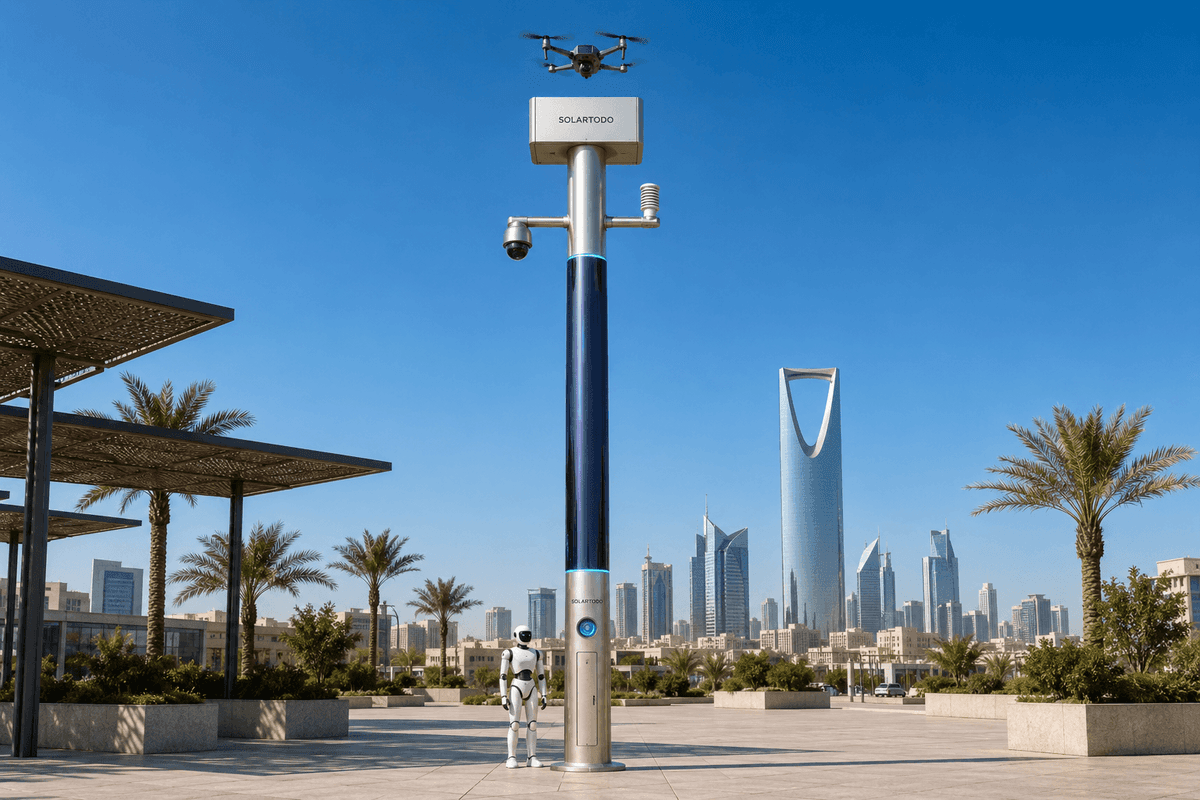
A City AI Pole, in this case SOLARTODO Sentinel Sky Hub, is a fully off-grid physical-AI urban edge node: a non-lighting smart pole with battery storage, wrapped flexible solar replenishment, edge compute, sensing, drone operations, robot support, and human-authorized response workflows. In Jakarta, it supports police night patrol continuity when communications and site power are unreliable.
1. Pilot Context
Jakarta’s police night-patrol problem is not simply visibility, manpower, or camera coverage. It is operational continuity during the hours when field teams need the most confidence and when infrastructure stress can be highest. During heatwave periods, air-conditioning load, local equipment failures, and overloaded telecom links can turn a routine patrol into a fragmented response picture. For districts that connect dense urban blocks with upland approaches toward the Greater Jakarta mountain corridors, police command teams may need to watch perimeter roads, logistics gates, campus boundaries, industrial lots, and river-adjacent access points without assuming that every camera backhaul, fiber route, or site utility feed remains healthy. This pilot-report configuration treats the city as a mountain-to-urban edge environment: steep weather gradients, fast-moving storms, hot nights, and complex movement between southern upland approaches and the metropolitan core. The proposed SOLARTODO Sentinel Sky Hub layout is therefore not positioned as a lighting upgrade. It is a pure smart pole with no lighting system. Its purpose is to hold a field node online, launch and recover autonomous drone sorties, support ground robot operations, process local sensing, and pass only de-identified event and status metadata into a police common-operating-picture view. The buyer lens is police availability: when network service is degraded or site power is unavailable, can the patrol function still detect, assess, dispatch, record, and recover?
2. Grid-Mesh Deployment
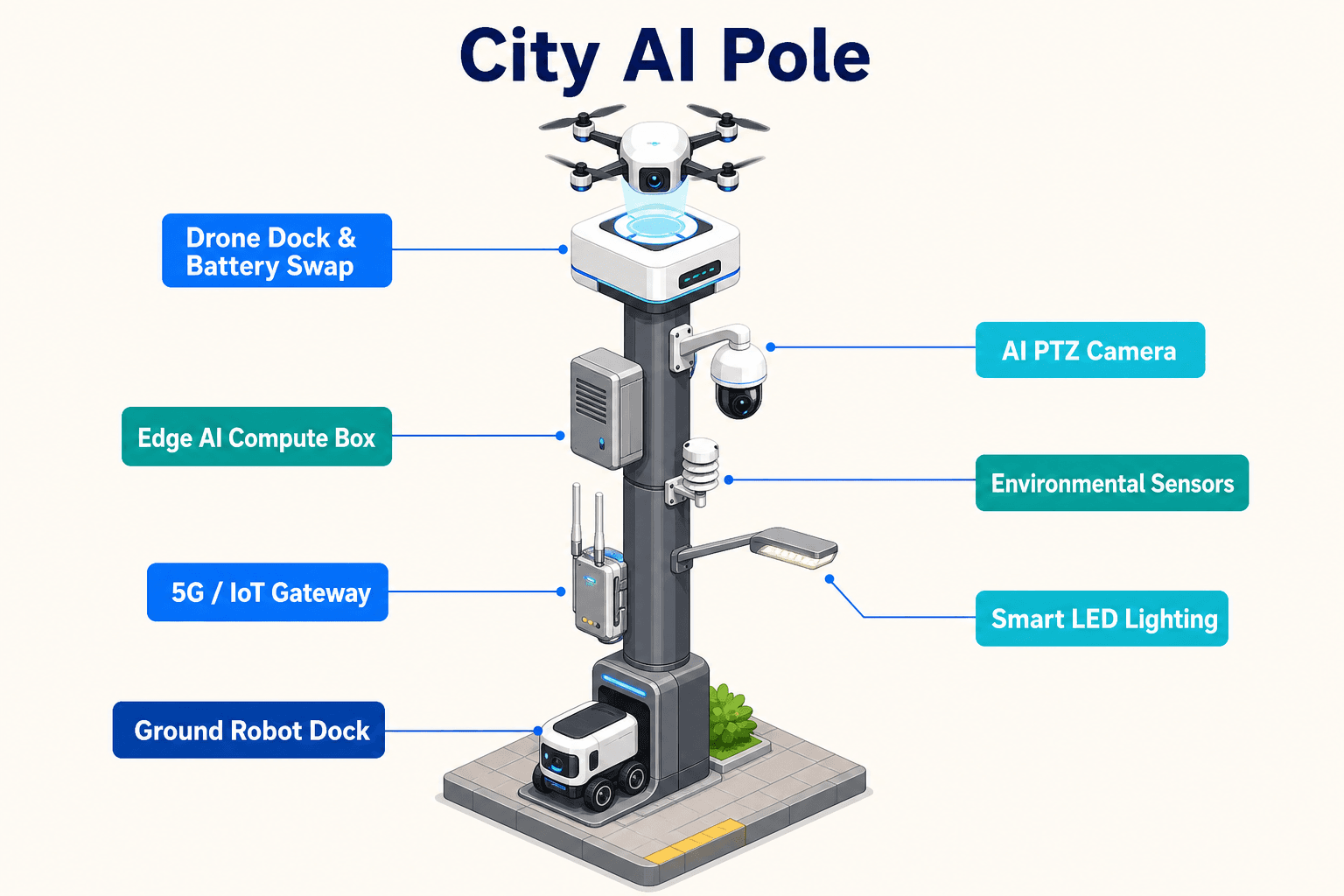
The proposed deployment mode is a grid-mesh of Sentinel Sky Hub nodes placed at selected patrol points rather than a single centralized asset. Candidate locations include smart-district perimeters, police-supervised campus routes, industrial-park entrances, port-adjacent service roads, and critical-infrastructure buffer zones where night patrol coverage must continue even if one link, one route, or one site fails. Each pole is a robot-ready and drone-ready physical-AI edge node running OTATODO at the edge. It hosts local perception, power management, mission queueing, and field operations workflows directly on the pole. Because the system is fully off-grid, every pole is configured as a battery-backed micro-station with 360-degree wrapped flexible CIGS thin-film solar replenishment. The wrapped surface is approximately 15 square meters over a vertical cylindrical body around 8 meters tall and 0.6 meters wide, giving about 2.4 to 2.7 kWp nameplate. The practical planning point is more conservative: a vertical cylinder does not collect direct sun across the whole wrap at once. In a high-irradiance benchmark region, clear-sky output is roughly 0.8 to 1.1 kW DC peak, with peaks often in the morning and afternoon rather than at noon, and about 6 to 9 kWh per day. Jakarta engineering must derate this further for humidity, haze, shading, rain, maintenance intervals, and siting. That is why the pilot frames solar as a replenishment layer, not unlimited self-sufficiency. Drone and robot workloads are buffered by 5 to 20 kWh-class storage and scheduled by duty cycle.
3. Night Drone Patrol
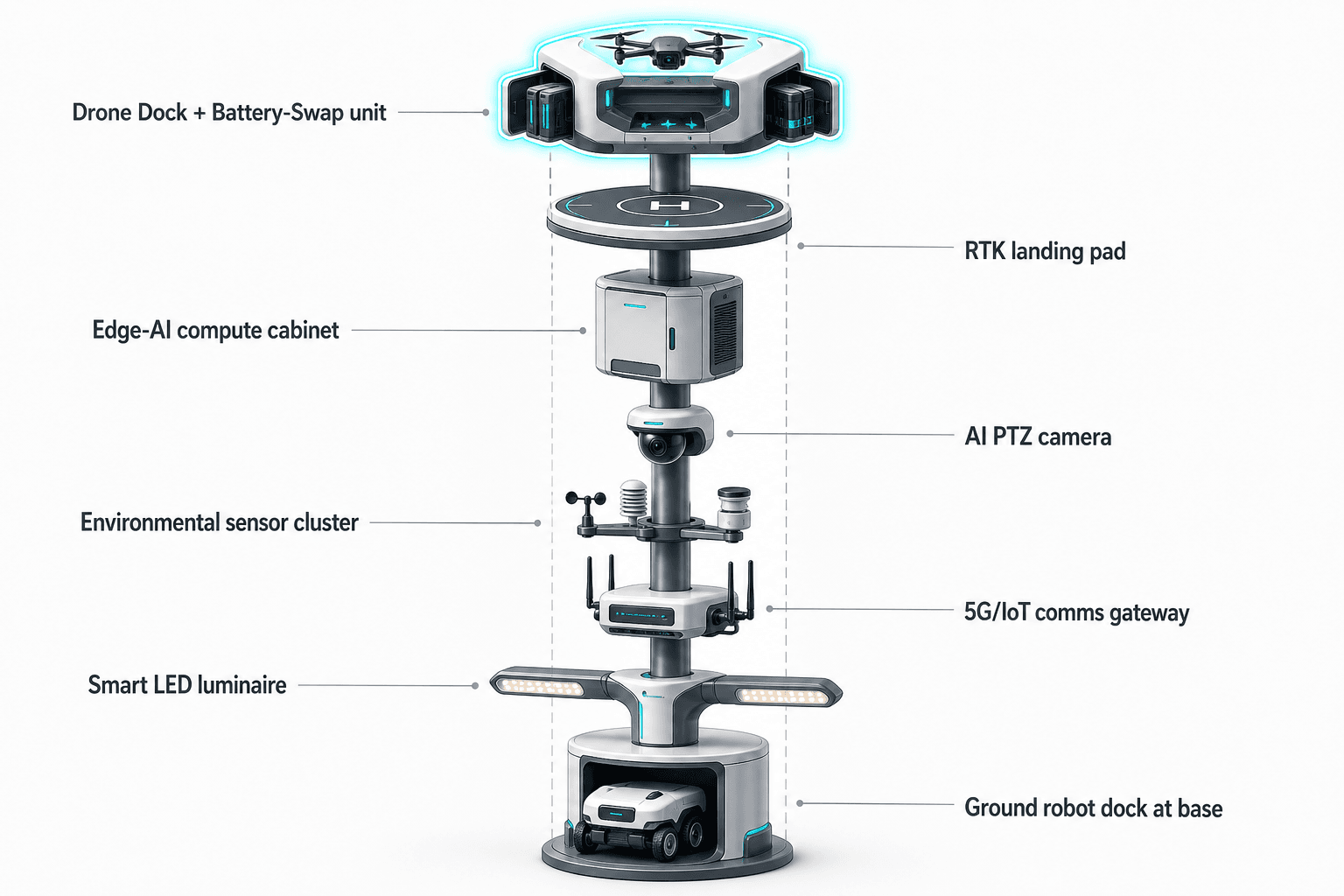
The core operational scenario is police night patrol under network-outage conditions. In normal operation, each node contributes to a shared command picture by sending metadata such as alert class, confidence band, node health, battery state, drone task state, and mission log summaries. Raw video and raw sensor streams stay on the pole and are processed locally. If a backhaul path degrades, the node continues local inference, keeps patrol tasks queued, and can synchronize metadata when a route returns. The drone module supports launch, regional patrol, inspection, return, and task redeployment without an operator standing at the pole. A multi-bay rear-service battery magazine performs automated hot-swap after landing, so a drone can receive a charged pack and relaunch. Multiple bays allow several consecutive sorties, subject to local aviation authorization, weather, duty-cycle policy, and energy budget. The management layer handles route planning, charge and swap state, task queueing, fleet health, and mission logs. A typical heatwave-night workflow begins with the on-pole PTZ camera detecting perimeter movement or unusual vehicle accumulation. The edge module classifies the event as anonymous vehicle count, crowd-density change, intrusion pattern, or perimeter-awareness alert. Police supervisors review the event in the COP, authorize a drone inspection if needed, and receive a de-identified incident trail. If local telecom service is intermittent, the field node still acts as the first line of continuity rather than becoming a dark endpoint.
4. Power-Led Availability
For this pilot report, the module focus is power because the KPI framing is availability. The relevant buyer question is not how much solar can be marketed on a clear day, but how long the police patrol loop can remain useful when heatwave stress, network degradation, and field access limits overlap. Sentinel Sky Hub is designed as a fully off-grid system with no dependency on city, grid, or site power. The wrapped CIGS layer replenishes the battery, while OTATODO schedules drone sorties, robot charging windows, compute workloads, and sensor sampling so that essential functions remain prioritized. In a police deployment, that means the pole can reserve energy for detection, local inference, command metadata, and authorized response before spending energy on discretionary patrol expansion. Environmental monitoring also matters during heatwaves. The nine-in-one sensor set records wind speed, wind direction, temperature, humidity, atmospheric pressure, noise, PM10, PM2.5, and illuminance. These inputs help determine whether a drone sortie should proceed, whether a ground robot is the better inspection asset, or whether the node should shift to observation-only mode until conditions improve. Ground robot operations are supported from the pole base through wireless charging and task coordination. A humanoid or service robot can perform autonomous patrol, alarm response, inspection, and air-ground coordination before returning to charge. The police COP should treat every action as energy-aware: detect locally, assess with human authorization, schedule compute and field assets, then record the event with minimal metadata leaving the pole.
5. Police Evaluation Plan
The proposed pilot should be evaluated as an availability program, not as a claimed citywide result. No specific deployment quantity, coverage area, response latency, or detection rate should be asserted until Jakarta site engineering, radio surveys, aviation permissions, civil works, and police operating procedures confirm them. A credible pilot can still define what will be measured. First, node uptime should be tracked during heatwave nights and planned network-interruption drills. Second, patrol continuity should be measured by the percentage of scheduled night routes that remain executable locally even when backhaul is degraded. Third, energy resilience should be tested through battery state, solar replenishment, hot-swap availability, and robot charging windows. Fourth, event discipline should be audited: raw video and sensor data remain on-pole, while only de-identified event and status metadata leaves the node. Fifth, counter-UAS coordination should be exercised under human authorization only. The pole may detect and track an unauthorized drone and command the friendly drone to perform soft aerial net-capture or close-approach deterrence where legally permitted. It does not shoot down, jam, destroy, or autonomously attack. Radar, if used, is an optional partner-sensor input, not built into the pole. The pilot’s success threshold should be set by police commanders around availability, procedural control, and evidence quality under outage conditions.
System Configuration
| Parameter | Configuration |
|---|---|
| Pole type | SOLARTODO Sentinel Sky Hub pure smart pole; no lighting system; robot-ready and drone-ready |
| Power system | Fully off-grid battery-backed micro-station with 360-degree wrapped flexible CIGS solar replenishment |
| Solar planning basis | ~15 m2 wrap, ~2.4-2.7 kWp nameplate; realistic clear-sky benchmark about 0.8-1.1 kW DC peak and 6-9 kWh/day in high-irradiance regions |
| Energy storage | 5-20 kWh-class storage, duty-cycle managed for sensing, compute, drone hot-swap, and robot charging |
| Edge AI compute | Jetson-class on-pole inference and workload scheduling; raw video and sensor data processed locally |
| Security sensing | AI PTZ camera for anonymous vehicle count, crowd density, intrusion, and perimeter awareness |
| Operations layout | Grid-mesh node configuration with COP metadata synchronization and degraded-network local autonomy |
How It Works
- On-pole sensing flags a night anomaly such as intrusion, crowd-density change, or unusual vehicle accumulation.
- Edge AI classifies and scores the event locally while raw video and raw sensor data remain on the pole.
- A police supervisor reviews the COP event and authorizes drone, robot, or observation-only response.
- OTATODO schedules power, compute, drone hot-swap, and robot charging against the node duty cycle.
- The friendly drone or ground robot performs the authorized inspection and returns to the pole for recovery.
- The node records mission logs and shares only de-identified event and status metadata.
Planning Assumptions (Indicative)
Illustrative planning inputs a buyer can recompute — target metrics, not achieved results. Subject to final engineering confirmation.
| Metric | Planning assumption | Indicative value |
|---|---|---|
| Night patrol continuity | Each node is assigned a repeatable police night route that can continue locally during degraded backhaul. | ~5-10 automated patrol windows per node per week as a planning target |
| Manual inspection offset | Drone inspection replaces selected perimeter walks after a human-authorized alert, while police retain response authority. | ~3-6 manual checks avoided per node per week as a target input |
| Energy availability reserve | Battery policy reserves capacity for sensing, local inference, command metadata, and recovery before optional patrol expansion. | ~30-40% reserve threshold for planning |
| Outage resilience | Local processing and metadata buffering allow patrol evidence to remain available when primary network service is interrupted. | ~8-12 hour degraded-network evaluation window |
| Asset utilization | Multi-bay battery hot-swap is sized for consecutive drone sorties before maintenance intervention. | ~2-4 consecutive sortie cycles per node as a planning target |
Deployed Equipment
- SOLARTODO Sentinel Sky Hub pure smart pole body
- 360-degree wrapped flexible CIGS solar skin
- Battery-backed off-grid power cabinet
- On-pole edge AI compute cabinet
- AI PTZ camera assembly
- Nine-in-one environmental sensor package
- Autonomous drone launch, landing, and battery hot-swap module
- Ground robot wireless charging base
Frequently Asked Questions
Is SOLARTODO Sentinel Sky Hub a smart streetlight?
No. Sky Hub is a pure smart pole and includes no lighting system. It is not designed as a street lighting project, lamp replacement, or luminaire upgrade. The deployment case is about a physical-AI edge node for police night patrol, off-grid power, drone operations, robot support, local sensing, and command metadata continuity.
How does the Jakarta police pilot handle network outages?
The proposed grid-mesh layout places local processing and task control at each pole. Raw video and sensor data stay on the pole, while de-identified event and status metadata can be buffered and synchronized when links are available. If backhaul degrades, the node can continue detection, scoring, mission queueing, and recovery workflows locally.
Can the pole run only on solar power during heavy drone use?
The system is fully off-grid, but the wrapped CIGS layer should be treated as supplemental replenishment, not unlimited pure solar self-sufficiency. Drone hot-swap, robot charging, sensing, and compute are buffered by 5-20 kWh-class storage and scheduled by duty cycle. Jakarta-specific autonomy requires final shade, weather, load, and maintenance engineering.
What data leaves the pole in this configuration?
The deployment is designed for local processing and PDPL-LGPD-oriented data handling. Raw video and raw sensor streams remain on the pole for edge inference. The command view receives only de-identified event and status metadata, such as alert type, node health, mission state, battery condition, and audit-log references.
What is the role of drones in the night-patrol workflow?
Drones provide human-authorized inspection after the pole detects and classifies a relevant event. The node supports launch, patrol, return, hot-swap battery exchange, and redeployment without an operator standing at the pole. Police supervisors still control authorization, route policy, and escalation decisions through the common-operating-picture workflow.
Does the system perform face recognition or licence-plate recognition?
No active deployed capability is claimed for face recognition or licence-plate recognition in this case study. Security sensing is framed around anonymous vehicle count, crowd density, intrusion, and perimeter awareness. This keeps the pilot focused on operational availability, local processing, and police-supervised event response rather than identity-based surveillance claims.
How is counter-UAS handled?
Counter-UAS coordination is non-lethal and human-authorized only. The pole can detect and track an unauthorized drone and command its own friendly drone for soft aerial net-capture or close-approach deterrence where permitted. It does not jam signals, deny navigation, shoot down aircraft, destroy targets, or perform autonomous attacks. Radar is only an optional partner-sensor input.
Explore Further
- City AI Pole / smart streetlight product line
- More smart-city deployment cases
- Talk to our engineering team
Planning a similar physical-AI deployment for streets, campuses or public spaces? Request an engineering consultation