Integrating Traffic Sensors into Smart Streetlight Networks

Cinn Song
Founder & Chief Solutions Architect
Watch the video
TL;DR
Traffic sensors turn smart streetlights into road-intelligence networks by combining LED dimming, AI cameras, radar, and IoT communications on one pole. For B2B projects, SOLARTODO configurations can reduce lighting energy by 30-50%, consolidate 3-4 roadside devices into 1 structure, and support FOB, CIF, or EPC turnkey pricing for 50-250+ pole deployments.
Smart streetlight networks with traffic sensors combine LED dimming, AI cameras, radar, and IoT control to cut lighting energy by 30-50%, reduce roadside assets by 25-75%, and support 10-25 year infrastructure planning.
Summary
Smart streetlight networks with traffic sensors combine LED dimming, AI cameras, radar, and IoT control to cut lighting energy by 30-50%, reduce roadside assets by 25-75%, and support 10-25 year infrastructure planning.
Key Takeaways
Traffic-sensor smart streetlights improve road visibility, congestion response, and asset utilization by combining 1 lighting pole with 2-4 sensing and communication functions.
- Define 3-5 target use cases before procurement, such as adaptive dimming, vehicle counting, incident detection, queue monitoring, and tunnel entrance safety.
- Select 4K AI cameras, 77GHz radar, or environmental sensors based on lane width, detection range, privacy rules, and 1-60 second reporting intervals.
- Specify IP66 enclosures, IEC 60598-1:2024 luminaire safety, and IEC 62722-1:2022 performance data for outdoor network reliability.
- Reduce civil works by 25-75% by consolidating lighting, traffic sensing, communications, and display modules onto 1 multifunction pole platform.
- Model energy savings of 30-50% when sensor-triggered dimming replaces fixed-output HID or non-networked LED roadway lighting.
- Plan 4G/5G, LoRaWAN, fiber, or Ethernet backhaul with less than 1-5 seconds latency for traffic alerts and control-room dashboards.
- Require cybersecurity testing aligned with UL 2900-1:2023 for network-connectable products handling video, radar, and control data.
- Budget USD 1,600-2,200 per smart pole for common 10m 4-in-1 configurations before project-specific EPC, foundation, and communications costs.
Why Traffic Sensors Belong in Smart Streetlight Networks
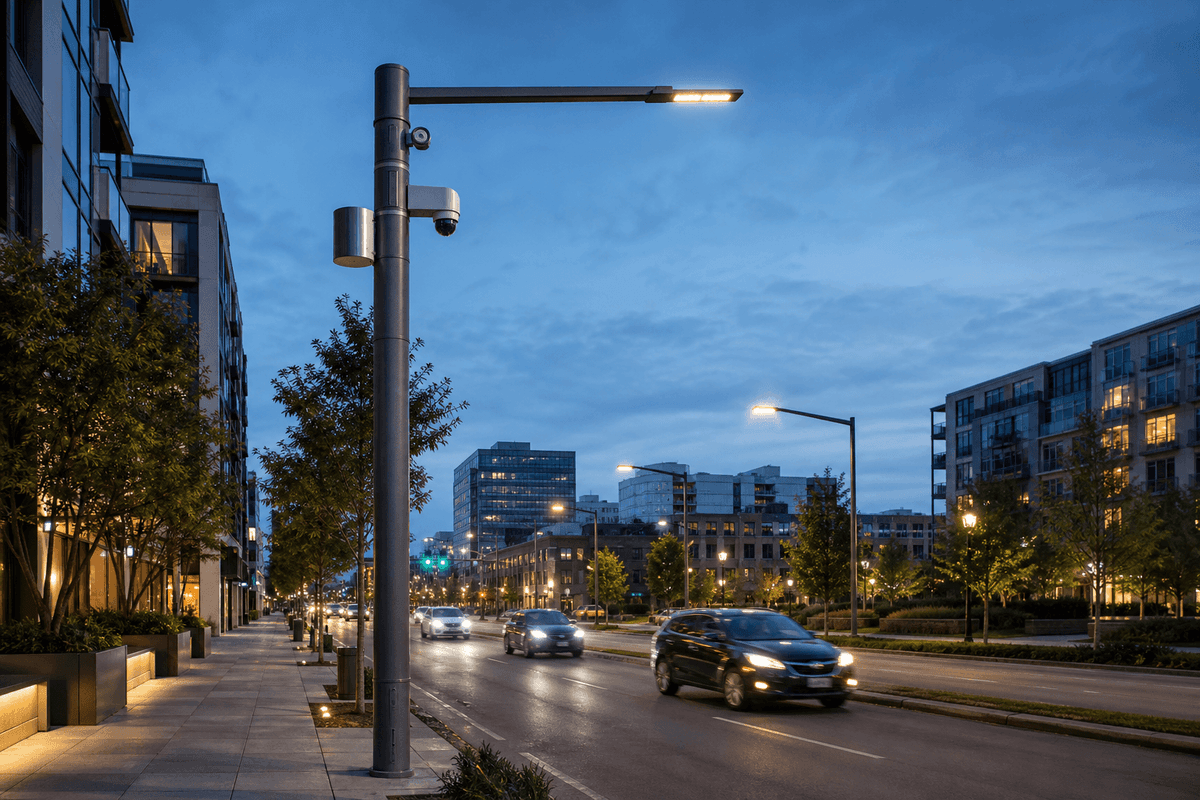
A smart streetlight network becomes a traffic intelligence platform when 1 pole carries LED lighting, sensors, communications, and power at 6-12m mounting heights.
For cities, road authorities, campuses, ports, industrial parks, and EPC contractors, the business case is not only energy reduction. The larger value is using the lighting grid as a distributed roadside network that already has power, height, spacing, and municipal maintenance access. SOLARTODO positions this as B2B infrastructure, not an online marketplace: buyers submit project requirements, receive offline quotation, and can request financing for large projects.
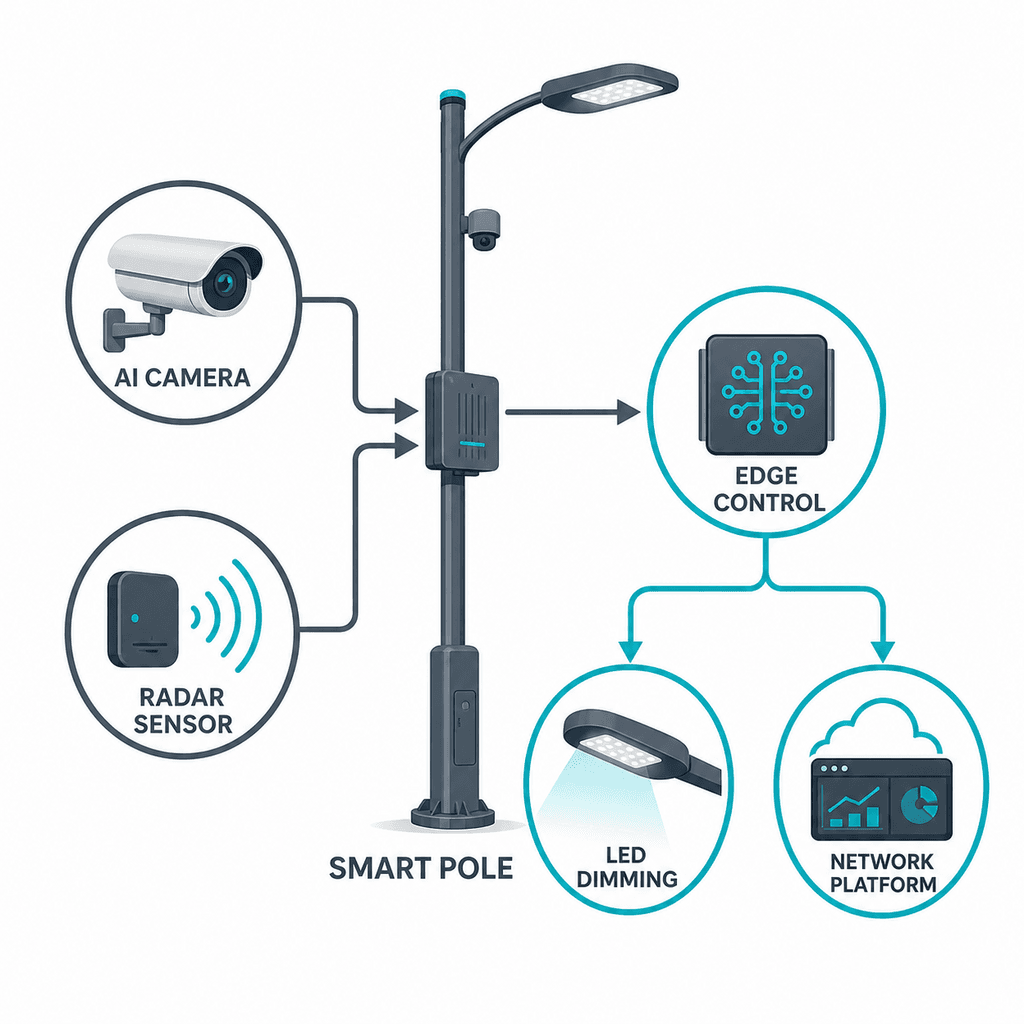
Traffic sensors can include AI cameras, millimeter-wave radar, inductive-loop gateways, acoustic sensors, environmental sensors, and Bluetooth or WiFi counting modules. In a conventional deployment, each function may require its own pole, cabinet, conduit, foundation, and maintenance contract. In a smart streetlight deployment, those functions can be consolidated into 1 shared steel pole with a common power entry, surge protection, communications link, and device management layer.
According to the IEA (2026), lighting in buildings and outdoor applications represented around 8% of global electricity demand in 2024, or about 2,200 TWh. The IEA also states, "Outdoor public lighting also offers additional opportunities" for LED upgrades, especially where coordinated retrofits can deliver fast payback. For B2B owners, that means smart streetlighting should be evaluated as an energy project and a digital road-operations project at the same time.
SOLARTODO smart streetlight configurations typically use 6m, 8m, 10m, and 12m pole architectures. A traffic-sensor network may use a 120W or 200W LED luminaire at 170 lm/W, generating about 20,400-34,000 lumens depending on the model. Where tunnel entrances, community gates, logistics corridors, or urban intersections need higher visibility, the same pole can carry camera, radar, display, emergency call, WiFi, and environmental modules.
Technical Architecture for Sensor-Enabled Smart Lighting
A traffic-sensor smart pole needs 5 technical layers: structure, lighting, sensing, communications, software control, and cybersecurity governance.
Pole and Power Layer
The physical pole must be sized for wind load, arm projection, device weight, cable entry, and future maintenance access. Common SOLARTODO 10m smart pole variants use galvanized steel structures with IP66-rated outdoor modules and a 25-year structural design target. For tunnel entrances and municipal corridors, a 150 km/h wind-resistance target is commonly specified, with foundation design adjusted to local soil bearing capacity.
Power architecture normally starts with AC 220V/380V utility supply, internal breakers, surge protection, grounding, and separate load circuits for lighting and low-voltage smart modules. Where solar or battery backup is required, the design must separate life-safety functions from optional analytics loads. Engineers should also confirm whether the traffic sensor must remain active during dimmed lighting hours, grid outages, or communication failures.
Lighting and Control Layer
The luminaire remains the core load. According to IEC (2024), IEC 60598-1:2024 specifies general safety requirements for luminaires up to 1,000V. According to IEC (2022), IEC 62722-1:2022 covers luminaire performance and environmental requirements, which helps procurement teams compare declared output, standby consumption, and environmental data across vendors.
Dimming control is the point where traffic sensing creates direct savings. A camera or radar can detect low traffic volume after midnight and trigger 30-60% dimming, then restore full output when pedestrians, vehicles, emergency activity, or congestion are detected. The U.S. Department of Energy (2024) reported that consistent 0-10V dimming performance is important for delivering expected light levels, energy savings, and cost savings in LED streetlight systems.
Sensor and Data Layer
Sensor selection should follow the operating problem. AI cameras are strong for classification, stopped-vehicle detection, wrong-way movement, lane occupancy, and incident verification. 77GHz radar is strong for speed, presence, range, and poor-light performance. Environmental sensors add PM2.5, PM10, NO2, O3, temperature, humidity, wind speed, and noise data, helping operators correlate road safety with air quality or weather conditions.
For road projects, the sensor layer should define at least 6 data fields: timestamp, pole ID, lane or zone ID, event type, confidence score, and communication status. A practical update interval ranges from 1-60 seconds, depending on whether the use case is adaptive lighting, traffic counting, congestion alerting, or enforcement support. Video storage policies should be separated from anonymized traffic statistics because privacy and retention rules vary widely by country.
Communications and Cybersecurity Layer
Backhaul can use 4G/5G, LoRaWAN, fiber, Ethernet, or mixed networks. LoRaWAN can support low-bandwidth telemetry, while 4G/5G or fiber is better for video, firmware updates, and control-room integration. For responsive traffic alerts, engineers should target 1-5 seconds end-to-end latency for event metadata, while full video may use separate bandwidth and retention rules.
Cybersecurity must be specified before installation, not added later. According to UL (2023), UL 2900-1 applies to network-connectable products evaluated for vulnerabilities, software weaknesses, and malware. UL Solutions states that connected products need "testable technical criteria" for repeatable validation. For smart poles, this translates into signed firmware, role-based access, encrypted transport, vulnerability disclosure process, device inventory, and disablement procedures for compromised modules.
Applications and Deployment Models
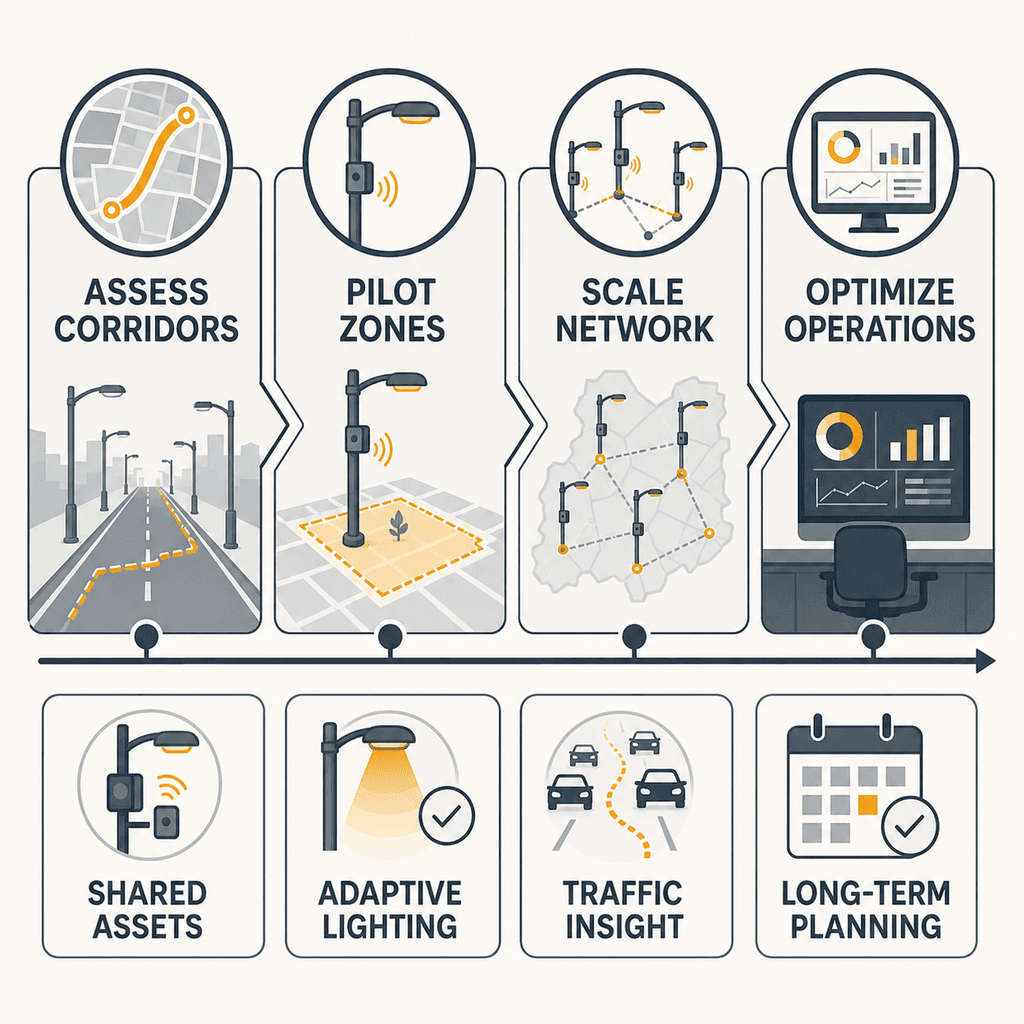
Traffic-sensor smart streetlights are strongest where 10-50 pole networks can improve safety, reduce maintenance points, and feed operations dashboards.
Municipal roads use traffic sensors to shift streetlighting from fixed schedules to demand-responsive control. A corridor with 100 conventional poles may operate at full output for 10-12 hours nightly even when traffic is low. With traffic detection, the same corridor can dim during low-flow periods and restore brightness for vehicles, pedestrians, cyclists, incidents, and emergency vehicles. According to the U.S. DOE (2024), connected controls have substantial potential to contribute to LED energy savings when implemented across lighting systems.
Tunnel entrances are another high-value use case. The first 30-100m of a tunnel approach is visually demanding because drivers move from daylight above 5,000-20,000 lux into an interior that may be below 100-300 lux. A SOLARTODO 10m tunnel entrance smart pole can combine a 200W LED, AI camera, environmental sensor, and LED display, targeting about 300 lux in the critical approach zone while reducing separate roadside devices from 3-4 assets to 1 integrated pole.
Community entrances, campuses, and industrial parks use sensor-enabled poles for security and access visibility. A 10m SOLARTODO community entrance configuration can integrate a 120W LED, AI security camera, emergency call module, and WiFi access point. In these sites, traffic intelligence is less about highway speed and more about queues, visitor flow, delivery timing, pedestrian safety, and incident response.
Ports, logistics parks, bus depots, and border facilities need durable detection across long operating hours. Radar and AI cameras can track truck queues, idle time, gate congestion, and unusual stopping behavior. Environmental sensors can add wind, noise, and particulate data. For owners operating 24/7, the value of reduced congestion and faster incident verification can exceed the electricity savings alone.
Selection Guide and Comparison Table
The best traffic sensor is the one that meets detection accuracy, privacy, latency, and maintenance targets for a defined 1-lane to 6-lane road segment.
| Option | Best use case | Typical data | Strength | Procurement note |
|---|---|---|---|---|
| 4K AI camera | Intersections, gates, tunnel portals | Vehicle class, lane occupancy, incident video | Visual verification and analytics in 1 device | Require privacy controls and retention rules of 7-90 days |
| 77GHz radar | Speed, presence, poor-weather detection | Range, speed, direction, count | Works without visible-light dependence | Validate lane coverage and mounting angle at 6-12m |
| Environmental sensor | Tunnel entrances, urban air-quality corridors | PM2.5, PM10, NO2, O3, wind, noise | Links traffic operations with environmental risk | Specify calibration cycle and 1-60 second sampling |
| Inductive-loop interface | Existing intersections | Presence and occupancy | Uses proven road-embedded detection | Higher civil works if new loops are required |
| WiFi/Bluetooth counter | Pedestrian zones and campuses | Device count and dwell trend | Lower cost for non-enforcement analytics | Use anonymization and avoid personal tracking |
| LED display module | Warnings and local traffic messaging | Text or symbol output | Adds immediate roadside communication | Confirm visibility range of 20-80m and brightness |
Selection should start with road geometry. A 2-lane community entrance may need a 120W LED and 1 camera, while a tunnel portal may need a 200W LED, 4K PTZ, environmental sensor, and LED display. A logistics yard may need radar at multiple points because truck occlusion can reduce camera performance. SOLARTODO can configure these modules around project-specific mounting height, power source, communications, and regional compliance needs.
Procurement teams should ask vendors for 8 documents before award: luminaire photometric file, pole structural drawing, wind-load calculation, wiring diagram, communications architecture, cybersecurity statement, maintenance procedure, and warranty terms. For public tenders, add IEC 60598-1:2024, IEC 62722-1:2022, ANSI/NEMA C136.41-2024, NEMA TS 2-2016, and UL 2900-1:2023 references where relevant to the project scope.
EPC Investment Analysis and Pricing Structure
EPC turnkey delivery for sensor-enabled smart streetlights should price supply, logistics, civil works, commissioning, and software integration across 50-250+ poles.
EPC means Engineering, Procurement, and Construction. For a smart streetlight network, EPC turnkey delivery normally includes site survey, lighting simulation, pole and foundation design, bill of materials, factory production, quality inspection, shipping coordination, foundation works, trenching, cable pulling, pole erection, communications setup, software commissioning, operator training, and handover documentation. Traffic-sensor projects also need data policy, cybersecurity setup, dashboard roles, and acceptance testing.
SOLARTODO pricing is project-specific because pole height, LED wattage, sensor type, steel thickness, wind zone, coating system, display size, communications, and installation country all affect cost. For reference, common 10m 4-in-1 smart pole configurations are often budgeted around USD 1,600-2,200 per pole before final EPC scope. Tunnel entrance 200W configurations usually sit toward the higher end because lighting output, environmental sensing, and display integration are more demanding.
| Pricing tier | What it includes | Buyer responsibility | Typical use |
|---|---|---|---|
| FOB Supply | Factory supply, inspection, export packing | Freight, import, installation, commissioning | Distributors and EPCs with local teams |
| CIF Delivered | FOB scope plus ocean freight and insurance to destination port | Customs, inland transport, installation | Importers needing logistics support |
| EPC Turnkey | Engineering, supply, delivery, civil works, installation, commissioning | Site access, permits, utility approvals | Municipal, campus, and industrial projects |
Volume pricing should be modeled early. As guidance, SOLARTODO can structure approximately 5% discount for 50+ poles, 10% for 100+ poles, and 15% for 250+ poles, subject to final specification, shipping lane, and payment risk. Standard payment terms are 30% T/T deposit plus 70% against bill of lading, or 100% L/C at sight. Financing may be available for large projects above USD 1,000K, especially for public infrastructure and multi-site EPC programs.
ROI depends on the baseline. Replacing non-dimmable HID lighting with LED smart poles can reduce lighting energy use by 30-50% when adaptive controls are enabled. Consolidating 3-4 roadside assets into 1 pole can reduce foundations, trenching, and maintenance visits by 25-75%, depending on the original design. For a 100-pole corridor, payback is often driven by avoided civil works, lower energy cost, reduced patrol time, and faster incident response rather than fixture savings alone.
For quotations, procurement teams should send road width, pole spacing, target illuminance, existing power availability, wind zone, sensor use cases, data-retention requirements, and installation country to [email protected]. SOLARTODO can then propose FOB, CIF, or EPC pricing with optional financing for qualified large projects.
FAQ
Traffic-sensor smart streetlight projects usually require 8 decisions: use case, sensor type, pole height, power, network, cybersecurity, budget, and maintenance model.
Q: What is a traffic-sensor smart streetlight network? A: A traffic-sensor smart streetlight network is a connected lighting system where poles carry sensors such as AI cameras, radar, or environmental modules. The network can measure vehicle flow, pedestrian movement, queue length, incidents, and air quality while controlling LED output. Typical projects use 6-12m poles and report data every 1-60 seconds.
Q: How do traffic sensors reduce streetlighting energy consumption? A: Traffic sensors reduce energy use by allowing LEDs to dim when roads are empty and brighten when vehicles or pedestrians appear. In many retrofit projects, adaptive control can support 30-50% lighting energy savings versus fixed-output HID or non-networked LED systems. The exact result depends on traffic profile, dimming limits, safety class, and local lighting regulations.
Q: What sensors are best for smart streetlight traffic monitoring? A: AI cameras are best when visual classification and incident verification are needed, while 77GHz radar is better for speed, presence, and poor-weather detection. Environmental sensors add PM2.5, PM10, NO2, O3, wind, noise, temperature, and humidity data. Many B2B projects combine 2-3 sensor types for more reliable operations.
Q: How much does a sensor-enabled smart streetlight cost? A: Common 10m 4-in-1 smart pole configurations are typically budgeted around USD 1,600-2,200 per pole before project-specific EPC costs. FOB supply is lowest, CIF adds freight and insurance, and EPC turnkey includes engineering, civil works, installation, and commissioning. Volume discounts may reach 5% at 50+ poles, 10% at 100+, and 15% at 250+.
Q: What does EPC turnkey delivery include for smart streetlights? A: EPC turnkey delivery includes engineering, procurement, construction, installation, commissioning, and handover documentation. For traffic-sensor networks, it should also include lighting simulation, pole structural design, foundation planning, communications setup, cybersecurity configuration, dashboard roles, operator training, and acceptance tests. SOLARTODO can quote FOB, CIF, or EPC based on site data.
Q: What standards should buyers specify for smart streetlight networks? A: Buyers should specify IEC 60598-1:2024 for luminaire safety and IEC 62722-1:2022 for performance requirements. ANSI/NEMA C136.41-2024 is relevant for locking-type dimming control interfaces, while NEMA TS 2-2016 applies to traffic controller assemblies. UL 2900-1:2023 supports cybersecurity evaluation for network-connectable products.
Q: Can traffic sensors be integrated into existing streetlight poles? A: Existing poles can sometimes accept sensors if they have sufficient structural capacity, power availability, cable access, and mounting height. However, many legacy poles were not designed for cameras, radar, displays, or communications boxes. Engineers should verify wind load, vibration, grounding, surge protection, and cabinet space before retrofit approval.
Q: How is privacy handled when smart poles use AI cameras? A: Privacy should be handled by defining the analytics purpose, retention period, access roles, and anonymization method before commissioning. Traffic counting can often use metadata instead of storing identifiable video. If face or license-plate functions are required, retention windows such as 7-90 days and local consent rules must be reviewed by the project owner.
Q: What communications network is best for smart streetlight sensors? A: The best network depends on data volume and latency requirements. LoRaWAN is suitable for low-bandwidth telemetry, while 4G/5G, fiber, or Ethernet is better for video, firmware updates, and real-time dashboards. Traffic alerts should normally target 1-5 seconds metadata latency, with video handled as a separate bandwidth class.
Q: How often do sensor-enabled smart poles need maintenance? A: Most smart poles need scheduled inspection every 6-12 months, depending on climate, dust, corrosion, and traffic exposure. Maintenance should check luminaire output, camera lens cleanliness, radar alignment, sensor calibration, enclosure seals, surge protection, grounding, and communication uptime. Environmental sensors may require periodic calibration to preserve data accuracy.
Q: When should a city choose radar instead of AI video analytics? A: A city should choose radar when speed, presence, and all-weather detection matter more than visual identification. Radar performs well in darkness, glare, fog, and privacy-sensitive corridors because it does not require facial imagery. AI video is better when operators need vehicle classification, incident verification, or evidence-quality visual context.
Q: Who should contact SOLARTODO for project quotations? A: Procurement managers, EPC contractors, municipal engineers, campus owners, and industrial project managers should contact SOLARTODO when planning 10-250+ pole deployments. Useful quotation inputs include road width, pole spacing, target illuminance, power source, wind zone, sensor functions, communications method, and delivery term. Large projects above USD 1,000K may qualify for financing review.
References
- IEA (2026): The next wave of LED lighting: smarter, circular and more efficient; reports 2024 lighting demand near 2,200 TWh and about 8% of global electricity demand — https://www.iea.org/reports/world-energy-outlook-2024
- IEC 60598-1:2024 (2024): Luminaires - Part 1: General requirements and tests; specifies safety requirements for luminaires operating up to 1,000V — https://webstore.iec.ch/
- IEC 62722-1:2022 (2022): Luminaire performance - Part 1: General requirements; covers performance and environmental requirements for luminaires — https://webstore.iec.ch/
- UL 2900-1 (2023): Software Cybersecurity for Network-Connectable Products, Part 1; defines evaluation for vulnerabilities, software weaknesses, and malware — https://www.ul.com/ Authoritative standards and agency publications support 7 procurement requirements: luminaire safety, performance, controls, traffic systems, cybersecurity, LED efficiency, and smart lighting planning.
- IEA (2026): The next wave of LED lighting: smarter, circular and more efficient; reports 2024 lighting demand near 2,200 TWh and about 8% of global electricity demand.
- U.S. Department of Energy (2024): The Energy and Operational Impacts of Using 0-10V Control for LED Streetlights; evaluates 23 LED streetlights and ANSI C137.1-2022 dimming performance.
- IEC 60598-1:2024 (2024): Luminaires - Part 1: General requirements and tests; specifies safety requirements for luminaires operating up to 1,000V.
- IEC 62722-1:2022 (2022): Luminaire performance - Part 1: General requirements; covers performance and environmental requirements for luminaires.
- ANSI/NEMA C136.41-2024 (2025): Roadway and area lighting equipment dimming control interface for external locking-type controls using 0-10V and DALI protocols.
- NEMA TS 2-2016 (2016): Traffic Controller Assemblies with NTCIP Requirements; defines traffic controller assemblies used in intelligent transportation systems.
- UL 2900-1 (2023): Software Cybersecurity for Network-Connectable Products, Part 1; defines evaluation for vulnerabilities, software weaknesses, and malware.
- ISO/TR 19482:2026 (2026): Intelligent transport systems smart streetlighting management platform for road traffic safety enhancement; overview and use cases.
Conclusion
Integrating traffic sensors into smart streetlight networks is strongest when 1 pole delivers lighting, sensing, communications, and control with measurable ROI.
For B2B buyers, the bottom line is clear: SOLARTODO sensor-enabled smart streetlights can reduce lighting energy by 30-50%, consolidate 3-4 roadside assets into 1 pole, and support 10-25 year infrastructure planning when engineered with IEC, NEMA, and UL-aligned specifications.
About SOLARTODO
SOLARTODO is a global integrated solution provider specializing in solar power generation systems, energy-storage products, smart street-lighting and solar street-lighting, intelligent security & IoT linkage systems, power transmission towers, telecom communication towers, and smart-agriculture solutions for worldwide B2B customers.
About the Author

Cinn Song
Founder & Chief Solutions Architect
Cinn Song founded SOLARTODO LIMITED and leads its smart-city infrastructure engineering — from solar, storage and integrated smart poles to the company's push into physical-AI city edge nodes: pole-mounted edge computing, vertical LLMs for smart cities, drone-based O&M with autonomous battery swapping, robotic maintenance, and high-speed counter-UAS interception. Since 2010, he has directed turnkey EPC + BOT delivery across 50+ countries, including telecom monopole supply for national grid operators, off-grid solar street-lighting for African municipalities, and integrated smart-pole programs for Gulf smart cities.
Cite This Article
Cinn Song. (2026). Integrating Traffic Sensors into Smart Streetlight Networks. SOLARTODO. Retrieved from https://solartodo.com/knowledge/integrating-traffic-sensors-into-smart-streetlight-networks
@article{solartodo_integrating_traffic_sensors_into_smart_streetlight_networks,
  title = {Integrating Traffic Sensors into Smart Streetlight Networks},
  author = {Cinn Song},
  journal = {SOLARTODO Knowledge Base},
  year = {2026},
  url = {https://solartodo.com/knowledge/integrating-traffic-sensors-into-smart-streetlight-networks},
  note = {Accessed: 2026-10-14}
}
Published: August 10, 2026 | Available at: https://solartodo.com/knowledge/integrating-traffic-sensors-into-smart-streetlight-networks
Subscribe to Our Newsletter
Get the latest solar energy news and insights delivered to your inbox.
View All Articles