insurance premium reduction with Solar-Powered Security…

SOLAR TODO
Solar Energy & Infrastructure Expert Team
Watch the video
TL;DR
Farms and ranches can use solar-powered security systems to reduce outage-related blind spots and improve insurer negotiations. A typical medium-site design uses 16 cameras, 32 alarm zones, 30 days of video retention, and about 8-18 kWh of battery storage. The strongest business case combines loss prevention, better claims evidence, and possible premium improvement rather than relying on energy savings alone.
Solar-powered security systems can help farms and ranches strengthen insurer negotiations by keeping 16 cameras and 32 alarm points online during outages, with 30 days of video retention and battery-backed 24/7 monitoring for better loss prevention and claims evidence.
Summary
Solar-powered security systems can help farms and ranches cut outage risk, protect 24/7 perimeter zones, and strengthen insurer discussions with measurable controls. A typical design combines 16 cameras, 32 detector points, and 30 days of video retention while reducing diesel backup dependence and supporting lower loss exposure.
Key Takeaways
- Quantify theft and outage exposure across at least 4-8 critical farm zones before procurement, including gates, fuel storage, workshops, livestock pens, and chemical rooms.
- Size solar generation and battery storage for 24/7 operation with at least 1 autonomy target, using camera, NVR, detector, and communications loads in watts and amp-hours.
- Specify 16-camera and 32-zone architectures when sites include multiple access roads, 2-4 buildings, and long perimeter lines that need separate alarm logic.
- Use dual communications paths such as 4G plus Ethernet or radio links to maintain alarm reporting above 99% pathway availability under rural grid instability.
- Document 30 days of video retention, event logs, and maintenance records to support insurer reviews, claim defense, and post-incident evidence quality.
- Compare FOB, CIF, and EPC pricing early; EPC turnkey delivery for complex security packages often shortens commissioning time by 10-20% versus fragmented procurement.
- Apply volume planning for multi-site ranch groups, where 50+ units can target 5% discount, 100+ units 10%, and 250+ units 15%.
- Review compliance against EN 50131, IEC 62676, UL 681, and NFPA 72 so the system specification matches insurer, consultant, and AHJ documentation requirements.
Why Solar-Powered Security Systems Can Reduce Insurance Pressure on Farms and Ranches
Solar-powered security systems reduce farm and ranch risk by maintaining 24/7 surveillance across 16 cameras, 32 alarm points, and 1 day or more of battery autonomy when rural grid supply is unstable.
For insurers, premium pricing follows loss probability, claim severity, and evidence quality. Farms and ranches often have 3 recurring weaknesses: remote perimeters, intermittent power, and delayed incident verification. A solar-backed security and surveillance system addresses all 3 by keeping cameras, detectors, communications, and recording online during outages that would disable a grid-only setup.
According to the International Energy Agency, “Solar PV is set to become the largest renewable power source by 2030,” reflecting its role as dependable distributed generation in remote assets. For agricultural sites, that matters because a 4-hour to 12-hour outage can leave fuel tanks, machinery sheds, livestock medicine rooms, and access roads without recorded coverage. Insurers may not publish universal discount schedules, but underwriters do reward documented mitigation, especially where theft, vandalism, trespass, and fire escalation risks are measurable.
According to NREL (2024), distributed PV plus storage improves resilience by supporting critical loads during grid interruptions when systems are correctly sized and maintained. According to IEA PVPS (2024), solar deployment continues to expand in commercial and industrial applications because lifecycle energy costs are predictable over 20-25 years. For a ranch operator, the practical issue is not only energy savings; it is preserving security uptime at 02:00 when a perimeter breach occurs.
SOLAR TODO typically advises buyers to frame the insurance discussion around 5 measurable controls:
- Continuous power to cameras and alarm panels during outages
- Recorded evidence retention for 30 days or more
- Faster verification using PTZ and fixed IP cameras
- Partitioned alarm zones for barns, gates, fuel, and residences
- Maintenance logs showing tested operation every 30-90 days
What insurers usually look for
Insurers usually review 4 categories—deterrence, detection, response, and documentation—and each category can be tied to a specific device count, retention period, or test interval.
A farm with only 2 analog cameras and no backup power gives weak evidence. A site with 12 HD fixed IP cameras, 4 PTZ cameras, 32 detector points, and a 32-channel NVR gives stronger incident reconstruction. The difference is important because verified events often reduce claim disputes, while unverified losses can increase deductibles, exclusions, or renewal scrutiny.
Technical Design Strategy for Solar Panels and Security Loads
A farm-grade solar security system should match continuous loads, 24-hour energy demand, and at least 1 autonomy target so cameras, detectors, NVRs, and communications stay online during night operation and outages.
The design starts with load calculation. A typical 16-camera agricultural package may include 12 fixed IP cameras at 8-12 W each, 4 PTZ cameras at 20-35 W each, 1 NVR at 25-60 W, 1 hybrid alarm panel at 15-25 W, network switches at 20-40 W, and 4G communications at 8-15 W. That places continuous demand near 250-400 W before surge and winter derating are added.
For 24-hour operation, a 300 W average load needs about 7.2 kWh per day. With 1 day of battery autonomy and 15-20% system losses, usable storage often lands near 8.5-9.0 kWh. If the site requires 2 days of autonomy due to storm risk or poor road access, storage can move into the 17-18 kWh range. This is why battery sizing cannot be guessed from panel wattage alone.
According to NREL (2024), solar resource and load matching are central to resilient off-grid design. According to IRENA (2024), battery-backed distributed solar can improve energy access reliability in remote commercial operations when systems are sized for actual duty cycles rather than nameplate assumptions. For ranches with 5 km to 20 km feeder lines, this resilience can be more valuable than direct kWh savings.
Recommended architecture for farms and ranches
A practical architecture for medium agricultural sites uses 32 zones, 16 cameras, and 2 communications paths so separate risk areas can be monitored and documented without merging all alarms into one response stream.
A typical specification can include:
- 12 HD fixed IP cameras for gates, barns, workshops, and fuel points
- 4 PTZ cameras for long lanes, corrals, and perimeter sweep
- 16 PIR detectors for indoor rooms and sheltered corridors
- 16 dual-technology detectors for dusty, windy, or thermally unstable zones
- 8 perimeter beam sets for fence lines or approach roads
- 1 32-channel NVR with 30 days retention target
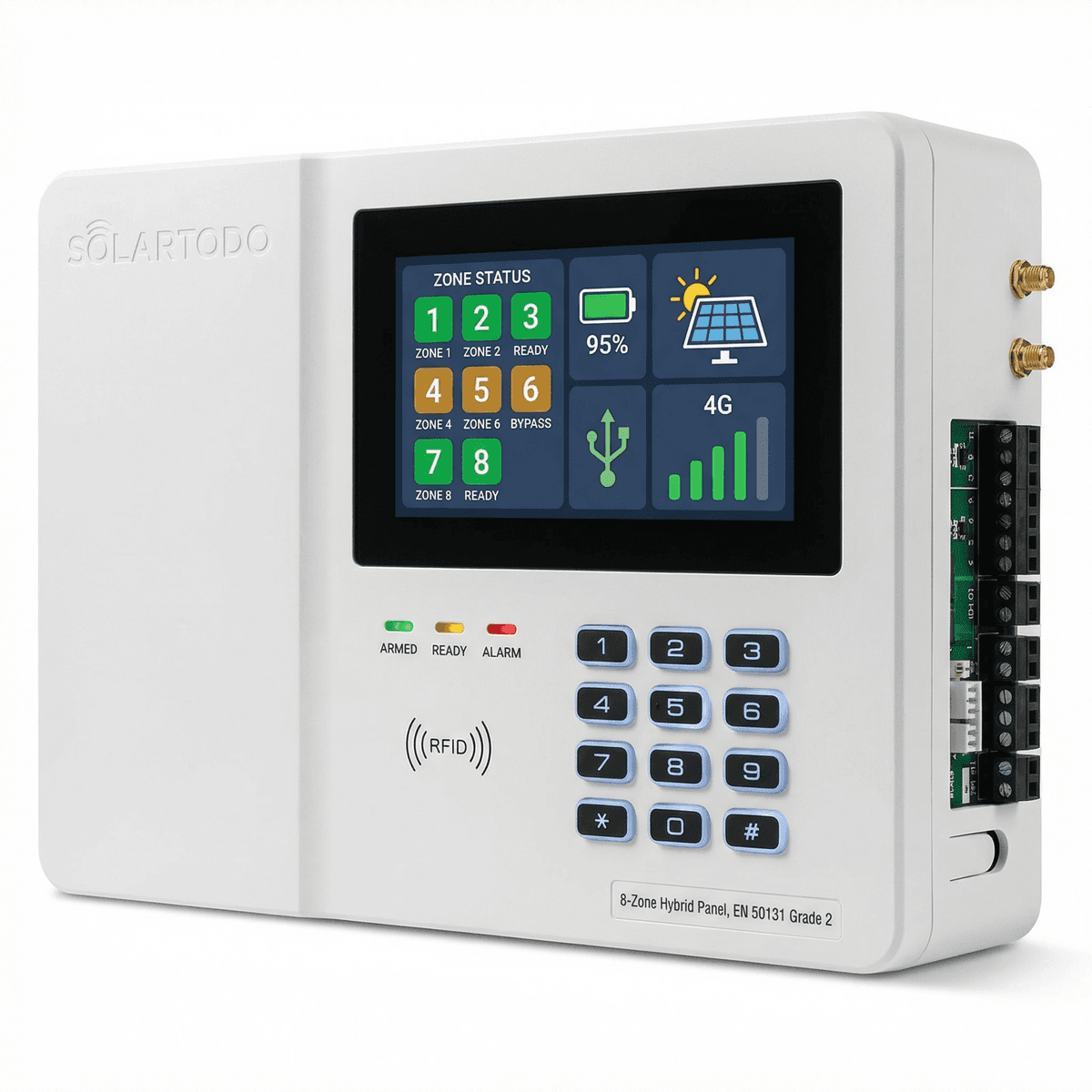
- 1 hybrid 64-zone control panel configured for 32 active zones
- 4G plus Ethernet, radio, or satellite backhaul depending on site constraints
This specification follows the same logic used in the SOLAR TODO Border Checkpoint 32-Zone Off-Grid package, adapted for agricultural security priorities rather than border control. The advantage is spare capacity: a 64-zone panel with 32 active zones leaves 32 spare zones for future fence loops, panic buttons, pump-house alarms, or cold-room contacts.
Standards and compliance checkpoints
Security specifications for insurer review should reference EN 50131, IEC 62676, UL 681, and NFPA 72 so the design language matches consultant, integrator, and authority expectations.
EN 50131 gives a framework for intrusion and hold-up systems. IEC 62676 covers video surveillance performance and system considerations. UL 681 addresses installation practices for burglary and holdup systems, while NFPA 72 supports signaling pathway and supervisory integration where required. These references do not guarantee a premium reduction, but they improve procurement clarity and reduce ambiguity during underwriting review.
The National Fire Protection Association states, “The purpose of this Code is to define the means of signal initiation, transmission, notification, and annunciation.” That statement matters in agriculture because many losses escalate when alarms are not transmitted, logged, or acknowledged within minutes.
Farm and Ranch Use Cases, Risk Mapping, and ROI Logic
Farms and ranches gain the most insurance value when solar-backed security is mapped to 6-10 loss points, each with a device count, response rule, and evidence trail.
The most common agricultural risk points are predictable. They include 1 main gate, 1-3 secondary access roads, 1 fuel storage area, 1 machinery shed, 1 chemical or veterinary medicine room, 1 livestock handling area, 1 workshop, and 1 residence or office. A 32-zone architecture lets each area receive separate arming schedules, user permissions, and alarm priorities.
Sample deployment scenario (illustrative): a ranch with 2 gates, 1 diesel tank, 3 barns, 1 workshop, and 1 office installs 16 cameras, 24 intrusion points, and 8 perimeter beams. The solar subsystem provides 9 kWh usable storage and 2.5-3.5 kWp PV depending on irradiance and winter reserve targets. The insurer may not promise a fixed discount in advance, but the site owner can present improved controls during renewal with evidence of reduced blind periods and stronger claims documentation.
According to IEA (2024), digitalization and distributed energy improve operational visibility in remote infrastructure. According to BloombergNEF (2024), battery-supported distributed systems continue to gain traction where outage costs exceed pure energy economics. On a ranch, one avoided theft of diesel, copper cable, veterinary stock, or portable equipment can offset a meaningful share of system cost.
Where premium reduction discussions are most credible
Insurance discussions are strongest when 4 conditions are documented: pre-installation loss exposure, post-installation control upgrades, maintenance records, and incident evidence quality over at least 6-12 months.
Buyers should prepare a short underwriting file with:
- Site map showing 4-8 critical zones
- Camera schedule with resolution, field of view, and retention days
- Alarm schedule with detector type and zone logic
- Power design with PV wattage, battery kWh, and autonomy hours
- Maintenance and test log every 30-90 days
- Incident response SOP with call tree and escalation times
This approach is more effective than asking for a discount based only on “having cameras.” Underwriters respond better to measurable controls than generic claims.
Comparison and Selection Guide for Agricultural Buyers
The best farm security choice balances camera count, zone count, power autonomy, and deployment method, with 16 cameras and 32 zones fitting many medium agricultural sites better than small residential kits.
The table below compares typical approaches for farms and ranches.
| Option | Typical Scale | Power Strategy | Security Scope | Strength | Limitation |
|---|---|---|---|---|---|
| Grid-only basic CCTV | 4-8 cameras | Utility only | Video only | Low upfront cost | Fails during outages, weak insurer case |
| Solar camera-only kit | 2-6 cameras | Small PV + battery | Localized observation | Fast deployment | Limited zone logic and evidence coverage |
| Hybrid farm security system | 8-16 cameras, 16-32 zones | Grid + PV + battery | Video + intrusion + alerts | Good balance of cost and resilience | Needs design coordination |
| Off-grid agricultural package | 12-16 cameras, 32 zones | PV + battery only | Full remote-site coverage | Works where grid is absent | Higher battery and winter sizing requirement |
| Multi-site ranch portfolio system | 16+ cameras/site, cloud dashboard | Site-specific hybrid | Centralized oversight | Standardized reporting across sites | Requires communications planning |
For many buyers, the hybrid or off-grid model is the most defensible insurance strategy because it addresses the insurer's core concern: whether the system still works when the utility supply does not. SOLAR TODO can supply equipment-only, delivered cargo, or EPC support depending on whether the buyer has an internal integrator, local contractor, or full turnkey requirement.
Selection checklist
A procurement decision should compare at least 8 technical points, not only camera resolution or panel wattage.
Check these items before RFQ closure:
- Number of active zones now versus spare zones for expansion
- Fixed versus PTZ camera ratio
- Detector mix for dust, heat, and wind exposure
- NVR retention target in days at required resolution
- PV array kWp and battery usable kWh
- Communications redundancy and signal strength survey
- Standard references in the specification
- Warranty scope for electronics, batteries, and structures
EPC Investment Analysis and Pricing Structure
EPC pricing should be evaluated across 3 delivery models—FOB Supply, CIF Delivered, and EPC Turnkey—with volume discounts of 5% at 50+ units, 10% at 100+, and 15% at 250+.
For agricultural security projects, EPC means Engineering, Procurement, and Construction. In practice, that includes site survey, load calculation, single-line diagrams, bill of materials, mounting design, cable schedules, installation, commissioning, testing, and operator training. Where civil works or poles are required, scope should state foundation, trenching, conduit, and earthing quantities in meters and millimeters.
A useful pricing framework is:
- FOB Supply: equipment ex-works or port basis, buyer manages freight, installation, and commissioning
- CIF Delivered: supplier covers freight and insurance to destination port, buyer manages inland works and installation
- EPC Turnkey: supplier or appointed partner covers design, supply, installation, testing, and handover
Based on the SOLAR TODO security system reference range, a 32-zone off-grid architecture can fall within a turnkey band similar to USD 7,100-9,200 depending on detector mix, communications, battery size, mounting structure, and local labor conditions. Agricultural projects may vary above or below that range if perimeter length, pole count, trenching, or autonomy targets increase.
Payment terms typically follow 30% T/T deposit and 70% against B/L for supply contracts, or 100% L/C at sight for qualified transactions. Financing may be available for large projects above USD 1,000K. For quotations, buyers can contact [email protected].
ROI and payback logic versus conventional alternatives
ROI should be measured against avoided losses, reduced diesel backup use, lower outage exposure, and possible premium improvement over a 3-7 year planning horizon.
A conventional grid-only setup may need generator runtime during outages, adding fuel, service, and failure risk. If a site avoids even 1 theft event worth USD 3,000-10,000, or prevents spoilage or fuel siphoning during an outage, the economics improve quickly. If the insurer grants a modest premium reduction after 1 renewal cycle, that becomes an additional benefit rather than the only justification.
For multi-site farm groups, standardization creates further value. One dashboard, one spare-parts list, and one maintenance SOP can reduce service inefficiency across 5-50 sites. That is often where SOLAR TODO adds value: aligning the power system, surveillance package, and deployment model under one procurement file.
FAQ
A well-sized farm security package usually needs 8-16 cameras, 16-32 alarm zones, and 1 day or more of battery autonomy to support a credible insurance risk-reduction discussion.
Q: How can a solar-powered security system help reduce farm insurance premiums? A: A solar-powered security system can support premium reduction discussions by lowering outage-related blind spots, improving evidence quality, and documenting stronger site controls. Insurers usually look for measurable mitigation such as 24/7 recording, 30-day retention, separate alarm zones, and maintenance logs rather than just the presence of cameras.
Q: What size system is suitable for a medium farm or ranch? A: A medium site often fits a 16-camera, 32-zone design with 1 hybrid control panel, 1 32-channel NVR, and roughly 8-18 kWh of usable battery storage depending on autonomy targets. Final sizing depends on perimeter length, number of buildings, camera wattage, and local solar irradiance.
Q: Why is solar backup better than a grid-only security setup in rural areas? A: Solar backup keeps cameras, detectors, and communications active when utility power fails for 4-12 hours or longer. In rural areas with long feeder lines, this matters because many theft and trespass events occur during outages, when grid-only systems stop recording and alarms cannot report.
Q: What technical standards should buyers request in the specification? A: Buyers should ask for references to EN 50131 for intrusion systems, IEC 62676 for video surveillance, UL 681 for installation practices, and NFPA 72 for signaling and supervisory logic where relevant. These standards improve procurement clarity and help align the design with insurer and consultant expectations.
Q: How much solar and battery capacity does a security system usually need? A: A 16-camera agricultural system commonly draws about 250-400 W continuously, which equals roughly 6-10 kWh per day. With 1 day of autonomy and system losses included, battery storage often lands near 8.5-12 kWh, while PV size may range from about 2-4 kWp depending on location.
Q: Can a solar-powered system work fully off-grid on a remote ranch? A: Yes, a fully off-grid design is practical when the load profile, winter irradiance, and battery reserve are calculated correctly. Many remote sites use PV, battery storage, 4G or radio communications, and a 32-zone architecture to maintain surveillance without relying on unstable utility service.
Q: What evidence should be shown to an insurer after installation? A: The best package includes a site map, camera layout, detector schedule, 30-day retention policy, maintenance logs every 30-90 days, and records of alarm tests and communications checks. Underwriters respond better to documented controls and incident response procedures than to verbal claims about improved security.
Q: What is included in EPC turnkey delivery for farm security projects? A: EPC turnkey delivery usually includes engineering, bill of materials, PV and battery sizing, mounting design, cabling, installation, commissioning, testing, and operator training. Scope should also state whether foundations, poles, trenching, earthing, and communications setup are included or priced separately.
Q: How are FOB, CIF, and EPC prices different? A: FOB Supply covers equipment supply only, with the buyer managing freight and installation. CIF Delivered adds freight and insurance to the destination port. EPC Turnkey includes design, supply, installation, testing, and handover, so it has a higher upfront price but lower coordination burden.
Q: What payment terms and financing options are common? A: Common terms are 30% T/T upfront and 70% against B/L for supply contracts, or 100% L/C at sight for approved transactions. Financing may be available for projects above USD 1,000K, especially where buyers are standardizing multiple ranch or farm sites under one procurement plan.
Q: How often should the system be maintained? A: Visual inspections are commonly done monthly, while functional tests of alarms, recording, communications, and battery status are often scheduled every 30-90 days. A deeper preventive maintenance visit every 6-12 months helps verify retention settings, detector calibration, enclosure sealing, and PV charging performance.
Q: When does the investment usually pay back? A: Payback depends more on avoided loss events than on electricity savings alone. Many agricultural buyers model a 3-7 year horizon, combining avoided theft, reduced generator runtime, lower outage exposure, and any premium improvement achieved after one or more renewal cycles.
References
A farm insurance strategy is more credible when supported by 6-8 authoritative references covering solar resilience, surveillance standards, and alarm installation practices.
- NREL (2024): PVWatts Calculator and distributed PV performance methodology used to estimate solar production and resilience-oriented sizing.
- IEA PVPS (2024): Trends in Photovoltaic Applications 2024, covering deployment economics and commercial use of PV systems.
- IRENA (2024): Renewable Power Generation Costs and distributed energy analysis relevant to remote-site solar economics.
- IEC 62676 (multiple parts, current editions): Video surveillance systems for use in security applications, including system requirements and performance guidance.
- EN 50131 (current editions): Intrusion and hold-up systems framework used in professional alarm system design and grading.
- UL 681 (current edition): Installation and classification standard for burglary and holdup alarm systems.
- NFPA 72 (2025): National Fire Alarm and Signaling Code covering signaling pathways, supervision, and notification logic.
- BloombergNEF (2024): Market intelligence on distributed energy and storage deployment economics relevant to remote commercial sites.
Conclusion
Solar-powered farm security systems provide the strongest insurance value when they combine 16 cameras, 32 zones, and battery-backed 24/7 uptime rather than relying on grid-only CCTV.
Bottom line: for farms and ranches with remote perimeters, fuel storage, and unstable utility supply, a SOLAR TODO solar-powered security and surveillance system offers a practical path to lower loss exposure, stronger underwriting documentation, and better long-term ROI than conventional outage-prone setups.
About SOLARTODO
SOLARTODO is a global integrated solution provider specializing in solar power generation systems, energy-storage products, smart street-lighting and solar street-lighting, intelligent security & IoT linkage systems, power transmission towers, telecom communication towers, and smart-agriculture solutions for worldwide B2B customers.
About the Author

SOLAR TODO
Solar Energy & Infrastructure Expert Team
SOLAR TODO is a professional supplier of solar energy, energy storage, smart lighting, smart agriculture, security systems, communication towers, and power tower equipment.
Our technical team has over 15 years of experience in renewable energy and infrastructure, providing high-quality products and solutions to B2B customers worldwide.
Expertise: PV system design, energy storage optimization, smart lighting integration, smart agriculture monitoring, security system integration, communication and power tower supply.
Cite This Article
SOLAR TODO. (2026). insurance premium reduction with Solar-Powered Security…. SOLARTODO. Retrieved from https://solartodo.com/knowledge/insurance-premium-reduction-with-solar-powered-security-systems-solar-panels-strategy-for-farms-and-ranches
@article{solartodo_insurance_premium_reduction_with_solar_powered_security_systems_solar_panels_strategy_for_farms_and_ranches,
  title = {insurance premium reduction with Solar-Powered Security…},
  author = {SOLAR TODO},
  journal = {SOLARTODO Knowledge Base},
  year = {2026},
  url = {https://solartodo.com/knowledge/insurance-premium-reduction-with-solar-powered-security-systems-solar-panels-strategy-for-farms-and-ranches},
  note = {Accessed: 2026-05-30}
}
Published: May 6, 2026 | Available at: https://solartodo.com/knowledge/insurance-premium-reduction-with-solar-powered-security-systems-solar-panels-strategy-for-farms-and-ranches
Subscribe to Our Newsletter
Get the latest solar energy news and insights delivered to your inbox.
View All Articles