Hybrid Power Security System Market 2026: Solar + Storage…

SOLARTODO Editorial Team
Solar Energy & Infrastructure Expert Team
Watch the video
TL;DR
Hybrid power security systems are becoming a strong 2026 option for sites with 24/7 surveillance loads, unstable grids, or expensive diesel backup. Typical systems use 2-15 kW solar PV and 5-60 kWh LiFePO4 storage, reduce diesel runtime by 60-95%, and often achieve payback in 2.5-7 years depending on region, outage profile, and delivered energy cost.
Hybrid power security systems in 2026 combine 2-15 kW solar PV and 5-60 kWh storage to cut diesel runtime by 60-95%, lower site OPEX by 25-55%, and provide 8-24 hours of backup for surveillance and alarm loads.
Summary
Hybrid power security systems in 2026 pair solar PV and battery storage to cut diesel runtime by 60-95%, lower site energy OPEX by 25-55%, and deliver 8-24 hours of backup autonomy for remote surveillance, gas stations, ports, and public facilities.
Key Takeaways
- Size hybrid power security systems at 1.2-1.5x average daily load to maintain 8-24 hours of backup autonomy during low-irradiance periods.
- Compare solar + LFP battery against diesel-only power where fuel logistics exceed $0.25-$0.45/kWh, because hybrid systems often reduce OPEX by 25-55%.
- Specify LiFePO4 storage with 4,000-7,000 cycles and 90-95% round-trip efficiency for security loads that run 24/7.
- Use cloud-monitored architectures with 4G + Ethernet + WiFi and alarm/video standards such as EN 50131 and IEC 62676 to improve uptime and evidence quality.
- Segment critical loads into camera, NVR, detector, lighting, and communications circuits so essential security functions stay online for at least 8 hours during grid loss.
- Evaluate EPC pricing in FOB, CIF, and turnkey formats; projects above 50 units can target 5% discounts, 100 units about 10%, and 250 units about 15%.
- Model payback with local diesel, grid, and maintenance costs; remote sites commonly see 2.5-5.5 year payback, while grid-edge sites often land at 4-7 years.
- Verify component compliance with IEC 61215, IEC 61730, IEC 62109, UL 681, and NFPA 72 where applicable to reduce procurement and insurance risk.
Market Overview and 2026 Demand Outlook
Hybrid power security systems in 2026 typically combine 2-15 kW solar PV, 5-60 kWh battery storage, and 24/7 surveillance loads to reduce fuel dependence and improve uptime at sites with unstable grids or high outage costs.
The market is expanding because security infrastructure now includes more always-on devices than it did in 2020. A single medium site can carry 16 HD IP cameras, 1 32-channel NVR, 16-32 detector points, routers, sirens, and access devices, creating a continuous load profile that often ranges from 0.8 kW to 4.5 kW. According to IEA (2024), global electricity demand growth remains strong through the decade, while distributed energy resilience is becoming a procurement priority for critical services.
For buyers, the main issue is not only energy cost. It is outage tolerance. A gas station, port gate, telecom compound, or government building can lose incident visibility within minutes if cameras, NVRs, and communications fail together. According to NREL (2024), battery-backed distributed systems improve resilience by maintaining critical loads during grid interruptions, especially where outage frequency exceeds 10-20 hours per year.
The addressable opportunity is strongest in Asia-Pacific, Middle East/Africa, Latin America, and selected North American edge sites where diesel backup remains common. According to IRENA (2025), global renewable capacity additions continue to favor solar, and BloombergNEF (2024) notes battery pack prices have fallen enough to make hybridization more economical for commercial and infrastructure applications than they were in 2021-2022.
| Region | 2026 Hybrid Security Demand Driver | Typical Site Condition | Indicative Growth Signal 2026-2030 |
|---|---|---|---|
| Asia-Pacific | Grid congestion, remote assets, industrial expansion | 4-12 outage events/year in weak-grid areas | High, often >12% CAGR in distributed backup segments |
| Europe | Energy resilience, compliance, high power quality needs | Grid-connected sites with backup requirements | Moderate, often 7-10% CAGR |
| North America | Wildfire, storm resilience, remote perimeter assets | Mixed grid and off-grid security loads | Moderate-high, often 8-11% CAGR |
| Middle East/Africa | Diesel displacement, weak grids, remote facilities | Long outage duration, high fuel logistics cost | High, often >14% CAGR |
| Latin America | Voltage instability, security expansion, fuel cost control | Urban edge and remote critical sites | High, often 10-13% CAGR |
According to the International Energy Agency, “solar PV is expected to account for the largest share of renewable capacity expansion through the end of the decade.” That matters for security buyers because PV is now the lowest-cost daytime generation source in many markets, while batteries cover night and outage periods.
System Architecture and Technical Design Benchmarks
A practical hybrid power security system uses solar PV, MPPT charge control, inverter/charger, LiFePO4 battery, and priority load management to keep cameras, alarms, NVRs, and communications online for 8-24 hours without full diesel dependence.
For security applications, the load profile is more predictable than for general commercial buildings. Cameras, NVRs, detectors, and routers run continuously, while sirens, PTZ movement, floodlights, and access motors create short peaks. A 16-camera gas station package can draw roughly 900-1,800 W depending on camera wattage, NVR size, displays, networking, and auxiliary lighting. A 48-camera port package can move into the 2.5-5.5 kW range when PTZ cameras, electric fence energizers, and perimeter beams are included.
Typical component sizing
A common design rule is to size PV for 1.2-1.5 times average daily energy demand and battery storage for the required autonomy window. If a site consumes 36 kWh/day, a practical starting point is 8-10 kW PV with 20-40 kWh LiFePO4 storage, depending on irradiance, depth of discharge, and generator support strategy. According to NREL PVWatts (2024), annual yield in good solar regions can range from 1,300 to 1,900 kWh/kW-year.
LiFePO4 chemistry is now preferred for most security projects because it offers 4,000-7,000 cycles, high thermal stability, and 90-95% round-trip efficiency. For integrators, this reduces replacement frequency compared with lead-acid systems that may deliver only 500-1,500 cycles under partial-state-of-charge stress. In hot climates above 35°C, thermal management and enclosure ventilation remain necessary to protect battery life.
Security-specific architecture requirements
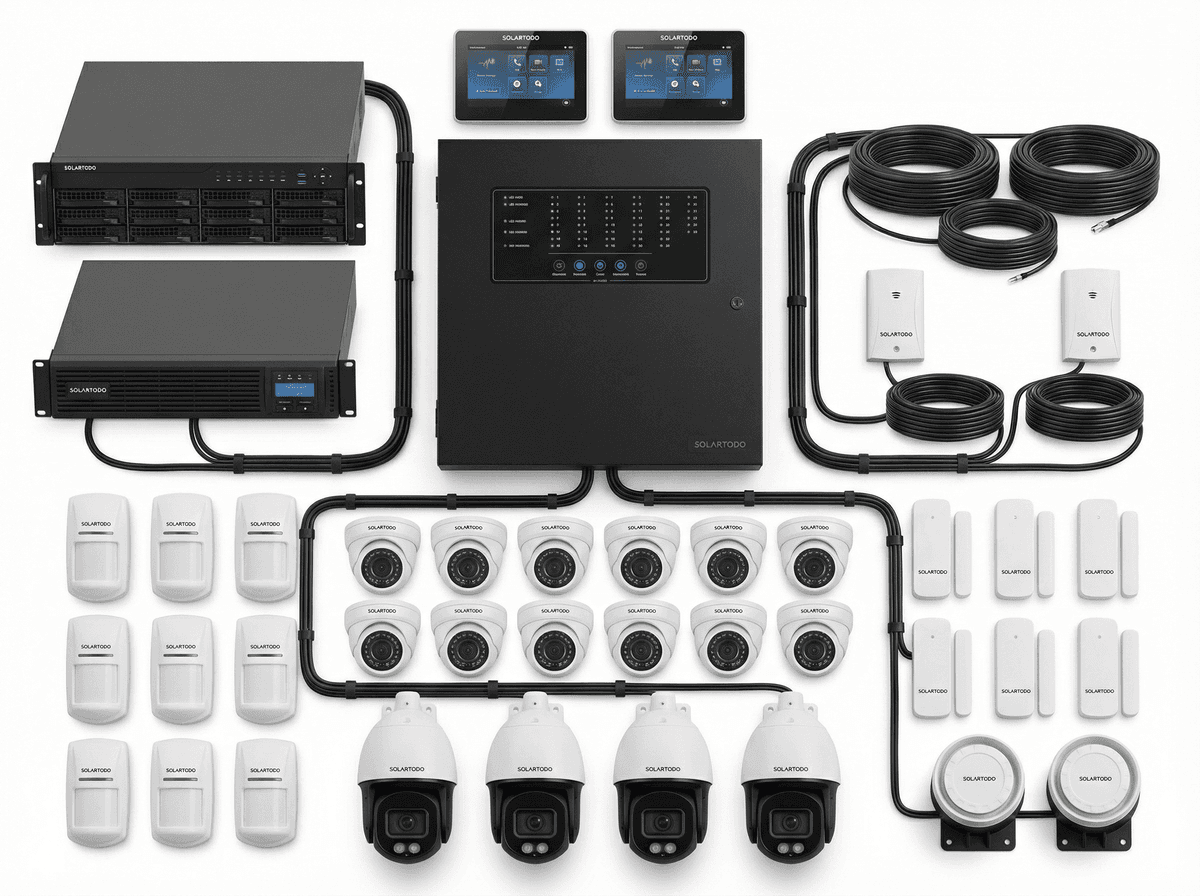
The power system must support communications redundancy as well as energy storage. For example, the SOLAR TODO Gas Station Chain 32-Zone Cloud package uses 4G + Ethernet + WiFi communications, 16 HD IP cameras, 32 primary detector points, and 30 days of 4K video retention. That means the hybrid power design should prioritize network switches, NVR, cloud gateway, and alarm panel partitions before nonessential loads.
The same logic applies to larger sites. The SOLAR TODO Port Terminal 96-Zone Full Security package includes 48 cameras, 96 detectors, and 1,000 meters of electric fence, so power design must separate life-safety and perimeter circuits from convenience loads. Where public-sector sites are involved, the SOLAR TODO Government Building 128-Zone Maximum package supports 128 security zones and 64 cameras, which typically requires multi-bus distribution, surge protection, and staged restart sequencing after outages.
| Parameter | Small Site | Medium Site | Large Site |
|---|---|---|---|
| Typical application | Retail kiosk, small gate | Gas station, warehouse edge | Port sector, campus perimeter |
| Continuous load | 0.5-1.0 kW | 1.0-2.5 kW | 2.5-5.5 kW |
| Solar PV size | 2-4 kW | 5-10 kW | 12-20 kW |
| Battery capacity | 5-10 kWh | 15-40 kWh | 40-80 kWh |
| Backup autonomy | 8-12 h | 12-24 h | 8-24 h |
| Typical cameras | 4-8 | 8-24 | 24-64 |
According to IEC (2023), safety and interoperability remain central to distributed power equipment selection. For procurement teams, the minimum review set usually includes IEC 61215, IEC 61730, IEC 62109, and application-side standards such as EN 50131, IEC 62676, UL 681, and NFPA 72.
Cost Data, EPC Investment Analysis and Pricing Structure
In 2026, hybrid power security systems commonly price from about $3,500-$9,000 for small sites, $12,000-$38,000 for medium sites, and $45,000-$160,000+ for larger multi-zone deployments depending on cameras, storage hours, and civil works.
The cost stack has shifted since 2021 because battery pricing has declined while labor, steel, freight, and compliance costs have stayed elevated. According to BloombergNEF (2024), lithium-ion battery pack prices fell to around $115/kWh on average in 2024, down from levels above $130/kWh in 2023. Delivered project pricing remains much higher than pack price because enclosures, BMS, inverter, mounting, cabling, and commissioning often add 2.0-4.5x to the battery component cost.
Three-tier pricing structure
For B2B procurement, pricing should be compared in three layers rather than one headline number.
- FOB Supply: equipment only, ex-factory or export port; buyer handles freight, import, installation, and commissioning.
- CIF Delivered: equipment plus ocean freight and insurance to destination port; local installation remains outside scope.
- EPC Turnkey: engineering, procurement, construction, installation, testing, commissioning, and handover; this is the correct basis for total cost of ownership comparison.
For large projects, SOLAR TODO typically supports offline quotation and project finance discussion rather than online checkout. Standard payment terms are 30% T/T + 70% against B/L, or 100% L/C at sight. Financing may be available for larger projects above $1,000K. Commercial inquiries can be directed to [email protected].
Volume pricing guidance
Volume effects matter because repeatable enclosures, battery cabinets, and security packages reduce engineering hours.
- 50+ units: target about 5% discount
- 100+ units: target about 10% discount
- 250+ units: target about 15% discount
Cost comparison by application
| Application | Typical Hybrid System Size | FOB Supply | CIF Delivered | EPC Turnkey |
|---|---|---|---|---|
| Small remote security post | 2-4 kW PV + 5-10 kWh | $3,500-$6,000 | $4,200-$7,200 | $6,000-$9,000 |
| Gas station security site | 5-10 kW PV + 15-30 kWh | $9,500-$18,000 | $11,000-$21,000 | $15,000-$32,000 |
| Warehouse or logistics edge | 8-15 kW PV + 20-50 kWh | $14,000-$28,000 | $16,500-$33,000 | $22,000-$48,000 |
| Port or campus perimeter sector | 12-20 kW PV + 40-80 kWh | $32,000-$75,000 | $38,000-$88,000 | $45,000-$160,000+ |
According to IRENA (2024), solar project economics remain favorable where daytime generation offsets retail or diesel-equivalent power above $0.10-$0.15/kWh. For remote security sites using diesel with delivered energy costs of $0.25-$0.45/kWh, hybrid systems often produce the strongest payback.
ROI, Regional Economics, and 2020-2040 Trend Analysis
Hybrid power security systems usually reach payback in 2.5-5.5 years at diesel-heavy remote sites and 4-7 years at grid-edge sites, with savings driven by lower fuel use, fewer outages, and longer equipment uptime.
The economics depend on three variables: local solar yield, avoided diesel or grid cost, and outage penalty. If a site with a 2.0 kW average load consumes about 17,520 kWh/year, then replacing 70% of diesel-generated energy at $0.32/kWh avoids roughly $3,925/year before maintenance savings. Add reduced generator servicing and lower truck rolls, and annual benefit can exceed $4,500-$6,000 for some remote sites.
ROI by region and application
| Region | Typical Avoided Energy Cost | Common Payback | Notes |
|---|---|---|---|
| Asia-Pacific | $0.12-$0.30/kWh | 3-6 years | Strong solar yield in many markets, mixed grid quality |
| Europe | $0.18-$0.35/kWh | 4-7 years | High retail tariffs support grid-tied hybrid ROI |
| North America | $0.10-$0.28/kWh | 4-7 years | Resilience value important in storm and wildfire zones |
| Middle East/Africa | $0.20-$0.45/kWh | 2.5-5 years | Diesel displacement often drives best economics |
| Latin America | $0.14-$0.32/kWh | 3-6 years | Voltage instability and security demand improve value |
Year-over-year trend analysis
From 2020 to 2022, many projects were delayed by freight volatility and battery cost inflation. From 2023 to 2025, battery pricing improved while buyers placed more emphasis on resilience after repeated outage events and fuel price shocks. In 2025-2026, procurement is moving from simple backup systems toward monitored hybrid platforms with cloud analytics, battery telemetry, and remote firmware management.
From 2027 to 2030, expect wider use of DC-coupled storage, AI-assisted dispatch, and modular battery cabinets in the 10-100 kWh range for security estates. According to Wood Mackenzie (2024), commercial and industrial storage deployments are expected to maintain strong growth through the decade, especially where demand charges, backup value, and solar self-consumption stack together.
From 2030 to 2040, the likely direction is deeper integration between security, microgrid, and facility management systems. Battery chemistry may diversify, but LiFePO4 should remain strong in the near term because of safety, cycle life, and bankability. According to Fraunhofer ISE (2024), continued PV efficiency gains and BOS optimization should keep reducing levelized daytime energy cost, even if labor costs remain firm.
The International Energy Agency states, “Energy security is a central pillar of clean energy transitions.” For security infrastructure buyers, that statement is practical rather than abstract: lower outage exposure and lower fuel dependence both improve operating resilience.
Procurement Guidance, Use Cases, and Selection Criteria
The best hybrid power security system is the one that matches load profile, autonomy target, and site risk level with verified standards, not the one with the lowest initial equipment price.
For a gas station chain, the power design should support forecourt cameras, cashier zone coverage, back-office alarm partitions, and cloud connectivity. A 32-zone, 16-camera package with 30 days of retention can justify 12-24 hours of battery autonomy if the site sees frequent outages or nighttime incidents. For ports and logistics yards, perimeter sectors and PTZ cameras raise both continuous and surge demand, so 40-80 kWh storage may be justified even when average load appears moderate.
Selection checklist
- Define critical load in kW and daily energy in kWh/day.
- Set minimum backup autonomy at 8, 12, or 24 hours.
- Verify solar resource using NREL PVWatts or local irradiance data.
- Choose battery chemistry with at least 4,000 cycles for daily cycling.
- Confirm standards: IEC 61215, IEC 61730, IEC 62109, EN 50131, IEC 62676, UL 681, NFPA 72.
- Ask for single-line diagram, battery warranty, and commissioning scope.
- Compare FOB, CIF, and EPC turnkey pricing on the same technical basis.
SOLAR TODO is relevant where buyers need integrated security plus power continuity rather than separate procurement streams. That is especially useful for multi-site operators managing 5 to 500 locations who want common dashboards, repeatable spare parts, and one commissioning workflow. For inquiry-led projects, SOLAR TODO can support technical discussion, offline quotation, and financing review for larger deployments.
FAQ
A hybrid power security system usually combines solar PV, battery storage, inverter/charger, and monitored security loads so cameras and alarms stay online during outages and fuel use drops.
Q: What is a hybrid power security system? A: A hybrid power security system combines solar PV, battery storage, inverter control, and security equipment such as cameras, alarms, NVRs, and communications devices. It is used to keep critical security loads online for 8-24 hours or longer while reducing diesel runtime by 60-95% at suitable sites.
Q: How much does a hybrid power security system cost in 2026? A: Small systems commonly start around $3,500-$9,000 installed, while medium commercial systems often range from $15,000-$32,000 turnkey. Large perimeter or campus deployments can exceed $45,000-$160,000 depending on PV size, battery capacity, trenching, poles, and commissioning scope.
Q: Why are solar and storage attractive for security applications? A: Security loads run 24/7, so outages create immediate operational risk and evidence gaps. Solar covers daytime energy at low marginal cost, and batteries keep cameras, NVRs, and alarm panels online for 8-24 hours, which reduces generator starts, fuel logistics, and maintenance visits.
Q: What battery type is best for security backup systems? A: LiFePO4 is usually the preferred option because it offers 4,000-7,000 cycles, 90-95% round-trip efficiency, and better thermal stability than most lead-acid alternatives. Lead-acid can still work for low-budget projects, but shorter life and deeper maintenance requirements often increase total cost.
Q: How do I size solar and battery capacity for a surveillance site? A: Start with the continuous load in kW and daily energy in kWh/day. Then size PV at roughly 1.2-1.5x average daily demand and battery for the required autonomy window, such as 12 hours or 24 hours, while accounting for local irradiance, depth of discharge, and future load growth.
Q: What standards should procurement teams check? A: For the power side, check IEC 61215, IEC 61730, and IEC 62109. For the security side, review EN 50131, IEC 62676, UL 681, and NFPA 72 where applicable. These standards help reduce compliance, insurance, and commissioning risk in cross-border projects.
Q: How does EPC turnkey delivery differ from FOB and CIF supply? A: FOB covers equipment supply at export point, and CIF adds freight and insurance to destination port. EPC turnkey includes engineering, procurement, installation, testing, and handover, so it is the best basis for comparing total delivered cost and performance responsibility.
Q: What payment terms are common for B2B orders? A: A common structure is 30% T/T + 70% against B/L, or 100% L/C at sight for qualified transactions. For larger projects above $1,000K, financing may be available subject to project scope, buyer profile, and destination market conditions.
Q: What payback period should buyers expect? A: Remote diesel-reliant sites often see payback in 2.5-5.5 years because avoided energy cost can exceed $0.25-$0.45/kWh. Grid-edge sites with fewer outages usually land closer to 4-7 years, especially where resilience value is important but hard to monetize directly.
Q: Can hybrid power support multi-site security portfolios? A: Yes. Multi-site operators such as gas station chains, logistics networks, and telecom compounds can standardize 5 to 500 sites with repeatable PV, battery, and monitoring blocks. This reduces spare-parts complexity, improves remote diagnostics, and makes fleet-level energy and alarm performance easier to manage.
Q: How much maintenance do these systems need? A: Maintenance is moderate and mostly preventive. Buyers should plan visual inspection every 3-6 months, electrical checks every 12 months, and battery/inverter telemetry review continuously through the monitoring platform. Dust control, terminal torque checks, and firmware updates are the main recurring tasks.
Q: When should a diesel generator still be retained? A: Keep a generator where outage duration can exceed 24 hours, solar resource is poor for several days, or site criticality is extremely high. In those cases, the hybrid system should reduce generator runtime and fuel use rather than eliminate the generator completely.
References
- IEA (2024): World Energy Outlook 2024 and related electricity market analysis on distributed energy resilience and solar growth.
- IRENA (2024): Renewable Power Generation Costs in 2023 with solar cost benchmarks and competitiveness data.
- IRENA (2025): Renewable Capacity Statistics 2025 covering global renewable deployment trends by region.
- NREL (2024): PVWatts Calculator methodology and solar resource assumptions for PV yield estimation.
- BloombergNEF (2024): Battery pack price survey and market outlook for lithium-ion cost trends.
- Wood Mackenzie (2024): Commercial and industrial energy storage market outlook and deployment trends.
- Fraunhofer ISE (2024): PV market and technology analysis, including efficiency and BOS trend observations.
- IEC 62676 (2023): Video surveillance systems for use in security applications.
- EN 50131 (2024 reference use): Intrusion and hold-up systems framework for alarm system design and grading.
- UL 681 (2023 reference use): Installation and classification guidance for burglary and holdup alarm systems.
Conclusion
Hybrid power security systems deliver the strongest value where sites need 24/7 surveillance, face unstable power, and spend more than $0.15-$0.25/kWh on delivered energy. For multi-site operators and critical facilities, SOLAR TODO can combine security architecture and solar-storage continuity into one procurement path, with typical payback of 2.5-7 years depending on region and outage profile.
About SOLARTODO
SOLARTODO is a global integrated solution provider specializing in solar power generation systems, energy-storage products, smart street-lighting and solar street-lighting, intelligent security & IoT linkage systems, power transmission towers, telecom communication towers, and smart-agriculture solutions for worldwide B2B customers.
About the Author

SOLARTODO Editorial Team
Solar Energy & Infrastructure Expert Team
SOLAR TODO is a professional supplier of solar energy, energy storage, smart lighting, smart agriculture, security systems, communication towers, and power tower equipment.
Our technical team has over 15 years of experience in renewable energy and infrastructure, providing high-quality products and solutions to B2B customers worldwide.
Expertise: PV system design, energy storage optimization, smart lighting integration, smart agriculture monitoring, security system integration, communication and power tower supply.
Cite This Article
SOLARTODO Editorial Team. (2026). Hybrid Power Security System Market 2026: Solar + Storage…. SOLARTODO. Retrieved from https://solartodo.com/knowledge/hybrid-power-security-system-market-2026-solar-storage-integration-cost-data
@article{solartodo_hybrid_power_security_system_market_2026_solar_storage_integration_cost_data,
  title = {Hybrid Power Security System Market 2026: Solar + Storage…},
  author = {SOLARTODO Editorial Team},
  journal = {SOLARTODO Knowledge Base},
  year = {2026},
  url = {https://solartodo.com/knowledge/hybrid-power-security-system-market-2026-solar-storage-integration-cost-data},
  note = {Accessed: 2026-10-15}
}
Published: April 30, 2026 | Available at: https://solartodo.com/knowledge/hybrid-power-security-system-market-2026-solar-storage-integration-cost-data
Subscribe to Our Newsletter
Get the latest solar energy news and insights delivered to your inbox.
View All Articles