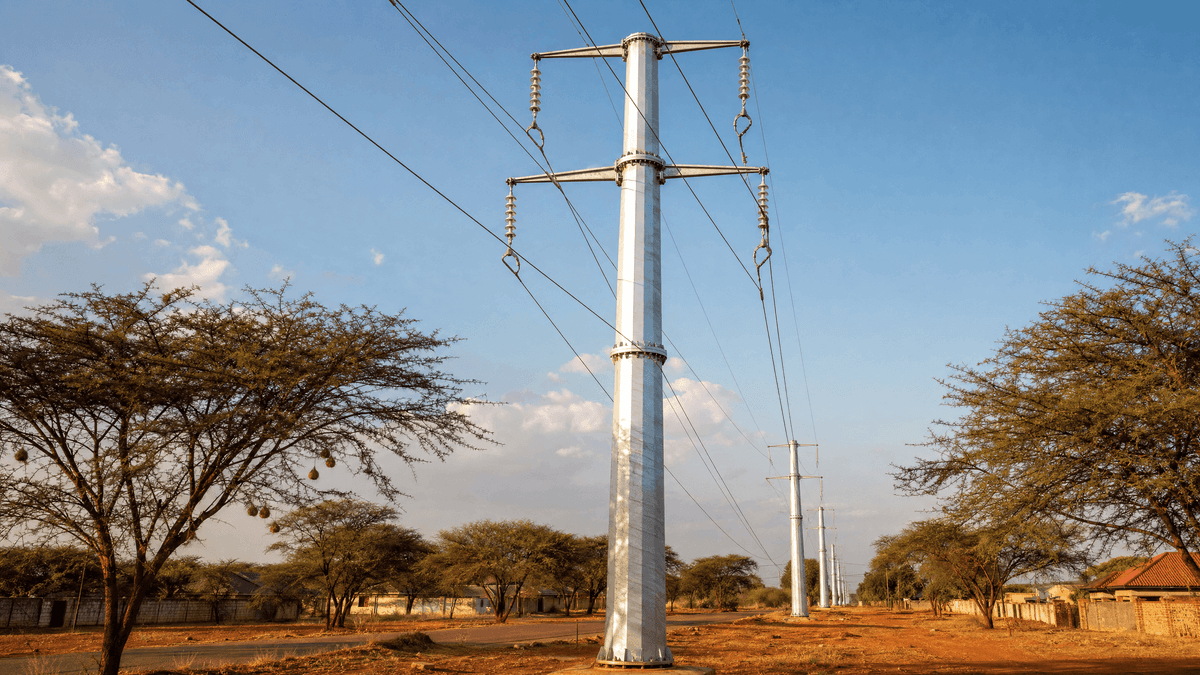
Harare Power Transmission Tower Market Analysis: 35kV Distribution Configuration Guide
Summary
Harare’s medium-voltage distribution expansion would typically suit a 35kV double-circuit steel tubular Power Transmission Tower configuration using approximately 191 poles across about 11km, with 40m/s wind design, 60m spans, and Q345 hot-dip galvanized steel for municipal network reinforcement.
Key Takeaways
- Harare’s urban service profile supports a 35kV medium-voltage municipal distribution configuration rather than 110kV or 220kV transmission for intra-city feeder reinforcement.
- A typical project scale for this corridor length would use approximately 191 steel tubular poles over about 11km, based on the provided municipal distribution layout.
- The specified pole form is a 22m tapered steel tubular pole, double circuit, fabricated in hot-dip galvanized Q345 steel with anchor-bolt cage foundations.
- Electrical fit is based on ACSR 70 conductor, rated at 275kg/km with maximum tension 22kN, suitable for short urban spans and moderate conductor loading.
- Mechanical design input is Wind Class 4 at 40m/s, with 1.5m phase spacing, 5.5m ground clearance, and 0.8m insulator length under IEC 60826 / GB 50545.
- For Harare’s urban rights-of-way, the provided 60m span is tighter than the generic 35kV benchmark and would typically be selected where crossings, road reserves, and distribution density constrain alignment.
- The specified 30-year design life and galvanized steel monopole form reduce routine maintenance compared with painted steel or timber alternatives in polluted urban environments.
- SOLAR TODO positions this product line for utility and EPC buyers needing a tubular alternative to lattice structures; details are available on the Power Transmission Tower product page and via contact us.
Market Context for Harare
Harare, at roughly 1,483m elevation and coordinates 17.83°S, 31.05°E, is Zimbabwe’s largest urban economy and requires medium-voltage distribution assets that fit dense road corridors, municipal substations, and mixed commercial-residential feeder routes. According to the Zimbabwe National Statistics Agency (ZIMSTAT) (2022), Harare Metropolitan Province had a population of 2.4 million+, making distribution network reliability a direct planning issue for a large urban load center.
According to the World Bank (2023), Zimbabwe continues to face electricity supply constraints, with reliability and access improvements tied to grid rehabilitation and distribution investment rather than generation alone. For Harare, that means city-scale reinforcement often happens at the distribution and sub-transmission interface, where 11kV, 22kV, and 33/35kV-class feeders connect substations, industrial loads, and municipal demand clusters.
Climate and mechanical loading also matter. According to Meteonorm climate datasets referenced by NREL (2020), Harare has a subtropical highland climate with a pronounced wet season and seasonal thunderstorms, while utility structures must also account for local gusting conditions and corrosion exposure. A 40m/s wind design class is therefore a practical municipal benchmark for exposed corridors, road reserves, and open peri-urban sections.
Local grid planning supports the case for compact steel poles. According to the Zimbabwe Energy Regulatory Authority (ZERA) (2023), distribution system strengthening remains necessary to reduce technical losses and improve service continuity. In dense city corridors, tubular steel poles can be preferred over lattice towers because they occupy a smaller footprint, simplify roadside placement, and reduce visual clutter while still supporting double-circuit 35kV arrangements.
This is where SOLAR TODO’s Power Transmission Tower line fits the Harare profile. For municipal and utility buyers, the relevant question is not whether a very tall transmission structure is needed, but whether a medium-voltage steel tubular pole system can support urban feeder capacity, withstand 40m/s wind, and maintain clearances within constrained corridors. For Harare, the answer is generally yes when the route is a city distribution line rather than a long-span interconnection corridor.
Recommended Technical Configuration
A Harare municipal feeder route of about 11km would typically fit a 35kV double-circuit steel tubular pole solution using approximately 191 units, subject to final survey, crossing density, and utility protection requirements. The supplied project-specific configuration points to a compact urban distribution design rather than a high-voltage transmission corridor.
The first engineering step is voltage class selection. Based on the product rules, 35kV falls in the 10–35kV distribution category, which normally corresponds to 12–18m height, 1–3 t/pole, single or double circuit, and 80–150m spans. However, the project-specific configuration explicitly calls for 22m tapered steel tubular poles for a 35kV double-circuit line, so this guide treats that as a customer-specified municipal configuration rather than a generic baseline. In practice, utilities may choose a taller pole where road crossings, communication attachments, clearance policy, or route geometry require added structure height.
A typical deployment of this scale would consist of:
- Approximately 191 tapered steel tubular poles
- 35kV double-circuit line configuration
- 22m pole height
- Hot-dip galvanized Q345 steel
- Anchor-bolt cage concrete foundations
- ACSR 70 conductor with 22kN max tension
- 1.5m phase spacing
- 5.5m minimum ground clearance
- 0.8m insulator string length
- 60m average span over about 11km
Why this configuration makes sense in Harare: the city has many constrained alignments where a shorter span such as 60m can reduce angle loading, simplify crossing control, and help maintain clearances over roads, drainage channels, and built-up frontage. The double-circuit arrangement also supports more feeder capacity within a single corridor, which is useful where acquiring new wayleave width is difficult.
From a procurement perspective, SOLAR TODO would typically position this as a medium-voltage municipal distribution pole class rather than a regional transmission tower. That distinction matters because it affects insulator selection, conductor size, erection method, and foundation geometry. It also avoids the common specification error of oversizing to 110kV or 220kV hardware where Harare’s urban feeder duty only requires 35kV-class equipment.
Technical Specifications
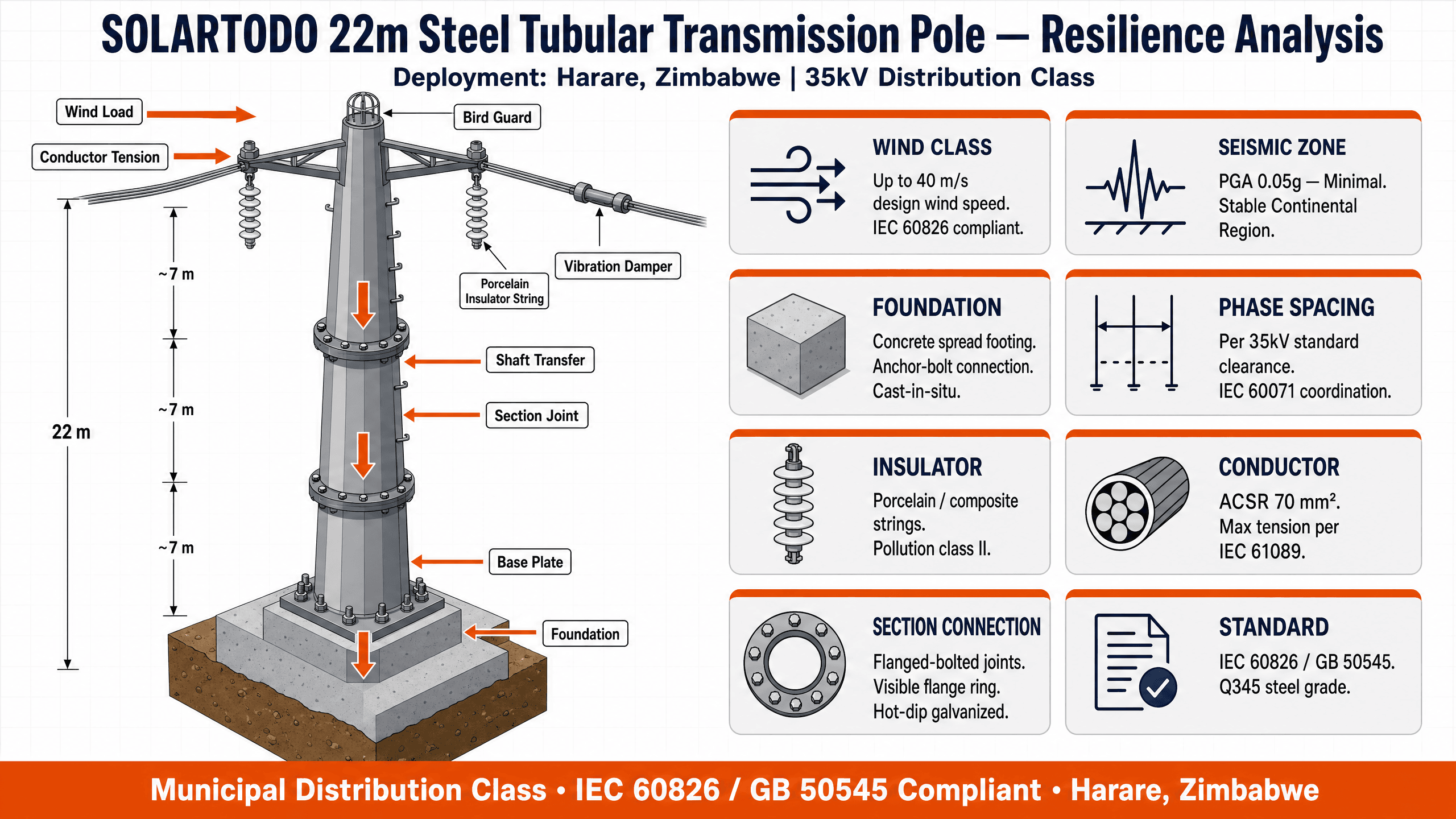
The Harare configuration analyzed here is a 35kV double-circuit, 22m steel tubular Power Transmission Tower system with approximately 191 poles over 11km, using Q345 hot-dip galvanized steel, ACSR 70 conductor, and 40m/s wind loading under IEC 60826 / GB 50545.
Core Pole and Line Data
- Product type: Steel tubular Power Transmission Tower
- Pole form: Tapered steel tubular pole
- Voltage class: 35kV
- Circuit arrangement: Double circuit
- Pole quantity: Approximately 191 units
- Pole height: 22m
- Pole weight: About 9t/pole
- Linear mass reference: 400kg/m
- Total route length: About 11km
- Average span: 60m
- Pole material: Q345 steel
- Surface treatment: Hot-dip galvanizing
Electrical and Mechanical Data
- Conductor type: ACSR 70
- Conductor mass: 275kg/km
- Maximum conductor tension: 22kN
- Phase spacing: 1.5m
- Minimum ground clearance: 5.5m
- Insulator length: 0.8m
- Wind class: Class 4
- Basic wind speed: 40m/s
- Design life: 30 years
Foundation and Accessories
- Foundation type: Concrete foundation with anchor-bolt cage
- Standard accessories:
- Cross arm
- Climbing steps
- Grounding set
- Bird guard
- Vibration damper
Standards and Compliance Basis
- Structural loading: IEC 60826
- Chinese transmission/distribution structural design basis: GB 50545
- Galvanizing quality should be checked against utility procurement requirements and commonly referenced coating inspection procedures.
According to IEC (2017), overhead line design must consider wind, conductor tension, and reliability level as an integrated system rather than as isolated component checks. According to IEEE (2023) guidance on overhead line practice, structure selection should match route constraints, electrical clearances, and maintenance access, which is why tubular poles are often specified in urban corridors.
Implementation Approach
A municipal 35kV line in Harare would typically be delivered in 5 phases over roughly 5-9 months, depending on permitting, foundation curing time, and customs clearance for steel sections and accessories. The practical sequence is route survey, detailed design, factory fabrication, civil works, pole erection, stringing, and energization testing.
1. Survey and Utility Design
The first phase is a corridor survey covering 11km, with every proposed pole location checked for road reserve width, drainage, buried utilities, and crossing points. At 60m average spans, the route would require close spotting of angle and terminal poles because urban geometry usually creates more deviation points than rural lines. Clearance checks should confirm the 5.5m ground clearance requirement and the 0.8m insulator geometry under maximum sag conditions.
2. Fabrication and Logistics
The steel poles would typically be fabricated in flanged sections from Q345 steel, then hot-dip galvanized before packing for shipment. For approximately 191 units at about 9t each, total steel tonnage is substantial, so transport planning should include offloading equipment, staging yard area, and sequence delivery by erection lot. SOLAR TODO would normally advise buyers to align section lengths with available truck access and crane capacity in Harare’s road network.
3. Civil Works and Foundations
Anchor-bolt cage foundations are suitable where repeatability and alignment control are important. Each foundation should be set out for bolt-circle accuracy before concrete pour, because even a few millimeters of anchor deviation can delay erection of a 22m flanged tubular pole. In Harare’s rainy season, contractors usually need to plan drainage, excavation support, and concrete curing windows carefully.
4. Pole Erection and Stringing
Pole erection would generally proceed section by section using mobile cranes sized to the heaviest lift and local access limits. After plumb checks and torque verification, crews install cross arms, insulators, bird guards, dampers, and grounding sets before conductor stringing. With ACSR 70 and 22kN maximum tension, stringing equipment can be smaller than what is needed for 110kV or 220kV lines, which helps in urban sites.
5. Testing and Commissioning
Before energization, the line should undergo foundation inspection, bolt torque checks, galvanizing touch-up verification where required, grounding continuity tests, and sag-tension confirmation. Utilities also typically require as-built documentation for all 191 locations, including foundation records and pole numbering. For buyers that need bid support, SOLAR TODO can provide technical schedules and fabrication data through the contact page.
Expected Performance & ROI
A 35kV tubular pole line in Harare would typically improve feeder routing efficiency, reduce corridor footprint, and lower recurring structure maintenance over a 30-year design life, with economic value driven more by outage reduction and asset longevity than by direct revenue from the poles themselves.
According to IRENA (2023), transmission and distribution investment is a core enabler of power system reliability, particularly in markets where constrained networks limit delivered electricity more than installed generation does. In Harare, the value case for a double-circuit 35kV line is usually based on three factors: more capacity in the same corridor, lower land-use conflict than lattice structures, and reduced maintenance frequency due to galvanizing.
According to the World Bank (2023), power interruptions in many developing grids impose meaningful economic costs on commercial and industrial users. For a municipal utility or private industrial feeder operator, the return on a properly specified line often appears as avoided outage hours, lower emergency repair frequency, and fewer pole replacements compared with timber systems over 20-30 years.
From a lifecycle perspective, hot-dip galvanized steel has a predictable inspection profile. According to NREL (2020) and broader utility asset practice, corrosion-resistant steel structures generally shift spending from frequent replacement toward periodic inspection and localized hardware maintenance. In a city such as Harare, where traffic control and access mobilization add cost to every intervention, fewer major structural interventions can materially improve total ownership cost.
A realistic ROI framework for buyers should include:
- 30-year design life baseline
- Reduced right-of-way footprint versus lattice alternatives
- Lower replacement frequency than untreated timber poles
- Better circuit density with double-circuit arrangement
- Lower outage exposure from structurally inconsistent legacy assets
- Faster repeatable installation where anchor-bolt foundations are standardized
For EPC and utility procurement teams, the payback period is therefore usually assessed at the network level, often in the 5-12 year range when outage reduction, loss reduction, and deferred replacement are included. Exact financial return depends on fault rates, energy-not-served valuation, and local financing terms rather than on pole cost alone.
Results and Impact
A Harare 35kV corridor built to this specification would typically deliver 11km of double-circuit municipal distribution capacity, support denser feeder routing with 191 pole positions, and maintain a 40m/s wind design basis suitable for exposed urban and peri-urban sections.
The main operational impact is corridor efficiency. A double-circuit arrangement can place two circuits on one line of support structures, reducing the need for parallel pole lines where road reserve is limited. The second impact is maintenance discipline: galvanized steel, standardized accessories, and anchor-bolt foundations make inspections more repeatable over a 30-year asset horizon.
For Harare specifically, this type of Power Transmission Tower is best understood as a distribution reinforcement asset, not a long-span bulk transmission structure. That distinction helps utilities avoid overbuilding and keeps the specification aligned with municipal feeder duty. SOLAR TODO uses this product category for buyers who need a compact steel alternative to larger tower forms on urban routes.
Comparison Table
A Harare buyer comparing structure options should focus on 35kV duty, 22m height, 60m span, and 30-year life, because those factors drive corridor fit and maintenance cost more than nominal steel tonnage alone.
| Parameter | Recommended Harare Configuration | Typical Timber Pole Alternative | 110kV Steel Pole Class (Not Recommended for this use) |
|---|---|---|---|
| Voltage class | 35kV | 11-33kV commonly | 66-110kV |
| Structure form | Tapered steel tubular pole | Timber pole | Heavy steel tubular pole |
| Circuit arrangement | Double circuit | Usually single | Single or double |
| Pole height | 22m | 12-16m typical | 18-30m |
| Average span in this guide | 60m | 40-70m | 200-300m typical class range |
| Wind design | 40m/s | Site-dependent | Site-dependent |
| Design life | 30 years | Often lower, maintenance-sensitive | 30+ years |
| Urban footprint | Small | Small | Moderate |
| Corrosion protection | Hot-dip galvanized | Not applicable | Hot-dip galvanized |
| Best fit for Harare municipal feeder | Yes | Partial, depending on loading | No, oversized for 35kV duty |
Pricing & Quotation
SOLAR TODO offers three pricing tiers for this product line: FOB Supply (equipment ex-works China), CIF Delivered (including ocean freight and insurance), and EPC Turnkey (fully installed, commissioned, with 1-year warranty). Volume discounts are available for large-scale deployments. Configure your system online for an instant estimate, or request a custom quotation from our engineering team at [email protected].
Frequently Asked Questions
A Harare utility buyer usually asks about 35kV fit, 22m height, 191-unit scale, 40m/s wind loading, and 30-year lifecycle, so the answers below focus on those procurement and engineering points.
Q1: Is this Power Transmission Tower suitable for Harare city distribution networks?
Yes, for municipal medium-voltage routes it is a suitable fit. The analyzed configuration is 35kV, double circuit, and 22m high, which aligns with urban feeder reinforcement rather than long-distance bulk transmission. Final suitability still depends on the utility’s protection scheme, clearance rules, and route survey.
Q2: Why use a steel tubular pole instead of a lattice tower in Harare?
A tubular pole usually needs a smaller footprint and works better in road reserves and dense urban corridors. For a route of about 11km with 191 positions, that can simplify placement and reduce visual and land-use impact. It also supports standardized accessories and hot-dip galvanized corrosion protection.
Q3: What conductor is recommended for this configuration?
The specified conductor is ACSR 70, with 275kg/km mass and 22kN maximum tension. That is appropriate for the provided 60m span layout and municipal distribution duty. If the utility needs higher current capacity, conductor selection should be rechecked together with sag, tension, and pole loading.
Q4: How long would a project of this size usually take?
A typical 191-pole, 11km project may take around 5-9 months from survey to commissioning. The schedule depends on foundation curing, customs clearance, weather, and outage windows for tie-ins. Urban access restrictions in Harare can also affect crane movement and daily erection productivity.
Q5: What maintenance should buyers expect over 30 years?
Routine work is usually limited to visual inspection, bolt torque checks, grounding checks, conductor hardware inspection, and corrosion review at damaged coating points. Because the poles are hot-dip galvanized Q345 steel, maintenance is usually lower than for painted steel or timber systems. Inspection intervals depend on utility policy and pollution exposure.
Q6: What is the expected ROI or payback period?
For utility assets, ROI is usually measured through outage reduction, deferred replacement, and lower maintenance rather than direct cash revenue. A network-level payback of roughly 5-12 years can be realistic if the new line reduces fault exposure and improves feeder capacity. Exact return depends on local tariffs, financing, and outage-cost assumptions.
Q7: Does SOLAR TODO provide EPC or supply-only options?
Yes. SOLAR TODO offers FOB Supply, CIF Delivered, and EPC Turnkey options for the power-tower line. Buyers can choose supply-only for utility-managed installation or turnkey delivery where one contractor handles fabrication, logistics, erection, and commissioning under the agreed scope.
Q8: What standards apply to this Harare configuration?
The stated design basis includes IEC 60826 and GB 50545. IEC 60826 covers loading and design criteria for overhead lines, including wind and reliability considerations. Utility tenders may also request additional inspection, galvanizing, or grounding requirements depending on Zimbabwean utility practice and consultant specifications.
Q9: What foundation type is used for these poles?
The specified foundation is a concrete anchor-bolt cage foundation. This approach gives repeatable alignment for flanged steel pole sections and supports faster erection once concrete reaches strength. Foundation dimensions still need geotechnical confirmation because soil bearing capacity and groundwater conditions vary across Harare sites.
Q10: Is the 22m pole height too tall for 35kV?
For generic 35kV distribution, many lines fall in the 12-18m class, so 22m is above the usual baseline. However, a utility may still specify 22m where crossings, clearance policy, route geometry, or double-circuit arrangement require added height. The key is that the full mechanical and clearance design must be checked as one system.
References
- Zimbabwe National Statistics Agency (2022): 2022 Population and Housing Census data showing Harare Metropolitan Province population above 2.4 million.
- World Bank (2023): Zimbabwe energy sector updates and electricity access/reliability context relevant to grid rehabilitation and distribution strengthening.
- Zimbabwe Energy Regulatory Authority (2023): National electricity sector regulatory information and planning context for distribution network performance.
- IEC (2017): IEC 60826 design criteria for overhead transmission lines, including loading and reliability requirements.
- IEEE (2023): Overhead line design and utility engineering guidance relevant to structure selection, clearances, and maintenance practice.
- IRENA (2023): Power system and network investment analysis highlighting the role of transmission and distribution infrastructure in reliability.
- NREL (2020): Climate and infrastructure planning resources used in energy-system design, including environmental conditions relevant to line engineering.
- Government of Zimbabwe / energy planning publications (latest available): National infrastructure and electricity planning context applicable to Harare distribution reinforcement.
Equipment Deployed
- 191 × 22m tapered steel tubular Power Transmission Tower poles, double circuit, Q345 hot-dip galvanized steel
- 35kV medium-voltage municipal distribution line configuration
- Pole weight approximately 9t per pole, linear mass reference 400kg/m
- ACSR 70 conductor, 275kg/km, maximum tension 22kN
- Insulator strings, 0.8m length
- Cross arms for double-circuit arrangement with 1.5m phase spacing
- Concrete anchor-bolt cage foundations
- Grounding system set for each pole position
- Climbing steps for maintenance access
- Bird guards and vibration dampers
- Design basis: Wind Class 4, 40m/s
- Standards basis: IEC 60826 / GB 50545