
Guatemala City Solar Streetlight (Split-Type) Market Analysis: 122-Unit 9m Configuration Guide for 10m Roads
Summary
Guatemala City's tropical solar resource of about 5.5 peak-sun-hours and dense 10m urban road corridors support a typical 122-unit split-type streetlight layout with 9m poles, 80W LED heads, 27m spacing, and 3-5 days of battery backup.
Key Takeaways
- A typical Guatemala City deployment of this profile would use approximately 122 units on 9m stainless steel 304 poles with 50 m/s wind resistance and a nominal 40-year structural life.
- For a 10m road width and 27m pole spacing, an 80W LED / 12,000 lm luminaire class is a practical fit for collector roads, access roads, and mixed urban corridors.
- Based on the specified configuration, each pole would carry a 910W Mono TOPCon panel with 23% efficiency, 0.3%/yr degradation, and a 30-year warranty.
- Energy storage in this profile uses an external 12V/200Ah NCM lithium battery box, rated around 2000 cycles, 85% DoD, and a 5-year warranty.
- Guatemala City's climate profile supports dusk-to-dawn operation with 3-5 days of cloudy-weather backup when paired with MPPT control and internal pole wiring.
- Smart controls such as dimming control and 4G/LoRa remote monitoring can reduce unnecessary runtime and improve fault visibility across a 122-point lighting network.
- The configuration aligns with CJJ 45-2015, IEC 60598, and IEC 62124, which matter for luminaire safety, outdoor lighting practice, and PV system performance assessment.
- For buyers comparing options, the split-type format keeps the battery box external and serviceable, unlike integrated fixtures that often require full-head replacement after battery degradation.
Market Context for Guatemala City
Guatemala City combines high urban density, tropical irradiance near 14.63, -90.51, and mixed road conditions that make autonomous streetlighting technically viable on selected corridors without trenching. According to the World Bank (2023), Guatemala's urban population exceeds 50% of the national total, and the Guatemala metropolitan area remains the country's main concentration of transport demand and public-lighting load.
Guatemala City's need is not simply more light points; it is more controllable and lower-civil-works lighting on roads where grid extension, cable theft, or service interruptions raise lifecycle cost. According to the World Bank (2022), access to electricity in Guatemala is above 90%, but distribution quality and municipal service reliability still vary by location, which is why off-grid or grid-independent lighting remains relevant for roads, parks, and peripheral urban zones.
Solar resource is a strong local advantage. According to the World Bank Global Solar Atlas (2024), central Guatemala typically records photovoltaic potential consistent with roughly 5.0-5.5 kWh/m2/day of average solar yield, which aligns with the project-specific climate assumption of 5.5h sun. That level supports split-type solar streetlights more comfortably than lower-irradiance cities in northern latitudes.
Road geometry also matters. A 10m road width usually falls into the urban collector or secondary-road category where 8-10m poles and 80W LED heads are common. According to IEA (2023), public lighting remains one of the most visible municipal electricity end-uses, and LED retrofits typically cut lighting electricity demand by 50% or more compared with legacy sodium systems when controls are added.
Standards compliance is essential for municipal procurement in Latin America. IEC states, "IEC 60598 specifies general requirements and tests for luminaires," which is directly relevant to outdoor streetlight safety. NREL also notes, "Battery lifetime is highly sensitive to depth of discharge and temperature," which is important in Guatemala City's warm climate where battery chemistry and enclosure design affect replacement intervals.
For SOLAR TODO, the local fit is strongest where buyers want independent lighting, minimal trenching, visible battery access, and remote fault reporting across dozens of poles. That is why the split-type format, rather than an all-in-one fixture, is the more serviceable recommendation for Guatemala City's mixed municipal and private-road applications.
Recommended Technical Configuration
For Guatemala City's 10m road width, 27m spacing, and tropical 5.5h sun profile, a typical 122-unit deployment would be best specified as a split-type system centered on the 80W secondary-road class, adapted to the exact project configuration below.
From the standard size-class table, the closest base class is 80W LED | 150W panel | 24V/100Ah | 8-10m pole for secondary roads and plazas. However, the project-specific configuration provided for this guide uses a higher-generation energy package and a larger panel while keeping the same road-lighting role: 9m pole, 80W LED, and battery storage sized for 3-5 days of autonomy. Because this article is a technical recommendation guide tied to the supplied specification, the exact configuration below should be treated as the target bill of materials for this road profile.
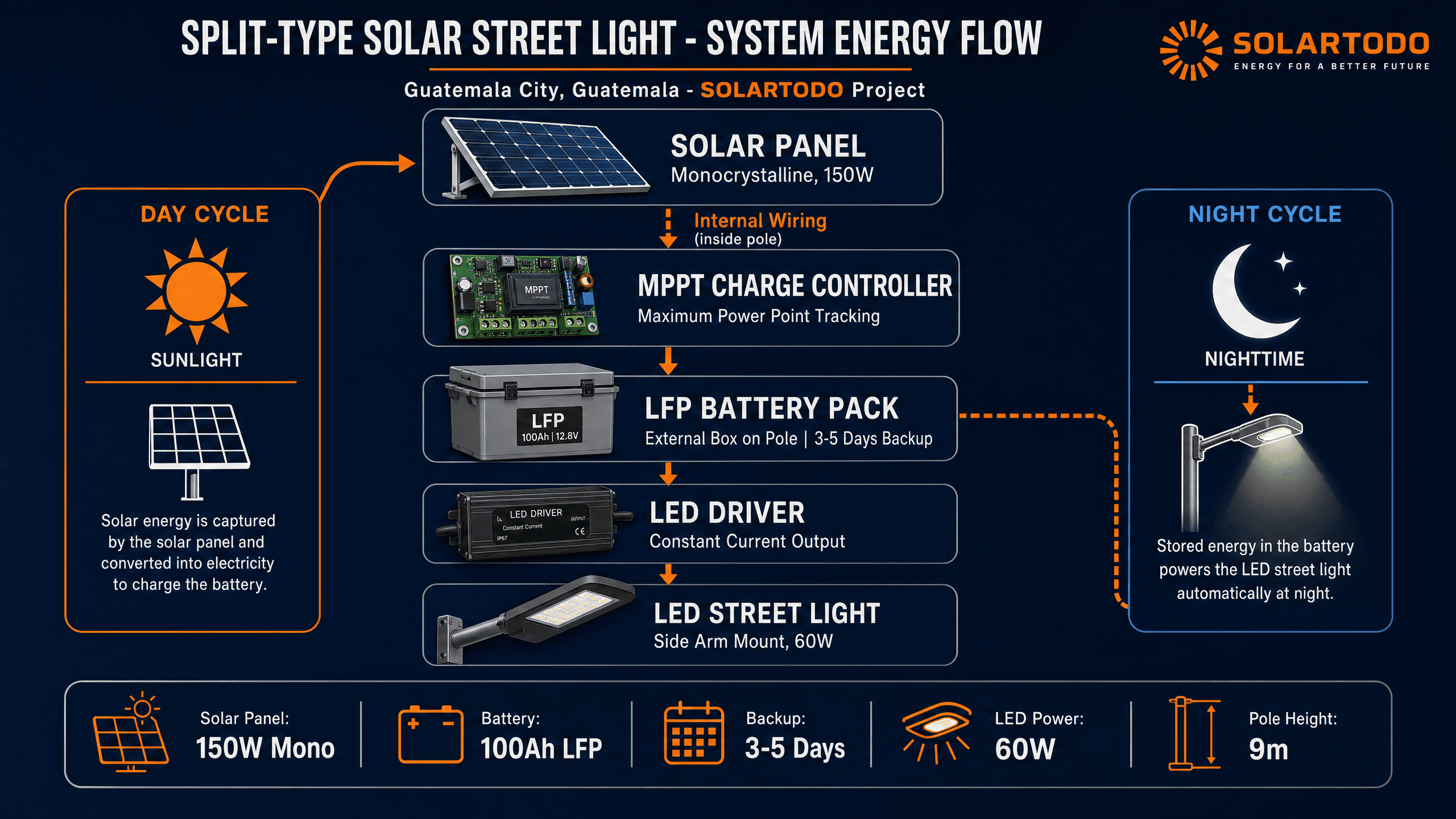
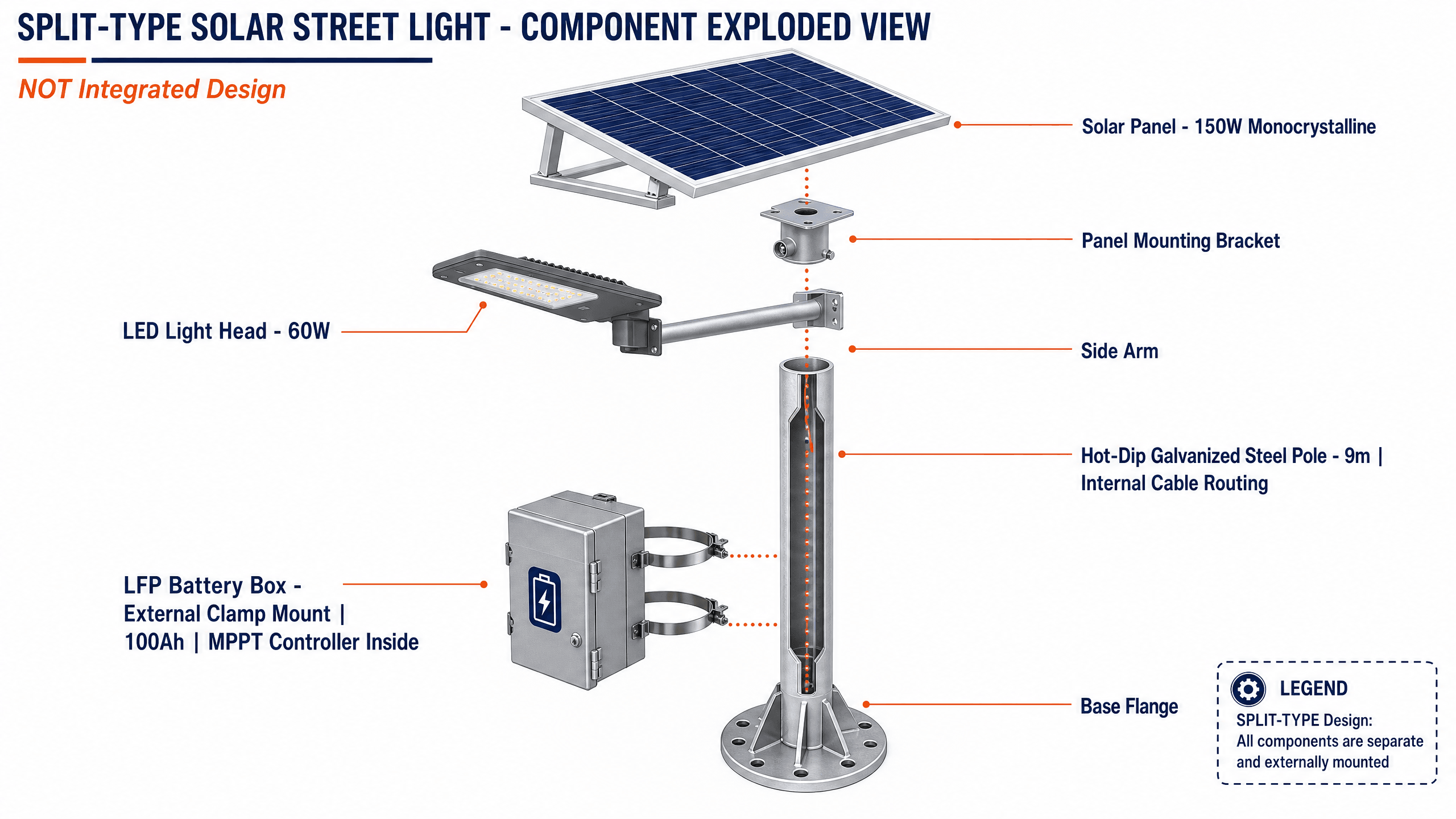
A typical 122-unit deployment of this scale in Guatemala City would consist of split-type poles placed at 27m intervals along a 10m carriageway, using side-mounted LED heads below top-mounted PV modules. The top-of-pole arrangement is important: the solar panel sits on a tilted bracket at the very top, and the pole does not penetrate the panel center. This preserves drainage, simplifies cleaning, and avoids the visual and mechanical issues common in poorly designed center-pierced panel mounts.
The recommended pole material here is stainless steel 304, not galvanized steel, because the supplied design calls for a 40-year service life and cleaner corrosion performance in humid tropical conditions. While Guatemala City is inland rather than coastal, year-round rain exposure and pollution still justify stainless steel when the buyer prioritizes lower repainting needs and visible finish quality.
The lighting package is also suitable for smart-networked municipal corridors. An 80W / 12,000 lm LED head at 150 lm/W with CRI >70 is a practical output level for roadways where the aim is safer vehicle and pedestrian visibility rather than stadium-grade illumination. With dimming control and 4G/LoRa remote monitoring, the operator can schedule lower output in low-traffic hours and detect battery, controller, or luminaire faults without waiting for public complaints.
SOLAR TODO should present this configuration as a city-fit recommendation, not as a historical deployment claim. For buyers evaluating whether this exact package is oversized, the answer depends on autonomy target: the unusually large 910W panel and 12V/200Ah battery package are defensible when the priority is 3-5 days of backup, stronger rainy-season resilience, and lower risk of deep discharge.
Technical Specifications
The recommended Guatemala City configuration uses 122 split-type units, each with a 9m stainless steel 304 pole, 80W LED, 910W TOPCon panel, 12V/200Ah NCM battery, and compliance with CJJ 45-2015, IEC 60598, and IEC 62124.
- Product type: Solar Streetlight (Split-Type), not integrated/all-in-one
- Quantity basis: approximately 122 units for the analyzed road profile
- Pole height: 9m
- Pole material: stainless steel 304
- Wind resistance: 50 m/s
- Design life of pole: 40 years
- Road width basis: 10m
- Pole spacing basis: 27m
- Solar module position: mounted at the very top of the pole on a tilted bracket
- Panel mounting rule: pole does not pass through the panel center
- Solar panel rating: 910W
- Panel technology: Mono TOPCon
- Panel efficiency: 23%
- Panel degradation: 0.3%/yr
- Panel warranty: 30 years
- LED power: 80W
- Luminous flux: 12,000 lm
- Luminous efficacy: 150 lm/W
- CRI: >70
- Lamp position: on side arm below the panel
- Battery type: NCM lithium
- Battery configuration: 12V/200Ah
- Battery energy density: 250Wh/kg
- Battery cycle life: 2000 cycles
- Depth of discharge: 85% DoD
- Battery warranty: 5 years
- Battery enclosure: external battery box mounted on pole body
- Battery box visibility: visible grey box clamped to pole, not inside base
- Controller type: MPPT controller inside battery box
- Wiring method: all wiring inside pole, no external visible cables
- Autonomy: 3-5 days cloudy-weather backup
- Operation mode: dusk-to-dawn automatic
- Smart features: dimming control + remote monitoring (4G/LoRa)
- Applicable standards: CJJ 45-2015 / IEC 60598 / IEC 62124
This specification is more robust than the standard 80W | 150W | 24V/100Ah | 8-10m size class, but it remains technically coherent because the pole height stays within the 8-10m band and the larger energy package is used to extend autonomy rather than to compensate for poor solar resource.
Implementation Approach
A phased implementation for 122 poles in Guatemala City would typically run through survey, lighting simulation, civil works, pole erection, electrical commissioning, and remote-platform onboarding over roughly 8-16 weeks, depending on permitting and import lead time.
The first phase is route validation. For a corridor with 10m width and 27m spacing, the EPC or municipal consultant would confirm pole count, setbacks, foundation coordinates, shading risk, and traffic conflict points. According to IES roadway practice, spacing and mounting height should be checked against illuminance and uniformity targets before procurement, not after equipment arrives.
The second phase is structural and electrical submittal. At 9m height and 50 m/s wind resistance, foundation design should be checked against local soil bearing capacity and wind exposure. IEC 62124 is relevant for PV performance evaluation, while IEC 60598 covers luminaire safety; both should appear in submittals together with battery and controller datasheets.
The third phase is logistics and assembly. Because this is a split-type system, the shipment usually includes poles, side arms, top brackets, LED heads, panels, battery boxes, controllers, and fasteners as separate packages. That format reduces transport damage risk versus shipping fully assembled fixtures and makes site replacement of individual parts easier.
The fourth phase is installation. Foundations are cast first, then 9m poles are erected, internal wiring is pulled, and the external battery box is clamped to the pole body at service height. The LED head is fixed on the side arm below the panel, and the 910W TOPCon module is mounted on the top bracket with the required tilt and orientation for local solar yield.
The fifth phase is commissioning and monitoring setup. Each MPPT controller is tested for charging profile, dusk-to-dawn switching, and dimming schedule. If 4G/LoRa monitoring is included, every node should be registered to the management platform, with alarm thresholds for low battery voltage, charging failure, and luminaire outage.
For SOLAR TODO, the practical procurement advice is to finalize pole drawings, battery box dimensions, and monitoring protocol before production release. That avoids the most common late-stage issues: bracket mismatch, gateway incompatibility, and battery-box access conflicts.
Expected Performance & ROI
For Guatemala City's 5.5h solar resource, an 80W split-type streetlight with smart dimming and 3-5 days autonomy would typically deliver full-night operation while avoiding grid electricity charges and reducing trenching, metering, and cable-theft exposure.
Expected performance should be viewed in three layers: lighting output, energy independence, and maintenance burden. The 12,000 lm output is adequate for many secondary roads and access corridors when poles are spaced at 27m and mounted at 9m. The larger-than-usual 910W panel gives substantial charging headroom during rainy periods, which helps protect the 12V/200Ah NCM battery from repeated deep discharge.
According to IEA (2023), LED public lighting commonly reduces electricity use by 50-70% versus legacy technologies. In an off-grid split-type design, the municipal electricity bill for the luminaire itself falls to 0 kWh from the grid, although the buyer still carries capex and maintenance cost. According to NREL (2021), proper charge control and moderated depth of discharge materially improve battery service life, which is why MPPT and dimming are not optional extras in warm climates.
A realistic payback discussion in Guatemala City depends on what the system replaces. If the alternative is a new grid-fed lighting line requiring trenching, conduit, service connection, metering, and monthly electricity charges, solar split-type poles often show a stronger lifecycle case than their fixture cost alone suggests. If the alternative is an existing healthy grid line with modern LED heads already in place, payback is slower and should be evaluated mainly on resilience and maintenance savings.
According to IRENA (2023), solar and battery costs have continued to decline over the last decade, but storage replacement still drives lifecycle economics in small autonomous systems. That means buyers should compare 10-year and 15-year total cost of ownership, not only initial supply price. For this reason, SOLAR TODO should quote battery replacement assumptions, monitoring subscription assumptions, and cleaning frequency as separate line items during technical review.
Results and Impact
A 122-unit split-type lighting network in Guatemala City would typically improve night visibility across roughly 3.3 km of roadway at 27m spacing while avoiding trenching along the same corridor.
The operational impact is usually strongest in four areas. First, there is no dependence on a local feeder for nightly operation, which matters in zones with unstable service or difficult interconnection. Second, the external battery box shortens maintenance time because technicians can inspect the 12V/200Ah pack without dismantling the pole base or replacing the luminaire head.
Third, remote monitoring across 122 nodes improves asset management. Faults such as low state of charge, charging interruption, or LED failure can be flagged centrally rather than discovered during patrols. According to IEA (2023), digital controls are an important part of maximizing the savings from LED public lighting because they reduce runtime and improve maintenance response.
Fourth, the split-type architecture gives more flexibility than integrated streetlights when component life cycles differ. A 30-year panel, 40-year pole, and 5-year battery do not age at the same rate. Keeping these as separable components usually lowers replacement waste over a 10-15 year operating horizon.
Comparison Table
For Guatemala City's 10m road corridors, the main buying choice is usually between split-type solar, integrated solar, and conventional grid-fed LED, with the split-type option offering the best serviceability for a 122-unit autonomous network.
| Option | Typical Pole/Fixture Class | Power Source | Battery Access | Civil Works | Smart Control | Best Fit in Guatemala City |
|---|---|---|---|---|---|---|
| SOLAR TODO Solar Streetlight (Split-Type) | 9m pole, 80W LED, 910W panel, 12V/200Ah | Solar only | External box on pole | Low to medium | Dimming + 4G/LoRa | 10m roads, resilience-focused corridors |
| Integrated solar streetlight | 6-8m, 30-60W common | Solar only | Usually inside fixture | Low | Basic to medium | Walkways, parks, lower mounting heights |
| Grid-fed LED streetlight | 8-10m, 70-120W common | Utility grid | No battery | High trenching/cabling | Medium to high | Existing powered roads with stable grid |
| Wind-solar hybrid split-type | 8-10m, 60-100W common | Solar + wind | External box on pole | Medium | Medium to high | Exposed windy sites, not typical inner-city roads |
Pricing & Quotation
SOLAR TODO offers three pricing tiers for this product line: FOB Supply (equipment ex-works China), CIF Delivered (including ocean freight and insurance), and EPC Turnkey (fully installed, commissioned, with 1-year warranty). Volume discounts are available for large-scale deployments. Configure your system online for an instant estimate, or request a custom quotation from our engineering team at [email protected].
For technical buyers, the quotation should separate pole material, panel brand/specification, battery chemistry, controller type, and monitoring scope. A clear RFQ should also identify whether foundations, anchor bolts, and gateway hardware are included. Buyers comparing offers from SOLAR TODO and other suppliers should request the same autonomy basis of 3-5 days to keep comparisons fair.
Frequently Asked Questions
A Guatemala City buyer usually needs answers on autonomy, pole spacing, battery life, standards, and EPC scope before issuing an RFQ for a 122-unit split-type streetlight package.
Q1: Why is split-type recommended over all-in-one for Guatemala City roads?
A split-type system is better for 9m poles and 80W roadway lighting because the panel, battery, and luminaire are separate. That allows a larger 910W panel, easier battery replacement, and lower thermal stress on electronics. For municipal roads, serviceability usually outweighs the simpler appearance of all-in-one fixtures.
Q2: Is 80W enough for a 10m-wide road with 27m spacing?
Yes, 80W / 12,000 lm is a practical starting point for many 10m urban roads when mounted at 9m and spaced at 27m. Final acceptance should still depend on a lighting simulation using local reflectance, lane count, and target illuminance or uniformity values rather than wattage alone.
Q3: Why does this guide specify a 910W panel for an 80W light?
The larger 910W panel is justified by the requirement for 3-5 days of backup and stronger rainy-season charging resilience. It is not the minimum needed to run an 80W luminaire nightly. It is a conservative energy package intended to reduce low-charge events and protect battery life.
Q4: What battery maintenance should be expected with 12V/200Ah NCM lithium?
Routine maintenance is light but not zero. Operators should inspect the external battery box, terminals, seals, and controller logs every 3-6 months. NCM chemistry offers good energy density at 250Wh/kg, but warm climates still require attention to enclosure temperature, charging profile, and replacement planning near the 5-year warranty window.
Q5: How long would a 122-unit project typically take to deliver and install?
A realistic program is often 8-16 weeks, depending on production slot, shipping method, customs clearance, and site readiness. Civil works and pole erection can move quickly once drawings are approved. Remote monitoring setup and commissioning usually add several days for a 122-node network.
Q6: What kind of ROI or payback should buyers expect?
Payback depends on the alternative. If the project avoids trenching, metering, and monthly utility charges, the economics are usually stronger than a simple fixture-to-fixture comparison suggests. If it replaces an existing efficient grid-fed LED system, the case shifts toward resilience and reduced cable-theft risk rather than fast payback.
Q7: Are external battery boxes a disadvantage aesthetically or technically?
Aesthetically, some buyers prefer hidden batteries, but technically the external box is often better for maintenance. It allows faster inspection, easier replacement, and simpler controller access. In this specification, the box is a visible grey enclosure clamped to the pole body, which is consistent with service-focused municipal designs.
Q8: What standards should appear in the tender documents?
At minimum, this configuration should reference CJJ 45-2015, IEC 60598, and IEC 62124. Buyers may also request structural calculations for 50 m/s wind loading, IP ratings for enclosures, and controller test reports. The tender should clearly state that all wiring runs inside the pole with no exposed external cables.
Q9: Can this system support remote monitoring across city districts?
Yes. The specified 4G/LoRa monitoring architecture is suitable for multi-site fleets if network coverage and gateway design are planned correctly. At a minimum, the platform should report lamp status, battery voltage, charging state, and controller alarms. That is especially useful when the fleet reaches 100+ units.
Q10: What should be included in an EPC quotation request?
The RFQ should list pole height (9m), material (stainless steel 304), wind rating (50 m/s), panel rating (910W TOPCon), battery (12V/200Ah NCM), controller type (MPPT), smart controls, spacing (27m), road width (10m), and required standards. It should also clarify whether foundations, anchor bolts, and monitoring software are included.
References
- World Bank (2024): Global Solar Atlas data indicating central Guatemala solar resource in the range of about 5.0-5.5 kWh/m2/day.
- World Bank (2023): Guatemala development indicators and urbanization data relevant to municipal infrastructure demand.
- World Bank (2022): Guatemala electricity access data showing national electrification above 90%, with relevance to service reliability and off-grid municipal assets.
- IEA (2023): Public lighting and LED efficiency trends; LED streetlighting can reduce electricity consumption by 50-70% versus legacy systems.
- IRENA (2023): Renewable power and storage cost trends affecting lifecycle economics for solar-powered lighting systems.
- IEC (2023): IEC 60598 general requirements and tests for luminaires used in outdoor lighting applications.
- IEC (2021): IEC 62124 performance monitoring and evaluation framework for stand-alone photovoltaic systems.
- NREL (2021): Battery lifetime guidance showing the effect of temperature and depth of discharge on storage durability in solar applications.
- Ministry of Energy and Mines, Guatemala (2023): National electricity and energy policy context relevant to municipal lighting and distributed energy planning.
- CJJ 45-2015 (2015): Chinese code for urban road lighting design and installation practice, commonly referenced in export streetlight specifications.
Equipment Deployed
- 122 × Solar Streetlight (Split-Type)
- 9m stainless steel 304 pole, 50 m/s wind resistance, 40-year design life
- 910W Mono TOPCon solar panel, 23% efficiency, 0.3%/yr degradation, 30-year warranty
- 80W LED luminaire, 12,000 lm, 150 lm/W, CRI >70
- Side arm mounting below top-mounted solar panel
- 12V/200Ah NCM lithium battery, 250Wh/kg, 2000 cycles, 85% DoD, 5-year warranty
- External grey battery box clamped to pole body
- MPPT controller installed inside battery box
- Internal pole wiring with no visible external cables
- Dimming control system
- 4G/LoRa remote monitoring module
- Dusk-to-dawn automatic control
- 3-5 days cloudy-weather backup design
- Compliance set: CJJ 45-2015 / IEC 60598 / IEC 62124