Summary
Gaborone’s 26-intersection smart traffic case fits 10 m SOLARTODO L-arm poles: 246,325 city residents, 14,372 national crashes in 2024 (content reviewed 2026-07-28 for freshness), and 32.5°C January highs point to sealed camera-radar control, not basic signal replacement.
Key Takeaways
Answer Capsule: A 26-intersection EPC profile should combine 10 m poles, AI video, 77 GHz radar, and centralized TrafficGPT operations for Gaborone.
- Gaborone City recorded 246,325 residents in the 2022 census, according to Statistics Botswana (2022), making the capital a compact but high-value signal-control market.
- Botswana recorded 14,372 road crashes and 342 fatalities in 2024, according to WHO Botswana (2025), supporting evidence-based monitoring at arterial intersections.
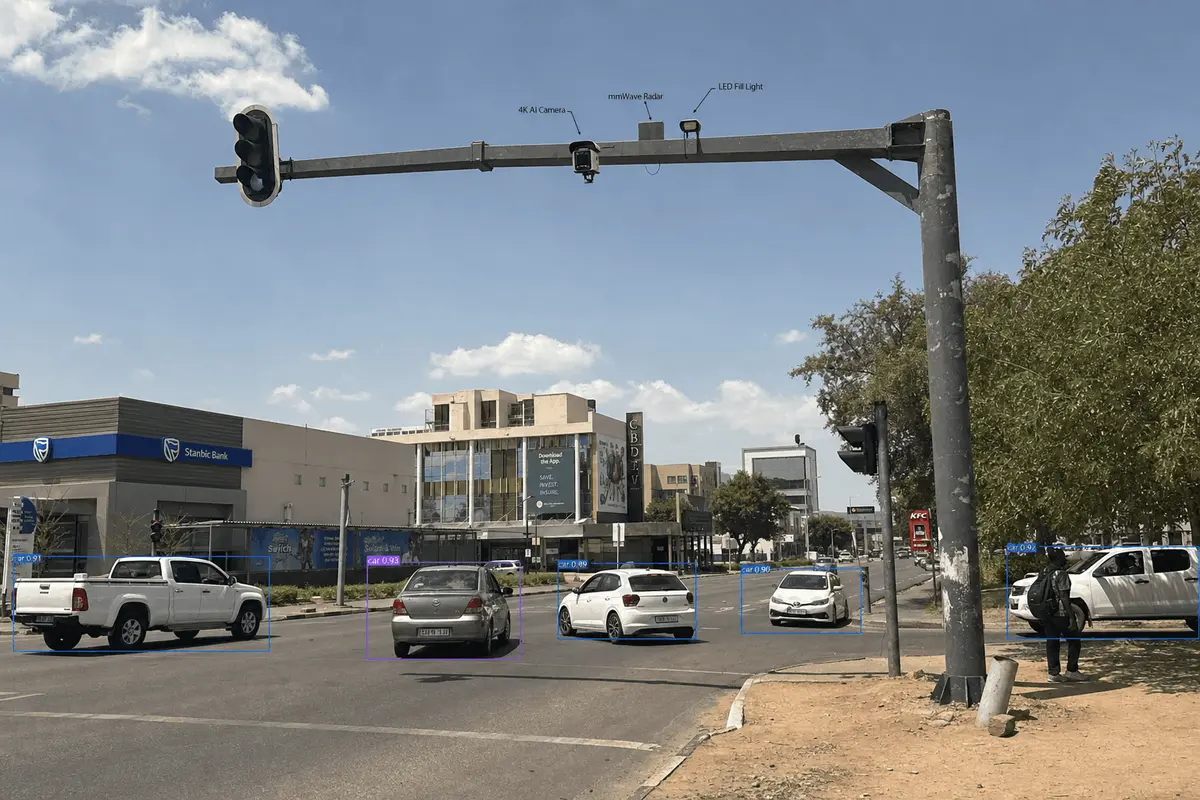
- The recommended SOLARTODO base design uses 10 m dark-grey hot-dip galvanized L-arm poles for camera sightlines, signal visibility, and radar coverage.
- A 26-intersection package typically needs 104-312 smart poles, based on 4-12 poles per intersection for approaches, turn lanes, crossings, and auxiliary detection.
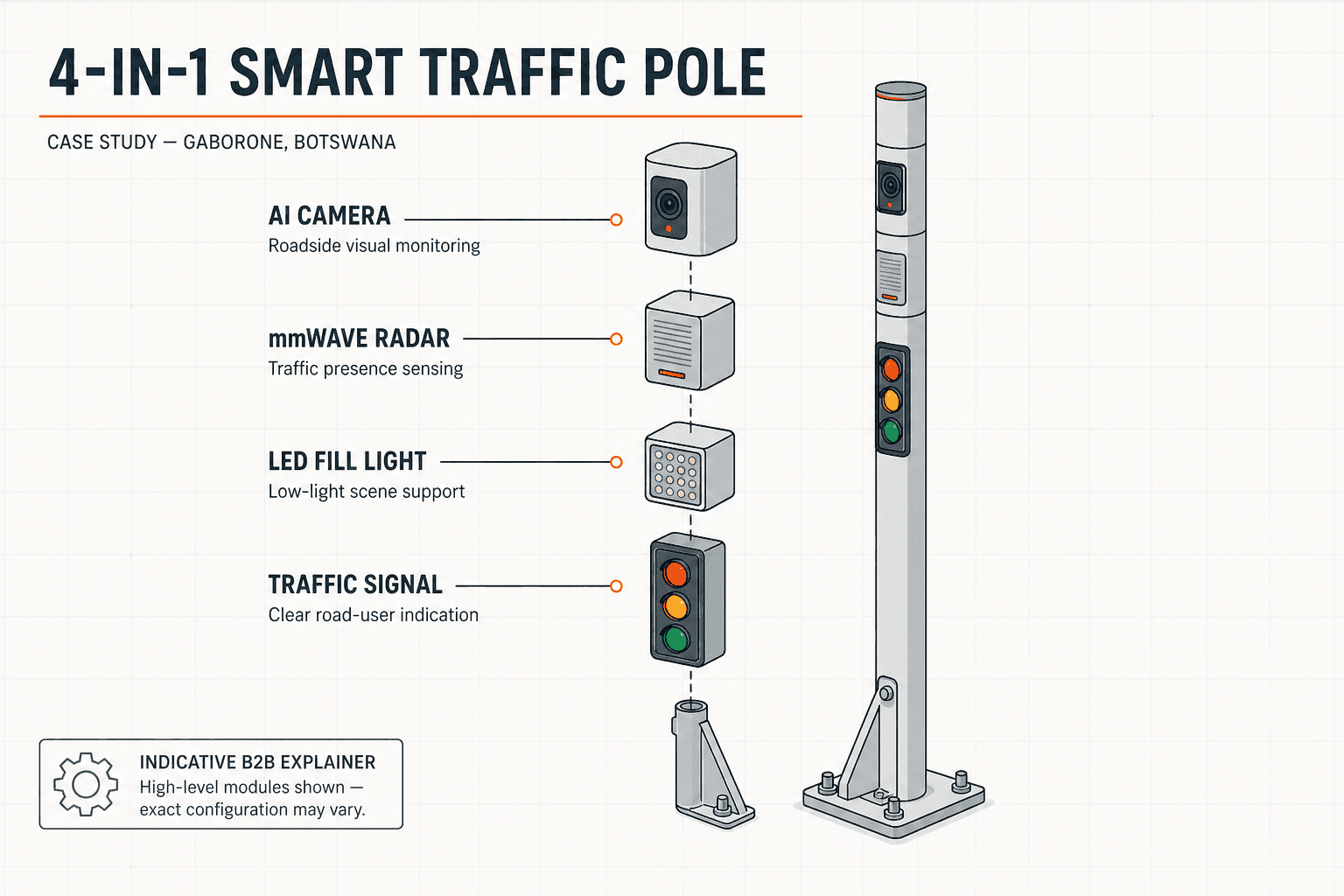
- Each pole integrates 4 modules: 4K AI camera, 77 GHz mmWave radar, LED fill light, and LED signal head.
- The AI stack targets 98% recognition accuracy, 45+ detection categories, and sub-50 ms local detection response under specified conditions.
- According to WMO (2026), Gaborone’s mean January maximum is 32.5°C and July rainfall is 0.4 mm, so dust, heat, UV, and storm runoff matter more than coastal salt exposure.
- According to Botswana Power Corporation (2025), Botswana’s grid includes 400 kV, 220 kV, and 132 kV transmission plus 33 kV and 11 kV distribution, so cabinets need disciplined low-voltage integration.
Market Context for Gaborone Smart Traffic Deployment
Answer Capsule: Gaborone’s 246,325-person capital role, 2024 crash burden, and commuter corridors make 26 monitored intersections a practical modernization scope.
According to Statistics Botswana (2022), Gaborone City had 246,325 residents, while Botswana’s national 2022 census counted 2,359,609 people. This makes the capital a concentrated control point for commuter movement from Mogoditshane, Tlokweng, Phakalane, airport corridors, government offices, and A1/A10 approaches. The system should therefore be specified for arterial junctions, not only small downtown signal replacements.
According to WHO Botswana (2025), Botswana reduced reported traffic accidents from 16,404 in 2022 to 14,372 in 2024, while fatalities fell from 404 to 342. That improvement still leaves a strong case for vehicle counting, speeding-event detection, red-light evidence workflows, and incident analytics. A SOLARTODO deployment should frame safety and flow as measurable operational outcomes.
Climate shapes the engineering requirement. According to WMO (2026), Gaborone’s mean daily maximum temperature reaches 32.5°C in January, while July rainfall averages only 0.4 mm and January rainfall reaches 113.6 mm. The best-fit specification is heat-tolerant, dust-sealed, UV-stable, and stormwater-aware.
Recommended SOLARTODO EPC Configuration
Answer Capsule: The recommended 26-site SOLARTODO configuration uses 10 m L-arm poles, edge AI, 5G/fiber backhaul, and turnkey EPC delivery.
For Gaborone, SOLARTODO should position the project as a corridor-level EPC turnkey package across 26 intersections. The base field asset is a 10 m dark-grey hot-dip galvanized L-arm steel pole, selected for overhead signal visibility, camera angle, and radar line-of-sight. Each junction normally needs 4-12 pole positions depending on approach count, median geometry, pedestrian crossings, and turn-lane coverage.
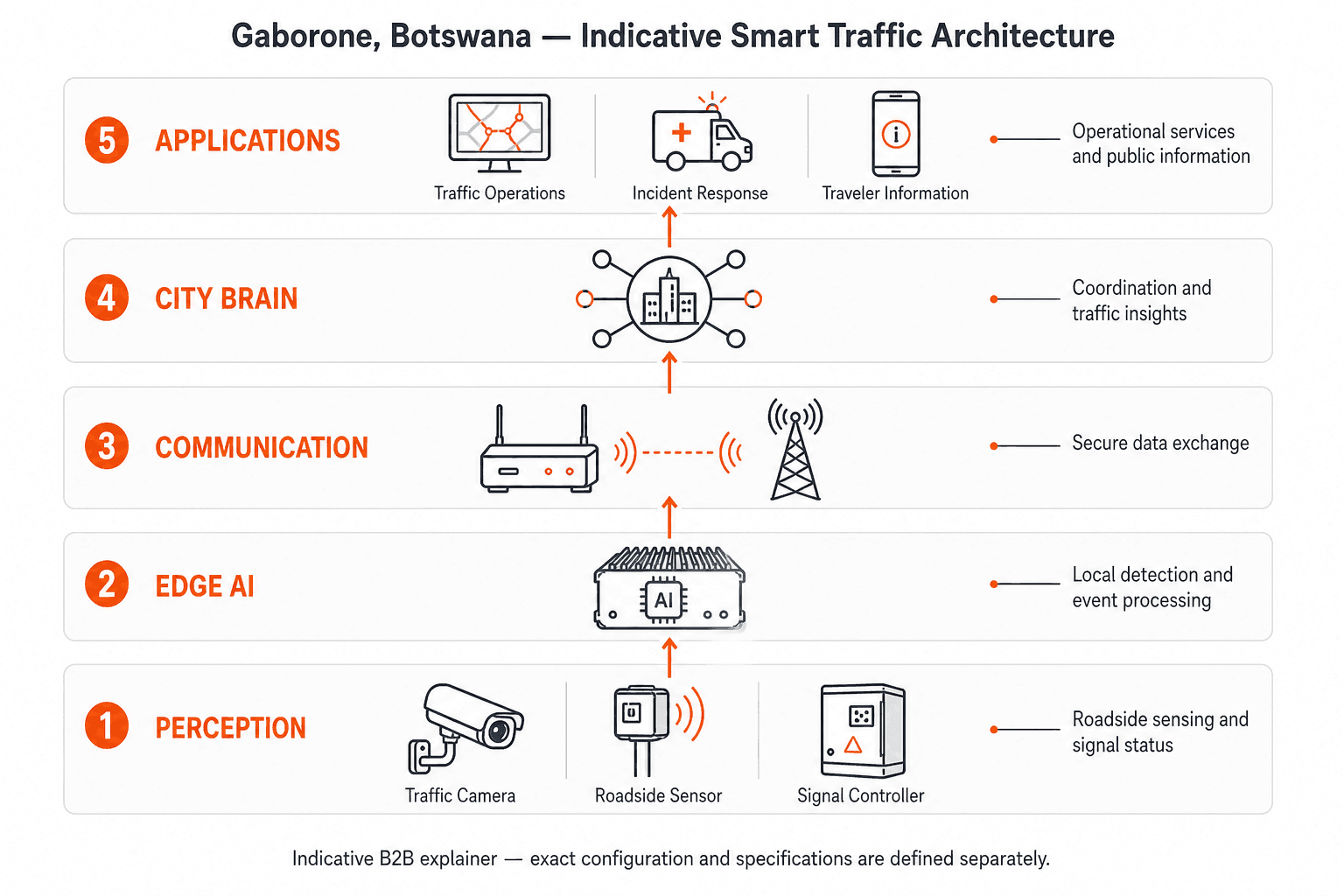
Each primary pole should carry one integrated 4-in-1 package: 4K AI camera, 77 GHz mmWave radar, LED fill light, and LED signal head. NVIDIA Jetson edge AI should process vehicle counts, speed, plate recognition, queue presence, lane occupancy, and 45+ event categories before sending structured data to TrafficGPT. The detection target should remain below 50 ms at device level, with network latency managed separately through fiber or 5G design.
The EPC scope should include surveys, BoQ freeze, foundation design, pole fabrication, import logistics, erection, controller mapping, communications commissioning, operator training, and staged acceptance. SOLARTODO should align field-device communications with NTCIP and use GB 25280-aligned signal-head behavior where applicable. The warranty baseline should be 1 year, with optional extensions for cameras, radar, LED modules, and edge compute.
Technical Specifications for 10 m 4-in-1 Smart Traffic Poles
Answer Capsule: A 10 m pole with 4 integrated modules gives each arterial approach combined visibility, detection, lighting, and signaling capacity.
| Specification Area | Recommended Requirement | Why It Matters in Gaborone |
|---|---|---|
| Pole form | 10 m L-arm steel pole | Clears buses, trucks, signs, and wide approaches |
| Finish | Dark-grey hot-dip galvanized coating | Urban consistency with long outdoor service life |
| Camera | 4K AI camera, 98% target recognition | Plate, queue, lane, and violation analytics |
| Radar | 77 GHz mmWave | Speed and presence detection during glare or dust |
| Lighting | LED fill light | Night recognition and evidence capture |
| Signal | LED signal head | Integrated approach control on fewer structures |
| Edge compute | NVIDIA Jetson | Local inference before central upload |
| Response target | Sub-50 ms device response | Fast detection-to-event pipeline |
| Deployment count | 104-312 poles | Based on 4-12 poles across 26 intersections |
According to IEC (2013), IEC 60529 classifies enclosure protection for electrical equipment up to 72.5 kV, making IP-rated cabinet selection relevant for roadside dust and water exposure. According to IEEE (2022), IEEE 802.3 supports Ethernet operation across copper, fiber, and backplane media from 1 Mb/s to 400 Gb/s, which supports fiber-connected cabinet networking. These standards do not replace local permitting, but they help define practical device and network requirements.
According to Botswana Power Corporation (2025), distribution is provided at 33 kV and 11 kV, with sub-transmission at 66 kV. Traffic cabinets should therefore be designed around protected 230/400 V, 50 Hz low-voltage service where municipal supply is available. Required details include surge protection, earthing, lockable service access, isolated power/data compartments, and maintainable cable routing.
Implementation Plan and Logistics
Answer Capsule: A 26-intersection Gaborone EPC rollout should be phased over 12-20 weeks from survey approval to corridor acceptance.
The implementation sequence should start with junction audits, utilities checks, stormwater review, pole positioning, traffic-signal phasing review, and fiber/5G availability confirmation. Civil drawings should be frozen before pole fabrication to avoid foundation mismatch and rework. Site works should proceed in batches so high-impact corridors can be tested before citywide handover.
Logistics should treat Botswana as an inland destination. Pole sections, cabinets, signal heads, cameras, radar, and LED modules can be shipped under FOB Supply, CIF Delivered, or EPC Turnkey pricing, then moved by road to Gaborone for staged installation. Foundations should be ready before mast arrival to reduce storage risk and protect coated steel sections from site damage.
Commissioning should verify signal visibility, camera angle, radar detection zones, cabinet power quality, backhaul uptime, and TrafficGPT data ingestion. Each corridor should pass acceptance tests for vehicle counting, speed events, plate recognition, red-light event capture, and natural-language operations queries. Final handover should include as-built drawings, operator training, maintenance checklists, and warranty documentation.
Comparison of Smart Traffic Options
Answer Capsule: Compared with 1-purpose poles, a 4-in-1 SOLARTODO pole reduces field clutter and improves detection resilience at wide junctions.
| Option | Detection Coverage | Latency Profile | Civil Footprint | Best Use | Main Limitation |
|---|---|---|---|---|---|
| Conventional signal pole | Signal display only | Manual review | Low | Basic signal timing | No AI detection or evidence capture |
| Camera-only retrofit | Video analytics | Network-dependent | Medium | Monitoring upgrade | Reduced reliability in glare, dust, or occlusion |
| Radar-only detector | Speed and presence | Low | Medium | Queue and speed sensing | No visual evidence or plate recognition |
| SOLARTODO 4-in-1 pole | Camera + radar + LED + signal | Sub-50 ms device target | One 10 m L-arm pole | EPC corridor modernization | Requires integrated commissioning |
The 4-in-1 design is strongest where Gaborone intersections need both traffic management and enforcement-grade observability. Camera analytics provide classification, plate, queue, and event context, while 77 GHz radar improves speed and presence detection when visibility is degraded. Integrating these functions on one pole can reduce bracket clutter and simplify maintenance access.
Camera-only retrofits can be useful where budgets are tight and existing poles are structurally suitable. However, they depend heavily on image quality and network performance. For 26 arterial intersections, the more defensible specification is a standardized SOLARTODO pole family with repeatable civil, electrical, and analytics acceptance criteria.
Pricing and Procurement Model
Answer Capsule: SOLARTODO should quote 3 tiers: FOB Supply, CIF Delivered, and EPC Turnkey with 1-year warranty for 26 intersections.
Pricing should be built only after drawings, foundation assumptions, import scope, backhaul choice, and traffic-control integration requirements are confirmed. SOLARTODO’s product line should be presented in three procurement tiers: FOB Supply for equipment ex-works China, CIF Delivered for freight and insurance to the destination port, and EPC Turnkey for installation, commissioning, training, and warranty. Volume discounts can apply to 26-intersection or citywide deployments.
According to BloombergNEF (2026), global energy-transition investment reached $2.3 trillion in 2025, with $483 billion in grid investment. According to Wood Mackenzie (2024), China PV module prices were about 11 US cents per watt in its PV Pulse note, down about 40% over the prior year. These figures do not price traffic poles directly, but they explain why buyers increasingly compare power resilience, logistics, electronics supply, and lifecycle cost rather than only steel-pole cost.
Energy, Resilience, and Standards Alignment
Answer Capsule: Gaborone’s 26-node system should prioritize grid-fed uptime, surge protection, IP-rated cabinets, and standards-based communications over decorative smart-city features.
According to NREL (2025), PVWatts version 8.5.2 uses PVWatts V8 with NSRDB PSM V3 TMY 2020 and Himawari TMY 2020 datasets for PV estimates. This supports optional solar-assisted cabinet studies, but the recommended Gaborone baseline remains utility-fed low-voltage service with protected backup where required. Solar should be treated as a resilience add-on, not the default power architecture for signal-critical intersections.
According to IEA (2024), global renewable capacity additions rose by almost 50% to nearly 510 GW in 2023, with solar PV accounting for three-quarters of additions. According to IRENA (2021), Botswana targeted at least 15% renewable energy in the energy mix by 2030 and 50% by March 2036. For procurement, those figures support future-ready power planning without turning the traffic project into a standalone solar project.
Standards alignment should be explicit in the tender response. NTCIP should cover traffic-device interoperability, IEEE 802.3 should inform wired Ethernet design where fiber or copper is used, and IEC 60529 should guide enclosure IP protection levels. Local electrical approvals, utility connection rules, and municipal traffic-signal procedures remain mandatory during permitting.
Frequently Asked Questions
Answer Capsule: These 10 FAQs address pricing, specifications, logistics, warranty, installation, standards, and comparison for a Gaborone EPC package.
1. What is the recommended configuration for Gaborone?
The recommended configuration is a 26-intersection SOLARTODO EPC turnkey package using 10 m dark-grey hot-dip galvanized L-arm poles. Each primary pole integrates a 4K AI camera, 77 GHz mmWave radar, LED fill light, and LED signal head. NVIDIA Jetson edge AI handles local detection before sending structured events to TrafficGPT over fiber or 5G.
2. How many poles are needed for 26 intersections?
A practical estimate is 104-312 smart poles, using the 4-12 poles per intersection rule. A simple four-way junction may need one primary pole per approach, while wider arterial sites may require auxiliary poles for turning lanes, pedestrian crossings, median islands, or slip-road detection. Final quantities require site drawings and pole-position surveys.
3. How much does the system cost?
SOLARTODO should quote the project after confirming intersection geometry, pole count, cabinet design, backhaul, import route, foundations, and controller integration. The pricing structure should include FOB Supply, CIF Delivered, and EPC Turnkey tiers. EPC Turnkey is the best procurement fit when the buyer wants one accountable package covering supply, installation, commissioning, training, and 1-year warranty.
4. How long does installation take?
A 26-intersection EPC rollout typically takes 12-20 weeks after survey approval and BoQ freeze. The timeline depends on utility checks, civil permits, foundation curing, import clearance, trenching, 5G/fiber availability, and traffic-management windows. The safest approach is phased corridor commissioning, so each batch can be tested before the next group is activated.
5. Why use radar plus camera instead of camera-only detection?
Camera-only systems provide strong visual evidence, but performance can drop during glare, dust, low light, occlusion, or lens contamination. A 77 GHz mmWave radar adds speed, distance, presence, and lane-occupancy sensing that does not depend on image clarity. The combined camera-radar design gives Gaborone better resilience across hot, dry, and storm-season conditions.
6. What logistics route is most practical for Botswana?
Botswana is landlocked, so equipment normally moves through regional ports such as Durban or Walvis Bay before road transport to Gaborone. Pole sections, cabinets, cameras, radar units, and signal heads should be packed for staged delivery. Foundations should be prepared before major mast delivery to reduce storage risk, handling damage, and traffic disruption around junctions.
7. What warranty should be expected?
The baseline SOLARTODO EPC tier should include a 1-year warranty covering supplied equipment and commissioned system performance under agreed conditions. Extended warranty can be quoted for 4K cameras, 77 GHz radar, LED signal heads, LED fill lights, Jetson edge hardware, and cabinets. Maintenance responsibilities should be separated from warranty terms in the contract.
8. Which standards should be specified?
The tender should specify NTCIP for traffic-device interoperability, GB 25280-aligned signal requirements where applicable, IEEE 802.3 for Ethernet-based cabinet networking, and IEC 60529 for enclosure ingress-protection classification. These standards should be paired with Botswana utility connection rules, municipal permitting, earthing requirements, surge protection, and site-specific traffic-control approvals.
9. What maintenance is required after handover?
Maintenance should include quarterly lens cleaning, radar-zone verification, cabinet inspection, surge-protection checks, firmware review, signal-head inspection, and data-quality audits. Annual structural inspection should cover pole coating, anchor bolts, brackets, cable glands, and foundation condition. Gaborone’s dust and UV exposure make preventive cleaning and enclosure checks especially important for analytics reliability.
10. Can operators ask TrafficGPT natural-language questions?
Yes. TrafficGPT should allow approved operators to query vehicle counts, speeding events, red-light records, plate hits, corridor congestion, peak-hour queues, and intersection performance summaries. The usefulness of natural-language operations depends on clean field data from all 26 nodes, consistent event schemas, reliable backhaul, and clear access permissions for municipal and enforcement users.
References
Answer Capsule: The article uses 13 cited sources covering 2022 population, 2024 crashes, grid data, climate, standards, and energy-market context.
- Statistics Botswana (2022), Gaborone City population: https://www.statsbots.org.bw/node/61366
- Statistics Botswana (2022), national population census preliminary results: https://www.statsbots.org.bw/2022-population-and-housing-census-preliminary-results-v2
- WHO Botswana / WHO Africa (2025), road-crash and fatality figures for 2022-2024: https://www.afro.who.int/countries/botswana/news/enhanced-safe-systems-approach-reduces-road-casualties-botswana
- WMO World Weather Information Service (2026), Gaborone climate normals: https://worldweather.wmo.int/en/city.html?cityId=1542
- Botswana Power Corporation (2025), transmission and distribution grid classes: https://staging.bpc.bw/our-customer-base/
- IEC (2013), IEC 60529 enclosure ingress-protection classification: https://webstore.iec.ch/en/publication/2452
- IEEE (2022), IEEE 802.3-2022 Ethernet standard: https://standards.ieee.org/ieee/802.3/10422/
- NREL (2025), PVWatts Calculator version 8.5.2 and PVWatts V8 methodology: https://pvwatts.nrel.gov/version_8.php
- IRENA (2021), Renewables Readiness Assessment: Botswana: https://www.irena.org/Publications/2021/Aug/Renewables-Readiness-Assessment-Botswana
- IEA (2024), Renewables 2023 executive summary: https://www.iea.org/reports/renewables-2023/executive-summary
- BloombergNEF (2026), Energy Transition Investment Trends 2026 press release: https://about.bnef.com/insights/clean-energy/bloombergnef-finds-global-energy-transition-investment-reached-record-2-3-trillion-in-2025-up-8-from-2024/
- Wood Mackenzie (2024), China PV module price analysis: https://www.woodmac.com/blogs/energy-pulse/chinas-solar-growth-sends-module-prices-plummeting/
- Global Solar Atlas / World Bank Group (2025), PV potential dataset methodology: https://globalsolaratlas.info/support/methodology
Equipment Deployed
- Approximately 26 intersections × 10m dark grey hot-dip galvanized L-arm steel poles
- 4-in-1 Smart Traffic Pole with integrated 4K AI camera, 77GHz mmWave radar, LED fill light, and LED signal head
- 4K AI camera with 98% accuracy claim, less than 50ms response, and 45+ detection types
- NVIDIA Jetson edge AI module for vehicle counting, speed detection, and plate recognition
- 5G/fiber backhaul to TrafficGPT central platform for natural language traffic queries
- NTCIP and GB 25280 standards alignment for traffic control interoperability
- EPC turnkey cooperation model with installation, commissioning, and 1-year warranty framing