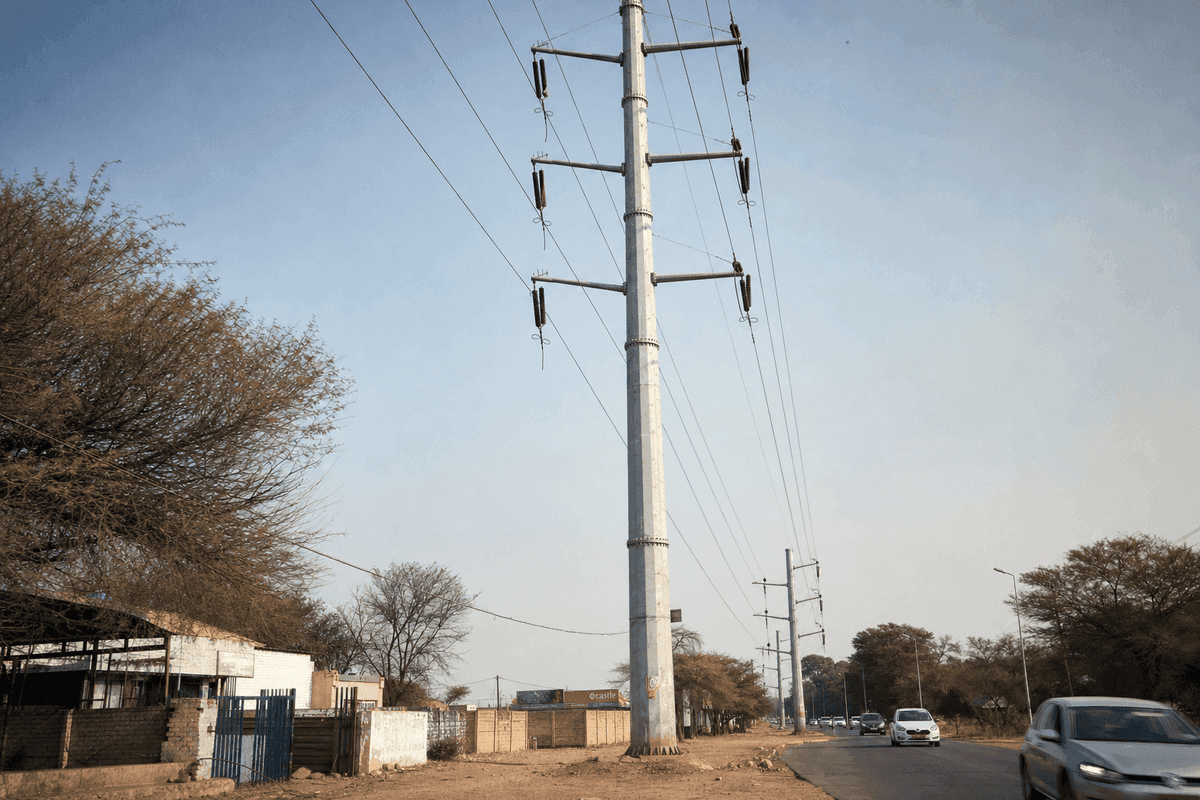
Gaborone Power Transmission Tower Market Analysis: 220kV Double-Circuit Steel Tubular Configuration
Summary
Gaborone's 246,325-city population and 534,842 metro base support a 220kV backbone recommendation: approximately 59 steel tubular poles, 40m height, 9km line length, and ACSR-400 conductors.
Key Takeaways
- A typical Gaborone 220kV backbone corridor would use approximately 59 tapered steel tubular poles over about 9km.
- The recommended SOLARTODO Power Transmission Tower class is 40m, double-circuit, Q345 hot-dip galvanized steel.
- ACSR-400 conductor selection provides 1,520kg/km mass and up to 110kN maximum tension for high-voltage service.
- The project-specific technical fit uses 6m phase spacing, 7m ground clearance, and 2.5m insulator strings.
- Wind class 2 design at 30m/s is appropriate for a semi-arid urban-fringe corridor near coordinates -24.65, 25.91.
- A 150m span implies approximately 6.6 structures/km, tighter than open-country 220kV spans because of clearance and right-of-way control.
- Standards alignment should reference IEC 60826, GB 50545, and DL/T 5092 for overhead-line loading and tower design.
Market Context for Gaborone
Gaborone's grid-planning case is driven by a 246,325-city population, a 534,842 metro area, and concentrated government-commercial demand in Botswana's capital.
Statistics Botswana reports Gaborone's 2022 city population at 246,325, while common metropolitan estimates place the broader urban area at about 534,842 residents. That concentration matters because transmission reinforcement near the capital serves public administration, commercial loads, peri-urban housing, and industrial estates more than one isolated customer. According to World Bank data (2023), Botswana's national electricity access was about 76.2%, which means urban reliability and rural extension both remain policy priorities.
Botswana Power Corporation is the national utility responsible for electricity generation, transmission, distribution, import, and sale, with its headquarters in Gaborone. BPC also participates in the Southern African Power Pool, making transmission reliability relevant not only for city demand but also for regional interchange. According to IRENA (2021), Botswana's solar, wind, and bioenergy resources could meet 15% of energy needs by 2030, but renewable integration still depends on strong high-voltage evacuation corridors.
For SOLARTODO, the relevant product is the steel tubular Power Transmission Tower, not a lattice tower, wood pole, concrete pole, FRP structure, or solar product. The recommended use case is a high-voltage transmission backbone for grid reinforcement around Gaborone, using present-tense technical analysis rather than any claim of a completed local deployment. IEC states, 'Design criteria of overhead transmission lines,' which is the correct engineering frame for this type of recommendation.
Recommended Technical Configuration
A Gaborone 220kV recommendation would specify approximately 59 double-circuit steel tubular poles, each 40m tall and about 40t, for a 9km backbone line.
The voltage class should be selected first: 220kV is the appropriate high-voltage transmission category for a backbone corridor feeding a capital-city load center. In the general engineering guide, 220kV steel structures normally fall in the 35-55m height band, use usually double-circuit geometry, and support high mechanical loads. The project-specific configuration sits within that height class at 40m and uses a heavy-duty double-circuit variant rated at about 1,000kg/m, resulting in approximately 40t per pole.
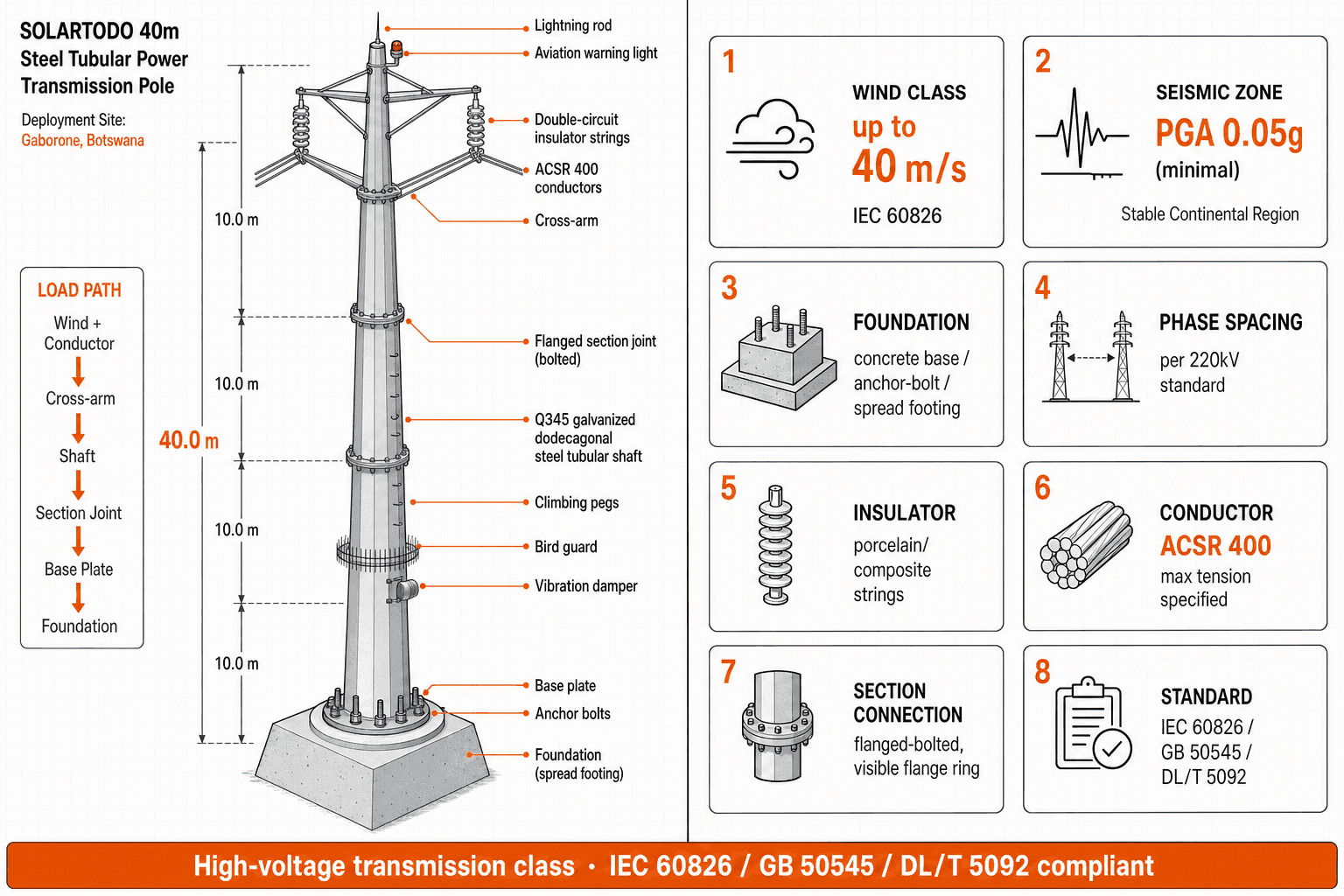
A typical 59-unit deployment of this scale would consist of tapered round or dodecagonal steel monopoles, hot-dip galvanized Q345 steel, flanged bolt sections, and concrete spread footing foundations with anchor cages. The conductor package would use ACSR-400 at 1,520kg/km with maximum tension of 110kN, supported by 2.5m insulator strings. Phase spacing should be 6m, minimum ground clearance should be 7m, and accessories should include climbing steps, cross arms, grounding hardware, bird guards, and vibration dampers.
The 150m span is tighter than many open-country 220kV corridors, where 350-450m spans may be practical. For a Gaborone urban-fringe or constrained right-of-way route, shorter spans can be justified by clearance management, road crossings, utility interfaces, and wind-induced conductor movement control. SOLARTODO should therefore frame the configuration as a high-voltage backbone pole package optimized for a dense capital-region corridor rather than a generic rural transmission line.
Technical Specifications
The recommended SOLARTODO 220kV configuration uses 40m galvanized Q345 tubular monopoles, double-circuit geometry, ACSR-400 conductors, and 30m/s wind design.
- Product: SOLARTODO Power Transmission Tower, steel tubular monopole form only.
- Voltage class: 220kV high-voltage transmission backbone.
- Circuit: double circuit, rated at approximately 1,000kg/m structural class.
- Pole geometry: tapered round or dodecagonal steel tubular pole with flanged bolt sections.
- Material: hot-dip galvanized Q345 steel, with Q420 available where final structural checks require higher yield strength.
- Height: 40m, aligned with the 220kV high-voltage height class of 35-55m.
- Weight: approximately 40t/pole under the project-specific heavy-duty 1,000kg/m double-circuit configuration.
- Quantity and route length: approximately 59 units across about 9km.
- Span: 150m project-specific design span for constrained corridor control.
- Conductor: ACSR-400, 1,520kg/km, maximum tension 110kN.
- Insulation: 2.5m insulator strings on cross-arm brackets.
- Clearances: 6m phase spacing and 7m ground clearance.
- Wind class: class 2, 30m/s basic wind speed basis.
- Foundation: concrete spread footing foundation with anchor cage.
- Accessories: climbing steps, cross arm, grounding, bird guard, and vibration damper.
- Design life: 30 years.
- Standards: IEC 60826, GB 50545, and DL/T 5092.
According to IEC 60826 (2017), overhead transmission line design should define climatic actions and reliability levels before selecting structure loads. According to GB 50545 (2010), 110-750kV overhead line design requires coordinated checks for conductor clearance, insulation coordination, tower loading, and foundation stability. DL/T 5092 is relevant for tower structural design in Chinese utility practice, especially where Q345 or Q420 steel fabrication is specified.
Implementation Approach
A typical 220kV Gaborone rollout would move through 6 controlled phases: survey, design, fabrication, shipping, foundation works, erection, and commissioning.
The first phase would confirm route alignment, geotechnical bearing capacity, road-crossing constraints, and utility interfaces. Survey teams would validate the 150m span assumption, check minimum 7m ground clearance, and identify any structures needing angle-pole or terminal-pole reinforcement. The engineering package would then freeze wind class, conductor tension, insulator length, earthing design, and foundation dimensions.
The second phase would cover manufacturing and quality control. SOLARTODO would prepare the tubular pole sections, cross-arm brackets, flange plates, anchor cage details, and hot-dip galvanizing documentation for Q345 steel. Factory inspection should include dimensional checks, weld inspection, galvanizing thickness verification, trial assembly where practical, and packing lists for CKD or sectioned ocean shipment.
The third phase would cover civil works and erection. Spread footing foundations would be excavated, reinforced, cast, cured, and checked for anchor bolt alignment before pole lifting. Tower erection would normally proceed with crane-assisted assembly, flange bolting, cross-arm installation, insulator string attachment, conductor pulling, sag-tension checks, vibration damper installation, bird guard fitting, and grounding continuity testing.
Commissioning would include tower verticality checks, torque verification, conductor clearance confirmation, earthing resistance tests, phase identification, protection-interface checks, and as-built documentation. No section should be energized until safety clearances, line labeling, and utility switching procedures are complete. For procurement or route-specific review, utilities can contact us for engineering coordination without treating this analysis as a completed project claim.
Expected Performance & ROI
A 30-year 220kV steel tubular pole line can reduce corridor width pressure, simplify inspection, and support higher urban load transfer than distribution-class poles.
The primary performance benefit is network capacity and reliability, not on-site power generation. A double-circuit 220kV line gives the utility two circuits on one pole line, which can improve transfer flexibility where right-of-way is limited. The tubular monopole format also reduces ground footprint compared with lattice towers, which is valuable near Gaborone's urban growth corridors and road approaches.
Expected ROI should be evaluated through avoided outage costs, deferred right-of-way acquisition, lower inspection complexity, and longer asset life. A 30-year design life allows lifecycle assessment over multiple planning cycles, while hot-dip galvanizing reduces corrosion risk in normal atmospheric exposure. According to IEA and World Bank tracking (2024), electricity access and reliability remain central measures for energy development, so transmission reinforcement has value even when direct tariff payback is utility-specific.
For budget modeling, the payback period is conditional rather than universal. A utility may justify the investment through higher delivered energy, improved N-1 operating flexibility, reduced congestion, and fewer structure-related maintenance events. SOLARTODO should not present a fixed ROI without load-flow studies, local outage cost data, land cost assumptions, and EPC scope definition.
Results and Impact
The expected impact of a 59-unit 220kV configuration is stronger 9km backbone capacity, 30-year structure life, and improved constrained-corridor reliability.
A typical configuration would support high-voltage power transfer into or around the capital region while keeping the structure count predictable at approximately 59 poles. The tighter 150m span can support clearance control in a suburban or infrastructure-dense route, although it increases pole count compared with open-country spans. The result is a technically conservative design for corridors where reliability, visual footprint, and maintenance access matter.
The most important operational outcome is resilience under wind and conductor-tension loading. Wind class 2 at 30m/s, ACSR-400 at 110kN maximum tension, 2.5m insulators, and vibration dampers create a coherent mechanical package. World Bank states, 'Access to electricity (% of population),' emphasizing why grid infrastructure is measured as a development indicator rather than only an equipment purchase.
Comparison Table
This comparison shows 4 voltage classes and confirms why the recommended Gaborone backbone configuration belongs in the 220kV high-voltage category.
| Voltage class | Typical height | Typical weight | Circuit fit | Typical span | Poles/km | Gaborone technical fit |
|---|---|---|---|---|---|---|
| 10-35kV distribution | 12-18m | 1-3t/pole | Single or double | 80-150m | 8-12 | Too small for 220kV backbone transfer |
| 66-110kV sub-transmission | 18-30m | 5-15t/pole | Single or double | 200-300m | 4-5 | Useful for substation feeders, not specified here |
| 220kV HV transmission | 35-55m | 15-35t/pole typical | Usually double | 350-450m typical | 2-3 | Recommended class; project-specific 40m, 40t, 150m constrained span |
| 500kV UHV | 50-70m | 35-55t/pole | Double | 400-500m | 2 | Over-scaled for this 9km city-region guide |
Pricing & Quotation
SOLARTODO provides 3 commercial pathways for this product line, with quotation accuracy dependent on tonnage, galvanizing, shipping terms, and EPC scope.
SOLARTODO offers three pricing tiers for this product line: FOB Supply (equipment ex-works China), CIF Delivered (including ocean freight and insurance), and EPC Turnkey (fully installed, commissioned, with 1-year warranty). Volume discounts are available for large-scale deployments. Configure your system online for an instant estimate, or request a custom quotation from our engineering team at [email protected].
Frequently Asked Questions
These 10 answers summarize the 220kV, 40m, 59-unit Gaborone configuration, covering scope, installation, maintenance, pricing, warranty, and comparison issues.
Q1: Why is 220kV the recommended voltage class for this Gaborone guide? 220kV is appropriate when the requirement is a high-voltage transmission backbone rather than neighborhood distribution. Gaborone's capital-city load concentration, 534,842 metro population, and regional grid role support a 220kV planning frame. Lower classes such as 35kV or 110kV may serve feeders, but they do not match the specified 40m double-circuit backbone configuration.
Q2: What are the core technical specifications of the recommended Power Transmission Tower? The recommended SOLARTODO Power Transmission Tower is a 40m tapered steel tubular monopole for a 220kV double-circuit line. It uses hot-dip galvanized Q345 steel, flanged bolt sections, spread footing foundation, 6m phase spacing, 7m ground clearance, 2.5m insulators, and ACSR-400 conductors rated at 1,520kg/km and 110kN maximum tension.
Q3: How long would deployment typically take for approximately 59 poles over 9km? A typical schedule would depend on permitting, geotechnical results, shipping route, and outage windows. For planning, utilities often separate 4-8 weeks for engineering review, 6-10 weeks for fabrication and galvanizing, ocean freight time, and phased civil erection. Commissioning follows foundation curing, conductor stringing, sag checks, grounding tests, and utility acceptance.
Q4: How should ROI or payback be evaluated for this type of transmission asset? ROI should be modeled from avoided outage costs, additional transferable energy, reduced right-of-way pressure, lower inspection complexity, and 30-year asset life. A fixed payback claim would be misleading without load-flow data, tariff assumptions, congestion estimates, and EPC cost scope. The stronger case is lifecycle reliability and capacity reinforcement for a capital-region corridor.
Q5: What maintenance is required for steel tubular transmission poles? Maintenance should include scheduled inspection of galvanizing condition, flange bolt torque, grounding continuity, insulator contamination, vibration dampers, bird guards, and foundation settlement. After high-wind events, crews should check verticality, conductor sag, hardware deformation, and access-step integrity. A 30-year design life still requires documented inspection intervals and corrective maintenance.
Q6: How does a steel tubular pole compare with a lattice transmission tower? A steel tubular monopole usually has a smaller ground footprint, cleaner urban appearance, and simpler climbing-path control than a lattice tower. Lattice towers can be efficient for long rural spans and very high loading, but they occupy more visual and land area. For constrained Gaborone corridors, a 40m tubular pole can be easier to site.
Q7: What pricing information is needed for an EPC quotation? An EPC quotation needs route length, pole schedule, soil data, wind class, conductor type, foundation type, access-road assumptions, customs terms, outage constraints, and commissioning scope. For this guide, the baseline is 59 units, 40m height, 40t/pole, 9km route, ACSR-400, and spread footing foundations. Prices should not be inferred from specifications alone.
Q8: What warranty structure is typical for this product line? For the SOLARTODO commercial framework, EPC Turnkey includes a 1-year warranty as stated in the pricing section. Longer workmanship, coating, or structural assurance can be reviewed in contract terms, depending on inspection requirements and operating environment. Warranty evaluation should distinguish supplied steel components, galvanizing, installation workmanship, and third-party accessories.
Q9: What installation steps are most critical for safe energization? The critical steps are foundation accuracy, anchor cage alignment, flange bolt torque, cross-arm installation, insulator attachment, conductor sag-tension control, grounding continuity, and final clearance verification. For 220kV operation, 7m ground clearance and phase spacing must be confirmed before energization. Utility switching and protection coordination should be completed before line acceptance.
Q10: Why use ACSR-400 instead of smaller ACSR conductors? ACSR-400 is a better match for the specified 220kV backbone because it provides higher current-carrying and mechanical capability than ACSR-70 or ACSR-120. The stated 1,520kg/km mass and 110kN maximum tension require tower, insulator, foundation, and damper coordination. Smaller conductors may suit distribution or sub-transmission, but not this specified configuration.
References
The 7 references below support the Gaborone population, electricity-access context, renewable-integration need, and 220kV overhead-line engineering standards used in this guide.
- Statistics Botswana (2022): Population and Housing Census data reporting Gaborone city population of 246,325.
- World Bank (2023): Access to electricity data for Botswana, including approximately 76.2% national electricity access.
- International Renewable Energy Agency (2021): Renewables Readiness Assessment for Botswana, including potential for 15% energy needs from indigenous renewables by 2030.
- Botswana Power Corporation (2023): Utility context for national electricity generation, transmission, distribution, import, and sale responsibilities.
- IEC (2017): IEC 60826, Design criteria of overhead transmission lines.
- GB 50545 (2010): Code for design of 110kV-750kV overhead transmission lines.
- DL/T 5092 (1999): Technical code for designing tower and pole structures of overhead transmission lines.
Equipment Deployed
- 59 units x 40m tapered steel tubular Power Transmission Tower, 220kV double circuit
- Hot-dip galvanized Q345 steel monopole with flanged bolt sections
- ACSR-400 conductor, 1,520kg/km, maximum tension 110kN
- 2.5m insulator strings with cross-arm brackets
- Spread footing foundation with anchor cage
- 6m phase spacing and 7m ground clearance configuration
- Wind class 2 design basis at 30m/s
- Accessories: climbing steps, cross arm, grounding, bird guard, vibration damper