Solar-Powered Construction Site Security ROI Guide

SOLAR TODO
Solar Energy & Infrastructure Expert Team
Watch the video
TL;DR
For construction sites, the best solar-powered security systems are engineered around actual daily loads, local irradiance, and a 48-120 hour battery autonomy target. A typical 4-12 camera setup can reduce guard labor by 60-90% and often pays back in 12-36 months when compared with overnight guard costs, theft losses, and delayed grid access.
Solar-powered security systems for construction sites typically combine 4-12 cameras, 48-120 hours of battery autonomy, and 60-90% guard labor reduction when designed around actual load profiles, solar resource data, and alarm response workflows.
Summary
Solar-powered security systems for construction sites typically combine 4-12 cameras, 48-120 hours of battery autonomy, and 60-90% guard labor reduction when designed around actual load profiles, solar resource data, and alarm response workflows.
Key Takeaways
- Size solar arrays from measured daily loads: a 300-600 W continuous security load usually needs roughly 2.5-6.0 kWp PV depending on site irradiance and winter derating.
- Design battery autonomy for 48-120 hours: most remote construction sites need 2-5 days of storage to ride through storms, dust, and theft-related outages.
- Reduce guard labor by automating detection: AI video analytics can cut nuisance alarms by up to 90% versus motion-only legacy setups in many integrator benchmarks.
- Segment risk zones into 16-96 alarm points: separate gates, fuel stores, tool containers, perimeter lines, and tower cranes to improve response speed and evidence quality.
- Use hybrid communications with 4G, Ethernet, and WiFi: dual or triple paths materially improve uptime for temporary sites with unstable utility connections.
- Compare delivery models before procurement: FOB Supply, CIF Delivered, and EPC Turnkey have different cost, risk, and commissioning implications for projects above 1 site.
- Model ROI against guard shifts: replacing even 1 overnight guard post can often produce payback in 12-36 months depending on wage rates, monitoring scope, and theft losses.
- Verify compliance with IEC 62676, EN 50131, UL 681, and NFPA 72 principles: standards-based design lowers integration risk and supports insurer and client acceptance.
Why Solar-Powered Security Fits Construction Sites
Solar-powered construction site security works best where projects need 4-16 cameras, 48-120 hours of autonomy, and rapid deployment without waiting 2-8 weeks for permanent grid access.
Construction sites are temporary, high-risk, and operationally fluid, which makes fixed utility-fed security infrastructure slow and expensive to deploy. Theft of copper, fuel, generators, tools, and compact equipment often happens before permanent power, fencing, and office cabins are fully established. A solar-powered security architecture solves that gap by combining PV generation, battery storage, AI-enabled surveillance, intrusion detection, and remote communications in a relocatable package.
For B2B buyers, the engineering question is not whether solar can power cameras and alarms, but how to size the system so security remains online through poor weather, dust accumulation, seasonal irradiance swings, and overnight peak loads. According to NREL (2024), solar production modeling must account for local irradiance, system losses, and orientation rather than nameplate assumptions alone. That matters because undersized systems fail at the exact moment a site is most vulnerable: nights, storms, and weekends.
The International Energy Agency states, "Solar PV is today one of the cheapest sources of electricity in many regions." For construction security, the practical implication is that on-site solar can be cheaper than extending temporary power lines or running diesel generators continuously for surveillance loads. SOLAR TODO uses this logic in project planning for remote and semi-urban deployments where mobility, resilience, and lower operating cost matter more than permanent civil works.
A useful benchmark comes from larger integrated security packages. The Port Terminal 96-Zone Full Security architecture shows how layered detection, 48 cameras, and 24/7 monitoring are engineered for mixed indoor-outdoor risk zones, while the Gas Station Chain 32-Zone Cloud package demonstrates resilient communications with 4G plus Ethernet plus WiFi and 30 days of video retention. Construction sites usually need fewer zones than ports, but the same engineering principles apply: partition risk areas, maintain communications redundancy, and preserve enough stored energy to keep evidence capture active during outages.
Battery Autonomy Engineering and Load Sizing
Battery autonomy for construction security should usually be engineered at 48-120 hours because camera towers, NVRs, radios, and detectors must survive 2-5 days of low solar input without losing evidentiary coverage.
The core design equation is straightforward: daily energy demand must be less than average solar harvest, and battery storage must cover the autonomy target after applying depth-of-discharge, temperature, inverter, and wiring derates. Yet many procurement teams still buy by camera count alone. That is risky because a 6-camera trailer with analytics, IR illumination, PTZ movement, LTE router, strobe, and local recording can consume two to four times more energy than a basic fixed-camera setup.
Typical load components
A realistic construction site security package may include:
- 4-12 IP cameras at 8-25 W each depending on resolution, IR, and PTZ duty
- 1 NVR or edge recorder at 20-80 W
- 1 4G router and network switch at 10-30 W combined
- 4-16 detectors and control electronics at 10-40 W total
- Warning lights, sirens, or speakers at intermittent peak loads of 20-150 W
- Optional mast lift, heaters, or access devices that can materially increase peak demand
A mid-range example is a 8-camera site system averaging 420 W continuous. Over 24 hours, that equals about 10.1 kWh/day. If the buyer wants 72 hours of autonomy and uses lithium batteries at 80% usable depth of discharge, required nominal storage is about 37.8 kWh before temperature and aging margin. Add a 15-20% reserve, and the practical battery bank becomes roughly 43-46 kWh.
According to IEA PVPS (2024), system performance assumptions should include losses from temperature, wiring, conversion, soiling, and downtime rather than relying on panel nameplate output. For construction sites, soiling is especially important because dust, cement particles, and crane activity can reduce yield materially between cleaning cycles. In dry regions, designers often add 10-20% extra PV capacity to offset dust and winter cloud cover.
Sizing solar generation
To size the PV array, divide required daily load by effective sun hours and then apply derating. If the same 10.1 kWh/day load is installed at a site with 4.5 peak sun hours and 75% net system efficiency, the minimum PV size is about 3.0 kWp. If the project is in a rainy season, shaded urban canyon, or dusty mining-adjacent corridor, prudent designers may increase that to 3.8-4.5 kWp.
According to NREL (2024), performance modeling tools are intended to estimate output from local weather and system assumptions, not generic global averages. That is why SOLAR TODO typically recommends irradiance-based design using the project coordinates, deployment season, and target uptime rather than a one-size-fits-all trailer package. The result is fewer battery deep cycles, longer storage life, and lower risk of security downtime.
BloombergNEF notes that bankability and lifecycle assumptions strongly affect project economics in distributed energy systems. In practice, a cheaper battery that fails after repeated deep discharge can erase any upfront savings through replacement cost and lost site coverage. For temporary security assets that move from project to project, cycle life and rugged enclosure design matter almost as much as initial capex.
System Architecture, Detection Layers, and Communications
A robust construction security system should combine 16-96 alarm zones, 4-16 cameras, and at least 2 communication paths so operators can verify events and dispatch response within minutes rather than hours.
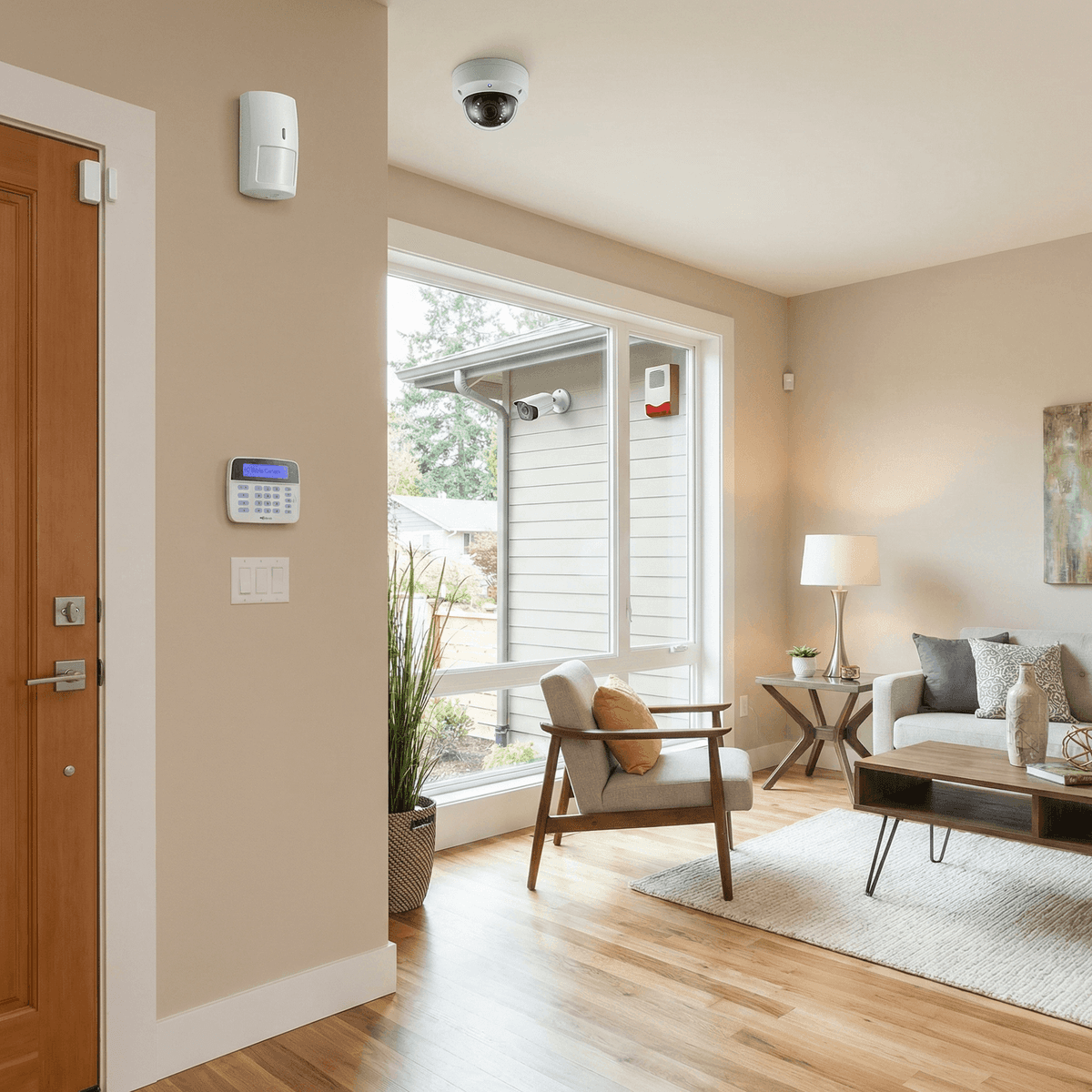
The most effective sites use layered protection instead of relying on perimeter motion alone. A typical architecture includes perimeter beams or virtual tripwires, PIR or dual-technology detectors near containers and offices, door contacts on storage units, AI video analytics for human and vehicle classification, local sirens, and remote monitoring software. This layered approach reduces false dispatches while increasing the chance of catching real intrusions before loss escalates.
According to IEC 62676 (2024 framework usage), video surveillance systems should be designed around image usability, scene purpose, and recording performance rather than camera quantity alone. That means a gate camera used for identification needs different placement and pixel density than a wide-area overview camera on a mast. Construction buyers often overspend on camera count and underspend on positioning, analytics, and night performance.
The National Fire Protection Association states in NFPA 72 that signaling pathways and alarm communication reliability are central to effective event transmission. For temporary sites, that translates into hybrid communications. A practical minimum is 4G primary plus local WiFi or Ethernet fallback where available. For major infrastructure projects, two cellular carriers or a satellite backup may be justified.
Comparison of common construction security configurations
| Configuration | Typical Cameras | Alarm Zones | Battery Autonomy | Solar Array | Best Use Case |
|---|---|---|---|---|---|
| Basic mobile tower | 4 | 8-16 | 48-72 hours | 1.5-2.5 kWp | Small urban infill site |
| Standard remote site package | 6-8 | 16-32 | 72-96 hours | 2.5-4.5 kWp | Mid-size civil or commercial build |
| Advanced multi-zone package | 8-12 | 32-64 | 72-120 hours | 4.0-6.5 kWp | Large logistics, highway, or industrial project |
| Critical infrastructure package | 12-16 | 64-96 | 96-120 hours | 5.5-9.0 kWp | Ports, substations, rail, energy sites |
SOLAR TODO can also adapt lessons from larger fixed-site packages. For example, the Government Building 128-Zone Maximum demonstrates how high-zone segmentation and 64-camera coverage support layered response across multiple perimeters and interior partitions. Construction projects rarely need that scale, but major airport, rail, or utility sites may benefit from a similar multi-partition logic with phased deployment as the site footprint changes.
The International Electrotechnical Commission states, "International Standards and conformity assessment underpin safety, performance and interoperability." In procurement terms, standards alignment is not paperwork; it is a practical way to ensure cameras, control panels, networking gear, and signaling pathways behave predictably under field conditions.
Guard Labor Savings, ROI, and Operational Benefits
Solar-powered security can reduce guard labor by 60-90% in many construction scenarios when remote monitoring replaces static overnight posts and escalates only verified events.
Labor is usually the largest recurring security cost on a construction site. A single 12-hour overnight guard shift can cost far more annually than the depreciation and maintenance of a solar-powered surveillance asset. If a project currently uses two guards per night across access points and material yards, even partial replacement with monitored towers, analytics, and audio challenge capability can create substantial savings.
Consider a simple example. If one overnight guard post costs $1,800-$3,500 per month depending on market, and a solar-powered monitored system costs $18,000-$40,000 installed, payback may fall in the 12-24 month range before accounting for avoided theft. If the system also prevents one fuel or cable theft event worth $5,000-$20,000, ROI improves further. For multi-phase contractors reusing the asset across 3-5 projects, lifecycle economics become even stronger.
According to IRENA (2024), renewable power economics continue to favor low-operating-cost systems where fuel and grid extension costs are avoided. In security applications, that means solar power is not only an energy source but also an opex control tool. Diesel generator-backed CCTV may appear flexible, but fuel logistics, servicing, noise, and theft exposure often make it more expensive over time.
Operational benefits beyond labor reduction
- Faster deployment before utility energization
- Lower theft risk for generators and fuel tanks
- Better evidence quality through continuous recording and event clips
- Easier relocation as site phases move
- Lower carbon and noise footprint for ESG-sensitive projects
- Improved insurer and client confidence through documented monitoring workflows
According to UL 681 (2020), installation and classification practices are fundamental to burglary and holdup system reliability. For construction firms, reliable installation means protected cable routing, tamper-resistant enclosures, stable mast foundations, and commissioning tests that verify alarm transmission, camera views, and battery endurance. SOLAR TODO emphasizes this because a poorly mounted camera or untested battery bank can negate the value of otherwise good components.
EPC Investment Analysis and Pricing Structure
For construction security projects, EPC turnkey delivery bundles engineering, procurement, installation, commissioning, and training into one scope, while FOB and CIF options shift more site risk and coordination back to the buyer.
B2B buyers should compare three commercial models before issuing a purchase order. The right choice depends on whether the contractor has in-house electrical teams, local integrators, and commissioning capacity. For one-off purchases, supply-only may be adequate. For multi-site rollouts or remote projects, EPC usually reduces schedule risk.
Three-tier pricing structure
| Delivery Model | What It Includes | Typical Buyer Responsibility | Best For |
|---|---|---|---|
| FOB Supply | Equipment ex-factory, packing, standard documentation | Freight, import, installation, commissioning | Experienced distributors and integrators |
| CIF Delivered | Equipment, ocean freight, insurance to destination port | Customs clearance, inland transport, installation | Importers with local project teams |
| EPC Turnkey | Engineering, supply, installation, testing, commissioning, training | Site access, civil readiness, operating approvals | End users, developers, major contractors |
For construction site systems, indicative pricing varies widely by camera count, mast height, storage capacity, and monitoring scope. As a directional guide, small 4-camera autonomous packages may start in the low five figures, while advanced 8-12 camera systems with 72-120 hour autonomy, analytics, and remote monitoring can move into mid five figures or higher. Large critical-infrastructure deployments can be benchmarked against fixed-site integrated systems such as the Port Terminal 96-Zone Full Security package at USD 16,500-21,300 and the Government Building 128-Zone Maximum EPC range of USD 36,300-46,600, though temporary solarized construction systems are configured differently.
Volume pricing, payment terms, and financing
- 50+ units: typically 5% discount
- 100+ units: typically 10% discount
- 250+ units: typically 15% discount
- Standard payment terms: 30% T/T + 70% against B/L
- Alternative payment terms: 100% L/C at sight
- Financing may be available for large projects above $1,000K
- Commercial contact: cinn@solartodo.com
ROI framework for buyers
Use this simple screening model:
- Calculate annual guard labor cost for the posts you aim to replace.
- Add annual theft and vandalism losses over the last 2-3 years.
- Compare against annualized system cost, monitoring fees, maintenance, and battery replacement reserve.
- Include redeployment value if the system will be reused on future sites.
A practical target is payback within 12-36 months. Projects with high wage rates, remote access challenges, or repeated material theft can beat that threshold comfortably. SOLAR TODO generally advises buyers to evaluate total cost of protection, not just equipment price, because labor avoidance and loss prevention usually drive the strongest business case.
Selection Guide for Procurement and Engineering Teams
The best construction security specification matches 48-120 hours of autonomy, 4-12 cameras, and 16-64 zones to the site’s theft profile, weather risk, and response workflow.
Procurement managers should start with risk mapping rather than product catalogs. Identify what must be protected, when incidents happen, and how response is triggered. A downtown tower project with enclosed boundaries needs a different design than a road project with 2 km of open perimeter and moving laydown yards.
Minimum data to collect before requesting quotation
- Site location and expected deployment season
- Utility availability and energization date
- Required camera count and night coverage distance
- Target autonomy in hours or days
- Monitoring model: self-monitored, central station, or guard dispatch
- Theft history: fuel, cable, tools, plant, or perimeter breach
- Communication conditions: 4G strength, WiFi, Ethernet, satellite options
- Redeployment plan after project completion
Recommended specification checkpoints
- Lithium battery chemistry with cycle-life data and BMS protection
- PV sizing based on winter irradiance, not summer averages
- 30 days of retention if evidence preservation is contractually important
- AI analytics for human and vehicle filtering to reduce false alarms
- Enclosures rated for dust, heat, and tamper resistance
- Compliance alignment with IEC 62676, EN 50131, UL 681, and NFPA 72 principles
According to IEEE 1547-2018, interoperability and electrical interface discipline are essential when distributed energy resources connect with broader power systems. Even when a construction security package is mostly standalone, the same engineering mindset applies: define electrical interfaces, surge protection, grounding, and communication resilience from the start. That reduces field failures and simplifies handover.
SOLAR TODO supports inquiry-led project development rather than online checkout because battery autonomy, camera duty cycle, and labor-saving ROI are site-specific engineering variables. For contractors, EPC firms, and developers, that usually produces a more accurate scope and a more defensible procurement decision.
FAQ
Construction site buyers most often ask about autonomy, sizing, costs, maintenance, and labor savings because those 5 variables determine whether a solar-powered security project delivers reliable protection and acceptable payback.
Q: How many days of battery autonomy should a construction site security system have? A: Most construction sites should target 2-5 days, or about 48-120 hours, of battery autonomy. The right figure depends on weather volatility, theft risk, and how critical continuous video evidence is. Remote or high-value sites usually justify 72 hours or more.
Q: What determines the solar panel size for a security tower or trailer? A: Solar size is determined by daily energy demand, local peak sun hours, and system losses from temperature, dust, wiring, and conversion. A site consuming about 10 kWh/day may need roughly 3.0-4.5 kWp depending on season and location. Winter design conditions should drive the final specification.
Q: Can solar-powered security really replace night guards? A: It can often replace static guard posts, especially where remote monitoring, audio challenge, and verified video alarms are accepted by the client. Many projects see 60-90% guard labor reduction, but some sites still keep mobile patrols or response teams. The best model is usually hybrid rather than all-human or all-technology.
Q: How much can a contractor save by switching from guards to monitored solar security? A: Savings depend on local wages and the number of posts removed. If one overnight guard costs $1,800-$3,500 per month, eliminating even one post can support payback in roughly 12-24 months for many systems. Theft reduction and redeployment across multiple projects improve ROI further.
Q: What camera and detector mix is typical for a medium-size construction site? A: A common medium-size design uses 6-8 cameras, 16-32 alarm zones, door contacts on containers, perimeter analytics, and 1-2 sirens or speakers. This setup usually covers gates, laydown yards, fuel stores, offices, and equipment parking. Final counts should follow a risk map, not a generic package.
Q: How much maintenance do solar-powered security systems need on dusty sites? A: Maintenance is moderate but important. Panels may need cleaning monthly or quarterly in dusty environments, while batteries, communications, and camera views should be checked routinely. A formal inspection every 3-6 months is a sensible baseline for construction deployments that move or expand frequently.
Q: What happens during several cloudy days or heavy rain? A: Properly designed systems continue operating from battery storage during low-generation periods. That is why autonomy is specified in hours or days rather than just battery voltage or amp-hours. If the site has severe seasonal weather, designers should increase both PV capacity and battery reserve.
Q: Is 4G communication enough for remote construction security? A: 4G is often adequate as a primary path, but critical sites should add a second communication path where possible. Dual-SIM, dual-carrier, WiFi bridge, Ethernet, or satellite backup can materially improve uptime. Communication resilience matters as much as camera quality when incident response depends on remote verification.
Q: What standards should procurement teams request in tenders? A: Buyers should reference IEC 62676 for video surveillance, EN 50131 for intrusion systems, UL 681 for installation practice, and NFPA 72 principles for alarm signaling. These standards help align performance expectations, integration quality, and acceptance testing. They also support insurer and client confidence.
Q: What is included in EPC turnkey delivery for construction security? A: EPC turnkey delivery usually includes engineering, equipment supply, installation, testing, commissioning, training, and handover documentation. It reduces coordination burden for contractors managing multiple trades and compressed schedules. Compared with FOB or CIF supply, EPC often lowers execution risk on remote or multi-site projects.
Q: What payment terms, discounts, and financing are typical? A: Standard terms are commonly 30% T/T and 70% against B/L, with 100% L/C at sight as an alternative. Volume guidance is often 5% discount for 50+ units, 10% for 100+, and 15% for 250+. Financing may be available for projects above $1,000K through negotiated structures.
Q: How should buyers compare one vendor’s battery autonomy claim with another’s? A: Ask each vendor to state autonomy in hours at a defined average load, usable depth of discharge, minimum temperature, and end-of-life battery condition. A claim of 72 hours without those assumptions is incomplete. Good specifications also state recharge time and expected cycle life.
Conclusion
For construction sites, solar-powered security delivers the strongest value when 48-120 hours of battery autonomy, 4-12 cameras, and verified remote monitoring are engineered together to cut guard labor by 60-90%.
The bottom line is simple: if your project faces delayed grid access, repeated theft exposure, or high overnight guard costs, a properly sized SOLAR TODO system can often achieve 12-36 month payback while improving evidence quality and deployment speed.
Related Reading
References
- NREL (2024): PVWatts Calculator methodology and solar resource modeling guidance for estimating PV output under site-specific conditions.
- IEA PVPS (2024): Trends in Photovoltaic Applications 2024, including performance assumptions, deployment trends, and system considerations for PV projects.
- IRENA (2024): Renewable Power Generation Costs in 2023, documenting the cost competitiveness of solar PV and low-operating-cost renewable systems.
- IEC 62676 (2024): Video surveillance systems for use in security applications; framework for performance, image usability, and system design.
- EN 50131 (2023 framework use): Alarm systems standard series for intrusion and hold-up applications used in professional security design.
- UL 681 (2020): Installation and classification standard for burglary and holdup alarm systems, relevant to commissioning and reliability practices.
- NFPA 72 (2022): National Fire Alarm and Signaling Code covering signaling pathways and communication reliability principles.
- IEEE 1547-2018 (2018): Standard for interconnection and interoperability of distributed energy resources with electric power system interfaces.
About SOLARTODO
SOLARTODO is a global integrated solution provider specializing in solar power generation systems, energy-storage products, smart street-lighting and solar street-lighting, intelligent security & IoT linkage systems, power transmission towers, telecom communication towers, and smart-agriculture solutions for worldwide B2B customers.
About the Author

SOLAR TODO
Solar Energy & Infrastructure Expert Team
SOLAR TODO is a professional supplier of solar energy, energy storage, smart lighting, smart agriculture, security systems, communication towers, and power tower equipment.
Our technical team has over 15 years of experience in renewable energy and infrastructure, providing high-quality products and solutions to B2B customers worldwide.
Expertise: PV system design, energy storage optimization, smart lighting integration, smart agriculture monitoring, security system integration, communication and power tower supply.
Cite This Article
SOLAR TODO. (2026). Solar-Powered Construction Site Security ROI Guide. SOLAR TODO. Retrieved from https://solartodo.com/knowledge/engineering-solar-powered-security-systems-for-construction-sites-battery-autonomy-and-guard-labor-savings
@article{solartodo_engineering_solar_powered_security_systems_for_construction_sites_battery_autonomy_and_guard_labor_savings,
  title = {Solar-Powered Construction Site Security ROI Guide},
  author = {SOLAR TODO},
  journal = {SOLAR TODO Knowledge Base},
  year = {2026},
  url = {https://solartodo.com/knowledge/engineering-solar-powered-security-systems-for-construction-sites-battery-autonomy-and-guard-labor-savings},
  note = {Accessed: 2026-04-18}
}
Published: April 17, 2026 | Available at: https://solartodo.com/knowledge/engineering-solar-powered-security-systems-for-construction-sites-battery-autonomy-and-guard-labor-savings
Subscribe to Our Newsletter
Get the latest solar energy news and insights delivered to your inbox.
View All Articles