energy management vs Alternatives: Smart Solar Streetlight…

SOLARTODO Editorial Team
Solar Energy & Infrastructure Expert Team
Watch the video
TL;DR
For EV charging corridors, choose integrated smart solar streetlights when the project needs lighting, surveillance, communications, and resilience in one roadside asset. The strongest options use 80-200 W LEDs, 170 lm/W efficacy, IP66 protection, 1-3 nights of managed autonomy, and a 25-year pole life. Compared with separate assets, they can cut trenching interfaces by 30-40% and reduce maintenance points significantly.
Smart solar streetlight systems for EV charging corridors must balance lighting, storage, and controls. A 120 W to 200 W smart pole with 170 lm/W efficacy, IP66 protection, and 25-year structural life can reduce trenching interfaces by 30-40% versus separate roadside assets.
Summary
Smart solar streetlight systems for EV charging corridors must balance lighting, storage, controls, and uptime. A 120 W to 200 W smart pole with IP66 protection, 170 lm/W efficacy, and 25-year structural life can cut trenching interfaces by 30-40% versus multi-asset alternatives.
Key Takeaways
- Compare corridor loads first: map 120 W to 200 W lighting demand, camera power, WiFi, display, and EV charger auxiliary loads before selecting battery capacity.
- Choose integrated poles when civil work is expensive: a 6-in-1 or 4-in-1 pole can reduce visible street furniture by up to 60% and trenching interfaces by 30-40%.
- Specify lighting performance by use case: use 120 W smart poles for commercial roads and up to 200 W, 34,000-lumen systems for tunnel-adjacent EV approaches.
- Size storage with autonomy targets: design for at least 1-3 nights of backup and verify operation across -40°C to +55°C where climate is severe.
- Verify enclosure and structure ratings: require IP66, wind resistance above 150 km/h, and a 25-year pole design life for corridor deployments.
- Evaluate EPC pricing in three tiers: expect smart pole budgets from about USD 1,400-1,600 for 8 m park units to USD 1,800-2,200 for 10 m tunnel-entry units.
- Use networked controls to improve uptime: connected monitoring can lower outage response times by more than 20% compared with non-connected assets, based on cited municipal studies.
- Standardize procurement around IEC and IEEE references: check IEC 60598, IEC 62722, IEEE 1547, and UL safety requirements before approving corridor packages.
Why energy management matters more than simple lighting in EV charging corridors
Energy management is the deciding factor because EV charging corridors combine 80 W to 200 W lighting loads, communications devices, and uptime targets that passive poles cannot manage during grid instability or peak tariffs.
EV charging corridors are not ordinary road-lighting projects. They combine roadway illumination, charger wayfinding, surveillance, environmental sensing, and in some cases public information display within a single roadside asset set. Once chargers are added, the corridor operator must control not only lux levels and pole spacing, but also battery dispatch, peak demand exposure, communication uptime, and maintenance response time across dozens or hundreds of points.
The main procurement mistake is comparing a smart solar streetlight only against a conventional light pole on first-cost basis. A corridor with 1 passive pole, 1 CCTV mast, 1 sign structure, and 1 separate communications bracket usually creates 4 foundations, 4 maintenance records, and multiple cable routes. By contrast, SOLAR TODO integrated smart poles consolidate these functions into 1 asset location, which can reduce trenching interfaces by roughly 30-40% and visible street furniture by up to 60% in suitable layouts.
According to the International Energy Agency, "electrification is a key pillar of clean energy transitions," and transport electrification increases the value of resilient distributed infrastructure. For EV corridors, that means roadside energy assets must support both mobility services and public safety functions. According to IEA (2024), electricity demand from new electrified transport loads continues to rise, making local load management and digital control more important than in legacy streetlighting schemes.
According to NREL (2024), distributed solar-plus-storage systems improve resilience when they are properly matched to critical loads, control logic, and duty cycle. That principle applies directly to EV charging corridors: if the pole only produces energy but does not manage it, the operator still faces outages, poor nighttime autonomy, and unnecessary battery cycling.
SOLAR TODO positions its smart streetlight portfolio for this exact gap between simple illumination and managed roadside infrastructure. For corridor planners, the question is not whether a pole can hold a luminaire at 8 m, 9 m, or 10 m; the question is whether the complete system can prioritize loads, maintain communications, and keep the site safe when grid quality drops or maintenance teams are delayed.
Smart solar streetlight systems vs alternatives: what buyers should compare
Integrated smart poles usually outperform separate roadside assets when projects need 1 pole to replace 4-6 devices, IP66 protection, and centralized control across 8 m to 10 m mounting heights.
For EV charging corridors, buyers generally compare four options: conventional grid streetlights, solar-only streetlights without smart control, integrated smart solar streetlights, and hybrid grid-plus-solar smart poles. Each option has a different risk profile for uptime, capex, and maintenance.
A conventional grid streetlight has the lowest equipment complexity, but it does not solve corridor digitization. If the site also needs CCTV, display, WiFi, public audio, or environmental sensing, those functions are added as separate assets. This increases interfaces, foundations, and outage points. In corridors with long feeder distances, trenching and cable protection can exceed the cost difference between a passive pole and an integrated smart pole.
A basic solar streetlight reduces grid dependence, but many low-cost units lack energy management logic, remote monitoring, and load prioritization. In practice, that means the light may operate, but the camera or communications module may fail first when battery state of charge drops below a safe threshold. For EV charging corridors, this is a serious issue because surveillance and wayfinding are often mandatory functions, not optional accessories.
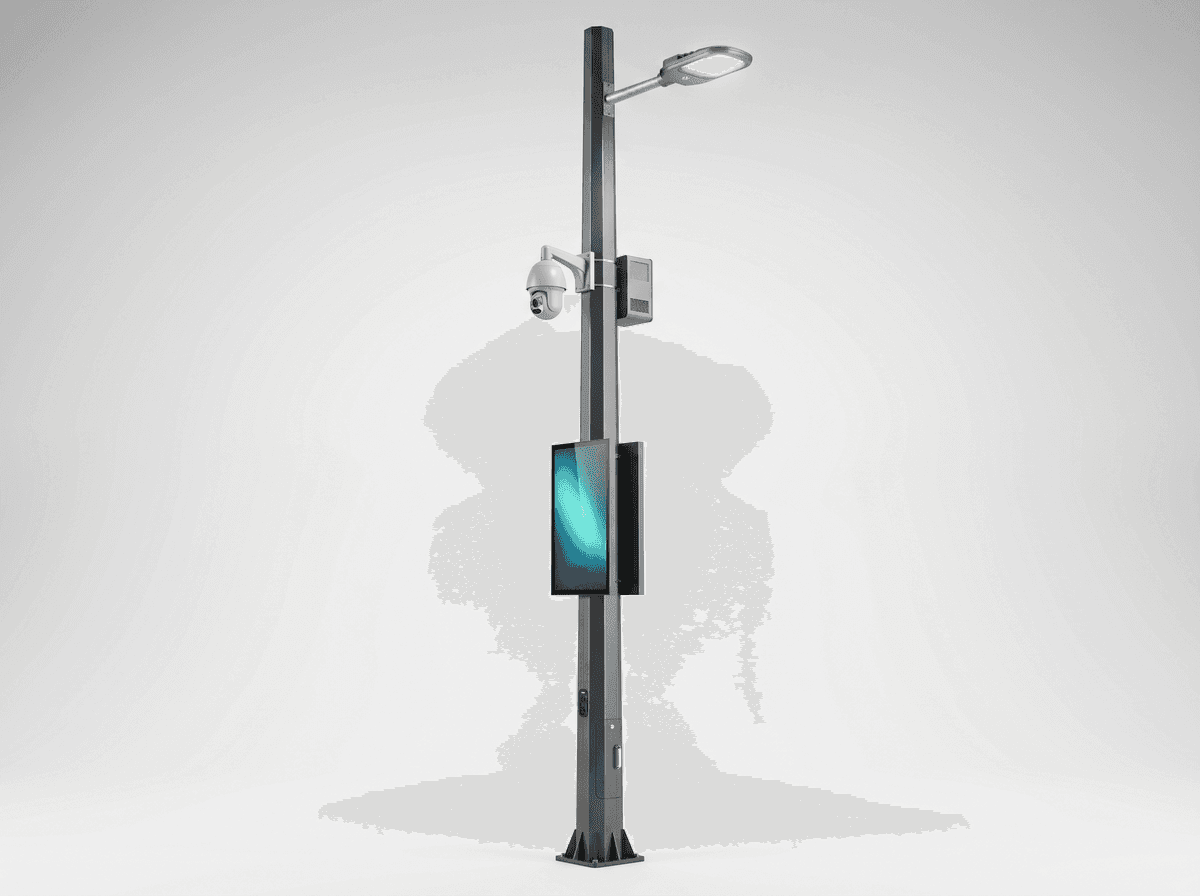
An integrated smart solar streetlight adds a controller that allocates available energy between lighting, cameras, displays, sensors, and communications. This is where energy management becomes the real differentiator. A 9 m commercial 6-in-1 smart pole from SOLAR TODO combines 120 W LED lighting, 4K camera surveillance, environmental sensing, LED display, WiFi, and IP public audio in 1 IP66 structure with more than 150 km/h wind resistance and 170 lm/W efficacy.
A hybrid grid-plus-solar smart pole is often the best choice for EV charging corridors with high uptime requirements. It allows the pole to use solar generation and battery storage first, then switch to grid support when irradiance is low or event loads increase. Sample deployment scenario (illustrative): a charging plaza access road may use solar power for nightly lighting and sensor loads while preserving grid supply for charger operation and emergency reserve.
Comparison table for corridor selection
The table below summarizes the practical differences procurement teams should evaluate.
| Option | Typical Functions | Civil Interfaces | Resilience | Control Level | Best Use Case |
|---|---|---|---|---|---|
| Conventional grid streetlight | Lighting only, usually 80-150 W | High when CCTV/signage are separate | Low during feeder faults | Minimal | Basic roads with no digital services |
| Basic solar streetlight | Lighting only, often 40-120 W | Low to medium | Medium for lighting only | Limited | Low-traffic roads with simple autonomy targets |
| Integrated smart solar streetlight | Lighting + camera + sensor + WiFi/display/audio | Low, 1 pole can replace 4-6 devices | High for critical roadside services | Advanced remote monitoring | EV corridors, campuses, commercial roads |
| Hybrid grid-plus-solar smart pole | All smart functions plus grid backup | Medium | Very high | Advanced with fallback modes | EV charging corridors with strict uptime |
SOLAR TODO product-fit examples
SOLAR TODO offers several configurations that align with corridor segments rather than a single one-size-fits-all pole.
- The 8 m Campus/Park Environmental Smart Streetlight uses an 80 W LED, AI camera, environmental sensor, WiFi module, and USB charging interface in a 5-in-1 package. It suits green corridors, rest nodes, and lower-speed EV parking approaches.
- The 9 m Commercial Street 6-in-1 with Display uses a 120 W LED, 4K camera, environmental sensor, LED display, WiFi, and IP public audio. It suits charging plazas, mixed-use streets, and retail-adjacent EV corridors.
- The 10 m Tunnel Entrance Smart Pole uses a 200 W LED module at 170 lm/W, about 34,000 lumens, plus AI camera, environmental sensor, and LED display. It suits tunnel entrance approaches and high-contrast threshold zones near EV highway corridors.
Technical selection criteria for energy management, storage, and controls
The right system uses load prioritization, 1-3 nights of battery autonomy, and IP66 hardware so lighting and surveillance stay online even when irradiance, temperature, or grid quality changes.
The first technical step is load classification. In an EV charging corridor, not every load has equal priority. Lighting and surveillance usually rank as Tier 1, communication and signage as Tier 2, and convenience features such as public charging ports or non-critical displays as Tier 3. A controller should reduce or shed lower-priority loads before it allows the luminaire or camera to fail.
The second step is battery autonomy. Many corridor tenders focus on nominal battery capacity, but autonomy is the more useful metric. If a pole supports 120 W lighting plus 20-60 W of electronics, the operator should define whether the site needs 1 night, 2 nights, or 3 nights of support at a specified dimming profile. In hot climates above +45°C or cold climates below -20°C, usable battery capacity can fall enough to change the design margin.
The third step is optical and structural performance. Lighting efficacy around 170 lm/W is useful because it lowers battery demand for the same roadway output. Pole height also matters: 8 m units fit parks and lower-speed lanes, 9 m units fit commercial corridors with about 28 m recommended spacing, and 10 m units fit wider carriageways or tunnel-adjacent threshold zones. Wind resistance above 150 km/h and a 25-year structural design life are baseline requirements for many exposed corridors.
According to IEC 60598, luminaires for road applications must meet electrical and mechanical safety requirements. According to IEC 62722, LED luminaires should be specified with clear performance data, including efficacy, thermal behavior, and output consistency. For corridor procurement, these standards are more useful than generic brochure claims because they define what can be verified during FAT and site commissioning.
The International Energy Agency states, "Digitalisation can make energy systems more connected, intelligent, efficient, reliable and sustainable." For smart poles, that means remote dimming, fault alarms, battery state-of-charge monitoring, and communications diagnostics should be standard functions, not add-ons. According to municipal digital infrastructure studies cited by NREL and industry reviews, networked monitoring can reduce outage response times by more than 20% compared with non-connected assets.
Minimum specification checklist for EV corridor tenders
Use a hard specification list so suppliers quote on the same basis.
- Pole height: 8 m, 9 m, or 10 m based on road class and spacing
- LED power: 80 W, 120 W, or 200 W depending on lux target
- Lighting efficacy: at least 170 lm/W
- Protection: IP66 minimum for luminaire and electronics enclosures
- Wind resistance: 150 km/h or higher
- Design life: 25 years for pole structure
- Operating temperature: verify up to +55°C and down to -40°C where required
- Smart modules: camera, environmental sensor, WiFi, display, IP audio as needed
- Control functions: dimming, battery management, remote alarms, load prioritization
- Compliance references: IEC 60598, IEC 62722, IEEE 1547 where grid interconnection applies, UL electrical safety requirements for target market
EPC Investment Analysis and Pricing Structure
For EV charging corridors, EPC analysis should compare FOB supply, CIF delivered, and turnkey installed pricing because civil work, controls, and commissioning can change total project cost by 20-40%.
EPC means Engineering, Procurement, and Construction. In a smart streetlight project, turnkey delivery typically includes pole and luminaire supply, control cabinet or embedded controller, battery and PV package where applicable, foundation and anchor design, cable routing, installation, testing, commissioning, and documentation. For corridor projects, EPC may also include charger-area integration, signage logic, and SCADA or platform connection.
SOLAR TODO generally discusses pricing in three tiers so buyers can align scope correctly.
| Pricing Tier | What It Includes | Typical Buyer Use |
|---|---|---|
| FOB Supply | Pole, lighting, smart modules, controller, packed at port of origin | Importers, distributors, EPC firms with local installation teams |
| CIF Delivered | FOB scope plus sea freight and insurance to destination port | Buyers who want landed-cost visibility before local works |
| EPC Turnkey | Delivered equipment plus civil works, installation, testing, and commissioning | Developers, municipalities, and corridor operators seeking one accountable package |
Using available product references, an 8 m 5-in-1 campus or park smart pole typically fits an installed EPC budget of about USD 1,400-1,600 per unit. A 10 m 4-in-1 tunnel entrance smart pole typically fits about USD 1,800-2,200 per unit. A 9 m 6-in-1 commercial corridor pole will usually sit between those ranges depending on display size, communications package, and local installation conditions.
Volume pricing should be planned early because corridor projects scale quickly. As a guidance structure for quotation review, 50+ units may qualify for about 5% discount, 100+ units for about 10%, and 250+ units for about 15%, subject to module mix, shipping terms, and destination compliance requirements. Payment terms commonly follow 30% T/T with 70% against B/L, or 100% L/C at sight. Financing is available for large projects above USD 1,000K, and inquiry handling can be directed to [email protected].
ROI should be calculated against the real alternative, not against a single passive light pole. If an integrated pole replaces 4-5 separate roadside assets, the savings come from fewer foundations, less trenching, fewer maintenance dispatch points, and lower energy use from LED lighting. According to IEA and IRENA urban efficiency studies, LED modernization with controls typically cuts lighting energy use by 50-70% versus legacy HID systems. In many corridor layouts, the payback period versus separated multi-asset infrastructure can fall in the 3-6 year range, depending on labor cost, feeder distance, and communications requirements.
Use cases and selection guide for EV charging corridors
The best corridor design usually mixes 8 m, 9 m, and 10 m smart poles so each road segment gets the right lux level, module set, and capex profile.
An EV charging corridor often contains three different lighting environments. The first is the approach road, where drivers need clear wayfinding and surveillance. The second is the charging plaza or service node, where display, public audio, and WiFi become more valuable. The third is any constrained or high-contrast segment such as underpasses or tunnel approaches, where higher-output lighting and environmental awareness matter more than extra public-service modules.
For lower-speed greenways, feeder roads, and parking-edge areas, the 8 m 5-in-1 configuration is usually sufficient. Its 80 W LED load is easier to support with solar-plus-storage, and the AI camera, environmental sensor, and WiFi module provide useful digital services without overloading the energy budget. This is often the most efficient option where charger canopies already provide some additional lighting.
For retail-adjacent charging corridors and urban commercial streets, the 9 m 6-in-1 configuration is often the best balance. The 120 W LED output, 4K camera, LED display, WiFi, and IP public audio support both safety and customer communication. The recommended spacing around 28 m helps planners estimate pole count quickly during concept design.
For tunnel-adjacent highway charging routes or threshold zones with sharp luminance transitions, the 10 m 4-in-1 tunnel entrance pole is the correct specialist option. Its 200 W LED module at 170 lm/W delivers about 34,000 lumens and targets around 300 lux in critical approach zones. That level of output is not necessary everywhere, but it is justified where driver adaptation and object recognition are safety-critical.
Practical selection matrix
| Corridor Segment | Recommended Pole | Key Reason | Main Trade-off |
|---|---|---|---|
| Parking edge / green corridor | 8 m 5-in-1 | Lower load, easier solar autonomy | Lower roadway coverage than 9-10 m poles |
| Charging plaza / commercial street | 9 m 6-in-1 | Best mix of lighting, display, WiFi, audio | Slightly higher capex than simple poles |
| Tunnel approach / high-contrast road | 10 m 4-in-1 | 200 W output and about 300 lux target | Higher energy demand requires stronger storage/grid support |
SOLAR TODO can support this segmented approach through offline quotation and project review rather than forcing one standard SKU across the whole corridor. For procurement managers, that reduces overspecification. For engineers, it improves energy budgeting because each pole type is matched to a defined duty cycle.
FAQ
The most common buyer questions cover cost, autonomy, standards, maintenance, and whether smart poles outperform separate assets over a 25-year project life.
Q: What is the main difference between energy management and a basic solar streetlight for EV corridors? A: Energy management means the system actively prioritizes loads such as lighting, cameras, and communications based on battery state, solar input, and grid status. A basic solar streetlight may power only the luminaire well, but it often lacks the logic needed to keep surveillance and wayfinding online during low-charge periods.
Q: Why are integrated smart poles better than separate roadside assets in charging corridors? A: Integrated smart poles reduce foundations, cable interfaces, and maintenance points because 1 pole can replace 4-6 separate devices. In many projects, that cuts visible street furniture by up to 60% and trenching interfaces by 30-40%, which matters more than unit price alone.
Q: How much do smart streetlight systems for EV corridors typically cost? A: Installed pricing depends on height, modules, and civil scope. As a reference, an 8 m 5-in-1 unit is about USD 1,400-1,600 installed, while a 10 m 4-in-1 tunnel-entry unit is about USD 1,800-2,200. A 9 m 6-in-1 commercial configuration usually falls between those ranges.
Q: What should EPC turnkey delivery include for these projects? A: EPC should include engineering, procurement, civil works, installation, testing, commissioning, and documentation. For EV corridors, it should also define platform connection, charger-area coordination, and acceptance testing for lighting, cameras, displays, and battery-control functions before handover.
Q: How should battery autonomy be specified for a smart solar streetlight? A: Specify autonomy in nights or hours at a defined dimming schedule, not only by nominal battery kWh. For corridor projects, 1-3 nights is a practical range depending on climate, criticality, and whether the pole has hybrid grid backup for low-irradiance periods.
Q: Which SOLAR TODO pole is best for a charging plaza with customer information display? A: The 9 m Commercial Street 6-in-1 with Display is usually the best fit for charging plazas. It combines 120 W LED lighting, 4K camera, environmental sensing, LED display, WiFi, and IP public audio, which supports both safety and customer communication in one asset.
Q: When is a 10 m tunnel entrance smart pole necessary? A: A 10 m tunnel entrance pole is necessary where drivers face sharp luminance transitions and need higher approach-zone visibility. The 200 W LED module delivers about 34,000 lumens and can target around 300 lux, which is appropriate for threshold lighting rather than ordinary plaza roads.
Q: What standards should buyers verify before approving a supplier? A: Buyers should check IEC 60598 for luminaire safety, IEC 62722 for LED luminaire performance, IEEE 1547 where grid interconnection applies, and relevant UL electrical safety requirements for the destination market. Structural requirements such as wind resistance above 150 km/h should also be written into the tender.
Q: What maintenance burden should operators expect over 25 years? A: Maintenance is lower than with separated assets because there are fewer poles, brackets, and cable interfaces to inspect. Operators should still plan periodic checks for battery health, controller logs, camera cleaning, luminaire output, and enclosure seals, typically on a 6-12 month cycle depending on dust and temperature.
Q: How do payment terms and volume discounts usually work? A: Common export terms are 30% T/T in advance with 70% against B/L, or 100% L/C at sight. For larger orders, 50+ units may receive about 5% discount, 100+ units about 10%, and 250+ units about 15%, subject to final configuration and shipping terms.
Q: Can these systems be financed for large corridor projects? A: Yes, financing can be arranged for larger projects above about USD 1,000K, subject to project scope and commercial review. That matters for corridor developers who want to combine smart poles, charger infrastructure, and phased rollout under one capital plan.
Q: How can buyers start a technical quotation with SOLAR TODO? A: Buyers should prepare pole count, road cross-section, lux target, module list, autonomy requirement, and destination standards before requesting a quote. SOLAR TODO handles projects through inquiry and offline quotation, and commercial contact can be made at [email protected] or +6585559114.
References
According to these standards and organizations, corridor buyers should base selection on verified lighting, safety, grid, and energy-transition criteria rather than brochure language alone.
- NREL (2024): PVWatts and distributed energy resource analysis methods used for estimating solar production, storage interaction, and resilience value in distributed systems.
- IEC 60598 (2024): Luminaire safety requirements for electrical, thermal, and mechanical performance relevant to road and outdoor lighting equipment.
- IEC 62722 (2014): LED luminaire performance requirements covering photometric data, efficacy, and product performance declarations.
- IEEE 1547 (2018): Standard for interconnection and interoperability of distributed energy resources with electric power systems interfaces.
- IEA (2024): Energy system digitalisation and electrification guidance showing why connected infrastructure improves efficiency and operational visibility.
- IRENA (2024): Urban energy efficiency and electrification findings showing the value of LED modernization and distributed clean-energy integration.
- UL (2024): Electrical safety and product compliance framework commonly referenced for power, lighting, and control equipment in applicable markets.
Conclusion
For EV charging corridors, integrated smart solar streetlights deliver the best value when they combine 80-200 W lighting, IP66 protection, and 1-3 nights of managed autonomy instead of acting as simple standalone lamps.
The bottom line is clear: if the corridor needs safety, surveillance, and digital services, energy management beats passive alternatives because 1 smart pole can replace 4-6 roadside assets while improving control, reducing trenching by 30-40%, and supporting a stronger 25-year total-cost case. For project-specific selection, SOLAR TODO should be evaluated by segment using 8 m, 9 m, and 10 m configurations rather than one uniform pole type.
About SOLARTODO
SOLARTODO is a global integrated solution provider specializing in solar power generation systems, energy-storage products, smart street-lighting and solar street-lighting, intelligent security & IoT linkage systems, power transmission towers, telecom communication towers, and smart-agriculture solutions for worldwide B2B customers.
Further Reading
About the Author

SOLARTODO Editorial Team
Solar Energy & Infrastructure Expert Team
SOLAR TODO is a professional supplier of solar energy, energy storage, smart lighting, smart agriculture, security systems, communication towers, and power tower equipment.
Our technical team has over 15 years of experience in renewable energy and infrastructure, providing high-quality products and solutions to B2B customers worldwide.
Expertise: PV system design, energy storage optimization, smart lighting integration, smart agriculture monitoring, security system integration, communication and power tower supply.
Cite This Article
SOLARTODO Editorial Team. (2026). energy management vs Alternatives: Smart Solar Streetlight…. SOLARTODO. Retrieved from https://solartodo.com/knowledge/energy-management-vs-alternatives-smart-solar-streetlight-systems-selection-guide-for-ev-charging-corridors
@article{solartodo_energy_management_vs_alternatives_smart_solar_streetlight_systems_selection_guide_for_ev_charging_corridors,
  title = {energy management vs Alternatives: Smart Solar Streetlight…},
  author = {SOLARTODO Editorial Team},
  journal = {SOLARTODO Knowledge Base},
  year = {2026},
  url = {https://solartodo.com/knowledge/energy-management-vs-alternatives-smart-solar-streetlight-systems-selection-guide-for-ev-charging-corridors},
  note = {Accessed: 2026-10-14}
}
Published: July 12, 2026 | Available at: https://solartodo.com/knowledge/energy-management-vs-alternatives-smart-solar-streetlight-systems-selection-guide-for-ev-charging-corridors
Subscribe to Our Newsletter
Get the latest solar energy news and insights delivered to your inbox.
View All Articles