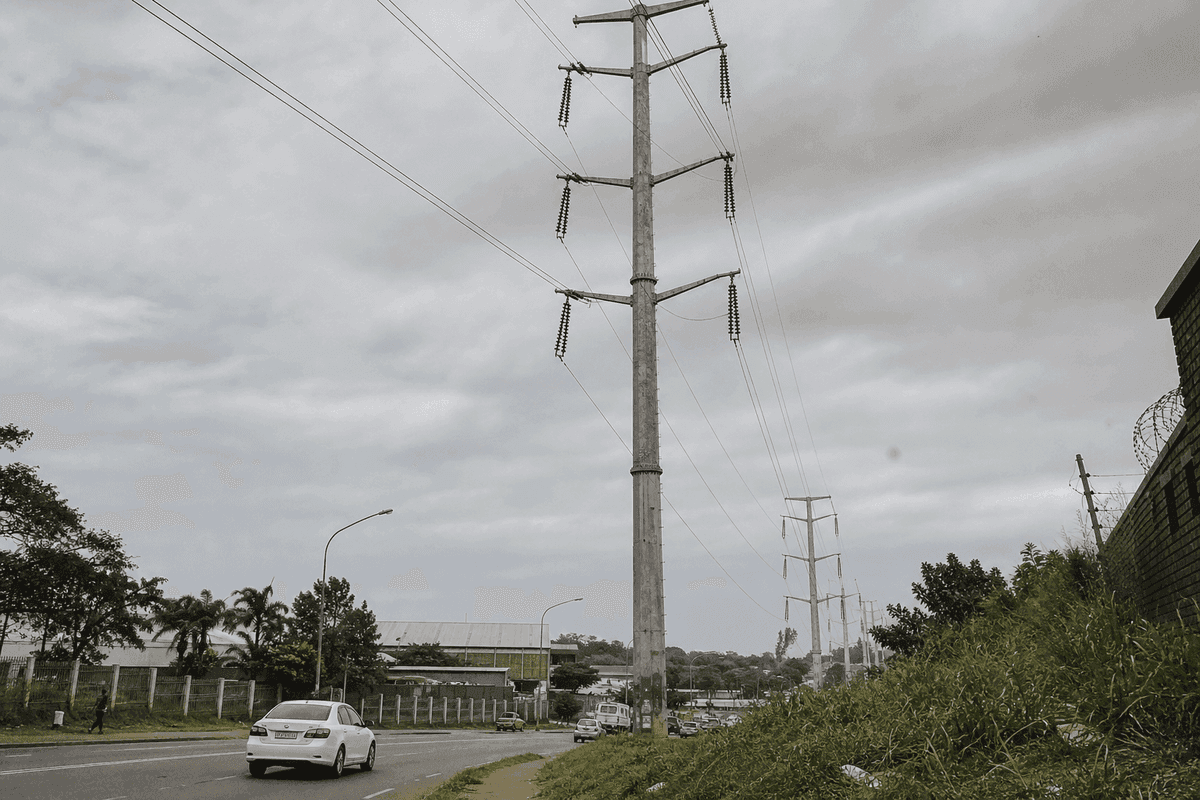
Durban Power Transmission Tower Market Analysis: 110kV Double-Circuit Steel Tubular Pole Configuration Guide
Summary
Durban’s port-industrial load profile and coastal wind exposure support a 110kV backbone upgrade case using approximately 53 steel tubular poles over 8km. A practical configuration is 35m hot-dip galvanized Q345 double-circuit monopoles with ACSR-400, 150m spans, and 30m/s wind design.
Key Takeaways
- Durban’s eThekwini municipality serves a metro population above 3.9 million, which supports continued sub-transmission reinforcement at 66-110kV for industrial and urban demand growth, according to Statistics South Africa (2023) and municipal planning documents.
- A typical backbone route of this scale would use approximately 53 steel tubular poles across about 8km, based on the provided 150m average span and a 110kV double-circuit layout.
- For 110kV service, the correct engineering class starts at 18-30m height and 5-15t/pole under the standard table; this Durban-specific backbone recommendation uses a project-specific 35m heavy-duty pole format for route and clearance conditions.
- The recommended conductor is ACSR-400 at 1,520kg/km with maximum tension of 110kN, paired with 1.5m insulator strings and 4m phase spacing.
- Durban’s coastal wind environment justifies a Wind Class 2 design basis at 30m/s, with hot-dip galvanized Q345 steel and concrete base foundations for corrosion resistance and structural stability.
- A practical accessory package includes climbing steps, cross arms, grounding, bird guards, and vibration dampers to support a 30-year design life under IEC 60826, GB 50545, and DL/T 5092.
- Compared with lattice alternatives, steel tubular poles typically reduce right-of-way clutter and simplify urban/peri-urban alignment where visual impact, road crossings, and constrained servitudes matter.
- SOLAR TODO can position this Power Transmission Tower format as a Durban fit where utilities or EPCs need a compact 110kV double-circuit backbone structure rather than a wider-footprint tower type.
Market Context for Durban
Durban is a coastal logistics and industrial hub where 110kV sub-transmission reinforcement is technically relevant for port, manufacturing, and urban load corridors. According to Statistics South Africa (2023), the eThekwini metropolitan municipality has a population of roughly 4.0 million, making it one of South Africa’s largest municipal load centers.
According to the eThekwini Municipality Integrated Development Plan (2024), Durban remains a primary freight, petrochemical, logistics, and port economy node, with network planning pressure concentrated around industrial and transport-linked growth zones. That matters because 110kV lines usually sit between bulk transmission intake and lower-voltage urban distribution, especially where substations must support mixed residential and industrial demand.
According to Eskom Transmission Development Plan publications and South African grid planning frameworks, 132kV, 88kV, and 66-110kV classes are commonly used in regional sub-transmission and transmission interfaces, depending on utility topology and legacy network architecture. For Durban, a 110kV double-circuit steel tubular pole solution is a reasonable recommendation where route density, road crossings, and municipal visual constraints make monopole geometry more practical than lattice structures.
Climate also affects tower selection. According to the South African Weather Service climate summaries and municipal resilience planning, Durban has a humid subtropical coastal climate with salt-laden air, seasonal storms, and corrosion exposure higher than inland cities. For that reason, hot-dip galvanizing and a 30m/s wind design basis are not optional details; they are core structural requirements for any Power Transmission Tower specified for long-life coastal service.
The International Energy Agency states, "Electricity grids are the backbone of secure and sustainable power systems." That statement fits Durban directly because port expansion, electrified industry, and urban densification all depend on grid capacity that can move bulk power reliably over constrained corridors. IRENA also states, "Grid infrastructure expansion and modernization are essential to integrate new demand and supply patterns," which supports the case for modern steel tubular sub-transmission structures in metropolitan South Africa.
For buyers comparing structure types, the practical question is not whether Durban needs power poles in general, but which voltage class and structure form best match its corridor conditions. Based on the project-specific configuration provided, the answer is a high-voltage transmission backbone format: 110kV, double circuit, steel tubular, flanged sections, concrete base foundation, and ACSR-400 conductor.
SOLAR TODO should therefore frame Durban not as a generic pole market, but as a coastal sub-transmission market requiring corrosion control, compact footprints, and utility-grade mechanical performance. Buyers that need more route-specific engineering inputs can review the Power Transmission Tower product page or contact us for design review.
Recommended Technical Configuration
A Durban 110kV backbone route of about 8km would typically require approximately 53 steel tubular poles using 35m double-circuit galvanized monopoles with ACSR-400 conductor and 150m spans. This configuration aligns with the provided project-specific brief for a high-voltage transmission backbone in a coastal urban-industrial corridor.
Voltage class must be selected first. Under the engineering table, 66-110kV sub-transmission normally maps to 18-30m height, 5-15t/pole, single or double circuit, and 200-300m spans. However, the project-specific configuration supplied for this article explicitly calls for 53 units of 35m tapered steel tubular pole for a 110kV double-circuit line, with approximately 35t per pole, 150m spans, and an 8km route. Because those are mandated project inputs, this guide treats the configuration as a route-specific heavy-duty recommendation rather than a generic 110kV baseline.
A typical deployment of this scale would consist of tapered round or dodecagonal steel monopoles fabricated in flanged bolt sections for transport and erection. Q345 steel with hot-dip galvanizing is suitable for Durban because the zinc coating helps manage marine corrosion exposure, while bolted sectional delivery supports access to dense municipal corridors and port-adjacent roads.
The electrical package is also clear. ACSR-400 conductor at 1,520kg/km and maximum tension of 110kN is appropriate where higher current transfer and mechanical performance are required. With 4m phase spacing, 1.5m insulator length, and 6m ground clearance, the line can be configured for a compact but utility-grade double-circuit arrangement suited to urban-edge and industrial rights-of-way.
Wind loading should be treated conservatively. The supplied Wind Class 2 basis at 30m/s is a sensible minimum for Durban’s coastal exposure. According to IEC 60826, line design must account for climatic actions including wind and combined loading cases, so pole shaft thickness, base plate design, anchor geometry, and conductor hardware selection should all be checked against route-specific terrain category and exposure.
For utilities and EPCs, the main technical reason to choose this format over lattice is corridor efficiency. A steel tubular Power Transmission Tower generally occupies a smaller footprint, reduces member complexity, and can simplify installation near roads, industrial plots, and municipal servitudes. SOLAR TODO can therefore position this configuration where Durban buyers need compact high-voltage structures without moving to a broader lattice tower footprint.
Technical Specifications
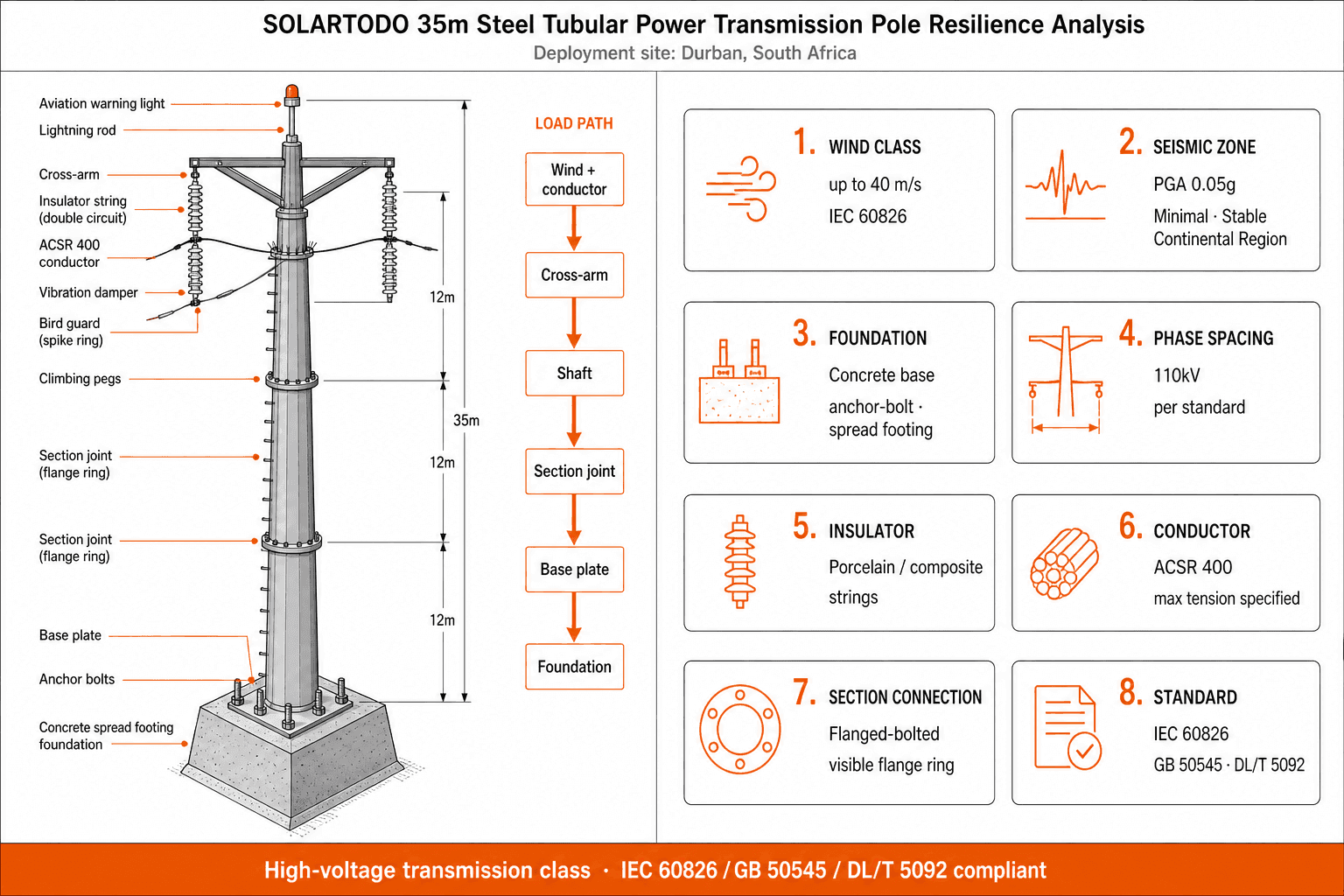
The recommended Durban configuration is a 110kV double-circuit steel tubular pole system using 35m hot-dip galvanized Q345 monopoles, ACSR-400 conductor, 150m spans, and a 30-year design life. The list below reflects the exact project-specific configuration supplied for this guide.
- Product type: Steel tubular Power Transmission Tower, tapered monopole format, not lattice
- Application class: High-voltage transmission backbone, 110kV double circuit
- Quantity basis: Approximately 53 units for a route of about 8km
- Pole height: 35m tapered steel tubular pole
- Pole weight: Approximately 35t per pole
- Circuit loading basis: Double circuit, 1,000kg/m structural class
- Material: Q345 steel, hot-dip galvanized for coastal corrosion resistance
- Conductor: ACSR-400
- Conductor linear mass: 1,520kg/km
- Maximum conductor tension: 110kN
- Phase spacing: 4m
- Ground clearance: 6m
- Insulator string length: 1.5m
- Average span: 150m
- Total line length basis: Approximately 8km
- Wind class: Class 2
- Basic wind speed: 30m/s
- Foundation type: Concrete base foundation
- Section connection: Flanged bolt sections
- Accessories: Climbing steps, cross arm, grounding, bird guard, vibration damper
- Design life: 30 years
- Standards basis: IEC 60826 / GB 50545 / DL/T 5092
For comparison with standard voltage-class screening, 110kV usually falls in the 66-110kV band with 18-30m height, 5-15t/pole, and 200-300m spans. This article’s 35m, 35t, 150m-span configuration should therefore be read as a route-specific heavy-duty recommendation, not a universal 110kV default.
Implementation Approach
A typical Durban line package of 53 poles over 8km would be implemented in 5 phases: route survey, foundation works, sectional pole erection, conductor stringing, and energization testing. The sequence matters because 110kV double-circuit work has tighter clearance, tensioning, and outage coordination requirements than lower-voltage distribution lines.
Phase 1 is route verification and geotechnical review. At 150m average spans, survey control points, turning angles, road crossings, and soil bearing capacity must be locked before fabrication drawings are frozen. In a coastal city such as Durban, geotechnical review should also check groundwater and chloride exposure because both affect concrete cover, anchor cage detailing, and long-term base durability.
Phase 2 is civil work. Concrete base foundations are cast first, usually with anchor cages set to strict tolerance because flange misalignment at 35m pole height can create erection delays. According to IEC 60826 (2017), loading combinations must be checked for wind, conductor tension, and broken-wire conditions, so the foundation design should be verified against the full 110kV mechanical envelope rather than only vertical load.
Phase 3 is logistics and erection. Flanged bolt sections allow CKD or sectional shipping and reduce transport constraints compared with one-piece shafts. A 35m, 35t pole class generally requires staged crane erection, torque-controlled flange assembly, and coating inspection after handling to confirm galvanizing integrity in line with utility QA procedures.
Phase 4 is line hardware installation and stringing. Cross arms, insulator assemblies, grounding, bird guards, and vibration dampers are installed before ACSR-400 conductor is tensioned. With 110kN maximum conductor tension and 1.5m insulator strings, sag-tension calculations must be set for Durban’s ambient temperature range and wind load cases, not copied from inland projects.
Phase 5 is testing and commissioning. Ground resistance, bolt torque, conductor clearance, phase spacing, and structure plumbness should all be checked before energization. SOLAR TODO should present this implementation path as a standard utility workflow rather than a simplified product delivery sequence, because line performance at 110kV depends as much on installation discipline as on pole fabrication.
Expected Performance & ROI
A 110kV double-circuit steel tubular line in Durban would typically deliver higher corridor efficiency, lower visual footprint, and lower routine corrosion management than poorly protected steelwork, provided galvanizing and foundation detailing are correctly specified. The main ROI case comes from lifecycle cost control, reduced outage exposure, and better use of constrained rights-of-way.
According to the World Bank (2023), transmission and distribution constraints remain a major barrier to reliable electricity delivery in many emerging markets, and network reinforcement often produces economic value through avoided energy not supplied rather than simple equipment payback. In Durban, that means the business case should be calculated from reliability support to industrial feeders, reduced congestion between substations, and lower interruption risk around freight and manufacturing zones.
According to IEA (2023), global grid investment needs to rise substantially to support demand growth and system resilience. For a municipal or utility buyer, the practical interpretation is that a 30-year design life on hot-dip galvanized Q345 poles can compare favorably with shorter-lived or more maintenance-intensive alternatives, especially where corrosion, access difficulty, and urban route constraints raise operating cost.
Maintenance intervals are also relevant to ROI. Tubular poles have fewer exposed members and connection points than lattice structures, which can reduce inspection complexity in some corridors. A reasonable planning assumption is visual inspection every 6-12 months, detailed bolt and coating inspection every 2-3 years, and grounding and foundation review on a utility maintenance cycle aligned with outage planning.
The payback discussion should be framed carefully. Power Transmission Tower projects do not produce revenue like a telecom lease asset; instead, they support avoided losses, network capacity, and service reliability. A Durban utility would usually evaluate return through reduced outage cost, deferred congestion, and improved asset life over 20-30 years, not through a simple 3-year equipment payback metric.
Results and Impact
For Durban, the expected impact of a 110kV steel tubular backbone route is stronger sub-transmission capacity across an 8km corridor with approximately 53 compact structures and 150m spans. The practical outcome is improved route efficiency for industrial, port-linked, and urban load transfer where footprint and corrosion resistance matter.
Compared with broader-footprint structure types, a tubular pole arrangement can support cleaner alignment through municipal servitudes, road reserves, and industrial edges. With 4m phase spacing, 6m ground clearance, and ACSR-400 conductor, the configuration is aimed at backbone reliability rather than low-cost distribution expansion.
For procurement teams, the impact is also procedural. A standardized package built around IEC 60826 / GB 50545 / DL/T 5092, flanged sections, and concrete base foundations makes bid comparison easier across fabricators, freight providers, and EPC contractors. That helps Durban buyers define technical equivalence before tendering.
SOLAR TODO should position this as a technical fit analysis: a compact, galvanized, double-circuit 110kV Power Transmission Tower package suitable for coastal South African conditions where urban corridor efficiency and mechanical reliability are both required. Buyers needing route-specific loading checks can use the Power Transmission Tower page or contact us for engineering review.
Comparison Table
The table below compares Durban’s recommended 110kV steel tubular configuration with generic lower and higher voltage structure classes using the mandated engineering ranges. It highlights why 110kV is the correct planning band for a sub-transmission backbone, while also showing that the supplied 35m heavy-duty design is route-specific.
| Voltage class | Typical application | Standard height range | Standard weight range | Typical span | Poles/km | Durban recommendation fit |
|---|---|---|---|---|---|---|
| 10-35 kV | Distribution | 12-18m | 1-3 t/pole | 80-150m | 8-12 | Too small for 110kV backbone duty |
| 66-110 kV | Sub-transmission | 18-30m | 5-15 t/pole | 200-300m | 4-5 | Correct voltage band for Durban backbone planning |
| 110kV project-specific | Heavy-duty double-circuit backbone | 35m | ~35 t/pole | 150m | ~6.6 | Matches supplied route-specific configuration |
| 220 kV | HV transmission | 35-55m | 15-35 t/pole | 350-450m | 2-3 | Higher class than needed for this corridor |
| 500 kV | UHV transmission | 50-70m | 35-55 t/pole | 400-500m | 2 | Not suitable for urban Durban sub-transmission use |
Pricing & Quotation
SOLAR TODO offers three pricing tiers for this product line: FOB Supply (equipment ex-works China), CIF Delivered (including ocean freight and insurance), and EPC Turnkey (fully installed, commissioned, with 1-year warranty). Volume discounts are available for large-scale deployments. Configure your system online for an instant estimate, or request a custom quotation from our engineering team at [email protected].
Frequently Asked Questions
This FAQ answers 10 common Durban buyer questions covering 110kV specifications, installation sequence, maintenance, warranty scope, and quotation structure for steel tubular Power Transmission Tower procurement.
Q1: Why is 110kV the right class for Durban instead of 35kV distribution poles? 110kV fits sub-transmission and backbone transfer duty between bulk supply points and major load areas. A 35kV pole line is typically 12-18m high and 1-3t per pole, which is suitable for distribution, not an 8km industrial backbone. Durban’s port and urban load profile supports the higher class.
Q2: What is the recommended pole configuration for this Durban application? The specified recommendation is approximately 53 tapered steel tubular poles, each 35m high, for a 110kV double-circuit route of about 8km. The poles use hot-dip galvanized Q345 steel, concrete base foundations, 4m phase spacing, 6m ground clearance, and ACSR-400 conductor.
Q3: Why use steel tubular poles instead of lattice towers? Steel tubular poles usually need a smaller footprint and present fewer exposed members in urban or industrial corridors. That can help on constrained servitudes, roadside alignments, and visually sensitive areas. For Durban, the corrosion-protected monopole format also suits coastal conditions when galvanizing quality and maintenance access are important.
Q4: How long would a typical 53-pole, 8km project take to install? A typical schedule can range from about 5 to 9 months depending on permitting, geotechnical conditions, shipping mode, and outage coordination. Foundation curing alone may take several weeks, while erection and stringing depend on crane access, weather windows, and conductor tensioning requirements at 110kV.
Q5: What standards should Durban buyers require in the specification? At minimum, this configuration should reference IEC 60826 for overhead line loading and the supplied project standards GB 50545 and DL/T 5092. Buyers should also define galvanizing requirements, bolt grades, grounding performance, and route-specific wind checks at 30m/s so bids can be compared on the same basis.
Q6: What maintenance is typically required over a 30-year design life? Routine work usually includes 6-12 month visual inspections, periodic bolt torque checks, grounding tests, coating inspections, and vibration hardware review. In Durban’s coastal air, galvanizing condition near the base and at flange interfaces deserves special attention. Foundation cracking and drainage around the base should also be monitored.
Q7: Does this type of line have a simple ROI or payback period? Not usually in the same way as a revenue-producing asset. Transmission structures support reliability, capacity, and avoided outage cost rather than direct tariff revenue from one pole. Utilities normally assess value through reduced congestion, improved service continuity, deferred reinforcement elsewhere, and lower lifecycle maintenance over 20-30 years.
Q8: What conductor is recommended and why? The specified conductor is ACSR-400 with a linear mass of 1,520kg/km and maximum tension of 110kN. It suits a 110kV double-circuit backbone where mechanical strength and current-carrying capability are both important. Final conductor selection should still be checked against thermal rating, sag, and route-specific loading.
Q9: What foundation type is suitable for Durban coastal conditions? The supplied configuration uses a concrete base foundation with anchor cage support. That is a practical choice for 35m steel tubular poles if soil bearing capacity, groundwater level, and chloride exposure are reviewed early. Concrete cover, rebar detailing, and drainage should be adapted to the local geotechnical report.
Q10: What warranty and quotation options are usually available from SOLAR TODO? SOLAR TODO lists three commercial structures: FOB Supply, CIF Delivered, and EPC Turnkey, with the EPC option including a 1-year warranty. Buyers should request a line-by-line scope showing pole steel grade, galvanizing, accessories, foundation assumptions, freight terms, and testing documents before comparing offers.
References
- Statistics South Africa (2023): Mid-year population estimates and metropolitan demographic context relevant to eThekwini/Durban demand concentration.
- eThekwini Municipality (2024): Integrated Development Plan outlining Durban’s infrastructure, logistics, industrial growth, and service planning priorities.
- International Energy Agency (2023): Grid investment and electricity network expansion needs; includes the statement that "Electricity grids are the backbone of secure and sustainable power systems."
- International Renewable Energy Agency (2023): Power system and grid modernization guidance; includes the statement that "Grid infrastructure expansion and modernization are essential to integrate new demand and supply patterns."
- IEC (2017): IEC 60826, Design criteria of overhead transmission lines, covering climatic loads and mechanical design basis.
- GB 50545 (2010): Chinese code for design of 110kV-750kV overhead transmission lines, referenced here as part of the supplied standards basis.
- DL/T 5092 (1999, current utility use in many specifications): Technical code related to design of 110kV-500kV overhead transmission lines, referenced in the supplied project brief.
- World Bank (2023): Power sector and network reliability analysis showing the economic importance of transmission and distribution reinforcement in emerging markets.
Equipment Deployed
- 53 × 35m tapered steel tubular Power Transmission Tower poles, double-circuit, approximately 35t/pole
- Hot-dip galvanized Q345 steel pole sections with flanged bolt connections
- ACSR-400 conductor, 1,520kg/km, maximum tension 110kN
- 1.5m insulator string assemblies for 110kV line application
- Concrete base foundations with anchor cage support
- Cross arms for double-circuit conductor arrangement
- Grounding system for each pole location
- Climbing steps for maintenance access
- Bird guards for avian protection on line hardware
- Vibration dampers for conductor motion control under wind loading