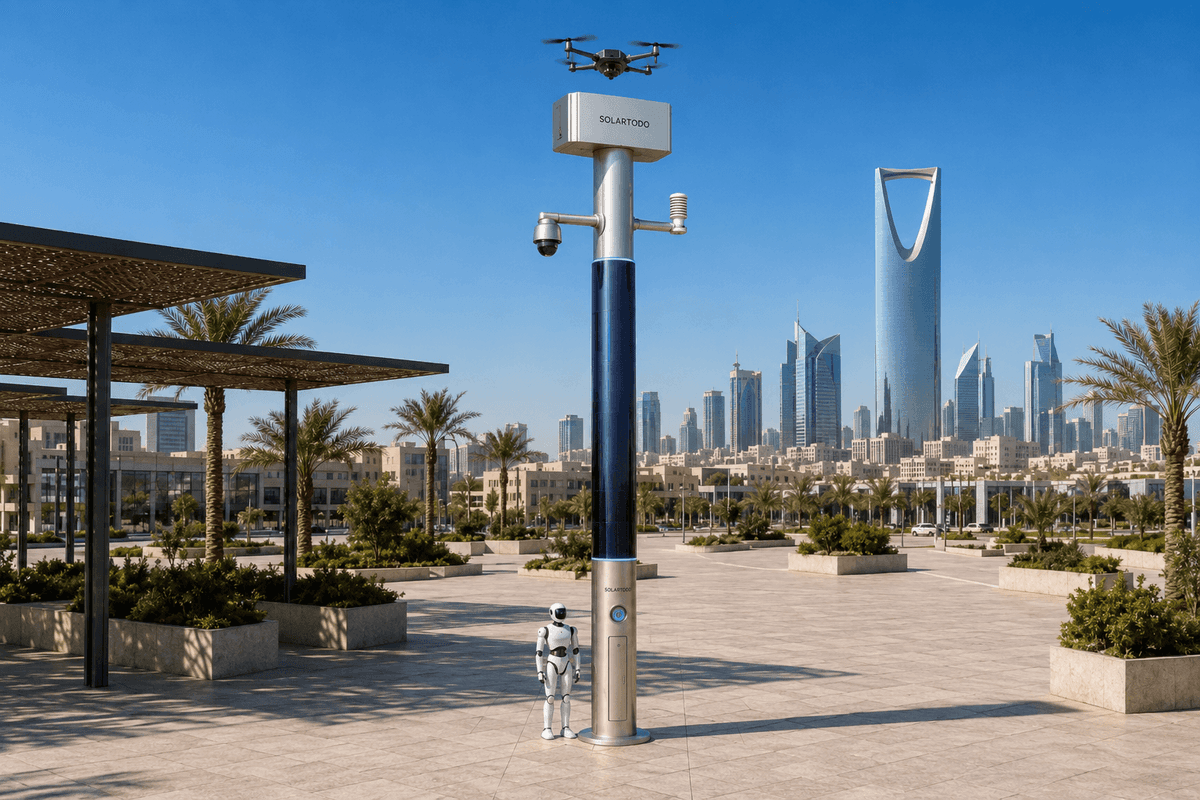
A City AI Pole is a non-lighting physical-AI edge node that combines off-grid energy, local compute, sensing, drone operations, and ground robot operations in one urban pole. In this Dubai CBD deployment, SOLARTODO Sentinel Sky Hub supports emergency-management night patrol after disruption by processing data on-pole and sharing only de-identified event/status metadata.
Procurement Context
Dubai’s central business district has a specific emergency-management problem during holiday periods: the city must keep high-value public realm, hospitality corridors, mixed-use towers, mobility links, service alleys, podium parking approaches, and perimeter zones observable at night, including after localized disruption. A sandstorm, flash flooding, utility interruption, traffic incident, localized fire, or major event crowd surge can create temporary blind spots exactly when night response teams are already stretched. The procurement case for SOLARTODO Sentinel Sky Hub is therefore not framed as a lighting upgrade or a generic sensor installation. It is framed as post-disaster infill: a fast-positioned, fully off-grid physical-AI node that can restore patrol frequency, situational awareness, and field coordination without waiting for site power or trenching.
The proposed buyer is an emergency-management stakeholder responsible for common-operating-picture coordination across security, civil defense liaison, facilities operators, district management, and field response teams. In a Dubai CBD context, the practical question is not whether one pole can replace a command center. It cannot. The question is whether a distributed set of robot-ready, drone-ready edge nodes can fill gaps between fixed cameras, mobile patrols, and temporary incident posts during nights when the district is busy, access routes are changing, and response windows are compressed.
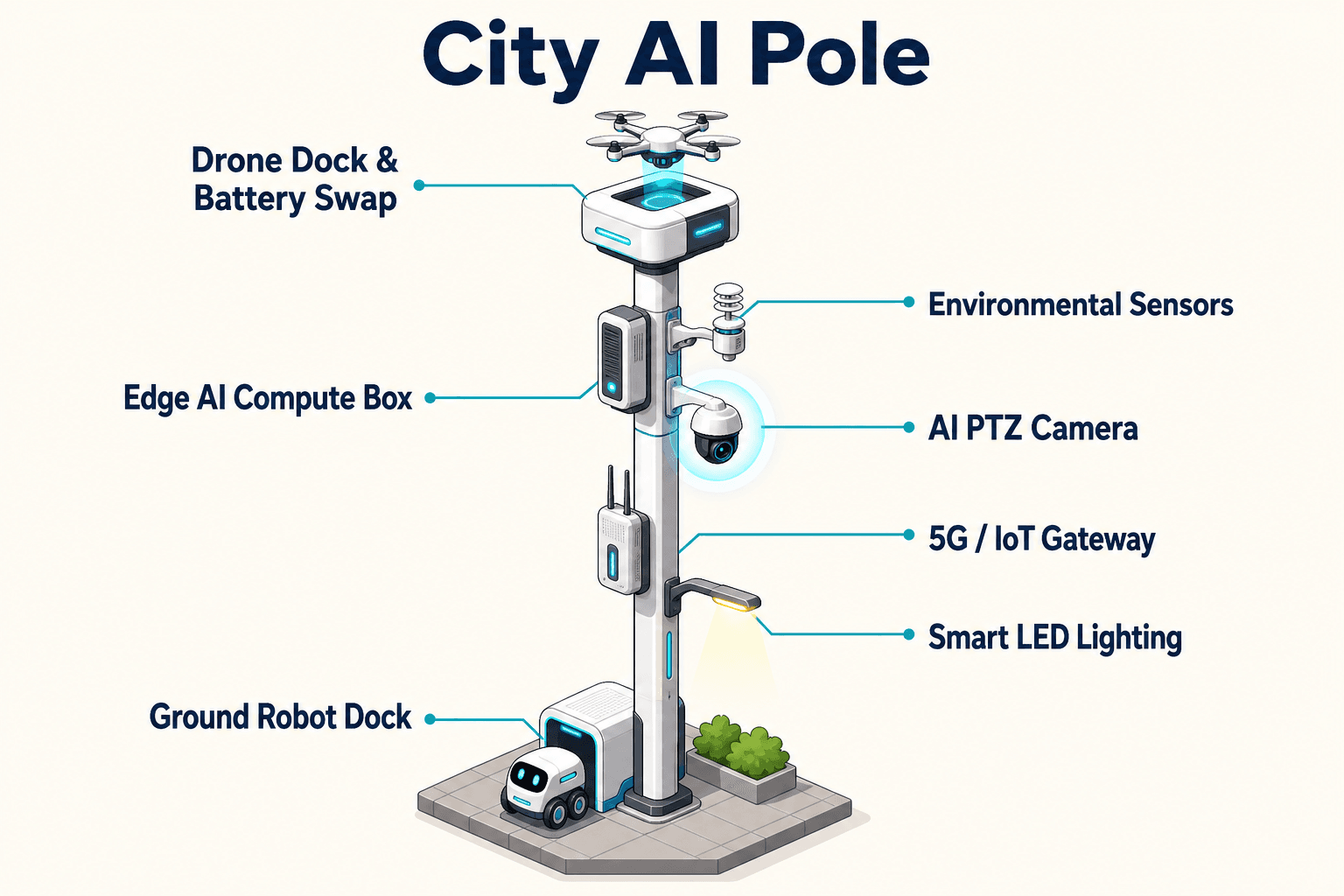
Sky Hub’s role in this procurement case is to create a local operational node at the edge of the affected zone. It carries sensing, compute, battery storage, solar replenishment, drone tasking, drone battery hot-swap, ground robot charging, and C-UAS coordination in a single PURE smart pole form. It includes no lighting system and is not positioned for illumination. It is a city-ai-pole category asset: a field-deployable micro-station for security operations, inspection, and autonomous response orchestration.
Proposed Deployment Shape
The illustrative configuration places Sky Hub nodes at CBD infill points where emergency managers need continuity after an incident: tower podium edges, hotel-service perimeters, event-adjacent plazas, district back-of-house access points, critical-infrastructure approaches, and temporary command perimeters. Final siting would be subject to engineering confirmation, radio planning, local aviation permissions, structural review, privacy review, and operational rules of engagement. No deployment quantity, coverage area, detection rate, or response time is assumed here.
Each node is a fully off-grid battery-backed micro-station. The vertical cylindrical body carries roughly 15 square meters of 360-degree wrapped flexible CIGS thin-film solar over an approximately 8-meter-tall, 0.6-meter-wide body, corresponding to about 2.4 to 2.7 kWp nameplate. The engineering planning point is conservative: a vertical cylinder collects direct sun on the sun-facing projection, not on the full wrap at once. In a high-irradiance Gulf operating environment, realistic clear-sky output is approximately 0.8 to 1.1 kW DC peak, with peaks typically occurring mid-morning and mid-afternoon rather than exactly at noon, and about 6 to 9 kWh per day. This solar layer is supplemental replenishment for a fully off-grid station. High-power drone and robot tasks are buffered by 5 to 20 kWh-class storage and governed by duty-cycle scheduling.
For holiday night operations, the node’s value comes from continuity. If site power is unavailable, contested, delayed, or not worth extending for a short infill period, the pole remains operational as its own energy and compute point. If access roads are restricted, the drone and ground robot can extend the patrol perimeter without requiring an operator to remain on site. If bandwidth is constrained, raw video and sensor streams stay on the pole for local processing; only de-identified event and status metadata may leave the node for the command view.
Night-Response Workflow
The operational scenario is a holiday night after a localized CBD disruption. The emergency-management team needs to increase patrol frequency across a temporary perimeter, verify blocked access points, watch for intrusion into restricted service zones, and maintain crowd-density awareness near public interfaces. Manual teams still decide, intervene, and authorize sensitive actions. Sky Hub supports them by turning repeated observation, classification, tasking, and mission logging into an edge-managed loop.
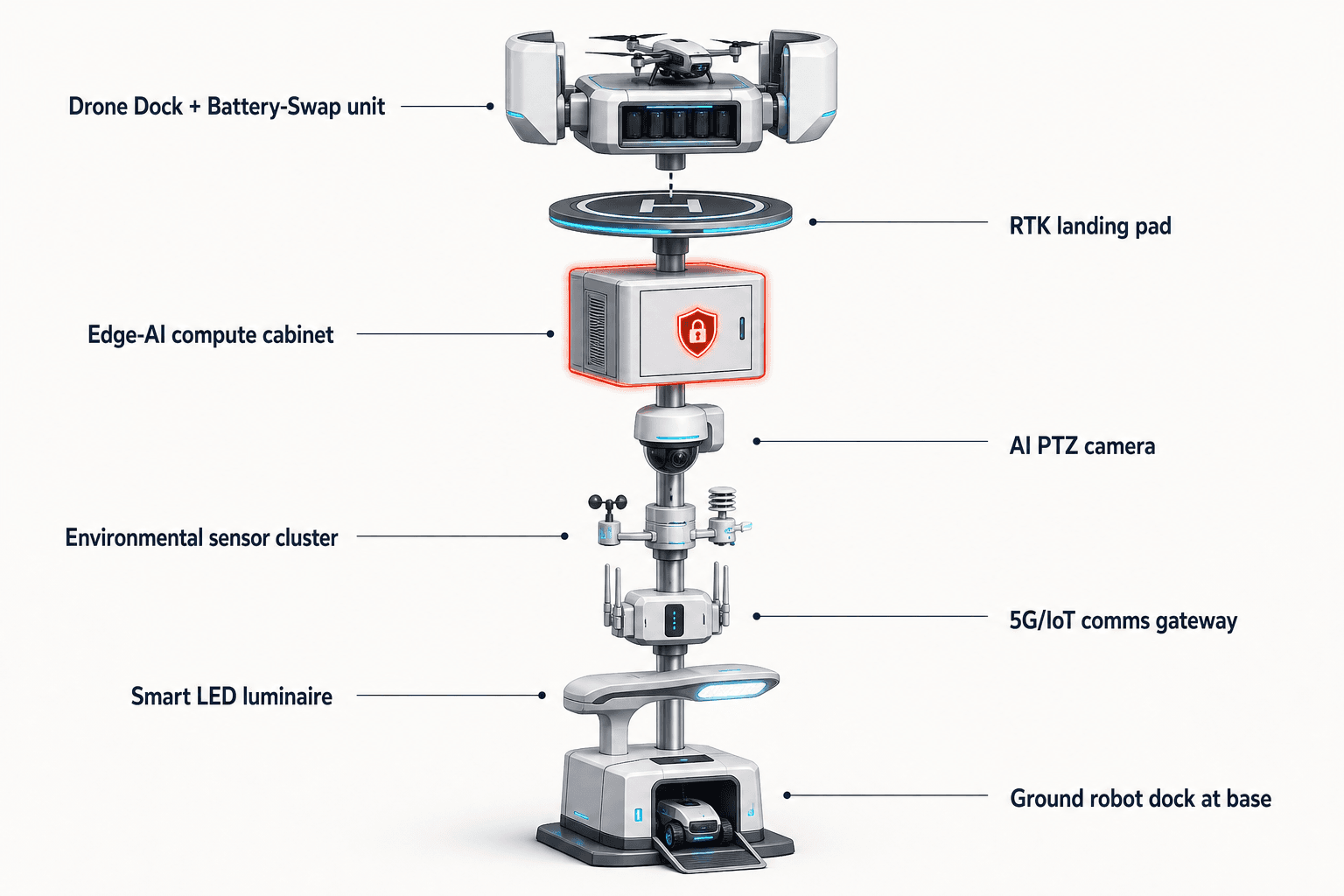
The edge-compute module is the center of the workflow. A Jetson-class edge module runs local inference on PTZ video, environmental readings, robot status, drone status, and task queues. Anonymous vehicle count, crowd density, intrusion, and perimeter-awareness events are processed locally. Environmental monitoring adds wind speed, wind direction, temperature, humidity, atmospheric pressure, noise, PM10, PM2.5, and illuminance. These streams help emergency managers distinguish a security event from an environmental or access condition, such as a dusty service-road approach, high wind that changes drone sortie rules, or noise patterns near a restricted loading bay.
When the on-pole system flags a night anomaly, the COP command view presents the event, confidence band, location context, recent sensor trend, nearby mission assets, and recommended response options. Human authorization remains part of the loop. A drone may be assigned to launch for an aerial inspection sortie, return, receive an automated rear-service battery exchange from the multi-bay magazine, and relaunch for the next route. A ground service or humanoid robot may be tasked to patrol a corridor, check an access point, coordinate with the aerial view, and return to the pole base for wireless charging.
For unauthorized drone activity, Sky Hub performs detection and tracking and can coordinate the node’s friendly drone for non-lethal response under human authorization. Allowed actions include soft aerial net-capture or close-approach deterrence. The workflow does not include shoot-down, destructive action, RF denial, GNSS denial, autonomous attack, or any weaponized response. Radar is not part of the pole hardware; if used in a final design, it would be an optional partner-sensor input feeding the COP and edge decision workflow.
KPI Evaluation
The central KPI framing is patrol frequency. In a CBD holiday night-response scenario, patrol frequency matters because gaps become operational risk: a restricted access point may reopen informally, a perimeter tape line may be crossed, a stranded vehicle may block an emergency route, or a public queue may change shape faster than a foot patrol can revisit it. Sky Hub is evaluated as an infill system that helps emergency managers increase the number of verified patrol passes and documented inspection loops without requiring continuous operator presence at every node.
Procurement evaluation should treat the numbers as planning inputs, not achieved results. A buyer can define target patrol routes per node, expected drone sorties per night, robot corridor passes per night, manual escalation thresholds, metadata retention rules, and acceptable duty-cycle limits. Edge compute makes the KPI measurable because each observation, classification, authorized task, drone launch, battery swap, robot dispatch, robot return, and operator decision can be logged as an event. The COP can then show whether patrol frequency is improving in the affected zone, whether certain access points remain under-observed, and whether storage state is constraining night operations.
The privacy and governance model also supports procurement evaluation. The node is designed for local processing and PDPL-LGPD-oriented data minimization. Raw video and raw sensor data remain on the pole for local inference and short operational use under the buyer’s governance rules. The command view receives de-identified event and status metadata, such as anomaly type, approximate location, task state, asset health, and operator action. This gives emergency-management stakeholders an auditable operating picture without turning the deployment into a centralized raw-data collection program.
Procurement Fit
The procurement case is strongest where Dubai stakeholders need deployable, off-grid, security-oriented edge capacity rather than permanent civil-works dependency. Smart districts, campuses, industrial parks, ports, city perimeters, and critical-infrastructure zones all share a similar need: put sensing, compute, drone operations, robot operations, and local energy at the point of action. For the CBD holiday scenario, the point of action is the night perimeter after disruption, where command decisions must be based on current field truth rather than delayed reports.
Final engineering confirmation should validate mounting loads, wind exposure, solar yield for the exact orientation and shading profile, battery sizing for the planned duty cycle, drone flight permissions, robot route surfaces, communications resilience, cybersecurity controls, and data-governance settings. The proposed configuration avoids exaggerated self-sufficiency claims: the solar wrap replenishes the battery-backed system, while mission tempo is scheduled against stored energy, weather, and operational priority. It also avoids overstating recognition features: the security layer focuses on anonymous counting, density, intrusion, and perimeter awareness, not face or licence-plate recognition.
For an emergency-management buyer, Sky Hub should be assessed as an operational infill asset. It gives the city a way to restore night patrol frequency, preserve local data handling, extend observation with drones and ground robots, and keep a human-authorized response loop in one common-operating-picture view. The outcome to evaluate is not a headline rollout number. It is whether the node configuration can help the district maintain verified patrol cadence and response coordination when normal infrastructure assumptions are temporarily weakened.
System Configuration
| Parameter | Configuration |
|---|---|
| Pole category | PURE non-lighting smart pole for city-ai-pole and physical-AI edge-node deployment |
| Energy system | Fully off-grid battery-backed micro-station with 360-degree wrapped flexible CIGS solar replenishment |
| Solar planning envelope | ~15 m2 CIGS wrap, ~2.4-2.7 kWp nameplate, ~0.8-1.1 kW DC clear-sky peak, ~6-9 kWh/day in high irradiance |
| Edge AI compute | Jetson-class on-pole inference and workload scheduling module; raw data processed locally |
| Security sensing | AI PTZ with local perception for anonymous vehicle count, crowd density, intrusion, and perimeter awareness |
| Autonomous operations | Drone launch/return/tasking with automated multi-bay battery hot-swap, plus ground robot patrol and wireless charging |
| Environmental monitoring | Wind speed, wind direction, temperature, humidity, atmospheric pressure, noise, PM10, PM2.5, and illuminance |
How It Works
- On-pole PTZ and environmental sensors flag a night anomaly near the CBD infill perimeter.
- Edge AI classifies the event locally and updates the COP with de-identified event/status metadata.
- The emergency-management operator reviews context and authorizes drone, robot, or manual response.
- The node schedules compute, energy, drone launch, battery swap, robot dispatch, and return-to-charge tasks.
- Field assets inspect the route, coordinate air-ground observations, and report status to the COP.
- The pole records the mission log, operator decision, asset health, and patrol-frequency evidence.
Planning Assumptions (Indicative)
Illustrative planning inputs a buyer can recompute — target metrics, not achieved results. Subject to final engineering confirmation.
| Metric | Planning assumption | Indicative value |
|---|---|---|
| Patrol frequency | Target drone and robot loops supplement manual night patrol after CBD disruption | ~20-40 automated patrol passes per node per holiday night |
| Manual escalation | Only scored anomalies and authorized response tasks are escalated to operators | ~5-10 priority reviews per node per shift |
| Inspection continuity | Battery hot-swap enables consecutive drone sorties without an operator stationed at the pole | ~3-6 consecutive aerial inspection sorties per prepared magazine cycle |
| Field reporting | Edge logs convert patrol activity into auditable event/status records for the COP | ~1 event trail per detected anomaly, mission, swap, dispatch, and return |
| Energy planning | High-power missions are duty-cycle scheduled against battery state and solar replenishment | 5-20 kWh-class storage sized to the final operating profile |
Deployed Equipment
- SOLARTODO Sentinel Sky Hub PURE smart pole body
- 360-degree wrapped flexible CIGS thin-film solar layer
- 5-20 kWh-class battery storage cabinet
- On-pole edge AI compute cabinet
- AI PTZ security sensing module
- Nine-parameter environmental monitoring package
- Autonomous drone operations bay with multi-bay battery magazine
- Ground robot wireless charging base
Frequently Asked Questions
Is Sky Hub a lighting pole for Dubai streets?
No. In this procurement case, Sky Hub is a PURE smart pole and physical-AI edge node with no lighting system. It is not procured to illuminate roads or pedestrian areas. Its purpose is to host edge compute, security sensing, autonomous drone operations, ground robot operations, energy storage, and command-view integration for security and emergency-management workflows.
How does the system remain operational if site power is unavailable after disruption?
The proposed node is designed as a fully off-grid micro-station using battery storage plus on-pole flexible CIGS solar replenishment. The solar wrap is not presented as unlimited self-sufficiency. It provides supplemental daily energy, while drone sorties, robot patrols, inference workloads, and communications are scheduled against stored energy, weather conditions, and mission priority.
What data leaves the pole during the night-response workflow?
The deployment is designed for local processing and PDPL-LGPD-oriented data minimization. Raw video and sensor data stay on the pole for local inference and operational review under the buyer’s governance settings. The command view receives de-identified event and status metadata, such as anomaly type, task state, asset health, and operator decisions.
What security analytics are active in the proposed configuration?
The proposed security sensing focuses on anonymous vehicle count, crowd density, intrusion, and perimeter awareness. It does not claim active face recognition or licence-plate recognition. This keeps the procurement case centered on emergency-management visibility, patrol prioritization, and local event scoring rather than identity-led surveillance.
How does drone battery hot-swap support holiday night patrol frequency?
After a drone lands, the rear-service battery exchange mechanism can replace a depleted pack with a charged pack from a multi-bay magazine. This supports several consecutive inspection sorties without positioning an operator at the node. The COP still manages route planning, task queueing, health state, charge/swap state, and mission logs.
What is the role of the ground robot in the CBD scenario?
The ground robot supports autonomous patrol, alarm response, inspection, air-ground coordination, and return-to-base wireless charging. In a holiday night-response scenario, it can verify access corridors, restricted entrances, service zones, and perimeter conditions that may not be visible from a single camera angle or aerial pass.
How is Counter-UAS handled without turning the pole into a weapon system?
Sky Hub can detect and track unauthorized drone activity and coordinate a friendly drone response only with human authorization. Permitted mitigation is non-lethal, such as soft aerial net-capture or close-approach deterrence. The workflow excludes destructive action, jamming, autonomous attack, and weaponized response. Radar, if used, is only an optional partner-sensor input.
What should Dubai emergency-management buyers validate before procurement?
Buyers should confirm site structure, wind exposure, solar shading, battery sizing, communications resilience, cybersecurity controls, drone permissions, robot route conditions, data-governance settings, and COP integration. The case should be evaluated through target planning metrics such as patrol frequency, authorized response cadence, event logging quality, and operational continuity after disruption.
Explore Further
- City AI Pole / smart streetlight product line
- More smart-city deployment cases
- Talk to our engineering team
Planning a similar physical-AI deployment for streets, campuses or public spaces? Request an engineering consultation