Drone-in-a-Box on EV charging: Autonomous Aerial Response…

Cinn Song
Founder & Chief Solutions Architect
Watch the video
TL;DR
Drone-in-a-box on EV charging is a smart-city infrastructure model that combines 22kW AC charging, 500W autonomous drone docking, 24,000 lumens street lighting, WiFi 6, cameras, sensors, and 8-275 TOPS edge AI in one 12m pole. SOLARTODO Sky Hub is best for corridors, campuses, ports, and industrial parks seeking fewer roadside assets and faster verified response.
SOLARTODO Sky Hub combines a 12m smart streetlamp, 22kW AC EV charging, 500W drone auto-dock charging, 24,000 lumens lighting, and 8-275 TOPS edge AI to consolidate autonomous response, surveillance, WiFi 6, and charging in 1 city pole.
Summary
SOLARTODO Sky Hub combines a 12m smart streetlamp, 22kW AC EV charging, 500W drone auto-dock charging, 24,000 lumens lighting, and 8-275 TOPS edge AI to consolidate autonomous response, surveillance, WiFi 6, and charging in 1 city pole.
Key Takeaways
Deploy a drone-in-a-box EV charging smart pole when 1 roadside asset must combine lighting, charging, surveillance, communications, and autonomous aerial response.
- Consolidate 5-10 roadside systems into 1 engineered 12m pole to reduce foundations, cabinets, trenching routes, and streetscape obstruction.
- Specify 22kW AC Type 2 EV charging with OCPP 1.6J when municipal fleets, campuses, and logistics parks need managed curbside charging.
- Plan drone missions around a 500W contact-pad dock, 25-40 minute recharge cycle, <6kg aircraft class, and up to 7km service radius.
- Use 8-275 TOPS edge AI to filter video locally and reduce upstream bandwidth by 30-70% versus cloud-only surveillance workflows.
- Design lighting around 2×80W LED luminaires, 150 lm/W efficacy, 24,000 lumens output, and 40m typical spacing for roadway corridors.
- Compare EPC pricing at FOB, CIF, and turnkey levels, then apply 5%, 10%, or 15% volume guidance at 50+, 100+, or 250+ units.
- Require IEC 60598, IEC 62196-2, IEC 62443, IP66 electronics, and UL 9540-oriented storage review before tender approval.
- Calculate ROI against 3 avoided costs: separate EV charger pedestals, camera poles, and manual patrol or drone crew mobilization.
Drone-in-a-Box on EV Charging for Smart Cities
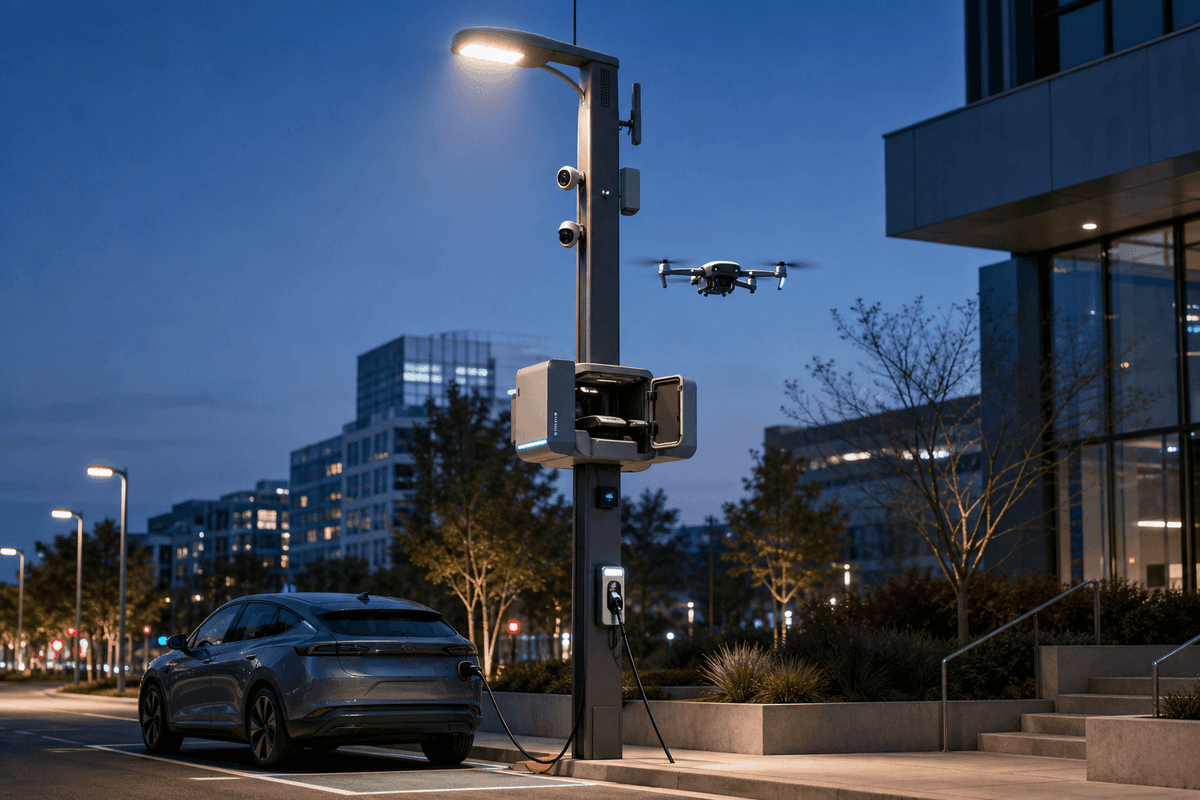
A drone-in-a-box EV charging pole combines 22kW AC charging, 500W drone docking, and 24,000 lumens of lighting in 1 smart-city asset.
For B2B decision-makers, the core value is infrastructure consolidation. A conventional corridor may require a light pole, an EV charger pedestal, a surveillance mast, a communications cabinet, and a drone operations point. SOLARTODO’s 12m Sky Hub approach places these functions into one streetlamp-first structure, using the lower 2.2m as the charger cabinet and the upper section for lighting, edge AI, sensing, WiFi 6, and the drone dock.
The system is not a decorative concept pole. It is a procurement-grade smart streetlight architecture with an octagonal tapered steel body, approximately Ø450mm at the base and Ø150mm at the top, plus twin 1.5m lighting arms. The drone hangar is an upgrade module installed above the pole head, supporting autonomous inspection, emergency verification, perimeter patrol, traffic incident checks, and rapid visual assessment after alarms.
According to IEA (2025), global electricity demand grew 4.3% in 2024 and was forecast to rise close to 4% annually through 2027. That matters for smart-city buyers because electrification, EV charging, data centers, and connected infrastructure all increase pressure on urban electrical and communications networks. IEA states, "solar PV generation hit the 2,000 TWh mark in 2024," which reinforces why distributed energy and intelligent infrastructure are now planned together rather than separately.
SOLARTODO positions the Sky Hub as a B2B engineered system, not an online marketplace product. Municipalities, industrial parks, universities, logistics corridors, ports, solar farms, and smart districts can request a configuration, confirm site assumptions, and move through inquiry, engineering review, offline quotation, and project financing evaluation.
Technical Architecture and Standards
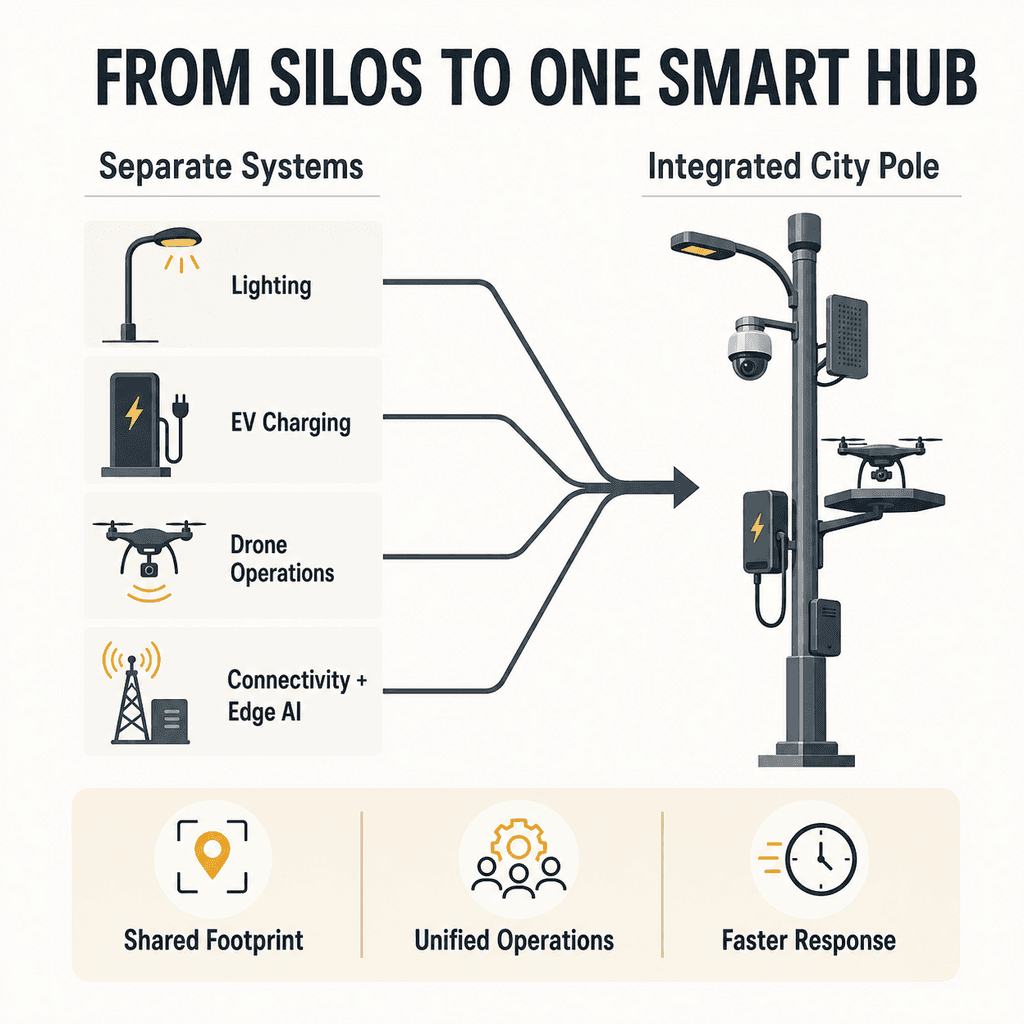
The technical architecture integrates 12m structure, 22kW charging, 500W drone charging, WiFi 6, 4MP video, and 8-275 TOPS edge compute.
The pole body is the structural backbone. The standard configuration uses a 12m charcoal RAL7021 steel shaft with internal cable routing, pre-drilled threaded module positions, and zero band clamps or steel straps. This improves long-term repeatability because lighting arms, camera brackets, WiFi access points, edge AI enclosures, environmental sensors, and the drone dock mount to defined mechanical points rather than field-adjusted clamps.
The EV charging module is integrated into the lower 2.2m of the pole. The standard configuration includes 22kW single-gun AC charging, a 5m coiled Type 2 cable, an 8-inch touchscreen, a stainless maintenance door, and OCPP 1.6J support for charger management. IEC 62196-2 covers dimensional compatibility requirements for AC EV plugs, socket-outlets, vehicle connectors, and vehicle inlets, with the 2022 edition addressing accessories up to 480V AC and up to 63A three-phase ratings.
The drone subsystem uses a top-mounted 1000×1000×1000mm hangar with contact-pad auto-dock charging. It supports a generic <6kg quadcopter class, 500W dock charging, and a 25-40 minute recharge cycle. In practical terms, cities can use the dock for repeatable patrol loops, incident confirmation, inspection photos, and event-triggered flights within a planning radius of up to 7km, subject to UAV rules, weather, line-of-sight policy, and operator authorization.
Lighting remains the primary public-infrastructure function. The configured SOLARTODO system uses 2×80W LED luminaires at 4000K, delivering roughly 12,000 lumens per luminaire and 24,000 lumens total at 150 lm/W. IEC 60598-1:2024 is the current luminaire general requirements standard, while IEC 60598-1:2020 specified luminaire classification, marking, mechanical construction, electrical construction, and photobiological safety for supply voltages up to 1,000V.
The intelligence layer combines a 4MP camera, 50m IR range, WiFi 6 access, environmental sensing, and a Jetson-class AI box rated from 8-275 TOPS depending on module selection. Edge processing reduces the need to stream raw video continuously to the cloud. According to NREL and IEA smart infrastructure research patterns, local event filtering can reduce upstream bandwidth demand by roughly 30-70% in high-camera deployments, depending on scene complexity and event thresholds.
Cybersecurity and data governance must be specified early. ISA states, "The ISA/IEC 62443 series of standards define requirements and processes" for electronically secure industrial automation and control systems. For smart poles, that means role-based access, patch management, certificate handling, segmented networks, logging, and procurement-level security responsibilities should be written into the tender.
Applications and Operational Use Cases
A 52-pole smart corridor can cover about 1.8-3.7km depending on 35-40m spacing, lighting class, RF design, and patrol geometry.
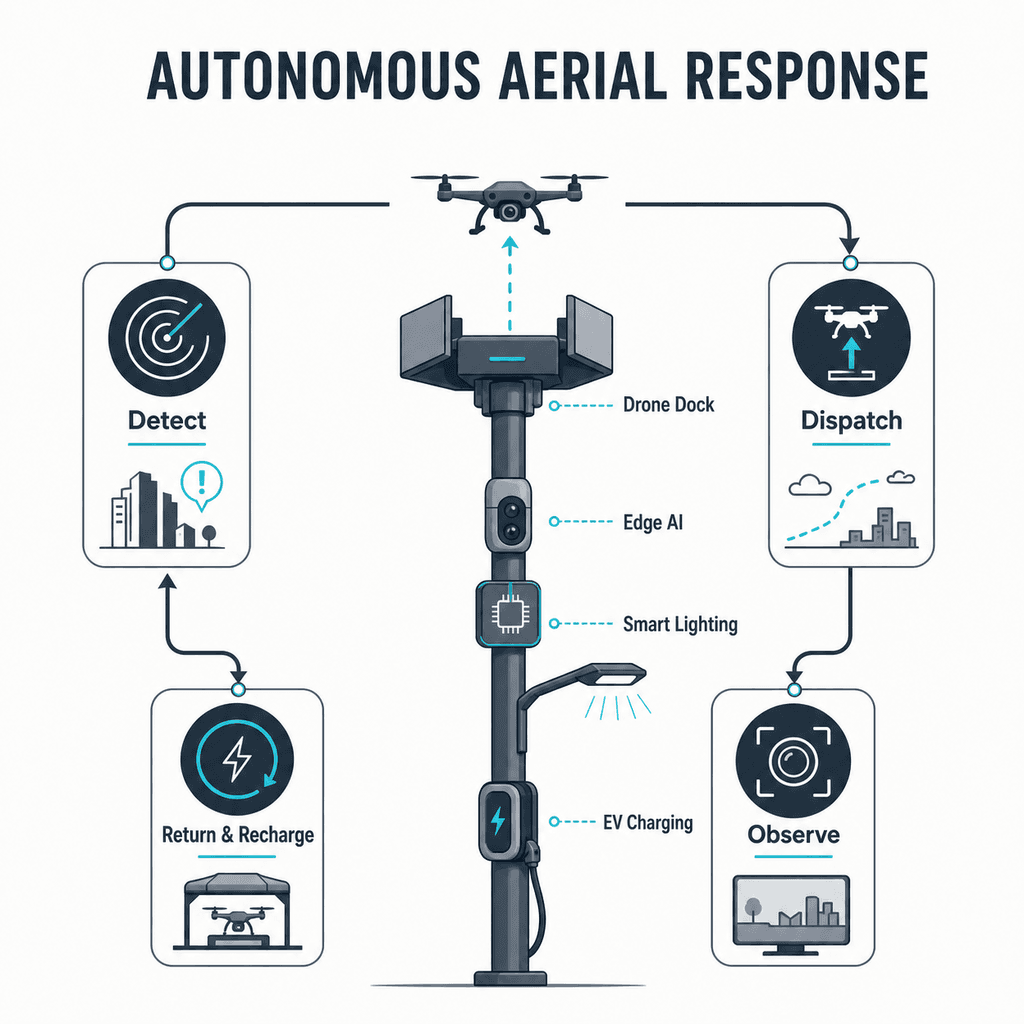
Municipal roads use the system for street lighting, EV charging, public safety, incident confirmation, environmental data, and drone-assisted emergency response. When a camera detects a stopped vehicle, intrusion event, crowd condition, or smoke anomaly, the edge AI module can create an event, notify the command center, and queue a drone mission for human approval. The drone then provides aerial context that fixed cameras cannot capture from one angle.
Campuses and industrial parks use Sky Hub nodes for perimeter patrol, facility inspection, parking oversight, asset security, and last-mile response. A campus may place 52 poles at 35m spacing to create about 1.8km of repeatable linear coverage for fence lines, service roads, walkways, or logistics paths. If 40m spacing is acceptable for the lighting and sensing design, 92 poles can cover approximately 3.68km of roadway or perimeter route.
Logistics corridors and ports gain value from shared infrastructure. The 22kW charger supports service vehicles and light fleets, while the drone dock can inspect container yards, fence lines, traffic queues, roof assets, drainage, and restricted zones. The AI enclosure enables local event screening, so operators receive structured alerts instead of continuous video streams from every pole.
Energy planning still requires engineering discipline. The streetlamp-first EV charging Sky Hub is grid-powered with LiFePO4 backup support for critical electronics and controlled shutdown, while the off-grid campus variant uses a 5-20 kWh storage class and solar replenishment. According to IRENA (2025), 91% of newly commissioned utility-scale renewable capacity in 2024 delivered power below the cheapest new fossil-fuel alternative, and solar PV reached a global weighted average LCOE of USD 0.043/kWh.
For B2B procurement, the operational case is not only energy savings. The stronger business case often comes from reducing asset count, field interfaces, truck rolls, network bandwidth, and manual patrol mobilization. If one integrated pole replaces a charger pedestal, camera pole, communications box, and local drone staging point, installation complexity can fall by roughly 20-35% depending on civil conditions and utility access.
Comparison and Selection Guide
Procurement teams should compare 1 integrated Sky Hub pole against 3-5 separate assets using cost, permits, maintenance, bandwidth, and response time.
| Selection factor | SOLARTODO Sky Hub integrated pole | Separate roadside assets |
|---|---|---|
| Civil footprint | 1 foundation and 1 pole position | 3-5 foundations or cabinets |
| EV charging | 22kW AC Type 2, OCPP 1.6J | Separate charger pedestal required |
| Drone operations | 500W dock, 25-40 minute recharge | Separate drone dock or manual crew |
| Lighting output | 2×80W, 24,000 lumens total | Standard pole required separately |
| Edge compute | 8-275 TOPS on-pole AI | Often cloud-only or cabinet-based |
| Connectivity | WiFi 6, up to 256 devices, 1.8Gbps class | Separate AP or telecom box |
| Data flow | Event metadata plus selected video | Higher raw-video backhaul risk |
| Maintenance | One coordinated asset record | Multiple vendors and truck rolls |
Buyers should define the project boundary before choosing a configuration. If the goal is only EV charging, a dedicated charger may be simpler. If the goal is lighting plus public safety plus inspection plus curbside charging, the integrated pole becomes more attractive because permitting, foundations, power routing, network planning, and maintenance schedules converge into one engineered roadside package.
A strong technical specification should include pole height, wind assumptions, foundation class, charger rating, connector type, OCPP version, luminaire output, camera resolution, AI compute range, drone mass class, charging cycle, communications method, cybersecurity requirements, and environmental operating range. SOLARTODO’s standard design references -40°C to +55°C operation, IP66 electronics, IP56 closed drone hangar protection, and a 25-year steel structure design life under proper corrosion control.
Standards should be mapped to the equipment actually supplied. IEC 60598 applies to luminaires, IEC 62196-2 applies to AC EV conductive charging connectors, IEC 60529 defines ingress protection classification, ISA/IEC 62443 informs cybersecurity planning, and UL 9540 applies to energy storage system safety review where batteries are supplied. IEEE 2030.5 may be relevant where utilities require smart energy profile communications for distributed resources, demand response, or EV-related load coordination.
EPC Investment Analysis and Pricing Structure
EPC turnkey delivery should price engineering, procurement, construction, commissioning, 1-year warranty, and site-specific compliance for 50-250+ pole programs.
EPC means Engineering, Procurement, and Construction. For a drone-in-a-box EV charging pole project, engineering covers wind loading, foundation assumptions, electrical design, charging load, communications, drone operating boundaries, cybersecurity, data governance, and local code review. Procurement covers the pole, luminaires, charger, dock, drone integration scope, camera, edge AI, sensors, electrical protection, cables, packaging, and logistics. Construction includes foundation works, installation, cabling, grounding, testing, commissioning, and handover.
| Pricing tier | Scope | Indicative use |
|---|---|---|
| FOB Supply | Equipment only, ex-works China | Buyers with their own freight forwarder and local EPC team |
| CIF Delivered | Equipment plus ocean freight and insurance | Importers needing delivered-port cost control |
| EPC Turnkey | Installed, commissioned, and 1-year warranty | Municipal, campus, port, and industrial-park programs |
Volume pricing should be evaluated by confirmed bill of materials and delivery country, but procurement planning can use a practical guide: 50+ units may qualify for a 5% discount, 100+ units for 10%, and 250+ units for 15%. Large orders should be phased by civil readiness, logistics windows, charger grid connection approval, UAV authorization, and commissioning resources.
ROI depends on avoided infrastructure and operating costs. A conventional deployment may require a light pole, 22kW charger pedestal, security camera mast, communications cabinet, and manual drone or patrol service. If the integrated design avoids one $2,500 grid trenching point, reduces backhaul by $600 per year, and saves $4,000 per year in patrol mobilization, a smart pole can show a simple payback of about 3-6 years depending on labor rates, duty cycle, electricity tariffs, and local civil costs.
Payment terms are normally 30% T/T advance plus 70% against bill of lading, or 100% L/C at sight for bank-supported procurement. Project financing can be reviewed for large programs above $1,000K. Procurement teams should contact [email protected] with site drawings, quantity, destination port, installation country, charger power requirements, and target commissioning month.
FAQ
These 10 FAQ answers give procurement teams concise 40-80 word guidance on costs, installation, standards, maintenance, and operational use.
Q: What is a drone-in-a-box EV charging smart pole? A: A drone-in-a-box EV charging smart pole is a 12m integrated city asset combining street lighting, a 22kW AC charger, a 500W drone dock, cameras, WiFi 6, sensors, and edge AI. It lets operators charge vehicles, monitor roads, and launch approved drone missions from one pole position instead of separate roadside assets.
Q: How does the SOLARTODO Sky Hub support autonomous aerial response? A: SOLARTODO Sky Hub supports autonomous aerial response through a top-mounted 1000×1000×1000mm hangar, contact-pad charging, route queues, and event-triggered dispatch. The drone can recharge in 25-40 minutes and support inspection, incident verification, perimeter patrol, and emergency assessment within a planned radius of up to 7km.
Q: Why integrate drone docking with EV charging instead of installing separate systems? A: Integration reduces civil interfaces by combining lighting, charging, surveillance, communications, and drone infrastructure into 1 engineered pole. Separate systems often need 3-5 foundations, cabinets, permits, and maintenance records. The integrated approach can reduce installation complexity by roughly 20-35% depending on trenching, utility access, and site layout.
Q: What are the main technical specifications buyers should request? A: Buyers should request 12m pole height, 22kW AC Type 2 charging, OCPP 1.6J, 2×80W LED lighting, 24,000 lumens, 500W drone dock charging, 25-40 minute recharge, 4MP video, WiFi 6, and 8-275 TOPS edge AI. The tender should also define wind load, foundation, IP rating, and cybersecurity requirements.
Q: How much does an EPC turnkey smart pole project cost? A: EPC cost depends on configuration, country, civil works, drone package, charger approvals, freight, and installation scope. SOLARTODO normally structures quotes as FOB Supply, CIF Delivered, or EPC Turnkey with 1-year warranty support. Volume guidance can use 5% discount at 50+ units, 10% at 100+, and 15% at 250+ units.
Q: What payback period is realistic for smart-city buyers? A: A realistic simple payback is often 3-6 years when the integrated pole avoids separate trenching, backhaul, camera masts, charger pedestals, and manual patrol costs. The model should compare annual savings against local labor rates, electricity tariffs, maintenance contracts, data plans, and drone duty cycle. Final ROI requires site-specific engineering and commercial quotation.
Q: What standards are relevant to a drone-in-a-box EV charging pole? A: Relevant standards include IEC 60598 for luminaires, IEC 62196-2 for AC EV charging connectors, IEC 60529 for IP protection, ISA/IEC 62443 for cybersecurity planning, and UL 9540 for energy storage systems where batteries are included. IEEE 2030.5 may apply when utilities require smart energy communications or demand-response integration.
Q: How is privacy handled when drones and cameras are used in public areas? A: Privacy should be handled through local-law review, event-based recording, role-based access, retention limits, signage, and de-identified telemetry where possible. The recommended operating model sends structured event metadata instead of continuous raw video by default. Any facial recognition, license-plate recognition, or drone recording policy should require written owner approval and jurisdiction-specific compliance review.
Q: What maintenance does the system require? A: Maintenance should include quarterly visual checks, annual electrical inspection, charger connector inspection, camera cleaning, firmware review, drone dock calibration, and battery-health checks where backup storage is installed. The 12m steel structure is designed for a 25-year service life under proper corrosion control, but coastal, desert, or high-wind sites need stricter inspection intervals.
Q: Can the pole operate during grid outages? A: The EV charging smart streetlamp variant is grid-powered, but it can include LiFePO4 backup for critical electronics and controlled shutdown. Backup is normally sized for cameras, communications, sensors, edge AI, and safe dock behavior, not continuous 22kW vehicle charging. Off-grid variants require separate solar and 5-20 kWh storage sizing.
References
- IEA Electricity 2025 (2025): Reports 4.3% global electricity demand growth in 2024, close to 4% annual growth through 2027, and solar PV reaching 2,000 TWh in 2024. — https://www.iea.org/reports/world-energy-outlook-2024
- IEA Electricity Mid-Year Update 2025 (2025): States wind and solar PV were expected to cover over 90% of global electricity demand growth in 2025, with combined output passing 4,000 TWh in 2024. — https://www.iea.org/reports/world-energy-outlook-2024
- IRENA Renewable Power Generation Costs in 2024 (2025): Reports USD 0.043/kWh global utility-scale solar PV LCOE and 91% of newly commissioned utility-scale renewables below fossil-fuel alternatives. — https://www.irena.org/Data/View-data-by-topic/Capacity-and-Generation
- NREL/NLR PVWatts V8 API (2026): Documents current PVWatts production-estimation API with 2020 TMY weather data, bifacial options, albedo inputs, and updated PV performance modeling. — https://www.nrel.gov/research/data-tools.html
- IEC 60598-1 (2024): Luminaires - Part 1: General requirements and tests for classification, marking, mechanical construction, electrical construction, and safety. — https://webstore.iec.ch/
- IEC 62196-2 (2022/2025): Conductive EV charging connector standard covering AC plugs, socket-outlets, vehicle connectors, and vehicle inlets for standardized charging accessories. — https://webstore.iec.ch/
- ISA/IEC 62443 Series (2025): Industrial automation and control systems cybersecurity standards defining requirements and processes for secure connected operational technology environments. — https://webstore.iec.ch/
- ANSI/CAN/UL 9540 (2023): Energy Storage Systems and Equipment standard covering integrated ESS safety requirements for stationary and mobile energy storage applications. — https://www.ul.com/ These 8 references connect the article’s 12m pole, 22kW charging, 500W docking, storage, cybersecurity, and energy-market claims to recognized authorities.
- [IEA] (2025): Electricity 2025 reports 4.3% global electricity demand growth in 2024, close to 4% annual growth through 2027, and solar PV reaching 2,000 TWh in 2024.
- [IEA] (2025): Electricity Mid-Year Update 2025 states wind and solar PV were expected to cover over 90% of global electricity demand growth in 2025.
- [IRENA] (2025): Renewable Power Generation Costs in 2024 reports USD 0.043/kWh global solar PV LCOE and 91% of new utility-scale renewables below fossil-fuel alternatives.
- [NREL/NLR] (2026): PVWatts V8 API documentation describes current production-estimation models, 2020 TMY weather data, bifacial options, albedo inputs, and updated loss modeling.
- [IEC 60598-1] (2024): Luminaires - Part 1 defines general luminaire requirements and tests for classification, marking, mechanical construction, electrical construction, and safety.
- [IEC 62196-2] (2022/2025): Conductive EV charging connector standard covering AC plugs, socket-outlets, vehicle connectors, and vehicle inlets for standardized charging accessories.
- [ISA/IEC 62443] (2025): Industrial automation and control systems cybersecurity series defining requirements and processes for secure connected operational technology environments.
- [ANSI/CAN/UL 9540] (2023): Energy Storage Systems and Equipment standard covering integrated ESS safety requirements for stationary and mobile energy storage applications.
Conclusion
Drone-in-a-box EV charging smart poles are strongest where 1 corridor needs 22kW charging, 24,000 lumens lighting, 500W drone docking, and edge AI.
The bottom line: SOLARTODO Sky Hub turns a 12m streetlight into a multifunction aerial-response and EV charging node, reducing separate roadside assets while preserving engineering discipline. For projects above 50 units, procurement teams should request a site-specific EPC quotation, standards matrix, UAV operating plan, and ROI model before tender release.
About SOLARTODO
SOLARTODO is a global integrated solution provider specializing in solar power generation systems, energy-storage products, smart street-lighting and solar street-lighting, intelligent security & IoT linkage systems, power transmission towers, telecom communication towers, and smart-agriculture solutions for worldwide B2B customers.
About the Author

Cinn Song
Founder & Chief Solutions Architect
Cinn Song founded SOLARTODO LIMITED and leads its smart-city infrastructure engineering — from solar, storage and integrated smart poles to the company's push into physical-AI city edge nodes: pole-mounted edge computing, vertical LLMs for smart cities, drone-based O&M with autonomous battery swapping, robotic maintenance, and high-speed counter-UAS interception. Since 2010, he has directed turnkey EPC + BOT delivery across 50+ countries, including telecom monopole supply for national grid operators, off-grid solar street-lighting for African municipalities, and integrated smart-pole programs for Gulf smart cities.
Cite This Article
Cinn Song. (2026). Drone-in-a-Box on EV charging: Autonomous Aerial Response…. SOLARTODO. Retrieved from https://solartodo.com/knowledge/drone-in-a-box-on-ev-charging-autonomous-aerial-response-for-smart-cities
@article{solartodo_drone_in_a_box_on_ev_charging_autonomous_aerial_response_for_smart_cities,
  title = {Drone-in-a-Box on EV charging: Autonomous Aerial Response…},
  author = {Cinn Song},
  journal = {SOLARTODO Knowledge Base},
  year = {2026},
  url = {https://solartodo.com/knowledge/drone-in-a-box-on-ev-charging-autonomous-aerial-response-for-smart-cities},
  note = {Accessed: 2026-09-02}
}
Published: September 2, 2026 | Available at: https://solartodo.com/knowledge/drone-in-a-box-on-ev-charging-autonomous-aerial-response-for-smart-cities
Subscribe to Our Newsletter
Get the latest solar energy news and insights delivered to your inbox.
View All Articles