diesel-solar hybrid in Telecom Tower Power Solutions: 5G…

SOLARTODO Editorial Team
Solar Energy & Infrastructure Expert Team
Watch the video
TL;DR
For 5G telecom tower and fiber node sites, a diesel-solar hybrid system is usually the most practical way to reduce fuel use without sacrificing uptime. Properly sized systems with 3-15 kW PV, 10-60 kWh batteries, and smart generator control can cut diesel runtime by 50-80% and often reach payback in 3-6 years, especially on weak-grid or remote sites.
Diesel-solar hybrid power for telecom and fiber node sites cuts diesel runtime by 50-80%, lowers fuel logistics risk, and supports 24/7 5G loads. Typical systems combine 3-15 kW PV, 10-60 kWh batteries, and smart generator control to improve site efficiency and uptime.
Summary
Diesel-solar hybrid power for telecom and fiber node sites cuts diesel runtime by 50-80%, lowers fuel logistics risk, and supports 24/7 5G loads. Typical systems combine 3-15 kW PV, 10-60 kWh batteries, and smart generator control to improve site efficiency and uptime.
Key Takeaways
- Size PV at 3-15 kW for fiber node and small telecom sites to reduce diesel runtime by 50-80% when paired with 10-60 kWh battery storage.
- Match battery autonomy to 6-24 hours of critical load so 5G radios, rectifiers, and transmission equipment stay online during grid loss or generator maintenance.
- Use hybrid controllers with automatic start-stop logic to keep diesel generators above 30-40% loading and avoid wet stacking, fuel waste, and excessive service intervals.
- Compare monopole and shared-pole options early: a 40 m or 45 m telecom tower can support macro equipment, while a 12 m shared pole suits compact roadside fiber and telecom expansion.
- Plan EPC budgets in three tiers—FOB, CIF, and turnkey EPC—and apply volume discounts of 5% at 50+ units, 10% at 100+, and 15% at 250+ units.
- Verify compliance with IEC, IEEE, UL, and telecom grounding practices, including battery safety, inverter performance, surge protection, and earthing resistance targets below project limits.
- Calculate ROI using diesel offset, lower truck rolls, and reduced maintenance; many off-grid or weak-grid sites reach payback in about 3-6 years depending on fuel price and solar yield.
- Standardize remote monitoring for fuel, battery SOC, PV yield, alarms, and load trends so O&M teams can cut emergency visits by 20-40% on distributed tower portfolios.
Why diesel-solar hybrid matters for 5G telecom tower and fiber node sites
Diesel-solar hybrid systems typically reduce diesel consumption by 30-70% and battery-supported runtime by 6-24 hours, making them a practical power architecture for 5G telecom tower and fiber node sites with unstable grids.
5G and fiber access networks increase site energy intensity because radios, baseband units, rectifiers, cooling, and transmission equipment run continuously. A small fiber node may draw 0.5-3 kW, while a macro telecom tower can exceed 5-15 kW depending on tenancy, radio count, and cooling method. When grid quality is poor, operators often rely on diesel generators that carry high fuel, maintenance, and logistics costs.
According to the International Energy Agency, "digital infrastructure is becoming a significant electricity consumer as connectivity expands," and that matters directly for telecom portfolios with hundreds of distributed sites. According to IEA (2024), efficiency gains in digital infrastructure are now a core planning issue because network traffic and edge equipment continue to rise. For telecom operators, the practical answer is not diesel alone or solar alone, but a hybrid architecture that balances uptime, fuel use, and capex.
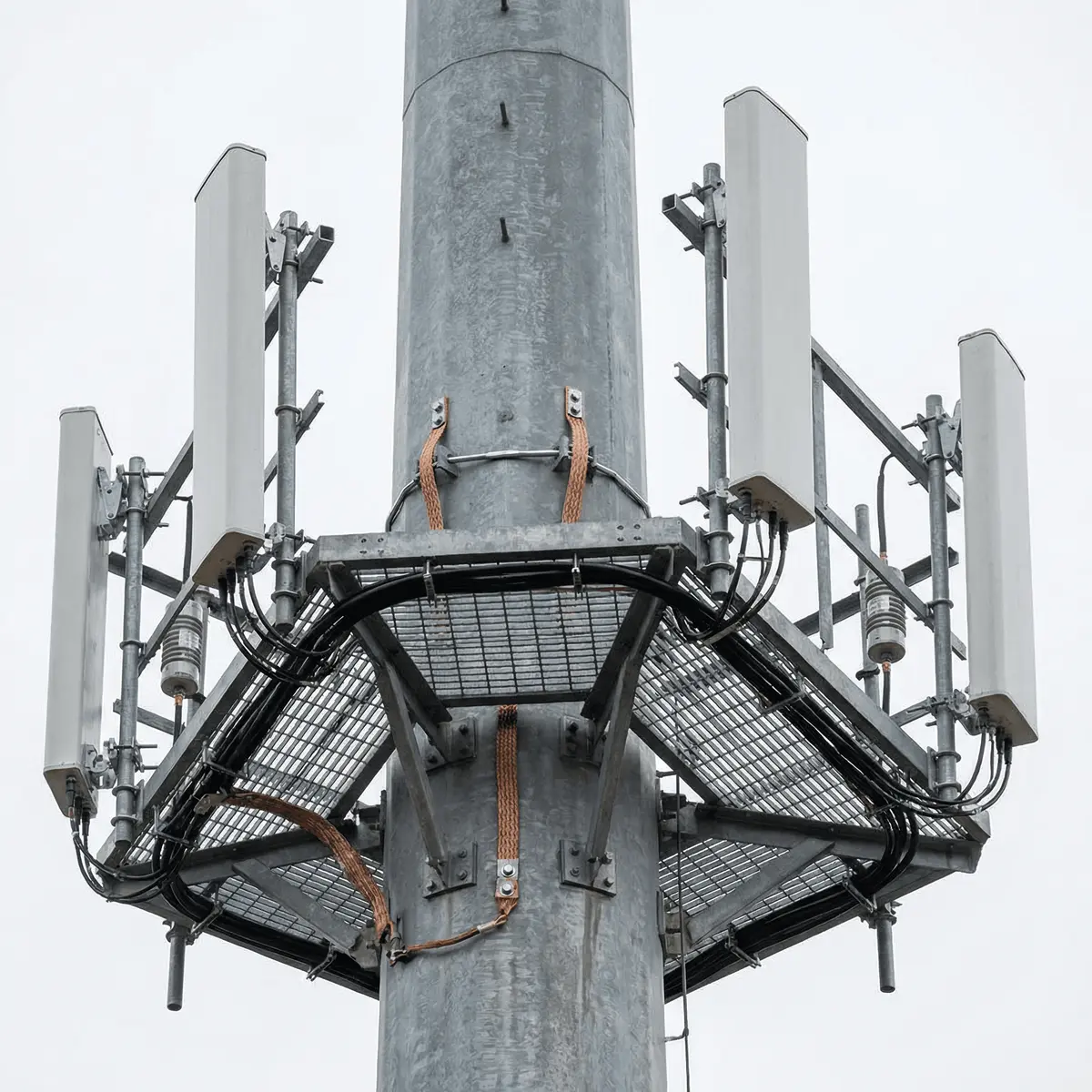
SOLAR TODO supplies B2B power and telecom infrastructure for projects that need offline quotation, technical review, and financing support for larger deployments. In this category, the power system must be evaluated together with the structure, such as a 40 m monopole, 45 m monopole, or 12 m distribution telecom shared pole, because antenna loading, cabinet placement, and roadside footprint affect both civil and electrical design.
System architecture and technical design for hybrid telecom power
A telecom hybrid power system usually combines 3-15 kW PV, 48 VDC rectification, 10-60 kWh batteries, and a diesel generator with automatic control to maintain 99.9%+ site availability under weak-grid conditions.
At site level, the architecture is straightforward. Solar PV supplies daytime energy. The battery stores excess solar and supports the DC load during low irradiance or grid failure. The generator starts only when battery state of charge, load level, or forecast conditions require it. This reduces idle hours and keeps the generator operating in a healthier load band.
Core subsystem configuration
A practical hybrid design for telecom sites uses a 48 VDC or 240 VDC power path with battery autonomy sized to the critical load and generator reserve margin.
Typical subsystem blocks include:
- PV array: 3-15 kW for fiber nodes and small tower compounds; 15-60 kW for larger off-grid macro sites
- Battery bank: 10-60 kWh for compact nodes; 50-300 kWh for high-load macro sites
- Rectifier system: N+1 modular telecom rectifiers, often 3-12 kW per cabinet
- Inverter or AC bus: used when cooling, AC auxiliaries, or mixed loads are present
- Diesel generator: commonly 5-30 kVA for node sites and 20-100 kVA for macro sites
- Hybrid controller: manages SOC, generator start-stop, load priority, alarms, and remote telemetry
- Protection system: SPD, MCB/MCCB, DC disconnects, earthing, and lightning protection
Battery chemistry selection matters. Lithium iron phosphate is common because it offers cycle life often above 4,000-6,000 cycles, better partial-state-of-charge behavior, and lower maintenance than VRLA. VRLA still appears in retrofit sites because the installed base is large and capex can be lower, but high ambient temperatures above 30°C usually shorten service life significantly.
According to NREL (2024), solar resource modeling and load matching are critical because oversizing PV without usable storage can increase curtailment and weaken project economics. According to IRENA (2024), solar generation costs remain among the lowest-cost new electricity options in many markets, which supports the diesel offset case for remote telecom assets. For a tower operator, that means PV should be sized against daytime load, battery window, and seasonal irradiance rather than nameplate ambition.
Load profile and 5G energy efficiency optimization
5G site efficiency improves when the power system is sized around real hourly demand, not just peak generator rating, with many sites showing 10-25% avoidable losses from poor generator loading and battery cycling strategy.
A 5G-enabled site often has variable load by hour. Radios, microwave links, fiber transmission, and cooling create a mixed profile. If the generator is too large, it may run below 30% load for long periods, causing wet stacking and poor fuel efficiency. If the battery is too small, the generator starts too often, increasing service hours and reducing component life.
Optimization steps usually include:
- Measure 30-90 days of interval load data before final sizing
- Separate critical DC load from noncritical AC auxiliaries
- Set generator start thresholds by SOC and forecasted solar window
- Keep generator loading in a healthier 30-80% operating band
- Apply free cooling or DC cooling where ambient conditions allow
- Use remote shutdown or sleep logic for noncritical edge devices during extended outages
The International Energy Agency states, "energy efficiency remains the first fuel," and that principle applies directly to telecom power design. For 5G and fiber node sites, the cheapest kilowatt-hour is often the one avoided through better rectifier efficiency, lower cooling demand, and fewer generator hours.
Telecom tower and fiber node deployment scenarios
Fiber node sites usually need 0.5-3 kW continuous power, while macro telecom tower sites often need 5-15 kW or more, so the hybrid architecture must follow the actual network role and structural footprint.
Sample deployment scenario (illustrative): a roadside fiber node with 1.2 kW average load can use about 4-6 kW PV, 15-20 kWh lithium battery storage, and a 5-8 kVA diesel generator. In a sunny market with stable daytime irradiance, diesel runtime can fall by more than 60% compared with generator-dominant operation. This is attractive where refueling trips involve long distances or security escorts.
Sample deployment scenario (illustrative): a macro 5G corridor site on a 45 m monopole may carry multi-sector radios, microwave backhaul, obstruction lighting, and security equipment. In that case, the average load may sit in the 5-10 kW range, and the hybrid package may require 15-30 kW PV, 60-150 kWh storage, and a 20-40 kVA generator depending on autonomy target and local irradiance.
SOLAR TODO product options in the telecom_tower category align with different deployment envelopes:
- 45m Monopole Highway Corridor Flanged: 45 m height, 4 antenna platforms, up to 12 antennas, 50 m/s wind design, compact roadside footprint
- 40m Monopole Industrial Zone Coverage Slip-Joint: 40 m height, 3 platforms, 12 antennas, 2 microwave dishes, 50 m/s design wind, about 3 m footprint class
- 12m Distribution Telecom Shared Pole: 12 m joint-use steel round pole for 10 kV distribution plus 1 antenna platform with up to 3 telecom antennas, 40 m/s wind design
For fiber node densification, the 12 m shared pole can reduce corridor occupation by about 30-50% versus separate utility and telecom poles where local code allows joint use. For macro coverage, the 40 m and 45 m monopoles reduce land take versus lattice alternatives and simplify roadside permitting where every extra 10 m² may affect total project cost.
Comparison and selection guide for diesel-solar hybrid site design
Selecting the right hybrid solution depends on load, autonomy, structure type, and fuel logistics, with the best designs balancing 3 variables: kW demand, battery hours, and generator operating band.
The table below summarizes typical decision points for B2B buyers comparing fiber node and telecom tower power solutions.
| Site type | Typical load | PV size | Battery size | Generator size | Suitable structure | Main objective |
|---|---|---|---|---|---|---|
| Fiber node / edge cabinet | 0.5-1.5 kW | 3-6 kW | 10-20 kWh | 5-8 kVA | 12 m shared pole or compact ground mount | Reduce truck rolls and stabilize weak-grid uptime |
| Small telecom site | 1.5-3 kW | 5-10 kW | 15-40 kWh | 8-15 kVA | 12 m shared pole or compact monopole | Cut diesel runtime by 50-70% |
| Industrial zone macro site | 3-8 kW | 10-20 kW | 40-100 kWh | 15-30 kVA | 40 m monopole | Support multi-tenant radios and backhaul |
| Highway corridor macro site | 5-15 kW | 15-30 kW | 60-150 kWh | 20-40 kVA | 45 m monopole | Maintain corridor coverage with lower fuel dependence |
Selection criteria should also include:
- Wind design and structure compliance, such as 40 m/s or 50 m/s site conditions
- Foundation type, especially pile foundations for difficult roadside geotechnical conditions
- Battery thermal management where ambient temperatures exceed 35°C
- Fuel theft risk and refill interval, especially when sites are more than 100 km from service depots
- Remote monitoring integration with NOC or energy management software
- Earthing, surge, and lightning design aligned with telecom and electrical safety practice
According to IEC and IEEE guidance, power quality, grounding, and battery safety are not secondary details. They affect uptime, fire risk, and maintenance cost over the full 10-30 year site life. That is why SOLAR TODO usually reviews structure, load, and power package together during quotation rather than treating them as separate procurement lines.
EPC Investment Analysis and Pricing Structure
A telecom hybrid EPC package typically includes civil works, PV, batteries, rectifiers, generator integration, monitoring, and commissioning, while project ROI often lands in the 3-6 year range when diesel offset exceeds 50%.
For B2B buyers, pricing should be separated into three tiers so commercial comparisons stay clear:
- FOB Supply: equipment only, ex-port basis, including tower or pole package if applicable, PV modules, battery system, rectifiers, controller, and electrical accessories
- CIF Delivered: FOB scope plus sea freight and insurance to destination port
- EPC Turnkey: CIF scope plus civil works, foundation, erection, cabling, commissioning, testing, and handover documentation
A standard EPC turnkey scope for hybrid telecom power usually includes:
- Site survey and load assessment
- Single-line diagram and equipment layout
- Foundation and mounting design
- Tower or pole erection interface
- PV, battery, rectifier, and generator integration
- Earthing, lightning, and surge protection
- Remote monitoring setup
- SAT, commissioning, and operator training
Volume pricing guidance for framework orders:
- 50+ units: about 5% discount
- 100+ units: about 10% discount
- 250+ units: about 15% discount
Commercial terms commonly used:
- Payment: 30% T/T deposit + 70% against B/L
- Alternative: 100% L/C at sight
- Financing: available for large projects above $1,000K subject to project review
- Contact: [email protected]
ROI should be calculated against the conventional baseline of diesel-only or grid-plus-diesel operation. The main savings lines are fuel reduction, fewer preventive maintenance visits, lower emergency callouts, and lower generator replacement frequency. Sample deployment scenario (illustrative): if a remote site spends $12,000-$25,000 per year on diesel and maintenance, and the hybrid package cuts that by 40-65%, annual savings may reach $4,800-$16,250. Under those conditions, payback often falls between 3 and 6 years depending on solar yield, logistics cost, and battery replacement assumptions.
FAQ
A diesel-solar hybrid system for telecom sites combines PV, batteries, and generator control to reduce fuel use by 30-70% while maintaining 24/7 uptime for 0.5-15 kW communications loads.
Q: What is a diesel-solar hybrid system in telecom tower power solutions? A: It is a site power architecture that combines solar PV, battery storage, rectifiers, and a diesel generator under one controller. The controller decides when to use solar, battery, grid, or generator power. For telecom and fiber node sites, this reduces fuel use and improves uptime compared with diesel-only operation.
Q: How much diesel can a hybrid system save at a 5G or fiber node site? A: Savings depend on load, solar resource, and battery size, but many sites reduce diesel runtime by 50-80% after proper sizing. A compact node with 1-2 kW average demand and 4-6 kW PV can often cut fuel use sharply. Sites with poor solar resource or oversized loads will save less.
Q: What battery size is typical for telecom hybrid power systems? A: Small fiber node sites often use 10-20 kWh, while macro telecom sites may use 40-150 kWh or more. The correct size depends on average load, required autonomy, and generator strategy. Most operators target 6-24 hours of backup for critical communications equipment.
Q: Why is generator loading important in a hybrid telecom site? A: Generator loading matters because diesel engines running below about 30-40% load can suffer poor combustion and wet stacking. That increases fuel consumption, maintenance frequency, and failure risk. A hybrid controller helps by starting the generator less often and keeping each run closer to an efficient load band.
Q: How do I choose between a 12 m shared pole and a 40 m or 45 m monopole? A: Use a 12 m shared pole for compact roadside or distribution-linked deployments where 10 kV joint use and up to 3 antennas are enough. Choose a 40 m or 45 m monopole when you need wider macro coverage, multiple platforms, or up to 12 antennas. The structure must match RF coverage, loading, and corridor constraints.
Q: What standards should be checked for hybrid telecom power projects? A: Buyers should review IEC, IEEE, UL, and structural standards relevant to batteries, inverters, grounding, surge protection, and tower design. Common references include IEC battery and PV standards, IEEE interconnection and grounding practices, and structural checks such as TIA-222-H or EN 1993-3-1 for towers. Local utility and telecom code checks are also required.
Q: What is the typical payback period for diesel-solar hybrid telecom systems? A: Many projects land in the 3-6 year payback range when diesel prices, transport costs, and maintenance burdens are high. Remote sites usually show the strongest economics because every avoided refueling trip adds value. Accurate ROI needs real load data, local irradiance, and a baseline of current fuel and O&M spending.
Q: What does EPC turnkey delivery include for a telecom hybrid system? A: EPC turnkey delivery usually includes survey, design, civil works, equipment supply, erection support, electrical integration, testing, and commissioning. It can also include tower or pole interfaces, remote monitoring, and operator training. This approach reduces coordination risk when one contractor handles both power and infrastructure scope.
Q: How are hybrid telecom power systems priced and what payment terms are common? A: Pricing is usually presented as FOB Supply, CIF Delivered, and EPC Turnkey so buyers can compare equipment-only and full-project costs. Standard terms are often 30% T/T and 70% against B/L, or 100% L/C at sight. For larger projects above $1,000K, financing may be available through project review; contact [email protected].
Q: What maintenance is required for a diesel-solar hybrid telecom site? A: Maintenance includes PV cleaning as needed, battery health checks, rectifier and controller alarm review, generator servicing, and earthing inspection. Remote monitoring can reduce emergency visits by flagging fuel levels, SOC, and abnormal load trends early. Service intervals depend on ambient temperature, dust, runtime hours, and battery chemistry.
Q: Can hybrid systems work on weak-grid sites, not only off-grid sites? A: Yes. Weak-grid sites are often a strong use case because the battery can bridge short outages and the generator starts only when the outage extends beyond the battery window. This reduces nuisance generator operation and improves power quality for sensitive telecom electronics.
Q: Why should B2B buyers source structure and power package together? A: The structure affects equipment layout, cable routing, foundation scope, and available footprint for PV, battery cabinets, and generator sets. Procuring them together reduces interface errors between civil, structural, and electrical teams. SOLAR TODO commonly reviews these items together to shorten technical clarification cycles.
References
A strong diesel-solar hybrid design should be based on recognized sources such as IEC, IEEE, IEA, IRENA, NREL, and telecom structural standards rather than generic product claims.
- NREL (2024): PVWatts and solar performance modeling methods used to estimate PV yield, load matching, and annual energy production.
- IEA (2024): Energy Efficiency and digital infrastructure analysis describing the growing electricity demand of networks and the role of efficiency.
- IRENA (2024): Renewable Power Generation Costs report showing solar PV remains one of the lowest-cost new generation sources in many markets.
- IEEE (2018): IEEE 1547-2018, interconnection and interoperability guidance relevant to distributed energy resources and site power integration.
- IEC (2021): IEC 61215-1, PV module design qualification and type approval requirements for long-term field durability.
- IEC (2023): IEC 61730-1, PV module safety qualification requirements for construction and testing.
- TIA (2022): TIA-222-H, structural standard for antenna supporting structures and antennas used in telecom tower design.
- EN (2006): EN 1993-3-1, Eurocode guidance for towers, masts, and chimneys relevant to monopole structural checks.
Conclusion
Diesel-solar hybrid telecom power reduces fuel dependence by 30-70%, supports 6-24 hours of battery autonomy, and improves 5G and fiber node uptime when the system is sized around real load data.
For B2B buyers, the best result comes from evaluating structure, power electronics, battery storage, and EPC scope as one package. SOLAR TODO can support this process with offline quotation, project review, and financing options for larger telecom infrastructure programs.
About SOLARTODO
SOLARTODO is a global integrated solution provider specializing in solar power generation systems, energy-storage products, smart street-lighting and solar street-lighting, intelligent security & IoT linkage systems, power transmission towers, telecom communication towers, and smart-agriculture solutions for worldwide B2B customers.
Procurement paths
About the Author

SOLARTODO Editorial Team
Solar Energy & Infrastructure Expert Team
SOLAR TODO is a professional supplier of solar energy, energy storage, smart lighting, smart agriculture, security systems, communication towers, and power tower equipment.
Our technical team has over 15 years of experience in renewable energy and infrastructure, providing high-quality products and solutions to B2B customers worldwide.
Expertise: PV system design, energy storage optimization, smart lighting integration, smart agriculture monitoring, security system integration, communication and power tower supply.
Cite This Article
SOLARTODO Editorial Team. (2026). diesel-solar hybrid in Telecom Tower Power Solutions: 5G…. SOLARTODO. Retrieved from https://solartodo.com/knowledge/diesel-solar-hybrid-in-telecom-tower-power-solutions-5g-energy-efficiency-optimization-for-fiber-node-sites
@article{solartodo_diesel_solar_hybrid_in_telecom_tower_power_solutions_5g_energy_efficiency_optimization_for_fiber_node_sites,
  title = {diesel-solar hybrid in Telecom Tower Power Solutions: 5G…},
  author = {SOLARTODO Editorial Team},
  journal = {SOLARTODO Knowledge Base},
  year = {2026},
  url = {https://solartodo.com/knowledge/diesel-solar-hybrid-in-telecom-tower-power-solutions-5g-energy-efficiency-optimization-for-fiber-node-sites},
  note = {Accessed: 2026-10-15}
}
Published: May 9, 2026 | Available at: https://solartodo.com/knowledge/diesel-solar-hybrid-in-telecom-tower-power-solutions-5g-energy-efficiency-optimization-for-fiber-node-sites
Subscribe to Our Newsletter
Get the latest solar energy news and insights delivered to your inbox.
View All Articles