Critical Infrastructure Protection Market 2026 Stats

SOLAR TODO
Solar Energy & Infrastructure Expert Team
Watch the video
TL;DR
Critical infrastructure security demand is rising because solar and distributed energy assets are expanding faster than legacy protection models. By 2026, buyers are standardizing on 32-128 zone systems, 16-64 cameras, and 30-day retention, with typical EPC references from USD 16,500 to USD 46,600 and payback often in 2.5-5.0 years when false alarms and dispatch costs are reduced.
Critical infrastructure protection is moving toward roughly $170-190 billion by 2030 as solar capacity passed 1.6 TW in 2024. Buyers now standardize 32-128 security zones, 16-64 cameras, and 30-day retention for fuel, port, government, and solar sites.
Summary
Critical infrastructure protection spending is rising toward an estimated $170-190 billion by 2030, while solar PV capacity passed 1.6 TW in 2024 and utility sites now target 24/7 coverage with 32-128 security zones, 16-64 cameras, and 30-day video retention.
Key Takeaways
- Prioritize 32-128 zone architectures because fuel, port, and public-sector sites often contain 6-60 controlled risk points that exceed standard 8-16 zone commercial alarm capacity.
- Specify 16-64 IP cameras with 30 days of 4K retention to improve evidence quality and reduce incident review time across single-site and multi-site operations.
- Use hybrid communications with 4G, Ethernet, and WiFi because critical sites need alarm continuity above 99% pathway availability during primary network outages.
- Compare EPC turnkey budgets early: gas station chain systems typically fit 32-zone cloud packages, while port and government deployments can range from USD 16,500 to USD 46,600.
- Segment alarms by perimeter, office, utility, hazardous area, and public interface because 96-128 detector points support faster triage than one undifferentiated event queue.
- Validate compliance against EN 50131, IEC 62676, UL 681, and NFPA 72 to reduce procurement risk and align installation, video, and signaling requirements.
- Model ROI from avoided losses, lower guard dispatches, and faster response because AI analytics can cut nuisance alarms by up to 90% versus motion-only legacy CCTV.
- Standardize cloud dashboards across 5-500 sites to centralize evidence, maintenance status, and incident workflows, especially for solar plants, substations, telecom towers, and fuel retail portfolios.
Critical Infrastructure Protection Market Outlook 2026
Critical infrastructure protection in 2026 combines a market moving toward roughly $170-190 billion by 2030 with solar capacity above 1.6 TW and rising demand for 24/7 monitoring across 32-128 security zones.
Critical infrastructure buyers are no longer evaluating security as a stand-alone CCTV purchase. They are buying operational resilience. According to IEA (2024), global renewable power additions reached record levels in 2023, with solar PV accounting for the largest share, and according to IRENA (2025), total installed solar capacity exceeded 1.6 TW in 2024. That expansion increases the number of exposed assets that require perimeter control, remote alarm signaling, and evidentiary video.
The protection market is also broadening beyond utilities. Ports, government buildings, fuel stations, telecom towers, water facilities, and solar farms now face similar requirements: 24/7 coverage, cyber-aware communications, and event verification in less than 60 seconds. According to MarketsandMarkets and multiple 2024-2025 industry trackers, the wider critical infrastructure protection market is on a path toward roughly USD 170-190 billion by 2030, with mid- to high-single-digit annual growth depending on segment scope.
For B2B procurement teams, the practical issue is system scale. A small commercial alarm with 8 zones and 4 cameras is undersized for most critical sites by a factor of 4 to 12. SOLAR TODO therefore positions integrated security packages around 32-zone, 96-zone, and 128-zone architectures, matching real operating environments such as fuel retail chains, port terminals, and government compounds.
The International Energy Agency states, "Solar PV is set to become the largest renewable power source globally by 2029." That matters for security planning because every additional MW of distributed and utility solar creates more inverter rooms, combiner areas, fence lines, and remote substations that must be monitored under IEC 62676 and EN 50131-aligned practices.
Solar Security Deployment Statistics by Region
Asia-Pacific, Europe, North America, Middle East and Africa, and Latin America all show rising solar deployment, but site risk profiles differ by climate, grid reliability, and perimeter length.
Regional security demand follows solar buildout, asset dispersion, and labor cost. Asia-Pacific leads in utility-scale deployment volume, Europe leads in distributed energy integration complexity, North America emphasizes compliance and evidentiary retention, the Middle East and Africa prioritize perimeter hardening in remote environments, and Latin America often balances CAPEX against multi-site monitoring efficiency.
According to IRENA (2025), global renewable capacity additions in 2024 remained heavily concentrated in Asia, with China as the largest contributor. According to BloombergNEF (2024), solar investment continued to dominate new power-sector capital allocation. For security planners, that means the highest unit demand often comes from large portfolios rather than single flagship sites.
| Region | 2024-2026 solar security demand driver | Typical protected assets | Common system scale |
|---|---|---|---|
| Asia-Pacific | Utility solar expansion, grid nodes, logistics growth | Solar farms, substations, ports | 96-128 zones, 32-64 cameras |
| Europe | Distributed PV, compliance, public infrastructure hardening | Public buildings, battery sites, transport hubs | 32-96 zones, 16-48 cameras |
| North America | Utility compliance, evidence retention, remote assets | Solar plants, substations, telecom, fuel retail | 32-128 zones, 16-64 cameras |
| Middle East & Africa | Remote perimeter exposure, hybrid comms need | Solar parks, oil & gas support sites, ports | 32-96 zones, 16-48 cameras |
| Latin America | Multi-site retail and logistics protection | Fuel stations, warehouses, municipal sites | 32-96 zones, 16-48 cameras |
A useful planning metric is camera density per risk area. Fuel stations typically need 6-12 critical views, ports may require 24-48 fixed and PTZ combinations, and government campuses can exceed 64 cameras where 4-12 floors and 20-60 controlled rooms are involved. These figures match the SOLAR TODO package logic used in 32-zone, 96-zone, and 128-zone deployments.
| Region | Estimated 2026 deployment emphasis | Communication preference | Indicative ROI range |
|---|---|---|---|
| Asia-Pacific | New-build utility and logistics | Ethernet + 4G backup | 2.5-4.5 years |
| Europe | Retrofit and compliance upgrades | Ethernet + cellular | 3.0-5.0 years |
| North America | Evidence-grade surveillance and AI analytics | Ethernet + LTE/5G | 3.0-4.5 years |
| Middle East & Africa | Remote perimeter and resilience | 4G + Ethernet + radio where needed | 2.5-4.0 years |
| Latin America | Multi-site cloud monitoring | 4G + Ethernet + WiFi | 2.5-4.5 years |
The International Renewable Energy Agency states, "Renewables are increasingly the most competitive source of new power generation." Lower generation cost does not reduce security need; it increases deployment count. More sites mean more exposed gates, transformer yards, battery containers, and unmanned operating windows.
Technology Benchmarks for Solar and Critical Site Security
Integrated intrusion and video systems for critical infrastructure now center on 32-128 zones, 16-64 cameras, 30-day retention, and dual or triple communication paths for alarm continuity.
Security performance depends on matching architecture to site geometry. A 32-zone package is suitable for a single fuel station or compact utility node. A 96-zone package fits long-fence logistics or marine assets. A 128-zone package is appropriate when multiple floors, public interfaces, and restricted rooms must be partitioned separately.
According to IEC 62676, video surveillance systems should be specified around image usability, recording performance, and operational conditions rather than camera count alone. According to EN 50131, intrusion systems must define grades, zones, and signaling logic suitable for site risk. That is why professional buyers now ask for detector counts, NVR channels, retention days, and communication redundancy in one schedule.
| Package type | Alarm zones | Cameras | Detector points | Typical use case | Retention |
|---|---|---|---|---|---|
| Gas Station Chain 32-Zone Cloud | 32 | 16 HD IP | 32 primary points | Fuel retail chains, forecourts | 30 days 4K |
| Port Terminal 96-Zone Full Security | 96 | 48 total | 96 detectors | Ports, logistics yards, bonded warehouses | 30 days 4K-equivalent |
| Government Building 128-Zone Maximum | 128 | 64 total | 128 detector points | Public buildings, multi-wing campuses | Continuous evidentiary retention |
Sample deployment statistics and component logic
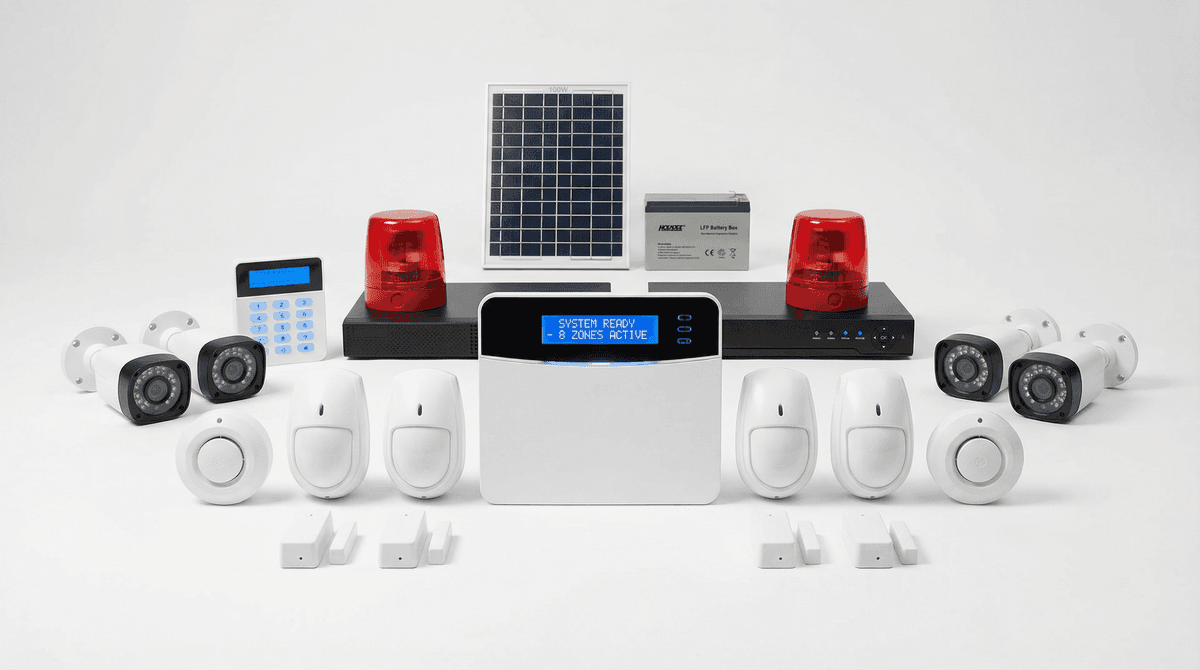
A typical 32-zone fuel retail site may use 16 PIR detectors, 16 door contacts, 8 glass-break detectors, 8 gas detectors, 4 LCD keypads, and 4 sirens. A 96-zone port package may add 1,000 meters of electric fence, 36 fixed IP cameras, 12 PTZ cameras, 24 dual-technology detectors, and 16 perimeter beam sets. A 128-zone government package can scale to 48 fixed cameras, 16 PTZ cameras, 64 PIR detectors, and 20 perimeter beam sets.
For solar-adjacent infrastructure, the same logic applies. A 100 MW solar plant often includes multiple inverter stations, one or more substations, O&M buildings, and perimeter sectors extending beyond 2,000 meters. That footprint usually requires at least 24-48 cameras, 32-96 detector points, and segmented alarm partitions for fence breach, equipment room access, and after-hours vehicle movement.
AI analytics matter because labor is expensive and false alarms delay response. According to current manufacturer and integrator benchmarks cited in public-sector security procurement, AI-assisted video analytics can reduce nuisance alarms by up to 90% compared with motion-only legacy CCTV. For sites with 10-30 daily false events, that reduction can remove hundreds of wasted reviews each month.
Year-over-Year Trends: 2021-2040 Security and Solar Convergence
The 2021-2026 period shows record solar additions and rising infrastructure hardening, while 2027-2030 should bring more AI verification and 2030-2040 will likely shift toward autonomous perimeter analytics.
From 2021 to 2023, solar additions accelerated as module pricing normalized and grid-scale procurement expanded. According to IEA (2024), annual renewable additions hit new highs in 2023. According to IRENA (2025), cumulative solar capacity crossed 1 TW before moving beyond 1.6 TW in 2024. Each annual jump increased the installed base that must be secured over a 20-30 year operating life.
In 2025-2026, buyers are standardizing around cloud dashboards, remote health checks, and hybrid communications. This is especially visible in portfolios of 5-500 fuel stations, telecom sites, and distributed energy assets. Security teams want one dashboard, one event taxonomy, and one retention policy rather than separate local DVRs and isolated alarm panels.
From 2027 to 2030, three changes are likely. First, AI event classification will move from basic motion filtering to object, behavior, and route-based analysis. Second, battery energy storage systems will add new protected zones around PCS rooms, thermal monitoring, and fire-alarm interfaces. Third, more tenders will require cybersecurity controls aligned with IEC 62443 or equivalent procurement language.
From 2030 to 2040, the long-term outlook points to autonomous inspection and predictive security. Sample deployment scenario (illustrative): a 500 MW solar park could combine fixed cameras, PTZs, thermal views, fence analytics, drone docking, and SCADA-linked alarm escalation under one command layer. The technical direction is clear even if exact adoption rates vary by region and regulation.
| Period | Solar market trend | Security implication | Typical buyer response |
|---|---|---|---|
| 2021-2023 | Record annual additions | More remote assets to protect | Add perimeter CCTV and basic alarms |
| 2024-2026 | Capacity above 1.6 TW, portfolio growth | Need cloud visibility and AI filtering | Standardize 32-128 zone platforms |
| 2027-2030 | More storage and hybrid plants | More protected rooms and interfaces | Specify integrated alarm-video-fire logic |
| 2030-2040 | Autonomous monitoring likely expands | Fewer manual patrols, more analytics | Invest in predictive and unmanned security |
EPC Investment Analysis and Pricing Structure
Critical infrastructure security projects are usually procured as FOB supply, CIF delivered, or EPC turnkey packages, with typical budgets from USD 16,500 to USD 46,600 for larger 96-128 zone systems.
For procurement managers, EPC means one accountable scope covering engineering, procurement, construction, installation, testing, and commissioning. In security projects, that usually includes panel design, camera layout, detector schedules, cable routing, communication setup, NVR configuration, siren and keypad installation, and final acceptance testing against agreed cause-and-effect logic.
SOLAR TODO generally supports three commercial structures:
- FOB Supply: equipment only, ex-port shipment, suitable when the buyer has a local integrator
- CIF Delivered: equipment plus freight and insurance to destination port, suitable for import-managed projects
- EPC Turnkey: supply, installation, commissioning, and handover, suitable for single-point responsibility
Known package references help frame budgets. The Port Terminal 96-Zone Full Security package sits in the USD 16,500-21,300 EPC range. The Government Building 128-Zone Maximum package sits in the USD 36,300-46,600 EPC range. A 32-zone cloud package for fuel retail is typically lower in total CAPEX, depending on communication hardware, civil work, and local labor.
Volume pricing matters in chain deployments. Practical guidance is:
- 50+ units: about 5% discount
- 100+ units: about 10% discount
- 250+ units: about 15% discount
Payment terms for export projects are commonly 30% T/T with 70% against B/L, or 100% L/C at sight. Financing may be available for larger projects above USD 1,000,000, subject to project profile, jurisdiction, and credit review. For quotations and EPC discussion, buyers can contact [email protected].
ROI is usually driven by avoided losses, lower guard dispatches, fewer nuisance alarms, and faster claim support. Sample deployment scenario (illustrative): if a 32-site fuel portfolio avoids just 2 major theft or fraud events per year at USD 12,000 each and cuts 20 unnecessary dispatches per month at USD 40 each, annual benefit exceeds USD 33,600 before insurance effects. That often supports a 2.5-4.5 year payback depending on site count and labor rates.
| Delivery model | Scope included | Buyer responsibility | Typical use |
|---|---|---|---|
| FOB Supply | Hardware, packing list, manuals | Freight, customs, installation | Experienced local integrator |
| CIF Delivered | Hardware, freight, insurance | Customs clearance, installation | Import-managed projects |
| EPC Turnkey | Design, supply, install, test, commission | Site access, approvals | Single-point responsibility |
Use Cases and Selection Guide for Critical Infrastructure Buyers
Selecting the right security architecture depends on zone count, camera density, hazardous-area exposure, and whether the operator manages 1 site or 500 sites from one cloud dashboard.
Fuel retail chains need fast event verification and standardized layouts. A 32-zone cloud package with 16 cameras and 30-day retention fits cashier zones, dispenser islands, tank fill points, back-office doors, and perimeter gates. Multi-site operators gain the most when 5-500 stations are monitored through one dashboard with common alarm rules.
Port and logistics sites need perimeter depth. A 96-zone package with 48 cameras, 96 detectors, and 1,000 meters of electric fence is more suitable where long fence lines, customs lanes, reefer yards, and marine access routes create dozens of simultaneous risk sectors. In these sites, PTZ coverage and beam sets often matter more than adding low-value indoor cameras.
Government and public administration sites need partitioning and evidence retention. A 128-zone, 64-camera design fits 4-12 floors, 20-60 controlled rooms, and at least 2 security perimeters. Separate partitions for lobby, records, executive offices, IT rooms, and archive areas improve response discipline and audit traceability.
For solar plants, substations, and hybrid energy sites, buyers should focus on perimeter length, unmanned hours, and communication resilience. SOLAR TODO can align the same architecture logic used in fuel, port, and government security packages to solar-adjacent infrastructure where 4G plus Ethernet backup, 30-day retention, and segmented alarm zones are required.
FAQ
What is driving the critical infrastructure protection market in 2026? Critical infrastructure protection demand is being driven by more distributed energy assets, stricter compliance, and higher evidence requirements. Solar capacity exceeded 1.6 TW in 2024 according to IRENA, and each new plant, substation, or fuel site adds perimeter, access-control, and video monitoring needs.
How large is the market for critical infrastructure protection? Most 2024-2025 market trackers place the broader sector on a path toward roughly USD 170-190 billion by 2030, with mid- to high-single-digit CAGR depending on scope. Buyers should separate physical security, cybersecurity, and integrated resilience budgets because tender structures differ by sector.
Why does solar deployment increase security demand? Solar deployment increases security demand because every new MW adds exposed equipment, fence lines, inverter rooms, and remote operating windows. A 100 MW solar site can require 24-48 cameras and 32-96 detector points when perimeter sectors, substations, and O&M buildings are protected properly.
What system size is suitable for a fuel station chain? A fuel station chain usually starts with a 32-zone cloud package per site, especially where 6-12 critical risk points must be monitored. A standard layout often includes 16 HD IP cameras, 32 primary detector points, 4 sirens, and 30 days of video retention.
How do 32-zone, 96-zone, and 128-zone systems differ? The main difference is coverage scale and partition complexity. A 32-zone system fits compact single sites, a 96-zone system fits long-perimeter logistics or marine assets, and a 128-zone system fits multi-floor campuses with 20-60 controlled rooms and multiple security perimeters.
What standards should buyers request in tenders? Buyers should request EN 50131 for intrusion, IEC 62676 for video surveillance, UL 681 for installation practice, and NFPA 72 for signaling interfaces. If the site includes networked controls or utility interfaces, adding cybersecurity language aligned with IEC 62443 is also prudent.
How much does an EPC turnkey security project cost? Known package references place a 96-zone port system at about USD 16,500-21,300 EPC and a 128-zone government system at about USD 36,300-46,600 EPC. Final pricing depends on camera count, trenching, communication hardware, hazardous-area requirements, and local labor conditions.
What payment terms are common for export security projects? Common export terms are 30% T/T in advance with 70% against B/L, or 100% L/C at sight. For larger projects above USD 1,000,000, financing may be available subject to project review, and buyers can discuss structure directly with SOLAR TODO at [email protected].
How fast is the payback period for critical site security? Payback is often 2.5-5.0 years when avoided theft, reduced dispatches, and lower false-alarm handling are included. Sites with frequent nuisance alarms can improve ROI faster, especially where AI analytics reduce false events by up to 90% versus motion-only CCTV.
What communication paths are recommended for remote or high-risk sites? Remote and high-risk sites should use at least two communication paths, typically Ethernet plus 4G or LTE backup. Fuel stations and distributed energy sites often add WiFi for local maintenance, but primary alarm signaling should not rely on a single consumer-grade connection.
How long should video be retained at critical infrastructure sites? Thirty days is a common baseline for fuel, logistics, and utility sites because it balances evidence needs and storage cost. Higher-risk public-sector facilities may retain longer periods depending on policy, incident category, and legal evidence requirements.
When should a buyer choose EPC turnkey instead of supply-only? EPC turnkey is the better choice when the project includes multi-site standardization, civil work, commissioning, or one-party accountability. Supply-only works best when the buyer already has a qualified local integrator and clear installation drawings, standards, and acceptance criteria.
Conclusion
Critical infrastructure protection in 2026 is increasingly tied to solar and distributed asset growth, with practical system demand centered on 32-128 zones, 16-64 cameras, and 30-day retention across multi-site portfolios.
The bottom line is simple: as solar capacity expands beyond 1.6 TW and critical assets become more distributed, buyers should standardize on compliant, cloud-managed security architectures that deliver 2.5-5.0 year payback and clear EPC scope. SOLAR TODO supports that approach with scalable packages for fuel, port, government, and solar-adjacent infrastructure.
References
- IEA (2024): Renewables 2024 and World Energy Outlook data on record renewable additions and solar PV growth.
- IRENA (2025): Renewable Capacity Statistics 2025, including global installed solar capacity above 1.6 TW in 2024.
- BloombergNEF (2024): Energy transition and solar investment tracking used by project financiers and procurement teams.
- IEC 62676 (2024 reference set): Video surveillance systems for use in security applications.
- EN 50131 (current framework): Intrusion and hold-up alarm systems requirements for zones, grades, and signaling.
- UL 681 (2023/2024 use reference): Installation and classification practices for burglary and holdup alarm systems.
- NFPA 72 (2025): National Fire Alarm and Signaling Code relevant to alarm signaling integration and interfaces.
- NREL (2024): Utility and distributed solar performance, storage integration, and site planning resources used in energy infrastructure projects.
About SOLARTODO
SOLARTODO is a global integrated solution provider specializing in solar power generation systems, energy-storage products, smart street-lighting and solar street-lighting, intelligent security & IoT linkage systems, power transmission towers, telecom communication towers, and smart-agriculture solutions for worldwide B2B customers.
About the Author

SOLAR TODO
Solar Energy & Infrastructure Expert Team
SOLAR TODO is a professional supplier of solar energy, energy storage, smart lighting, smart agriculture, security systems, communication towers, and power tower equipment.
Our technical team has over 15 years of experience in renewable energy and infrastructure, providing high-quality products and solutions to B2B customers worldwide.
Expertise: PV system design, energy storage optimization, smart lighting integration, smart agriculture monitoring, security system integration, communication and power tower supply.
Cite This Article
SOLAR TODO. (2026). Critical Infrastructure Protection Market 2026 Stats. SOLAR TODO. Retrieved from https://solartodo.com/knowledge/critical-infrastructure-protection-market-2026-solar-security-deployment-statistics
@article{solartodo_critical_infrastructure_protection_market_2026_solar_security_deployment_statistics,
  title = {Critical Infrastructure Protection Market 2026 Stats},
  author = {SOLAR TODO},
  journal = {SOLAR TODO Knowledge Base},
  year = {2026},
  url = {https://solartodo.com/knowledge/critical-infrastructure-protection-market-2026-solar-security-deployment-statistics},
  note = {Accessed: 2026-05-01}
}
Published: May 1, 2026 | Available at: https://solartodo.com/knowledge/critical-infrastructure-protection-market-2026-solar-security-deployment-statistics
Subscribe to Our Newsletter
Get the latest solar energy news and insights delivered to your inbox.
View All Articles