Solar-Powered Border Security Systems Guide

SOLAR TODO
Solar Energy & Infrastructure Expert Team
Watch the video
TL;DR
Solar-powered border and fence security systems are best for remote perimeters where trenching power is expensive or unreliable. A strong design uses at least 3 days of battery autonomy, IP66-IP67 weatherproof hardware, layered sensors, and hybrid storage with 7-30 days local retention plus cloud event backup. For B2B buyers, EPC scope, communications redundancy, and standards alignment are the key procurement factors.
Solar-powered border and fence security systems combine 24/7 surveillance, IP66-IP67 weatherproof hardware, and 7-30 days of storage planning to protect remote perimeters where grid power is unreliable. The best designs pair 48-96 detectors, 16-48 cameras, and hybrid cloud-local recording.
Summary
Solar-powered border and fence security systems combine 24/7 surveillance, IP66-IP67 weatherproof hardware, and 7-30 days of storage planning to protect remote perimeters where grid power is unreliable. The best designs pair 48-96 detectors, 16-48 cameras, and hybrid cloud-local recording for faster response and lower cabling costs.
Key Takeaways
- Size solar power systems for at least 3 days of autonomy and 20-30% energy margin to keep cameras, detectors, and radios online during poor weather.
- Specify IP66 or IP67 field devices and corrosion-resistant enclosures for fence lines exposed to dust, rain, salt spray, and temperatures from -20°C to 60°C.
- Deploy layered detection with 2-4 technologies per sector, such as PIR, dual-tech, beam sensors, and video analytics, to reduce nuisance alarms by up to 90%.
- Use hybrid storage with 7-30 days of local NVR retention plus cloud event backup to balance evidence security, bandwidth, and operating cost.
- Segment long perimeters into 100-300 meter zones so operators can isolate intrusions faster and dispatch teams with more precise alarm location data.
- Compare communications paths using 4G, Ethernet, radio, or fiber, and design for at least 2 redundant links at critical border gates and command posts.
- Evaluate EPC pricing in three tiers—FOB Supply, CIF Delivered, and EPC Turnkey—and apply volume discounts of 5% at 50+, 10% at 100+, and 15% at 250+ units.
- Standardize on EN 50131, IEC 62676, UL 681, and NFPA 72-aligned architectures to simplify procurement, compliance review, and multi-site maintenance.
Why Solar-Powered Security Systems Fit Borders and Fences
Solar-powered perimeter security is most effective where fence lines extend 500 meters to several kilometers, utility power is absent, and operators need 24/7 detection with 3-30 days of resilient energy and video retention.
Border zones, logistics perimeters, substations, pipelines, farms, and remote depots often face the same problem: the fence is long, the terrain is difficult, and trenching for AC power and data can become more expensive than the security equipment itself. A solar-powered architecture solves that by moving energy generation to the edge, reducing dependence on grid availability and shortening deployment time in remote sectors.
According to the International Energy Agency, “Solar PV is expected to account for the largest share of renewable capacity expansion,” reflecting the maturity and cost competitiveness of solar power for distributed infrastructure. For security buyers, that matters because proven solar generation, lithium battery storage, and low-power IP devices now make autonomous perimeter nodes practical for year-round operation.
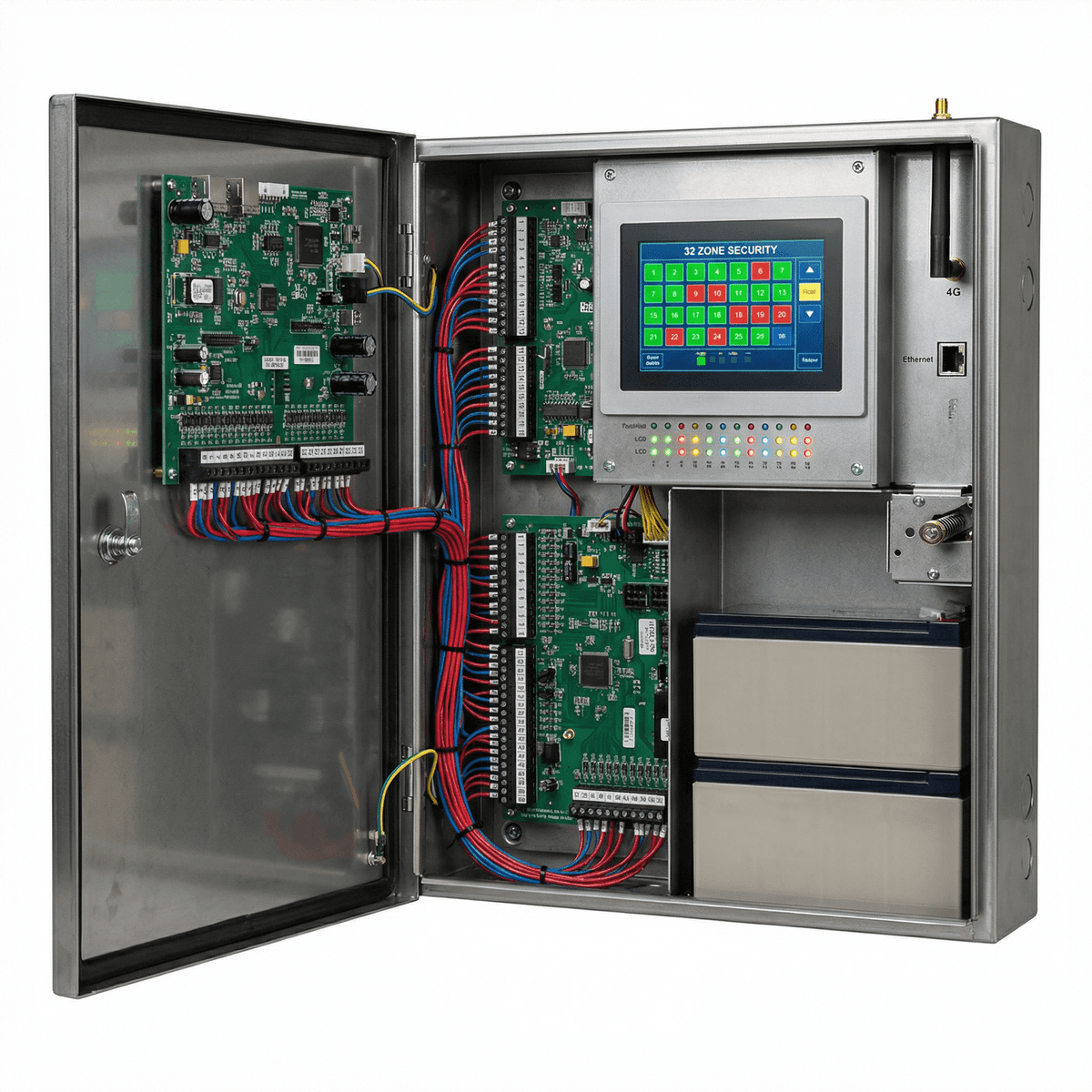
SOLAR TODO typically supports B2B buyers that need integrated packages rather than consumer-grade kits. For large perimeter projects, the closest benchmark within the broader category is the Port Terminal 96-Zone Full Security package, which uses 48 cameras, 96 detectors, 1,000 meters of electric fence planning, and 24/7 monitoring logic suitable for critical infrastructure. That type of architecture translates well to border fencing, remote compounds, and long industrial perimeters.
According to NREL (2024), solar performance modeling can estimate system output using local irradiance and load assumptions, which is essential when every camera watt and radio watt affects battery autonomy. In practice, a border security node should be designed around daily load, worst-month solar resource, charging losses, and a reserve margin rather than nameplate panel size alone.
System Architecture and Technical Design
A robust solar-powered border security system usually combines 1 control platform, 4-48 cameras, 8-96 detectors, 4G or radio backhaul, and battery autonomy sized for at least 72 hours without charging.
The technical objective is not simply to power cameras with panels. It is to create a layered, fault-tolerant perimeter system that detects, verifies, records, and communicates incidents under harsh environmental conditions. For long fences, the design should separate the project into sectors, each with its own power budget, communications path, and alarm logic.
Core hardware layers
A complete field architecture typically includes the following subsystems:
- Solar modules sized to daily load and worst-season irradiance
- MPPT charge controller for charging efficiency and battery protection
- Lithium battery bank, commonly LiFePO4, for 3-5 days of autonomy
- Low-power IP cameras, thermal cameras, or PTZ units depending on range
- Intrusion sensors such as PIR, dual-tech, beam detectors, fence vibration sensors, or buried cable systems
- Edge communications using 4G, point-to-point radio, fiber, or Ethernet
- Local recording through NVR or edge SD storage
- Cloud dashboard for alarms, health monitoring, and multi-site management
- Sirens, strobes, or relay outputs for deterrence and response integration
For example, a medium remote perimeter may use 8 fixed cameras, 2 PTZ cameras, 16 beam sectors, and 16 dual-tech detectors across 1 to 2 kilometers. A larger border checkpoint or logistics perimeter may scale toward the SOLAR TODO Port Terminal profile with 48 cameras and 96 detectors, while still using solar-powered subnodes for fence sectors where grid extension is impractical.
Power sizing basics
The most common design error is underestimating daily energy demand. A practical sizing method is:
- Add the wattage of all always-on devices
- Multiply by 24 hours for daily Wh consumption
- Add 15-25% for conversion and temperature losses
- Size battery storage for 3 days minimum autonomy
- Size PV array for the worst-month peak sun hours, not annual average
If a sector consumes 420 Wh/day, the design target may rise to roughly 500-525 Wh/day after losses. With 3 days of autonomy, usable storage should cover about 1.5 kWh, and battery oversizing is usually required to preserve depth-of-discharge limits and winter reliability.
According to IRENA (2024), solar and storage economics continue to improve across distributed applications, supporting more off-grid and hybrid infrastructure deployments. That trend benefits security projects because higher battery cycle life and lower module costs improve lifecycle economics versus trenching power across remote terrain.
Detection strategy for borders and fences
Perimeter security works best when detection is layered rather than dependent on a single technology. Typical combinations include:
- Beam sensors for straight fence corridors and gate approaches
- Dual-tech detectors for nuisance-alarm resistance in mixed weather
- Video analytics for human and vehicle classification
- Thermal imaging for low-light or no-light sectors
- Fence-mounted vibration sensors for climb or cut attempts
The National Fire Protection Association emphasizes the importance of reliable signaling pathways and integrated alarm communication in critical systems. In perimeter terms, that means a valid alarm should include location, time, device identity, and preferably video verification to reduce false dispatches.
Weatherproofing, Communications, and Storage Choices
Weatherproofing and storage strategy determine whether a perimeter system survives 5 years in the field or fails after 1 wet season, especially when devices face dust, UV, rain, condensation, and unstable bandwidth.
Weatherproofing for outdoor security nodes
Weatherproofing is more than selecting an IP-rated camera. Buyers should review the full environmental stack:
- Camera and sensor ingress protection: IP66 minimum, IP67 preferred for exposed nodes
- Enclosure material: powder-coated steel, stainless steel, or UV-stabilized polycarbonate
- Surge protection on DC, Ethernet, and antenna lines
- Corrosion resistance for coastal or saline environments
- Thermal design with ventilation, heaters, or sun shields where required
- Cable glands and connectors rated for outdoor UV and moisture exposure
- Pole and bracket wind-load verification
According to UL (2023), environmental and installation safety standards remain essential for field reliability, especially where power conversion, batteries, and communications equipment are integrated into one enclosure. In practice, a failed gland, poor grounding point, or underspecified battery cabinet often causes more downtime than the camera itself.
For desert borders, dust loading and high ambient temperatures can reduce both panel output and battery life. For tropical fences, humidity and condensation are larger risks. For marine terminals, salt-air corrosion becomes critical. SOLAR TODO generally recommends matching enclosure and connector specifications to the actual site class rather than using a universal bill of materials.
Cloud storage vs local storage
The best answer is usually hybrid: local recording for continuity and cloud backup for resilience, searchability, and central oversight.
| Storage Mode | Typical Retention | Main Advantage | Main Limitation | Best Use Case |
|---|---|---|---|---|
| Local NVR | 7-30 days | Full-resolution continuous recording | Theft or damage risk at site | Remote sectors with weak bandwidth |
| Edge SD on camera | 3-15 days | Simple failover at device level | Limited capacity and management | Small autonomous nodes |
| Cloud event storage | 7-90 days | Off-site evidence protection | Recurring bandwidth and subscription cost | Multi-site command centers |
| Hybrid local + cloud | 7-30 days local + event backup | Best balance of resilience and cost | More design complexity | Borders, ports, utilities, long fences |
Local storage is usually superior for continuous 24/7 recording because uplinking all video from a remote fence can be expensive or impossible. Cloud storage is stronger for event clips, health reporting, remote access, and evidence protection if local hardware is stolen or vandalized.
According to IEC 62676, video surveillance system design should consider image quality, recording purpose, and operational environment rather than treating all cameras equally. That means a gate PTZ, a thermal perimeter camera, and a low-traffic fence-side fixed camera may justify different frame rates, retention periods, and upload rules.
Applications, Comparison, and EPC Investment Analysis and Pricing Structure
For remote borders and fences, the most cost-effective solution usually combines solar edge nodes, 16-48 cameras, 32-96 detectors, and hybrid recording under a centralized cloud dashboard.
Typical use cases
Common B2B applications include:
- Border fencing and customs approach roads
- Port terminal and bonded warehouse perimeters
- Oil, gas, and pipeline rights-of-way
- Utility substations and transmission compounds
- Agricultural estates and livestock boundaries
- Telecom towers and remote infrastructure yards
A border checkpoint may require higher density around gates, inspection lanes, and vehicle queues, while open fence sectors prioritize long-range detection and low-power operation. A port or bonded yard may mirror the SOLAR TODO Port Terminal 96-Zone Full Security approach, using 48 cameras and 96 detectors for layered coverage across gates, quays, and storage edges.
Comparison of deployment approaches
| Option | Power Source | Typical Scale | Strength | Limitation |
|---|---|---|---|---|
| Conventional grid-powered perimeter | AC utility + backup battery | 200 m to multi-km | High continuous power availability | Trenching and cabling cost can be high |
| Solar standalone node | Solar + battery | 1 camera to 4 cameras per node | Fast deployment in remote sectors | Requires careful winter sizing |
| Solar hybrid perimeter | Solar + battery + grid/generator fallback | 500 m to multi-km | Best resilience and flexible scaling | More integration work |
| Centralized CCTV only | AC power + network | Short urban perimeters | Lower initial complexity | Weak intrusion verification on long fences |
| Layered solar intrusion + video | Solar + battery + cloud/local storage | Critical infrastructure | Better detection and evidence quality | Higher upfront engineering effort |
EPC Investment Analysis and Pricing Structure
EPC turnkey delivery for perimeter security typically includes engineering design, bill of materials, solar sizing, mounting structures, cabling, installation, commissioning, testing, and operator training.
For B2B buyers, three commercial structures are common:
- FOB Supply: equipment only, suitable for local integrators with in-house installation teams
- CIF Delivered: equipment plus freight and insurance to destination port, reducing import logistics burden
- EPC Turnkey: full engineering, procurement, construction, integration, commissioning, and handover
Indicative pricing depends on camera count, detector density, fence length, storage days, and communications complexity. As a directional guide for professional buyers:
- Small remote fence package, 4-8 cameras and 8-16 detectors: FOB supply often starts in the low five-figure USD range
- Mid-scale perimeter, 16-24 cameras and 32-48 detectors: CIF or EPC pricing typically rises into the mid five-figure range
- Large critical-infrastructure perimeter, 48 cameras and 96 detectors: pricing can align with SOLAR TODO benchmark ranges similar to the Port Terminal 96-Zone Full Security package at USD 16,500-21,300 supply scope, with EPC scope higher depending on civil works and communications
Volume pricing guidance:
- 50+ units: 5% discount
- 100+ units: 10% discount
- 250+ units: 15% discount
Standard payment terms:
- 30% T/T deposit + 70% against B/L
- 100% L/C at sight
Financing is available for large projects above USD 1,000K. For quotations, EPC scoping, and commercial support, buyers can contact cinn@solartodo.com.
ROI and operating economics
Solar-powered perimeter systems can reduce trenching, generator runtime, and emergency maintenance visits, which often improves payback even when hardware CAPEX is higher than a simple wired camera package.
Typical ROI drivers include:
- Lower civil works cost versus long-distance AC trenching
- Reduced diesel fuel and generator maintenance in off-grid sites
- Fewer theft losses and faster incident verification
- Lower nuisance alarm handling through analytics and layered detection
- Faster deployment in temporary or expanding perimeter zones
If trenching utility power costs USD 20-80 per meter depending on terrain, a 1,000-meter fence can create a major hidden cost before cameras are even installed. In those cases, solar edge nodes may reach practical payback in roughly 2-5 years, especially where diesel backup or repeated cable theft is a recurring expense.
As the International Energy Agency states, “Security of electricity supply and system flexibility are becoming increasingly important,” and that principle applies equally to security infrastructure. For border and fence projects, resilient local power is not just an energy choice; it is an operational continuity decision.
SOLAR TODO can support buyers needing standardized multi-site packages, cloud monitoring logic, and export-oriented delivery for remote perimeter applications across Latin America, the Middle East, Africa, Southeast Asia, and Europe.
FAQ
A well-designed solar-powered border security system typically uses 3 days of battery autonomy, IP66-IP67 devices, and hybrid storage to maintain 24/7 detection even when grid power and bandwidth are unreliable.
Q: What is a solar-powered security system for borders and fences? A: It is an off-grid or hybrid perimeter protection system that uses solar panels, batteries, cameras, detectors, and communications equipment to monitor remote fence lines. Typical designs support 4-48 cameras, 8-96 detectors, and 24/7 operation where trenching grid power is difficult or costly.
Q: How much battery autonomy should a border security node have? A: Most professional designs target at least 72 hours of autonomy, with 3-5 days preferred for critical sites or poor-weather regions. This margin protects operations during cloudy periods, charging faults, or temporary communications outages while preserving battery life and alarm continuity.
Q: What weatherproof rating should outdoor cameras and enclosures meet? A: For exposed perimeter use, IP66 is the practical minimum and IP67 is preferred for harsher sectors. Buyers should also check UV resistance, corrosion protection, surge protection, operating temperature range, and proper outdoor cable glands, because ingress rating alone does not guarantee long-term field reliability.
Q: Is cloud storage better than local storage for remote fence surveillance? A: Cloud storage is better for off-site evidence protection and centralized access, while local storage is better for continuous recording where bandwidth is limited. Most border projects use a hybrid model with 7-30 days of local retention plus cloud event backup for critical alarms and health logs.
Q: How many cameras and detectors are needed for a long fence line? A: The answer depends on terrain, detection range, and risk density, but many projects segment perimeters into 100-300 meter zones. A 1-kilometer fence may use 8-16 cameras and 16-32 detectors, while critical infrastructure can scale to 48 cameras and 96 detectors.
Q: Which sensor types work best for border and fence intrusion detection? A: The best approach is layered detection using beam sensors, dual-tech detectors, fence vibration sensors, and video analytics. Combining 2-4 technologies per sector improves verification and can reduce nuisance alarms significantly compared with single-technology motion detection alone.
Q: What communications options are best for remote solar security systems? A: 4G is common for fast deployment, while radio links, fiber, or Ethernet may suit permanent sites with better infrastructure. Critical sectors should have at least 2 communications paths, such as 4G plus radio, so alarms still reach the command center during a primary link failure.
Q: How often do solar-powered perimeter systems need maintenance? A: Most systems need quarterly visual inspection and at least annual preventive maintenance. The service plan should include panel cleaning, battery health review, enclosure sealing checks, grounding inspection, firmware updates, and testing of cameras, detectors, sirens, and communications links.
Q: What standards should B2B buyers ask for in procurement documents? A: Buyers should request alignment with EN 50131 for intrusion systems, IEC 62676 for video surveillance, UL 681 for installation practices, and NFPA 72 principles for alarm signaling. These standards help structure technical compliance, maintenance expectations, and integrator accountability.
Q: What does EPC turnkey delivery include for perimeter security? A: EPC turnkey delivery usually includes engineering, procurement, solar sizing, mounting design, installation, commissioning, testing, and training. It is the best fit for buyers who want one accountable supplier for performance, integration, and handover rather than managing multiple contractors.
Q: How are these projects priced and what payment terms are common? A: Pricing is usually offered as FOB Supply, CIF Delivered, or EPC Turnkey depending on scope and logistics. Common terms are 30% T/T deposit plus 70% against B/L, or 100% L/C at sight, with financing available for projects above USD 1,000K and volume discounts up to 15%.
Q: When should a buyer choose SOLAR TODO for a border or fence project? A: SOLAR TODO is a fit when the project needs export-ready B2B supply, multi-site standardization, and integrated security architecture rather than standalone retail products. It is especially relevant for remote perimeters requiring solar power, cloud monitoring, and scalable detector-camera layouts.
References
- NREL (2024): PV performance modeling methodologies and solar resource tools used to estimate off-grid and hybrid system energy yield.
- IEC 62676 (2024): Video surveillance system standards covering performance, image usability, recording, and operational design considerations.
- EN 50131 (2024): Intrusion and hold-up alarm system framework for detection architecture, grading, and system design principles.
- UL 681 (2023): Installation and classification practices for burglary and holdup alarm systems relevant to professional security deployments.
- NFPA 72 (2022): National Fire Alarm and Signaling Code principles for alarm transmission, monitoring, and signaling pathway reliability.
- IEA (2024): Renewable energy and power system outlooks supporting the maturity of solar PV for distributed infrastructure applications.
- IRENA (2024): Renewable power cost and market analysis showing continued improvements in solar and storage economics.
Conclusion
Solar-powered border and fence security systems deliver the best results when they combine 3 days of battery autonomy, IP66-IP67 field hardware, and hybrid 7-30 day storage with centralized alarm management.
For most remote perimeter projects, the bottom line is clear: a layered solar-powered architecture lowers trenching dependence, improves deployment speed, and supports 24/7 protection across 500-meter to multi-kilometer sites. Buyers comparing options should prioritize weatherproofing, hybrid storage, and EPC accountability to achieve lower lifecycle risk and faster operational payback.
About SOLARTODO
SOLARTODO is a global integrated solution provider specializing in solar power generation systems, energy-storage products, smart street-lighting and solar street-lighting, intelligent security & IoT linkage systems, power transmission towers, telecom communication towers, and smart-agriculture solutions for worldwide B2B customers.
About the Author

SOLAR TODO
Solar Energy & Infrastructure Expert Team
SOLAR TODO is a professional supplier of solar energy, energy storage, smart lighting, smart agriculture, security systems, communication towers, and power tower equipment.
Our technical team has over 15 years of experience in renewable energy and infrastructure, providing high-quality products and solutions to B2B customers worldwide.
Expertise: PV system design, energy storage optimization, smart lighting integration, smart agriculture monitoring, security system integration, communication and power tower supply.
Cite This Article
SOLAR TODO. (2026). Solar-Powered Border Security Systems Guide. SOLAR TODO. Retrieved from https://solartodo.com/knowledge/complete-guide-to-solar-powered-security-systems-for-borders-and-fences-from-weatherproofing-to-cloud-storage-vs-local
@article{solartodo_complete_guide_to_solar_powered_security_systems_for_borders_and_fences_from_weatherproofing_to_cloud_storage_vs_local,
  title = {Solar-Powered Border Security Systems Guide},
  author = {SOLAR TODO},
  journal = {SOLAR TODO Knowledge Base},
  year = {2026},
  url = {https://solartodo.com/knowledge/complete-guide-to-solar-powered-security-systems-for-borders-and-fences-from-weatherproofing-to-cloud-storage-vs-local},
  note = {Accessed: 2026-04-21}
}
Published: April 18, 2026 | Available at: https://solartodo.com/knowledge/complete-guide-to-solar-powered-security-systems-for-borders-and-fences-from-weatherproofing-to-cloud-storage-vs-local
Subscribe to Our Newsletter
Get the latest solar energy news and insights delivered to your inbox.
View All Articles