Power Transmission Towers for Substation Connections

SOLARTODO Editorial Team
Solar Energy & Infrastructure Expert Team
Watch the video
TL;DR
For substation connections, choose towers by voltage, footprint, soil conditions, and schedule risk. Typical solutions range from 18m 10kV poles to 40m 220kV monopoles, target 50-year service life, and often complete in 12-24 weeks. Monopoles can reduce land use by 40% to 75% and cut erection time by 20% to 40%, making them attractive for dense or time-critical projects.
Power transmission towers for substation connections must balance clearance, loading, and build speed; common solutions span 10kV to 220kV, use 18m to 40m structures, and target 50-year life with 20-40% faster erection for modular steel designs.
Summary
Power transmission towers for substation connections must balance electrical clearance, mechanical loading, and construction speed; typical monopole or lattice solutions serve 10kV to 220kV lines, use 18m to 40m structures, and target 50-year design life with 20-40% faster erection for modular steel options.
Key Takeaways
- Define the substation connection voltage early; 10kV distribution links often use 18m poles, while 110kV to 220kV connections commonly require 35m to 40m structures.
- Match tower type to land constraints; monopoles can reduce occupied ground area by roughly 40% to 75% versus comparable lattice structures in urban corridors.
- Select foundations from geotechnical data; pad-and-chimney, pile, or drilled shaft designs should be based on soil bearing, uplift, and groundwater conditions from at least 2-3 boreholes.
- Plan for a 50-year design life by specifying hot-dip galvanized steel with typical zinc coating thickness around 70-100 micrometers in corrosive outdoor environments.
- Sequence procurement tightly; sectional flanged or slip-joint steel poles can cut erection activities by about 20% to 40% compared with more site-intensive alternatives.
- Verify standards compliance before tender award; use IEC 60826, ASCE 10-15, IEEE loading methods, and project-specific utility rules for wind, broken-wire, and clearance cases.
- Budget by delivery model; FOB supply is lowest initial cost, CIF improves logistics certainty, and EPC turnkey can reduce interface risk on projects above $1,000K.
- Reduce commissioning delays by integrating tower design with substation gantry, conductor, grounding, and protection packages at least 8-12 weeks before civil works start.
Tower Types and Design Criteria for Substation Connections
Substation connection towers typically range from 18m distribution poles to 40m transmission monopoles, with design spans of 100m to 300m and service life targets of 50 years.
For substation tie-ins, the right structure is not simply a matter of voltage class. Engineers must coordinate electrical clearance, conductor attachment geometry, line angle, short-span behavior near the substation portal, and the available right-of-way. A connection line may only be a few hundred meters long, but it often carries the highest scrutiny because it interfaces directly with energized yard equipment, access roads, fencing, and future expansion bays.
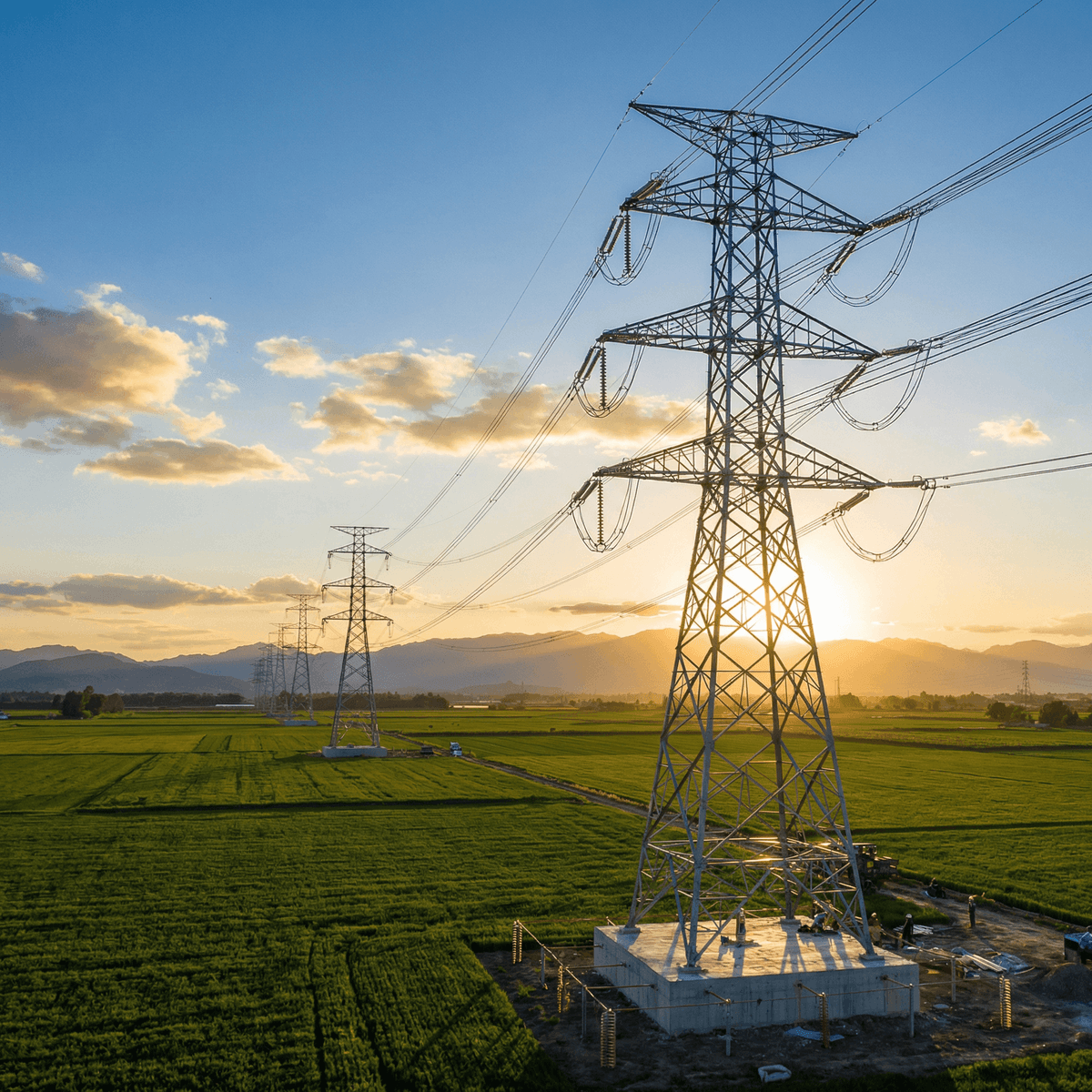
The main structural options are lattice towers, tubular monopoles, and polygonal transmission poles. Lattice towers remain common where land is available and heavy angle or dead-end loads must be handled economically. Tubular and polygonal monopoles are increasingly selected for urban substations, industrial parks, and roadside corridors because they reduce visual clutter and can shrink the footprint substantially.
According to IEC 60826 load philosophy, overhead line structures must be checked for wind, conductor tension, temperature variation, and accidental cases such as broken conductors. IEEE and ASCE methodologies are also widely used to verify structural adequacy and conductor behavior. For B2B buyers, the practical implication is clear: tower selection should be based on the full loading envelope, not only nominal voltage.
The International Energy Agency states, "Electricity networks are the backbone of secure and affordable power systems." That is especially true at the substation interface, where a poorly specified terminal structure can delay energization of an entire feeder or transmission bay. SOLAR TODO typically advises buyers to classify each structure as suspension, tension, terminal, or angle type before finalizing steel tonnage and foundation scope.
Common tower configurations near substations
Terminal and dead-end structures near substations usually see higher longitudinal loads than mid-line suspension structures. Because of this, a 110kV substation connection may use a 35m flanged monopole for straight entry sections but require heavier end structures at the final approach.
Common configurations include:
- Suspension structures for straight runs with balanced span loads
- Angle structures for route deviations and corridor alignment
- Terminal or dead-end structures for substation entry and cable transition points
- Special portal-compatible poles where yard geometry is constrained
A practical example from the SOLAR TODO power_tower range is the 35m 110kV Octagonal Transmission Pole Flanged, designed for a 250m span and 1 circuit. For higher-capacity links, the 40m 220kV Dodecagonal Transmission Pole supports 2 circuits, 2 subconductors per phase, and a 300m design span. On lower-voltage urban feeders, the 18m 10kV Tapered Monopole suits compact municipal or industrial distribution corridors.
Foundation Types and Geotechnical Selection
Foundation choice for substation connection towers is governed by soil bearing capacity, uplift, overturning, and groundwater, and it often determines 20-30% of total installed civil cost.
Foundation engineering starts with geotechnical investigation, not steel detailing. Even a well-designed tower can underperform if the foundation is mismatched to weak clay, collapsible fill, rock layers, or high water tables. For short substation connections, buyers sometimes underestimate this step because the line length is limited, but the terminal structures often carry the highest reaction forces.
Typical foundation types include isolated spread footings, pad-and-chimney foundations, drilled shafts, pile caps with driven or bored piles, and raft or mat solutions for special sites. Monopoles often use large-diameter drilled shafts or anchor-bolt cage foundations, while lattice towers may use four-leg pad foundations or chimney-type footings depending on the load case and terrain.
According to ASCE 10-15, transmission structure foundations must be designed for compression, uplift, lateral, and overturning effects under governing load combinations. In practice, engineers should obtain at least 2-3 boreholes along short connection alignments and more at terminal structures, especially where cut-and-fill or reclaimed land is present. SOLAR TODO recommends geotechnical review before final pole optimization because foundation cost can outweigh modest savings in steel weight.
Typical foundation options
| Foundation type | Best use case | Key advantage | Main limitation |
|---|---|---|---|
| Spread footing | Dense soil, lower uplift | Lower concrete complexity | Larger excavation footprint |
| Pad-and-chimney | Lattice towers, moderate soils | Proven utility design | More rebar and formwork |
| Drilled shaft | Monopoles, urban sites | Compact footprint | Needs specialized drilling equipment |
| Pile foundation | Soft soil, high groundwater | Better deep load transfer | Higher mobilization cost |
| Rock anchor foundation | Shallow rock sites | Strong uplift resistance | Requires precise drilling and grouting |
Grounding must also be integrated into the foundation package. For many utility projects, target tower footing resistance is specified below 10 ohms, though local utility requirements may be stricter depending on fault level and soil resistivity. This affects earthing conductor length, rod count, and whether chemical electrodes or counterpoise conductors are needed.
The National Renewable Energy Laboratory emphasizes that site-specific engineering inputs strongly affect infrastructure performance and cost forecasting. While NREL is better known for generation assets, the same principle applies to grid connection structures: better site data reduces contingency, redesign, and schedule slippage.
Materials, Standards, and Mechanical Performance
Power transmission towers for substation connections are usually fabricated from hot-dip galvanized steel, designed to IEC 60826 or ASCE 10-15, and specified for 50 years of outdoor service.
Steel grade, shaft geometry, joint method, and corrosion protection all influence lifecycle cost. Tubular monopoles commonly use high-strength steel such as Q460 or equivalent to improve strength-to-weight ratio, while lattice structures may use angle steel sections sized for connection efficiency and transport practicality. For coastal, industrial, or high-humidity sites, galvanization thickness and coating quality become critical procurement criteria.
According to ASTM A123/A123M, hot-dip galvanizing provides a durable zinc coating for fabricated steel products exposed to atmospheric corrosion. In many utility specifications, zinc thickness around 70-100 micrometers is common, although exact values depend on steel chemistry, member thickness, and environmental category. Buyers should request coating test reports, weld inspection records, and dimensional tolerance documentation before shipment release.
Electrical performance is inseparable from structural design. Clearance to ground, phase spacing, insulator swing, lightning shield wire geometry, and conductor temperature all affect the final tower profile. According to IEEE 738, conductor temperature and current relationship must be evaluated to ensure ampacity and sag remain within safe limits under expected loading.
The International Renewable Energy Agency states, "Grid expansion and modernization are essential to integrate new power capacity reliably and cost-effectively." For substation connections, this means the tower package must be coordinated with conductor type, insulator string length, shield wire arrangement, and substation bay layout. SOLAR TODO therefore treats the tower as part of a system package rather than a standalone steel item.
Typical specification comparison
| Parameter | 18m 10kV Tapered Monopole | 35m 110kV Octagonal Pole | 40m 220kV Dodecagonal Pole |
|---|---|---|---|
| Voltage class | 10kV | 110kV | 220kV |
| Height | 18m | 35m | 40m |
| Circuits | 2 | 1 | 2 |
| Design span | 100m | 250m | 300m |
| Joint type | Slip-joint | Flanged | Sectional polygonal |
| Typical use | Urban distribution | City/suburban transmission | Suburban high-voltage link |
| Design life | 50 years | 50 years | 50 years |
For procurement managers, the key decision is often not only capex but transport and erection efficiency. A sectional flanged monopole may cost more per ton than a simple lattice assembly, yet it can reduce urban lane closures, foundation footprint, and installation interfaces. That tradeoff is often favorable for substation expansions in dense industrial or municipal environments.
Construction Timeline, Installation Workflow, and Risk Control
A typical substation connection tower project takes 12-24 weeks from approved drawings to erection, with foundations often consuming 25-35% of the total schedule.
The construction timeline depends on voltage class, permitting, soil conditions, and whether the project is supply-only or EPC turnkey. For a short 10kV or 35kV connection, fabrication and installation may be completed in roughly 10-14 weeks if approvals are fast. For 110kV to 220kV links, especially where terminal structures and outages are involved, 16-24 weeks is more realistic.
A standard workflow includes route confirmation, topographic survey, geotechnical investigation, preliminary loading, utility approval, detailed design, steel fabrication, galvanizing, factory inspection, shipment, foundation works, curing, pole erection, stringing, grounding, testing, and energization. Delays usually occur at three points: late design freeze, civil surprises in the field, and interface conflicts with substation contractors.
Indicative construction timeline
| Phase | Typical duration | Key output |
|---|---|---|
| Survey and geotechnical work | 1-3 weeks | Alignment and soil data |
| Structural and foundation design | 2-4 weeks | IFC drawings and calculations |
| Fabrication and galvanizing | 4-8 weeks | Finished steel package |
| Shipping and customs | 1-4 weeks | Delivered materials |
| Foundation construction and curing | 2-5 weeks | Ready foundation |
| Erection and stringing | 1-3 weeks | Installed line section |
| Testing and energization | 3-7 days | Commissioned connection |
Risk control should focus on outage coordination, crane access, bolt traceability, and grounding verification. Near substations, live-line interface rules and exclusion zones can sharply limit working hours. Contractors should also verify anchor-bolt templates, flange flatness, and concrete strength before pole erection to avoid rework.
SOLAR TODO supports buyers with drawing review, packing lists, bolt schedules, and erection guidance to reduce site errors. For export projects, sectional design is especially important because it affects container utilization, customs handling, and inland transport. In many cases, better packaging and preassembly planning save more time than marginal fabrication acceleration.
EPC Investment Analysis and Pricing Structure
For substation connection towers, EPC turnkey delivery bundles engineering, procurement, civil works, erection, and commissioning, reducing interface risk and improving schedule certainty by one accountable contractor.
B2B buyers usually evaluate three commercial models: FOB Supply, CIF Delivered, and EPC Turnkey. FOB Supply covers tower steel, bolts, drawings, and factory documentation at the export port; the buyer manages freight, customs, civil works, and installation. CIF Delivered adds ocean freight and insurance to the destination port, improving logistics predictability for overseas projects.
EPC Turnkey is the most comprehensive option and generally includes route verification, detailed engineering, tower supply, foundation construction, grounding, erection, conductor hardware integration, testing support, and handover documentation. For substation tie-ins, EPC often reduces coordination failures between civil, structural, and electrical packages, especially where outage windows are short and penalties for delay are high.
Pricing logic and volume guidance
| Commercial model | What is included | Best for | Cost position |
|---|---|---|---|
| FOB Supply | Steel structure, bolts, drawings, QA docs | Experienced utilities and EPCs | Lowest initial price |
| CIF Delivered | FOB scope plus freight and insurance | Importers needing logistics control | Mid-range |
| EPC Turnkey | Supply, civil works, erection, testing support | Time-critical or interface-heavy projects | Highest upfront, lower risk |
Typical volume pricing guidance for standardized tower packages is:
- 50+ units: about 5% discount
- 100+ units: about 10% discount
- 250+ units: about 15% discount
Payment terms commonly follow 30% T/T deposit and 70% against B/L, or 100% L/C at sight for qualified transactions. Financing is available for large projects above $1,000K, subject to project profile and buyer qualification. For commercial inquiries, EPC pricing, and technical clarification, contact [email protected] or SOLAR TODO at +6585559114.
ROI and lifecycle view
Compared with conventional lattice alternatives in constrained corridors, monopole-based substation connections can reduce occupied ground area by roughly 40% to 75% and shorten erection activities by 20% to 40%, depending on voltage and site conditions. The direct ROI comes from lower land acquisition, fewer traffic management days, reduced permitting friction, and faster energization of revenue-generating loads.
For industrial users, even a 2-4 week acceleration in substation connection completion can materially improve project cash flow if the connected plant, data center, or processing line is waiting for power. Over a 50-year design life, corrosion resistance, lower maintenance access complexity, and fewer structural components can also reduce total ownership cost. SOLAR TODO generally advises buyers to compare total installed cost and schedule risk, not only ex-works steel price.
FAQ
Q: What is the best tower type for a substation connection project? A: The best tower type depends on voltage, land availability, and terminal load conditions. For compact urban sites, monopoles are often preferred because they can reduce footprint by about 40% to 75%, while lattice towers remain cost-effective for heavy-angle or rural applications with more available space.
Q: How do I choose the right foundation for a power transmission tower? A: Choose the foundation from geotechnical data, not from tower type alone. Engineers should review soil bearing capacity, uplift, groundwater, and overturning loads, then select spread footings, drilled shafts, piles, or rock anchors based on the governing conditions and utility design criteria.
Q: How long does a substation connection tower project usually take? A: Most projects take about 12-24 weeks from approved design to energization. Short 10kV links may move faster, while 110kV to 220kV connections usually require more time for approvals, fabrication, foundation curing, outage planning, and final testing.
Q: What standards should transmission towers for substations comply with? A: Common design references include IEC 60826 for overhead line loading, ASCE 10-15 for structural design, IEEE 738 for conductor thermal behavior, and ASTM A123/A123M for galvanizing. Local utility standards and national electrical clearance rules must also be applied before procurement approval.
Q: Why are monopoles increasingly used instead of lattice towers? A: Monopoles are increasingly chosen because they use less land, present a cleaner visual profile, and can simplify urban permitting. In many projects, modular flanged or slip-joint designs also reduce erection time by around 20% to 40%, which is valuable near roads, factories, and substations.
Q: What is included in EPC turnkey delivery for a tower project? A: EPC turnkey delivery usually includes engineering, tower supply, foundation works, grounding, erection, and commissioning support. It is useful for projects with tight schedules or multiple contractors because one party manages interfaces, documentation, and site coordination from design through handover.
Q: How much does a substation connection tower project cost? A: Cost varies by voltage, tower height, foundation complexity, and delivery scope. FOB Supply has the lowest upfront price, CIF adds freight and insurance, and EPC Turnkey costs more initially but can reduce delay risk, site rework, and coordination overhead on larger projects.
Q: What payment terms are common for international tower supply? A: Standard export terms are often 30% T/T in advance and 70% against B/L, or 100% L/C at sight. For large projects above $1,000K, structured financing may be available depending on buyer credit profile, project location, and contract scope.
Q: How important is galvanizing for transmission tower service life? A: Galvanizing is critical because it protects steel from long-term atmospheric corrosion. For many utility projects, hot-dip galvanized coatings in the 70-100 micrometer range support a 50-year design life, especially when combined with proper drainage, detailing, and periodic inspection.
Q: When should grounding design be finalized for tower foundations? A: Grounding design should be finalized during foundation engineering, not after civil work begins. Soil resistivity, target footing resistance, fault current, and substation earthing coordination all affect conductor sizing, rod layout, and whether counterpoise or enhancement materials are required.
References
- IEC (2017): IEC 60826, design criteria of overhead transmission lines, including loading and reliability methodology.
- ASCE (2015): ASCE 10-15, design of lattice steel transmission structures and associated loading combinations.
- IEEE (2012): IEEE 738, standard for calculating current-temperature relationship of bare overhead conductors.
- ASTM (2023): ASTM A123/A123M, specification for zinc hot-dip galvanizing on iron and steel products.
- IEA (2023): Electricity Grids and Secure Energy Transitions, network infrastructure as a prerequisite for reliable power systems.
- IRENA (2023): Planning and Prospects for Renewable Power, highlighting the need for grid expansion and modernization.
- NREL (2024): Engineering-economic modeling guidance emphasizing the value of site-specific inputs for infrastructure planning.
Conclusion
For substation connections, the optimal power transmission tower solution typically combines a 50-year galvanized steel design, foundation selection from 2-3 boreholes, and a 12-24 week execution plan aligned with utility standards and outage windows.
The bottom line is that buyers should compare tower options by total installed cost, footprint reduction, and schedule certainty rather than steel price alone; for dense or time-critical projects, SOLAR TODO monopole solutions often deliver the strongest lifecycle value.
About SOLARTODO
SOLARTODO is a global integrated solution provider specializing in solar power generation systems, energy-storage products, smart street-lighting and solar street-lighting, intelligent security & IoT linkage systems, power transmission towers, telecom communication towers, and smart-agriculture solutions for worldwide B2B customers.
Procurement paths
About the Author

SOLARTODO Editorial Team
Solar Energy & Infrastructure Expert Team
SOLAR TODO is a professional supplier of solar energy, energy storage, smart lighting, smart agriculture, security systems, communication towers, and power tower equipment.
Our technical team has over 15 years of experience in renewable energy and infrastructure, providing high-quality products and solutions to B2B customers worldwide.
Expertise: PV system design, energy storage optimization, smart lighting integration, smart agriculture monitoring, security system integration, communication and power tower supply.
Cite This Article
SOLARTODO Editorial Team. (2026). Power Transmission Towers for Substation Connections. SOLARTODO. Retrieved from https://solartodo.com/knowledge/complete-guide-to-power-transmission-towers-for-substation-connections-from-foundation-types-to-construction-timeline
@article{solartodo_complete_guide_to_power_transmission_towers_for_substation_connections_from_foundation_types_to_construction_timeline,
  title = {Power Transmission Towers for Substation Connections},
  author = {SOLARTODO Editorial Team},
  journal = {SOLARTODO Knowledge Base},
  year = {2026},
  url = {https://solartodo.com/knowledge/complete-guide-to-power-transmission-towers-for-substation-connections-from-foundation-types-to-construction-timeline},
  note = {Accessed: 2026-10-15}
}
Published: April 21, 2026 | Available at: https://solartodo.com/knowledge/complete-guide-to-power-transmission-towers-for-substation-connections-from-foundation-types-to-construction-timeline
Subscribe to Our Newsletter
Get the latest solar energy news and insights delivered to your inbox.
View All Articles