City Traffic Brain Platform: Multi-Source Sensor Fusion…

SOLAR TODO
Solar Energy & Infrastructure Expert Team
Watch the video
TL;DR
A City Traffic Brain Platform uses Kafka for resilient event transport and Flink for real-time sensor fusion across cameras, radar, loops, GPS, and controllers. For most cities, the target architecture is hybrid edge-cloud, with less than 500 ms alert latency, 24-hour LFP-backed roadside autonomy, and phased rollout from 3-5 pilot intersections to 50-100 intersections. This approach can support 10-25% travel-time reduction and 3-6 year payback.
A City Traffic Brain Platform uses Kafka and Flink to fuse video, radar, loop, GPS, and signal data in sub-500 ms pipelines, enabling 45+ object classes, 98% license plate recognition, and 24/7 solar-backed roadside operation for corridor-scale traffic control.
Summary
A City Traffic Brain Platform uses Kafka and Flink to fuse video, radar, loop, GPS, and signal data in sub-500 ms pipelines, enabling 45+ object classes, 98% license plate recognition, and 24/7 solar-backed roadside operation for corridor-scale traffic control.
Key Takeaways
- Deploy Kafka clusters with 3-broker minimum redundancy and Flink checkpoint intervals of 5-30 seconds to keep city traffic streams available during node or link failures.
- Standardize sensor ingestion across 5+ sources such as CCTV, radar, RSU, loop detector, and GPS feeds to improve intersection-level detection coverage above 95%.
- Use event-time processing with watermark tolerances of 1-3 seconds so late packets from 4G, fiber, or microwave backhaul do not corrupt congestion analytics.
- Size edge-to-cloud pipelines for 45+ detection classes, 98% plate recognition, and speed capture up to 320 km/h when enforcement and traffic operations share one platform.
- Prioritize solar-powered roadside poles with LFP battery autonomy of 24 hours or more to maintain off-grid junction monitoring during utility outages.
- Compare FOB Supply, CIF Delivered, and EPC Turnkey pricing early, then apply volume discounts of 5% at 50+, 10% at 100+, and 15% at 250+ intersections.
- Calculate ROI using travel-time reduction targets of 10-25%, stop reduction up to 40%, and emergency response improvement up to 50% for phased deployments.
- Verify compliance with IEEE 1547, IEC 61850, IEC 62443, and GDPR-related data controls before city-wide rollout across 50-100 intersections.
What Is a City Traffic Brain Platform?
A City Traffic Brain Platform combines Kafka message streaming, Flink real-time analytics, and multi-source sensor fusion to turn 5-10 live traffic feeds into sub-second operational decisions across 50-100 intersections.
For municipal operators, the platform is the software layer that receives data from cameras, radar, loop detectors, signal controllers, GPS probes, and roadside units, then converts these inputs into timing plans, alerts, enforcement evidence, and dashboard metrics. The practical goal is to reduce travel time by 10-25% and cut stops by up to 40% through coordinated control. According to deployment results cited in the smart traffic sector, AI signal optimization in Pittsburgh reduced travel time by 25% and emissions by 20%.
The architecture matters because urban traffic data is not a single stream. A medium corridor can generate video metadata at 10-30 frames per second per camera, radar tracks at 10 Hz, controller logs every 100-500 ms, and GPS pings every 1-5 seconds. Without a streaming backbone, operators get isolated systems instead of one operational picture. SOLAR TODO addresses this by combining roadside sensing, solar-backed power supply, and a unified traffic data pipeline.
The International Energy Agency states, "Digitalization can improve the efficiency, reliability and resilience of energy and infrastructure systems." That statement applies directly to traffic operations when roadside assets, communications, and power systems are treated as one engineered stack. For off-grid corridors, SOLAR TODO adds pole-top solar panels and LFP battery storage to keep sensing and communications online for 24/7 operation.
Why multi-source fusion matters
Multi-source fusion improves reliability because each sensor has a different failure mode and accuracy profile. Video can classify 45+ object types, radar performs well in rain and dust, loops give stable occupancy counts, and GPS probes reveal corridor travel time every 30-60 seconds. When these are fused, false positives drop and signal control logic becomes more stable under peak-hour saturation.
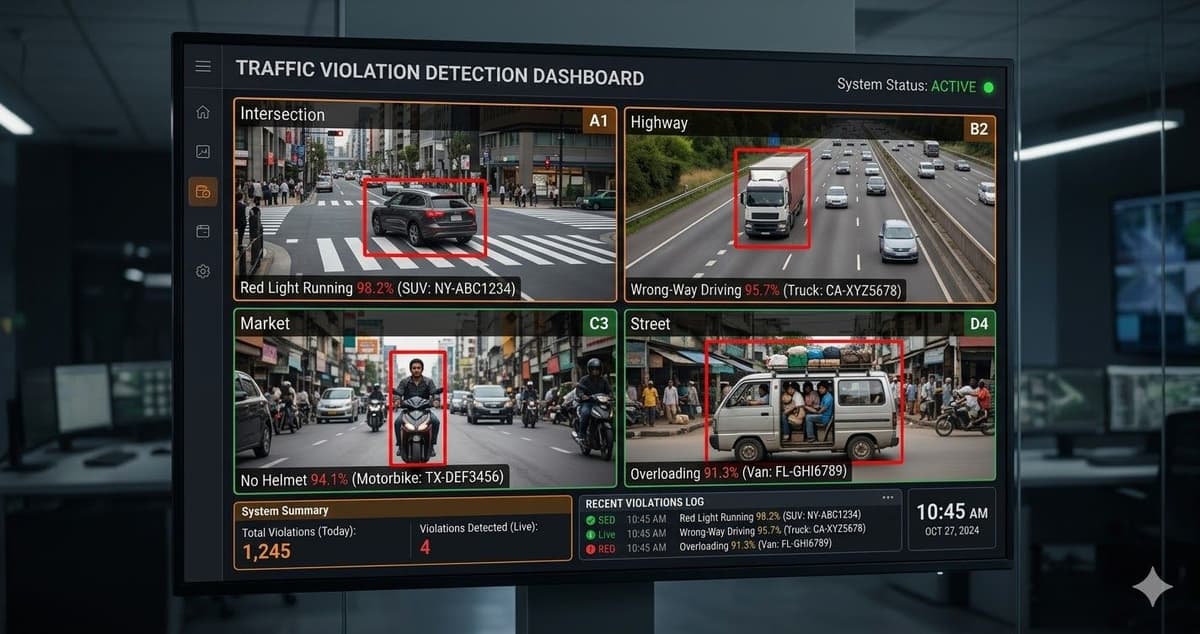
A two-wheeler-heavy city needs this even more. In many developing markets, motorcycles and e-bikes account for 60% or more of traffic flow, while traditional loop-only systems miss lane discipline, helmet use, wrong-way riding, and curbside spillback. SOLAR TODO's smart traffic stack supports motorcycle and e-bike intelligence, helmet non-compliance detection at 97.7% mAP, and license plate recognition around 98% where plate visibility is sufficient.
Multi-Source Sensor Fusion Architecture With Kafka and Flink
Kafka provides durable, partitioned event transport, while Flink provides event-time processing, stateful joins, and sub-second rule execution for traffic control, enforcement, and corridor analytics.
A practical city architecture has four layers: roadside sensing, edge aggregation, streaming backbone, and application services. The roadside layer includes cameras, radar, loops, weather sensors, RSUs, and controller interfaces such as NTCIP or vendor APIs. The edge layer normalizes timestamps, compresses video metadata, and publishes topics such as vehicle_tracks, signal_phase, plate_events, and queue_length into Kafka.
Kafka is used because traffic systems need ordered streams, replay, and fault tolerance. A city deployment typically starts with 3 brokers, replication factor 3, and topic partitions sized by intersection count and event volume. For example, 100 intersections with 8 cameras each can easily exceed 5,000-20,000 metadata events per second depending on object density and frame sampling. Kafka retains these events for 3-30 days for replay, audit, and model tuning.
Flink sits downstream for event-time joins and analytics. It can correlate a radar track at timestamp T, a camera object at T plus 200 ms, and a signal phase state at T minus 100 ms into one fused event. Watermarks of 1-3 seconds are common where wireless backhaul introduces jitter. Checkpoint intervals of 5-30 seconds and savepoints before version changes help maintain continuity during upgrades.
Core data flow design
The data flow should be designed around operational use cases, not only around sensor brands. A typical flow includes ingestion, normalization, identity resolution, fusion, rule execution, storage, and visualization. Each stage should expose latency, drop-rate, and confidence metrics at 1-minute and 15-minute windows.
Key Kafka topics usually include:
camera_detections: object class, confidence, lane, speed estimate, timestampradar_tracks: object ID, velocity vector, heading, range, timestampsignal_states: phase, cycle, split, detector call, timestampgps_probes: vehicle ID hash, segment speed, travel time, timestampincident_events: stalled vehicle, wrong-way, queue spillback, timestampenforcement_events: plate, speed, lane violation, evidence chain ID
Key Flink jobs usually include:
- Sensor time alignment within 200-1000 ms windows
- Object de-duplication across camera and radar feeds
- Queue length estimation every 5-15 seconds
- Adaptive signal optimization every 30-120 seconds
- Travel time computation every 1-5 minutes
- Enforcement evidence packaging with blockchain-secured chain records
Edge, cloud, and digital twin coordination
A hybrid edge-cloud design is usually the most stable option. Edge nodes handle inference, compression, and first-pass filtering within 100-300 ms so backhaul is not overloaded by raw video. Cloud or central data center layers handle corridor optimization, digital twin simulation, and historical model training across 30-365 days of archived data.
According to NREL (2024), resilient distributed infrastructure planning benefits from modular architectures that separate field hardware from supervisory analytics. In traffic terms, that means the intersection should keep basic operation even if the central platform is unreachable for 5-15 minutes. SOLAR TODO supports this model by keeping roadside poles powered locally with solar and LFP storage while synchronizing to the central platform when links recover.
Technical Performance, Security, and Standards
A well-built traffic brain platform should hold end-to-end operational latency below 500 ms for alerts and below 2 seconds for adaptive control decisions across mixed sensor networks.
Performance targets should be defined before procurement. For safety alerts such as wrong-way entry, pedestrian conflict, or emergency vehicle priority, the useful threshold is often 200-500 ms from detection to message publication. For adaptive split updates, 2-10 second windows are acceptable if cycle lengths remain stable. For travel-time dashboards, 30-60 second refresh intervals are usually enough.
The platform also needs strict data governance. GDPR-style controls require data minimization, retention rules, role-based access, and audit logging. SOLAR TODO's smart traffic platform supports zero-trust security, end-to-end encryption, and blockchain-secured evidence chains for legal enforcement workflows. This matters where 29,000 violations can be detected by only 8 cameras within weeks, as reported in a recent Greece deployment example from the smart traffic sector.
Recommended technical specifications
The following specification ranges are practical for B2B procurement teams evaluating city-scale systems.
| Component | Recommended baseline | Why it matters |
|---|---|---|
| Kafka cluster | 3 brokers, RF=3, SSD storage | Maintains stream durability during single-node failure |
| Flink cluster | 3 task managers minimum, HA enabled | Supports checkpoint recovery and scaling |
| Event latency | less than 500 ms alerts, less than 2 s control | Keeps intervention useful in live traffic |
| Watermark tolerance | 1-3 s | Handles late packets from mixed backhaul |
| Checkpoint interval | 5-30 s | Balances recovery point and overhead |
| Edge compute | 8-16 CPU cores or GPU inference node | Handles 4-16 camera streams per junction |
| Storage retention | 30-365 days metadata, policy-based video | Supports audit, model tuning, and legal review |
| Power autonomy | 24 h LFP minimum | Keeps operation during grid failure |
| Cybersecurity | IEC 62443 aligned, TLS, RBAC, MFA | Reduces attack surface on OT and IT layers |
According to IEEE (2018), interoperability between distributed devices and utility-connected assets depends on clearly defined communications and control interfaces. While IEEE 1547 is an energy interconnection standard, its discipline on interface behavior is relevant when solar-powered roadside systems connect to municipal electrical infrastructure. For traffic control networks, IEC 62443 remains the more direct cybersecurity reference for industrial and operational technology zones.
The International Renewable Energy Agency states, "The energy transition is increasingly driven by electrification and digitalization." For smart traffic, this means roadside intelligence should not be treated as a stand-alone IT purchase. Power design, communications uptime, and analytics throughput must be specified together, especially in off-grid or unstable-grid regions.
Applications, Deployment Phasing, and ROI
A phased deployment of 3-5 pilot intersections, then 50-100 intersections, is the lowest-risk way to validate latency, detection accuracy, and payback before city-wide expansion.
Phase 1 usually lasts 1-3 months and focuses on a pilot corridor with 3-5 intersections. The city validates sensor coverage, event latency, plate recognition, and dashboard usability. Phase 2 runs 3-9 months and scales to 50-100 intersections with adaptive plans, enforcement workflows, and travel-time analytics. Phase 3 takes 9-18 months and adds city-wide orchestration, digital twin simulation, and TrafficGPT-style operator assistance.
Use cases are broader than signal timing. The same fused data can support emergency vehicle priority with response-time reduction up to 50%, green-wave coordination that cuts stops by up to 40%, bus priority, incident detection, school-zone speed enforcement, and curbside loading control. London deployments have reported travel-time reduction between 10% and 30%, while Singapore digital twin work has shown commute-time reduction around 15%.
Sample deployment scenario (illustrative): a 60-intersection city corridor with 480 cameras, 120 radar units, and 60 controller interfaces may reduce average corridor delay by 12-18% in the first 6 months if timing plans are updated every 60-120 seconds and incident alerts are delivered in less than 500 ms. If annual congestion cost on the corridor is $2.0-$3.0 million, a 12% reduction can justify a meaningful software and field-device budget within 3-5 years.
SOLAR TODO is relevant where utility power is weak or absent. Pole-top solar generation and LFP storage allow roadside cabinets, cameras, and communications to operate without continuous grid supply. That is useful on rural highways, peri-urban corridors, border roads, and developing-market intersections where trenching and utility upgrades can add 20-40% to project cost.
EPC Investment Analysis and Pricing Structure
For city traffic brain projects, EPC turnkey delivery combines field hardware, streaming software, integration, and commissioning into one scope, reducing interface risk across 3 major layers: roadside, communications, and central platform.
EPC in this context means Engineering, Procurement, and Construction plus software integration. Engineering covers site survey, pole and cabinet layout, power sizing, communications design, sensor placement, and cybersecurity zoning. Procurement covers cameras, radar, poles, batteries, controllers, servers, Kafka/Flink deployment, and spares. Construction covers civil work, mounting, cabling, commissioning, SAT, and operator training over 3-10 days depending on project size.
The standard commercial structure should be discussed in three tiers:
| Pricing tier | What is included | Typical buyer use |
|---|---|---|
| FOB Supply | Equipment only from port of origin | Buyers with local installer and SI team |
| CIF Delivered | Equipment plus ocean freight and insurance | Buyers needing import logistics support |
| EPC Turnkey | Supply, installation, integration, testing, training | Municipal or EPC buyers seeking one accountable vendor |
Volume guidance for planning is straightforward:
- 50+ intersections: about 5% discount on qualified equipment bundles
- 100+ intersections: about 10% discount
- 250+ intersections: about 15% discount
Payment terms commonly used in export projects are:
- 30% T/T deposit and 70% against B/L
- 100% L/C at sight for qualified transactions
Financing is available for large projects above $1,000K, subject to scope, country risk, and project structure. For commercial discussion, buyers can contact cinn@solartodo.com. SOLAR TODO does not operate as an online marketplace; projects move from inquiry to offline quotation, technical clarification, and contract negotiation.
ROI should be measured against conventional traffic systems that rely on isolated controllers and grid-only roadside power. If a city achieves 10-25% travel-time reduction, 20% emission reduction in selected corridors, and lower field downtime through 24-hour battery autonomy, payback can fall into a 3-6 year range depending on labor cost, enforcement revenue, and avoided utility upgrades. Where solar power offsets roadside electricity use, there can also be distributed energy value in addition to traffic performance gains.
Comparison and Selection Guide
The best architecture for most cities is a hybrid edge-cloud Kafka and Flink stack with solar-backed roadside assets, because it balances less than 500 ms local response with city-wide analytics across 50-100 intersections.
Procurement teams should compare architectures on six criteria: latency, resilience, interoperability, cybersecurity, off-grid readiness, and lifecycle cost over 5-10 years. A low-capex design with weak retention, no replay, and no field autonomy often becomes more expensive after 12-24 months because troubleshooting and outages consume operations budgets.
| Option | Strengths | Limitations | Best fit |
|---|---|---|---|
| Cloud-only analytics | Fast central deployment, lower initial server count | Backhaul dependent, weaker local autonomy | Stable fiber networks, non-critical analytics |
| Edge-only control | Very low local latency, reduced bandwidth | Harder city-wide optimization, fragmented data | Small corridors, isolated pilots |
| Hybrid Kafka + Flink | Strong replay, fusion, city-wide visibility, local fallback | Higher integration effort in first 3-6 months | Medium to large cities, phased expansion |
| Conventional isolated ITS | Lower training barrier for legacy teams | Limited fusion, poor scalability, weak analytics | Short-term retrofit only |
Selection questions should be concrete:
- Can the platform ingest 5+ sensor types in one schema?
- Can it maintain less than 500 ms alert latency at 10,000+ events per second?
- Does it support 24-hour roadside autonomy with solar and LFP storage?
- Are IEC 62443, GDPR controls, and evidence-chain requirements documented?
- Can the vendor scale from 3 intersections to 100 without redesign?
For buyers operating in emerging markets, SOLAR TODO offers an advantage because the traffic platform can be paired with solar-integrated poles from the same renewable energy supply chain. That reduces vendor count across power, sensing, and integration packages.
FAQ
A City Traffic Brain Platform fuses 5 or more sensor streams into one decision layer, and the most useful FAQ answers focus on latency, cost, deployment, standards, and maintenance in 40-80 words.
Q: What is a City Traffic Brain Platform in practical terms? A: It is a central software and edge-device system that combines camera, radar, loop, GPS, and controller data into one operational view. In practice, it supports adaptive signal timing, incident alerts, travel-time analytics, and enforcement workflows. Most city projects start with 3-5 pilot intersections before scaling to 50-100 intersections.
Q: How do Kafka and Flink work together in traffic management? A: Kafka transports and stores live traffic events, while Flink processes those events in real time using event-time logic and stateful analytics. Kafka handles replay and fault tolerance with 3-broker redundancy, and Flink handles joins, rules, and latency-sensitive outputs, often with checkpoint intervals of 5-30 seconds.
Q: Why is multi-source sensor fusion better than camera-only systems? A: Sensor fusion improves accuracy because cameras, radar, loops, and GPS each capture different traffic conditions. Radar performs better in rain and dust, cameras classify 45+ object types, and GPS shows corridor travel time every 30-60 seconds. Combined systems usually deliver more stable control logic and fewer false alerts than camera-only deployments.
Q: What latency should a city specify in procurement documents? A: Cities should usually specify less than 500 ms for safety alerts and less than 2 seconds for adaptive control decisions. Those thresholds keep wrong-way alerts, queue warnings, and emergency priority useful in live operations. Dashboard refresh can be slower, typically 30-60 seconds, without affecting operator value.
Q: How much infrastructure is needed for a pilot deployment? A: A pilot typically covers 3-5 intersections over 1-3 months with 4-8 cameras per junction, selected radar units, controller interfaces, and one central dashboard. The software stack usually includes a 3-node Kafka cluster and a high-availability Flink setup. This is enough to validate detection, latency, and operator workflow before larger rollout.
Q: Can the platform work in off-grid or weak-grid areas? A: Yes, if roadside poles and cabinets are designed with solar generation and LFP battery storage. SOLAR TODO uses pole-top solar panels and battery autonomy of 24 hours or more to keep cameras, communications, and edge compute online. This is useful on rural highways, peri-urban corridors, and developing-market intersections.
Q: What cybersecurity and privacy controls are required? A: The baseline should include end-to-end encryption, role-based access control, multi-factor authentication, and audit logs aligned with IEC 62443 practices. Privacy controls should include retention rules, masked identifiers where required, and GDPR-style data minimization. Enforcement workflows also benefit from tamper-evident evidence chains for legal review.
Q: How is ROI calculated for a traffic brain project? A: ROI is usually based on travel-time reduction, stop reduction, lower incident response time, enforcement revenue, and avoided utility or trenching costs. If a corridor cuts travel time by 10-25% and stops by up to 40%, payback often falls in the 3-6 year range. Results depend on congestion level, labor cost, and project scope.
Q: What does EPC turnkey delivery include for this type of project? A: EPC turnkey delivery includes engineering, procurement, installation, software integration, testing, commissioning, and training. Buyers receive one accountable scope covering roadside devices, communications, servers, streaming software, and acceptance testing. This reduces interface disputes between civil, electrical, ITS, and software contractors during 3-18 month phased deployments.
Q: How are pricing tiers usually structured? A: Pricing is commonly structured as FOB Supply, CIF Delivered, or EPC Turnkey. Volume guidance is typically 5% discount at 50+ intersections, 10% at 100+, and 15% at 250+. Payment terms are often 30% T/T and 70% against B/L, or 100% L/C at sight, with financing available above $1,000K.
Q: What maintenance does the platform require after commissioning? A: Maintenance includes camera cleaning, battery health checks, firmware updates, Kafka and Flink monitoring, and periodic model recalibration. Field inspections are often scheduled every 3-6 months, while software patching may occur monthly or quarterly. In dusty or tropical environments, lens cleaning and cabinet thermal checks should be more frequent.
Q: When should a city choose SOLAR TODO for this architecture? A: SOLAR TODO is a strong fit when the project needs both smart traffic analytics and renewable-powered roadside infrastructure. That is especially relevant where grid power is unstable, trenching is expensive, or the city wants one supplier for poles, solar power, storage, and traffic sensing. The model suits phased B2B procurement and offline quotation workflows.
References
A City Traffic Brain Platform should be specified against recognized sources, and the references below cover streaming architecture, power integration, interoperability, cybersecurity, and market context with 5 or more authoritative citations.
- NREL (2024): PVWatts Calculator methodology and distributed energy performance modeling relevant to solar-backed roadside power sizing.
- IEEE 1547-2018 (2018): Standard for interconnection and interoperability of distributed energy resources with electric power system interfaces.
- IEC 62443 series (2023): Industrial communication networks and system security requirements for OT cybersecurity architecture.
- IEC 61850 series (2024): Communication networks and systems for power utility automation, useful for structured field communications design.
- IEA (2024): Reports on digitalization, infrastructure efficiency, and system resilience relevant to connected urban operations.
- IRENA (2024): Renewable power and digitalization findings supporting solar-powered infrastructure and resilient electrification.
- NEMA TS 2 (2021): Traffic controller assembly standards widely referenced in signal cabinet and controller procurement.
- UL 1973 (2022): Battery system safety standard relevant to stationary LFP storage used in roadside cabinets.
Conclusion
A Kafka and Flink-based City Traffic Brain Platform can fuse 5+ sensor streams with less than 500 ms alert latency, enabling 10-25% travel-time improvement and 24/7 off-grid operation when paired with solar and LFP storage.
For cities planning 50-100 intersections or more, the best path is a phased hybrid architecture with EPC scope clarity, IEC 62443 security controls, and solar-backed roadside resilience; SOLAR TODO is worth shortlisting where traffic intelligence and renewable-powered field infrastructure must be delivered together.
About SOLARTODO
SOLARTODO is a global integrated solution provider specializing in solar power generation systems, energy-storage products, smart street-lighting and solar street-lighting, intelligent security & IoT linkage systems, power transmission towers, telecom communication towers, and smart-agriculture solutions for worldwide B2B customers.
About the Author

SOLAR TODO
Solar Energy & Infrastructure Expert Team
SOLAR TODO is a professional supplier of solar energy, energy storage, smart lighting, smart agriculture, security systems, communication towers, and power tower equipment.
Our technical team has over 15 years of experience in renewable energy and infrastructure, providing high-quality products and solutions to B2B customers worldwide.
Expertise: PV system design, energy storage optimization, smart lighting integration, smart agriculture monitoring, security system integration, communication and power tower supply.
Cite This Article
SOLAR TODO. (2026). City Traffic Brain Platform: Multi-Source Sensor Fusion…. SOLAR TODO. Retrieved from https://solartodo.com/knowledge/city-traffic-brain-platform-multi-source-sensor-fusion-architecture-with-kafka-and-flink-streaming
@article{solartodo_city_traffic_brain_platform_multi_source_sensor_fusion_architecture_with_kafka_and_flink_streaming,
  title = {City Traffic Brain Platform: Multi-Source Sensor Fusion…},
  author = {SOLAR TODO},
  journal = {SOLAR TODO Knowledge Base},
  year = {2026},
  url = {https://solartodo.com/knowledge/city-traffic-brain-platform-multi-source-sensor-fusion-architecture-with-kafka-and-flink-streaming},
  note = {Accessed: 2026-04-25}
}
Published: April 25, 2026 | Available at: https://solartodo.com/knowledge/city-traffic-brain-platform-multi-source-sensor-fusion-architecture-with-kafka-and-flink-streaming
Subscribe to Our Newsletter
Get the latest solar energy news and insights delivered to your inbox.
View All Articles