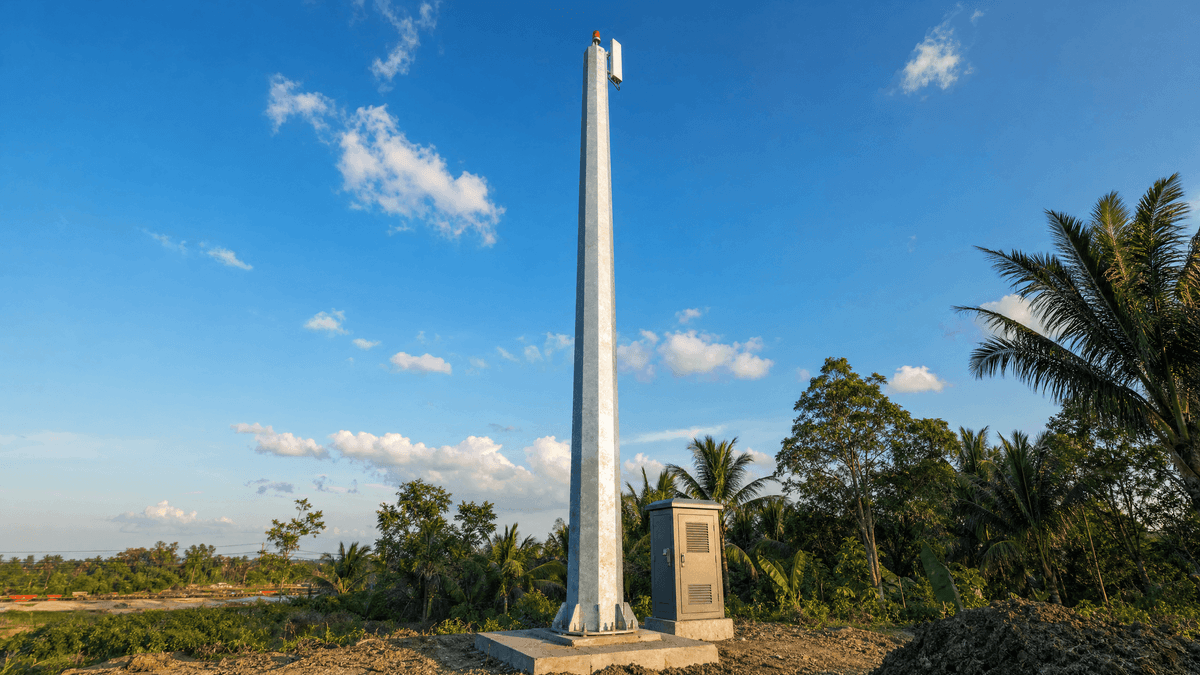
Chittagong Telecom Tower Market Analysis: 10m Community 5G Infill Configuration Guide
Summary
Chittagong’s dense urban wards, port logistics demand, and cyclone exposure make 10m small-cell Telecom Tower poles a practical infill option. A typical program would use approximately 137 galvanized Q345 steel monopoles, Wind Class 2 at 50 m/s, with CKD shipping cutting logistics volume by 60-70%.
Key Takeaways
- Chittagong City Corporation serves a dense coastal urban area, and a typical community infill plan would use approximately 137 units of 10m Telecom Tower poles for ward-level 5G/WiFi coverage densification.
- The specified pole class is small cell/community infill: 10m tapered steel monopole, about 2t per tower, using hot-dip galvanized Q345 steel and a 25-year design life.
- Wind Class 2 at 50 m/s with a 1.15 factor is suitable for many urban Chittagong sites, but micro-siting should still check cyclone exposure, topography, and local shielding conditions.
- Each pole would typically support 1× small cell and 1× RRU, plus 2 antenna mounting brackets, climbing pegs, cable tray, and a grounding system.
- Concrete pad foundations are the recommended baseline for this 10m class in low-corrosion urban soils, subject to geotechnical confirmation and utility clearance.
- CKD shipping can reduce transport volume by 60-70%, which matters for port handling, city access, and staged delivery into dense neighborhoods near 22.34, 91.83.
- A typical production window is 15-25 days for this specification, followed by civil works, erection, grounding, and commissioning in phased urban batches.
- The governing standards for this configuration are GB/T 51316 for small-cell poles and TIA-222-H for structural loading, with local permitting and utility coordination required before installation.
Market Context for Chittagong
Chittagong is Bangladesh’s main port city and a logical priority zone for dense 4G/5G infill because high population concentration, logistics activity, and mixed mid-rise neighborhoods create short-range capacity demand rather than only macro coverage demand. According to the Bangladesh Bureau of Statistics (2022), Chattogram District has a population above 9 million, while dense urban service demand is concentrated in the metropolitan area. According to the Bangladesh Telecommunication Regulatory Commission (BTRC) (2024), Bangladesh has more than 190 million mobile subscriptions, indicating a mature mobile market where incremental capacity and quality improvements matter.
The city context also favors compact pole infrastructure over large macro towers in many wards. According to the Chattogram City Corporation, the city area is approximately 168 km², with mixed commercial, residential, transport, and institutional land use. In this profile, a 10m Telecom Tower pole fits community 5G infill, WiFi offload, camera backhaul, and targeted coverage improvement on streets where 25-45m macro structures would face larger visual, permitting, and setback constraints.
Climate is a major design variable in Chittagong. According to the World Bank Climate Change Knowledge Portal (2021), Bangladesh’s coastal cities face high exposure to cyclones, heavy rainfall, and humidity. According to ITU (2020), resilient digital infrastructure in climate-exposed regions should account for wind loading, grounding, corrosion environment, and maintainability. For that reason, a galvanized steel monopole with a 50 m/s wind rating and low-corrosion-zone assumption should still be checked against local marine influence, especially in sites closer to port and shoreline conditions.
The telecom market signal is also clear: Bangladesh is shifting from coverage-led growth to capacity-led network investment. According to GSMA (2023), mobile broadband traffic growth in South Asia continues to rise as smartphone adoption and video usage increase. In Chittagong, that means dead zones, street-level congestion, and weak indoor edge performance can often be addressed more efficiently with 10m small-cell poles than with full-height macro tower additions.
As the ITU states, "Infrastructure sharing and densification are both important tools for extending broadband quality in urban environments" (ITU, 2020). That statement aligns with Chittagong’s mixed-density urban form, where targeted pole deployment can improve user experience without requiring a high number of large greenfield sites. The World Bank also notes that "Digital infrastructure is a foundational enabler of economic activity and service delivery" (World Bank, 2023), which is relevant for a port city where logistics, commerce, and public services depend on reliable connectivity.
Recommended Technical Configuration
A practical Chittagong infill configuration is approximately 137 units of 10m small-cell Telecom Tower poles with 1× small cell and 1× RRU per site, using Q345 galvanized steel and concrete pad foundations.
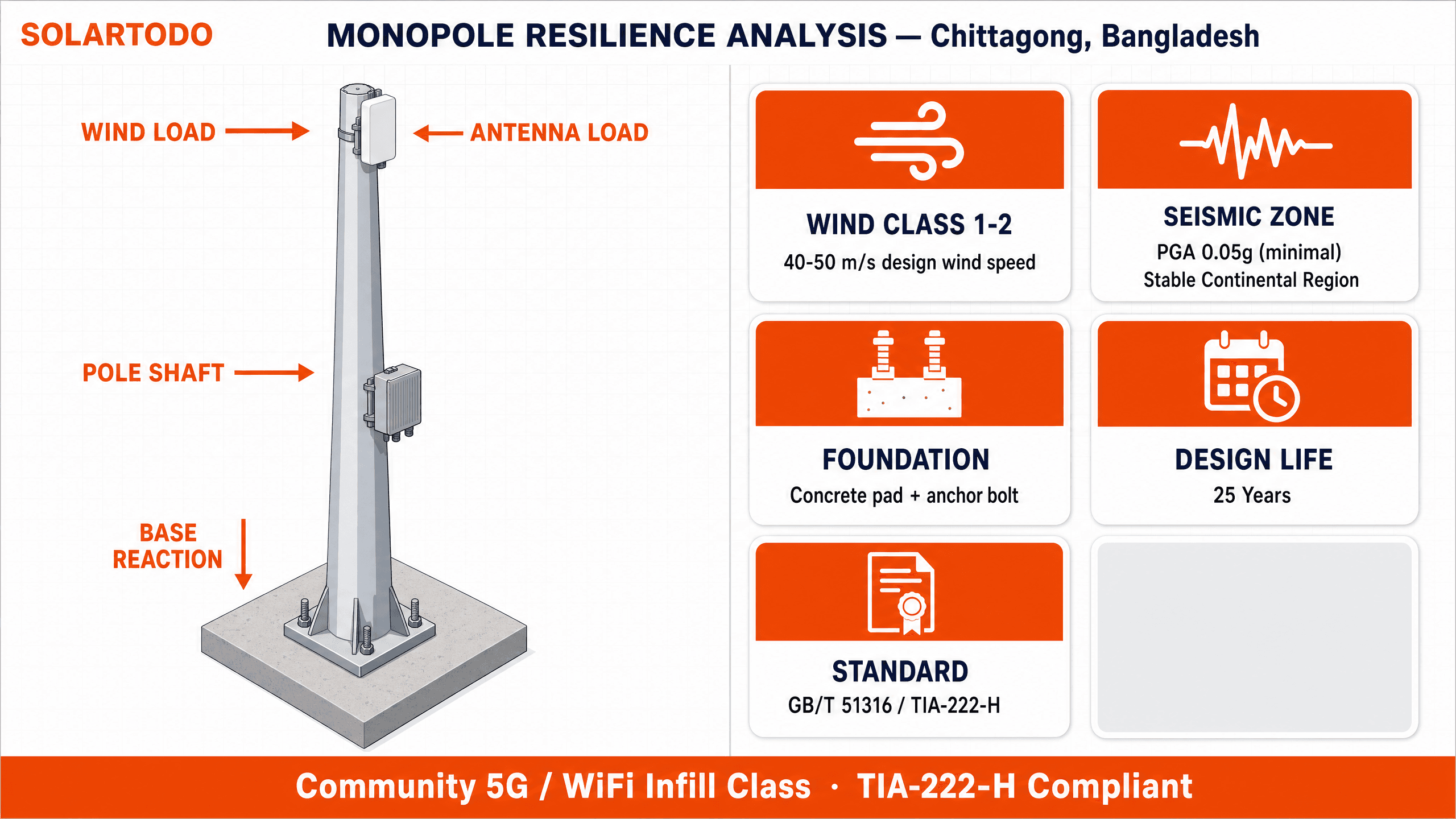
This product line should be treated as a small-cell/community 5G infill pole class rather than a conventional 25-45m macro telecom monopole. The project-specific specification provided for Chittagong is exact: 137 units × 10m tapered steel monopole tower, hot-dip galvanized Q345 steel, about 2t per tower, Wind Class 2 at 50 m/s with 1.15 factor, low-corrosion zone, and concrete pad foundation. That combination fits community streets, public-space edges, campus-style blocks, and neighborhood capacity upgrades.
The standard telecom size-class table for macro monopoles starts at 15-25m for rooftop and urban infill applications, but this Chittagong requirement is a smaller special class under GB/T 51316 for small-cell poles. In practical terms, that means the structure is optimized for lighter radio equipment and shorter coverage footprints. It is not intended to replace a 30m or 40m macro site carrying 6-9 panel antennas and microwave dishes. It is intended to fill capacity gaps at street level.
A typical 137-unit deployment of this scale would consist of distributed poles near commercial corridors, residential blocks, transit nodes, and municipal service areas. At 10m height, the network objective would usually be improved signal quality, lower user congestion, and better line-of-sight for compact radios in built-up areas. This is especially useful where rooftop access is inconsistent or where landlords, aesthetics, and zoning make larger towers difficult.
For Chittagong, the recommended site package per pole would include:
- 1× small cell radio
- 1× remote radio unit (RRU)
- 2× antenna mounting brackets
- climbing pegs
- cable tray
- grounding system
- concrete pad foundation
SOLAR TODO would typically position this configuration as a dense urban or community infill solution, not a rural wide-area tower. SOLAR TODO should also advise buyers to separate these 10m poles from macro-layer planning because the structural loading, RF radius, and civil footprint are different. For municipal and operator procurement teams, that distinction avoids specification errors during tendering.
Technical Specifications
The specified Chittagong configuration is a 10m tapered steel Telecom Tower pole rated for 50 m/s wind, approximately 2t self-weight, and designed for 1 small cell plus 1 RRU under GB/T 51316 and TIA-222-H.
- Product type: Telecom Tower, tapered steel monopole pole for small cell/community 5G infill
- Quantity basis for planning: approximately 137 units
- Height: 10m
- Pole form: tapered steel monopole; not lattice, not FRP, not joint-use
- Material: Q345 steel
- Surface treatment: hot-dip galvanizing
- Approximate tower weight: ~2t per tower (about 200 kg/m)
- Antenna load: 1× small cell + 1× RRU
- Pole class: small cell / community 5G infill
- Wind class: Class 2
- Basic wind speed: 50 m/s
- Wind factor: 1.15
- Corrosion zone: low
- Foundation type: concrete pad foundation
- Accessories: climbing pegs, cable tray, grounding system, 2 antenna mounting brackets
- Design life: 25 years
- Shipping mode: CKD, with 60-70% volume reduction versus fully assembled transport
- Typical production lead time: 15-25 days
- Applicable standards: GB/T 51316, TIA-222-H
These numbers are internally consistent for a 10m small-cell structure. The engineering rule given for macro telecom monopoles, about 500 kg/m × height, applies to the larger 25-55m classes with heavier antenna loading. This Chittagong specification is a lighter pole class at about 200 kg/m because it carries only 1 small cell and 1 RRU rather than 6-9 panel antennas or microwave dishes.
According to TIA-222-H, wind loading, exposure category, topographic effects, and appurtenance area all affect final structural verification. According to GB/T 51316, small communication poles should be checked for structural safety, installation quality, and serviceability under the intended equipment load. In procurement terms, that means buyers should request sealed calculations for the exact antenna model, projected area, and local wind exposure before mass release.
Implementation Approach
A phased Chittagong rollout would typically move from site screening to CKD delivery, concrete pad construction, pole erection, grounding, and radio commissioning in batches of 20-40 sites.
The first phase is site selection and permitting. In Chittagong, this usually means checking road reserve, utility conflict, pedestrian clearance, and municipal approval conditions for each 10m pole. A 137-site program would normally be divided into 3-5 geographic clusters so that civil works, traffic management, and utility coordination can be handled without citywide disruption.
The second phase is structural and geotechnical verification. Even with a standard concrete pad foundation, each site should be checked for soil bearing capacity, drainage, flood exposure, and underground utility congestion. According to the World Bank (2021), coastal Bangladesh faces significant rainfall and flooding stress, so foundation elevation, cable entry sealing, and earthing resistance should be reviewed carefully for low-lying streets.
The third phase is manufacturing and logistics. SOLAR TODO specifies CKD shipment, which can reduce shipping volume by 60-70%. For Chittagong, that matters because the city’s port access is strong, but last-mile delivery into dense neighborhoods can still be restrictive for long, preassembled structures. A 15-25 day production window supports phased release if foundation readiness is confirmed in advance.
The fourth phase is installation. For a 10m pole, the sequence would usually be anchor setting or base preparation, pad curing, base plate alignment, pole erection, bracket mounting, cable tray installation, grounding, and equipment mounting. Compared with a 30m or 40m macro monopole, crane demand, road closure time, and crew size are lower, which can reduce urban disruption and simplify night work windows.
The fifth phase is commissioning and acceptance. That includes plumbness check, galvanizing inspection, fastener torque verification, grounding continuity, and radio integration tests. SOLAR TODO should recommend that acceptance records include foundation dimensions, coating inspection, and as-built coordinates for each pole, because 137-unit urban portfolios are difficult to maintain without standardized documentation.
Expected Performance & ROI
A 10m small-cell Telecom Tower program in Chittagong would typically improve localized capacity and user experience faster than adding a small number of new macro sites, with ROI driven by traffic offload, lease efficiency, and lower civil complexity.
For urban infill, the main performance gain is not broad-area coverage radius. It is capacity where users actually cluster. According to GSMA (2023), mobile data traffic in South Asia continues to grow rapidly, which increases the value of dense, short-range radio layers. In practical terms, a 10m pole carrying 1 small cell and 1 RRU can improve street-level throughput and reduce congestion in zones where macro sectors are already present but overloaded.
From a cost-of-ownership perspective, small-cell poles can reduce the need for heavier foundations, large compounds, and high-capacity steel structures. According to NREL (2023), modular infrastructure and standardized components generally lower installation complexity and support faster replacement cycles. In Chittagong, that means a 137-pole program may offer better incremental economics for hotspot coverage than a smaller number of full macro builds, especially where rooftop leasing is uncertain.
Maintenance expectations are also favorable if galvanizing quality and grounding are controlled. A 25-year design life is realistic for low-corrosion-zone assumptions, but Chittagong buyers should still plan annual inspection of coating damage, bolt condition, cable tray integrity, and earthing performance. In humid coastal environments, preventive inspection every 12 months is usually more economical than reactive repair after corrosion or water ingress appears.
A reasonable ROI model would usually consider four value streams:
- reduced network congestion in high-demand blocks
- improved service quality for enterprise and residential users
- lower site-acquisition difficulty than rooftop alternatives
- staged expansion without committing to 25-45m macro structures
Payback depends on operator traffic value, tenancy model, and municipal lease terms, so exact numbers require a live quotation and RF business case. Still, for dense urban pockets, small-cell poles often reach a better utilization rate because capacity is placed close to demand rather than oversupplying low-traffic sectors. Buyers evaluating a Chittagong rollout can contact us or review the product page for the Telecom Tower to align structural scope with radio objectives.
Results and Impact
For Chittagong, approximately 137 units of 10m small-cell Telecom Tower poles would primarily deliver denser street-level coverage, faster deployment in constrained wards, and lower structural footprint than macro monopoles.
The likely impact is strongest in commercial streets, education zones, transport corridors, and residential clusters where user density is high but available rooftop inventory is inconsistent. Because each pole is only 10m, visual impact and civil footprint are lower than 25-45m structures, while CKD logistics help with phased delivery into dense urban blocks. This makes the configuration suitable for municipal broadband support, operator densification, and localized public-space connectivity.
For procurement teams, the main benefit is specification clarity. The Chittagong requirement is not a generic telecom tower tender. It is a defined small-cell steel monopole package with 137 units, 10m height, 50 m/s wind rating, and concrete pad foundations. That clarity reduces mismatch risk during bidding, fabrication, and permit review.
SOLAR TODO can support this type of analysis by aligning pole geometry, accessories, and shipping mode to the actual city use case. In Chittagong, the strongest technical fit is community infill rather than macro expansion. SOLAR TODO should therefore keep the tender language focused on small-cell loading, low-corrosion-zone galvanizing, and phased urban installation.
Comparison Table
The table below shows why a 10m small-cell Telecom Tower is a better fit for Chittagong community infill than standard 25-45m macro monopole classes.
| Parameter | Chittagong Recommended Pole | 25-35m Macro Monopole Class | 35-45m Macro Monopole Class |
|---|---|---|---|
| Primary use | Community 5G/WiFi infill | Suburban/residential macro | Highway/peri-urban macro |
| Height | 10m | 25-35m | 35-45m |
| Typical antenna load | 1× small cell + 1× RRU | 6-9 panels | 6-9 panels + 1-2 microwave |
| Approx. steel weight | ~2t | 15-22t | 22-30t |
| Wind class in this guide | Class 2, 50 m/s | Project-specific | Project-specific |
| Foundation baseline | Concrete pad | Pad/pier | Pier/pile/pad |
| Civil footprint | Small | Medium | Larger |
| Urban permitting difficulty | Lower | Medium | Higher |
| Logistics mode | CKD, 60-70% volume reduction | CKD possible | CKD possible |
| Best fit in Chittagong | Dense ward infill | Outer residential zones | Peri-urban corridors |
Pricing & Quotation
SOLAR TODO offers three pricing tiers for this product line: FOB Supply (equipment ex-works China), CIF Delivered (including ocean freight and insurance), and EPC Turnkey (fully installed, commissioned, with 1-year warranty). Volume discounts are available for large-scale deployments. Configure your system online for an instant estimate, or request a custom quotation from our engineering team at [email protected].
Frequently Asked Questions
A Chittagong buyer usually needs answers on wind rating, foundation scope, lead time, maintenance, and commercial packaging before issuing a 137-unit Telecom Tower RFQ.
Q1: What tower type is recommended for this Chittagong application?
A 10m tapered steel monopole is the recommended type because the stated use case is community 5G/WiFi infill, not macro coverage. The specified configuration uses hot-dip galvanized Q345 steel, supports 1 small cell plus 1 RRU, and is designed under GB/T 51316 and TIA-222-H.
Q2: Why use 10m poles instead of 25-40m telecom monopoles?
A 10m pole is better for dense street-level capacity where short-range coverage and easier permitting matter more than wide-area reach. In Chittagong’s mixed urban wards, this class can fit sidewalks, public spaces, and neighborhood roads more easily than 25-45m macro towers carrying 6-9 panel antennas.
Q3: Is 50 m/s wind rating enough for Chittagong?
Wind Class 2 at 50 m/s with factor 1.15 is the provided specification and can suit many urban sites. However, each location should still be checked for exposure, shielding, elevation, and cyclone risk. Coastal and port-adjacent sites may need more detailed verification before final approval.
Q4: What foundation is suitable for this 10m Telecom Tower?
The baseline recommendation is a concrete pad foundation, which matches the project-specific configuration. Final sizing should depend on soil bearing capacity, groundwater, and utility conflicts. In flood-prone streets, drainage, cable sealing, and base elevation should also be reviewed before construction starts.
Q5: How long would production and delivery typically take?
The stated production window is 15-25 days for this specification. Total schedule depends on permit release, foundation readiness, and shipping mode. Because the poles ship CKD with 60-70% lower transport volume, staged delivery is practical for urban batches rather than one large site release.
Q6: What maintenance cycle should buyers expect?
A practical plan is one visual and electrical inspection every 12 months, with extra checks after severe storms. Maintenance should cover galvanizing damage, bolt torque, grounding continuity, cable tray condition, and equipment bracket integrity. In humid coastal environments, preventive inspection is usually cheaper than reactive repair.
Q7: What is the expected service life?
The specified design life is 25 years, assuming the low-corrosion-zone condition remains valid and maintenance is carried out. In Chittagong, actual life depends on marine exposure, coating quality, drainage around the base, and whether damaged galvanizing is repaired promptly after installation or storm events.
Q8: How does CKD shipping help this project?
CKD shipping reduces transport volume by 60-70%, which improves container efficiency and makes last-mile delivery easier in dense city streets. For Chittagong, this is useful because the port is strong for inbound logistics, but neighborhood access and staging space can still be limited.
Q9: What affects ROI for a small-cell pole program?
ROI usually depends on traffic offload value, improved user experience in congested areas, site-acquisition efficiency, and the number of radios activated per pole. Payback is project-specific, but urban infill often performs well because capacity is added exactly where subscriber demand is concentrated.
Q10: Does SOLAR TODO provide EPC or supply-only options?
Yes. SOLAR TODO offers FOB Supply, CIF Delivered, and EPC Turnkey commercial structures for this product line. Buyers should request a quotation with site count, wind assumptions, grounding scope, and installation responsibilities clearly defined so the commercial comparison remains technically accurate.
References
- Bangladesh Bureau of Statistics (2022): Population and Housing Census data for Chattogram District and urban demographics.
- Bangladesh Telecommunication Regulatory Commission (2024): Mobile subscription and telecom sector statistics for Bangladesh.
- Chattogram City Corporation (2024): City profile, administrative area, and urban service context for Chittagong.
- World Bank Climate Change Knowledge Portal (2021): Bangladesh coastal climate risk, rainfall, flooding, and cyclone exposure data.
- ITU (2020): Broadband infrastructure and resilient digital connectivity guidance for urban and developing markets.
- GSMA (2023): South Asia mobile economy and mobile broadband traffic growth trends.
- TIA (2022): TIA-222-H structural standard for antenna-supporting structures and appurtenances.
- Standardization Administration of China (2018): GB/T 51316 technical requirements for small communication poles and related structures.
Equipment Deployed
- 137 × 10m tapered steel Telecom Tower monopoles
- Hot-dip galvanized Q345 steel pole body
- Approx. 2t per tower self-weight
- Wind Class 2 design, 50 m/s basic wind speed, factor 1.15
- 1 × small cell radio per pole
- 1 × RRU per pole
- Concrete pad foundation
- 2 × antenna mounting brackets per pole
- Climbing pegs
- Cable tray
- Grounding system
- CKD shipping configuration with 60-70% volume reduction