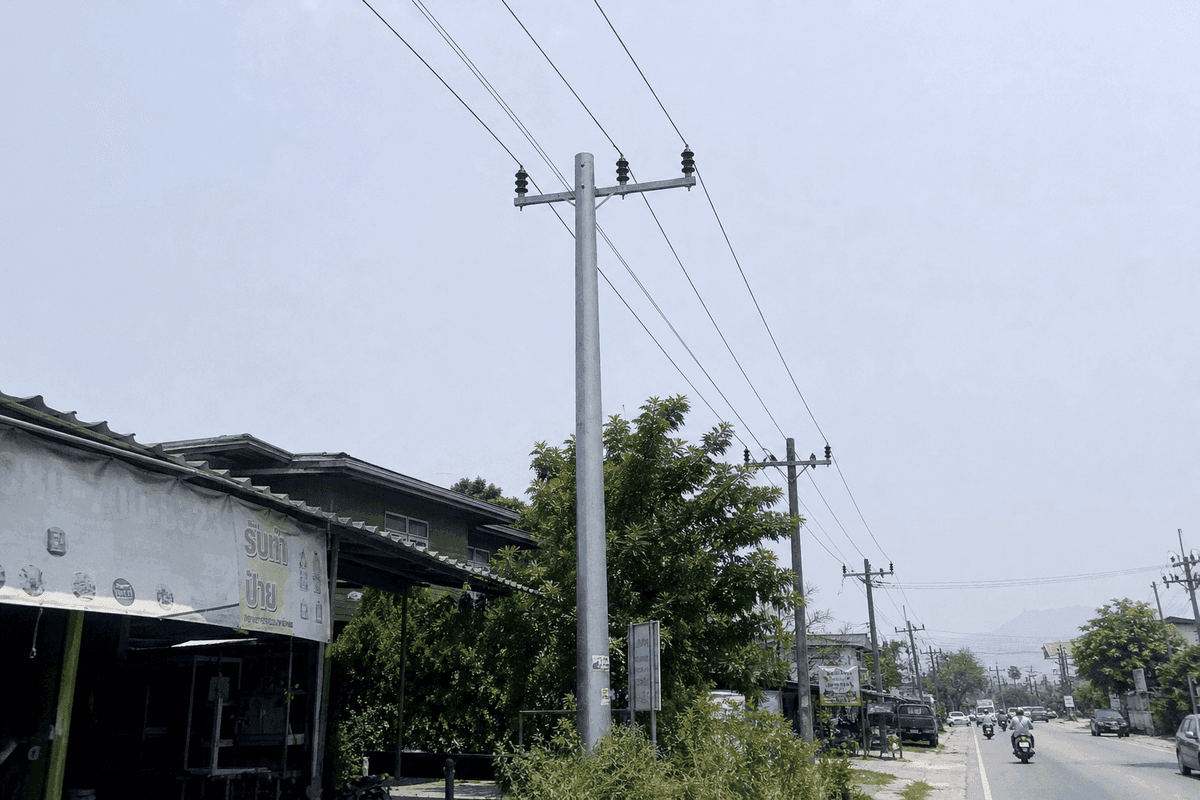
Chiang Mai Power Transmission Tower Market Analysis: 0.4kV Low-Voltage Steel Tubular Pole Configuration
Summary
Chiang Mai’s low-voltage distribution profile supports an approximately 351-unit, 8m galvanized steel tubular pole configuration over about 11km, using ACSR 50 conductor, 30m spans, and 25m/s wind design.
Key Takeaways
For an 11km low-voltage corridor near Chiang Mai, the practical specification is 351 8m Q345 monopoles rather than 12m-plus medium-voltage structures.
- Recommended scale: approximately 351 units of 8m tapered steel tubular poles for about 11km of 0.4kV single-circuit distribution.
- Electrical fit: ACSR 50 conductor at about 200kg/km and 16kN maximum tension, with 0.4m phase spacing.
- Safety geometry: 4.5m minimum ground clearance and 0.1m insulator length suit low-voltage rural and community distribution.
- Structural class: hot-dip galvanized Q345 steel, about 2t per pole, 200kg/m pole mass, and 25-year design life.
- Line geometry: 30m nominal span, anchor-bolt cage foundations, cross arm, grounding, insulator pin, and climbing pegs.
- Wind basis: Class 1 at 25m/s is appropriate for an inland low-voltage feeder, subject to site survey confirmation.
- Engineering boundary: 10-35kV distribution poles normally use 12-18m height and 80-150m spans, so this 0.4kV design should not be upsized unnecessarily.
Market Context for Chiang Mai
Chiang Mai’s 1.799 million provincial population and 22,311 km2 area create a mixed urban-rural grid need at 18.79°N, 98.98°E.
Chiang Mai is an inland northern Thailand load center with dense urban service areas, agricultural villages, and mountain-edge communities. According to Thailand’s Department of Provincial Administration (2024), Chiang Mai province has about 1,799,019 registered residents across 22,311 km2, making route density and right-of-way access more varied than in compact metropolitan districts. According to Thailand’s National Statistical Office (2023), the greater Chiang Mai urban area is commonly estimated near 1.2 million residents, increasing peri-urban distribution demand around Hang Dong, San Sai, and Saraphi.
The local power context points toward distribution reinforcement rather than high-voltage bulk transmission for this configuration. According to the Provincial Electricity Authority (2024), PEA serves 74 provinces outside the Bangkok metropolitan utility area, and its northern Region 1 includes Chiang Mai, Mae Hong Son, Lamphun, Lampang, Chiang Rai, and Phayao. According to the IEA (2023), at least 3,000GW of renewable projects worldwide are waiting in grid connection queues, showing why local distribution corridors need repeatable construction methods. IEA states, "bigger, stronger and smarter grids" are needed for national energy goals.
Chiang Mai’s tropical wet-and-dry climate adds heat, rain, and access constraints to design review. According to the Thai Meteorological Department climate record cited in public climatology summaries, Chiang Mai has recorded temperatures above 42°C, so galvanized finish, conductor sag checks, and foundation drainage are practical inputs. The route should therefore be designed for low-voltage reliability, maintainable spans, and corrosion control rather than oversized transmission aesthetics.
Recommended Technical Configuration
A typical 351-unit deployment of this scale would use 8m low-voltage steel tubular poles because the feeder is 0.4kV, not 10-35kV.
The recommended SOLARTODO Power Transmission Tower configuration for Chiang Mai is a low-voltage rural and community distribution pole, not a lattice tower, FRP pole, concrete pole, or wood pole. A typical N-unit deployment in this profile would consist of approximately 351 units of 8m tapered steel tubular poles, hot-dip galvanized Q345 steel, arranged over approximately 11km of single-circuit 0.4kV overhead distribution. The 30m span is appropriate where road curvature, customer connections, vegetation, and village access points govern pole spacing.
The engineering sequence should start with voltage class. Because this line is 0.4kV low-voltage distribution, the project-specific 8m pole is technically coherent; it should not be compared with a 35kV feeder requiring 12-18m structures or a 220kV line requiring 35-55m structures. SOLARTODO’s recommendation is to retain the 8m class unless a utility survey changes the voltage, conductor size, wind class, or clearance envelope. For engineering review, contact SOLARTODO through contact us with route drawings, soil class, transformer connection points, and service-drop requirements.
Technical Specifications
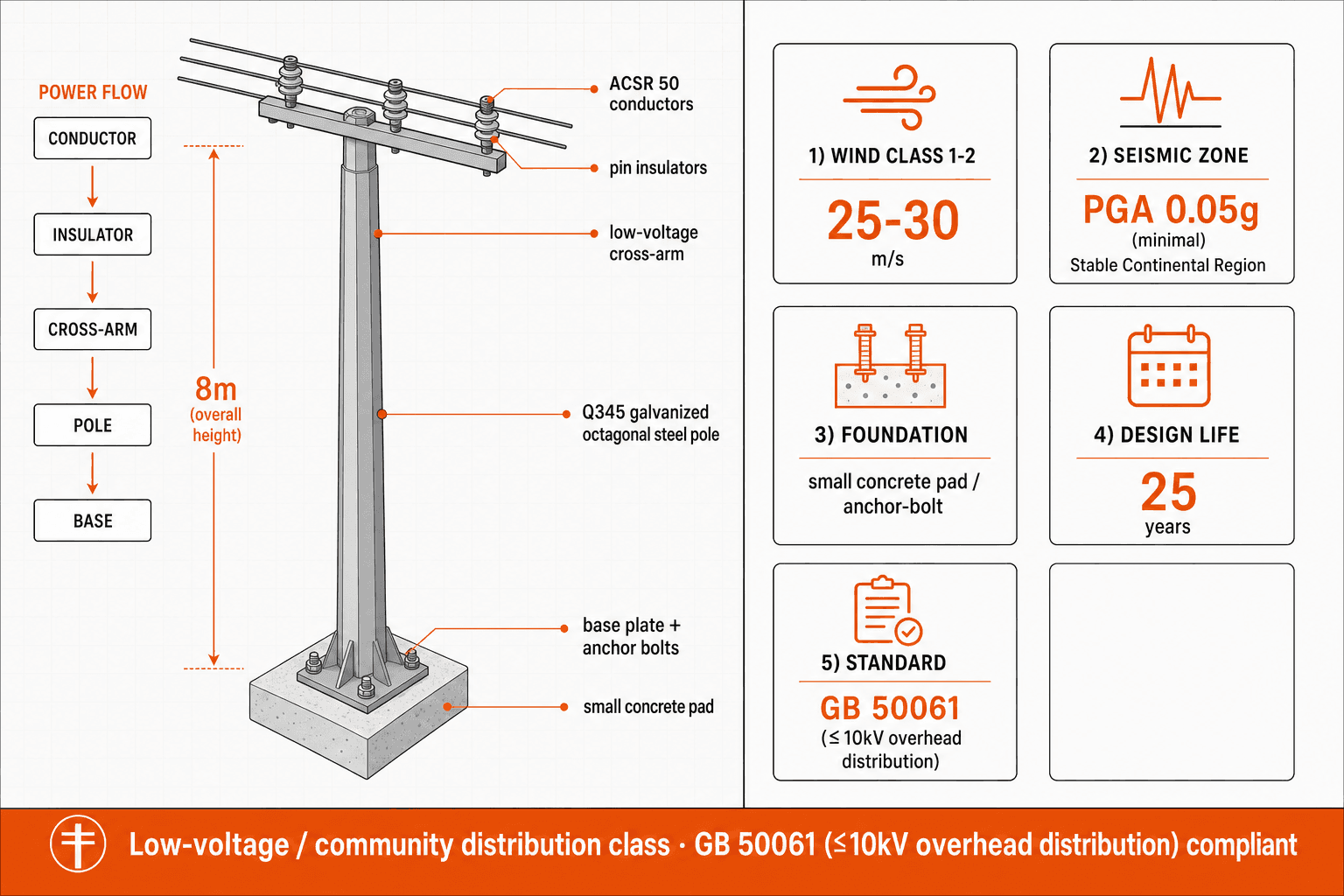
The recommended SOLARTODO Power Transmission Tower configuration is a 0.4kV single-circuit, 8m Q345 tapered steel pole with 30m nominal spans.
- Product form: tapered round or dodecagonal steel tubular monopole, not lattice, FRP, concrete, or wood.
- Quantity basis: approximately 351 units for an 11km low-voltage corridor.
- Voltage and circuit: 0.4kV low-voltage distribution, single circuit.
- Pole height and mass: 8m height, about 2t per pole, about 200kg/m.
- Material: hot-dip galvanized Q345 steel, with flanged bolt sections where sectional transport is required.
- Conductor: ACSR 50, about 200kg/km, maximum tension 16kN.
- Electrical geometry: 0.4m phase spacing, 0.1m insulator length, and 4.5m ground clearance.
- Span and route length: 30m nominal span and approximately 11km total line length.
- Wind and foundation: Class 1 wind at 25m/s, concrete anchor-bolt cage foundation.
- Accessories: climbing pegs, cross arm, grounding, insulator pin, cross-arm brackets, and conductor hardware.
- Design life: 25 years, subject to galvanizing quality, drainage, foundation workmanship, and inspection regime.
- Standards basis: GB 50061 for overhead distribution at 66kV and below, applied here to the ≤10kV class; IEC 60865 for short-circuit mechanical effects; ISO 1461 and ISO 14713 for hot-dip galvanizing practice.
According to IEC (2026), international standards support safe and interoperable electrical infrastructure, and IEC states, "International Standards facilitate technical innovation, efficient and sustainable energy access." For this low-voltage class, IEC 60865 is relevant to short-circuit force checks, while GB 50061 governs overhead distribution design logic.
Implementation Approach
A typical 11km implementation should be phased into survey, procurement, anchor-cage foundations, erection, conductor stringing, grounding, and commissioning over roughly 8-14 weeks.
The first phase is route confirmation. Survey crews would confirm pole coordinates, road offsets, transformer tie-in points, service-drop locations, soil bearing capacity, flood-prone shoulders, and vegetation conflicts. The design team would then finalize pole schedule, cross-arm orientation, grounding intervals, and foundation depth before releasing fabrication drawings for SOLARTODO supply.
Manufacturing and logistics should keep the pole package easy to inspect and install. Poles should be fabricated as tapered hot-dip galvanized Q345 steel monopoles with accessory drilling checked against cross-arm, insulator pin, grounding, and climbing peg layouts. After anchor-bolt cage foundations cure, crews would erect poles, install ACSR 50 conductor, verify sag-tension for 30m spans, check 4.5m clearance, test grounding continuity, and prepare utility acceptance documentation.
Expected Performance & ROI
For Chiang Mai community distribution, the 351-pole configuration prioritizes safe 4.5m ground clearance, 25-year design life, and lower corrosion maintenance.
Expected performance should be framed as reliability and lifecycle value, not a fabricated operating result. A galvanized Q345 steel pole line should provide predictable geometry, consistent conductor support, and better dimensional repeatability than ad hoc wood replacement programs. According to ISO 1461 and ISO 14713 (2017), hot-dip galvanized coating life depends on atmospheric corrosivity and coating thickness, which supports a 25-year design target when inspection and drainage are maintained.
ROI depends on avoided outage hours, reduced emergency pole replacement, fewer clearance defects, and faster installation per kilometer. According to the IEA (2023), economically damaging outages already cost around USD 100 billion per year globally, and grid investment needs to exceed USD 600 billion per year by 2030 to meet climate targets. Those figures do not create a Chiang Mai payback number, but they justify standardized overhead assets where low-voltage service continuity matters.
Results and Impact
For a typical 351-pole Chiang Mai low-voltage corridor, the expected impact is better route standardization across 11km and more maintainable 0.4kV service.
The practical result of this configuration would be a repeatable low-voltage distribution structure suited to village roads, community loads, agricultural service points, and peri-urban expansion. The 8m height avoids overbuilding for a 0.4kV feeder while preserving 4.5m ground clearance. The 30m span also gives crews more control over route bends, tree conflicts, and household service-drop points than long-span medium-voltage geometry.
This is not a claim that SOLARTODO has completed a Chiang Mai installation. It is a market analysis and technical configuration guide for a buyer evaluating an approximately 351-unit low-voltage Power Transmission Tower package. Impact should be verified through utility inspection, local permitting, foundation testing, and energization records after any actual project is awarded and installed.
Comparison Table
The 0.4kV SOLARTODO low-voltage pole class uses 8m height and 30m spans, while 10-35kV distribution normally starts at 12-18m.
| Configuration class | Recommended use in Chiang Mai | Height | Weight | Span | Circuit | Conductor |
|---|---|---|---|---|---|---|
| 0.4kV low-voltage steel tubular pole | Community/rural distribution, approximately 351 units over 11km | 8m | About 2t/pole, 200kg/m | 30m | Single | ACSR 50, 200kg/km, 16kN |
| 10-35kV distribution pole | Medium-voltage feeder extension | 12-18m | 1-3t/pole | 80-150m | Single/double | ACSR-70 to ACSR-120 typical |
| 66-110kV sub-transmission pole | Sub-transmission corridor | 18-30m | 5-15t/pole | 200-300m | Single/double | ACSR-120 to ACSR-240 typical |
| 220kV HV transmission pole | High-voltage transmission | 35-55m | 15-35t/pole | 350-450m | Usually double | ACSR-240 to ACSR-400 typical |
| 500kV UHV pole | Bulk power corridor | 50-70m | 35-55t/pole | 400-500m | Double | ACSR-400 class and above |
This comparison prevents applying a medium- or high-voltage pole to a low-voltage route. A 35kV line belongs in the 12-18m distribution class, while a 220kV line belongs in the 35-55m high-voltage class. For Chiang Mai’s specified 0.4kV corridor, the 8m pole is a project-specific class below the 10-35kV row.
Pricing & Quotation
For Chiang Mai procurement, quotation scope should separate 351-pole FOB supply, CIF delivery, and EPC turnkey responsibility without publishing unit prices.
SOLARTODO offers three pricing tiers for this product line: FOB Supply (equipment ex-works China), CIF Delivered (including ocean freight and insurance), and EPC Turnkey (fully installed, commissioned, with 1-year warranty). Volume discounts are available for large-scale deployments. Configure your system online for an instant estimate, or request a custom quotation from our engineering team at [email protected].
A quotation package should identify Incoterms, galvanizing standard, pole drawings, anchor-bolt cage scope, conductor supply responsibility, accessory list, packing method, inspection hold points, and warranty boundary. For EPC evaluation in Chiang Mai, buyers should also separate local civil works, traffic control, utility outage coordination, and energization approvals from factory supply.
Frequently Asked Questions
These 8 FAQs answer Chiang Mai buyer questions on 0.4kV specifications, installation, maintenance, warranty, EPC scope, timelines, and commercial evaluation.
Q1: What pole type is recommended for this Chiang Mai low-voltage configuration? The recommended product is an 8m tapered steel tubular monopole made from hot-dip galvanized Q345 steel. It is a single-circuit 0.4kV low-voltage distribution pole, not a lattice tower, FRP pole, concrete pole, or wood pole. The typical route basis is approximately 351 units over about 11km with 30m nominal spans.
Q2: Why is an 8m pole acceptable when distribution poles are often 12-18m? The 12-18m class applies to 10-35kV distribution lines, not this 0.4kV low-voltage feeder. For the specified Chiang Mai corridor, 8m height supports 4.5m ground clearance, 0.4m phase spacing, and ACSR 50 conductor geometry. Voltage class is selected first, then height and span are derived from the electrical requirement.
Q3: How long would a typical 351-pole installation take? A practical schedule is often 8-14 weeks after drawings, permits, and utility approvals are ready. Survey and foundation work usually drive the critical path, because anchor-bolt cages need positioning and concrete curing before erection. Weather, road access, outage windows, and customs clearance can extend the schedule, especially during monsoon months.
Q4: What maintenance is expected over a 25-year design life? Maintenance should include periodic bolt checks, grounding continuity tests, conductor clearance inspections, vegetation control, and visual inspection of galvanized surfaces. Hot-dip galvanizing reduces corrosion exposure, but it does not remove the need for inspection. After storms or roadworks, crews should verify pole plumbness, foundation condition, cross-arm hardware, and service-drop clearances.
Q5: How should ROI or payback be evaluated for this product? A pole line does not create direct generation revenue, so ROI should be evaluated through lifecycle cost and reliability value. Buyers should compare steel, concrete, and wood options using installed cost, outage reduction, inspection cost, expected replacement cycle, and emergency repair exposure. Local tariff data and outage-cost assumptions are needed before a credible payback period can be calculated.
Q6: How does this compare with concrete or wood distribution poles? Galvanized steel tubular poles offer consistent factory geometry, predictable accessory drilling, and easier sectional logistics than many concrete alternatives. Compared with wood, Q345 galvanized steel provides better dimensional stability and fire resistance. Concrete may be familiar locally, but it is heavier to handle and less adaptable when cross-arm or grounding details change during route engineering.
Q7: What is included in an EPC turnkey quotation? An EPC turnkey scope typically includes engineering, supply, civil foundations, pole erection, conductor stringing, grounding, testing, commissioning, and a 1-year warranty. It should also clarify exclusions such as utility fees, land access compensation, vegetation permits, transformer upgrades, and energized switching. SOLARTODO can quote FOB, CIF, or EPC depending on buyer responsibility.
Q8: What information is needed before SOLARTODO can finalize a quotation? A reliable quotation needs route length, pole schedule, voltage class, conductor type, soil data, wind class, foundation preference, accessory list, delivery term, and warranty boundary. For this Chiang Mai profile, the baseline is 351 units, 8m Q345 galvanized steel, ACSR 50, 30m span, 25m/s wind, and anchor-bolt cage foundation.
References
The analysis cites 7 public standards and data sources covering Chiang Mai demographics, Thailand power access, grid investment, galvanizing, and overhead-line design.
- [Department of Provincial Administration, Thailand] (2024): Chiang Mai registered population of about 1,799,019 and provincial area of 22,311 km2.
- [National Statistical Office, Thailand] (2023): Chiang Mai urban-area demographic estimates near 1.2 million residents in the wider metropolitan area.
- [Provincial Electricity Authority, Thailand] (2024): PEA service responsibility for 74 provinces and northern Region 1 coverage including Chiang Mai.
- [International Energy Agency] (2023): Electricity Grids and Secure Energy Transitions; 80 million km of grids needed by 2040 and over 3,000GW waiting in connection queues.
- [World Bank] (2022): Thailand access-to-electricity indicator reported at approximately 100% of population, supporting a reliability-focused rather than access-only grid agenda.
- [IEC] (2011): IEC 60865 for calculation of short-circuit current mechanical effects in electrical installations.
- [ISO] (2009/2017): ISO 1461 and ISO 14713 for hot-dip galvanized coatings and atmospheric durability guidance for steel structures.
Equipment Deployed
- 351 units × 8m tapered hot-dip galvanized Q345 steel tubular pole for 0.4kV low-voltage single circuit
- ACSR 50 conductor, about 200kg/km, maximum tension 16kN
- Concrete anchor-bolt cage foundation for each pole location
- Cross arm, insulator pin, 0.1m insulator length, and 0.4m phase spacing hardware
- Grounding set, climbing pegs, flanged bolt sections, and installation accessories
- Wind Class 1 design at 25m/s with 4.5m ground clearance and 30m nominal span