Cebu City’s Coastal Salt Air and 30m Street Grid: Smart Streetlight Configuration for Hybrid Multi-Function Poles
Summary
Cebu City’s 964,169 residents, coastal salt exposure, and 68.83 inches annual rainfall make an 11m hybrid Smart Streetlight fit practical for 30m urban spacing, EV top-up, CCTV, WiFi 6, and emergency communications.
Key Takeaways
Cebu City smart-lighting procurement should treat 108 poles, 30m spacing, and 11m hybrid self-power as a coastal urban configuration, not a highway-lighting template.
- A typical deployment of this scale would use approximately 108 units at 30m spacing, covering about 3.2km of priority corridors.
- The recommended pole class is 11m octagonal tapered steel, with a 45cm base diameter and 15cm top diameter.
- Each pole would carry 2 x 80W LED luminaires at 4000K and 150 lm/W, giving 160W total lighting load per pole.
- Hybrid generation would combine a 300W Savonius VAWT, 2 x 150W monocrystalline panels, and a 10kWh LFP battery.
- Cebu City’s public procurement context already includes 150W LED street-light bid items under RA 9184 open competitive bidding.
- Philippine distribution planning must coordinate with 230V/60Hz utilization, common 13.8kV and 34.5kV primary distribution classes, and local utility approvals.
- Coastal exposure near Cebu Strait favors sealed, hot-dip galvanized, color-matched, flush modules over protruding boxes and separate EV pillars.
- SOLARTODO’s Smart Streetlight should be specified under IEC 60598, IEC 62196-2, GB/T 37024, OCPP 1.6J, and local electrical permitting.
Market Context for Cebu City
Cebu City combines 964,169 residents, a coastal port economy, and wet tropical exposure, creating a strong case for sealed multi-function street poles.
According to the Philippine Statistics Authority (2021), Cebu City had 964,169 residents in the 2020 Census, making it the most populous highly urbanized city in Central Visayas. This density changes the Smart Streetlight requirement: the pole is not only a luminaire support, but also a node for CCTV, WiFi, public address, emergency call, air-quality sensing, and EV top-up along commercial corridors.
The climate is a hardware-design issue, not a background detail. According to PAGASA, the Philippines has a “tropical and maritime” climate with high temperature, high humidity, and abundant rainfall. Cebu City sits on the Cebu Strait side of Cebu Island, so salt air, wind-driven rain, corrosion, and occasional flooding should influence coating, cable glands, access doors, battery enclosure design, and connector selection.
According to Timeanddate climate normals for nearby Mactan station (2012-2021), Cebu City’s mean temperature is about 83°F, annual precipitation is about 68.83 inches, and the wettest month averages 8.49 inches of rain. Those conditions support using LFP battery storage inside the raised pole base, sealed flush electronics, and a single welded pole-as-charger cabinet rather than freestanding charger pillars exposed to curbside splash.
The city’s infrastructure management also matters. According to Cebu City Government procurement notices (2025), the city solicited 200 sets of 150W LED street lights through RA 9184 open competitive bidding. According to the Cebu City Department of Engineering and Public Works, its functions include engineering design, feasibility studies, project management, bid documents, road maintenance, drainage repair, and electrical and auxiliary permits. That means a smart-pole package should be written as a compliant public-infrastructure specification, not as a consumer lighting order.
Cebu’s distribution context is utility-led. According to Visayan Electric (2026), the utility serves Cebu City, Mandaue, Talisay, Naga, and nearby Metro Cebu municipalities and is recognized as the Philippines’ second largest distribution utility. According to the Philippine Department of Energy (2015), the Philippine Distribution Code governs distribution-system operation, connection, maintenance, and development; it is therefore relevant to grid backup, EV-charger connection, protection, metering, and commissioning.
Recommended Technical Configuration
A Cebu City 108-unit Smart Streetlight package should use 11m hybrid poles because coastal reliability and dense corridors favor autonomous backup.
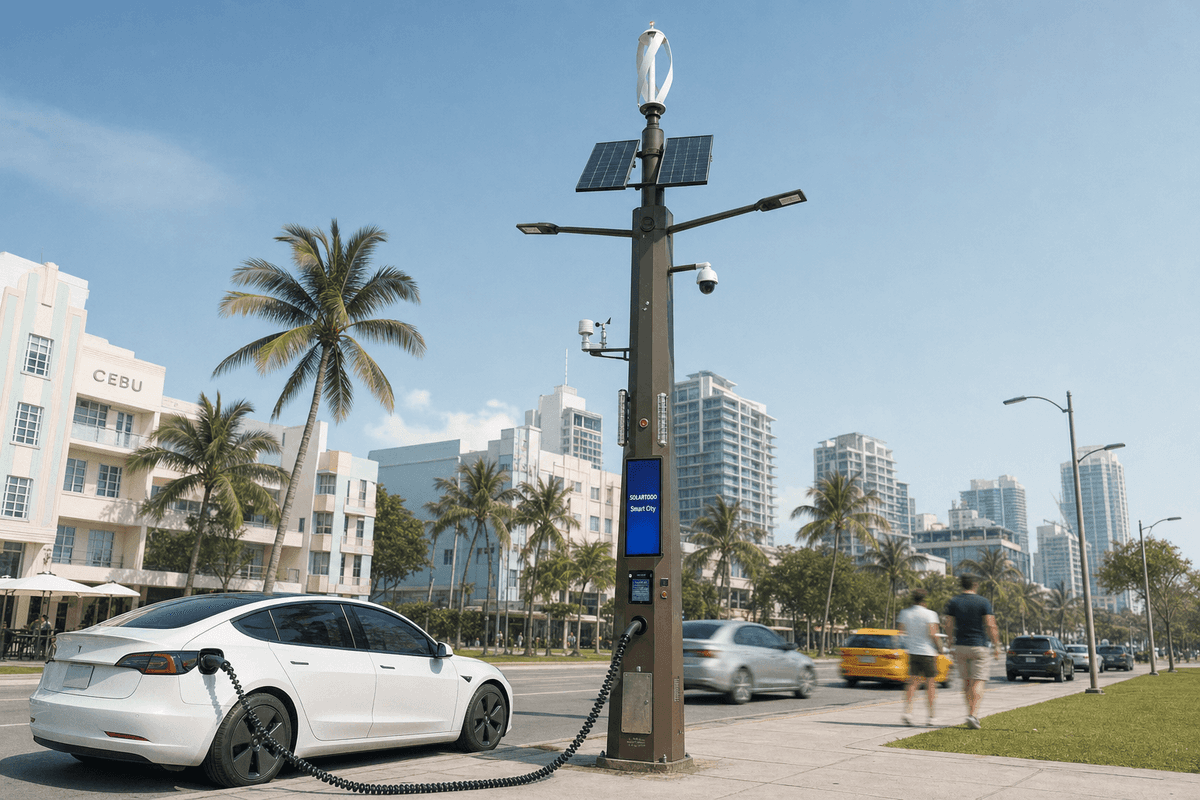
For the specified Cebu City profile, the recommended SOLARTODO variant is the hybrid 12m family adapted to an 11m octagonal tapered steel smart pole. The 11m class is appropriate for urban and municipal streets with 30m spacing, twin symmetric LED arms, and integrated smart-city accessories. It is not a highway high-mast solution and not a park-scale garden light.
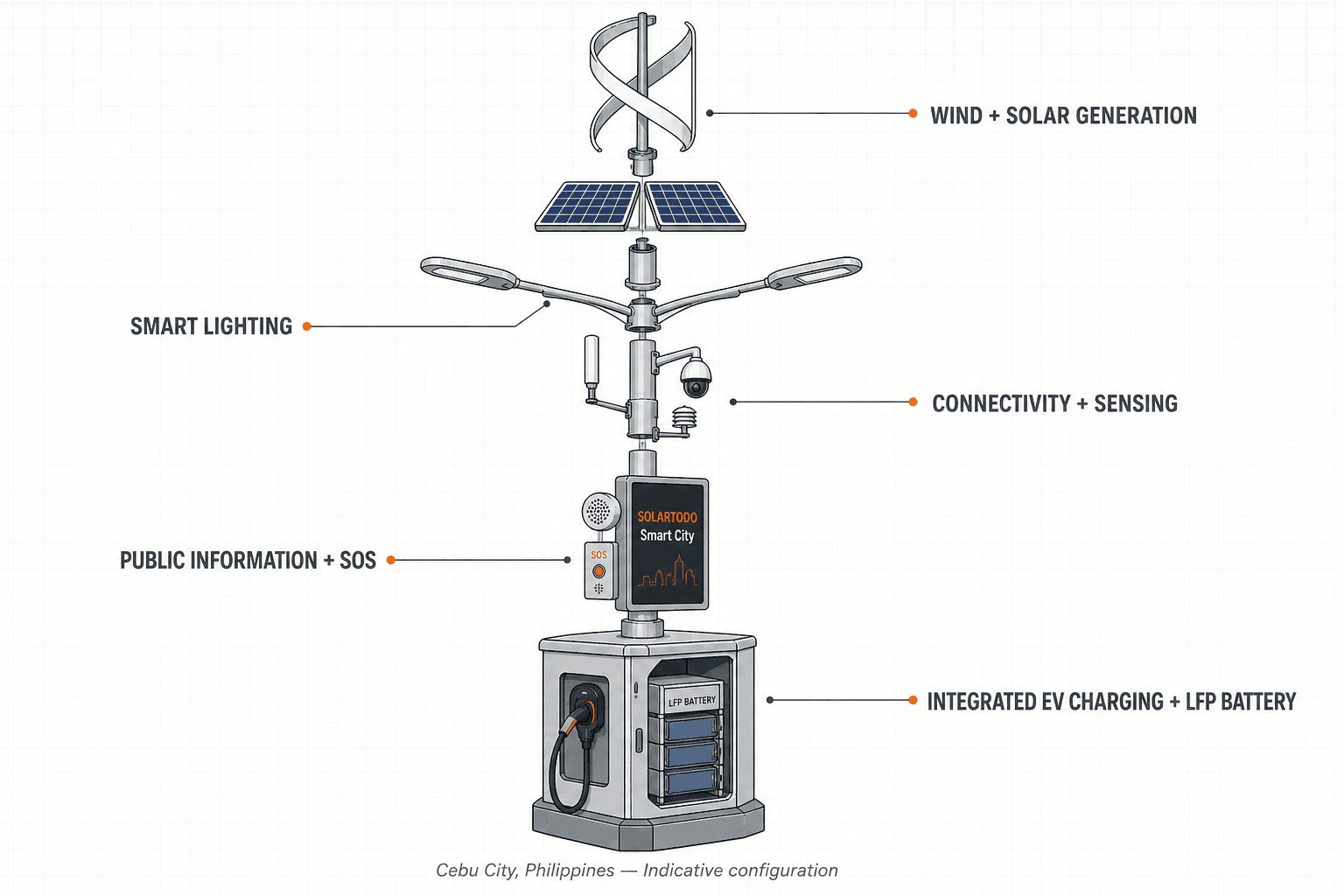
A typical 108-unit deployment in this profile would consist of 108 units x 11m octagonal tapered steel smart poles in antique bronze RAL8011. The base diameter would taper from 45cm to 15cm at the top, improving wind presentation while retaining enough lower-body volume for the integrated EV charging cabinet, LFP battery, MPPT controller, maintenance access, and cable routing.
The lower 2.2m of each pole should be specified as the EV charging cabinet itself, welded as one continuous steel structure. This distinction matters in Cebu City because narrow downtown streets, sidewalk encroachment, and coastal maintenance needs make separate EV pedestals harder to protect. A unified pole body also reduces civil clutter and gives the procurement team one structural asset to inspect.
SOLARTODO should position this as a Smart Streetlight configuration for municipal streets, waterfront corridors, transport-adjacent roads, and civic districts. For barangay-level phasing, the city can begin with approximately 36 poles per tranche and expand to 108 poles after foundation, utility, and communications checks are standardized. Technical consultation can be requested through contact us before final BOQ release.
Technical Specifications
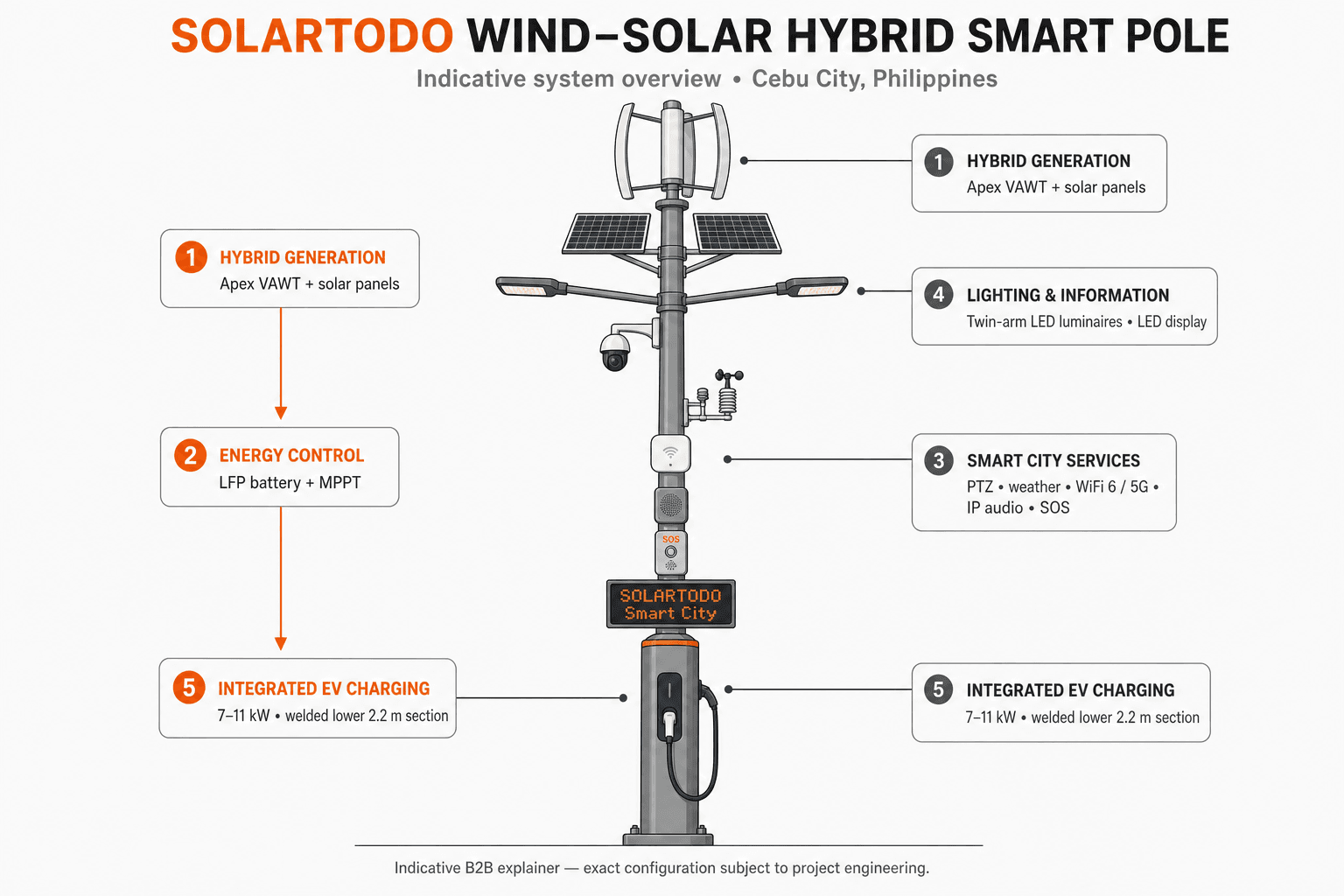
Each Cebu City pole should combine 160W LED output, 300W wind input, 300W solar input, 10kWh storage, and 7kW AC charging.
- Pole body: 11m octagonal tapered steel smart pole, base Ø45cm to top Ø15cm, antique bronze RAL8011.
- Integrated EV cabinet: lower 2.2m of pole is the charger body, seamlessly welded as one continuous steel structure, not a separate pillar.
- Wind generation: Savonius bucket VAWT, 2 curved scoops, Ø60 x 90cm, 300W, with red aviation LED.
- Solar generation: 2 x 150W monocrystalline deep-black panels on symmetric east-west A-frame brackets at 15° tilt.
- Battery and control: 10kWh LFP battery inside pole base with MPPT controller and backup grid tie.
- Lighting: twin symmetric 1.5m arms with +8° upward tilt, 2 x 80W LED, 150 lm/W, 4000K.
- Camera: 15cm mini white PTZ dome camera, 360° pan, 20x zoom, IR range up to 100m, mounted on 40cm L-bracket.
- Environmental sensor: 8-parameter sensor for temperature, humidity, wind, pressure, noise, PM2.5, PM10, and illuminance.
- Public address: 1 x 30W/93dB IP audio column, Ø10 x 50cm, TCP/IP networked, slim vertical perforated aluminum tube, flush against flat pole face and color-matched.
- Emergency interface: one-press SOS button, two-way audio intercom, and visual LED indicator.
- EV charging: integrated 7kW single-gun AC charger, Type 2 connector, IEC 62196-2 interface, OCPP 1.6J, 5m coiled cable, touchscreen, E-stop, and maintenance door.
- LED display: P3 portrait LED screen, 1000 x 2000mm, above 6000 cd/m², with content strictly reading “SOLARTODO Smart City” in white sans-serif on deep blue.
- Communications: dual-mode WiFi 6 and 5G gateway, GbE uplink, LoRaWAN, flush on the flat pole face at 8.7m with continuous color-matched paint across housing and pole.
- Convenience modules: Qi wireless phone charging pad and USB-A charging point.
- Standards basis: IEC 60598 for luminaires, GB/T 37024 for smart pole technical requirements, and IEC 62196-2 for AC charging connectors.
Implementation Approach
A 108-unit Cebu City rollout should be phased across 3 tranches so civil works, utility tie-ins, and communications can be validated early.
The first phase should map sidewalks, drainage grates, existing utility poles, CCTV blind spots, flood-prone gutters, and old-town curb widths. Cebu City’s dense barangay streets and port-side corridors make foundation placement as important as device selection. Survey drawings should define 30m spacing, service clearances, pedestrian clearance, and cabinet-door swing before procurement quantities are locked.
The second phase should align specifications with RA 9184 procurement documents and Visayan Electric connection requirements. According to the DOE (2015), distribution users and distributors must follow the Philippine Distribution Code for connection and operation. That makes breaker coordination, grounding, surge protection, grid-backup metering, and EV charger commissioning part of the technical package.
The third phase should use CKD or modular shipment planning to reduce damage risk during ocean freight and local delivery. Poles can be staged by corridor, with foundations poured first, steel erected second, and electronics commissioned after weatherproofing inspection. Each pole should receive a serial number, torque record, insulation check, network test, camera alignment, charger test, and cloud-platform registration.
The fourth phase should monitor the first 30 days of operation before scaling to all 108 units. Acceptance should include night illuminance checks, battery charge-discharge logs, OCPP session tests, WiFi 6 access-point validation, SOS call routing, audio clarity, LED display brightness control, and camera IR checks. The objective is repeatable municipal acceptance, not a one-off showcase.
Expected Performance & ROI
A Cebu City hybrid Smart Streetlight can reduce lighting grid dependence while adding 7kW EV service and smart-city functions per pole.
According to IEA (2023), energy efficiency remains central to lowering energy bills and emissions, and LED street lighting is one of the most direct municipal efficiency measures. A 2 x 80W LED head operating 12 hours per night consumes about 1.92kWh per pole per night, before controls. For 108 poles, that is about 207kWh per night, while dimming schedules and motion-based profiles can reduce non-peak consumption.
The 10kWh LFP battery is sized for continuity, not full isolation from the grid under every rainy-week condition. With a 160W lighting load, the battery can support several nights of lighting-only operation depending on depth of discharge, sensor load, camera duty cycle, and charging behavior. The backup grid tie is important in Cebu City because monsoon cloud cover, salt air maintenance, and EV charging events can coincide.
Revenue and payback should be modeled conservatively. The LED display is fixed in this specification to show only “SOLARTODO Smart City,” so ROI should not depend on local advertising revenue unless the owner later changes content policy. The more defensible value stack is energy saving, reduced patrol cost from remote monitoring, emergency-call coverage, WiFi offload, improved night visibility, EV top-up access, and avoided duplicate poles.
According to IRENA (2023), renewable power and electrification are core pillars of energy-transition investment, but municipal projects still need lifecycle cost discipline. For Cebu City, payback analysis should compare hybrid smart poles against separate LED poles, CCTV masts, PA speakers, WiFi mounts, EV pedestals, civil works, grid trenching, and maintenance visits. The integrated SOLARTODO pole is most competitive where multiple functions share the same corridor asset.
Comparison Table
This comparison shows why the 11m hybrid Smart Streetlight is stronger for 30m Cebu corridors than separate lighting and charger assets.
| Option | Height and spacing | Power system | Smart functions | Cebu City fit | Main limitation |
|---|---|---|---|---|---|
| SOLARTODO 11m hybrid Smart Streetlight | 11m, 30m spacing | 300W VAWT + 300W solar + 10kWh LFP + grid backup | LED, PTZ, WiFi 6, 5G gateway, SOS, PA, EV, sensor, display | Best fit for coastal mixed-use corridors | Higher engineering coordination |
| Standard LED street pole | 8-10m, 30-40m spacing | Grid only | Lighting only or limited controller | Simple replacement for existing roads | Separate poles needed for CCTV, WiFi, EV |
| Separate EV pedestal plus light pole | 6-10m, site-specific | Grid only | EV and lighting split across assets | Useful in parking-focused locations | More sidewalk clutter and civil works |
| Premium cylindrical smart pole | Ø180-400mm, 25-50m spacing | CIGS wrap plus grid options | Flush embedded premium modules | Strong for signature districts | Less aligned with specified hybrid VAWT design |
Pricing & Quotation
SOLARTODO provides 3 quotation paths for Cebu City projects: FOB Supply, CIF Delivered, and EPC Turnkey, with final scope tied to civil works.
SOLARTODO offers three pricing tiers for this product line: FOB Supply (equipment ex-works China), CIF Delivered (including ocean freight and insurance), and EPC Turnkey (fully installed, commissioned, with 1-year warranty). Volume discounts are available for large-scale deployments. Configure your system online for an instant estimate, or request a custom quotation from our engineering team at [email protected].
For public-sector evaluation, the quotation should separate pole hardware, batteries, EV charger components, LED display, communications equipment, civil foundations, testing, commissioning, and maintenance spares. EPC pricing also depends on soil conditions, flood-control interfaces, traffic management, utility interconnection, night-work restrictions, and import logistics. SOLARTODO can support BOQ alignment for the Smart Streetlight package before bid release.
Frequently Asked Questions
These 10 questions address Cebu City technical fit, 108-unit deployment planning, EV charging, ROI, warranty, EPC pricing, installation, and maintenance.
Q1: Why is the hybrid 11m Smart Streetlight recommended for Cebu City? The 11m hybrid class fits Cebu City’s dense coastal corridors because it combines 30m lighting spacing, local backup power, CCTV, WiFi 6, public address, SOS, and EV top-up in one pole. The 10kWh LFP battery and grid tie reduce dependence on continuous grid supply during rain, maintenance, or emergency operations.
Q2: Is this a confirmed SOLARTODO deployment in Cebu City? No. This article is a market analysis and technical configuration guide, not a case study. The 108-unit quantity is a recommended project-scale configuration based on the provided specification, 30m spacing, and Cebu City infrastructure context. It should be validated through site survey, utility review, procurement documents, and final engineering design.
Q3: What installation timeline is realistic for approximately 108 units? A practical timeline is usually 12-20 weeks after approved drawings, depending on foundation conditions, permitting, shipping, and utility coordination. A 3-tranche rollout of about 36 poles each lets the owner validate foundation details, grid backup, OCPP charger operation, communications coverage, and night lighting before completing the full 108-unit corridor package.
Q4: How should ROI be calculated without inventing advertising revenue? ROI should compare integrated poles against separate LED poles, CCTV masts, PA speakers, WiFi mounts, EV pedestals, trenching, and maintenance visits. For this specification, the LED screen content is fixed to “SOLARTODO Smart City,” so payback should rely on energy savings, avoided duplicate assets, remote monitoring, safety coverage, and lifecycle maintenance reduction.
Q5: What maintenance is most important in Cebu City’s coastal environment? Coastal maintenance should focus on corrosion inspection, cabinet gasket checks, drainage around foundations, connector sealing, battery temperature logs, VAWT bearing condition, panel cleaning, and surge-protection status. Cebu City’s salt air and heavy rainfall make sealed flush housings, hot-dip galvanized steel, quality paint, and scheduled torque checks more important than decorative appearance alone.
Q6: How does the integrated EV charger differ from a separate roadside charger? The lower 2.2m of the pole is the EV charging cabinet, welded into the same steel body rather than added as a separate pedestal. It includes a 7kW single-gun AC charger, Type 2 connector, OCPP 1.6J, 5m cable, touchscreen, E-stop, and maintenance door, reducing sidewalk clutter.
Q7: What standards should procurement documents reference? Procurement documents should reference IEC 60598 for luminaires, IEC 62196-2 for AC charging connectors, GB/T 37024 for smart pole requirements, and the Philippine Distribution Code for utility connection. Local electrical permits, grounding, surge protection, and Visayan Electric coordination should be included in commissioning requirements before final acceptance.
Q8: How does this compare with a standard LED-only pole? A standard LED-only pole can light a street, but it does not consolidate EV charging, CCTV, environmental sensing, emergency intercom, WiFi 6, public address, 5G gateway readiness, and LED display functions. In Cebu City, where sidewalks and old-town streets can be constrained, one multi-function structure can reduce duplicate civil works.
Q9: What warranty and spare-parts assumptions are reasonable? The EPC Turnkey tier includes a 1-year warranty in the SOLARTODO pricing framework. For municipal buyers, the bid should also request spare LED drivers, surge protectors, communication modules, gaskets, charger consumables, and battery-service documentation. Longer service plans can be quoted separately after site conditions and operating hours are confirmed.
Q10: What affects EPC pricing for Cebu City installations? EPC pricing depends on soil investigation, foundation depth, road closures, traffic control, drainage conflicts, coastal coating requirements, grid interconnection distance, shipping terms, commissioning scope, and after-sales service level. SOLARTODO separates FOB Supply, CIF Delivered, and EPC Turnkey so buyers can compare equipment-only procurement with fully installed municipal infrastructure delivery.
References
These 7 references ground the Cebu City Smart Streetlight analysis in population, climate, procurement, power, and technical-standard sources.
- Philippine Statistics Authority (2021): 2020 Census reported Cebu City population of 964,169 and Central Visayas population of 8,081,988. https://psa.gov.ph/content/highlights-region-vii-central-visayas-population-2020-census-population-and-housing-2020?vcode=zal21k
- PAGASA (2026): Climate of the Philippines describes the country as tropical and maritime, with high temperature, humidity, and abundant rainfall. https://www.pagasa.dost.gov.ph/index.php/information/climate-philippines
- Cebu City Government (2025): Procurement notice for 200 sets of 150W LED street lights under RA 9184 open competitive bidding. https://www.cebucity.gov.ph/procurement-of-200-sets-led-street-lights-150-watts-and-other-items/
- Cebu City Department of Engineering and Public Works (2026): DEPW handles engineering design, feasibility studies, project management, bid documents, road maintenance, drainage repair, and electrical permits. https://www.cebucity.gov.ph/department-of-engineering-and-public-works/
- Visayan Electric (2026): Utility serving Cebu City and other Metro Cebu cities; recognized as the Philippines’ second largest distribution utility. https://www.visayanelectric.com/
- Department of Energy Philippines (2015): Philippine Distribution Code establishes mandatory rules for distribution-system operation, maintenance, development, connection, and use. https://staging.doe.gov.ph/site/epimb/articles/group/online-databases?category=Power+Industry+Reform&display_type=Card
- IEC (2014/2022): IEC 60598 covers luminaire safety requirements; IEC 62196-2 covers AC charging plug, socket-outlet, vehicle connector, and vehicle inlet interfaces.
Equipment Deployed
- 108 units x 11m octagonal tapered steel smart pole, base Ø45cm to top Ø15cm, antique bronze RAL8011
- Integrated lower 2.2m pole-as-EV-charger cabinet, welded as one continuous steel structure
- Savonius bucket VAWT, 2 curved scoops, Ø60 x 90cm, 300W, red aviation LED
- 2 x 150W monocrystalline deep-black solar panels on 15° symmetric east-west A-frame brackets
- 10kWh LFP battery inside pole base with MPPT controller and backup grid tie
- Twin 1.5m symmetric arms with +8° tilt and 2 x 80W LED, 150 lm/W, 4000K
- 15cm mini white PTZ dome camera, 360°, 20x zoom, IR 100m, 40cm L-bracket
- 8-parameter environmental sensor for temperature, humidity, wind, pressure, noise, PM2.5, PM10, illuminance
- 30W/93dB IP audio column Ø10 x 50cm, flush mounted and color-matched
- One-press SOS button with two-way audio intercom and visual LED indicator
- Integrated 7kW single-gun AC charger, Type 2, OCPP 1.6J, 5m coiled cable, touchscreen, E-stop
- P3 portrait LED display 1000 x 2000mm, >6000 cd/m², content: SOLARTODO Smart City
- Dual-mode WiFi 6 + 5G gateway with GbE uplink and LoRaWAN, flush mounted at 8.7m
- Qi wireless phone charging pad and USB-A charging point